Results for "Morges+|+9+>+232"
2588 results found.
Annapurna pour 14 jours en avril 2004 English translation pending
Bonjour à tous,
Je pars ce samedi 27 mars pour le Népal et je pense me diriger sur l'Annapurna (j'ai déjà fait la route Langtang/Gosaikung). J'aurais voulu faire le tour, mais je n'ai que 16 jours en tout (c'est à dire 14 jrs de KTM à KTM)... c'est quand même un peu juste - et c'est parce que je n'aurai pas beaucoup de temps que j'ai en fait besoin de conseil. Jomson / Sanctuaire /ou les deux? J'ai lu des revues diverses sur la partie le tronçon Jomson-Tatopani, ainsi d'ailleurs que sur Jomson-Muktinat. Les vues du Sanctuaire semblent valoir le coup, et de monter un peu ne me dérange pas, au contraire...
- Neige en avril sur MBC/ABC?
- Thorung-la passable en cette période? Est-ce que ça vaudrait plus le coup de faire l'autre partie du circuit: Manang/Thorung La/Jomson ?
Excusez-moi pour le vague de la question "ça vaut le coup?" qui est évidemment bien subjectif...
Merci pour votre input...
Je pars ce samedi 27 mars pour le Népal et je pense me diriger sur l'Annapurna (j'ai déjà fait la route Langtang/Gosaikung). J'aurais voulu faire le tour, mais je n'ai que 16 jours en tout (c'est à dire 14 jrs de KTM à KTM)... c'est quand même un peu juste - et c'est parce que je n'aurai pas beaucoup de temps que j'ai en fait besoin de conseil. Jomson / Sanctuaire /ou les deux? J'ai lu des revues diverses sur la partie le tronçon Jomson-Tatopani, ainsi d'ailleurs que sur Jomson-Muktinat. Les vues du Sanctuaire semblent valoir le coup, et de monter un peu ne me dérange pas, au contraire...
- Neige en avril sur MBC/ABC?
- Thorung-la passable en cette période? Est-ce que ça vaudrait plus le coup de faire l'autre partie du circuit: Manang/Thorung La/Jomson ?
Excusez-moi pour le vague de la question "ça vaut le coup?" qui est évidemment bien subjectif...
Merci pour votre input...
Peut-il y avoir un tourisme « intelligent » dans les pays pauvres? English translation pending
Beaucoup de touristes donnent des chewing-gums bonbons ou autres sucreries aux enfants or ils n’ont pas de brosse à dents, de plus cela les transforme en mendiants.
En mars 2003, lors de ma 2ème mission humanitaire en Mauritanie c’est dans un village sur le passage des touristes se rendant à Tergit que j’ai vu le plus d’enfants avec des caries, 2 à 3 fois plus que dans les oasis isolées ! C’est là aussi qu’on a vu le plus de mains tendues… Personne n’y a voulu de nos cours de jardinage ni de ceux d’hygiène, par contre ils voulaient bien se faire soigner par les 2 dentistes et les 2 infirmières, ou que nous leur donnions de l’argent ce que l’on ne fait JAMAIS.
Autre problème lié aux touristes : les stylos, ce sont des bouts de plastique qui finiront dans le désert ! A la rigueur des crayons à papier ou de couleur (bois= biodégradable), mais remettez les à un enseignant qui les donnera aux élèves les plus nécessiteux, tjs pour ne pas les inciter à mendier.
Donner du savon c’est une bonne idée, mais il faut se limiter au savon type « de Marseille », afin de ne pas créer un besoin inutile avec des savonnettes parfumées… On peut en acheter sur place, et garder la place en fret pour des médicaments... que l’on pourra remettre sur place à un dispensaire.
Pensez-vous qu’un jour nous puissions passer dans des lieux pauvres et touristiques sans être suivi par des enfants répétant « cadeaux, bonbons, stylos » ? Votre expérience m’intéresse.
Anne l’Ardéchoise webmestre de l’association «Liberté par les Chamelles ».
Autre problème lié aux touristes : les stylos, ce sont des bouts de plastique qui finiront dans le désert ! A la rigueur des crayons à papier ou de couleur (bois= biodégradable), mais remettez les à un enseignant qui les donnera aux élèves les plus nécessiteux, tjs pour ne pas les inciter à mendier.
Donner du savon c’est une bonne idée, mais il faut se limiter au savon type « de Marseille », afin de ne pas créer un besoin inutile avec des savonnettes parfumées… On peut en acheter sur place, et garder la place en fret pour des médicaments... que l’on pourra remettre sur place à un dispensaire.
Pensez-vous qu’un jour nous puissions passer dans des lieux pauvres et touristiques sans être suivi par des enfants répétant « cadeaux, bonbons, stylos » ? Votre expérience m’intéresse.
Anne l’Ardéchoise webmestre de l’association «Liberté par les Chamelles ».
Qu'avez-vous déjà mangé de particulier? English translation pending
Juste une petite question de curiosité.
On entend toujours à travers le monde que les français mangent des choses "ragoutantes" comme les escargots ou les cuisses de grenouilles.
Mais vous, n'avez vous pas eu à manger, à l'occasion d'un voyage, quelque viande ou spécialité un peu "particulière" voire "ragoutante" au premier abord ?
A vos souvenirs et si vous avez en plus une façon de la cuisiner ....
nathalie
Mais vous, n'avez vous pas eu à manger, à l'occasion d'un voyage, quelque viande ou spécialité un peu "particulière" voire "ragoutante" au premier abord ?
A vos souvenirs et si vous avez en plus une façon de la cuisiner ....
nathalie
Pourquoi aller en Irak et Afghanistan? English translation pending
Je suis toujours partante pour découvrir de nouveaux horizons, mais je ne comprends pas très bien l'envie de certains de se rendre dans des zones à hauts risques comme l'Irak ou l'Afghanistan... Quel est l'intérêt de partir en voyage dans des endroits où on risque de se faire tirer dessus ou de marcher sur une mine anti-personnelle? J'avoue que ça me laisse perplexe!!! Y-a-t-il des amateurs de ce genre de trips qui pourraient m'éclairer sur ce sujet?
Spitzberg (Norvège): budget, guide, précautions English translation pending
Salut à tous;
je recherche des infos concernant le Spitzberg; à savoir: comment circuler là bas quelles précautions à prendre (nottament contre les ours) y-a-t-il obligation / recommandation d'avoir un guide? comment se rendre sur les iles du Nord comment se ravitailler le budget à prévoir (hors transport continent-spitzberg)
je recherche des infos concernant le Spitzberg; à savoir: comment circuler là bas quelles précautions à prendre (nottament contre les ours) y-a-t-il obligation / recommandation d'avoir un guide? comment se rendre sur les iles du Nord comment se ravitailler le budget à prévoir (hors transport continent-spitzberg)
Breathtaking Kyrgyzstan!
This trip had been on my mind for about fifteen years.
But the discomfort of overnight stays, the difficulty of communication, and the prices of the few car rental options kept making me postpone the project.
And then, everything suddenly fell into place—I told myself, it’s time!
The preparations took longer than usual; the destination is still far from mainstream.
A bit of Kazakhstan? Not in the end.
The south or not the south? Yes, in the end.
Pre-book or go with the flow? Only two stops were a leap into the unknown.
To help me find the ideal route, I made great use of this forum (thanks to everyone for patiently answering my questions!), pored over travel journals and blogs (Christian, Jeff), zoomed in on Google Maps and Yandex, and bought the guide published by OunTravela about this destination (the guide has been updated since).
---/---
You’ve got your passport, international driver’s license, bank cards, and euros?
Off we go to Lyon—just one night left before our early morning flight.
Tomorrow night, we’ll be sleeping in Bishkek! (Steak for my partner’s mischievous nephews...)
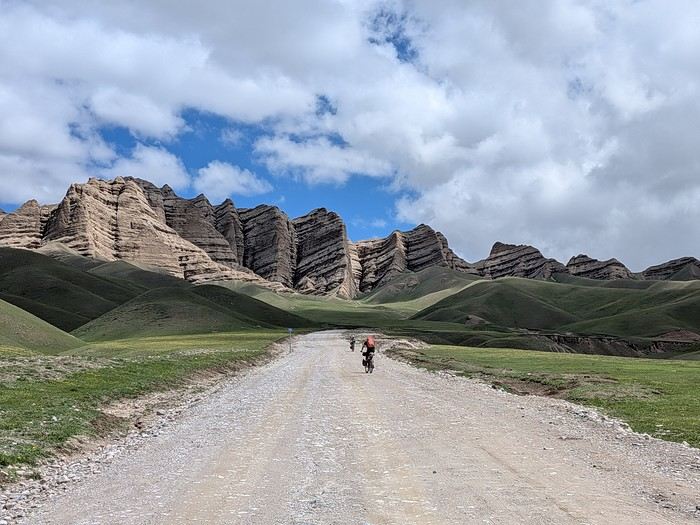
You’ll find here a post with some practical information.
And here, the version of the travel journal without comments.
---/---
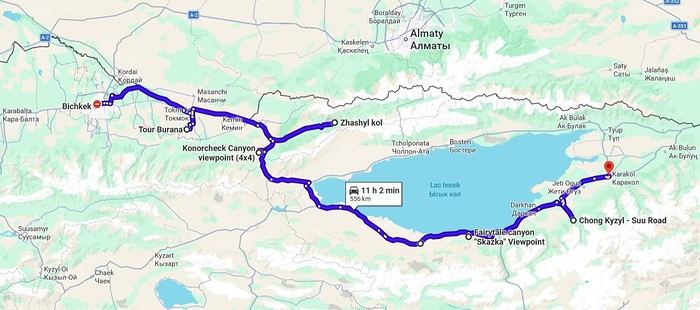
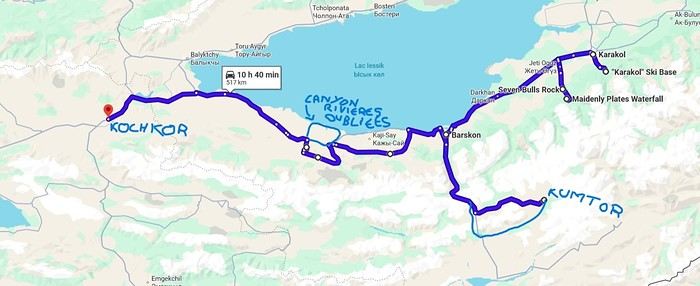
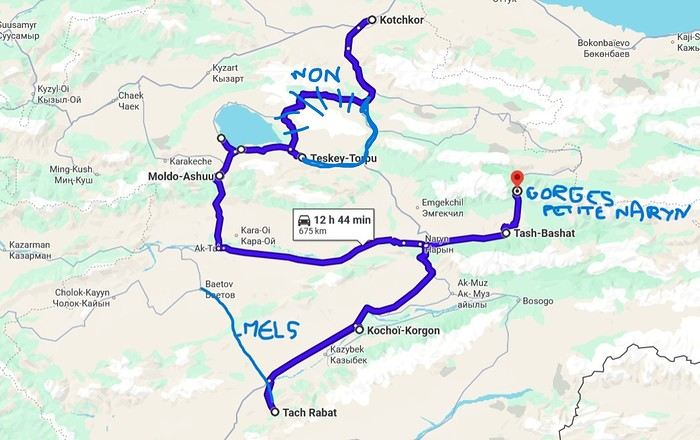
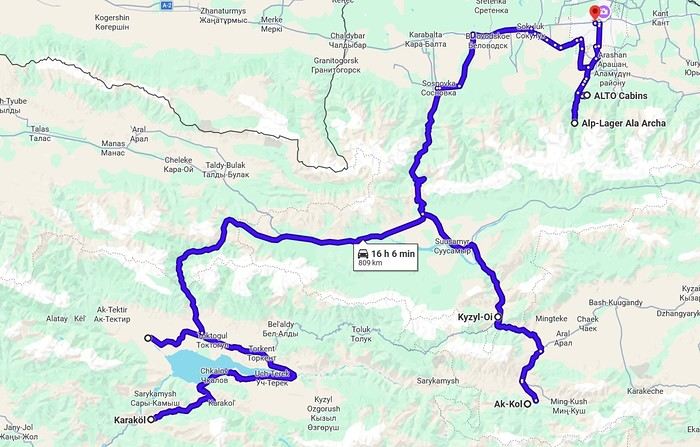
As a supplement, the route track. Not necessarily ultra-accurate since Google has serious gaps for this destination...
From Bishkek to Karakol:
From Karakol to Kochkor:
From Kochkor to Baetov:
From Baetov to Kara-Köl:
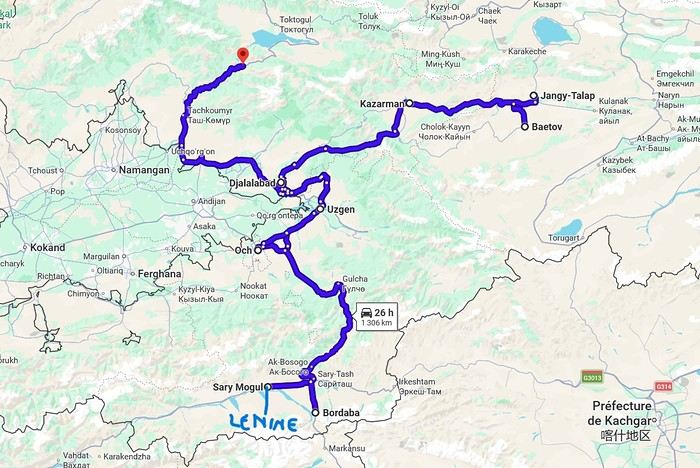
From Kara-Köl to Bishkek:

But the discomfort of overnight stays, the difficulty of communication, and the prices of the few car rental options kept making me postpone the project.
And then, everything suddenly fell into place—I told myself, it’s time!
The preparations took longer than usual; the destination is still far from mainstream.
A bit of Kazakhstan? Not in the end.
The south or not the south? Yes, in the end.
Pre-book or go with the flow? Only two stops were a leap into the unknown.
To help me find the ideal route, I made great use of this forum (thanks to everyone for patiently answering my questions!), pored over travel journals and blogs (Christian, Jeff), zoomed in on Google Maps and Yandex, and bought the guide published by OunTravela about this destination (the guide has been updated since).
---/---
You’ve got your passport, international driver’s license, bank cards, and euros?
Off we go to Lyon—just one night left before our early morning flight.
Tomorrow night, we’ll be sleeping in Bishkek! (Steak for my partner’s mischievous nephews...)
You’ll find here a post with some practical information.
And here, the version of the travel journal without comments.
---/---
As a supplement, the route track. Not necessarily ultra-accurate since Google has serious gaps for this destination...
From Bishkek to Karakol:
From Karakol to Kochkor:
From Kochkor to Baetov:
From Baetov to Kara-Köl:
From Kara-Köl to Bishkek:
Page by Page on the Assisi Way – 1,200 km on Foot
Preamble
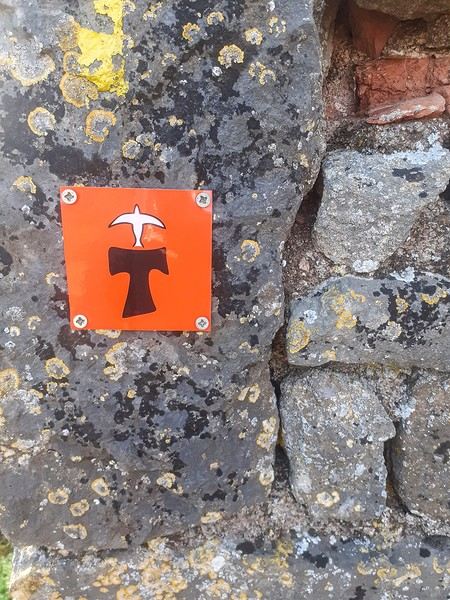
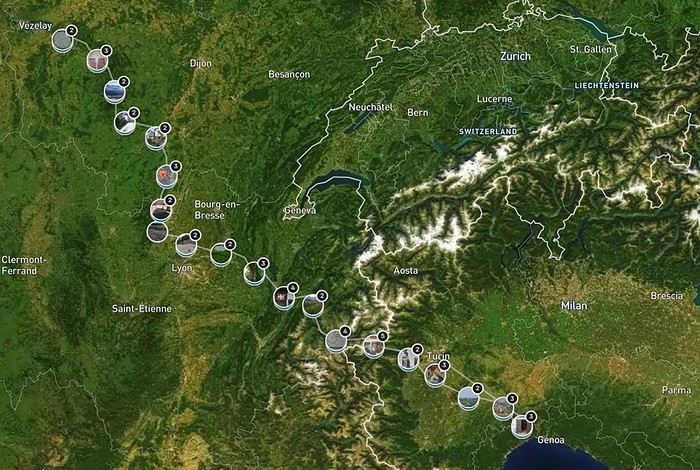
June 2024. While hiking with my brother on the GR 36 Tour du Morvan, I catch sight now and then of strange rectangular markers fixed to tree trunks. Against a bright orange background, a deep black Greek tau topped with a white dove. My first encounter with the Assisi Way. The Way of St. Francis: a pilgrimage route linking Vézelay in Burgundy to Assisi in Italy, covering nearly 1,800 km. It felt like an obvious next step—I immediately knew I’d take it on, attempt the adventure solo.
In the months that followed, I talked about my project to everyone—family, friends, my partner. An avalanche of comments, more or less the same but varying depending on each person’s character and life experiences. But deep down, it all boiled down to one legitimate question: why?
And the answers? Hesitant, awkward, partial, even confused. I quickly realized they weren’t so easy to find. It was as if my project seemed more like a whim, a kind of intimate caprice, rather than a well-thought-out plan. Of course, I knew the reasons that pushed me to leave—you always have to give some. Loved ones need to understand to feel reassured, and that’s understandable. But I fear that when I list them, they’ll sound like the same old checklist anyone embarking on this kind of journey might give. Of all the reasons I could mention, I’ll highlight just one here: the call of the road, the solo adventure that brings a powerful sense of freedom. A bit like Monsieur Seguin’s goat, who from her comfortable pen gazes longingly at the unconstrained horizon of the mountain. But if I’m being honest, I think I didn’t really know what I was looking for—or, more importantly, what I’d find. Deep down, when I reflect on it, one word keeps coming up that explains nothing and everything at once: desire.
Now well past sixty, I know that when I ask myself who I am or where I’m going, two things bring me fully back to myself: hiking and writing. And my intention was also to anchor this adventure through words, day by day. Writing down my feelings, emotions, discoveries, and reflections each evening. The famous travel journal that grounds the daily experience in reality. When I discovered the app "Polarstep," which was initially just meant to keep my loved ones updated and reassured, inform them of my progress, and maintain a connection, I found an opportunity to do it a little differently than usual. No retrospective notes polished up after returning, but spontaneous writing—recounting everything that crossed my mind during the day and publishing it immediately. A journey lived in real time.
This text is the exact transcription of my daily writings. Rereading them, I didn’t change a thing—just corrected a few mistakes and tweaked some awkward phrasing here and there. Short texts, fitting the format imposed by this kind of app. Writing as if addressing others.
Now, all that was left was to walk. April 18, 2026 – Vézelay.
June 2024. While hiking with my brother on the GR 36 Tour du Morvan, I catch sight now and then of strange rectangular markers fixed to tree trunks. Against a bright orange background, a deep black Greek tau topped with a white dove. My first encounter with the Assisi Way. The Way of St. Francis: a pilgrimage route linking Vézelay in Burgundy to Assisi in Italy, covering nearly 1,800 km. It felt like an obvious next step—I immediately knew I’d take it on, attempt the adventure solo.
In the months that followed, I talked about my project to everyone—family, friends, my partner. An avalanche of comments, more or less the same but varying depending on each person’s character and life experiences. But deep down, it all boiled down to one legitimate question: why?
And the answers? Hesitant, awkward, partial, even confused. I quickly realized they weren’t so easy to find. It was as if my project seemed more like a whim, a kind of intimate caprice, rather than a well-thought-out plan. Of course, I knew the reasons that pushed me to leave—you always have to give some. Loved ones need to understand to feel reassured, and that’s understandable. But I fear that when I list them, they’ll sound like the same old checklist anyone embarking on this kind of journey might give. Of all the reasons I could mention, I’ll highlight just one here: the call of the road, the solo adventure that brings a powerful sense of freedom. A bit like Monsieur Seguin’s goat, who from her comfortable pen gazes longingly at the unconstrained horizon of the mountain. But if I’m being honest, I think I didn’t really know what I was looking for—or, more importantly, what I’d find. Deep down, when I reflect on it, one word keeps coming up that explains nothing and everything at once: desire.
Now well past sixty, I know that when I ask myself who I am or where I’m going, two things bring me fully back to myself: hiking and writing. And my intention was also to anchor this adventure through words, day by day. Writing down my feelings, emotions, discoveries, and reflections each evening. The famous travel journal that grounds the daily experience in reality. When I discovered the app "Polarstep," which was initially just meant to keep my loved ones updated and reassured, inform them of my progress, and maintain a connection, I found an opportunity to do it a little differently than usual. No retrospective notes polished up after returning, but spontaneous writing—recounting everything that crossed my mind during the day and publishing it immediately. A journey lived in real time.
This text is the exact transcription of my daily writings. Rereading them, I didn’t change a thing—just corrected a few mistakes and tweaked some awkward phrasing here and there. Short texts, fitting the format imposed by this kind of app. Writing as if addressing others.
Now, all that was left was to walk. April 18, 2026 – Vézelay.
Excessive Abbreviations
Hello everyone on this forum!
I know in advance that what I'm about to say here won't please everyone, but honesty is a virtue, isn't it?
Here's the thing: for many years now, I've noticed a habit in French-speaking posts of using abbreviations left and right, as if to show that we're "in the know." Let me explain with a few examples:
- - In discussions about Peru, I see "Aguas" for "Aguas Calientes." And if it's Mexico, well, it'll be "Aguas" for "Aguascalientes"!
- - For Guatemala, "travelers" will say "Guaté." Come on, saying "Guatemalas" would maybe be the undeniable sign that you know nothing about the country???
- - Back from Indonesia, many will talk about how familiar they've become with the country's language: "bahasa." Of course, everyone will know what you're talking about, but it still gets on my nerves because the language (one of the many languages) of Indonesia is "bahasa Indonesia." "Bahasa" actually means "language," and you'll find this word of Indian origin ‘Bhāṣā’ (it's Sanskrit originally) outside Indonesia too: in Thailand, for example, any language will be "phasa" as in "phasa thai" (official Thai), "phasa isan" (what's spoken in northeastern Thailand), "phasa angkrit" = English, etc.
Am I an incorrigible nitpicker? Maybe. But I'd also find it ridiculous if a foreigner came and told me they visited "Monte" during their trip to France, when it was actually Monte Carlo.
I read a lot in English and don't think I've encountered such a habit among English speakers.