Results for "Viseu+|+9+>+225"
11153 results found.
Bons plans logement Canada en hiver English translation pending
bonjour
je souhaite passer Noel ou le jour de l'an (2004/2005) au canada (région de quebec ou montréal, séjour d'une petite dizaine de jours)
qui peux me conseiller (location de chalet ou hotel, location de voiture ou pas) je voyage avec mes 3 enfants 16 et 17 ans, nous vivons en martinique depuis 8 ans nous recherchons un peu de frais 😛
merci de vos réponses éventuelles et bonne journée à tous
ps je peux donner quelques renseignements sur la martinique si quelqu'un le souhaite
je souhaite passer Noel ou le jour de l'an (2004/2005) au canada (région de quebec ou montréal, séjour d'une petite dizaine de jours)
qui peux me conseiller (location de chalet ou hotel, location de voiture ou pas) je voyage avec mes 3 enfants 16 et 17 ans, nous vivons en martinique depuis 8 ans nous recherchons un peu de frais 😛
merci de vos réponses éventuelles et bonne journée à tous
ps je peux donner quelques renseignements sur la martinique si quelqu'un le souhaite
Quel hôtel choisir ( Cayo Guillermo )? English translation pending
Bonjour à vous tous,
Quel hôtel choisir entre Iberostar Daiquiri, Sol Cayo Guillermo ou bien Mélia Cayo Guillermo ????
Voyage de 2 semaines prix environs 2 100 $ à 2 300 max.
Bonne bouffe au moins 2 resto à la carte minimum, bon spectacle endroit reposant et surtout belle plage.
Merci de me répondre rapidement.
😎
Quel hôtel choisir entre Iberostar Daiquiri, Sol Cayo Guillermo ou bien Mélia Cayo Guillermo ????
Voyage de 2 semaines prix environs 2 100 $ à 2 300 max.
Bonne bouffe au moins 2 resto à la carte minimum, bon spectacle endroit reposant et surtout belle plage.
Merci de me répondre rapidement.
😎
Traditions en Arabie Saoudite English translation pending
j'envisage un voyage à Riyadh, je ne veux pas commettre d'impair, qui me renseigne sur les us et coutumes recommandés aux occidentales ? je connais déjà l'algérie, le maroc, la tunisie, je rêve du moyen-orient...
Cinéma et photo à Pékin English translation pending
bonjour!
c'est moi le petit dernier.
je pars en chine en mars et aimerai savoir si quelqu'un connaît des contacts de le milieu du cinéma et de la photo là-bas, notamment à Pékin.
merci beaucoup
roto
c'est moi le petit dernier.
je pars en chine en mars et aimerai savoir si quelqu'un connaît des contacts de le milieu du cinéma et de la photo là-bas, notamment à Pékin.
merci beaucoup
roto
Voyager seul ou à deux? English translation pending
Je suis parti avec un pote pour faire Paris-pékin. On s'est trouvés sur le net, car chacun avait plus ou moins peur de se lancer seul ds l'aventure. Finallement, au bout de deux mois on a choisi de poursuivre chacun de son côté. Non que l'on ne s'entendait pas, mais on a remarqué que les rencontres étaient plus nombreuses et plus sympa en solo. Qu'en pensez-vous ?
Climat en Asie Sud-Est (avril-octobre)? English translation pending
Bonjour à tous,
Un conseil de votre part serait vraiment le bienvenu parce que je n'y vois plus très clair !!
Je projette de partir en avril en Asie du Sud-Est principalement : Népal (trek notamment), Tibet, Cambodge, Laos, Vietnam, Birmanie, Thaïlande, Chine.... un beau programme. Seulement voilà, je sais bien que la période n'est pas idéale côté climats.
Que me conseilleriez-vous, sachant que je ne veux pas décaler mon départ ? Regarder dans d'autres directions (Indonésie ? voire carrément Pérou qui m'attire énormément aussi) ? Persévérer quand même sur certaines de ces destinations ?
Autre question, mais plutôt pour vérifier : pas de problème pour une fille seule là-bas ?
Merci d'avance de votre aide... A bientôt
Un conseil de votre part serait vraiment le bienvenu parce que je n'y vois plus très clair !!
Je projette de partir en avril en Asie du Sud-Est principalement : Népal (trek notamment), Tibet, Cambodge, Laos, Vietnam, Birmanie, Thaïlande, Chine.... un beau programme. Seulement voilà, je sais bien que la période n'est pas idéale côté climats.
Que me conseilleriez-vous, sachant que je ne veux pas décaler mon départ ? Regarder dans d'autres directions (Indonésie ? voire carrément Pérou qui m'attire énormément aussi) ? Persévérer quand même sur certaines de ces destinations ?
Autre question, mais plutôt pour vérifier : pas de problème pour une fille seule là-bas ?
Merci d'avance de votre aide... A bientôt
Bon plan nouvelle année Malaisie ou Thaïlande? English translation pending
Bonjour,
Je pars en Malaisie le 26/12 pour 1 mois et je cherche un bon plan pour le Réveillon du Nouvel An...
Aidez moi !
Darwin?Cairns?Sidney?... en Australie English translation pending
bonjour! disposant de seulement 1 semaine en Australie
apres 3 semaines en indonésie, j'ai la possibilité de me
poser dans un de ces trois endroits.Je serais tenté par un endroit nature.Lequel me conseillez vous sachant que j ai pas le permis et que je le ferais soit en tour, soit en bus.Au premier abord, je serais tenté par Darwin a cause de Kakadu park a 250 km.Mais je meurs d'envie surtout de visiter Ayers rock!!!!!!!😇mais est ce materiellement possible par rapport au temps que j ai
et comment et avec qui m'y rendre?
MERci d'avance!!
MERci d'avance!!
Soudan ou Jourdanie? English translation pending
Salut tous,
J'ai prévu déjà 3 semaines de voyage toute seule en Egypte, y compris 1 semaine dans le desert. Mais j'ai finalement annulé le semaine dans desert, et maintenant, je voudrais des propositions pour où aller voir pendant cette semaine, je suis en train de comparer le Soudan et Jourdanie, est-ce que vous avez des conseils a propos des soucis comme de sécurité etc. ?
1 semaine peut prolonger à 10j au plus, et d'autre pays proche d'Egypte sont aussi bienvenues! Merci d'avance,
J'ai prévu déjà 3 semaines de voyage toute seule en Egypte, y compris 1 semaine dans le desert. Mais j'ai finalement annulé le semaine dans desert, et maintenant, je voudrais des propositions pour où aller voir pendant cette semaine, je suis en train de comparer le Soudan et Jourdanie, est-ce que vous avez des conseils a propos des soucis comme de sécurité etc. ?
1 semaine peut prolonger à 10j au plus, et d'autre pays proche d'Egypte sont aussi bienvenues! Merci d'avance,
Hors des sentiers battus en Inde du nord English translation pending
Namasté les routard!!!!!
Je part pour le premiere fois en Inde du nord, j'arrive a delhi et compte me balader 3semaines......
J'ai deja un pti itinéraire de prevu, Bénares, radjastant.....(bon ok c leger...lol...)
c donc pour sa que je me tourne vers vous pour avoir une ptite idée des ville vraiment interressante et surtout des coin que l'on ne trouve pas dans les guides, mais qui malgré tout vallent le détour.....
merci a tous 😎
Je part pour le premiere fois en Inde du nord, j'arrive a delhi et compte me balader 3semaines......
J'ai deja un pti itinéraire de prevu, Bénares, radjastant.....(bon ok c leger...lol...)
c donc pour sa que je me tourne vers vous pour avoir une ptite idée des ville vraiment interressante et surtout des coin que l'on ne trouve pas dans les guides, mais qui malgré tout vallent le détour.....
merci a tous 😎
Sejour dans le sud de la Thailande English translation pending
Bonjour a tous,
Je compte partir dans le sud de la Thailande au mois de fevrier-mars et j'aimerai avoir quelques conseils. Le but de mon voyage est de faire de la plongée dans des endroits beaux de preference 😉 et de me laisser dorer au soleil sans pour autant que ce soit trop touristique. Avez vous un itineraire a me proposer ?
Merci
Je compte partir dans le sud de la Thailande au mois de fevrier-mars et j'aimerai avoir quelques conseils. Le but de mon voyage est de faire de la plongée dans des endroits beaux de preference 😉 et de me laisser dorer au soleil sans pour autant que ce soit trop touristique. Avez vous un itineraire a me proposer ?
Merci
Conseils pratiques sur le Mexique en août? English translation pending
Ayant envisagé dans un premier temps l'équateur comme destination, un pb s'est posé à moi : mes vaccinations ne sont pas à jour pour cette destination, et les 3 semaines à peine kil me reste avant mon départ ne suffiront pas je pense. Ce n'est que partie remise dans ce cas (je garde note des conseils qui m'ont été donnés). J'ai donc pensé au besoin me rabattre sur le mexique, qui impose moins de contraintes en matière de vaccination.
Quels sont les parcours les plus intéressants?
Connaissez-vous des bon plans en matière de logement : par ex, est-ce que le logement chez l'habitant s'y pratique, et dans quelles conditions? et les auberges de jeunesses?
Quelles consignes de sécurité spécifiques à ce pays (et tous autres conseils important) seraient à suivre?
Merci beaucoup 😉
Quels sont les parcours les plus intéressants?
Connaissez-vous des bon plans en matière de logement : par ex, est-ce que le logement chez l'habitant s'y pratique, et dans quelles conditions? et les auberges de jeunesses?
Quelles consignes de sécurité spécifiques à ce pays (et tous autres conseils important) seraient à suivre?
Merci beaucoup 😉
Le Népal sans forcément faire de trek? English translation pending
Bonjour
On part à 2 au Nepal en septembre prochain, du 5 au 30. C'est la fin de mousson mais on a pas de possibilité de partir plus tard ... On ne cherche pas forcément à faire des exploits sportifs type gros treks, vu que ce n'est pas forcément la saison et qu'on est physiquement pas en méga forme avant de partir. On privilégie surtout le fait de découvrir des petits villages sympa et la vie de leurs habitants, en espèrant quand même voir de beaux sommets entre les nuages ! On aime bien les paysages de "moyenne" montagne, cad pas mal de vert par rapport à la haute montage plus minérale qui nous attire à priori moins. Auriez-vous des coins sympa à nous proposer ? Le Teraï semble très attirant, mais est-il possible de se balader facilement là bas en cette saison ?
merci
Greg
On part à 2 au Nepal en septembre prochain, du 5 au 30. C'est la fin de mousson mais on a pas de possibilité de partir plus tard ... On ne cherche pas forcément à faire des exploits sportifs type gros treks, vu que ce n'est pas forcément la saison et qu'on est physiquement pas en méga forme avant de partir. On privilégie surtout le fait de découvrir des petits villages sympa et la vie de leurs habitants, en espèrant quand même voir de beaux sommets entre les nuages ! On aime bien les paysages de "moyenne" montagne, cad pas mal de vert par rapport à la haute montage plus minérale qui nous attire à priori moins. Auriez-vous des coins sympa à nous proposer ? Le Teraï semble très attirant, mais est-il possible de se balader facilement là bas en cette saison ?
merci
Greg
Barcelona at the end of October: what's the difference in crowds between weekends and weekdays?
Hi,
I’ll be in Barcelona at the end of October.
I can choose to be there over the weekend or during the week. Probably 4 nights.
Is there a big difference in terms of crowds in the city and in the museums?
Little or no difference would simplify my itinerary on the way.
Thanks
Little or no difference would simplify my itinerary on the way.
Thanks
"Glory": an Animal Farm for Zimbabwe—and the world
"400 pages of verbal pyrotechnics and animal magic" — The Times
"Bulawayo leans into exaggeration and irony to tell hard truths. *Glory* is jam-packed with comedy and farce, poking fun at an autocratic regime while illustrating the absurdity and surreal nature of a police state." — The Guardian
The cruelty and savagery of Zimbabwe’s (and Africa’s in general) "powerful animals"
Zimbabwean author NoViolet Bulawayo has written a novel that illustrates better than any documentary the complexity of colonial legacy. In doing so, she revisits George Orwell’s Animal Farm. Her novel *Glory* is a political satire about Zimbabwe—and it’s brimming with humor.
For thirty years, Zimbabwe has been stagnating under Robert Mugabe’s presidency. Human rights violations, corruption, and international sanctions have kept the population mired in poverty and oppression, while the regime exploits the meager earnings of the economy. As the 2017 elections approach, a power struggle erupts over the succession of the very elderly Father of the Nation (Mugabe). On the streets, people hope for long-awaited reforms; the people feel their moment has come.
And indeed, the army ousts Mugabe and his wife—"with her Gucci heels" (p.32)—who was positioning herself for the presidency. Hopes are dashed, however. The generals install former vice-president Emmerson Mnangagwa in power; the regime merely changes faces, but the problems remain the same.
In the novel, the country is called "Jidada, with a -da and another -da" (p.1); there’s no mistaking that this fictional state is Zimbabwe.
For *Glory*, her second novel, NoViolet Bulawayo invents a whole series of codes whose strength lies precisely in how easy they are to decipher. Like George Orwell’s Animal Farm, the characters populating Bulawayo’s universe aren’t humans but horses, goats, or crocodiles with all-too-human traits. Mugabe and Mnangagwa are horses, the spiritual leader is a pig, the soldiers are all bloodthirsty dogs, while the populace consists of goats, chickens, donkeys, and cats. The shift to the animal world serves only to better grasp the laws of despotism—and to ridicule real-life models. On one hand, the animals are humanized: they tweet, torture, travel in private jets. On the other, their greed, stupidity, and brutality stem from their animal nature.
It’s the old trick of fable: dressing men in animal disguises to make them easier to recognize. That’s how Orwell, in Animal Farm, traced how the promise of liberation from the Russian Revolution turned into Stalinist terror. In his 1945 fable, George Orwell describes how the animals of a farm drive out their farmer to organize the exploitation themselves, collectively. For a time, they truly taste freedom, but a clique of pigs ends up taking control. The central figures of the Soviet story—Stalin, Trotsky, Molotov—were easily recognizable.
Yet Bulawayo departs sharply from Orwell. She’s less concerned with precision and the force of argument than with satirical exaggeration. The deposed president is a senile old man who believes he can control even the sun’s course. The new stallion in power is a greedy debaucher. His soldiers sniff respectfully at his tail and backside.
In Bulawayo’s *Glory*, things are more complicated, but her novel also tells of a failed, incomplete liberation. In the author’s Animal Farm, Jidada, the colonial exploiters are followed by new forms of oppression. Because the former liberators become tyrants themselves. And because global power dynamics persist in neocolonial structures.
Wouldn’t that be enough to fuel a deeply depressing narrative? No—Bulawayo turns it into a blazing satire, full of wit and uncompromising criticism of power, a thread running through contemporary (not just) Zimbabwean history. The old warhorses in NoViolet Bulawayo’s Jidada, who continue to act as pack leaders, are easily recognizable as caricatures of the longtime dictator Robert Mugabe and his successor, current president Emmerson Mnangagwa.
The plot kicks off in high gear with independence day festivities. From the crack of dawn, everyone waits on Jidada Square for the Old Horse, the Father of the Nation and former liberator, whose reign "was nearing all of—not one, not two, not three, but four solid decades" (p.1). Everywhere, the colors of the Jidada Party shine; everywhere, true supporters cheer. Even the scorching sun plays its part: "At this point the sun, upon seeing arrive the leader who was decreed by God himself to rule and rule and keep ruling, a leader who'd in turn decreed the very sun to head his cheerleading squad, took a deep, deep breath and thoroughly blazed to impress" (p.2).
Finally, the Old Horse’s luxury carriage approaches "with the slowness of a hearse" (p.2), and "hoping to catch a glimpse of the legendary Father of the Nation," which causes "the animals fell over themselves like intoxicated frogs" (p.2). The sovereign’s speech is delayed a moment longer: "what I really want is a nap," groans the Old Horse as he takes his seat with such care "like his backside was made of expensive porcelain" (p.6).
Meanwhile, Bulawayo parades his entourage: the president’s wife (who earns her doctorate at Jidada University faster than "you could say diss, for dissertation. Tholukuthi it was as easy as ordering from a KFC drive-through, or perhaps even easier being that it was cheaper than KFC; it in fact cost her nothing and the degree actually came with a zero-calorie Diet Coke and a purple straw" (p.41), and she’s now known as Dr Sweet Mother. The cabinet includes "the Minister of the Revolution, the Minister of Corruption, the Minister of Order, the Minister of Things, the Minister of Nothing, the Minister of Propaganda, the Minister of Homophobic Affairs, the Minister of Disinformation and the Minister of Looting" (p.9). And of course the vice-president, who will soon become interim president when the Old Horse finally kicks the bucket—and then settle in as the new long-term president, who in the novel is called Tuvius Delight Shasha, or "Tuvy" for short (p.253), none other than Emmerson Mnangagwa. It’s him Bulawayo reserves her most merciless character description for.
"New Dispensation" (p.109) is Tuvy’s slogan for Jidada, and he loves repeating it so much he even named his parrot after it ("So inspired was Tuvy by the realisation that he rechristened his new pet parrot with the name New Dispensation—tholukuthi the bird having been acquired explicitly for the purposes of tweeting eulogies and accordingly glorifying the Saviour throughout the airs and skies of the nation. Tuvy then went on to hire a lecturer in English from the University of Jidada to teach New Dispensation to say the phrase 'New Dispensation'" p.110). But Tuvy’s Zimbabwe remains a nation without free, fair, and credible elections ("#freefairncredibleelection" p.161), and the promised equal treatment applies only insofar as Zimbabweans now queue up without discrimination in endless lines—and everyone is as poor as the next in the "queuenation" (p.283). Except for the powerful. They can "yes, tholukuthi, her immeasurable riches theirs to take. And take they did—
just take—take—take—take—take—take—take—take—take—take—take—take—take—take—take—take—take—take—take—take—take—take—take—take—take—take—take" (p.249-250).
In short: Bulawayo brilliantly depicts how former independence fighters become exploiters themselves. And how the country threatens to suffocate under the weight of corruption and repression. But she also literally stages the polyphony with which the people oppose imposed obedience to the official line.
Controversial online discussions keep interrupting the narrative—dialogues and social threads (see photo below) that Bulawayo masterfully integrates. From a literary standpoint, it’s a brilliant idea. And it shows, above all, that the author’s sympathy—so likeable—goes to all those who refuse to let their dream of true freedom be stolen, not even by the corrupt elites of their own country.
In the book’s acknowledgments, the first tribute goes to "The Jidadas of the world, clamouring for freedom on many fronts—A luta continua." (p.401) This reflects the realization that, not only in Jidada-Zimbabwe but in many other corners of the world, the end of colonial domination is still far from meaning the freedom hoped for by the vast majority of people. But it also means, more broadly, that this freedom must be won "on many fronts" (see above), both domestically and geopolitically.
That’s precisely what *Glory* so vividly highlights: how complex the project behind the term "postcolonialism" really is. With *Glory*, Bulawayo also delivers a scathing critique of the persistence of colonial mindsets in the West.
In the novel, the murder of George Floyd, racist police violence, and white-supremacist ideology in Trump’s United States perfectly illustrate the persistence of racism. It’s especially in the final chapters that Bulawayo lets Jidada’s inhabitants explicitly and unflinchingly criticize a neocolonial world order:
"It was not lost on us how the West, which loved to 'save' Africa and announce every action to the whole world, did so with one limb while manipulating, looting and fleecing us with the rest of its limbs so that more money in fact poured out of the continent than trickled in." (p.376)
"It was no mistake that multinational corporations yearly reaped and shipped colossal profits from Africa back to their countries as had been the case during colonial times. Even the sticks and stones would tell you that the African earth at any given time howled and shook and heaved from the extraction of its precious minerals that rarely benefited its own miserable children." (p.376)
"(...) we vowed to wage yet another war for Africa's second Liberation from neocolonial oppression. From exploitation. From plunder. From Western dominion. From indignity. From Abuse. We wanted real freedom. We wanted greedy, thieving paws off our wealth. We wanted Justice. We wanted a new world; we wanted a brand-new world so much we didn't sleep a wink that night." (p.377)
The Jidadas of this world must fight two enemies: Western neocolonialism and the autocratic instrumentalization of that argument; the persistence of Western racism and the populist appropriation of that humiliation by tyrants from their own ranks. Neither of these obstacles to freedom diminishes the historical and current guilt of the other. But the path to postcolonial liberation must overcome all these forms of oppression. After all, the colonizers didn’t bequeath democracies to formerly dominated nations, but instability and the principles of oppression and exploitation—which the so-called liberators have also internalized. Yet the fact that a satirical novel can capture the complexity of historical relationships while remaining, despite all the darkness of the subject, hilarious—well, that’s truly astonishing.
Finally, *Glory* ties into a major trauma in Zimbabwe’s post-independence history: the so-called Gukurahundi massacres. Between 1983 and 1987, tens of thousands of civilians were murdered by Mugabe’s bloody henchmen, most of them Ndebele. The State Security Minister and head of secret services at the time? You guessed it—Emmerson Mnangagwa.
When *Glory* turns to the massacres, the novel’s tone shifts completely. The story is now told through the narrative of the goat called Destiny, who, like NoViolet Bulawayo herself, left her home country at 18 for the United States and only returned after 13 years. In the book, the city of Bulawayo becomes a village where Destiny retraces her family’s history—and learns that part of it was also brutally murdered during the massacres.
The abuse of power and life under a dictatorship, dispossession, and a fiercely proud awareness of the psychological wounds and emotional vulnerability of a uprooted and disenfranchised people who had to forge a new language—a new set of names—to express their lived experiences are at the heart of this wonderful Zimbabwean author’s literary work, NoViolet Bulawayo. Shortly after her studies, she was already writing short stories about postcolonial power dynamics in Africa. But her playful, masterful, and often unconventional approach to language also plays a key role in her work. With virtuosity, she shifts from cynical images of power-obsessed elites to compassionate descriptions of the people’s suffering, ending with a hopeful sermon on courage—the courage to break free from fear and thus gain the strength for change ("And every one of them understood that whatever they heard within those hearts was the new national anthem, tholukuthi an anthem that spoke of the kind of glory that burns eternal and glows with living light." p.400). This novel is a genuine pleasure to read. And it’s exceptional. Good, African...
Book info (original English and German translation):
NoViolet Bulawayo. Glory. Chatto & Windus, 2022. NoViolet Bulawayo. Glory. Suhrkamp, 2023.
Hery
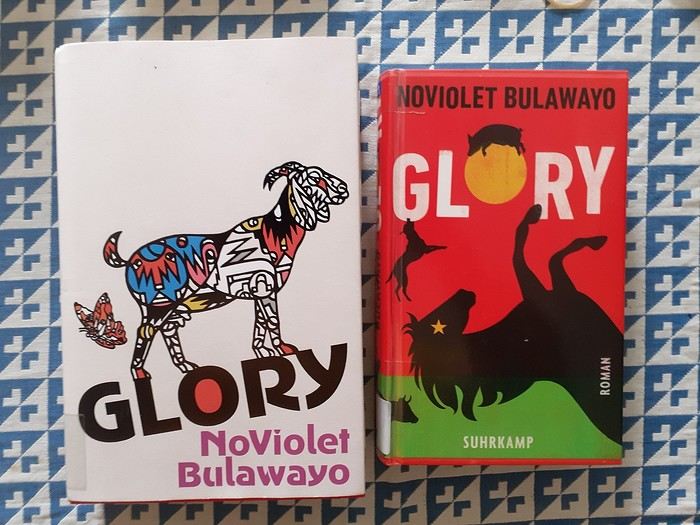 The books (in English, in German)
 Author NoViolet Bulawayo, Zimbabwe
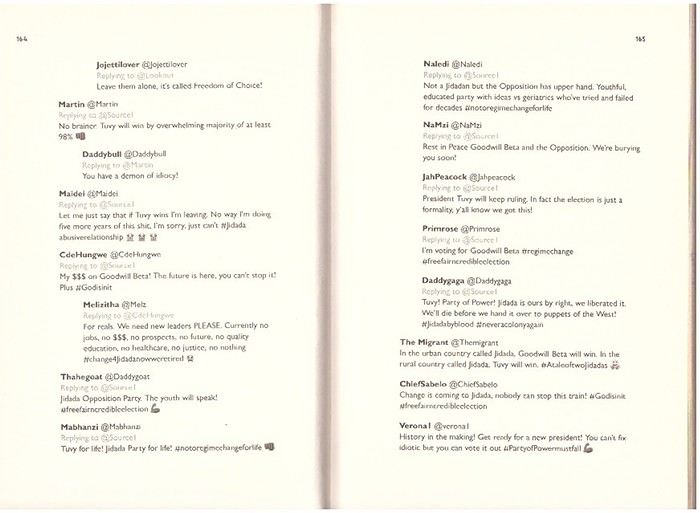 Threads (p.164-165)
"Bulawayo leans into exaggeration and irony to tell hard truths. *Glory* is jam-packed with comedy and farce, poking fun at an autocratic regime while illustrating the absurdity and surreal nature of a police state." — The Guardian
The cruelty and savagery of Zimbabwe’s (and Africa’s in general) "powerful animals"
Zimbabwean author NoViolet Bulawayo has written a novel that illustrates better than any documentary the complexity of colonial legacy. In doing so, she revisits George Orwell’s Animal Farm. Her novel *Glory* is a political satire about Zimbabwe—and it’s brimming with humor.
For thirty years, Zimbabwe has been stagnating under Robert Mugabe’s presidency. Human rights violations, corruption, and international sanctions have kept the population mired in poverty and oppression, while the regime exploits the meager earnings of the economy. As the 2017 elections approach, a power struggle erupts over the succession of the very elderly Father of the Nation (Mugabe). On the streets, people hope for long-awaited reforms; the people feel their moment has come.
And indeed, the army ousts Mugabe and his wife—"with her Gucci heels" (p.32)—who was positioning herself for the presidency. Hopes are dashed, however. The generals install former vice-president Emmerson Mnangagwa in power; the regime merely changes faces, but the problems remain the same.
In the novel, the country is called "Jidada, with a -da and another -da" (p.1); there’s no mistaking that this fictional state is Zimbabwe.
For *Glory*, her second novel, NoViolet Bulawayo invents a whole series of codes whose strength lies precisely in how easy they are to decipher. Like George Orwell’s Animal Farm, the characters populating Bulawayo’s universe aren’t humans but horses, goats, or crocodiles with all-too-human traits. Mugabe and Mnangagwa are horses, the spiritual leader is a pig, the soldiers are all bloodthirsty dogs, while the populace consists of goats, chickens, donkeys, and cats. The shift to the animal world serves only to better grasp the laws of despotism—and to ridicule real-life models. On one hand, the animals are humanized: they tweet, torture, travel in private jets. On the other, their greed, stupidity, and brutality stem from their animal nature.
It’s the old trick of fable: dressing men in animal disguises to make them easier to recognize. That’s how Orwell, in Animal Farm, traced how the promise of liberation from the Russian Revolution turned into Stalinist terror. In his 1945 fable, George Orwell describes how the animals of a farm drive out their farmer to organize the exploitation themselves, collectively. For a time, they truly taste freedom, but a clique of pigs ends up taking control. The central figures of the Soviet story—Stalin, Trotsky, Molotov—were easily recognizable.
Yet Bulawayo departs sharply from Orwell. She’s less concerned with precision and the force of argument than with satirical exaggeration. The deposed president is a senile old man who believes he can control even the sun’s course. The new stallion in power is a greedy debaucher. His soldiers sniff respectfully at his tail and backside.
In Bulawayo’s *Glory*, things are more complicated, but her novel also tells of a failed, incomplete liberation. In the author’s Animal Farm, Jidada, the colonial exploiters are followed by new forms of oppression. Because the former liberators become tyrants themselves. And because global power dynamics persist in neocolonial structures.
Wouldn’t that be enough to fuel a deeply depressing narrative? No—Bulawayo turns it into a blazing satire, full of wit and uncompromising criticism of power, a thread running through contemporary (not just) Zimbabwean history. The old warhorses in NoViolet Bulawayo’s Jidada, who continue to act as pack leaders, are easily recognizable as caricatures of the longtime dictator Robert Mugabe and his successor, current president Emmerson Mnangagwa.
The plot kicks off in high gear with independence day festivities. From the crack of dawn, everyone waits on Jidada Square for the Old Horse, the Father of the Nation and former liberator, whose reign "was nearing all of—not one, not two, not three, but four solid decades" (p.1). Everywhere, the colors of the Jidada Party shine; everywhere, true supporters cheer. Even the scorching sun plays its part: "At this point the sun, upon seeing arrive the leader who was decreed by God himself to rule and rule and keep ruling, a leader who'd in turn decreed the very sun to head his cheerleading squad, took a deep, deep breath and thoroughly blazed to impress" (p.2).
Finally, the Old Horse’s luxury carriage approaches "with the slowness of a hearse" (p.2), and "hoping to catch a glimpse of the legendary Father of the Nation," which causes "the animals fell over themselves like intoxicated frogs" (p.2). The sovereign’s speech is delayed a moment longer: "what I really want is a nap," groans the Old Horse as he takes his seat with such care "like his backside was made of expensive porcelain" (p.6).
Meanwhile, Bulawayo parades his entourage: the president’s wife (who earns her doctorate at Jidada University faster than "you could say diss, for dissertation. Tholukuthi it was as easy as ordering from a KFC drive-through, or perhaps even easier being that it was cheaper than KFC; it in fact cost her nothing and the degree actually came with a zero-calorie Diet Coke and a purple straw" (p.41), and she’s now known as Dr Sweet Mother. The cabinet includes "the Minister of the Revolution, the Minister of Corruption, the Minister of Order, the Minister of Things, the Minister of Nothing, the Minister of Propaganda, the Minister of Homophobic Affairs, the Minister of Disinformation and the Minister of Looting" (p.9). And of course the vice-president, who will soon become interim president when the Old Horse finally kicks the bucket—and then settle in as the new long-term president, who in the novel is called Tuvius Delight Shasha, or "Tuvy" for short (p.253), none other than Emmerson Mnangagwa. It’s him Bulawayo reserves her most merciless character description for.
"New Dispensation" (p.109) is Tuvy’s slogan for Jidada, and he loves repeating it so much he even named his parrot after it ("So inspired was Tuvy by the realisation that he rechristened his new pet parrot with the name New Dispensation—tholukuthi the bird having been acquired explicitly for the purposes of tweeting eulogies and accordingly glorifying the Saviour throughout the airs and skies of the nation. Tuvy then went on to hire a lecturer in English from the University of Jidada to teach New Dispensation to say the phrase 'New Dispensation'" p.110). But Tuvy’s Zimbabwe remains a nation without free, fair, and credible elections ("#freefairncredibleelection" p.161), and the promised equal treatment applies only insofar as Zimbabweans now queue up without discrimination in endless lines—and everyone is as poor as the next in the "queuenation" (p.283). Except for the powerful. They can "yes, tholukuthi, her immeasurable riches theirs to take. And take they did—
just take—take—take—take—take—take—take—take—take—take—take—take—take—take—take—take—take—take—take—take—take—take—take—take—take—take—take" (p.249-250).
In short: Bulawayo brilliantly depicts how former independence fighters become exploiters themselves. And how the country threatens to suffocate under the weight of corruption and repression. But she also literally stages the polyphony with which the people oppose imposed obedience to the official line.
Controversial online discussions keep interrupting the narrative—dialogues and social threads (see photo below) that Bulawayo masterfully integrates. From a literary standpoint, it’s a brilliant idea. And it shows, above all, that the author’s sympathy—so likeable—goes to all those who refuse to let their dream of true freedom be stolen, not even by the corrupt elites of their own country.
In the book’s acknowledgments, the first tribute goes to "The Jidadas of the world, clamouring for freedom on many fronts—A luta continua." (p.401) This reflects the realization that, not only in Jidada-Zimbabwe but in many other corners of the world, the end of colonial domination is still far from meaning the freedom hoped for by the vast majority of people. But it also means, more broadly, that this freedom must be won "on many fronts" (see above), both domestically and geopolitically.
That’s precisely what *Glory* so vividly highlights: how complex the project behind the term "postcolonialism" really is. With *Glory*, Bulawayo also delivers a scathing critique of the persistence of colonial mindsets in the West.
In the novel, the murder of George Floyd, racist police violence, and white-supremacist ideology in Trump’s United States perfectly illustrate the persistence of racism. It’s especially in the final chapters that Bulawayo lets Jidada’s inhabitants explicitly and unflinchingly criticize a neocolonial world order:
"It was not lost on us how the West, which loved to 'save' Africa and announce every action to the whole world, did so with one limb while manipulating, looting and fleecing us with the rest of its limbs so that more money in fact poured out of the continent than trickled in." (p.376)
"It was no mistake that multinational corporations yearly reaped and shipped colossal profits from Africa back to their countries as had been the case during colonial times. Even the sticks and stones would tell you that the African earth at any given time howled and shook and heaved from the extraction of its precious minerals that rarely benefited its own miserable children." (p.376)
"(...) we vowed to wage yet another war for Africa's second Liberation from neocolonial oppression. From exploitation. From plunder. From Western dominion. From indignity. From Abuse. We wanted real freedom. We wanted greedy, thieving paws off our wealth. We wanted Justice. We wanted a new world; we wanted a brand-new world so much we didn't sleep a wink that night." (p.377)
The Jidadas of this world must fight two enemies: Western neocolonialism and the autocratic instrumentalization of that argument; the persistence of Western racism and the populist appropriation of that humiliation by tyrants from their own ranks. Neither of these obstacles to freedom diminishes the historical and current guilt of the other. But the path to postcolonial liberation must overcome all these forms of oppression. After all, the colonizers didn’t bequeath democracies to formerly dominated nations, but instability and the principles of oppression and exploitation—which the so-called liberators have also internalized. Yet the fact that a satirical novel can capture the complexity of historical relationships while remaining, despite all the darkness of the subject, hilarious—well, that’s truly astonishing.
Finally, *Glory* ties into a major trauma in Zimbabwe’s post-independence history: the so-called Gukurahundi massacres. Between 1983 and 1987, tens of thousands of civilians were murdered by Mugabe’s bloody henchmen, most of them Ndebele. The State Security Minister and head of secret services at the time? You guessed it—Emmerson Mnangagwa.
When *Glory* turns to the massacres, the novel’s tone shifts completely. The story is now told through the narrative of the goat called Destiny, who, like NoViolet Bulawayo herself, left her home country at 18 for the United States and only returned after 13 years. In the book, the city of Bulawayo becomes a village where Destiny retraces her family’s history—and learns that part of it was also brutally murdered during the massacres.
The abuse of power and life under a dictatorship, dispossession, and a fiercely proud awareness of the psychological wounds and emotional vulnerability of a uprooted and disenfranchised people who had to forge a new language—a new set of names—to express their lived experiences are at the heart of this wonderful Zimbabwean author’s literary work, NoViolet Bulawayo. Shortly after her studies, she was already writing short stories about postcolonial power dynamics in Africa. But her playful, masterful, and often unconventional approach to language also plays a key role in her work. With virtuosity, she shifts from cynical images of power-obsessed elites to compassionate descriptions of the people’s suffering, ending with a hopeful sermon on courage—the courage to break free from fear and thus gain the strength for change ("And every one of them understood that whatever they heard within those hearts was the new national anthem, tholukuthi an anthem that spoke of the kind of glory that burns eternal and glows with living light." p.400). This novel is a genuine pleasure to read. And it’s exceptional. Good, African...
Book info (original English and German translation):
NoViolet Bulawayo. Glory. Chatto & Windus, 2022. NoViolet Bulawayo. Glory. Suhrkamp, 2023.
Hery
The books (in English, in German)
Author NoViolet Bulawayo, Zimbabwe
Threads (p.164-165)Feeling lost trying to plan my solo trip to French Polynesia: snorkeling and homestays or budget guesthouses
I'm feeling a bit overwhelmed with all the scattered info out there and I'm struggling to organize my solo trip to French Polynesia. I'm all about snorkeling—no hiking for me—so it's all about the water, water, water... I'd love to meet whales (what's the best season?), stay with locals or in budget guesthouses (I'm pretty low-key, no worries about comfort), and most importantly, be as close to the coral reefs as possible (all day long...).
I'm retired, so I've got plenty of time... If you can help, it would mean the world to me. Thanks everyone! !
I'm retired, so I've got plenty of time... If you can help, it would mean the world to me. Thanks everyone! !
Which entrance to choose for Pinnacles National Park (California): East or West?
Hi everyone! 🙂
I’m almost done planning our September road trip. After our 3-night visit to Sequoia, we’ll have a stopover night in Coalinga (to break up the drive). We’ll be staying two nights in Monterey and would like to stop along the way to visit one side of Pinnacles National Park. We’re torn between the West entrance and the East entrance, and we’d like to do a short hike of no more than 2 hours since we don’t want to arrive too late in Monterey.
This park is split into two distinct zones with no connection between them, and the mileage from Coalinga to Monterey is pretty much the same for both. Which area do you recommend visiting—east or west? And which route is the most scenic?
I’ve spotted two short hikes: - East: Moses Spring to Rim Trail Loop - West: Balconies Cliffs Cave Loop
Has anyone been there, or do you have another hike to suggest?
Thanks in advance, and have a great afternoon! Marcalamar 🙂
I’m almost done planning our September road trip. After our 3-night visit to Sequoia, we’ll have a stopover night in Coalinga (to break up the drive). We’ll be staying two nights in Monterey and would like to stop along the way to visit one side of Pinnacles National Park. We’re torn between the West entrance and the East entrance, and we’d like to do a short hike of no more than 2 hours since we don’t want to arrive too late in Monterey.
This park is split into two distinct zones with no connection between them, and the mileage from Coalinga to Monterey is pretty much the same for both. Which area do you recommend visiting—east or west? And which route is the most scenic?
I’ve spotted two short hikes: - East: Moses Spring to Rim Trail Loop - West: Balconies Cliffs Cave Loop
Has anyone been there, or do you have another hike to suggest?
Thanks in advance, and have a great afternoon! Marcalamar 🙂
How to find out where to see animals while traveling?
After taking a little trip around the world, I came back a few months ago with an idea in mind.
I mostly do diving, and I love observing animals in their natural habitat without disturbing them.
During the trip, I realized it was quite complicated to know where and when to see certain species.
For example:
where to dive with sharks or manta rays where you might get a chance to swim with whales
I even discovered thresher sharks during my trip… I didn’t even know this species existed before, even though they’re incredible to see.
We spent a ton of time searching for info all over the place, especially on social media, without ever getting a clear picture.
So I started putting all this together on my own, in the form of a map, to make it easier to visualize where to go depending on the seasons.
I recently put a first version online (it’s called Fauneya). There are probably mistakes, inconsistencies, or things to improve, and that’s partly why I’m posting here.
I’d really love to know how you all go about planning this kind of trip.
I mostly do diving, and I love observing animals in their natural habitat without disturbing them.
During the trip, I realized it was quite complicated to know where and when to see certain species.
For example:
where to dive with sharks or manta rays where you might get a chance to swim with whales
I even discovered thresher sharks during my trip… I didn’t even know this species existed before, even though they’re incredible to see.
We spent a ton of time searching for info all over the place, especially on social media, without ever getting a clear picture.
So I started putting all this together on my own, in the form of a map, to make it easier to visualize where to go depending on the seasons.
I recently put a first version online (it’s called Fauneya). There are probably mistakes, inconsistencies, or things to improve, and that’s partly why I’m posting here.
I’d really love to know how you all go about planning this kind of trip.
Testing an AI prompt to plan a trip to Bali
I spent 3 weeks in Bali last summer (+ 3 nights on Gili Meno and a day trip to Kawah Ijen in Java). So I wanted to see what ChatGPT could suggest for comparison...
Here’s the prompt I gave:
"You’re a local expert guide for Bali.
- Plan a 20-day itinerary for Bali with a side trip to Gili Meno and a day trip to Kawah Ijen in Java without staying overnight.
- I’m traveling with my wife, and I love visiting historical sites, hiking, relaxing at the beach, snorkeling, and exploring rice terraces...
- For the duration of the stay, I don’t want more than 8 places to sleep, and I’d like to stay at least 2 days at each stop to avoid unpacking too often. Except for the last night, where I’m okay with just one night near the airport.
- I prefer neighborhoods that are walkable and try to avoid typical tourist traps, though I don’t want to miss the must-see spots. So suggest a mix of iconic sites and hidden gems.
- Recommend hotels or guesthouses with a budget of 50 to 100 € per night, including breakfast. Make suggestions in areas popular with travelers, specifying the vibe (I prefer quiet), and consider safety and proximity to attractions.
- For lunch and dinner, suggest two to three restaurants that are well-rated by customers.
- Give me a day-by-day program with details on travel times, visiting times for each point of interest, and recommendations for transportation (taxi, train, bike, etc.). Estimate the total cost of the trip, including accommodations, food, transportation, and activities, and suggest two tips for saving money in each category.
- Don’t make anything up—be realistic about travel times, take into account the opening dates and hours of sites, and give me the entry fees for places to visit.
- Ask me all the questions until you’re 95% sure you understand what’s being asked. Don’t generate your response until you’ve understood."
The AI asked for a few clarifications:
"Great request—I can build you a really optimized and enjoyable itinerary, but to be 95% sure I hit the mark, I need a few key clarifications (this will really influence the pace, areas, and accommodations)."
In the end, it proposed a program very close to what we actually did. I’ll skip its accommodation and restaurant suggestions...
Its proposal:
"Ubud (4 nights) => we did 5 nights Sidemen (2 nights) Amed (3 nights) => we’d planned 2 nights Gili Meno (3 nights) => we did Gili between Sidemen and Amed Munduk (3 nights) => we did 2 nights before Pemuteran Pemuteran (3 nights) with Ijen => we did 4 nights Sanur (2 nights + 1 last night) => we chose Jatiluwih instead of Sanur
It suggested "activities" (and accommodations too):
IN UBUD: - Walk around central Ubud (1–2h) - Campuhan Ridge Walk - Tegalalang Rice Terrace - Tirta Empul - Gunung Kawi - Massage / market / slow café
IN SIDEMEN: - Rice terrace hike (2–3h) - Cooking class
IN AMED: - Snorkeling - Japanese Shipwreck - Beach + relaxation - Volcano sunset
ON GILI: - Snorkeling at Gili Meno Turtle Point, Nest Underwater Statues
IN MUNDUK: - Jungle & waterfall hike - Munduk Waterfall + Melanting Waterfall - Loop: 3–4h (perfect for your level) - Ulun Danu Bratan Temple - Twin Lakes
IN PEMUTERAN - Snorkeling: Menjangan Island
For Kawah Ijen, it detailed the day well: 👍 from Pemuteran = best possible option 12 PM: leave hotel (we left at 10 PM) 1 PM: ferry 3 PM: arrival in Java + transfer 11 PM: start ascent 2 AM–6 AM: volcano Return to Bali around 11 AM–12 PM (we got back at 4 PM) 👍 still very intense, but doable with an agency 💰 ~80–120 €/person all-inclusive
IN SANUR: - Relaxation - Quiet beach - Proximity to airport (30 min)"
BUDGET: "3,000 – 3,900 € for 2 people" (We paid 3,200 €)
In conclusion, it’s not (yet) enough, but it’s (already) pretty impressive!
Here’s the prompt I gave:
"You’re a local expert guide for Bali.
- Plan a 20-day itinerary for Bali with a side trip to Gili Meno and a day trip to Kawah Ijen in Java without staying overnight.
- I’m traveling with my wife, and I love visiting historical sites, hiking, relaxing at the beach, snorkeling, and exploring rice terraces...
- For the duration of the stay, I don’t want more than 8 places to sleep, and I’d like to stay at least 2 days at each stop to avoid unpacking too often. Except for the last night, where I’m okay with just one night near the airport.
- I prefer neighborhoods that are walkable and try to avoid typical tourist traps, though I don’t want to miss the must-see spots. So suggest a mix of iconic sites and hidden gems.
- Recommend hotels or guesthouses with a budget of 50 to 100 € per night, including breakfast. Make suggestions in areas popular with travelers, specifying the vibe (I prefer quiet), and consider safety and proximity to attractions.
- For lunch and dinner, suggest two to three restaurants that are well-rated by customers.
- Give me a day-by-day program with details on travel times, visiting times for each point of interest, and recommendations for transportation (taxi, train, bike, etc.). Estimate the total cost of the trip, including accommodations, food, transportation, and activities, and suggest two tips for saving money in each category.
- Don’t make anything up—be realistic about travel times, take into account the opening dates and hours of sites, and give me the entry fees for places to visit.
- Ask me all the questions until you’re 95% sure you understand what’s being asked. Don’t generate your response until you’ve understood."
The AI asked for a few clarifications:
"Great request—I can build you a really optimized and enjoyable itinerary, but to be 95% sure I hit the mark, I need a few key clarifications (this will really influence the pace, areas, and accommodations)."
In the end, it proposed a program very close to what we actually did. I’ll skip its accommodation and restaurant suggestions...
Its proposal:
"Ubud (4 nights) => we did 5 nights Sidemen (2 nights) Amed (3 nights) => we’d planned 2 nights Gili Meno (3 nights) => we did Gili between Sidemen and Amed Munduk (3 nights) => we did 2 nights before Pemuteran Pemuteran (3 nights) with Ijen => we did 4 nights Sanur (2 nights + 1 last night) => we chose Jatiluwih instead of Sanur
It suggested "activities" (and accommodations too):
IN UBUD: - Walk around central Ubud (1–2h) - Campuhan Ridge Walk - Tegalalang Rice Terrace - Tirta Empul - Gunung Kawi - Massage / market / slow café
IN SIDEMEN: - Rice terrace hike (2–3h) - Cooking class
IN AMED: - Snorkeling - Japanese Shipwreck - Beach + relaxation - Volcano sunset
ON GILI: - Snorkeling at Gili Meno Turtle Point, Nest Underwater Statues
IN MUNDUK: - Jungle & waterfall hike - Munduk Waterfall + Melanting Waterfall - Loop: 3–4h (perfect for your level) - Ulun Danu Bratan Temple - Twin Lakes
IN PEMUTERAN - Snorkeling: Menjangan Island
For Kawah Ijen, it detailed the day well: 👍 from Pemuteran = best possible option 12 PM: leave hotel (we left at 10 PM) 1 PM: ferry 3 PM: arrival in Java + transfer 11 PM: start ascent 2 AM–6 AM: volcano Return to Bali around 11 AM–12 PM (we got back at 4 PM) 👍 still very intense, but doable with an agency 💰 ~80–120 €/person all-inclusive
IN SANUR: - Relaxation - Quiet beach - Proximity to airport (30 min)"
BUDGET: "3,000 – 3,900 € for 2 people" (We paid 3,200 €)
In conclusion, it’s not (yet) enough, but it’s (already) pretty impressive!
Feedback on 13-day loop in May starting and ending in Essaouira
Hi everyone! :)
I’m finalizing the loop I’d like to do in May over 13 days, starting and ending in Essaouira.
We’re planning to rent a vehicle and are pretty active—we’re not really into crowds (that’s why I’ve decided to skip Marrakech).
Here’s my proposed itinerary:
Trip Proposal Summary: From May 13 (morning arrival) to May 26 (morning departure) Arrival and departure: Essaouira Day 1 (May 13): Arrival in Essaouira – Settling in / Exploring / Rest Day 2 (May 14): Essaouira – Water activities Day 3 (May 15): Essaouira to Tafraoute (~5h30) – route via Agadir – arrival and first exploration; Question: Is a detour to Taroudant worth considering? Day 4 (May 16): Tafraoute – Hike in the granite rocks – wild bivouac Day 5 (May 17): Tafraoute – Aït Mansour gorges – oasis – night in a hostel Day 6 (May 18): Tafraoute → Foum Zguid (~5h) – transition route – simple overnight or bivouac Day 7 (May 19): Foum Zguid → Zagora (~3h) – Draa Valley – desert prep Day 8 (May 20): Zagora → M'Hamid El Ghizlane → Erg Chigaga – departure with 4x4 guide – entering the dunes – bivouac Day 9 (May 21): Erg Chigaga – full desert day – walking, exploring – bivouac Day 10 (May 22): Desert → Ouarzazate (~5–6h) – leaving the desert – rest Day 11 (May 23): Aït Benhaddou – early visit – short hike – overnight stay Day 12 (May 24): Aït Benhaddou → Telouet – route toward the Atlas – start of trek – bivouac Day 13 (May 25): Atlas → Essaouira (~5–6h) – end of trek – return to Essaouira (overnight) Day 14 (May 26): Essaouira – free time + return flight
What do you think?
I aimed for an excursion to the Chigaga desert from M’Hamid because it seems less touristy and allows for a more compact loop. Is that a good idea? Is the drive to M’Hamid maybe too tedious?
Open to your great tips if there’s room for optimization!
All ears! :)
Thanks in advance and have a great day!
Clément
I’m finalizing the loop I’d like to do in May over 13 days, starting and ending in Essaouira.
We’re planning to rent a vehicle and are pretty active—we’re not really into crowds (that’s why I’ve decided to skip Marrakech).
Here’s my proposed itinerary:
Trip Proposal Summary: From May 13 (morning arrival) to May 26 (morning departure) Arrival and departure: Essaouira Day 1 (May 13): Arrival in Essaouira – Settling in / Exploring / Rest Day 2 (May 14): Essaouira – Water activities Day 3 (May 15): Essaouira to Tafraoute (~5h30) – route via Agadir – arrival and first exploration; Question: Is a detour to Taroudant worth considering? Day 4 (May 16): Tafraoute – Hike in the granite rocks – wild bivouac Day 5 (May 17): Tafraoute – Aït Mansour gorges – oasis – night in a hostel Day 6 (May 18): Tafraoute → Foum Zguid (~5h) – transition route – simple overnight or bivouac Day 7 (May 19): Foum Zguid → Zagora (~3h) – Draa Valley – desert prep Day 8 (May 20): Zagora → M'Hamid El Ghizlane → Erg Chigaga – departure with 4x4 guide – entering the dunes – bivouac Day 9 (May 21): Erg Chigaga – full desert day – walking, exploring – bivouac Day 10 (May 22): Desert → Ouarzazate (~5–6h) – leaving the desert – rest Day 11 (May 23): Aït Benhaddou – early visit – short hike – overnight stay Day 12 (May 24): Aït Benhaddou → Telouet – route toward the Atlas – start of trek – bivouac Day 13 (May 25): Atlas → Essaouira (~5–6h) – end of trek – return to Essaouira (overnight) Day 14 (May 26): Essaouira – free time + return flight
What do you think?
I aimed for an excursion to the Chigaga desert from M’Hamid because it seems less touristy and allows for a more compact loop. Is that a good idea? Is the drive to M’Hamid maybe too tedious?
Open to your great tips if there’s room for optimization!
All ears! :)
Thanks in advance and have a great day!
Clément
Where to stay in the Lofoten Islands?
Hi there, 🙂
Summer 2027 is going to be Norwegian for us! We’re heading to the Lofoten Islands first, then Senja, near Tromsø, and finally the North Cape. We’ll likely start from northern Finland (flight tickets and car rentals are more affordable there).
I’d like to book accommodations early to have more options. Good value-for-money places go fast in these pricey Nordic destinations...
But where should we book?
We’re planning to stay around ten nights in the Lofoten Islands.
What’s the best approach?
One place in the central part and explore from there?
One place in the south and another in the center?
Or one in the south, one in the center, and one in the north (3-4-3 nights)?
Our main goal is hiking.
Thanks for your tips!😉
Summer 2027 is going to be Norwegian for us! We’re heading to the Lofoten Islands first, then Senja, near Tromsø, and finally the North Cape. We’ll likely start from northern Finland (flight tickets and car rentals are more affordable there).
I’d like to book accommodations early to have more options. Good value-for-money places go fast in these pricey Nordic destinations...
But where should we book?
We’re planning to stay around ten nights in the Lofoten Islands.
What’s the best approach?
One place in the central part and explore from there?
One place in the south and another in the center?
Or one in the south, one in the center, and one in the north (3-4-3 nights)?
Our main goal is hiking.
Thanks for your tips!😉
Question about how Kruger Park works for accommodations and visits
Hi everyone, I’m here to get some advice on visiting KRUGER Park.
From what I’ve gathered through my reading, I understand there are two ways to visit the park:
- Independently with your own vehicle
=> Do you drive all day?
- By booking with a professional
=> Safari early in the morning and late in the afternoon. But what do you do in between?
When it comes to accommodations, the options are: - Booking in one of the park’s camps, where the lodging is basic but functional - Booking in a private reserve, which is more comfortable but prohibitively expensive - Booking outside the park, which means entering the park every morning. But if you want to stay for 3 days, that doesn’t seem practical to me. Do you have any advice for accommodations?
To be honest, I’m really struggling to understand how it all works... Thanks to everyone for your help. Bidule 27
When it comes to accommodations, the options are: - Booking in one of the park’s camps, where the lodging is basic but functional - Booking in a private reserve, which is more comfortable but prohibitively expensive - Booking outside the park, which means entering the park every morning. But if you want to stay for 3 days, that doesn’t seem practical to me. Do you have any advice for accommodations?
To be honest, I’m really struggling to understand how it all works... Thanks to everyone for your help. Bidule 27
Airport bus from Hanoi to Cao Bang
Hi there, we’re landing at Hanoi Airport and would like to head straight to Cao Bang without going into Hanoi. Does anyone know if there are buses that go directly from the airport to Cao Bang (especially in the early afternoon)? Thanks in advance!
Which Cape Verde islands should we prioritize (for hiking and swimming) for a first trip?
Hello, my wife and I are planning a trip to Cape Verde at the end of May for 20 days. We’re still unsure which islands to prioritize (they all look amazing!). Santo Antão and São Vicente seem like must-sees. Which other islands should we visit, given that we love hiking (nothing too challenging) and swimming?
Thanks
Need advice to finalize Malaysia itinerary
Hey everyone,
I’m over in East Borneo in mid-July.
I’m struggling to wrap up the end of my itinerary, even though it’s pretty straightforward (long but simple).
Last year, we did Malaysia (KL and the mainland + around Kuching).
Day 1 – Arrive in Kota Kinabalu early, stroll around town and hit the must-sees. Day 2 – Excursion to Tunku Abdul Rahman Park, snorkeling at 3 islands. Day 3 – Hike around Mount Kinabalu without summiting (450 per person, no way). Day 4 – Poring Hot Springs + evening flight to Sandakan. Day 5-6-7 – Kinabatangan River (still looking for the right guide). Day 8 – Sepilok for the orangutans, the Sun Bear Centre, and Rainforest Discovery Centre. Day 9 – Selingan, turtle island. Day 10 – Head to Semporna. Day 11-12-13-14 – Sipadan, Mabul, Kapalai. Day 15 – Bohey Dulang. Day 16 to Day 25: I’M STUCK.
I looked into Danum Valley, but for 3 days/2 nights, they’re quoting 650 € per person—come on, that’s ridiculous. I checked out a detour into Indonesia (still East Borneo), but I’m having trouble deciding what would be amazing. I read about Sangalaki + Kakaban (2 islands, 1 base) / Mahakam Delta - Kutai (orangutans and river) / Sungai Boh (Dayak Kayan) – jungle & culture. But honestly, I’m struggling to finalize this itinerary. If we venture that way, we’d head back to KK from Balikpapan.
What do you all think? Thanks in advance!
Day 1 – Arrive in Kota Kinabalu early, stroll around town and hit the must-sees. Day 2 – Excursion to Tunku Abdul Rahman Park, snorkeling at 3 islands. Day 3 – Hike around Mount Kinabalu without summiting (450 per person, no way). Day 4 – Poring Hot Springs + evening flight to Sandakan. Day 5-6-7 – Kinabatangan River (still looking for the right guide). Day 8 – Sepilok for the orangutans, the Sun Bear Centre, and Rainforest Discovery Centre. Day 9 – Selingan, turtle island. Day 10 – Head to Semporna. Day 11-12-13-14 – Sipadan, Mabul, Kapalai. Day 15 – Bohey Dulang. Day 16 to Day 25: I’M STUCK.
I looked into Danum Valley, but for 3 days/2 nights, they’re quoting 650 € per person—come on, that’s ridiculous. I checked out a detour into Indonesia (still East Borneo), but I’m having trouble deciding what would be amazing. I read about Sangalaki + Kakaban (2 islands, 1 base) / Mahakam Delta - Kutai (orangutans and river) / Sungai Boh (Dayak Kayan) – jungle & culture. But honestly, I’m struggling to finalize this itinerary. If we venture that way, we’d head back to KK from Balikpapan.
What do you all think? Thanks in advance!
Traveling alone with my 10-year-old daughter in Morocco
Hello,
I’d like to go to Morocco with my 10-year-old daughter for three weeks in February.
Do you think, as women traveling alone, we’ll feel comfortable? Sorry if my question seems odd, but when I mentioned my plans, I got some hesitant reactions.
I’ve never been to North Africa. I’ve traveled several times to the Sultanate of Oman, where I felt very at ease as long as we respected the basic cultural norms. For those who know Morocco, do you think it’s different? Would it be appropriate for me to cover my head?
I was thinking of arriving in Agadir and spending a few days in Taghazout and the surrounding area. After that, if you have any tips, I’m all ears. We’re looking to discover Moroccan cultures, see artisans at work, or even try our hand at a local craft—we’d love that. Simply meeting families, seeing landscapes, animals, and soaking in the culture gently, opening ourselves to something new—that’s what motivates us. And if there are opportunities to listen to local music, even better.
We’ll be traveling by public transport. Thanks in advance for your ideas. Happy travels to everyone.
I was thinking of arriving in Agadir and spending a few days in Taghazout and the surrounding area. After that, if you have any tips, I’m all ears. We’re looking to discover Moroccan cultures, see artisans at work, or even try our hand at a local craft—we’d love that. Simply meeting families, seeing landscapes, animals, and soaking in the culture gently, opening ourselves to something new—that’s what motivates us. And if there are opportunities to listen to local music, even better.
We’ll be traveling by public transport. Thanks in advance for your ideas. Happy travels to everyone.
Patagonia Itinerary
Hi there,
I’m about to fulfill a dream that includes a trip to Patagonia between October and December 2026. I’ll be traveling solo.
My plan: - Take a boat from Puerto Montt to Puerto Natales (4-5 days) - Torres del Paine National Park (2-3 days) - Bus from Puerto Natales to Ushuaïa (1-2 days) - Exploring around Ushuaïa (3-4 days) - Cruise from Ushuaïa to Punta Arenas (Oct 31 - Nov 4) - Rent a vehicle and head back up to Puerto Montt by around December 10, which is about 35 days total, via Los Glaciares, El Chaltén, Patagonia NP, Caleta Tortel, Villa O’Higgins, Puerto Río Tranquilo, Bahía Exploradores, Cerro Castillo NP, Coyhaique, Queulat NP, Chaitén, Pumalín NP, and Hornopirén NP.
My goal is to enjoy nature and do some hiking.
I’ll be in Torres del Paine around October 20—is the weather manageable for day hikes at that time?
30-35 days from Punta Arenas to Puerto Montt? That’s about 3,600 km. Is this timeframe doable to enjoy the scenery without rushing? If I arrive in the north earlier, it’s no big deal—I’ll just explore more spots above Puerto Montt.
Now, about the vehicle... I’m torn between a car + tent (regular car with a tent on top) and a small van. Is this enough for the Carretera Austral or unpaved roads? Or would a 4x4 be better? I’m not an experienced 4x4 driver—I’ve only driven occasionally to give the main driver a break on easy sections. A van is tempting for the comfort. Are there any rental options for slightly modified cars or ones where you can sleep, like a Kangoo?
Thanks in advance for your thoughts on my itinerary and advice on the vehicle!
I’m about to fulfill a dream that includes a trip to Patagonia between October and December 2026. I’ll be traveling solo.
My plan: - Take a boat from Puerto Montt to Puerto Natales (4-5 days) - Torres del Paine National Park (2-3 days) - Bus from Puerto Natales to Ushuaïa (1-2 days) - Exploring around Ushuaïa (3-4 days) - Cruise from Ushuaïa to Punta Arenas (Oct 31 - Nov 4) - Rent a vehicle and head back up to Puerto Montt by around December 10, which is about 35 days total, via Los Glaciares, El Chaltén, Patagonia NP, Caleta Tortel, Villa O’Higgins, Puerto Río Tranquilo, Bahía Exploradores, Cerro Castillo NP, Coyhaique, Queulat NP, Chaitén, Pumalín NP, and Hornopirén NP.
My goal is to enjoy nature and do some hiking.
I’ll be in Torres del Paine around October 20—is the weather manageable for day hikes at that time?
30-35 days from Punta Arenas to Puerto Montt? That’s about 3,600 km. Is this timeframe doable to enjoy the scenery without rushing? If I arrive in the north earlier, it’s no big deal—I’ll just explore more spots above Puerto Montt.
Now, about the vehicle... I’m torn between a car + tent (regular car with a tent on top) and a small van. Is this enough for the Carretera Austral or unpaved roads? Or would a 4x4 be better? I’m not an experienced 4x4 driver—I’ve only driven occasionally to give the main driver a break on easy sections. A van is tempting for the comfort. Are there any rental options for slightly modified cars or ones where you can sleep, like a Kangoo?
Thanks in advance for your thoughts on my itinerary and advice on the vehicle!
Recommendations for a southern Morocco road trip with kids
Hi there,
We’re heading out at the end of February for a road trip with our two kids, ages 3 and 7. Our itinerary includes Ait Ben Haddou, Tizi-n-Tichka, Sourate, Tinghir, Zagora, Ouarzazate, Ouzoud, and Essaouira. I’d love recommendations for accommodations, restaurants, and typical/spectacular spots to visit. We’d like to spend a night in the Zagora desert. We’re looking for authenticity and a friendly vibe—not tourist traps—for our trip. We’ll be there during Ramadan—any tips? Thanks in advance!
Your fellow globetrotter’s perspective is invaluable.
We’re heading out at the end of February for a road trip with our two kids, ages 3 and 7. Our itinerary includes Ait Ben Haddou, Tizi-n-Tichka, Sourate, Tinghir, Zagora, Ouarzazate, Ouzoud, and Essaouira. I’d love recommendations for accommodations, restaurants, and typical/spectacular spots to visit. We’d like to spend a night in the Zagora desert. We’re looking for authenticity and a friendly vibe—not tourist traps—for our trip. We’ll be there during Ramadan—any tips? Thanks in advance!
Your fellow globetrotter’s perspective is invaluable.
Feedback on 15-day Quebec itinerary
Hi there, I’m heading to Quebec from 08/07/26 to 08/21/26 with my wife and our two sons, aged 8 and 10. I’m sharing my itinerary below—if you have any suggestions or feedback, I’d love to hear it!
Day 1: Arrival in Montreal on Friday, August 7th around 2 PM (it’s also one of my sons’ 8th birthday!). We’ll head to Westmount via public transit or taxi to pick up our Airbnb.
Day 2 & 3: Exploring Montreal.
Day 4: Picking up our rental car (not yet booked, but likely with Hertz via BSP Auto). We’ll explore the area around Montreal and then head to Montebello for the night.
Day 5: Visit to Parc Omega, staying overnight in Montebello (Airbnb).
Day 6: Heading to Shawinigan, possibly catching an evening show at Cité de l’Énergie. I’ve spotted Motel Auberge Pique-Nique for the night.
Day 7: Mauricie National Park. Overnight in Shawinigan.
Day 8: Heading to Lac Saint-Jean. I’ve looked into the Village Historique Val-Jalbert, but many say there are better options for visiting an old village, like the Village Québécois d’Antan near Quebec City. We’ll stay somewhere around the lake.
Day 9: Day around the lake, then overnight in Saguenay. FYI, August 15th is a holiday in Quebec (like in France), so some places might be busier or closed.
Day 10: Heading to Tadoussac. Staying overnight at the youth hostel to meet other travelers.
Day 11: Day in Tadoussac—whale watching and a guided forest excursion to see bears. Another night in Tadoussac.
Day 12: Heading to Quebec City, possibly stopping at Montmorency Falls along the way. We’ll pick up our Airbnb along the St. Lawrence River, not far from the aquarium.
Day 13 & 14: Exploring Quebec City and its surroundings.
Day 15: Returning to Montreal to catch our flight in the late afternoon.
I’ve tried to stay in the same place for two nights in a row for logistical reasons—it’s easier with kids. So far, only the Airbnbs are booked. For the rest, motels seem like the most budget-friendly option. I’d also love to find B&Bs with meals included, like Gîtes de France, but I’m not sure if that’s a thing here—I’m struggling to find options.
Don’t hesitate to let me know if this itinerary seems too packed. I’ve been mindful of the distances, but unfortunately, we can’t do everything, so we’ve had to make some tough choices.
Thanks in advance to anyone who can chime in!
Day 1: Arrival in Montreal on Friday, August 7th around 2 PM (it’s also one of my sons’ 8th birthday!). We’ll head to Westmount via public transit or taxi to pick up our Airbnb.
Day 2 & 3: Exploring Montreal.
Day 4: Picking up our rental car (not yet booked, but likely with Hertz via BSP Auto). We’ll explore the area around Montreal and then head to Montebello for the night.
Day 5: Visit to Parc Omega, staying overnight in Montebello (Airbnb).
Day 6: Heading to Shawinigan, possibly catching an evening show at Cité de l’Énergie. I’ve spotted Motel Auberge Pique-Nique for the night.
Day 7: Mauricie National Park. Overnight in Shawinigan.
Day 8: Heading to Lac Saint-Jean. I’ve looked into the Village Historique Val-Jalbert, but many say there are better options for visiting an old village, like the Village Québécois d’Antan near Quebec City. We’ll stay somewhere around the lake.
Day 9: Day around the lake, then overnight in Saguenay. FYI, August 15th is a holiday in Quebec (like in France), so some places might be busier or closed.
Day 10: Heading to Tadoussac. Staying overnight at the youth hostel to meet other travelers.
Day 11: Day in Tadoussac—whale watching and a guided forest excursion to see bears. Another night in Tadoussac.
Day 12: Heading to Quebec City, possibly stopping at Montmorency Falls along the way. We’ll pick up our Airbnb along the St. Lawrence River, not far from the aquarium.
Day 13 & 14: Exploring Quebec City and its surroundings.
Day 15: Returning to Montreal to catch our flight in the late afternoon.
I’ve tried to stay in the same place for two nights in a row for logistical reasons—it’s easier with kids. So far, only the Airbnbs are booked. For the rest, motels seem like the most budget-friendly option. I’d also love to find B&Bs with meals included, like Gîtes de France, but I’m not sure if that’s a thing here—I’m struggling to find options.
Don’t hesitate to let me know if this itinerary seems too packed. I’ve been mindful of the distances, but unfortunately, we can’t do everything, so we’ve had to make some tough choices.
Thanks in advance to anyone who can chime in!
Looking for info on a campervan road trip in Eastern Europe
Hi everyone,
I’m planning a campervan road trip and would love some tips from those who know these countries: Slovenia, Bosnia and Herzegovina, Croatia, Montenegro, and Slovenia again. At the moment, nothing’s set in stone, but for example, is it better to visit Slovenia or Bosnia? My preferences lean toward landscapes (rivers, sea, lakes)—basically anywhere there’s water! :) Wild camping, cheap or even free spots, and a *very* tight budget—it’s the discovery, curiosity, and meeting locals that drive me. I’ll visit cities and sites only if access is easy (by bike, for example, or by train from an affordable campsite) and if visitors aren’t treated like cash cows. Just reasonable stuff, really. So, any advice is welcome—like swimming spots or easy hikes along coasts or rivers. I love caves and offbeat visits (salt mines in Poland, La Roque Saint-Christophe in France, etc.). Castles and old ruins? Not really my thing... Thanks for your help! Sylvia
I’m planning a campervan road trip and would love some tips from those who know these countries: Slovenia, Bosnia and Herzegovina, Croatia, Montenegro, and Slovenia again. At the moment, nothing’s set in stone, but for example, is it better to visit Slovenia or Bosnia? My preferences lean toward landscapes (rivers, sea, lakes)—basically anywhere there’s water! :) Wild camping, cheap or even free spots, and a *very* tight budget—it’s the discovery, curiosity, and meeting locals that drive me. I’ll visit cities and sites only if access is easy (by bike, for example, or by train from an affordable campsite) and if visitors aren’t treated like cash cows. Just reasonable stuff, really. So, any advice is welcome—like swimming spots or easy hikes along coasts or rivers. I love caves and offbeat visits (salt mines in Poland, La Roque Saint-Christophe in France, etc.). Castles and old ruins? Not really my thing... Thanks for your help! Sylvia