Results for "Îles+des+Princes+|+123+>+233"
54449 results found.
Bateau-stop des Antilles vers l'Amérique Latine English translation pending
Bonjour,
J'arriverai en Martinique fin janvier 2009 (je fais la transat sur le bel Espoir, avec l'assoce du Père Jaouen, si certains connaissent), et mon objectif est de voyager en l'Amérique Latine.
Une fois l'Atlantique traversé à la voile, ça me chiffonnerait un peu de prendre l'avion pour faire un petit bout de trajet. il ne semble pas y avoir de bateaux de passagers réguliers (du genre ferry) entre les îles des Antilles ou vers le continent, ou même vers Cuba.
Est-ce que vous pensez je trouverai un bateau qui fasse la route vers le continent (Venezuela) ? Est-ce que ça se fait le 'bateau-stop' en voilier, ou bien est-ce que je rêve complètement ?
Je sais un peu naviguer, et suis bien sûr OK pour participer à la caisse de bord.
A bientôt de lire vos conseils !
Nina
J'arriverai en Martinique fin janvier 2009 (je fais la transat sur le bel Espoir, avec l'assoce du Père Jaouen, si certains connaissent), et mon objectif est de voyager en l'Amérique Latine.
Une fois l'Atlantique traversé à la voile, ça me chiffonnerait un peu de prendre l'avion pour faire un petit bout de trajet. il ne semble pas y avoir de bateaux de passagers réguliers (du genre ferry) entre les îles des Antilles ou vers le continent, ou même vers Cuba.
Est-ce que vous pensez je trouverai un bateau qui fasse la route vers le continent (Venezuela) ? Est-ce que ça se fait le 'bateau-stop' en voilier, ou bien est-ce que je rêve complètement ?
Je sais un peu naviguer, et suis bien sûr OK pour participer à la caisse de bord.
A bientôt de lire vos conseils !
Nina
Trinidad et Tobago en février/mars 2008 English translation pending
Vous voulez en savoir un peu plus sur ces deux iles des Caraïbes et vous avez raison ! Quelques idées et des images pour rêver sur le tout nouveau site de notre voyage en famille, un itinéraire de deux semaines réalisé en février/mars 2008 :
http://www.trinidadtobago.fr/
Le site n'est pas terminé. Vos commentaires seront les bienvenus !
Le site n'est pas terminé. Vos commentaires seront les bienvenus !
Quelles îles visiter dans les Cyclades? English translation pending
Bon, je n'arrive pas à me décider sur les îles à visiter et où résider pendant mon séjour (26 juin – 3 juillet).
Car après Athènes et Delphes ma copine et moi souhaitons aller sur les Cyclades.
J’hésiter beaucoup entre Mykonos, Tinos ou Paros. J’ai cru comprendre que Mykonos était finalement moins intéressante de Tinos.
Qu’en pensez-vous ? Avez-vous d’autres suggestions ?
Et pour aiguiller le débat, nos attentes sont : découvertes de jolis villages (typiques et emprunts d’histoire si possible) - beaux paysages - échange avec les habitants + voir quelques vestiges s’il y a. Les plages ne sont pas la priorité ! Si possible éviter les flots de touristes ! Logement chez l'habitant (à pas cher ... 😎) Durée dans les Cyclades, environ 4/5 jours.
Merci 😉
Et pour aiguiller le débat, nos attentes sont : découvertes de jolis villages (typiques et emprunts d’histoire si possible) - beaux paysages - échange avec les habitants + voir quelques vestiges s’il y a. Les plages ne sont pas la priorité ! Si possible éviter les flots de touristes ! Logement chez l'habitant (à pas cher ... 😎) Durée dans les Cyclades, environ 4/5 jours.
Merci 😉
Visite des Philippines et sécurité pour une femme seule? English translation pending
Bonjour,
ca y est, maintenant que j'ai mes billets en main, j'essaie d'ameliorer mon plannig.
On m'a parlé des rizières de Banaue à aller voir...cela se situe ou?je vais surement y aller tout seule, alors je voudrais savoir si c'est loin par rapport à Manille et si c'est faisable pour une fille seule (niveau sécurité...)sinon si vous avez d'autres coins sympas à me proposer...
a bientôt!
Voyage dans les îles Cyclades en juillet English translation pending
😏salut
nous aimerions partir dans les cyclades à 6 personnes au mois de juillet plus précisement en demarrant de SANTORIN POUR amorgos en passant surement par parros .notre problème étant les liaisons maritimes entre les iles .....😠
ex : entre santorin et amorgos existe t'il des liaisons directes et régulières.?
ensuite est ce qu'il existe des moyens de se loger autre que en hotels........?genre locations ou chambres d'hotes avec cuisine.....
si quelqu'un peux nous refiler quelques tuyaux se serait sympa
merci 😎
merci 😎
Thaïlande début novembre: îles à visiter en priorité? English translation pending
Bonjour,
Je m'organise un petit voyage en Thailande, à priori du 30 octobre au 15 Novembre 2007. Je compte passer 1 petite semaine à Bangkok, puis après je voudrais descendre vers le sud du pays, trouver des îles, des plages, du dépaysement.
Avez-vous des conseils sur les îles ou bord de mer à visiter en priorité, sachant que j'ai un budget assez serré (1200 euros pour 2 pour logement+nourriture+le reste) et en fonction du temps qu'il fera à cette époque de l'année?
Je ne suis pas difficile au niveau du logement, juste une douche et des toilettes séparées ça me suffit.
Par ailleurs, avez-vous déjà volé avec Emirates? J'ai un peu peur pour les escales, très longues.
Je m'organise un petit voyage en Thailande, à priori du 30 octobre au 15 Novembre 2007. Je compte passer 1 petite semaine à Bangkok, puis après je voudrais descendre vers le sud du pays, trouver des îles, des plages, du dépaysement.
Avez-vous des conseils sur les îles ou bord de mer à visiter en priorité, sachant que j'ai un budget assez serré (1200 euros pour 2 pour logement+nourriture+le reste) et en fonction du temps qu'il fera à cette époque de l'année?
Je ne suis pas difficile au niveau du logement, juste une douche et des toilettes séparées ça me suffit.
Par ailleurs, avez-vous déjà volé avec Emirates? J'ai un peu peur pour les escales, très longues.
Les plus belles plages des Cyclades? (Grèce) English translation pending
Bonjour à tous,
Pouvez vous me dire quelles sont les plus belles plages des cyclades? Quelle île est la plus propice à la détente sur des plages de rêves?
Pas spécialement pour plonger, aucun souci si il faut faire des heures de marche pour y acceder, ...
Merci d'avance pour vos infos.
Alex
Pouvez vous me dire quelles sont les plus belles plages des cyclades? Quelle île est la plus propice à la détente sur des plages de rêves?
Pas spécialement pour plonger, aucun souci si il faut faire des heures de marche pour y acceder, ...
Merci d'avance pour vos infos.
Alex
Trekking dans les îles grecques fin avril English translation pending
je souhaite partir en trekking 3 semaines dans ces iles
1)lesquelles choisir pour leurs authenticités et le moins de tourisme
2)quel parcours?
3)hébergement en chambre chez l'habitant, le côut, l'acceuil, la langue?
4)l'arrivée à athènes ou en crête?
5)Billet de retourà prévoir?
Merci beaucoup, je suis un fervant des sentiers de compostelle et je souhaite changer, rencontre-t-on d'autres marcheurs facilement?
Claude
Quelles îles grecques choisir pour commencer? English translation pending
nous nous lançons dans le voyage "vol sec" à l'aventure et sans retenir de logement. je n'ai plus envie de voyage tout compris. je voudrais de l'inattendu. je voudrais commencer par la grèce la première semaine de mai et visiter les cyclades ; mais je ne sais pas par où commercer dans toutes ces iles ! Santorin ? Paros ? Milos ? Myconos ? que ceux qui connaissent bien ces iles m'aiguillent un peu en me donnant leurs préférences. J'aimerais aussi savoir si on peut se loger facilement dans les pensions, chez l'habitant, sans réserver à l'avance ; et si l'on peut facilement prendre des ferries à l'improviste. peut-on visiter les différentes ïles en scoot ? mange-t-on pour très cher ? faut-il se centrer sur 2 ou 3 îles en une semaine? nous attendons beaucoup de vos conseils car je n'ai jamais voyager comme ça et étant saisonniers ... nous sommes nazes de chez nazes. merci!
Croatie ou Canaries en mai English translation pending
Bonjour,
On est en couple et on aimerait partir vers le 15 mai en vacances. On voudrait la mer, le beau temps, pas trop de monde, et des beaux paysages pour faire de belles rando. On a pense aux iles canaries ou a la croatie. Qu en pensez vous? Que nous conseillerez vous? On ne connait ni l une ni lautre destination. Et on n hesite aussi à louer une voiture et à changer de lieux et d hotel tous les jours ou tous les deux jours, ou alors carrement rester dans un hotel toute la semaine et visiter les environs en louant aussi une voiture.. Merci d avance de vos conseils
On est en couple et on aimerait partir vers le 15 mai en vacances. On voudrait la mer, le beau temps, pas trop de monde, et des beaux paysages pour faire de belles rando. On a pense aux iles canaries ou a la croatie. Qu en pensez vous? Que nous conseillerez vous? On ne connait ni l une ni lautre destination. Et on n hesite aussi à louer une voiture et à changer de lieux et d hotel tous les jours ou tous les deux jours, ou alors carrement rester dans un hotel toute la semaine et visiter les environs en louant aussi une voiture.. Merci d avance de vos conseils
S'installer à Gran Canaria English translation pending
Je suis Francaise et je m'installe en Août prochain à Gran Canaria, à l'aventure. Je ferai une recherche d'emploi directement sur place.
Je ne connais personne sur l'île. Qui peut me dire comment me loger les premiers temps, de préférence sur La Garita/Telde?
Outre demander mon nº d'étranger au commissariat, quelle(s) autre(s) formalité(s) d'urgence dois-je faire à mon arrivée?
Mon fort sont les langues (Francais, Español et Anglais) et le Commerce Extérieur. Je sais que les relations jouent beaucoup pour trouver un boulot. Autres pistes, organismes à joindre...?
Merci par avance 😉
Histoire des Antilles... 2ème partie English translation pending
Bonjour a tous,
Comme il a été dit, les populations Arawaks était donc très structurées et développaient des techniques très savantes...Il faut savoir que nous utilisons, sans le savoir pour la plupart, des mots de l'arawak ainsi : canoë(repris par les anglais) ( ou dogou), tabac, hamac, barbecue, coco, pagaie(c'est aussi un mot malais!), maracuja ( fruit de la passion, utilisé par la plupart des tribues Indiennes)... .
L'art ( ou du moins l'expression artistique Arawak était florissante) Arawak reprénte essentiellement des animaux, divinités en poterie( les Indiens n'utilisent tjs pas de tour, ils travaillent en façonnant de longs tubes de diamétre variable et en les superposant les uns sur les autres, en travaillant la matiére ils arrivent a lui donner la forme désirée, un peu d'eau et la technicité s'opère...), des sculptures sur bois, peintures, tissages, sans parler des ses magnifiques dogous ou canoës qui pouvaient atteindre plus de 40 mètres de long et finement décorés, masques pour les rituels somptueux, peintures sur corps a base de jenipapo(graine rouge utilisée dans les rituel mais aussi dans la vie courante contre les piqures de moustiques) ...
La société Arawak était particulièrement égalitaire aussi bien au niveau du partage que de la vie social, en effet lors de congrégations des villageois en présence du cacique et du chaman, chacun peut prendre la parole et discuter du sujet qui l'interroge, quand je dis tout le monde c'est bien sur les hommes mais aussi les femmes et... les enfants, et oui: si un enfant prend la parole il sera écouté au même titre qu'un adulte et une réponse lui sera proposé après mûres réflections. La femme, vivent les Femmes!, a les mêmes droits que l'homme, elle peut "divorcée" quand elle le désire et choisir le partenaire de son choix, aucune décision n'est prise sans la consulter, elle est respecté de tous (les viols ou brutalité sur une femme sont passibles d'exclusion du village et de la tribue: ce qui signifie la mort pour un indien), son rôle est essentiel dans la famille et il est reconnu comme tel ( si une femme ne veut pas être a la plantation et a s'occuper des enfants, elle peut aller a la pêche ou a la chasse ou même juste bavarder avec d'autres femmes; le mari accomplira avec bcp de fierté les tâches qu'elle faisait...).
Les enfants qui naissent avec des "anormalités" sont considérés comme des demi-dieux( les albinos sont considérés comme "enfants de la lune" et ont des pouvoirs magiques, les enfants "diforment" sont eux aussi très bien acceptés).
Cette société qui est basée sur l'art, l'amour ( même Colomb dira d'eux qu'ils sont "plein d'amour") et le respect ayant vécu des centaines d'années sur toutes les îles des Antilles, sera pourtant anéantie, en peu de temps... Non pas par les guerres presques incessantes entre les Arawaks et les Caraibes, mais par un tout autre... dieu: l'homme blanc.
Il existe une légende, encore vivace aujourd'hui, et que tout Indien connait: celle de l'homme a poils sur le visage qui habitait une grande maison flotant sur l'eau...Cette légende raconte l'histoire du jour ou des Indiens habitant les cotes des îles qui ont différentes tailles( les Antilles) rencontreront les hommes aux poils blanc sur le visage...
" Ils se promenaient comme tous les jours sur la plage, certains se baignaient, d'autres montaient aux cocotiers, d'autres netoyaient du poisson, certains enfin restaient a l'ombre des arbres près de la plage... De la un homme a crier:" je voie une grosse taches labas", il semblait émergé, au loin, une embarcation de taille superieur au plus grand dogou jamais construit, en se raprochant des cotes, ils purent apercevoir un énorme canoë avec de grands hamacs retenus par des arbres sans branche( les voiles) et une maison avec des fenêtres qui brillaient, elles étaient toutes fermées, a pic de l'eau et ne ressemblaient pas a la maison du cacique... Certains, paniqués, se sont enfuient vers le village en criant: "un canoë énorme arrive dans notre direction, il est tellement grand qu'il va finir par cacher le soleil et nous tuer tous...", d'autres plus fou ou plus vaillant se sont précipités vers la plage dans l'intention d'aller voir de plus près ce gigantesque canoë et de comprendre ce qu'il se passait... Bien sûr, tous avaient en tête la légende et, plus ils se raprochaient, plus la légende devenait réalité... Ils commençaient même a entendre "le bruit du tonnerre et la fumée blanche séchaper des flancs du monstre", a mi-hauteur ils virent la profécie se réaliser: l'homme a poils sur le visage recouvert de lumiére( les armures), vivant sur un canoë monstrueux qui crachait de la fumée blanche et grondait comme le tonnerre...
Voila qui nous permettra, je l'espère, d'aborder la troisième partie de cette histoire des Antilles. Si vous avez pris plaisir a la lecture de cette partie merci de partager vos opinions.
A bientot, nicodemus.
Liste officielle des pays indépendants du monde English translation pending
Salut
Je cherche une liste officielle qui recense TOUS les pays indépendants. J'ai un peu cherché mais le problème c'est que j'ai jamais rien trouvé d'officiel et bien fait. Peut-être l'ONU publie-t-elle quelque chose de correct ?
Je cherche une liste officielle qui recense TOUS les pays indépendants. J'ai un peu cherché mais le problème c'est que j'ai jamais rien trouvé d'officiel et bien fait. Peut-être l'ONU publie-t-elle quelque chose de correct ?
voyage sur les iles greques English translation pending
😉 Salut à toutes et à tous.
Revenant d'Athènes pour le week-end, j'aimerai bien partir une semaine en juin sur les petites îles qui sont aux alentours. pouvez vous me conseiller sur les îles, sachant que je recherche à voir un minimum de monuments et paysages. de plus, si vous pouvez aussi me renseigner sur les tarifs des ferry pour se rendre sur les îles, ce serait pas mal.
merci beaucoup pour vos réponse.
Revenant d'Athènes pour le week-end, j'aimerai bien partir une semaine en juin sur les petites îles qui sont aux alentours. pouvez vous me conseiller sur les îles, sachant que je recherche à voir un minimum de monuments et paysages. de plus, si vous pouvez aussi me renseigner sur les tarifs des ferry pour se rendre sur les îles, ce serait pas mal.
merci beaucoup pour vos réponse.
Fêtes des eaux et circuit au Cambodge English translation pending
Bonjour, 
Nous (2 copines) allons être au cambodge pour la fête des eaux et nous aimerions savoir s'il est préférable d'être à PP ou dans une autre ville à ce moment. Où y a t-il le plus d'animation ? Si nous sommes à PP, quel est le quartier le mieux pour loger lors de cette fête ? Est-il intéressant de rester pendant toute la durée de la fête (3 jours je crois) ou est ce que c'est toujours pareil d'un jour à l'autre.
Pour un circuit de 3 semaines, nous aimerions faire: arrivée PP, départ le lendemain pour Kampong Thom (1 nuit), Siem Reap et Angkor (3-4 nuits), Battambang, village flottant entre Battambang et Kampong Chnang, PP (fête des eaux), Kampong Cham et Kratie, Sianoukville et ses alentours.
Est-ce bien de le faire dans ce sens ou est-il mieux de quitter PP par Kampong Chnang.
D'autre part n'est-ce pas trop chargé comme programme ? nous ne voulons pas faire le parcours du combattant et avoir nos sacs sur le dos tous les jours. Si nous devions supprimer des étapes, lesquelles nous conseilleriez vous d'enlever.
Est-il facile de rencontrer des cambodgiens qui parlent français ?
Dernière question, quel budget routard nous conseillez vous de prévoir pour 3 semaines, tout compris (GH pas chères, bouffe, transport (hors vol international), guides, entrées aux musées et à Angkor, etc...)? 😛
Merci pour les renseignements que vous voudrez bien nous apporter.🙂
Nous (2 copines) allons être au cambodge pour la fête des eaux et nous aimerions savoir s'il est préférable d'être à PP ou dans une autre ville à ce moment. Où y a t-il le plus d'animation ? Si nous sommes à PP, quel est le quartier le mieux pour loger lors de cette fête ? Est-il intéressant de rester pendant toute la durée de la fête (3 jours je crois) ou est ce que c'est toujours pareil d'un jour à l'autre.
Pour un circuit de 3 semaines, nous aimerions faire: arrivée PP, départ le lendemain pour Kampong Thom (1 nuit), Siem Reap et Angkor (3-4 nuits), Battambang, village flottant entre Battambang et Kampong Chnang, PP (fête des eaux), Kampong Cham et Kratie, Sianoukville et ses alentours.
Est-ce bien de le faire dans ce sens ou est-il mieux de quitter PP par Kampong Chnang.
D'autre part n'est-ce pas trop chargé comme programme ? nous ne voulons pas faire le parcours du combattant et avoir nos sacs sur le dos tous les jours. Si nous devions supprimer des étapes, lesquelles nous conseilleriez vous d'enlever.
Est-il facile de rencontrer des cambodgiens qui parlent français ?
Dernière question, quel budget routard nous conseillez vous de prévoir pour 3 semaines, tout compris (GH pas chères, bouffe, transport (hors vol international), guides, entrées aux musées et à Angkor, etc...)? 😛
Merci pour les renseignements que vous voudrez bien nous apporter.🙂
La Grèce et ses îles English translation pending
Bonjour,
J'aimerais bien aller en grèce au mois de mai prochain.J'ai besoin de votre aide pour organiser mon voyage.Combien de temps dois-je consacré pour visiter athène ? quelle sont les iles a ne pas manquer ? combien je peux prévoir en faire en 3 semaines ? Avez-vous des sugestions d'hotel pas trop cher a me faire ? A quel endroit sont les plus belles
plages ? Un budget de combien environ ? Merci beaucoup a l'avance.Carolyne
Accueil des antillais English translation pending
je souhaiterais aller aux antilles et plus particulièrement à l'ile de saint martin et j'aimerais savoir si les habitants sont accueillants. toutes les personnes que je connais qui sont allées en martinique ou guadeloupe m'ont dit que l'accueil n'est vraiment pas terrible et qu'on a l'impression de déranger plutôt qu'autre chose. merci de me donner vos avis.
16 days with family in La Gomera (Canary Islands)
Preamble: Why La Gomera?
When we started looking for a summer destination a few months ago, our first criterion was to avoid extreme heat and heatwaves. We had already been to Norway two years ago and are considering going back in the future for other occasions. So, we had some fun asking ChatGPT which destinations enjoyed a mild climate during the summer without going too far. Among the list provided by the AI were the Canary Islands... The idea of a place we wouldn’t have thought of first, both not too far away and exotic enough, appealed to us: “Hmm, why not?”
This destination had never really attracted me, though Magali was a bit more interested. Five years earlier, COVID had caused a short break in my professional activity, and I had planned a trip because the flight price was attractive, and I was looking for a destination different from what usually appeals to me, more than out of deep interest. From a distance and with a social judgment I acknowledge (it’s not great, but it’s not completely wrong), I had the image of a destination for party-goers enjoying the sun without the slightest interest in local culture, with concrete coastlines and denatured landscapes—everything I detest the most. Still, I had done some quick research on the different islands and spotted Lanzarote for its beautiful volcanic landscapes, hiking trails, beaches, and the impression of a good balance between activity and fewer crowds than Tenerife or Gran Canaria. Then I dropped the idea of going, without ever reconsidering traveling to the Canaries...
Until now! Because we started researching the different islands of the archipelago to see which ones might appeal to us the most. It was La Gomera, the third smallest island of the archipelago, more praised for its hiking trails and preserved nature than for its beaches, away from mass tourism (fifty times fewer tourists than Tenerife) but still a bit more developed than its wild neighbor El Hierro, that caught our attention. Contrary to what might be suggested later, I’m not at all addicted to AI, but I use it from time to time to synthesize quick research or simply for experimentation. Since ChatGPT had started anticipating my tastes lately as if it had become my buddy (often successfully, sometimes off the mark), I asked which Canary Island would suit me best for a trip with my family. The tool answered first with... La Gomera. So, I tested it and teased it a bit to see if this suggestion was well-founded, as the method sometimes makes it contradict itself. But no luck: “You’d appreciate the wild nature of El Hierro, but with family, you’ll find little activity for the kids. You won’t like the touristy vibe of the big islands like Tenerife, Gran Canaria, Lanzarote, and Fuerteventura. You could consider La Palma, but it’s really La Gomera that will suit you best, based on your interests and the criteria given.” So, we dug deeper into our research and were convinced without a shadow of a doubt that this island was the one waiting for us.
Without knowing it, we had Canarians in our circle who revealed their origins when they heard about our travel plans. One from Tenerife insisted we’d be better off choosing Tenerife (obviously...) because it also has preserved spots and that La Gomera, “you can explore it in two or three days, you’ll get bored quickly...” The other, a colleague from Gran Canaria who had never visited La Gomera, still recommended it without hesitation because it turned out her parents had just gone there on vacation: they loved it and had encountered few tourists. She also tended to think this destination was usually the subject of short stays, but according to what her parents told her, taking your time there was also a great idea. However, in our research, the idea that La Gomera is an island you can explore in three or four days max kept coming up. So, we considered combining its visit with La Palma or El Hierro, the other two that caught our eye. But hopping between islands by ferry represents a significant budget for non-Canarians, even more so for a family of four. Then, scrutinizing Google Maps, it seemed obvious that two weeks were too short to discover two islands as they deserve, and that there seemed to be plenty to see in La Gomera, given its very unique culture. After all, we read that some people spend several months a year there, others never even leave... Finally, these landscapes and this atmosphere, which seemed to us a mix of Europe, North Africa, and Latin America, tempted us. So, it would be two weeks in La Gomera, deal!
La Gomera is therefore the second... well, the third smallest island of the Canaries since La Graciosa was recently recognized as a fully inhabited island. It has the shape of a rough circle about 20 to 25 kilometers in diameter and has just over 20,000 inhabitants, half of them in its capital, San Sebastián de la Gomera, the only real town. Like its Canarian sisters, La Gomera is a volcanic formation that rose about 10 million years ago. The island is very mountainous and rugged, covered with red and black rocky landscapes. Geological activity has shaped, between the sprawling massifs that end in steep cliffs in the ocean, six coastal valleys with tropical vegetation that have favored human settlement. They divide the island like slices of a cake; from the north clockwise: the agricultural Vallehermoso, the rustic Agulo, the green, humid, and fertile Hermigua, the sunny capital San Sebastián de la Gomera, the southern and isolated Alajeró-Santiago, and the seaside Valle Gran Rey. They constitute the six municipalities (more like cantons to our French understanding) of the territory.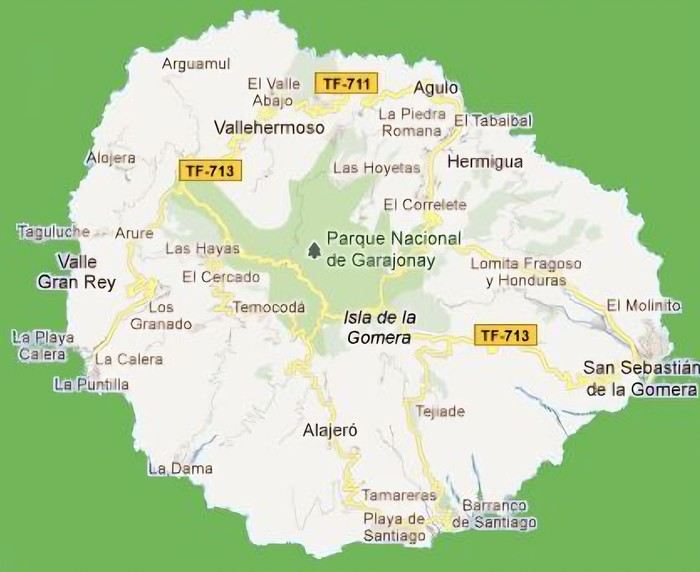 The large solidified magma massifs that shape the heart of the island have created a large depression more protected from the sun at its center, allowing the growth of a vast laurel forest, today grouped within the Garajonay National Park, La Gomera’s green lung, which has earned it the status of a World Biosphere Reserve. Its completely European appearance contrasts sharply with the rocky and tropical landscapes of the rest of the island. Thus, the climate varies greatly from one point to another on the island: in summer, you can quickly go from a dry and sunny valley at 35°C to a humid forest area at altitude at 18°C.
La Gomera was populated late. As with the rest of the Canaries, human presence is thought to have begun about 2,000 years ago. Groups of animist Berbers, probably fleeing persecution, gradually populated the archipelago, especially the western islands and La Gomera, becoming its small aboriginal population: the Guanches (or later Gomeros). The animist and pastoral civilization of the Guanches thrived until the Spanish takeover in the 15th century, which, after a short period of harmony and mixing with the indigenous people, suddenly ended in bloodshed... La Gomera later became the “Columbus Island” after Christopher Columbus’s stopover, increasing the blending of populations. In the 20th century, many Gomeros emigrated to Cuba and other Latin American countries in search of a better life, bringing back a mix of cultures and traits quite palpable in today’s Gomeran culture. It is, however, in La Gomera that the vestiges of Guanche culture seem to have left the most traces, in the language, gastronomy, social practices... Moreover, most Gomeros, especially in remote villages, have a particular identifiable type and proudly claim their ancestral roots, even making La Gomera a bit exotic in the eyes of other Canarians.
Perhaps that’s why it has never really wanted to develop its tourist infrastructure too much. If we set aside the tourists who visit for the day by bus or boat from Tenerife on a marked itinerary (and whom we ultimately rarely encounter), La Gomera has remained a hidden gem, a destination focused on nature discovery that attracts hikers, nature-loving divers, and scientists for its fauna and flora, and to a lesser extent, beachgoers who don’t seek overly developed coastlines. Tourist activity is therefore limited. Roughly speaking, you’ll find a majority of Spaniards, including a substantial number of residents from other Canary Islands, many Germans who have a particular fondness for La Gomera and spend long stays there or own second homes, to the point that the German cultural footprint is clearly noticeable in some places (it’s said to be Angela Merkel’s favorite holiday spot), and still quite a few French. The presence of other nationalities seemed negligible to us. Most travelers come mainly for hiking, but it’s also a prime spot for whale watching. Additionally, the seaside resorts of La Gomera—San Sebastián, Santiago, and especially Valle Gran Rey—are well-known destinations for hippies, especially German ones, ranging from chic boho hippies to old-school hippies who’ve been there for decades, quite similar to those you’d meet in India in Goa, Rishikesh, or Paharganj. Thus, practices like naturism, vegetarianism, and local organic production are quite well established in some areas.
Some practical info: - The round-trip flight from Paris to Tenerife cost us 365 € per person (outbound with Transavia, return with EasyJet), including checked luggage and three seats reserved side by side. - We chose two bases to explore the island: one week in Valle Gran Rey, reputed to be the most pleasant of the three seaside resorts, and one week in Hermigua, more mountainous and close to the natural park. We booked two houses with balconies and views: the first at 120 € per night, the second at 99 €. - The round-trip ferry between Tenerife and La Gomera cost us 270 € with the company Baleària Canarias, including discounts for children aged 4 and 12, but I don’t have the exact details. It was a bit cheaper than with the other company, Fred Olsen. - Finally, we rented a car through the agency Cicar for 360 € for 16 days, which comes to 22.50 € per day. - Apart from that, we didn’t plan anything and decided the day before or even the morning of what we wanted to do. We didn’t invest in any paper guide on the Canaries, as information on La Gomera was scarce, but we used the very comprehensive site La Gomera Travel, a travel guide published by the Canary Islands Tourism Council, a real goldmine of almost exhaustive information on the island.
Alright, off we go for 16 days of adventure discovering La Gomera!
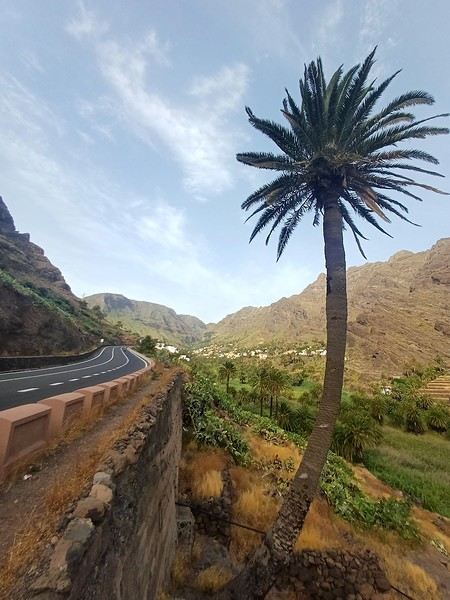
And we start the trip with music!
We start the trip with music!
When we started looking for a summer destination a few months ago, our first criterion was to avoid extreme heat and heatwaves. We had already been to Norway two years ago and are considering going back in the future for other occasions. So, we had some fun asking ChatGPT which destinations enjoyed a mild climate during the summer without going too far. Among the list provided by the AI were the Canary Islands... The idea of a place we wouldn’t have thought of first, both not too far away and exotic enough, appealed to us: “Hmm, why not?”
This destination had never really attracted me, though Magali was a bit more interested. Five years earlier, COVID had caused a short break in my professional activity, and I had planned a trip because the flight price was attractive, and I was looking for a destination different from what usually appeals to me, more than out of deep interest. From a distance and with a social judgment I acknowledge (it’s not great, but it’s not completely wrong), I had the image of a destination for party-goers enjoying the sun without the slightest interest in local culture, with concrete coastlines and denatured landscapes—everything I detest the most. Still, I had done some quick research on the different islands and spotted Lanzarote for its beautiful volcanic landscapes, hiking trails, beaches, and the impression of a good balance between activity and fewer crowds than Tenerife or Gran Canaria. Then I dropped the idea of going, without ever reconsidering traveling to the Canaries...
Until now! Because we started researching the different islands of the archipelago to see which ones might appeal to us the most. It was La Gomera, the third smallest island of the archipelago, more praised for its hiking trails and preserved nature than for its beaches, away from mass tourism (fifty times fewer tourists than Tenerife) but still a bit more developed than its wild neighbor El Hierro, that caught our attention. Contrary to what might be suggested later, I’m not at all addicted to AI, but I use it from time to time to synthesize quick research or simply for experimentation. Since ChatGPT had started anticipating my tastes lately as if it had become my buddy (often successfully, sometimes off the mark), I asked which Canary Island would suit me best for a trip with my family. The tool answered first with... La Gomera. So, I tested it and teased it a bit to see if this suggestion was well-founded, as the method sometimes makes it contradict itself. But no luck: “You’d appreciate the wild nature of El Hierro, but with family, you’ll find little activity for the kids. You won’t like the touristy vibe of the big islands like Tenerife, Gran Canaria, Lanzarote, and Fuerteventura. You could consider La Palma, but it’s really La Gomera that will suit you best, based on your interests and the criteria given.” So, we dug deeper into our research and were convinced without a shadow of a doubt that this island was the one waiting for us.
Without knowing it, we had Canarians in our circle who revealed their origins when they heard about our travel plans. One from Tenerife insisted we’d be better off choosing Tenerife (obviously...) because it also has preserved spots and that La Gomera, “you can explore it in two or three days, you’ll get bored quickly...” The other, a colleague from Gran Canaria who had never visited La Gomera, still recommended it without hesitation because it turned out her parents had just gone there on vacation: they loved it and had encountered few tourists. She also tended to think this destination was usually the subject of short stays, but according to what her parents told her, taking your time there was also a great idea. However, in our research, the idea that La Gomera is an island you can explore in three or four days max kept coming up. So, we considered combining its visit with La Palma or El Hierro, the other two that caught our eye. But hopping between islands by ferry represents a significant budget for non-Canarians, even more so for a family of four. Then, scrutinizing Google Maps, it seemed obvious that two weeks were too short to discover two islands as they deserve, and that there seemed to be plenty to see in La Gomera, given its very unique culture. After all, we read that some people spend several months a year there, others never even leave... Finally, these landscapes and this atmosphere, which seemed to us a mix of Europe, North Africa, and Latin America, tempted us. So, it would be two weeks in La Gomera, deal!
La Gomera is therefore the second... well, the third smallest island of the Canaries since La Graciosa was recently recognized as a fully inhabited island. It has the shape of a rough circle about 20 to 25 kilometers in diameter and has just over 20,000 inhabitants, half of them in its capital, San Sebastián de la Gomera, the only real town. Like its Canarian sisters, La Gomera is a volcanic formation that rose about 10 million years ago. The island is very mountainous and rugged, covered with red and black rocky landscapes. Geological activity has shaped, between the sprawling massifs that end in steep cliffs in the ocean, six coastal valleys with tropical vegetation that have favored human settlement. They divide the island like slices of a cake; from the north clockwise: the agricultural Vallehermoso, the rustic Agulo, the green, humid, and fertile Hermigua, the sunny capital San Sebastián de la Gomera, the southern and isolated Alajeró-Santiago, and the seaside Valle Gran Rey. They constitute the six municipalities (more like cantons to our French understanding) of the territory.
The large solidified magma massifs that shape the heart of the island have created a large depression more protected from the sun at its center, allowing the growth of a vast laurel forest, today grouped within the Garajonay National Park, La Gomera’s green lung, which has earned it the status of a World Biosphere Reserve. Its completely European appearance contrasts sharply with the rocky and tropical landscapes of the rest of the island. Thus, the climate varies greatly from one point to another on the island: in summer, you can quickly go from a dry and sunny valley at 35°C to a humid forest area at altitude at 18°C.La Gomera was populated late. As with the rest of the Canaries, human presence is thought to have begun about 2,000 years ago. Groups of animist Berbers, probably fleeing persecution, gradually populated the archipelago, especially the western islands and La Gomera, becoming its small aboriginal population: the Guanches (or later Gomeros). The animist and pastoral civilization of the Guanches thrived until the Spanish takeover in the 15th century, which, after a short period of harmony and mixing with the indigenous people, suddenly ended in bloodshed... La Gomera later became the “Columbus Island” after Christopher Columbus’s stopover, increasing the blending of populations. In the 20th century, many Gomeros emigrated to Cuba and other Latin American countries in search of a better life, bringing back a mix of cultures and traits quite palpable in today’s Gomeran culture. It is, however, in La Gomera that the vestiges of Guanche culture seem to have left the most traces, in the language, gastronomy, social practices... Moreover, most Gomeros, especially in remote villages, have a particular identifiable type and proudly claim their ancestral roots, even making La Gomera a bit exotic in the eyes of other Canarians.
Perhaps that’s why it has never really wanted to develop its tourist infrastructure too much. If we set aside the tourists who visit for the day by bus or boat from Tenerife on a marked itinerary (and whom we ultimately rarely encounter), La Gomera has remained a hidden gem, a destination focused on nature discovery that attracts hikers, nature-loving divers, and scientists for its fauna and flora, and to a lesser extent, beachgoers who don’t seek overly developed coastlines. Tourist activity is therefore limited. Roughly speaking, you’ll find a majority of Spaniards, including a substantial number of residents from other Canary Islands, many Germans who have a particular fondness for La Gomera and spend long stays there or own second homes, to the point that the German cultural footprint is clearly noticeable in some places (it’s said to be Angela Merkel’s favorite holiday spot), and still quite a few French. The presence of other nationalities seemed negligible to us. Most travelers come mainly for hiking, but it’s also a prime spot for whale watching. Additionally, the seaside resorts of La Gomera—San Sebastián, Santiago, and especially Valle Gran Rey—are well-known destinations for hippies, especially German ones, ranging from chic boho hippies to old-school hippies who’ve been there for decades, quite similar to those you’d meet in India in Goa, Rishikesh, or Paharganj. Thus, practices like naturism, vegetarianism, and local organic production are quite well established in some areas.
Some practical info: - The round-trip flight from Paris to Tenerife cost us 365 € per person (outbound with Transavia, return with EasyJet), including checked luggage and three seats reserved side by side. - We chose two bases to explore the island: one week in Valle Gran Rey, reputed to be the most pleasant of the three seaside resorts, and one week in Hermigua, more mountainous and close to the natural park. We booked two houses with balconies and views: the first at 120 € per night, the second at 99 €. - The round-trip ferry between Tenerife and La Gomera cost us 270 € with the company Baleària Canarias, including discounts for children aged 4 and 12, but I don’t have the exact details. It was a bit cheaper than with the other company, Fred Olsen. - Finally, we rented a car through the agency Cicar for 360 € for 16 days, which comes to 22.50 € per day. - Apart from that, we didn’t plan anything and decided the day before or even the morning of what we wanted to do. We didn’t invest in any paper guide on the Canaries, as information on La Gomera was scarce, but we used the very comprehensive site La Gomera Travel, a travel guide published by the Canary Islands Tourism Council, a real goldmine of almost exhaustive information on the island.
Alright, off we go for 16 days of adventure discovering La Gomera!
And we start the trip with music!
We start the trip with music!
Are there any effects from the war in Iran in Greece?
Hi there!
We bought our tickets to Greece at the end of November 2025, and let’s just say the geopolitical climate has really taken a turn since then with the war started by the United States against Iran. Not to mention all the other conflicts happening around the world 😕... Anyway!
Our flight from Montreal is on May 1st, and I was wondering how things are currently being experienced in Greece.
We were planning to rent a car and had already booked accommodations on three Cyclades islands!!
The oil shortage is also worrying us...
If you could share some insights on this, that would be great!
Thanks!!
Thanks!!
Crossing the border from 4000 Islands (Laos) to Cambodia and ongoing conflict
Hi,
I’m arriving soon in southern Laos and the 4000 Islands, with plans to head to Cambodia next.
The latest news I got this morning (Paksé, La Boulange) isn’t great—the Cambodian border is also in a latent conflict with Laos for the same reasons as with Thailand...
So, what’s the best site to check for updates on the border opening? Since the situation isn’t stable right now and could change from one day to the next?
Thanks for your input.
So, what’s the best site to check for updates on the border opening? Since the situation isn’t stable right now and could change from one day to the next?
Thanks for your input.
Tahiti - Croisière aux Iles Marquises et Huahine English translation pending
Bonjour tout le monde
Je viens partager avec vous le magnifique voyage que nous avons fait en Polynésie Française du 3 au 23 Novembre 2019
Depuis de très nombreuses années nous avions envie d’aller en Polynésie Française, mais le nombre d’heures de voyage pour y arriver ainsi que le décalage horaire nous rebutait un peu, voir beaucoup. L’an passé nous avons fait 18 heures de voyage ça c’est très bien passé, alors pourquoi pas aller en Polynésie.
Des personnes rencontrées au cours de nos différents voyages, nous parlaient d’une croisière qu’ils avaient faite aux Iles Marquises sur un cargo mixte L’Aranui et qu’ils en étaient revenus enchantés. Une croisière sur ce bateau nous tentait bien. Régulièrement on reparlait de ce voyage, donc courant 2018 je ressors donc les guides, me renseigne sur le trajet du bateau, sa durée, etc.. Nous aimerions aussi passer 4 nuits et 3 jours pleins à Papeete pour nous remettre du voyage, du décallage horaire, visiter l’île tranquillement, ensuite nous ferions la croisière aux Iles Marquises et finirions par 2 nuits et une journée complète à Huahine. Yapuka à articuler tout ça.
Début Octobre 2018 je me renseigne auprès de Voyageurs du Monde pour avoir un devis. nous pensions faire ce voyage en Septembre 2019 mais il n’y avait plus de place dans la catégorie de cabine que je voulais, ce sera donc pour début Novembre 2019. Bon nous allons casser la tirelire, mais c’est maintenant où jamais.
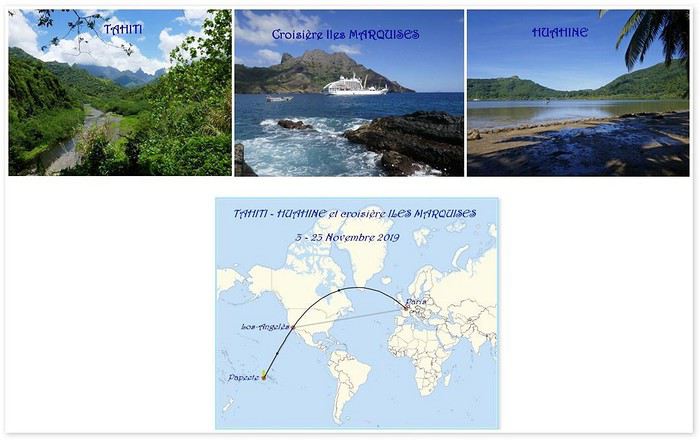 Voilà notre trajet
Paris – Papeete (Tahiti) Iles de la Société Papeete Vallée de la Papenoo Tour de l’ile Embarquement sur l’Aranui Fakarava Iles des Tuamotu En mer Hiva Oa – Tahuata Iles Marquises Fatu Hiva (Omoa-Hananave) Hiva Oa – (Tahuata (plage) Ua Huka (Vaipaee – Hokatu) Nuku-Hiva Ua Pou En mer Rangiroa Iles Tuamotu Bora-Bora Iles de la Société Papeete – Huahine Huahine Huhaine – Papeete Papeete - Paris
Pour plus de photos c'est ici.
à suivre
Je viens partager avec vous le magnifique voyage que nous avons fait en Polynésie Française du 3 au 23 Novembre 2019
Depuis de très nombreuses années nous avions envie d’aller en Polynésie Française, mais le nombre d’heures de voyage pour y arriver ainsi que le décalage horaire nous rebutait un peu, voir beaucoup. L’an passé nous avons fait 18 heures de voyage ça c’est très bien passé, alors pourquoi pas aller en Polynésie.
Des personnes rencontrées au cours de nos différents voyages, nous parlaient d’une croisière qu’ils avaient faite aux Iles Marquises sur un cargo mixte L’Aranui et qu’ils en étaient revenus enchantés. Une croisière sur ce bateau nous tentait bien. Régulièrement on reparlait de ce voyage, donc courant 2018 je ressors donc les guides, me renseigne sur le trajet du bateau, sa durée, etc.. Nous aimerions aussi passer 4 nuits et 3 jours pleins à Papeete pour nous remettre du voyage, du décallage horaire, visiter l’île tranquillement, ensuite nous ferions la croisière aux Iles Marquises et finirions par 2 nuits et une journée complète à Huahine. Yapuka à articuler tout ça.
Début Octobre 2018 je me renseigne auprès de Voyageurs du Monde pour avoir un devis. nous pensions faire ce voyage en Septembre 2019 mais il n’y avait plus de place dans la catégorie de cabine que je voulais, ce sera donc pour début Novembre 2019. Bon nous allons casser la tirelire, mais c’est maintenant où jamais.
Voilà notre trajetParis – Papeete (Tahiti) Iles de la Société Papeete Vallée de la Papenoo Tour de l’ile Embarquement sur l’Aranui Fakarava Iles des Tuamotu En mer Hiva Oa – Tahuata Iles Marquises Fatu Hiva (Omoa-Hananave) Hiva Oa – (Tahuata (plage) Ua Huka (Vaipaee – Hokatu) Nuku-Hiva Ua Pou En mer Rangiroa Iles Tuamotu Bora-Bora Iles de la Société Papeete – Huahine Huahine Huhaine – Papeete Papeete - Paris
Pour plus de photos c'est ici.
à suivre
Retrait d'argent ou prévoir des euros au Cap Vert English translation pending
On part au Cap Vert sur:
Soa vicente
Soa Nicolau
Sao antao
Maio
Sao felipe
Santiago
Est ce que l on peut retirer de l argent facilement ou faut il prévoir des euros pour le change?Merci
Est ce que l on peut retirer de l argent facilement ou faut il prévoir des euros pour le change?Merci
Vacances en septembre: Crète, Mykonos ou les Canaries? English translation pending
Bonjour à tous! Nous sommes un couple de trentenaires. Nous avons été en Crête en aout l'année dernière. On a adoré!!!
Je voulais y retourner cette année mais mon chéri me dit qu'on pourrait peut être aller ailleurs.
On aime se ballader, aller de plage en plage, découvrir de belles criques, location de voiture et quad. Resto, petit verre, crêpes er glaces le soir. Tout ça pour que vous compreniez ce qu'on cherche.
Les idées sont Mykonos, mais je veux pas me retrouver au milieu des fêtards jours et nuit, quels coins nous conseillez vous?
Ou autre ile de Grèce!!
Sinon les canaries, Tenerife ou Lanzarote?
Merci de vos bons conseils!!!😉
Pass inter-îles en Nouvelle-Calédonie English translation pending
Bonjour ,
Je suis en préparation de notre voyage mais j'aurai besoin d'aides pour visiter les iles .Nous partons de métropole pour Tahiti vers le 20 janvier 2019 , nous resterions sur place une dizaine de jours puis nous aimerions partir pour la Nelle calédonie ( j'ai trouvé un billet AR le 2 février 2019 avec un retour le 23 février 2019. nous envisageons de faire le tour sur la grande terre durant une dizaine de jours et le reste consacré aux iles de la loyauté.
Qui pourrait nous aider à établir un circuit pour la grande terre avec des pensions de familles où autres types d'hébergements puis nous aider pour un pass iles ( Lifou, Ouvéa , Maré, et Iles des pins ) hébergements , excursions .
Est il aisé de faire des réservations par internet ? merci de votre aide à tous
Février en Indonésie (saison des pluies): une mauvaise idée? English translation pending
Bonjour,
J'aimerais beaucoup voyager en Indonésie cette hiver pendant 4 semaines au mois de février ou encore mars.... Mais je constate que cette période est identifié comme la PIRE au niveau de la température (saison des pluies). Nous ne savons pas encore exactement où nous souhaitons aller, par contre, Bali, Lombook, Ile de Komodo, Java nous intéresse (vu la proximité) . Les activités qui nous intéresse le plus sont la plongée sous-marine, les plages, la fête (quelques fois), la nature.les temples peut être un volcan.
Y'a t-il d'autre voyageurs qui sont aller dans cette période et qui pourrait nous en dire plus par rapport a la température??
Merci!!!!
Christina C.
J'aimerais beaucoup voyager en Indonésie cette hiver pendant 4 semaines au mois de février ou encore mars.... Mais je constate que cette période est identifié comme la PIRE au niveau de la température (saison des pluies). Nous ne savons pas encore exactement où nous souhaitons aller, par contre, Bali, Lombook, Ile de Komodo, Java nous intéresse (vu la proximité) . Les activités qui nous intéresse le plus sont la plongée sous-marine, les plages, la fête (quelques fois), la nature.les temples peut être un volcan.
Y'a t-il d'autre voyageurs qui sont aller dans cette période et qui pourrait nous en dire plus par rapport a la température??
Merci!!!!
Christina C.
8-Day Trip to the Marquesas Islands from Papeete
This trip is a more budget-friendly—and shorter—alternative to the 14-day Aranui 5 cruise, which includes a few days at sea and a detour to Bora Bora in the Leeward Islands on the way back. The advantage of the cruise is that it lets you see and visit (though far too quickly) the two islands of Tahuata and Fatu Hiva, which don’t have airports. By plane, you’ll only be able to land on 4 of the 6 islands. However, Tahuata is accessible from Hiva Oa via a day trip (or two-day trip) shuttle. Plan for two extra days in your total time dedicated to the Marquesas Islands (called *Fenua Enata* in Marquesan language).
Our itinerary is perfect for those who aren’t excited by cruises and prefer to get closer to the local communities. This 9-day trip cost us around 2500 € all-inclusive. For a 14-day cruise on the Aranui, expect to pay 2300 € per person for a basic cabin for four, or 3800 € per person for a superior double cabin.
Air Tahiti offers a 4-island Marquesas Pass (Nuku Hiva, Ua Pou, Ua Huka, and Hiva Oa) for 86,000 XPF (about 700 €). The journey is made on an ATR 72 from Tahiti to Nuku Hiva or Hiva Oa, and on a 19-seat Twin Otter between the islands (often only 13 or 15 seats are available due to cargo, so book well in advance). We’re traveling as a couple. We booked our family-run guesthouse stays at the Tourism Fair in early February, where you can meet the owners and make your choice. Stays are almost always half-board or breakfast-only. Transfers are usually included, but you can always book a car or taxi.
**NUKU HIVA**
**A LITTLE GEOGRAPHY** Nuku Hiva (NH) is located about 1,500 km from Tahiti, in the north of French Polynesia. At 387 km², it’s the second-largest island in French Polynesia after Tahiti. It was formed by incredible volcanic phenomena and cataclysms between 1 and 6 million years ago, which lifted the island thousands of meters above the sea. Even after millennia of slow erosion, collapses, and settling, NH remains the most majestic of the Marquesas, with its sheer cliffs, deep valleys featuring immense waterfalls, and black walls that were once the inner walls of enormous volcanoes.
**A LITTLE HISTORY** The first contact between NH’s inhabitants and Europeans was in 1595 with Spanish navigators who only stayed briefly. It wasn’t until the late 18th century that Europeans arrived in greater numbers on NH (and the other Marquesas Islands), disrupting a very fragile social and cultural balance. It’s believed that nearly 100,000 people lived on Nuku Hiva at that time—a population decimated over the decades by epidemics, diseases brought by Europeans, and alcohol used for barter. The disastrous result: by the 1930s, only 2,500 people remained, having largely lost their identity and living in poverty. Today, the island has about 2,600 inhabitants spread across several villages, with Taiohae as the main one.
**NUKU HIVA IN LITERATURE**
1 / One of the famous writers who visited NH and stayed there was Herman Melville, who arrived in July 1842, the author of *Moby Dick*. The island had just come under French protectorate. Seduced by the enchanting *vahinés* and dazzled by his paradisiacal vision of the place, Melville deserted his ship. He ended up a prisoner of a local tribe, the Taipi, in Taipivai, where he stayed for a month and a half until an Australian ship captain secured his release in exchange for a musket and a roll of cotton fabric! Melville wrote a novel about this tumultuous episode in his life, considered a classic of travel literature. The book, *Typee: A Peep at Polynesian Life*, published in 1846 in the United States, was a huge success.
2 / Another famous Scottish writer, Robert Louis Stevenson, arrived in NH aboard a yacht that anchored in Anaho Bay, the island’s most beautiful, in July 1888. Stevenson was already known for two magnificent novels that marked their era: *Treasure Island* and *Dr. Jekyll & Mr. Hyde*. Stevenson, too, was captivated by the island’s natural beauty, though he also noted the devastating decline in identity, socio-cultural life, and physical health of a population ravaged by disease and alcohol. His account of his stay, *In the South Seas: An Account of Experiences and Observations in the Marquesas, Paumotus, and Gilbert Islands During Two Cruises on the Yacht Casco (1888) and the Schooner Equator (1889)*, was published in 1896 in New York, four years after his death in Apia, Western Samoa, where he had settled. It was also published in London in 1900.
3 / In August 1903, Victor Segalen, a French naval doctor, ethnologist, and archaeologist, landed in NH from the ship *La Durance*, sent to Polynesia to recover the possessions of the painter Paul Gauguin, who had died in April of that year. He, too, was enthralled by the Marquesas but lamented the loss of identity, dignity, and pride of the Māori, alienated by a Christianization that destroyed their culture and customs, denied their gods, and erased their past. He wrote about his experience, doubts, and fears in *Les Immémoriaux*.
4 / In December 1907, Jack London arrived in NH aboard the sailboat *Stark*, following in the footsteps of his illustrious predecessor, Herman Melville. London was in poor physical condition, exhausted from his relentless travels that had taken him from the Klondike in Canada to Japan, Australia, and London in Europe. He was appalled and shocked by Nuku Hiva’s degraded health situation: where Melville had encountered over 2,000 vigorous and healthy Marquesan warriors, London found only 12 suffering from various diseases—the rest had been wiped out by tuberculosis! His approach remained humanistic, and he maintained a sharp geopolitical awareness of these traditional Polynesian cultures, weakened by the inexorable advance of modernity in the early 20th century. He continued his journey to the Tuamotu Islands and Tahiti, publishing *Martin Eden*, the moving account of his initiatory voyage in the South Pacific, in 1911.
5 / Finally, Alain Gerbault, a writer, linguist, ethnologist, and tireless traveler, arrived in the Marquesas via the Panama Canal in December 1933. He was completely exhausted after an endless crossing on a small sailboat, the *Firecrest*. Enthralled by his stay in the Marquesas, he continued to the Tuamotu Islands in 1934, then Tahiti in 1935. Gerbault fought for the preservation of traditions, as well as the songs and dances banned by the Churches and the French Administration (these bans lasted over 50 years, mind you...!!!). Bora Bora remained his favorite island. A staunch Pétainist during World War II, he was forced to flee Bora Bora for Samoa, then Tonga, and finally Timor, a half-Portuguese island and thus neutral during the war. His travel accounts, *In Pursuit of the Sun: Logbook from New York to Tahiti* and *A Paradise Is Dying*, were published in the late 1940s. He died in Timor in 1941, and his ashes were repatriated to Bora Bora.
Back to our trip and stay.
**Day 1: April 27**
Departure from Papeete at 6:30 AM—we had to wake up two hours earlier and reach the airport in the dark. Takeoff at dawn, good weather en route, flight duration: 4 hours.
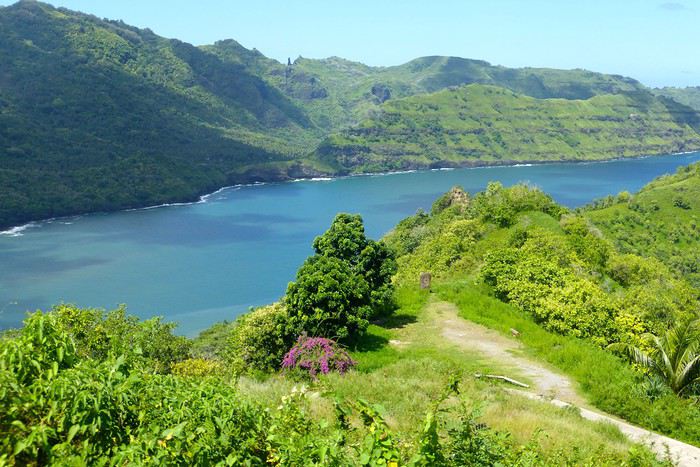
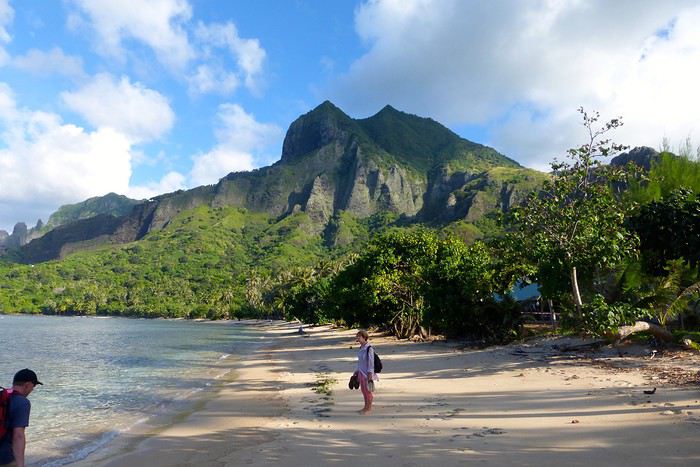
Arrival around 10:30 AM in Nuku Hiva, the first stop of this trip. We booked two nights in half-board at Pension Koku’u, transfers included. Maybe not such a great idea, those included transfers, especially on this unique island where the airport is located on *Terre Déserte*, on the other side of the mountain, opposite and about 45 km from the main village of Taiohae. They’re charged at a steep price. Expect 6,000 XPF round-trip by taxi, but 15,000 XPF charged by guesthouses or hotels. The difference is notable. It wasn’t the best idea, but we can’t go back. Even for residents like us who know how to travel in Polynesia, the Air Tahiti employee who sold me the Pass couldn’t give any useful advice about the stay itself—probably because he’d never been to the Marquesas. It’s really annoying! In short, the good idea to remember is renting a car (like a Suzuki) to be free to manage your time and stop at leisure. The road signage is a bit basic, but you’ll manage just fine. Our host Alvane waits for us—without a sign (sic!)—and after searching for each other for 5 minutes, we’re off on a journey of over an hour (with photo stops) in a Land Rover with smooth tires (luckily, it’s not raining!). The recently paved and marked mountain road is impeccable. No time to catch our breath at the guesthouse; we leave immediately (not a great idea after waking up at dawn plus 4 hours on a plane) for a half-day hike that was also included in the prepaid stay. A sandwich was provided (really pathetic for the physical effort required), we have water, and we fill a few bottles at the spring near the ceremonial site of Taipivai, our first stop. Then the hike begins in the Hanaheu Valley, descending toward Anaho Bay and its namesake beach. A magnificent and wild spot, a few sailboats anchored, we swim—the water is really warm, over 30°C at the shore. That warm is rare and not necessarily pleasant. We then have to climb a very steep slope; this hike is actually quite tough. The air is still, humid, and stifling under the foliage, there’s a bit of mud, and tiny ants (which don’t bite, I’ll have you know), locally called *fofolles*, running over shoes, ankles, and calves. Not very pleasant...! On top of that, there are mosquitoes to protect against! In hindsight, it seems wise to bring energy bars from Papeete if you plan to hike on the afternoon of your arrival day. We weren’t careful... Result: a moment of weakness for me and a hyperventilation attack climbing back up from Anaho Bay!!! We return to the guesthouse at night. There we find Claudine and her four children—Marquesan-style atmosphere, friendly and casual. We share family life. Very simple room with a bathroom, no mosquitoes, we can sleep with the window open, but the night will be noisy, as is often the case in Polynesia. Roosters are everywhere and don’t sleep, dogs bark or whine. So we end up waking up early... like everyone else.
**Day 2: April 28**
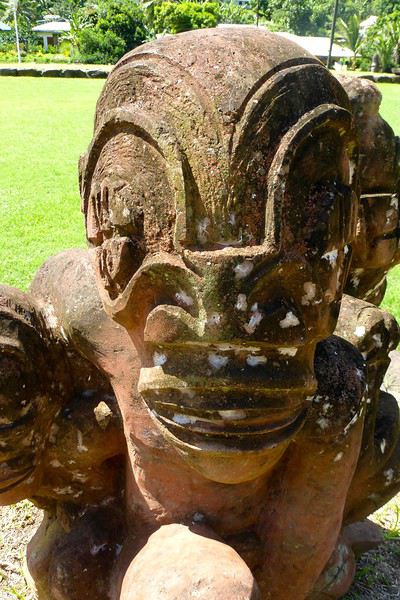
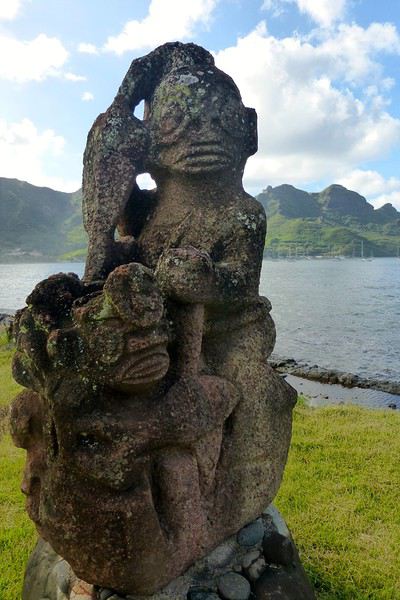
We booked a full-day excursion with Thierry: it starts with a 45-minute boat ride to reach Hakatea Beach, hidden in a small secret bay like many along Nuku Hiva’s coasts. From there, the hike lasts all day—11 km round-trip on flat but also rugged terrain (ancient paved and elevated paths over 1,000 years old)—and river crossings. Bring the right shoes (like plastic Crocs with high socks—not very stylish but practical). We cross the former village of Hakaui, walk along the foundations of dwellings, and there are still weathered tikis in the lush vegetation. The ultimate goal of this hike is to reach the tall Vaipo waterfall. The place is magical, with openings in the vegetation and immense trees allowing photos of the treetops and caves where funeral canoes containing the bones of chiefs or great warriors were once placed. We return the same way to the beach and take another boat ride to reach Taihoae’s port. Back at the guesthouse after a glimpse of Taihoae’s waterfront.
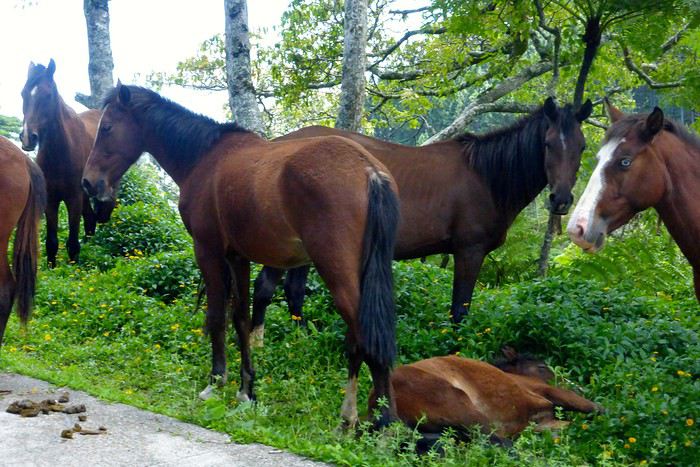
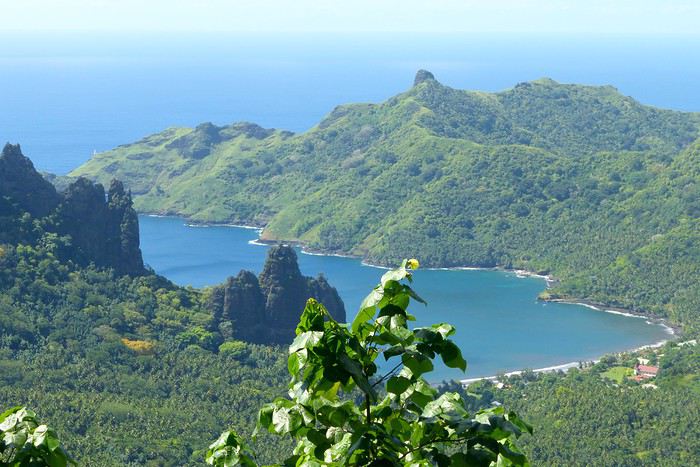
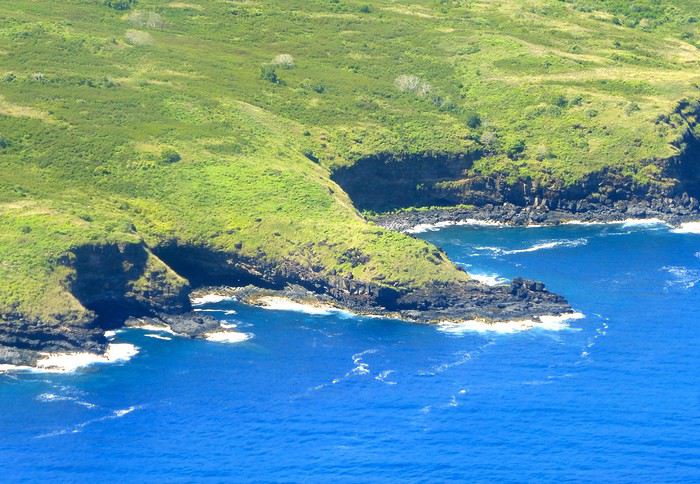
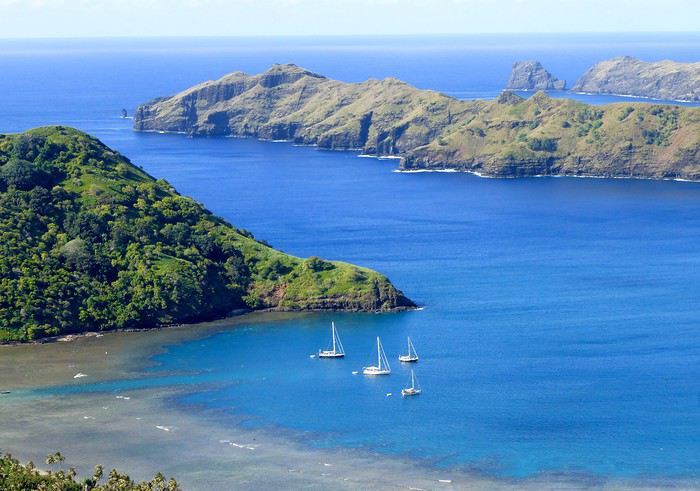
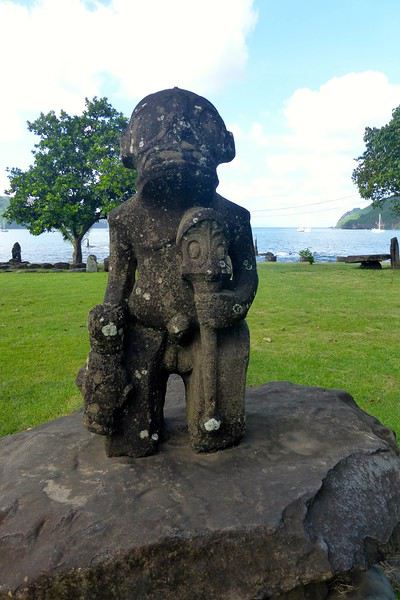
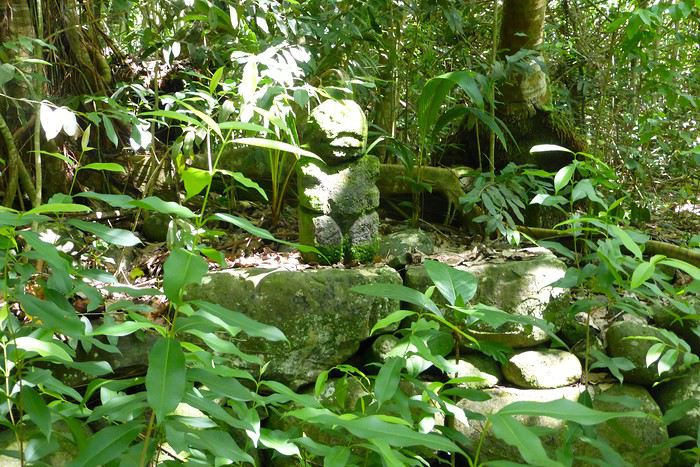
**UA POU**
**Day 3: April 29**
Back to the airport in the late morning for the second flight of the trip to Ua Pou. 20-minute crossing in a Twin Otter (18 seats but only 13 occupied due to cargo between the islands). Beautiful weather, blue sea, nice photos to take upon departure from NH and arrival in UP. We’re greeted by Jérôme, a former military man turned tourism professional, who runs Pension Pukue’e with his wife Elisa, a native of UP. We’re in for two exceptional days. The guesthouse is comfortable, Jérôme and Elisa are very professional and pleasant. Jérôme is also a professional hiker, and Elisa is an excellent cook. We leave quickly for a half-day excursion to Hohoi, after a stop at the archaeological, cultural, and religious site of Maui’a, the Tavaka tribe’s territory. Jérôme is there to explain how Marquesan society functioned at the time and the events that took place on a site still largely buried under vegetation. Then we visit a flower-stone sculptor he knows—the only place in the Marquesas where you’ll find these stones. They’re collected in the river flowing into the sea at Hohoi, sometimes on the beach itself. Back to the guesthouse.
**Day 4: April 30**
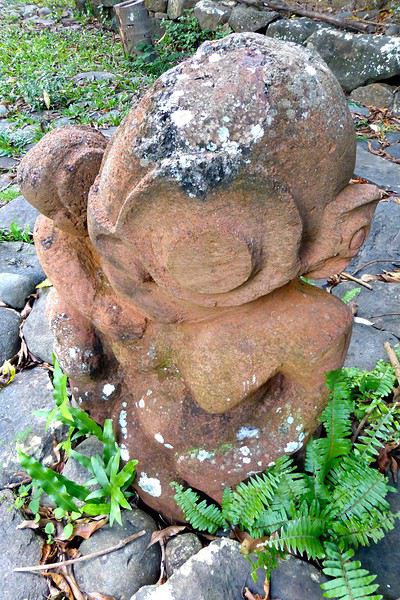
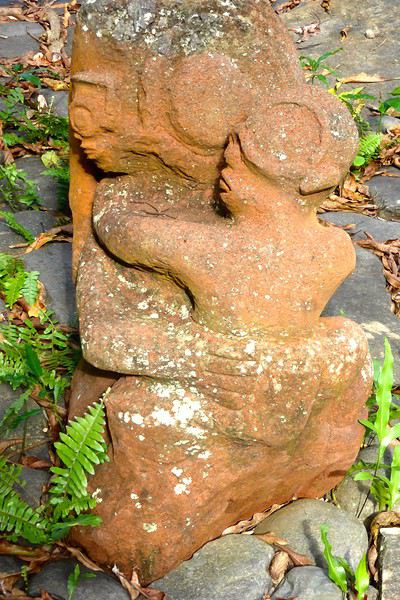
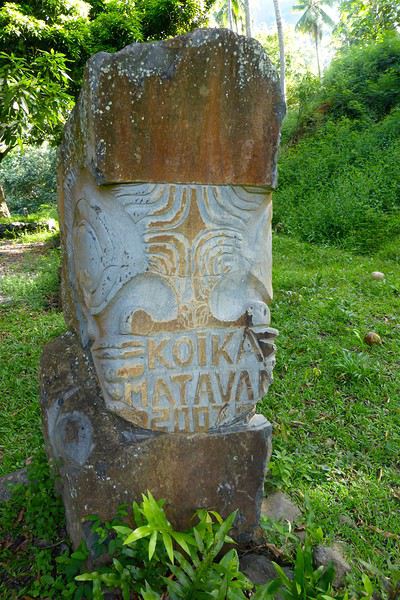
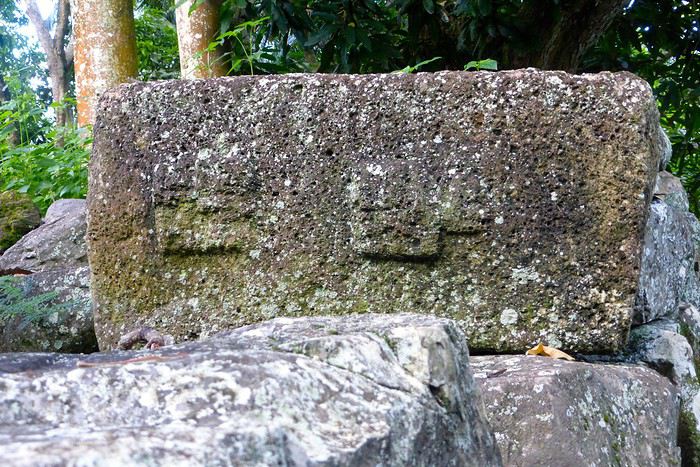
A nature hike in the mountains—moderately difficult—toward the Vaiea waterfall is on our program for a good 4 hours. It’s hot, there are mosquitoes, and the dip in the pool under the waterfall (24°C water) is a rare pleasure. Lunch at a friend of Jérôme’s, a former chef for French minister François Fillon, who prepares delicious food. Elisa picks us up by car to return to the guesthouse. Ua Pou is a beautiful and elegant island with its sharp peaks and wild nature. Our favorite, thanks to Jérôme and his wife.
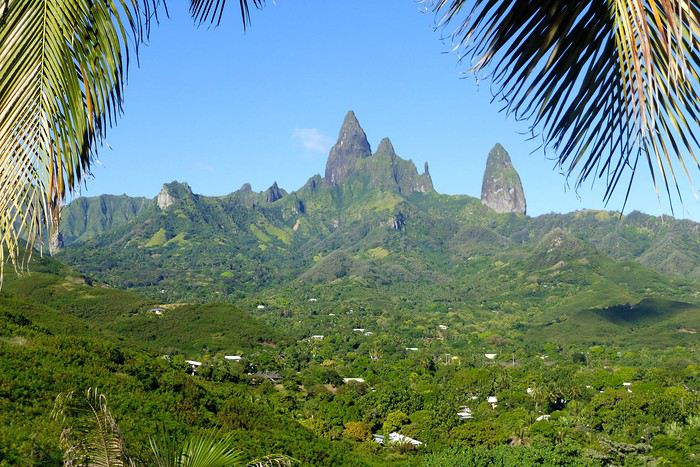
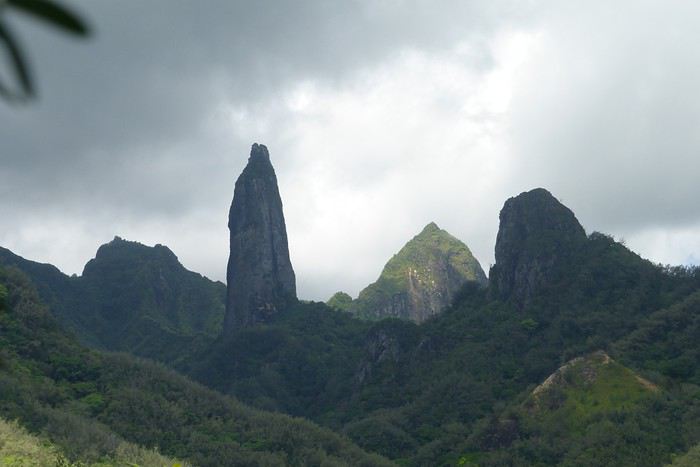
**UA HUKA**
**Day 4: May 1**
Departure for Ua Huka, the smallest inhabited island in the northern group of the Marquesas, located about 1,300 km northeast of Tahiti. Landing is at the oldest airfield in the Marquesas, built in 1972, between the villages of Vaipaee and Hane. Ua Huka has about 680 inhabitants, according to the last census, spread across 3 villages (since the 1870s): Vaipaee, Hane, and Hokatu. The island peaks at Mount Hitikau at only 884 meters. Its origin: a Hawaiian-type shield volcano that—over a few million years—collapsed to become a caldera (or elliptical depression) in which two small volcanoes appeared, the craters of Tahoatikiau and Teepoepo, now part of the Vaikivi Park. The island is rugged and wild, lower than the others, so less cloud-covered and drier. The bays are jagged, the coastline in ochre tones above the intense blue of the sea, and the beaches are constantly disturbed by the powerful surf. The village of Hokatu is only a few kilometers away (just 14 km of road on the island), but Maurice, our host, drives slowly, and it takes time to go up and down. The road is entirely paved or concreted, which isn’t the case on Ua Pou, for example. The guesthouse is disappointing, perched above the village and thus isolated. Beautiful view of the famous Hane motu and the sparkling sea under the bright sun. Apart from that, there are mosquitoes and cockroaches, the bungalow isn’t clean. Meals are taken with Maurice and Delphine in the village—fine dining isn’t on the menu! Ouch!!! We didn’t luck out...
**Day 5: May 2**
Early in the morning, after breakfast, Delphine takes us to the craft center, which turns out to be a letdown—the items for sale are, in my opinion, crude and poorly carved. Nothing like what’s offered at the Marquesas Fair, held twice a year in Papeete, where you can admire and buy small wonders: wood carvings, flower stone, and coral. Delphine is disappointed we’re not interested, and it shows... She’s a bit sulky! These are items meant for Aranui cruise passengers who land on Ua Huka once every two weeks... Solo travelers like us don’t seem to interest her much. The rest of the day—spent with Maurice—is dedicated to visiting cultural centers and small museums, like the Sea Museum in Hane with its ancient canoes, the municipal archaeological museum on the Te Tumu site above the airfield, the petroglyph house near Hokatu Beach, and finally the Papuakeikaraa arboretum, which gathers endemic plants from all over Polynesia and an impressive citrus collection. No excursion planned to Vaikivi Park, toward the previously mentioned craters that recall the island’s volcanic past. Also missing are the viewpoints, the unique endemic vegetation, and especially the petroglyphs. Too bad... at that price!!! Still, in the evening, we go fishing—with sandwiches and drinks in coolers—with other villagers from the dock at the end of the paved road. It’s cool, windy, no mosquitoes, lots of fish caught, and a great atmosphere. Plus, magnificently starry skies.
Ua Huka is one of the rare islands not invaded by the black rat, which has preserved its birdlife, particularly the ultramarine lorikeet (or *pihiti* in Marquesan), which feeds almost exclusively on flower nectar (banana, coconut, hibiscus, mango, guava trees). A dog imported from New Zealand has been specially trained to detect rats: it inspects cargo unloaded from boats and the docks.
I recommend spending two full days on the island—one for visiting the various museums, the other for hiking in the island’s center park, where the archaeological sites are in their raw state: foundations of agricultural terrace walls, gathering places (or *tohua*), dwelling pavements (or *paepae*), sacred sites (or *me’ae* in Marquesan, *marae* in Tahitian) with their tikis and petroglyphs.
To finish, a bit of info on the island’s name, tied to Marquesan oral culture: according to the legend of the creation of the six Marquesas Islands, Ua Huka is the one that puts the finishing touch on the construction of the god Oatea’s house, each island having a defined architectural function. Ua Huka represents the hole (*ua*) where the god deposits what’s left (*huka* in Marquesan) of the unused materials during construction.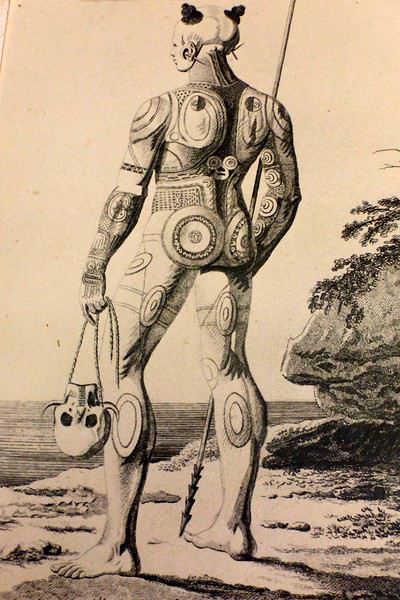
**HIVA OA**
**Day 6: May 3**
Departure in the late morning for Hiva Oa. Maurice—who had other things to do—dropped us off at the airfield 3 hours early... so this stop is a bit of a flop, even if we decided to stay positive! Hiva Oa is the third-largest island in French Polynesia after Tahiti and Nuku Hiva, and before Raiatea in the Leeward Islands. The island is beautiful, lush, verdant, and jagged. The mountains soar into the sky, the sea views are grand, the light is sublime—we’re lucky. Beautiful weather. Tania from Pension Kanahau waits for us at the airport. We’re in for two wonderful days with her. Tania is welcoming, smiling, and dynamic. What a pleasure to be with her, at her place—she cooks divinely and serves the best tuna in the world (the Big Eye reserved for the Japanese) and croquettes made with lobster, shrimp, and crab with breadfruit cubes, for example. Comfortable bungalow, no mosquitoes at night, we can sleep with the window open. It’s fantastic! After settling in, Tania takes us to town in Atuona, a pleasant and well-laid-out little village. We start with lunch—a delicious raw fish in coconut milk—then continue with the must-see attractions: the Catholic cemetery where Paul Gauguin and Jacques Brel’s graves are, overlooking the town; the abandoned Protestant cemetery, reclaimed by the bush, with impressive Marquesan warrior tombs made of huge coral slabs and adorned with a tiki head (harder to find, as no one goes there... ask for directions!); the craft center; the Gauguin Museum (and the Jacques Brel Museum); and the waterfront. While we stroll peacefully, Tania organizes an excursion for the next day, May 4, a full day with Pifa O’Connor, a 36-year-old who knows his island inside out, is passionate about local history, and with whom we’ll hit it off.
**Day 7: May 4**
Pifa arrives at 8 AM sharp at the guesthouse, and we immediately buy sandwiches and water at a small supermarket in Atuona. First, we make a brief stop by the roadside at an unmarked spot, from which we descend a small path through dense vegetation leading to the famous smiling tiki—the only one of its kind in the Marquesas and Polynesia. The place is improbable, the tiki isn’t huge, but it’s beautiful and impressive. Then we’re off on the road that, dizzyingly, runs along and overlooks the island’s northern coast, at the edge of the ancient volcano. Few vehicles pass, the road—now a rocky track—is full of potholes, and we proceed slowly. (Note that this road has been fully paved since 2018.) The panoramas are majestic, with every shade of green against the blue sea. We stop again at the top of a cliff adorned with a huge stone, the *sacrifice stone*, from which young virgin girls were once thrown into the sea to appease angry gods. Another pause for lunch this time, at a small restaurant near the exceptional archaeological site of Puamau. We’ll experience the highlights of this trip during this excursion with our guide, Pifa, who spares no explanations. We discover, on a vast esplanade, the ceremonial complexes of Ta’a Oa and Meae Te I’Ipona, the latter featuring superb tikis, particularly the reclining tiki—or *Maki Taua Pepe*—representing Motherhood, a woman giving birth in a squatting position, as was often the case in many civilizations. Also notable is the *Takaii*, the largest tiki recorded in Polynesia to date. There’s also a huge stone with a now-blunt edge, on which the circumcision of chiefs’ and notables’ pre-adolescent sons was performed. A tough ordeal! But that’s not all! It seems there are more on the mountainside rising steeply behind the archaeological site—overturned tikis, platforms, and, apparently, a giant tiki at the top, which must have fallen but was visible from afar on the sea 30 or 40 years ago, according to the island’s elders. This meeting, worship, and living place—it was actually a small town—is immense. Thousands of people once lived in this part of the island. The site—a religious, social, and cultural sanctuary—would be the size of the largest Mayan sites in Yucatán, but the few concerned owners—two or three families who own the mountainside—don’t want to hear about intensive clearing or tree cutting for now. UNESCO rightly asks for some compliance efforts to grant special treatment to Hiva Oa in particular and the Marquesas in general. We’re not there yet, unfortunately, due to insurmountable local rigidities! This kind of attitude is quite typical in Polynesia: people are afraid to uncover *marae* buried under vegetation—they’re taboo and sometimes said to emit negative and deadly waves, so it’s better not to disturb or anger the ancient spirits or gods who might take revenge. The old religion is never far away in Polynesia, despite the successes of the missionaries.
We return to the guesthouse in the late afternoon. Last night in the Marquesas with Tania, who prepares a fine and delicious meal. Note that dinner costs 2,500 XPF per person.
**Day 8: May 5**
We take the plane as planned, via Nuku Hiva (short stopover). Arrival on time in Papeete.
May this travel journal inspire many of you to visit the Marquesas one day. It’s far, it’s expensive, it’s the trip of a lifetime—it’s unforgettable and unmissable.
Our itinerary is perfect for those who aren’t excited by cruises and prefer to get closer to the local communities. This 9-day trip cost us around 2500 € all-inclusive. For a 14-day cruise on the Aranui, expect to pay 2300 € per person for a basic cabin for four, or 3800 € per person for a superior double cabin.
Air Tahiti offers a 4-island Marquesas Pass (Nuku Hiva, Ua Pou, Ua Huka, and Hiva Oa) for 86,000 XPF (about 700 €). The journey is made on an ATR 72 from Tahiti to Nuku Hiva or Hiva Oa, and on a 19-seat Twin Otter between the islands (often only 13 or 15 seats are available due to cargo, so book well in advance). We’re traveling as a couple. We booked our family-run guesthouse stays at the Tourism Fair in early February, where you can meet the owners and make your choice. Stays are almost always half-board or breakfast-only. Transfers are usually included, but you can always book a car or taxi.
**NUKU HIVA**
**A LITTLE GEOGRAPHY** Nuku Hiva (NH) is located about 1,500 km from Tahiti, in the north of French Polynesia. At 387 km², it’s the second-largest island in French Polynesia after Tahiti. It was formed by incredible volcanic phenomena and cataclysms between 1 and 6 million years ago, which lifted the island thousands of meters above the sea. Even after millennia of slow erosion, collapses, and settling, NH remains the most majestic of the Marquesas, with its sheer cliffs, deep valleys featuring immense waterfalls, and black walls that were once the inner walls of enormous volcanoes.
**A LITTLE HISTORY** The first contact between NH’s inhabitants and Europeans was in 1595 with Spanish navigators who only stayed briefly. It wasn’t until the late 18th century that Europeans arrived in greater numbers on NH (and the other Marquesas Islands), disrupting a very fragile social and cultural balance. It’s believed that nearly 100,000 people lived on Nuku Hiva at that time—a population decimated over the decades by epidemics, diseases brought by Europeans, and alcohol used for barter. The disastrous result: by the 1930s, only 2,500 people remained, having largely lost their identity and living in poverty. Today, the island has about 2,600 inhabitants spread across several villages, with Taiohae as the main one.
**NUKU HIVA IN LITERATURE**
1 / One of the famous writers who visited NH and stayed there was Herman Melville, who arrived in July 1842, the author of *Moby Dick*. The island had just come under French protectorate. Seduced by the enchanting *vahinés* and dazzled by his paradisiacal vision of the place, Melville deserted his ship. He ended up a prisoner of a local tribe, the Taipi, in Taipivai, where he stayed for a month and a half until an Australian ship captain secured his release in exchange for a musket and a roll of cotton fabric! Melville wrote a novel about this tumultuous episode in his life, considered a classic of travel literature. The book, *Typee: A Peep at Polynesian Life*, published in 1846 in the United States, was a huge success.
2 / Another famous Scottish writer, Robert Louis Stevenson, arrived in NH aboard a yacht that anchored in Anaho Bay, the island’s most beautiful, in July 1888. Stevenson was already known for two magnificent novels that marked their era: *Treasure Island* and *Dr. Jekyll & Mr. Hyde*. Stevenson, too, was captivated by the island’s natural beauty, though he also noted the devastating decline in identity, socio-cultural life, and physical health of a population ravaged by disease and alcohol. His account of his stay, *In the South Seas: An Account of Experiences and Observations in the Marquesas, Paumotus, and Gilbert Islands During Two Cruises on the Yacht Casco (1888) and the Schooner Equator (1889)*, was published in 1896 in New York, four years after his death in Apia, Western Samoa, where he had settled. It was also published in London in 1900.
3 / In August 1903, Victor Segalen, a French naval doctor, ethnologist, and archaeologist, landed in NH from the ship *La Durance*, sent to Polynesia to recover the possessions of the painter Paul Gauguin, who had died in April of that year. He, too, was enthralled by the Marquesas but lamented the loss of identity, dignity, and pride of the Māori, alienated by a Christianization that destroyed their culture and customs, denied their gods, and erased their past. He wrote about his experience, doubts, and fears in *Les Immémoriaux*.
4 / In December 1907, Jack London arrived in NH aboard the sailboat *Stark*, following in the footsteps of his illustrious predecessor, Herman Melville. London was in poor physical condition, exhausted from his relentless travels that had taken him from the Klondike in Canada to Japan, Australia, and London in Europe. He was appalled and shocked by Nuku Hiva’s degraded health situation: where Melville had encountered over 2,000 vigorous and healthy Marquesan warriors, London found only 12 suffering from various diseases—the rest had been wiped out by tuberculosis! His approach remained humanistic, and he maintained a sharp geopolitical awareness of these traditional Polynesian cultures, weakened by the inexorable advance of modernity in the early 20th century. He continued his journey to the Tuamotu Islands and Tahiti, publishing *Martin Eden*, the moving account of his initiatory voyage in the South Pacific, in 1911.
5 / Finally, Alain Gerbault, a writer, linguist, ethnologist, and tireless traveler, arrived in the Marquesas via the Panama Canal in December 1933. He was completely exhausted after an endless crossing on a small sailboat, the *Firecrest*. Enthralled by his stay in the Marquesas, he continued to the Tuamotu Islands in 1934, then Tahiti in 1935. Gerbault fought for the preservation of traditions, as well as the songs and dances banned by the Churches and the French Administration (these bans lasted over 50 years, mind you...!!!). Bora Bora remained his favorite island. A staunch Pétainist during World War II, he was forced to flee Bora Bora for Samoa, then Tonga, and finally Timor, a half-Portuguese island and thus neutral during the war. His travel accounts, *In Pursuit of the Sun: Logbook from New York to Tahiti* and *A Paradise Is Dying*, were published in the late 1940s. He died in Timor in 1941, and his ashes were repatriated to Bora Bora.
Back to our trip and stay.
**Day 1: April 27**
Departure from Papeete at 6:30 AM—we had to wake up two hours earlier and reach the airport in the dark. Takeoff at dawn, good weather en route, flight duration: 4 hours.
Arrival around 10:30 AM in Nuku Hiva, the first stop of this trip. We booked two nights in half-board at Pension Koku’u, transfers included. Maybe not such a great idea, those included transfers, especially on this unique island where the airport is located on *Terre Déserte*, on the other side of the mountain, opposite and about 45 km from the main village of Taiohae. They’re charged at a steep price. Expect 6,000 XPF round-trip by taxi, but 15,000 XPF charged by guesthouses or hotels. The difference is notable. It wasn’t the best idea, but we can’t go back. Even for residents like us who know how to travel in Polynesia, the Air Tahiti employee who sold me the Pass couldn’t give any useful advice about the stay itself—probably because he’d never been to the Marquesas. It’s really annoying! In short, the good idea to remember is renting a car (like a Suzuki) to be free to manage your time and stop at leisure. The road signage is a bit basic, but you’ll manage just fine. Our host Alvane waits for us—without a sign (sic!)—and after searching for each other for 5 minutes, we’re off on a journey of over an hour (with photo stops) in a Land Rover with smooth tires (luckily, it’s not raining!). The recently paved and marked mountain road is impeccable. No time to catch our breath at the guesthouse; we leave immediately (not a great idea after waking up at dawn plus 4 hours on a plane) for a half-day hike that was also included in the prepaid stay. A sandwich was provided (really pathetic for the physical effort required), we have water, and we fill a few bottles at the spring near the ceremonial site of Taipivai, our first stop. Then the hike begins in the Hanaheu Valley, descending toward Anaho Bay and its namesake beach. A magnificent and wild spot, a few sailboats anchored, we swim—the water is really warm, over 30°C at the shore. That warm is rare and not necessarily pleasant. We then have to climb a very steep slope; this hike is actually quite tough. The air is still, humid, and stifling under the foliage, there’s a bit of mud, and tiny ants (which don’t bite, I’ll have you know), locally called *fofolles*, running over shoes, ankles, and calves. Not very pleasant...! On top of that, there are mosquitoes to protect against! In hindsight, it seems wise to bring energy bars from Papeete if you plan to hike on the afternoon of your arrival day. We weren’t careful... Result: a moment of weakness for me and a hyperventilation attack climbing back up from Anaho Bay!!! We return to the guesthouse at night. There we find Claudine and her four children—Marquesan-style atmosphere, friendly and casual. We share family life. Very simple room with a bathroom, no mosquitoes, we can sleep with the window open, but the night will be noisy, as is often the case in Polynesia. Roosters are everywhere and don’t sleep, dogs bark or whine. So we end up waking up early... like everyone else.
**Day 2: April 28**
We booked a full-day excursion with Thierry: it starts with a 45-minute boat ride to reach Hakatea Beach, hidden in a small secret bay like many along Nuku Hiva’s coasts. From there, the hike lasts all day—11 km round-trip on flat but also rugged terrain (ancient paved and elevated paths over 1,000 years old)—and river crossings. Bring the right shoes (like plastic Crocs with high socks—not very stylish but practical). We cross the former village of Hakaui, walk along the foundations of dwellings, and there are still weathered tikis in the lush vegetation. The ultimate goal of this hike is to reach the tall Vaipo waterfall. The place is magical, with openings in the vegetation and immense trees allowing photos of the treetops and caves where funeral canoes containing the bones of chiefs or great warriors were once placed. We return the same way to the beach and take another boat ride to reach Taihoae’s port. Back at the guesthouse after a glimpse of Taihoae’s waterfront.
**UA POU**
**Day 3: April 29**
Back to the airport in the late morning for the second flight of the trip to Ua Pou. 20-minute crossing in a Twin Otter (18 seats but only 13 occupied due to cargo between the islands). Beautiful weather, blue sea, nice photos to take upon departure from NH and arrival in UP. We’re greeted by Jérôme, a former military man turned tourism professional, who runs Pension Pukue’e with his wife Elisa, a native of UP. We’re in for two exceptional days. The guesthouse is comfortable, Jérôme and Elisa are very professional and pleasant. Jérôme is also a professional hiker, and Elisa is an excellent cook. We leave quickly for a half-day excursion to Hohoi, after a stop at the archaeological, cultural, and religious site of Maui’a, the Tavaka tribe’s territory. Jérôme is there to explain how Marquesan society functioned at the time and the events that took place on a site still largely buried under vegetation. Then we visit a flower-stone sculptor he knows—the only place in the Marquesas where you’ll find these stones. They’re collected in the river flowing into the sea at Hohoi, sometimes on the beach itself. Back to the guesthouse.
**Day 4: April 30**
A nature hike in the mountains—moderately difficult—toward the Vaiea waterfall is on our program for a good 4 hours. It’s hot, there are mosquitoes, and the dip in the pool under the waterfall (24°C water) is a rare pleasure. Lunch at a friend of Jérôme’s, a former chef for French minister François Fillon, who prepares delicious food. Elisa picks us up by car to return to the guesthouse. Ua Pou is a beautiful and elegant island with its sharp peaks and wild nature. Our favorite, thanks to Jérôme and his wife.
**UA HUKA**
**Day 4: May 1**
Departure for Ua Huka, the smallest inhabited island in the northern group of the Marquesas, located about 1,300 km northeast of Tahiti. Landing is at the oldest airfield in the Marquesas, built in 1972, between the villages of Vaipaee and Hane. Ua Huka has about 680 inhabitants, according to the last census, spread across 3 villages (since the 1870s): Vaipaee, Hane, and Hokatu. The island peaks at Mount Hitikau at only 884 meters. Its origin: a Hawaiian-type shield volcano that—over a few million years—collapsed to become a caldera (or elliptical depression) in which two small volcanoes appeared, the craters of Tahoatikiau and Teepoepo, now part of the Vaikivi Park. The island is rugged and wild, lower than the others, so less cloud-covered and drier. The bays are jagged, the coastline in ochre tones above the intense blue of the sea, and the beaches are constantly disturbed by the powerful surf. The village of Hokatu is only a few kilometers away (just 14 km of road on the island), but Maurice, our host, drives slowly, and it takes time to go up and down. The road is entirely paved or concreted, which isn’t the case on Ua Pou, for example. The guesthouse is disappointing, perched above the village and thus isolated. Beautiful view of the famous Hane motu and the sparkling sea under the bright sun. Apart from that, there are mosquitoes and cockroaches, the bungalow isn’t clean. Meals are taken with Maurice and Delphine in the village—fine dining isn’t on the menu! Ouch!!! We didn’t luck out...
**Day 5: May 2**
Early in the morning, after breakfast, Delphine takes us to the craft center, which turns out to be a letdown—the items for sale are, in my opinion, crude and poorly carved. Nothing like what’s offered at the Marquesas Fair, held twice a year in Papeete, where you can admire and buy small wonders: wood carvings, flower stone, and coral. Delphine is disappointed we’re not interested, and it shows... She’s a bit sulky! These are items meant for Aranui cruise passengers who land on Ua Huka once every two weeks... Solo travelers like us don’t seem to interest her much. The rest of the day—spent with Maurice—is dedicated to visiting cultural centers and small museums, like the Sea Museum in Hane with its ancient canoes, the municipal archaeological museum on the Te Tumu site above the airfield, the petroglyph house near Hokatu Beach, and finally the Papuakeikaraa arboretum, which gathers endemic plants from all over Polynesia and an impressive citrus collection. No excursion planned to Vaikivi Park, toward the previously mentioned craters that recall the island’s volcanic past. Also missing are the viewpoints, the unique endemic vegetation, and especially the petroglyphs. Too bad... at that price!!! Still, in the evening, we go fishing—with sandwiches and drinks in coolers—with other villagers from the dock at the end of the paved road. It’s cool, windy, no mosquitoes, lots of fish caught, and a great atmosphere. Plus, magnificently starry skies.
Ua Huka is one of the rare islands not invaded by the black rat, which has preserved its birdlife, particularly the ultramarine lorikeet (or *pihiti* in Marquesan), which feeds almost exclusively on flower nectar (banana, coconut, hibiscus, mango, guava trees). A dog imported from New Zealand has been specially trained to detect rats: it inspects cargo unloaded from boats and the docks.
I recommend spending two full days on the island—one for visiting the various museums, the other for hiking in the island’s center park, where the archaeological sites are in their raw state: foundations of agricultural terrace walls, gathering places (or *tohua*), dwelling pavements (or *paepae*), sacred sites (or *me’ae* in Marquesan, *marae* in Tahitian) with their tikis and petroglyphs.
To finish, a bit of info on the island’s name, tied to Marquesan oral culture: according to the legend of the creation of the six Marquesas Islands, Ua Huka is the one that puts the finishing touch on the construction of the god Oatea’s house, each island having a defined architectural function. Ua Huka represents the hole (*ua*) where the god deposits what’s left (*huka* in Marquesan) of the unused materials during construction.
**HIVA OA**
**Day 6: May 3**
Departure in the late morning for Hiva Oa. Maurice—who had other things to do—dropped us off at the airfield 3 hours early... so this stop is a bit of a flop, even if we decided to stay positive! Hiva Oa is the third-largest island in French Polynesia after Tahiti and Nuku Hiva, and before Raiatea in the Leeward Islands. The island is beautiful, lush, verdant, and jagged. The mountains soar into the sky, the sea views are grand, the light is sublime—we’re lucky. Beautiful weather. Tania from Pension Kanahau waits for us at the airport. We’re in for two wonderful days with her. Tania is welcoming, smiling, and dynamic. What a pleasure to be with her, at her place—she cooks divinely and serves the best tuna in the world (the Big Eye reserved for the Japanese) and croquettes made with lobster, shrimp, and crab with breadfruit cubes, for example. Comfortable bungalow, no mosquitoes at night, we can sleep with the window open. It’s fantastic! After settling in, Tania takes us to town in Atuona, a pleasant and well-laid-out little village. We start with lunch—a delicious raw fish in coconut milk—then continue with the must-see attractions: the Catholic cemetery where Paul Gauguin and Jacques Brel’s graves are, overlooking the town; the abandoned Protestant cemetery, reclaimed by the bush, with impressive Marquesan warrior tombs made of huge coral slabs and adorned with a tiki head (harder to find, as no one goes there... ask for directions!); the craft center; the Gauguin Museum (and the Jacques Brel Museum); and the waterfront. While we stroll peacefully, Tania organizes an excursion for the next day, May 4, a full day with Pifa O’Connor, a 36-year-old who knows his island inside out, is passionate about local history, and with whom we’ll hit it off.
**Day 7: May 4**
Pifa arrives at 8 AM sharp at the guesthouse, and we immediately buy sandwiches and water at a small supermarket in Atuona. First, we make a brief stop by the roadside at an unmarked spot, from which we descend a small path through dense vegetation leading to the famous smiling tiki—the only one of its kind in the Marquesas and Polynesia. The place is improbable, the tiki isn’t huge, but it’s beautiful and impressive. Then we’re off on the road that, dizzyingly, runs along and overlooks the island’s northern coast, at the edge of the ancient volcano. Few vehicles pass, the road—now a rocky track—is full of potholes, and we proceed slowly. (Note that this road has been fully paved since 2018.) The panoramas are majestic, with every shade of green against the blue sea. We stop again at the top of a cliff adorned with a huge stone, the *sacrifice stone*, from which young virgin girls were once thrown into the sea to appease angry gods. Another pause for lunch this time, at a small restaurant near the exceptional archaeological site of Puamau. We’ll experience the highlights of this trip during this excursion with our guide, Pifa, who spares no explanations. We discover, on a vast esplanade, the ceremonial complexes of Ta’a Oa and Meae Te I’Ipona, the latter featuring superb tikis, particularly the reclining tiki—or *Maki Taua Pepe*—representing Motherhood, a woman giving birth in a squatting position, as was often the case in many civilizations. Also notable is the *Takaii*, the largest tiki recorded in Polynesia to date. There’s also a huge stone with a now-blunt edge, on which the circumcision of chiefs’ and notables’ pre-adolescent sons was performed. A tough ordeal! But that’s not all! It seems there are more on the mountainside rising steeply behind the archaeological site—overturned tikis, platforms, and, apparently, a giant tiki at the top, which must have fallen but was visible from afar on the sea 30 or 40 years ago, according to the island’s elders. This meeting, worship, and living place—it was actually a small town—is immense. Thousands of people once lived in this part of the island. The site—a religious, social, and cultural sanctuary—would be the size of the largest Mayan sites in Yucatán, but the few concerned owners—two or three families who own the mountainside—don’t want to hear about intensive clearing or tree cutting for now. UNESCO rightly asks for some compliance efforts to grant special treatment to Hiva Oa in particular and the Marquesas in general. We’re not there yet, unfortunately, due to insurmountable local rigidities! This kind of attitude is quite typical in Polynesia: people are afraid to uncover *marae* buried under vegetation—they’re taboo and sometimes said to emit negative and deadly waves, so it’s better not to disturb or anger the ancient spirits or gods who might take revenge. The old religion is never far away in Polynesia, despite the successes of the missionaries.
We return to the guesthouse in the late afternoon. Last night in the Marquesas with Tania, who prepares a fine and delicious meal. Note that dinner costs 2,500 XPF per person.
**Day 8: May 5**
We take the plane as planned, via Nuku Hiva (short stopover). Arrival on time in Papeete.
May this travel journal inspire many of you to visit the Marquesas one day. It’s far, it’s expensive, it’s the trip of a lifetime—it’s unforgettable and unmissable.
Voyage en Polynésie Française English translation pending
Bonjour,
Nous voudrions partir mi-août ( 15j )pour la Polynésie française en couple avec un enfant de 10 ans
Nous ne savons pas vraiment à qui nous fier : agence? Tour op?local?
Le but de notre voyage :
Découvrir les îles principales et la faune ( baleines, raies.......)
Nous sommes conscient que il est déjà tard pour réserver ..!!
Existe t il un plan sur et raisonnable en budget?
Merci d avance pour vos infos
Le Soléal du Ponant aux îles sub-antarctiques néo-zélandaises (Macquarie exclue) English translation pending
Bonjour à Tous,
Avant d'entrer un peu en détail , et pour ceux que cela pourrait intéresser, dans un récit forcément limité de ce voyage , il me semble important de reprendre, ici, un chapitre de la traduction française d'un livre tout à fait remarquable écrit par un des plus grand connaisseur de cette région Néo-Zélandaise : Monsieur Neville Peat , présent comme conférencier anglophone à bord du Soléal et pour les voyageurs Anglophones. La traduction française à titre de plaisir , de l'intégralité du livre original a été effectué par un passager Parisien - Monsieur H.T-, également présent à bord mais comme passager payant , et ce n'est que la veille de l'arrivée à Milford Sound , dans les brumes en quittant le Dusky fjord que les Commandants Daumesnil et Garcia en ont été informés , de l'existence de cette traduction par un passager, de sa présence comme passager à bord, et qui en définitive en connaissait bien plus sur toutes ces Iles que quiconque de francophone à bord –dont les « Naturalistes » puisque aucune n’ayant jamais posé un pied sur ces iles Merci Henri T. pour ton remarquable travail de bénévole . Merci aussi d'autoriser la diffusion de ton texte de traduction et libre de droits d'auteurs . Cette lecture attentive permet de se rendre compte que cette croisière était bien loin d'être une croisière "comme une autre" , bien loin d' être une croisière d'exploration ou de découverte, comme le Ponant nous offre régulièrement dans toutes ses autres destinations Découvertes & Explorations- et que beaucoup d'entre Nous apprécient à leur juste valeur (Antarctique, Géorgie du sud , Tchoukotka, Kamchatka, Kurils etc ..) Il me parait important de souligner ici et dès à présent , la difficulté de la tâche rencontrée par la Commandant Daumesnil de devoir "concilier" quasi à chaque escale , ces innombrables contraintes, limitations, interdictions, imposés (dont aussi l'interdiction de s'approcher à moins de 600 mètres des côtes, interdiction de mettre un zodiac passager à l'eau sans présence d'un surveillant -contrôleur- agréé) avec les attentes ou souhaits de passagers habitués aux "libertés" des croisières Explorations du Ponant sur toutes ses autres destinations A titre personnel je tiens à lui rendre , ici, un vibrant et particulier hommage. Quant aux "naturalistes" francophones à bord … oublions ...et passons à un autre sujet !
En décembre 1988, les premières croisières depuis la Nouvelle Zélande ont été inaugurées par les vingt passagers du voilier Tradewind, opérant depuis Bluff et Dunedin. Aujourd'hui, d'autres navires font jusqu'à dix visites par saison dans la région et le tour des archipels Auckland et Campbell comprend parfois également celui de l'île Macquarie. Le tourisme subantarctique, qui offre une expérience du domaine de l'écotourisme est spécifiquement réservé aux navires de croisière de petite ou de moyenne dimension. Quelques yachts privés à moteur apportent également des visiteurs. Beaucoup de gens voulant se rendre dans ces îles, toutes ces visites comportent des risques et des impacts potentiels, qu’elles soient à des fins de gestion, de recherche scientifique, d’information ou touristiques. Des règles strictes sont applicables à tous les types de visiteurs. Une approche précautionneuse est essentielle. Les multiples risques encourus par la faune et la flore autochtones, l'histoire des incursions et de leurs impacts négatifs et la nature unique des îles comparée à celle de tout autre endroit terrestre sont tous des facteurs qui justifient les directives de prudence. Lorsque le tourisme est concerné, les règles qui régissent les secteurs où les visiteurs peuvent ou ne peuvent pas aller, et le nombre de personnes qui sont autorisées à pénétrer ensemble sur le site, sont basées sur une évaluation de sa vulnérabilité et sur d'autres facteurs. Les sites où les touristes sont autorisés à débarquer sont classés "grand" ou "petit" en fonction du nombre de visiteurs qu'ils peuvent gérer. Il n’y a que trois "grands" sites – l’île Enderby, le site historique de la colonie / cimetière d’Enderby dans les îles Auckland, et le site de la promenade du col entre Point Beeman et Col. Lyall, sur l'île Campbell. Trois à quatre heures sont nécessaires pour le trajet aller et retour sur la promenade de l'île Campbell, et une durée similaire est nécessaire pour explorer l'île Enderby. Quelques autres endroits - les "petits" sites plus vulnérables - ont été identifiés dans les îles Auckland et Campbell. Ce sont Northwest Bay sur celle-ci et deux stations historiques de garde-côtes de l'île Auckland. Un code d’impact minimum fourni aux visiteurs avant le débarquement énonce ce qu’ils peuvent ou ne peuvent pas faire. Les visiteurs sont priés de ne pas sortir des pistes tracées pour les promenades afin de limiter la dégradation des sols fragiles et des plantes. Toute la faune a un droit prioritaire de passage et ne doit pas être perturbée. Une marge de sécurité de cinq mètres s’applique lorsqu’on désire observer les lions de mer, les otaries, les éléphants de mer, les manchots, les albatros et autres oiseaux. Le code rappelle aux visiteurs que la perturbation des oiseaux nicheurs peut conduire à la perte de leurs œufs en les exposant à la prédation des labbes bruns qui saisissent la moindre opportunité. Il faut un guide par groupe de vingt passagers et il est interdit de se promener seul. Chaque navire embarque un représentant du Ministère de la Conservation, chargé de prodiguer ses conseils et de superviser les activités.
Suite plus tard

En décembre 1988, les premières croisières depuis la Nouvelle Zélande ont été inaugurées par les vingt passagers du voilier Tradewind, opérant depuis Bluff et Dunedin. Aujourd'hui, d'autres navires font jusqu'à dix visites par saison dans la région et le tour des archipels Auckland et Campbell comprend parfois également celui de l'île Macquarie. Le tourisme subantarctique, qui offre une expérience du domaine de l'écotourisme est spécifiquement réservé aux navires de croisière de petite ou de moyenne dimension. Quelques yachts privés à moteur apportent également des visiteurs. Beaucoup de gens voulant se rendre dans ces îles, toutes ces visites comportent des risques et des impacts potentiels, qu’elles soient à des fins de gestion, de recherche scientifique, d’information ou touristiques. Des règles strictes sont applicables à tous les types de visiteurs. Une approche précautionneuse est essentielle. Les multiples risques encourus par la faune et la flore autochtones, l'histoire des incursions et de leurs impacts négatifs et la nature unique des îles comparée à celle de tout autre endroit terrestre sont tous des facteurs qui justifient les directives de prudence. Lorsque le tourisme est concerné, les règles qui régissent les secteurs où les visiteurs peuvent ou ne peuvent pas aller, et le nombre de personnes qui sont autorisées à pénétrer ensemble sur le site, sont basées sur une évaluation de sa vulnérabilité et sur d'autres facteurs. Les sites où les touristes sont autorisés à débarquer sont classés "grand" ou "petit" en fonction du nombre de visiteurs qu'ils peuvent gérer. Il n’y a que trois "grands" sites – l’île Enderby, le site historique de la colonie / cimetière d’Enderby dans les îles Auckland, et le site de la promenade du col entre Point Beeman et Col. Lyall, sur l'île Campbell. Trois à quatre heures sont nécessaires pour le trajet aller et retour sur la promenade de l'île Campbell, et une durée similaire est nécessaire pour explorer l'île Enderby. Quelques autres endroits - les "petits" sites plus vulnérables - ont été identifiés dans les îles Auckland et Campbell. Ce sont Northwest Bay sur celle-ci et deux stations historiques de garde-côtes de l'île Auckland. Un code d’impact minimum fourni aux visiteurs avant le débarquement énonce ce qu’ils peuvent ou ne peuvent pas faire. Les visiteurs sont priés de ne pas sortir des pistes tracées pour les promenades afin de limiter la dégradation des sols fragiles et des plantes. Toute la faune a un droit prioritaire de passage et ne doit pas être perturbée. Une marge de sécurité de cinq mètres s’applique lorsqu’on désire observer les lions de mer, les otaries, les éléphants de mer, les manchots, les albatros et autres oiseaux. Le code rappelle aux visiteurs que la perturbation des oiseaux nicheurs peut conduire à la perte de leurs œufs en les exposant à la prédation des labbes bruns qui saisissent la moindre opportunité. Il faut un guide par groupe de vingt passagers et il est interdit de se promener seul. Chaque navire embarque un représentant du Ministère de la Conservation, chargé de prodiguer ses conseils et de superviser les activités.
Suite plus tard
Majorque ou Gran Canaria? English translation pending
Bonsoir tout est dans le titre...Nous avons le choix d'aller à Majorque ou Gran Canaria mi juin.Nous hesitons entre les deux iles.Nous allons louer une voiture dans les deux cas.Ce qu'on souhaite faire:bronzette et visite.Ne pas rester cloué a l'hotel.Quelle ile vaut plus le coup entre les deux?Ne me proposez pas les autres iles des canaries ou baleares car il n'y a que ces deux là qui sont intéressantes niveau prix des billets.Voila...merci des conseils!!
Trinidad: Quellles autres îles et pays à visiter autour? English translation pending
Bonjour à tous je pars 2 mois et demi à Trinidad pour un stage qui durera 2 mois. Pour les 15 jours restants j'aimerais découvrir d'autres îles et pays et je pensais à La Barbade, Costa Rica, Panama, Porto Rico, Cuba ou encore le Venezuela. Le problème c'est que je n'ai aucune idée de comment s'y rendre. Faut il prendre l'avion, le bus? Si quelqu'un a déjà fait l'un de ces pays à partir ou en direction du Trinidad je serais ravie d'avoir votre parcours et plus amples informations.
Merci d'avance :)
Merci d'avance :)