Results for "Brézé+|+127"
2764 results found.
Super Club Breezes Punta Cana English translation pending
Bonjour,
Je m'en vais en voyage à cette hôtel là le 25 janvier 2004 pour 2 semaines. J'aimerais avoir vos commentaires car j'en ai lu bcp de non positif en furetant sur internet.
J'aimerais aussi savoir ce qu'il faut porter pour aller manger dans les resto.. j'ai entendu dire qu'on ne pouvait pas y aller en costume de bain.. que les garçons devaient avoir des pantalons etc... est-ce vrai?
Merci d'avance pour vos messages sur cette endroit ou les villes avoisinantes, les choses à faire ou non...
Nathalie
Je m'en vais en voyage à cette hôtel là le 25 janvier 2004 pour 2 semaines. J'aimerais avoir vos commentaires car j'en ai lu bcp de non positif en furetant sur internet.
J'aimerais aussi savoir ce qu'il faut porter pour aller manger dans les resto.. j'ai entendu dire qu'on ne pouvait pas y aller en costume de bain.. que les garçons devaient avoir des pantalons etc... est-ce vrai?
Merci d'avance pour vos messages sur cette endroit ou les villes avoisinantes, les choses à faire ou non...
Nathalie
Côte atlantique ou caraïbes? English translation pending
salut...
on part cet hiver en RD (voyage de noces) et on ne sait pas trop où aller.
Désolé pour les voyageurs mais sur ce coup là, on va faire les gros touristes et profiter du "all-in"... peut-être une autre fois !
bref, on s'était, jusqu'à ce soir, arrêté sur Punta Cana (paradisus ou secret excellence). Mais à en croire les nombreux messages sur ce forum, ces hôtels restent sur-côtés, trop chers et loin des promesses des brochures. Info ou intox ??? Plus étonnant, un internaute a dit que, le matin, la plage était pleine d'algues... vrai ? Cette région n'est-elle pas un piège à touristes ? 😠 Pourtant, il semble que les chambres (d'après les brochures !) soient plus belles, qu'il y a plus d'activités, des petits plus du genre "séjour prestige".
on a pu voir que bayahibe était moins touristique, et que les deux hôtels "iberostar hacienda dominicus" et "viva dominicus" étaient les plus recommandés. Les brochures les détaillent peu. J'imagine que tous les hôtels proposent les mêmes activités mais la différence semble être dans ce qui est inclus ou pas !!!
on a aussi vu sur le forum que les plages de la région de bayahibe étaient artificielles 😮 ! Non sans déconné c'est vrai ? Pourtant, c'est la mer des caraïbes....
Donc, il y a une heure, on était prêt à partir à punta cana, et maintenant c'est la grosse remise en question.
On sait que la région de punta cana est plus venteuse et que la mer est plus virulente, mais y a-t-il une réelle différence avec bayahibe ?
Punta cana est-il aussi beau que les brochures le montrent ? et bayahibe ?
Si l'on recherche un endroit romantique et calme 😊 pour être tranquille à deux et pouvoir sortir de l'hôtel pour voir quand même un minimum la RD, vaut-il mieux aller à bayahibe "iberostar hacienda dominicus" (ou "viva dominicus") ou à punta cana "paradisus" (ou "secret excellence") ?
merci d'avance.
on part cet hiver en RD (voyage de noces) et on ne sait pas trop où aller.
Désolé pour les voyageurs mais sur ce coup là, on va faire les gros touristes et profiter du "all-in"... peut-être une autre fois !
bref, on s'était, jusqu'à ce soir, arrêté sur Punta Cana (paradisus ou secret excellence). Mais à en croire les nombreux messages sur ce forum, ces hôtels restent sur-côtés, trop chers et loin des promesses des brochures. Info ou intox ??? Plus étonnant, un internaute a dit que, le matin, la plage était pleine d'algues... vrai ? Cette région n'est-elle pas un piège à touristes ? 😠 Pourtant, il semble que les chambres (d'après les brochures !) soient plus belles, qu'il y a plus d'activités, des petits plus du genre "séjour prestige".
on a pu voir que bayahibe était moins touristique, et que les deux hôtels "iberostar hacienda dominicus" et "viva dominicus" étaient les plus recommandés. Les brochures les détaillent peu. J'imagine que tous les hôtels proposent les mêmes activités mais la différence semble être dans ce qui est inclus ou pas !!!
on a aussi vu sur le forum que les plages de la région de bayahibe étaient artificielles 😮 ! Non sans déconné c'est vrai ? Pourtant, c'est la mer des caraïbes....
Donc, il y a une heure, on était prêt à partir à punta cana, et maintenant c'est la grosse remise en question.
On sait que la région de punta cana est plus venteuse et que la mer est plus virulente, mais y a-t-il une réelle différence avec bayahibe ?
Punta cana est-il aussi beau que les brochures le montrent ? et bayahibe ?
Si l'on recherche un endroit romantique et calme 😊 pour être tranquille à deux et pouvoir sortir de l'hôtel pour voir quand même un minimum la RD, vaut-il mieux aller à bayahibe "iberostar hacienda dominicus" (ou "viva dominicus") ou à punta cana "paradisus" (ou "secret excellence") ?
merci d'avance.
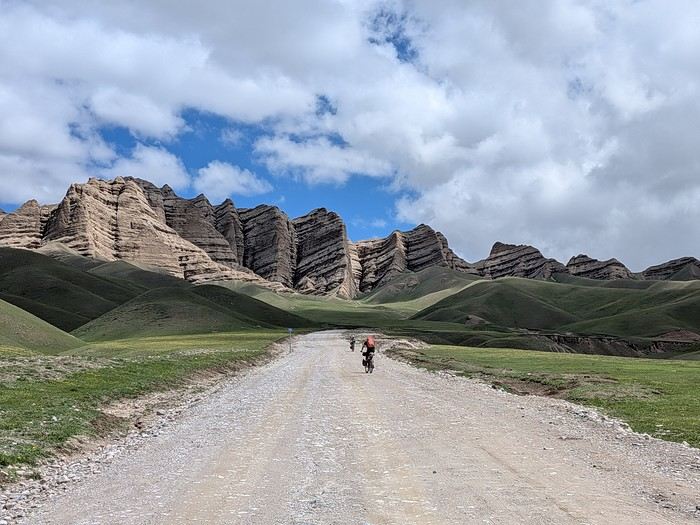
Breathtaking Kyrgyzstan!
This trip had been on my mind for about fifteen years.
But the discomfort of overnight stays, the difficulty of communication, and the prices of the few car rental options kept making me postpone the project.
And then, everything suddenly fell into place—I told myself, it’s time!
The preparations took longer than usual; the destination is still far from mainstream.
A bit of Kazakhstan? Not in the end.
The south or not the south? Yes, in the end.
Pre-book or go with the flow? Only two stops were a leap into the unknown.
To help me find the ideal route, I made great use of this forum (thanks to everyone for patiently answering my questions!), pored over travel journals and blogs (Christian, Jeff), zoomed in on Google Maps and Yandex, and bought the guide published by OunTravela about this destination (the guide has been updated since).
---/---
You’ve got your passport, international driver’s license, bank cards, and euros?
Off we go to Lyon—just one night left before our early morning flight.
Tomorrow night, we’ll be sleeping in Bishkek! (Steak for my partner’s mischievous nephews...)
You’ll find here a post with some practical information.
And here, the version of the travel journal without comments.
---/---
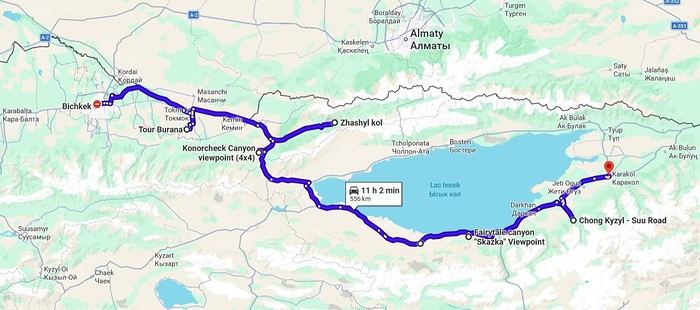
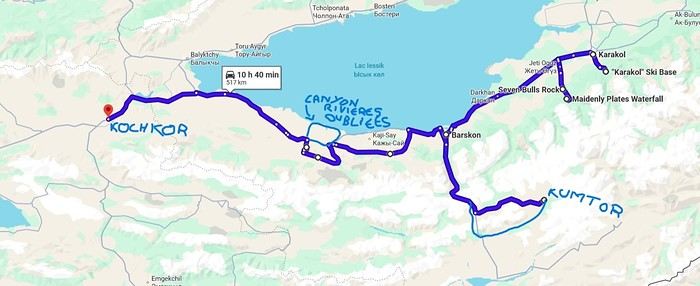
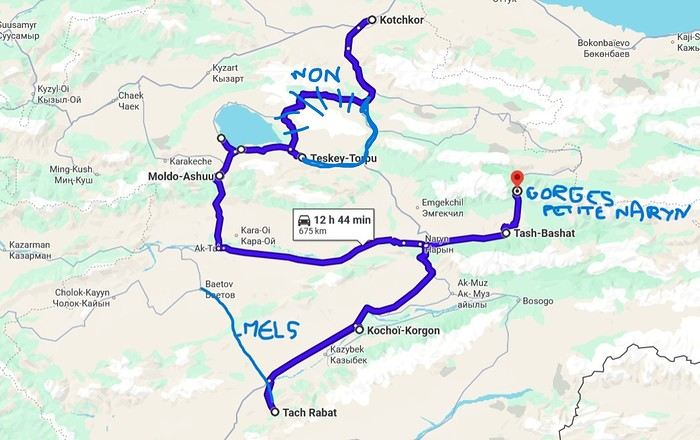
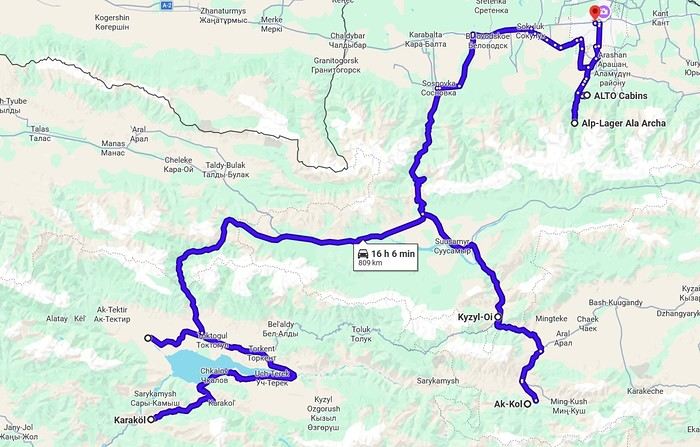
As a supplement, the route track. Not necessarily ultra-accurate since Google has serious gaps for this destination...
From Bishkek to Karakol:
From Karakol to Kochkor:
From Kochkor to Baetov:
From Baetov to Kara-Köl:
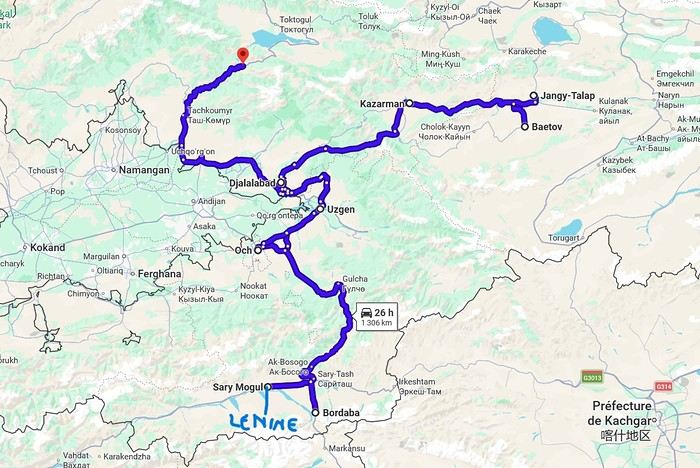
From Kara-Köl to Bishkek:

But the discomfort of overnight stays, the difficulty of communication, and the prices of the few car rental options kept making me postpone the project.
And then, everything suddenly fell into place—I told myself, it’s time!
The preparations took longer than usual; the destination is still far from mainstream.
A bit of Kazakhstan? Not in the end.
The south or not the south? Yes, in the end.
Pre-book or go with the flow? Only two stops were a leap into the unknown.
To help me find the ideal route, I made great use of this forum (thanks to everyone for patiently answering my questions!), pored over travel journals and blogs (Christian, Jeff), zoomed in on Google Maps and Yandex, and bought the guide published by OunTravela about this destination (the guide has been updated since).
---/---
You’ve got your passport, international driver’s license, bank cards, and euros?
Off we go to Lyon—just one night left before our early morning flight.
Tomorrow night, we’ll be sleeping in Bishkek! (Steak for my partner’s mischievous nephews...)
You’ll find here a post with some practical information.
And here, the version of the travel journal without comments.
---/---
As a supplement, the route track. Not necessarily ultra-accurate since Google has serious gaps for this destination...
From Bishkek to Karakol:
From Karakol to Kochkor:
From Kochkor to Baetov:
From Baetov to Kara-Köl:
From Kara-Köl to Bishkek:
Villages around Hazaribagh in West Bengal
Wednesday, April 1st
Hazaribagh I’ve got a meet-up with Adam Iman, a guide and painter. He picks me up from the hotel at 10 AM. Another traveler from Bangalore is supposed to join us, but while we wait for him to arrive, Adam takes me to see the paintings his mother and sister created at Hazaribagh station. The town became famous thanks to these murals, which can also be found in several surrounding villages. This art form has earned recognition and is now protected, a sign of its cultural importance. Once the visit is over, we go to pick up the other traveler and then head to our first village: Belwara, where Sohrai art is practiced. At the entrance, a sign proudly announces that we’re entering an artists’ village, where this art is created by women organized into micro-enterprises. Some even offer workshops for those who’d like to learn this tradition.
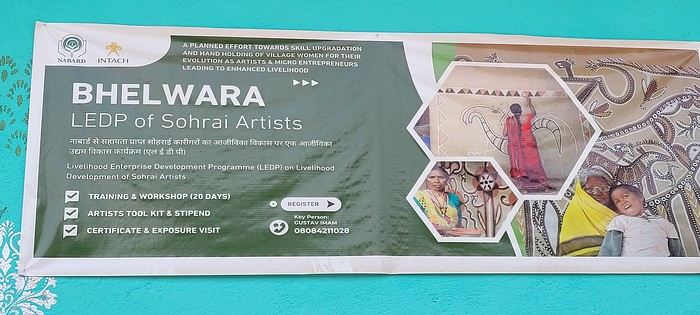
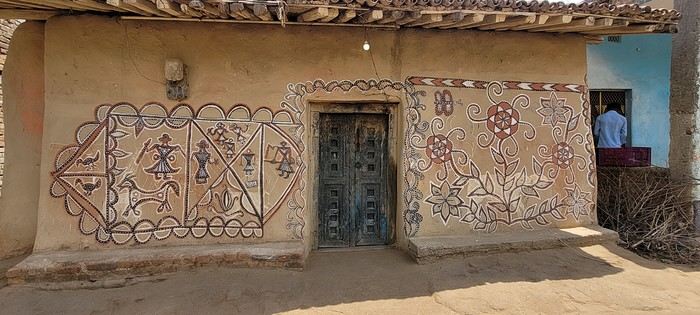
Sohrai art is tied to the harvest season, from October to mid-November. The motifs, in natural colors, celebrate fertility and abundance. The artists use pigments from the earth: red oxides, ochre, white kaolin, and black manganese. On the walls, you’ll see animals, fish, birds—all symbols of life and prosperity. As I look closer at the murals, I start to realize that each motif tells a story. Large animals like cows or bulls often take center stage. Their bodies are filled with intricate, almost hypnotic patterns. They symbolize wealth and prosperity for the household, as well as the deep respect for cattle, which are essential to daily life. On some facades, elephants stand out—massive and decorated with the same precision. They evoke quiet strength and protection. But it’s when I stop in front of one of the houses that I really take the time to look. The wall, a soft ochre, is entirely covered in murals. Two large animals stretch out on either side of the door, their elongated bodies fitting the length of the wall. Their silhouettes are filled with geometric patterns and incredibly fine curved lines, as if every space was patiently filled. Around them, stylized plants, flowers, and small decorative elements fill every gap. The door, dark and worn, becomes almost the silent center of the composition, framed by these living, protective forms. To the right, a more colorful motif catches the eye—a flower or a stylized lamp—like a touch of light on the earth. The whole thing gives an impression of perfect balance, between the rigor of the patterns and the freedom of the gesture.
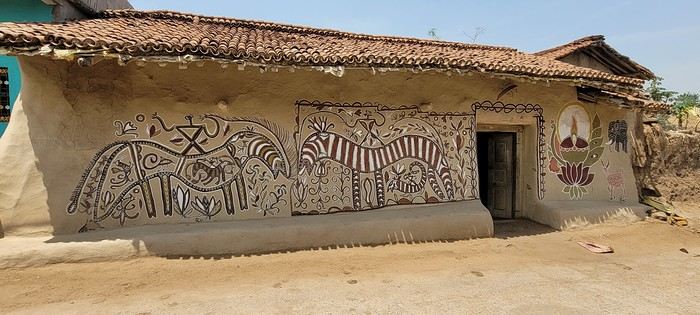
Elsewhere, birds and freer forms bring movement. Peacocks, recognizable by their stylized silhouettes, embody beauty and vitality, while fish symbolize water, fertility, and the continuity of life.
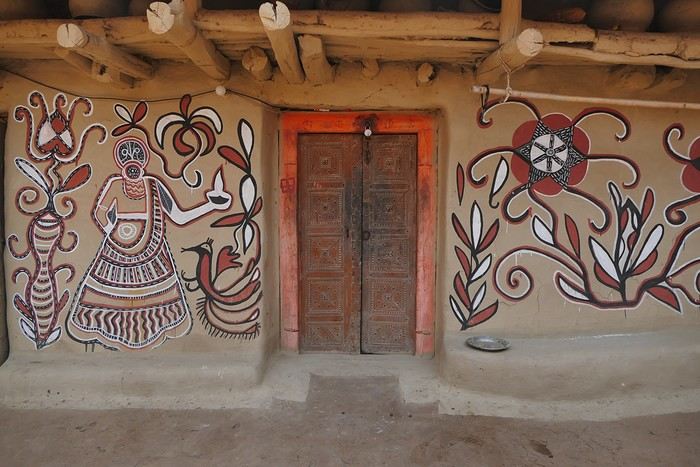
 On some paintings, the scenes become almost narrative: you can make out figures, everyday gestures, like a memory of the village inscribed in the walls. The decorative frames around the doors aren’t left to chance either—they symbolically protect the house, like a boundary between the inside and the outside world.
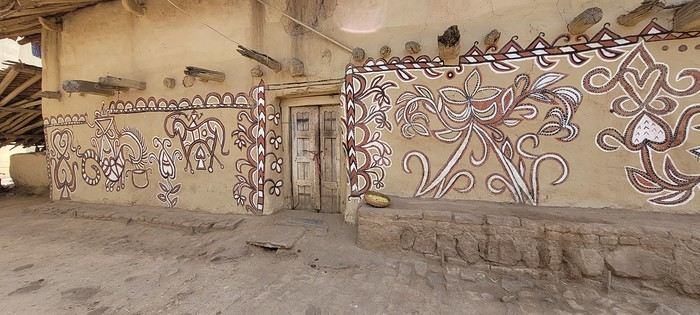
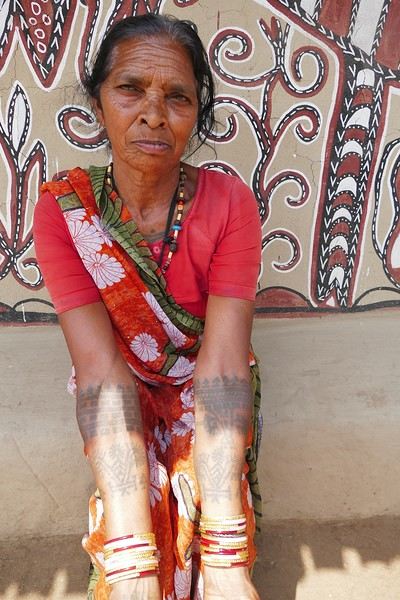
During the Sohrai festival, cattle are led into the jungle in the morning. Meanwhile, the women finish the *aripans*—these floor paintings—and continue the wall murals. Around noon, the animals return to the village, and the bulls’ horns are anointed with oil and vermilion in a gesture of gratitude, amid the vibrant colors adorning the houses. We visit several artists, including Parvat Devi, a well-known woman who has received many awards. Her arms are adorned with intriguing tattoos, which I’ll talk about in more detail later.
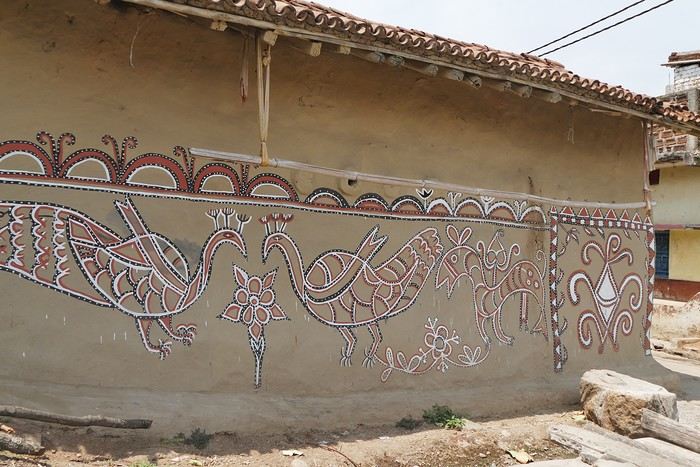
On another wall, the style changes completely. Here, no massive animals—just birds occupying the space, light and graceful, as if caught in mid-movement. Two silhouettes face each other, their long necks arched almost like mirrors, while their outstretched wings seem to vibrate with the patterns that compose them.
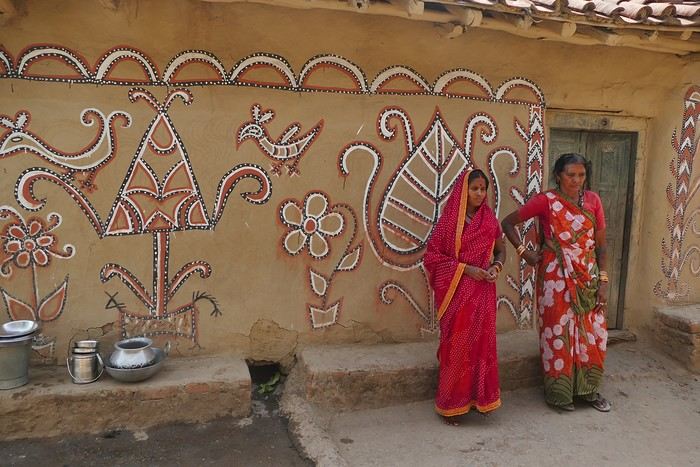
The design is more graphic, almost airy. The lines are smoother, more fluid, as if drawn in one confident stroke. The birds’ bodies aren’t solid—they’re filled with repetitive motifs like scales, stylized feathers, and spirals, giving a sense of continuous movement. Around them, everything comes to life: flowers burst open, arabesques swirl, and even the simplest shapes seem alive. What strikes me here is the sense of lightness. Where the large animals evoked stability and grounding, these birds bring something freer, almost joyful. They seem to embody movement, the circulation of life, like a breath flowing through the village.
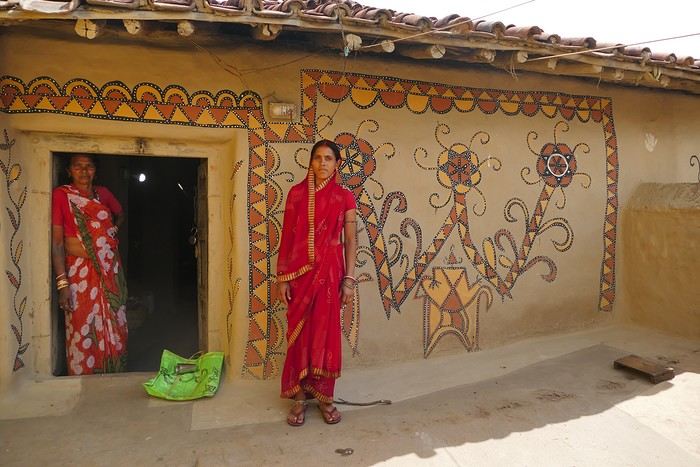
The colors remain the same—deep reds, intense blacks, and chalky white—but the rhythm is different. Faster, more spontaneous. As if each wall had its own personality, while still speaking the same language.
That’s probably why I’m so moved. I’d heard about these paintings from my friend Raja, and last year, I saw an exhibition in a village near my home. That first encounter made me want to come here. But seeing them in person is a whole different experience. These paintings are unique. This ancient art is passed down from mother to daughter, or mother-in-law to daughter-in-law, in a quiet, deeply living continuity. At first glance, it might seem almost childlike in its simplicity and pared-down forms. And yet, everything is thought out, balanced, mastered. Nothing is left to chance.
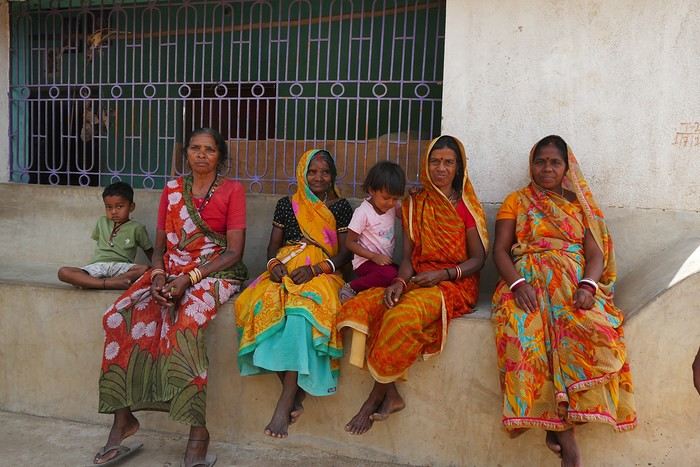
That apparent simplicity, combined with such rich symbolism, touches me deeply. There’s something sincere and essential in these walls—and that’s what moves me.
Hazaribagh I’ve got a meet-up with Adam Iman, a guide and painter. He picks me up from the hotel at 10 AM. Another traveler from Bangalore is supposed to join us, but while we wait for him to arrive, Adam takes me to see the paintings his mother and sister created at Hazaribagh station. The town became famous thanks to these murals, which can also be found in several surrounding villages. This art form has earned recognition and is now protected, a sign of its cultural importance. Once the visit is over, we go to pick up the other traveler and then head to our first village: Belwara, where Sohrai art is practiced. At the entrance, a sign proudly announces that we’re entering an artists’ village, where this art is created by women organized into micro-enterprises. Some even offer workshops for those who’d like to learn this tradition.
Sohrai art is tied to the harvest season, from October to mid-November. The motifs, in natural colors, celebrate fertility and abundance. The artists use pigments from the earth: red oxides, ochre, white kaolin, and black manganese. On the walls, you’ll see animals, fish, birds—all symbols of life and prosperity. As I look closer at the murals, I start to realize that each motif tells a story. Large animals like cows or bulls often take center stage. Their bodies are filled with intricate, almost hypnotic patterns. They symbolize wealth and prosperity for the household, as well as the deep respect for cattle, which are essential to daily life. On some facades, elephants stand out—massive and decorated with the same precision. They evoke quiet strength and protection. But it’s when I stop in front of one of the houses that I really take the time to look. The wall, a soft ochre, is entirely covered in murals. Two large animals stretch out on either side of the door, their elongated bodies fitting the length of the wall. Their silhouettes are filled with geometric patterns and incredibly fine curved lines, as if every space was patiently filled. Around them, stylized plants, flowers, and small decorative elements fill every gap. The door, dark and worn, becomes almost the silent center of the composition, framed by these living, protective forms. To the right, a more colorful motif catches the eye—a flower or a stylized lamp—like a touch of light on the earth. The whole thing gives an impression of perfect balance, between the rigor of the patterns and the freedom of the gesture.
Elsewhere, birds and freer forms bring movement. Peacocks, recognizable by their stylized silhouettes, embody beauty and vitality, while fish symbolize water, fertility, and the continuity of life.
On some paintings, the scenes become almost narrative: you can make out figures, everyday gestures, like a memory of the village inscribed in the walls. The decorative frames around the doors aren’t left to chance either—they symbolically protect the house, like a boundary between the inside and the outside world.During the Sohrai festival, cattle are led into the jungle in the morning. Meanwhile, the women finish the *aripans*—these floor paintings—and continue the wall murals. Around noon, the animals return to the village, and the bulls’ horns are anointed with oil and vermilion in a gesture of gratitude, amid the vibrant colors adorning the houses. We visit several artists, including Parvat Devi, a well-known woman who has received many awards. Her arms are adorned with intriguing tattoos, which I’ll talk about in more detail later.
On another wall, the style changes completely. Here, no massive animals—just birds occupying the space, light and graceful, as if caught in mid-movement. Two silhouettes face each other, their long necks arched almost like mirrors, while their outstretched wings seem to vibrate with the patterns that compose them.
The design is more graphic, almost airy. The lines are smoother, more fluid, as if drawn in one confident stroke. The birds’ bodies aren’t solid—they’re filled with repetitive motifs like scales, stylized feathers, and spirals, giving a sense of continuous movement. Around them, everything comes to life: flowers burst open, arabesques swirl, and even the simplest shapes seem alive. What strikes me here is the sense of lightness. Where the large animals evoked stability and grounding, these birds bring something freer, almost joyful. They seem to embody movement, the circulation of life, like a breath flowing through the village.
The colors remain the same—deep reds, intense blacks, and chalky white—but the rhythm is different. Faster, more spontaneous. As if each wall had its own personality, while still speaking the same language.
That’s probably why I’m so moved. I’d heard about these paintings from my friend Raja, and last year, I saw an exhibition in a village near my home. That first encounter made me want to come here. But seeing them in person is a whole different experience. These paintings are unique. This ancient art is passed down from mother to daughter, or mother-in-law to daughter-in-law, in a quiet, deeply living continuity. At first glance, it might seem almost childlike in its simplicity and pared-down forms. And yet, everything is thought out, balanced, mastered. Nothing is left to chance.
That apparent simplicity, combined with such rich symbolism, touches me deeply. There’s something sincere and essential in these walls—and that’s what moves me.