Results for "Monts+Cantal+|+127"
68992 results found.
Drakensberg in August: is it the right time?
Hi there,
We’re heading to South Africa in August 2025 and planning a classic loop that I’d love to finish with the Drakensberg (I’m a big hiking fan) before returning to Johannesburg to catch our flight.
I’ve got 3 nights for this part of our trip. But I’m wondering if it’s actually a good idea to hike in the Drakensberg in August, since it’s the Southern Hemisphere winter (I’m from Réunion and we hike year-round there, but I don’t know what the climate’s like in South Africa, especially the Drakensberg).
I’m particularly worried about getting stuck because of snow and missing our flight... ;)
I’ve read so many different things that I’m totally confused!
If it’s okay to hike at this time of year, what would you recommend? I’m torn between Champagne Valley and Royal Natal National Park.
Thanks in advance for your firsthand tips!
Malijp
In MIKUMI and SELOUS, Southern Tanzania (June 2024)
Hi everyone,
I’m a newbie to this forum, passionate about wildlife, the landscapes of East Africa, and Tanzania in particular. This June 2024 trip/safari is our 7th visit to Tanzania and our 5th in the south, which has drawn us more than the north ever since we discovered it in 2015.
In 2024, the entrance fees for the reserves and services have gone up again since our last visit. I chose to return first to Mikumi Reserve, which was the very first one we visited in the south. Then, we’ll head to Selous (J. Nyerere N. P.) as usual. Initially, we wanted to spend 2/3 days on Mafia Island at the end of the trip, but it made the total cost too high, so we gave up... We usually go to Ruaha and Selous, but I wanted to mix it up a bit—also to save some money...
As for the timing, June is a new experience for us. I thought it might be interesting to come just after the lodges reopen... hoping for some great wildlife encounters??
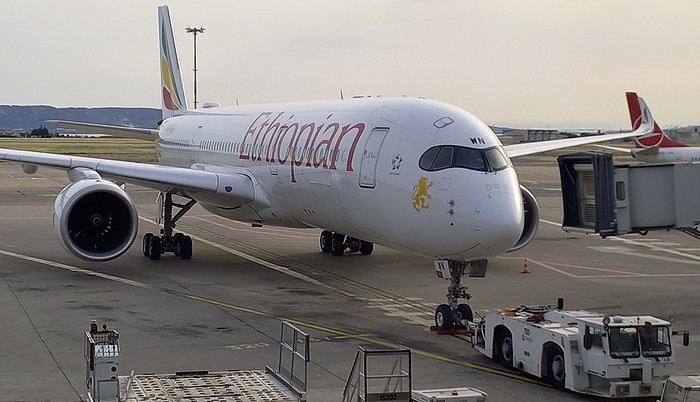
The trip starts in Marseille with our first flight on Ethiopian Airlines to Addis Ababa, then continues to Dar es Salaam, where we’ll finally set foot on Tanzanian soil again.
In Addis... "our" A-350.
.....
After arriving in Dar, we spent one night at a hotel near the airport. The next morning, we headed to the domestic flights terminal, which hasn’t changed in years.
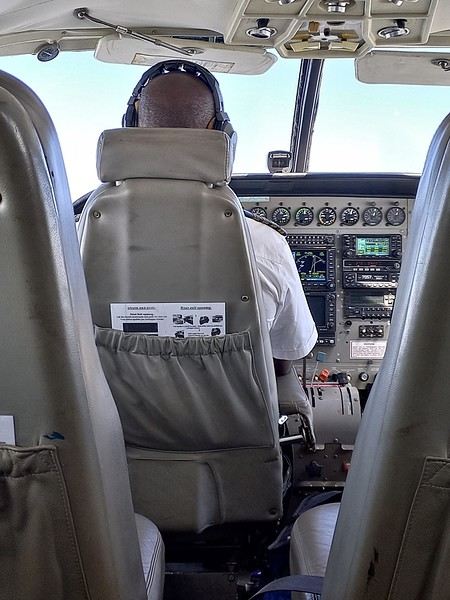
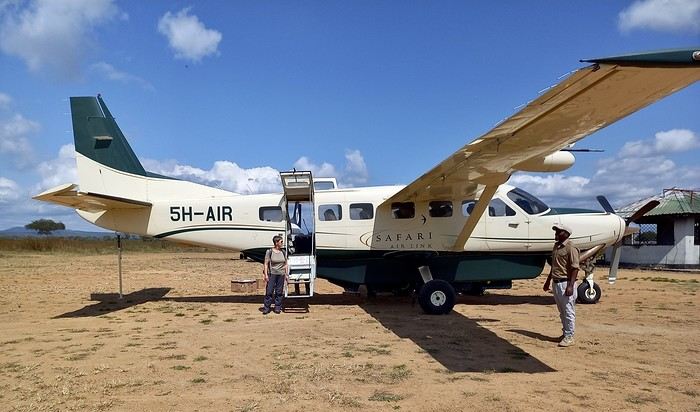
By mid-morning, we boarded a Cessna 208B Caravan with Safari Air Link, heading to the Kikoboga bush airstrip in Mikumi, which we reached 45 minutes later. Fun fact: the pilot was the same one as on our return flight two years ago.
Welcome on board:
Of course, a driver/guide team from our chosen lodge was waiting for us upon arrival:
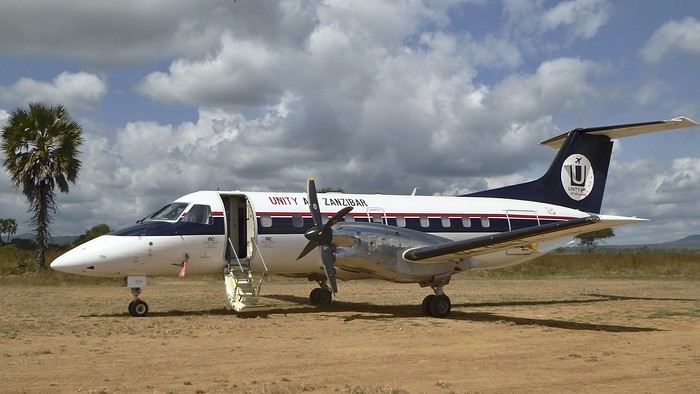
I was surprised to see so many aircraft parked there... even twin-engine Embraer Brasilias?? As a fan of vintage planes, I loved it...
On the other hand, the light was incredibly harsh.....!! Our guides only speak English. We knew that in advance. In the south, it’s very rare to find someone who speaks French. This’ll force us to dig into our high school English memories... from 60 years ago... at least.
It’s noon, and we head toward the lodge. Near the airstrip, next to the Mikumi rangers’ base, there are quite a few herbivores. They find a bit more peace here—the big cats don’t venture this way...
Our first encounter was a group of Masai giraffes.
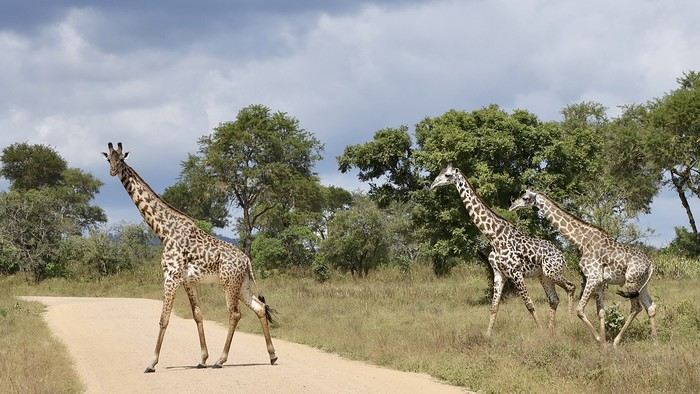
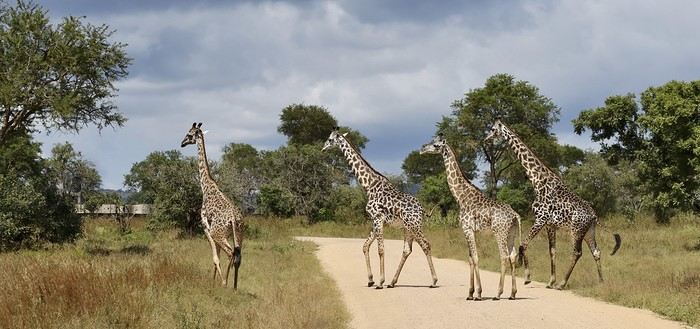
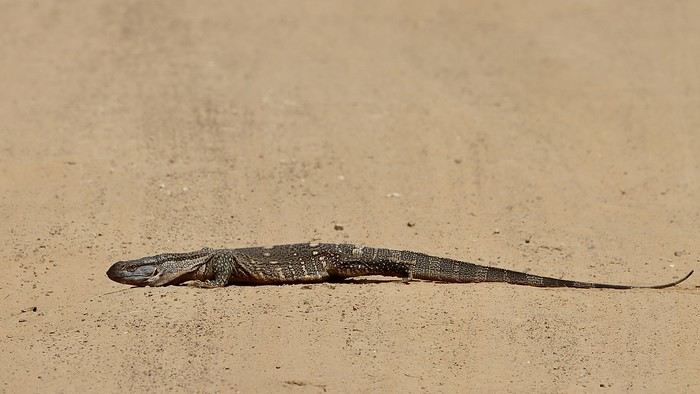
Rarer (for us), a savanna monitor lizard basking in the sun right in the middle of the track...??
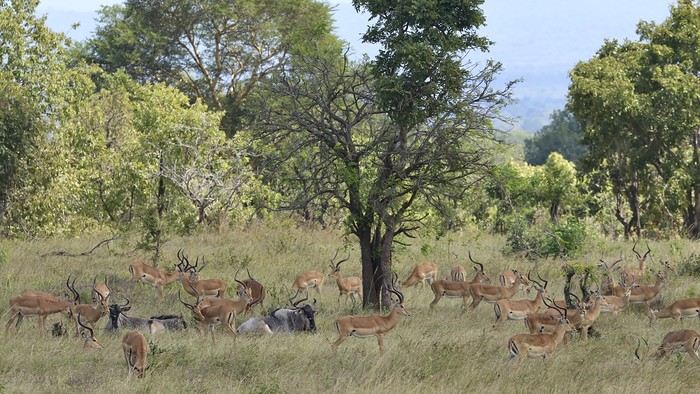
A large gathering of impalas (mostly males) along with a few blue wildebeest:

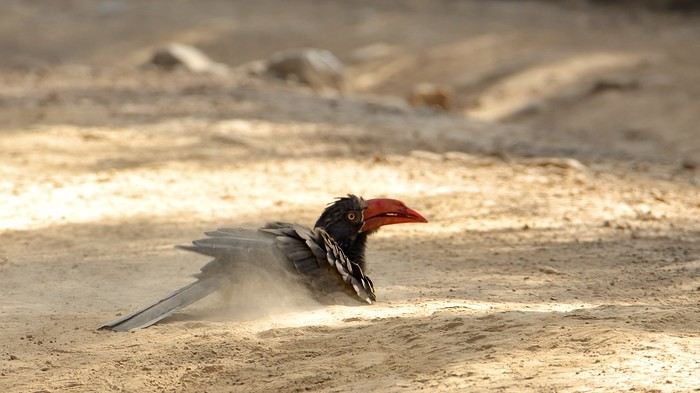
Also unusual: a African crowned hornbill taking a dust bath in the middle of the track...!!
When it comes to identifying mammals or birds, I don’t know everything... so I might make mistakes. Please forgive me. I’m counting on my friend Blesl’s active participation... 😉
...
I’m a newbie to this forum, passionate about wildlife, the landscapes of East Africa, and Tanzania in particular. This June 2024 trip/safari is our 7th visit to Tanzania and our 5th in the south, which has drawn us more than the north ever since we discovered it in 2015.
In 2024, the entrance fees for the reserves and services have gone up again since our last visit. I chose to return first to Mikumi Reserve, which was the very first one we visited in the south. Then, we’ll head to Selous (J. Nyerere N. P.) as usual. Initially, we wanted to spend 2/3 days on Mafia Island at the end of the trip, but it made the total cost too high, so we gave up... We usually go to Ruaha and Selous, but I wanted to mix it up a bit—also to save some money...
As for the timing, June is a new experience for us. I thought it might be interesting to come just after the lodges reopen... hoping for some great wildlife encounters??
The trip starts in Marseille with our first flight on Ethiopian Airlines to Addis Ababa, then continues to Dar es Salaam, where we’ll finally set foot on Tanzanian soil again.
In Addis... "our" A-350.
.....
After arriving in Dar, we spent one night at a hotel near the airport. The next morning, we headed to the domestic flights terminal, which hasn’t changed in years.
By mid-morning, we boarded a Cessna 208B Caravan with Safari Air Link, heading to the Kikoboga bush airstrip in Mikumi, which we reached 45 minutes later. Fun fact: the pilot was the same one as on our return flight two years ago.
Welcome on board:
Of course, a driver/guide team from our chosen lodge was waiting for us upon arrival:
I was surprised to see so many aircraft parked there... even twin-engine Embraer Brasilias?? As a fan of vintage planes, I loved it...
On the other hand, the light was incredibly harsh.....!! Our guides only speak English. We knew that in advance. In the south, it’s very rare to find someone who speaks French. This’ll force us to dig into our high school English memories... from 60 years ago... at least.
It’s noon, and we head toward the lodge. Near the airstrip, next to the Mikumi rangers’ base, there are quite a few herbivores. They find a bit more peace here—the big cats don’t venture this way...
Our first encounter was a group of Masai giraffes.
Rarer (for us), a savanna monitor lizard basking in the sun right in the middle of the track...??
A large gathering of impalas (mostly males) along with a few blue wildebeest:
Also unusual: a African crowned hornbill taking a dust bath in the middle of the track...!!
When it comes to identifying mammals or birds, I don’t know everything... so I might make mistakes. Please forgive me. I’m counting on my friend Blesl’s active participation... 😉
...
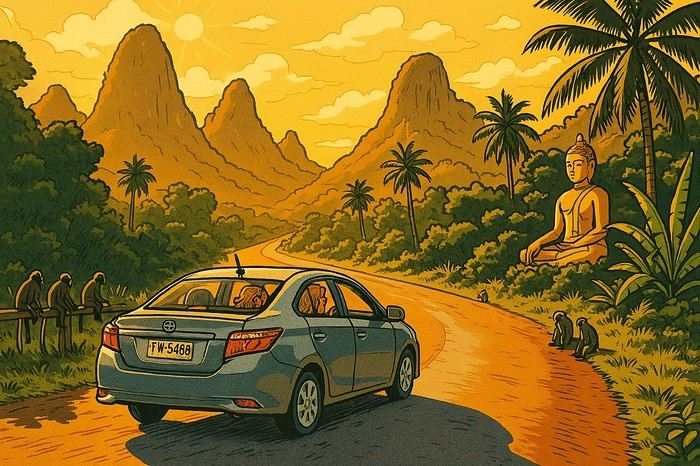
From Bangkok to Krabi, Thailand by Car!
This first trip of 2025 will have the taste of Asia.
More precisely, Thailand!
It’s not my first time—I’ve often traveled across Southeast Asia between 2000 and 2015. (This travel journal, for example...)
But it’ll be my partner’s first steps in this part of the world.
The itinerary we’ve chosen will alternate between familiar sights for me and new discoveries for both of us.
I’ll get to see how the country has changed in 20 years—and what’s stayed the same!
We were torn between the north and the south of the kingdom. Fears of smoke from slash-and-burn farming and a desire to relax on the sand tipped the scales toward the south...
What if we rented a car?
I think driving in sprawling Bangkok would be a bit ambitious, so we’ll only book our vehicle from Hua Hin to return it in Surat Thani.
Other transportation will range from tuk-tuks to overnight trains and ride-hailing services.
And of course, the plane!
I’d love to travel from Auvergne to Bangkok by road, but 15 days wouldn’t be enough...
Plus, the current geopolitical situation isn’t exactly favorable...
So, once again, we’ll be stuck for hours in the less-than-comfortable economy class of Qatar Airways.
The arrival time was on schedule, entry formalities were quick, and all our luggage made it.
We left Lyon in wind and cold—now we’re breathing in the warm, humid air of กรุงเทพมหานคร.
To reach our hotel, we first took the metro, which dropped us off in the city center in about 30 minutes for the incredible price of 1.18 €.
A few taps on the GRAB app, and we booked a ride-hailing service for the last few kilometers.
We waited a while for our driver due to insane traffic in the area, but once in the 4x4, we were at our lodging in no time.
We chose this small hotel for its riverside location, tranquility, and price.
It’ll do the job perfectly—the only downside is the weak breakfast.
The room is inviting, and we collapse onto the bed for a well-deserved short nap.
Wake-up call in an hour for our first visits!
See you soon...
More precisely, Thailand!
It’s not my first time—I’ve often traveled across Southeast Asia between 2000 and 2015. (This travel journal, for example...)
But it’ll be my partner’s first steps in this part of the world.
The itinerary we’ve chosen will alternate between familiar sights for me and new discoveries for both of us.
I’ll get to see how the country has changed in 20 years—and what’s stayed the same!
We were torn between the north and the south of the kingdom. Fears of smoke from slash-and-burn farming and a desire to relax on the sand tipped the scales toward the south...
What if we rented a car?
I think driving in sprawling Bangkok would be a bit ambitious, so we’ll only book our vehicle from Hua Hin to return it in Surat Thani.
Other transportation will range from tuk-tuks to overnight trains and ride-hailing services.
And of course, the plane!
I’d love to travel from Auvergne to Bangkok by road, but 15 days wouldn’t be enough...
Plus, the current geopolitical situation isn’t exactly favorable...
So, once again, we’ll be stuck for hours in the less-than-comfortable economy class of Qatar Airways.
The arrival time was on schedule, entry formalities were quick, and all our luggage made it.
We left Lyon in wind and cold—now we’re breathing in the warm, humid air of กรุงเทพมหานคร.
To reach our hotel, we first took the metro, which dropped us off in the city center in about 30 minutes for the incredible price of 1.18 €.
A few taps on the GRAB app, and we booked a ride-hailing service for the last few kilometers.
We waited a while for our driver due to insane traffic in the area, but once in the 4x4, we were at our lodging in no time.
We chose this small hotel for its riverside location, tranquility, and price.
It’ll do the job perfectly—the only downside is the weak breakfast.
The room is inviting, and we collapse onto the bed for a well-deserved short nap.
Wake-up call in an hour for our first visits!
See you soon...
So where are they and what are they doing?
This catchy and somewhat mysterious title comes from several questions I’ve been asking myself.
VF has been back open for a reasonable number of weeks and months now. The number of visitors overall matches past averages, but the number of members online in the last 24 hours seems relatively lower than what we used to see.
Yet, to my surprise, I’m seeing fewer travel journals, way fewer messages, and way fewer questions. I don’t see many new registered users online, and I notice a number of members who are logged in but either aren’t participating or have stopped participating.
Something’s not adding up for me because, in my opinion, VF is still appealing, and I don’t see which other sites could really compete.
Was there a real break between pre- and post-Covid? Does it just take more time for some people to discover the site or learn that it’s active again? Do people now prefer quick consumption on sites like FB or others I’m not familiar with? Where have the site’s old-timers gone, and what are they doing with their time now? What’s really going on here?
VF has been back open for a reasonable number of weeks and months now. The number of visitors overall matches past averages, but the number of members online in the last 24 hours seems relatively lower than what we used to see.
Yet, to my surprise, I’m seeing fewer travel journals, way fewer messages, and way fewer questions. I don’t see many new registered users online, and I notice a number of members who are logged in but either aren’t participating or have stopped participating.
Something’s not adding up for me because, in my opinion, VF is still appealing, and I don’t see which other sites could really compete.
Was there a real break between pre- and post-Covid? Does it just take more time for some people to discover the site or learn that it’s active again? Do people now prefer quick consumption on sites like FB or others I’m not familiar with? Where have the site’s old-timers gone, and what are they doing with their time now? What’s really going on here?
A month in Cambodia in November 2024
Here we go!!!
I left home at 4 AM on October 31st and headed to Barcelona. Driving through Barcelona on the ring road stresses me out a bit, but at 6 AM the traffic is smooth, and I arrive at the airport without any issues. I call the valet, who quickly comes to pick up my car. He takes photos of it from all angles before letting me go.
Baggage check-in hasn’t started yet, and there are already several of us waiting.
Once free, everything happens very quickly. The flight to Abu Dhabi is on time and goes smoothly. I’ve never had any problems with this airline, which I’ve been using for several years.
The flight to Bangkok arrives at 7 AM as scheduled. This is my first time in Thailand and Bangkok. I’m used to traveling in India, and I notice that everything here is well organized—the customs process is quick, and the luggage is already on the carousel.
I booked a taxi on Booking. All I have to do is find the right exit and door based on the agency’s instructions. A large sign with the names of people who booked is posted on a wall. A hostess greets me and calls the taxi, which arrives 5 minutes later. I booked one night at the Lost Inn BKK hotel in the Phra Nakhon district, and we arrive at 9 AM. The welcome isn’t warm, and I have to wait until noon, sitting on a chair, before I can check into my room. I’m exhausted, and sleeping sitting up isn’t ideal. Noon finally arrives—the room is small but clean, which is fine for one night. I quickly take a shower to wake up because I plan to spend the afternoon visiting the Grand Palace. First, I need to exchange some money, and the banks are all close together on the same street, which is very convenient. When I enter one, a hostess gives me a ticket and invites me to sit down. There are about twenty counters, and I wait quietly until my number is called. The exchange is quick, so I can head out to find the Royal Palace. It’s actually very easy, and the walk is pleasant.
Entry to the Royal Palace (500 baht).
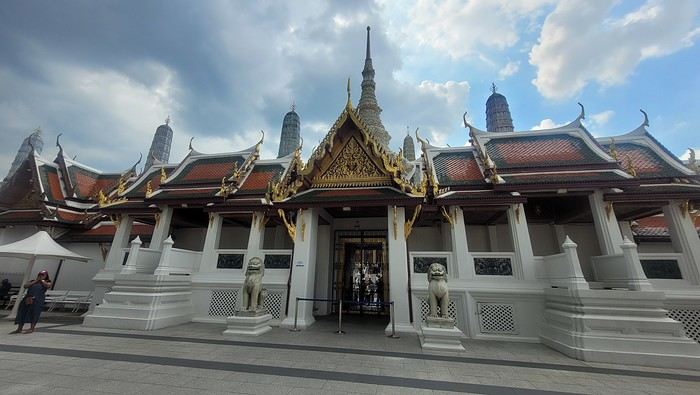
It’s magnificent and grand, and there are quite a few of us visiting. The sky is gray, it’s very humid, and a shower interrupts the visit. It’s a vast complex of temples and palaces. The buildings are colorful and sparkling, with a great sense of serenity (without the tourists, of course). I quietly enjoy the place and try to take photos without tourists, which isn’t easy.
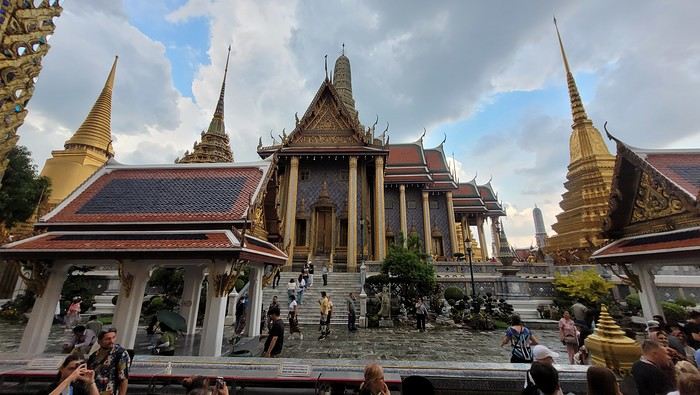
Very close to the Grand Palace is Wat Pho, one of the oldest Buddhist temples in the capital.
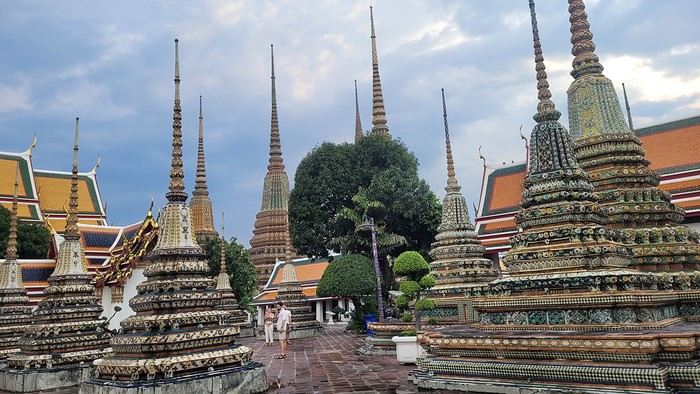
It’s very famous for its 46-meter-long reclining Buddha statue.
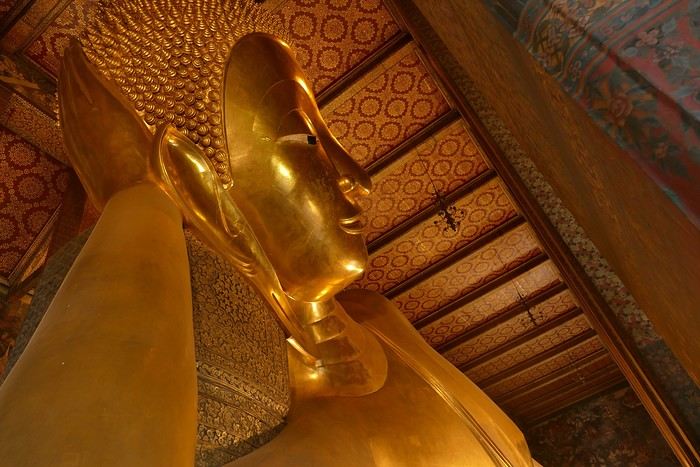
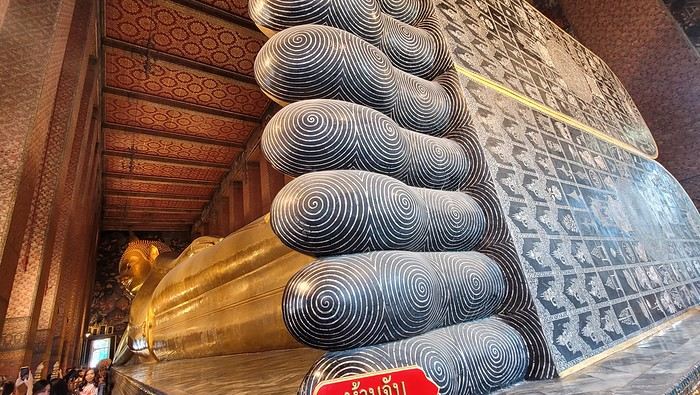
Walking around the temple, you can see different representations of Buddha, all covered in gold leaf.
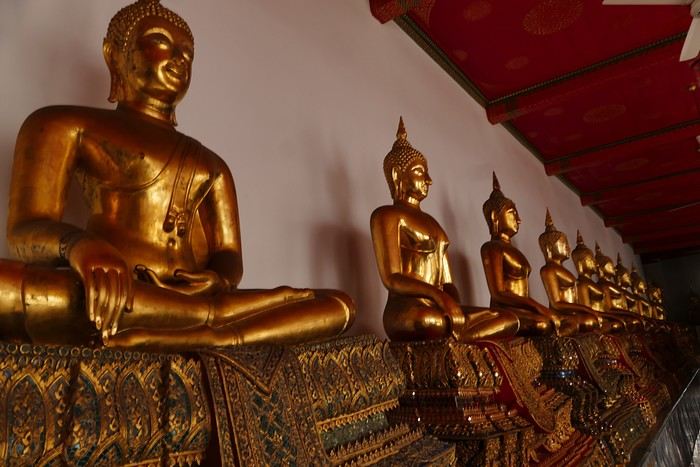
Inside the temple, on one side, monks recite their prayers, while the other side is reserved for tourists who come to meditate in silence.
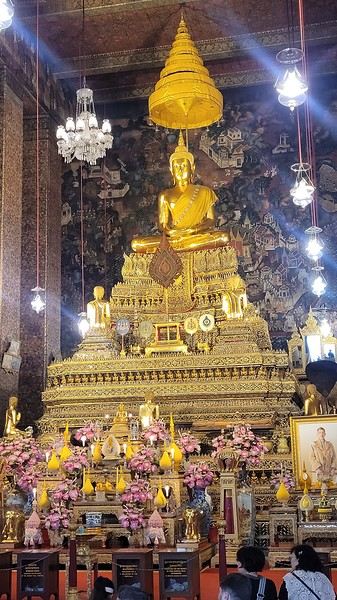
Before returning to the hotel, I have dinner at an Indian restaurant. I go to bed early because tomorrow’s wake-up call will be very early again.
Saturday, November 2nd Wake-up at 4 AM, departure from the hotel at 4:30 AM. The taxi I booked via Booking is waiting for me and takes me to the airport. The trip is fairly quick—he takes small roads, and at this hour, there’s no traffic.
The flight to Phnom Penh is on time. Before boarding, I realize I left my fleece jacket on the carousel, but it’s too late to go back for it.
The flight goes well, and customs is quick.
At the exit, I take a tuk-tuk to Julieka’s GH near the museum. The welcome is friendly. I won’t be able to check into my room until noon, so I take the opportunity to exchange some euros on the market street. The street is lined with restaurants, and I’ll have my first meal there.
The museum is right across the street, so I don’t waste any time visiting it.
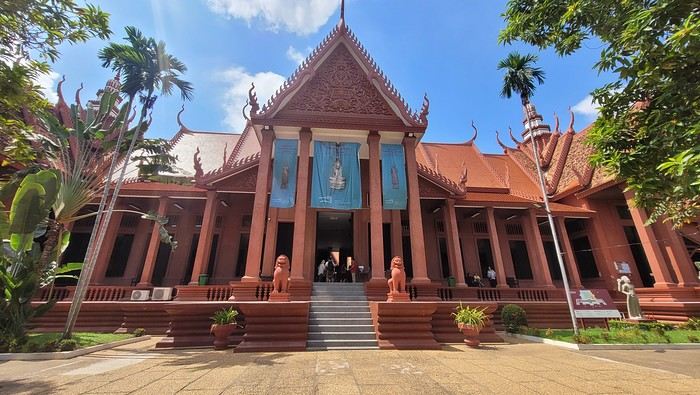
The representations of Hindu deities are very different from those in India, and I don’t recognize them. Many beautiful Buddhas are on display.
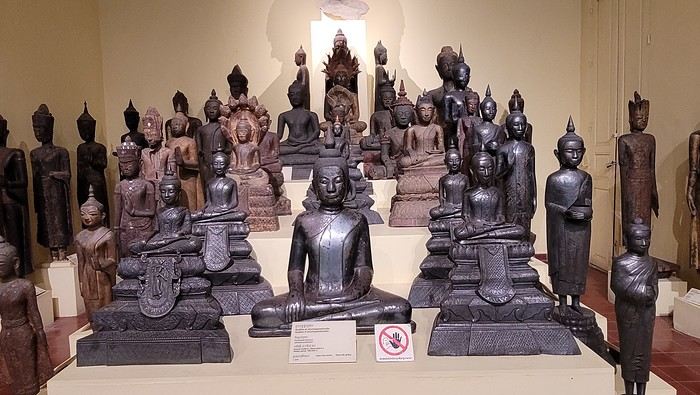
The museum is very pleasant, and there aren’t too many people, which is a plus.
At the exit, I return to the GH, settle into my room—which is decent and clean.
The Royal Palace is 1 km away. I walk along a garden, and at the end of the street is the Tonlé Sap, but I turn right. I arrive at a large esplanade and see the buildings with tiered roofs and glazed tiles. The entrance to the palace is a little further away.
At the entrance, I notice there isn’t the same crowd as at the one in BKK.
Khmer architecture is magnificent. The complex consists of gardens, palaces, pagodas with golden roofs, and slender spires.
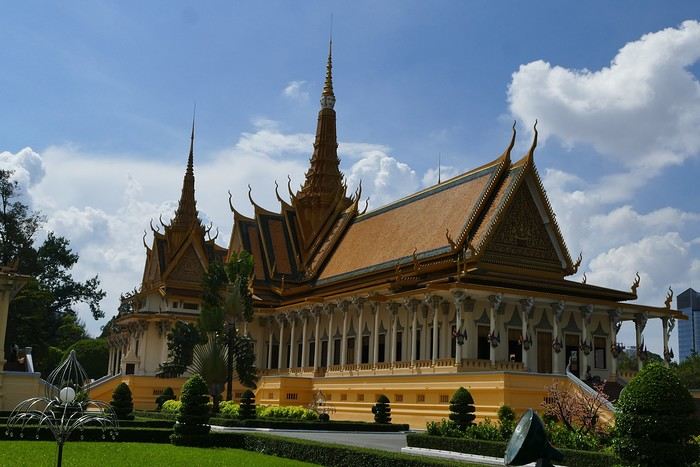
The Silver Pagoda houses the small Emerald Buddha, which is actually made of jade. The silver flooring is covered with carpets. Photos are not allowed.
The walls surrounding the pagoda are covered with frescoes depicting scenes from the Ramayana.
Baggage check-in hasn’t started yet, and there are already several of us waiting.
Once free, everything happens very quickly. The flight to Abu Dhabi is on time and goes smoothly. I’ve never had any problems with this airline, which I’ve been using for several years.
The flight to Bangkok arrives at 7 AM as scheduled. This is my first time in Thailand and Bangkok. I’m used to traveling in India, and I notice that everything here is well organized—the customs process is quick, and the luggage is already on the carousel.
I booked a taxi on Booking. All I have to do is find the right exit and door based on the agency’s instructions. A large sign with the names of people who booked is posted on a wall. A hostess greets me and calls the taxi, which arrives 5 minutes later. I booked one night at the Lost Inn BKK hotel in the Phra Nakhon district, and we arrive at 9 AM. The welcome isn’t warm, and I have to wait until noon, sitting on a chair, before I can check into my room. I’m exhausted, and sleeping sitting up isn’t ideal. Noon finally arrives—the room is small but clean, which is fine for one night. I quickly take a shower to wake up because I plan to spend the afternoon visiting the Grand Palace. First, I need to exchange some money, and the banks are all close together on the same street, which is very convenient. When I enter one, a hostess gives me a ticket and invites me to sit down. There are about twenty counters, and I wait quietly until my number is called. The exchange is quick, so I can head out to find the Royal Palace. It’s actually very easy, and the walk is pleasant.
Entry to the Royal Palace (500 baht).
It’s magnificent and grand, and there are quite a few of us visiting. The sky is gray, it’s very humid, and a shower interrupts the visit. It’s a vast complex of temples and palaces. The buildings are colorful and sparkling, with a great sense of serenity (without the tourists, of course). I quietly enjoy the place and try to take photos without tourists, which isn’t easy.
Very close to the Grand Palace is Wat Pho, one of the oldest Buddhist temples in the capital.
It’s very famous for its 46-meter-long reclining Buddha statue.
Walking around the temple, you can see different representations of Buddha, all covered in gold leaf.
Inside the temple, on one side, monks recite their prayers, while the other side is reserved for tourists who come to meditate in silence.
Before returning to the hotel, I have dinner at an Indian restaurant. I go to bed early because tomorrow’s wake-up call will be very early again.
Saturday, November 2nd Wake-up at 4 AM, departure from the hotel at 4:30 AM. The taxi I booked via Booking is waiting for me and takes me to the airport. The trip is fairly quick—he takes small roads, and at this hour, there’s no traffic.
The flight to Phnom Penh is on time. Before boarding, I realize I left my fleece jacket on the carousel, but it’s too late to go back for it.
The flight goes well, and customs is quick.
At the exit, I take a tuk-tuk to Julieka’s GH near the museum. The welcome is friendly. I won’t be able to check into my room until noon, so I take the opportunity to exchange some euros on the market street. The street is lined with restaurants, and I’ll have my first meal there.
The museum is right across the street, so I don’t waste any time visiting it.
The representations of Hindu deities are very different from those in India, and I don’t recognize them. Many beautiful Buddhas are on display.
The museum is very pleasant, and there aren’t too many people, which is a plus.
At the exit, I return to the GH, settle into my room—which is decent and clean.
The Royal Palace is 1 km away. I walk along a garden, and at the end of the street is the Tonlé Sap, but I turn right. I arrive at a large esplanade and see the buildings with tiered roofs and glazed tiles. The entrance to the palace is a little further away.
At the entrance, I notice there isn’t the same crowd as at the one in BKK.
Khmer architecture is magnificent. The complex consists of gardens, palaces, pagodas with golden roofs, and slender spires.
The Silver Pagoda houses the small Emerald Buddha, which is actually made of jade. The silver flooring is covered with carpets. Photos are not allowed.
The walls surrounding the pagoda are covered with frescoes depicting scenes from the Ramayana.
A Turquoise Dream Come True in Uzbekistan - 2022
We took this trip from September 12 to October 7, 2022. I didn’t post this travel journal earlier in Voyage Forum because the site wasn’t back up yet (and also because I was short on time).
Then, at the end of 2024, I made a promise to a friend: to publish my travel journal on VF. So here it is!
 We took off from Paris in the late afternoon on September 12 and arrived in Tashkent around 7:15 AM on the 13th.
This trip was the result of long contemplation and preparation (it was originally planned for the year of the lockdown (2020) and was prepared with the help and advice of Nasrullo Jumanov from Turquoise Travel.
Stages and Itinerary
Stage 1: Tashkent - September 13 and 14
Stage 2: Ferghana Valley – September 15 to 17
Stage 3: Nukus and Moynaq - September 18 and 19
Stage 4: Mysterious Khiva - September 20 to 22
Stage 5: Holy Bukhara - September 23 to 26
Stage 6: Asraf - September 27 and 28
Stage 7: Mythical Samarkand - September 29 to October 2
Stage 8: Tersak (via Shakhrisabz and Urgut) – October 3 and 4
Stage 9: Samarkand – October 5 and 6
Stage 10: Tashkent/Istanbul/Paris – October 6 and 7
Stage 1: Tashkent
September 13
At the airport exit, we were greeted by the owner of our B&B (B&B Gulnara).
Today was all about recovery and our first steps in the capital. Our first currency exchange made us feel like sudden millionaires.
Our first stroll down the avenue leading to Chorsu Market introduced us to the fact that 80 to 90% of the cars here are white Chevrolets.
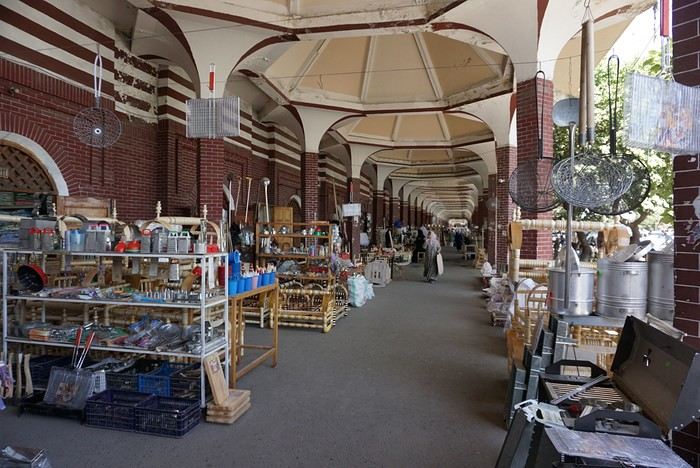
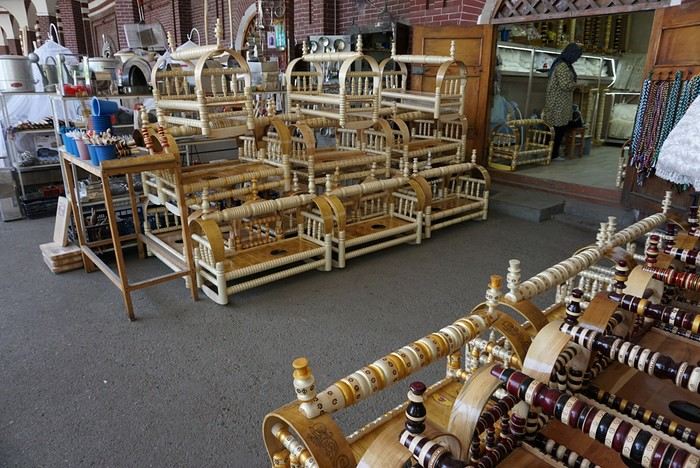
A walk under the arcades facing Chorsu: hardware stores, cabinetmakers, lute makers (one of them gave me a little concert/demo of a few string instruments).
We took off from Paris in the late afternoon on September 12 and arrived in Tashkent around 7:15 AM on the 13th.
This trip was the result of long contemplation and preparation (it was originally planned for the year of the lockdown (2020) and was prepared with the help and advice of Nasrullo Jumanov from Turquoise Travel.
Stages and Itinerary
Stage 1: Tashkent - September 13 and 14
Stage 2: Ferghana Valley – September 15 to 17
Stage 3: Nukus and Moynaq - September 18 and 19
Stage 4: Mysterious Khiva - September 20 to 22
Stage 5: Holy Bukhara - September 23 to 26
Stage 6: Asraf - September 27 and 28
Stage 7: Mythical Samarkand - September 29 to October 2
Stage 8: Tersak (via Shakhrisabz and Urgut) – October 3 and 4
Stage 9: Samarkand – October 5 and 6
Stage 10: Tashkent/Istanbul/Paris – October 6 and 7
Stage 1: Tashkent
September 13
At the airport exit, we were greeted by the owner of our B&B (B&B Gulnara).
Today was all about recovery and our first steps in the capital. Our first currency exchange made us feel like sudden millionaires.
Our first stroll down the avenue leading to Chorsu Market introduced us to the fact that 80 to 90% of the cars here are white Chevrolets.
A walk under the arcades facing Chorsu: hardware stores, cabinetmakers, lute makers (one of them gave me a little concert/demo of a few string instruments).
As we entered the market, many vendors called out to us, including this florist who asked where we were from: ‘France? Ah! Macron! PSG!’ He then recited a list of players from the Parisian team as well as past (Platini, Zidane, etc.) and current (Giroud, Griezmann, Mbappé, etc.) French national team players. Since we’re more into rugby (we live near Toulouse), he knew more players than I did!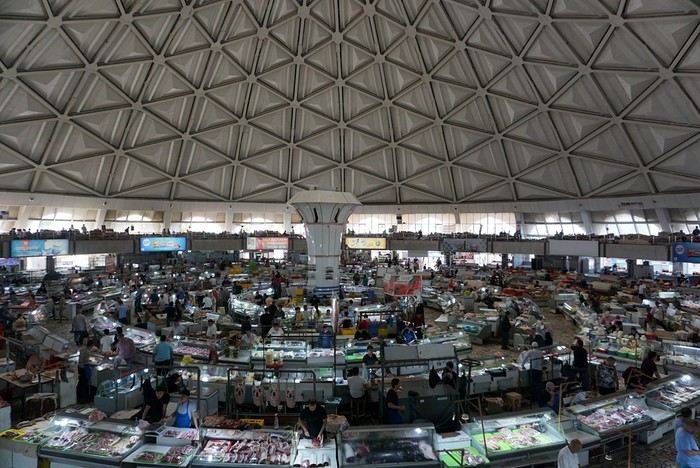
The market sprawls outside around the large circular, multi-story hall. We bought some grapes and bottles of freshly squeezed pomegranate juice for just a few sums. This evening, we had a meet-up with Nasrullo. The reunion was very warm: we’d been exchanging messages for over two years, and I’d been ‘torturing’ him with changes to our itinerary and trip duration. We were finally eager to meet, and honestly, I wasn’t disappointed—in fact, it was the opposite. Nasrullo was very attentive throughout our trip and always made sure, even from a distance (and most often from a distance!), that everything went smoothly. His goal was for us to leave delighted with our trip and, why not, indirectly become ambassadors for this destination. September 14 Breakfast with Nasrullo, then we set off with him by taxi to explore some of the capital’s sites.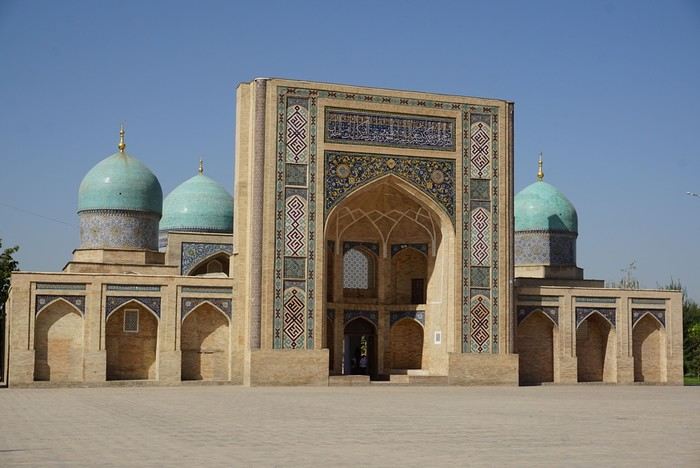
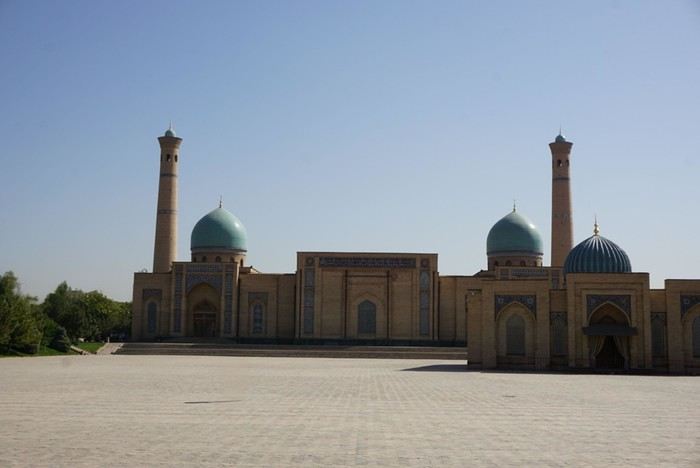
We started by visiting the Khazrati Imam complex, which includes the mausoleum of Kaffal Shashi, the Barak Khan and Muyi Muborak madrasas, and the great Khazrati Imam Mosque with its immense prayer hall.
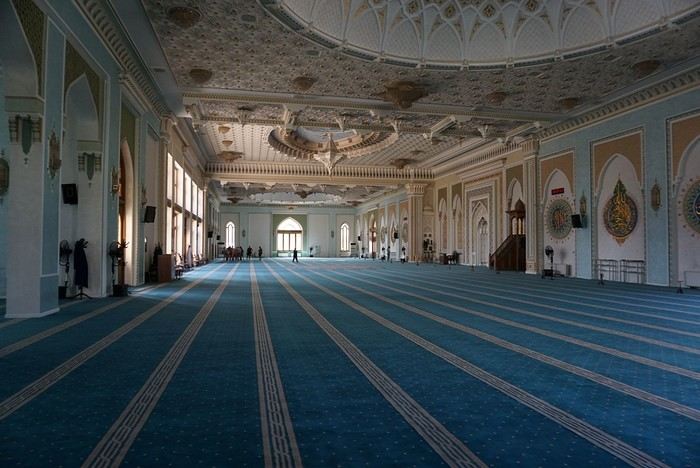
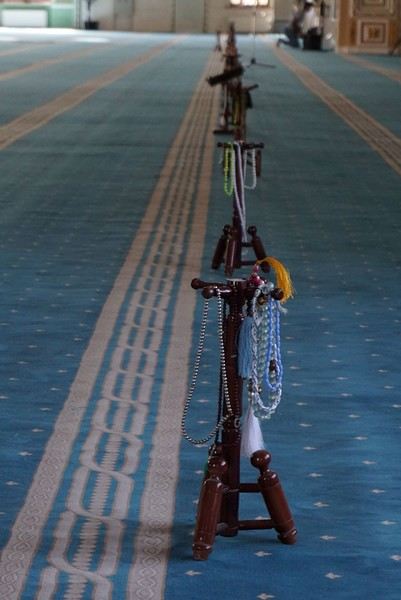
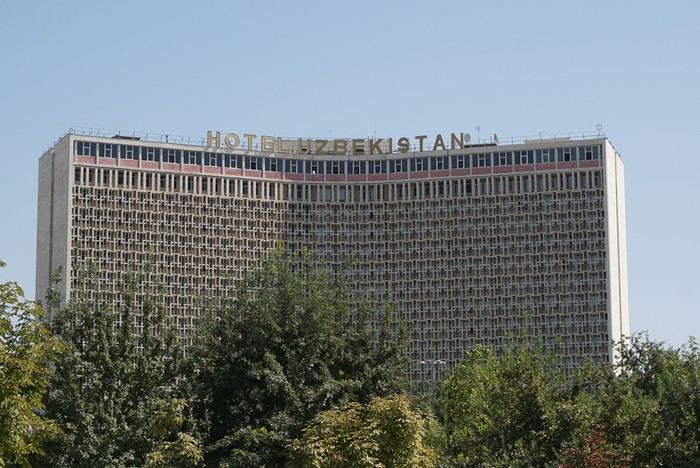
In the Muyi Muborak madrasa, now a museum, you can see the oldest Quran in the world. It was written by three religious scholars, including the secretary of the Prophet Muhammad, on large ‘pages’ made of antelope skin. Next, we explored Soviet-era Tashkent, discovering its parks, canals, and squares: Independence Square with its storks and phoenixes, Amir Temur Square with its large statue and, in the background, the massive Soviet-era hotel that has become one of Tashkent’s iconic buildings. Nasrullo took us through Broadway Boulevard and along what he calls ‘Tashkent’s Montmartre’… Well, it’s far, very far from Montmartre (in every sense of the word!). Then we took the metro to Chorsu station. Rush hour is pretty much the same everywhere in the metro… When we arrived at Chorsu, it was time to say goodbye. Nasrullo had to head back to Samarkand. Before leaving, he recommended some chaikhanas at the end of the galleries facing the market. We ate there for just a few euros (2 or 3 € for two people). After eating, we headed back to our room to cool off (our B&B is about a 10-minute walk away).
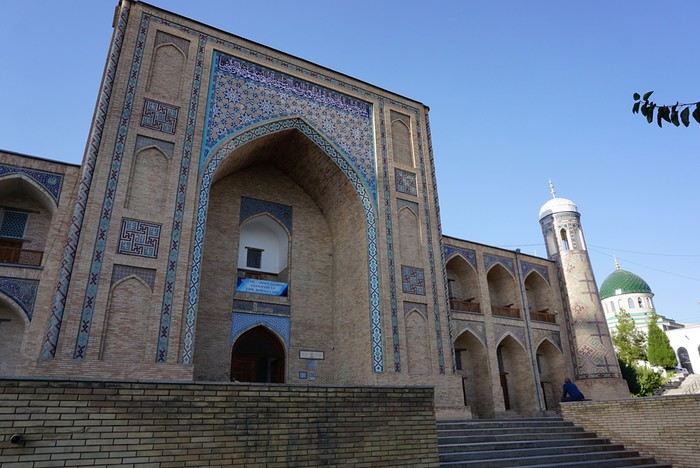
Around 4 PM, we set off to visit the Kokeldash Madrasa, which is still active. On the way, we stopped to watch some bread vendors and take a few photos. We were hesitating about buying some for our evening picnic when a young woman approached us. In perfect English, she asked: ‘Are you looking for something? Do you want to buy bread? Which one? How much?’ She then spoke to one of the vendors and negotiated the price. ‘Do you want one?’ And she took two. She paid directly. I took out my wallet to reimburse her, but she refused. It’s on the house! Then the vendor asked where we were from. And off we went again: Macron, PSG, football players… We’ll have to get used to it. The young woman smiled at the questions and comments, barely gave us time to thank her, and left as quickly as she had approached us.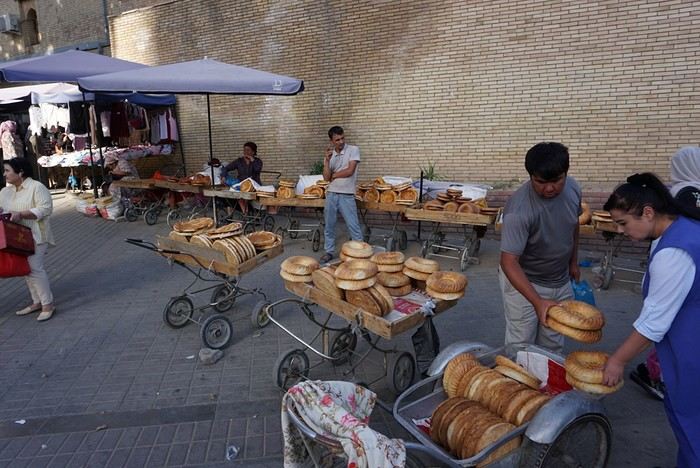
We continued our walk. Visited the madrasa. Then we crossed the boulevard to see the Tashkent Circus. I would’ve loved to go in and visit, but the ticket seller wouldn’t hear of it. We carried on around what should’ve been a park with old-fashioned rides and attractions. All we found was a construction site. Oh well! Back at our hotel, a message from Nasrullo was waiting for us. He had managed to change our train ticket for the next day. Instead of taking the 6:00 AM train, we’d take the 8:00 AM one. And instead of second class, we’d be in first class! Great! This evening, we had a picnic at one of the breakfast tables in the B&B courtyard. Under a shelter, the owner and his family were celebrating a birthday. The owner started by offering us some tea. Then they brought us some fruit (watermelon and melon). Finally, after the song, candles, and cake cutting, they brought us two generous slices of that beautiful birthday cake. Delicious!
We took off from Paris in the late afternoon on September 12 and arrived in Tashkent around 7:15 AM on the 13th.
This trip was the result of long contemplation and preparation (it was originally planned for the year of the lockdown (2020) and was prepared with the help and advice of Nasrullo Jumanov from Turquoise Travel.
Stages and Itinerary
Stage 1: Tashkent - September 13 and 14
Stage 2: Ferghana Valley – September 15 to 17
Stage 3: Nukus and Moynaq - September 18 and 19
Stage 4: Mysterious Khiva - September 20 to 22
Stage 5: Holy Bukhara - September 23 to 26
Stage 6: Asraf - September 27 and 28
Stage 7: Mythical Samarkand - September 29 to October 2
Stage 8: Tersak (via Shakhrisabz and Urgut) – October 3 and 4
Stage 9: Samarkand – October 5 and 6
Stage 10: Tashkent/Istanbul/Paris – October 6 and 7
Stage 1: Tashkent
September 13
At the airport exit, we were greeted by the owner of our B&B (B&B Gulnara).
Today was all about recovery and our first steps in the capital. Our first currency exchange made us feel like sudden millionaires.
Our first stroll down the avenue leading to Chorsu Market introduced us to the fact that 80 to 90% of the cars here are white Chevrolets.
A walk under the arcades facing Chorsu: hardware stores, cabinetmakers, lute makers (one of them gave me a little concert/demo of a few string instruments).As we entered the market, many vendors called out to us, including this florist who asked where we were from: ‘France? Ah! Macron! PSG!’ He then recited a list of players from the Parisian team as well as past (Platini, Zidane, etc.) and current (Giroud, Griezmann, Mbappé, etc.) French national team players. Since we’re more into rugby (we live near Toulouse), he knew more players than I did!
The market sprawls outside around the large circular, multi-story hall. We bought some grapes and bottles of freshly squeezed pomegranate juice for just a few sums. This evening, we had a meet-up with Nasrullo. The reunion was very warm: we’d been exchanging messages for over two years, and I’d been ‘torturing’ him with changes to our itinerary and trip duration. We were finally eager to meet, and honestly, I wasn’t disappointed—in fact, it was the opposite. Nasrullo was very attentive throughout our trip and always made sure, even from a distance (and most often from a distance!), that everything went smoothly. His goal was for us to leave delighted with our trip and, why not, indirectly become ambassadors for this destination. September 14 Breakfast with Nasrullo, then we set off with him by taxi to explore some of the capital’s sites.
We started by visiting the Khazrati Imam complex, which includes the mausoleum of Kaffal Shashi, the Barak Khan and Muyi Muborak madrasas, and the great Khazrati Imam Mosque with its immense prayer hall.
In the Muyi Muborak madrasa, now a museum, you can see the oldest Quran in the world. It was written by three religious scholars, including the secretary of the Prophet Muhammad, on large ‘pages’ made of antelope skin. Next, we explored Soviet-era Tashkent, discovering its parks, canals, and squares: Independence Square with its storks and phoenixes, Amir Temur Square with its large statue and, in the background, the massive Soviet-era hotel that has become one of Tashkent’s iconic buildings. Nasrullo took us through Broadway Boulevard and along what he calls ‘Tashkent’s Montmartre’… Well, it’s far, very far from Montmartre (in every sense of the word!). Then we took the metro to Chorsu station. Rush hour is pretty much the same everywhere in the metro… When we arrived at Chorsu, it was time to say goodbye. Nasrullo had to head back to Samarkand. Before leaving, he recommended some chaikhanas at the end of the galleries facing the market. We ate there for just a few euros (2 or 3 € for two people). After eating, we headed back to our room to cool off (our B&B is about a 10-minute walk away).
Around 4 PM, we set off to visit the Kokeldash Madrasa, which is still active. On the way, we stopped to watch some bread vendors and take a few photos. We were hesitating about buying some for our evening picnic when a young woman approached us. In perfect English, she asked: ‘Are you looking for something? Do you want to buy bread? Which one? How much?’ She then spoke to one of the vendors and negotiated the price. ‘Do you want one?’ And she took two. She paid directly. I took out my wallet to reimburse her, but she refused. It’s on the house! Then the vendor asked where we were from. And off we went again: Macron, PSG, football players… We’ll have to get used to it. The young woman smiled at the questions and comments, barely gave us time to thank her, and left as quickly as she had approached us.
We continued our walk. Visited the madrasa. Then we crossed the boulevard to see the Tashkent Circus. I would’ve loved to go in and visit, but the ticket seller wouldn’t hear of it. We carried on around what should’ve been a park with old-fashioned rides and attractions. All we found was a construction site. Oh well! Back at our hotel, a message from Nasrullo was waiting for us. He had managed to change our train ticket for the next day. Instead of taking the 6:00 AM train, we’d take the 8:00 AM one. And instead of second class, we’d be in first class! Great! This evening, we had a picnic at one of the breakfast tables in the B&B courtyard. Under a shelter, the owner and his family were celebrating a birthday. The owner started by offering us some tea. Then they brought us some fruit (watermelon and melon). Finally, after the song, candles, and cake cutting, they brought us two generous slices of that beautiful birthday cake. Delicious!
Slow Travel or the Illusion of Authenticity
“Slow travel” is a concept that some tout as a philosophical revolution in travel. But on closer inspection, it’s nothing more than a marketing repackaging of an age-old practice.
This term is wrapped in an aura of intellectualism. It promises to reinvent the experience of travel by valuing slowness, contemplation, and cultural immersion.
The term “slow travel” claims to bring depth to travel, but it often relies on clichés.
Taking your time, meeting locals, avoiding quick visits—these practices have always existed and are nothing revolutionary.
Before the era of airplanes, high-speed trains, and express stays, traveling necessarily meant taking your time. Pilgrims, merchants, and explorers already practiced a form of “slow travel,” without hashtags or self-proclaimed spiritual guides.
Crossing lands on foot or by horse required total immersion in the landscapes, cultures, and unpredictability of the journey. Yet, no one attributed philosophical intentions to them: it was a necessity.
Slow travel, in its current version, may be less a philosophy than a reflection of the contradictions of an affluent class searching for meaning in a world they help overload.
So-called “slow” travel is presented as a privileged way to understand a culture, but this claim is debatable. A region never represents an entire country.
Immersing yourself in a community doesn’t guarantee a complete or more authentic understanding than any other way of traveling.
Slowness in itself doesn’t guarantee depth or ethics. You can immerse yourself in a place over a weekend, just as you can spend months in a country without grasping its subtleties.
By positioning itself as an antidote to “fast” tourism, slow travel fetishizes a temporality that only makes sense if it’s accompanied by real openness and an effort to integrate.
But this over-intellectualization often masks a desire to belong to a trend or a need to stand out socially.
Behind this posture sometimes lies a whim: the urge to reinvent one’s life elsewhere in an idealized form. But this quest for elsewhere remains fundamentally a way to escape or respond to unease, rather than a true commitment to the cultures visited.
When we talk about “encounters” while traveling, we often forget that these exchanges are facilitated by biased contexts. As a traveler, you’re seen as a temporary visitor, unattached, and that changes the dynamic.
Locals, whether curious or used to tourists, adopt a different stance than they would with a neighbor they see daily.
This interaction is also tinged with asymmetry: the traveler has the luxury of time and availability, while in daily life, personal concerns often take precedence over the desire to connect.
The flip side is that the openness displayed while traveling is often a facade. We boast about chatting with a fisherman or sharing a meal with a local family, but how many of these encounters lead to a real understanding of cultural differences or sincere reflection?
Once home, these moments become anecdotes, social trophies to show off, without fundamentally changing our relationship with others in our daily lives.
By imposing a definition, we push people to adapt their practices to fit an idealized model. This can lead to a paradoxical standardization: “slow travel” becomes a checklist of behaviors (meetings, immersion, slowness).
The “bobos” (bourgeois-bohemians), often in search of meaning in a world saturated with options, believe that giving a name to a practice grants it legitimacy or moral value. But this obsession with framing and theorizing travel only drains it of its spontaneity.
Someone who grew up at the crossroads of multiple cultures, on the other hand, doesn’t feel this need. For them, traveling isn’t a philosophical project but an intrinsic part of their life.
The very concept of “slow travel” can seem absurd: why glorify what’s simply natural?
Why try to turn into an ideology what should be a personal, intimate experience, free from semantic constraints?
Ultimately, this need for labeling, this frantic quest to name every gesture, reveals a society craving simplicity.
Travel, in its purest form, doesn’t need justification or slogans. It doesn’t need slowness or speed: it’s simply lived.
Perhaps the real challenge is to unlearn this Western habit of conceptualizing everything that should simply be felt.
For many, travel is a parenthesis, a temporary break from daily life. But if we reject this distinction between “home” and “elsewhere,” every human life becomes a continuous journey through varied environments.
From this perspective, “slow travel” loses all meaning, because living somewhere—whether for a week or five years—is part of the same experience of adaptation.
So, we ask the fans of marketing slogans: is travel a parenthesis or a journey?
“Slow travel” is often driven by a Western eco-bobo ideology, tinged with post-colonial guilt. This discourse promotes a supposedly virtuous way of traveling while forgetting that these practices remain a privilege.
Far from deconstructing power dynamics, it sometimes reinforces them by glorifying a different kind of consumption, still centered on comfort.
There’s also a condescending side to this rhetoric. By idealizing slowness, slow travel advocates imply that those who travel quickly or on a budget are less “authentic” in their approach.
Yet, isn’t that a form of contempt? Do those who leave for a well-deserved week after months of hard work deserve less consideration?
Concepts like “slow travel” or “sustainable tourism” seem hollow when reduced to marketing slogans or standardized behaviors. They confine travel to preconceived frameworks, stripping it of its spontaneous and unpredictable dimension.
Instead of categorizing, it would be more relevant to recognize the plurality of human experiences without trying to define them.
Slow travel doesn’t invent anything. It simply puts into words—and often slogans—what travel has always been for those who practice it with intention.
Maybe we should stop trying to theorize every movement and simply rediscover travel for what it is: a human experience, sometimes slow, sometimes fast, but always personal.
More info on our site
This term is wrapped in an aura of intellectualism. It promises to reinvent the experience of travel by valuing slowness, contemplation, and cultural immersion.
The term “slow travel” claims to bring depth to travel, but it often relies on clichés.
Taking your time, meeting locals, avoiding quick visits—these practices have always existed and are nothing revolutionary.
Before the era of airplanes, high-speed trains, and express stays, traveling necessarily meant taking your time. Pilgrims, merchants, and explorers already practiced a form of “slow travel,” without hashtags or self-proclaimed spiritual guides.
Crossing lands on foot or by horse required total immersion in the landscapes, cultures, and unpredictability of the journey. Yet, no one attributed philosophical intentions to them: it was a necessity.
Slow travel, in its current version, may be less a philosophy than a reflection of the contradictions of an affluent class searching for meaning in a world they help overload.
So-called “slow” travel is presented as a privileged way to understand a culture, but this claim is debatable. A region never represents an entire country.
Immersing yourself in a community doesn’t guarantee a complete or more authentic understanding than any other way of traveling.
Slowness in itself doesn’t guarantee depth or ethics. You can immerse yourself in a place over a weekend, just as you can spend months in a country without grasping its subtleties.
By positioning itself as an antidote to “fast” tourism, slow travel fetishizes a temporality that only makes sense if it’s accompanied by real openness and an effort to integrate.
But this over-intellectualization often masks a desire to belong to a trend or a need to stand out socially.
Behind this posture sometimes lies a whim: the urge to reinvent one’s life elsewhere in an idealized form. But this quest for elsewhere remains fundamentally a way to escape or respond to unease, rather than a true commitment to the cultures visited.
When we talk about “encounters” while traveling, we often forget that these exchanges are facilitated by biased contexts. As a traveler, you’re seen as a temporary visitor, unattached, and that changes the dynamic.
Locals, whether curious or used to tourists, adopt a different stance than they would with a neighbor they see daily.
This interaction is also tinged with asymmetry: the traveler has the luxury of time and availability, while in daily life, personal concerns often take precedence over the desire to connect.
The flip side is that the openness displayed while traveling is often a facade. We boast about chatting with a fisherman or sharing a meal with a local family, but how many of these encounters lead to a real understanding of cultural differences or sincere reflection?
Once home, these moments become anecdotes, social trophies to show off, without fundamentally changing our relationship with others in our daily lives.
By imposing a definition, we push people to adapt their practices to fit an idealized model. This can lead to a paradoxical standardization: “slow travel” becomes a checklist of behaviors (meetings, immersion, slowness).
The “bobos” (bourgeois-bohemians), often in search of meaning in a world saturated with options, believe that giving a name to a practice grants it legitimacy or moral value. But this obsession with framing and theorizing travel only drains it of its spontaneity.
Someone who grew up at the crossroads of multiple cultures, on the other hand, doesn’t feel this need. For them, traveling isn’t a philosophical project but an intrinsic part of their life.
The very concept of “slow travel” can seem absurd: why glorify what’s simply natural?
Why try to turn into an ideology what should be a personal, intimate experience, free from semantic constraints?
Ultimately, this need for labeling, this frantic quest to name every gesture, reveals a society craving simplicity.
Travel, in its purest form, doesn’t need justification or slogans. It doesn’t need slowness or speed: it’s simply lived.
Perhaps the real challenge is to unlearn this Western habit of conceptualizing everything that should simply be felt.
For many, travel is a parenthesis, a temporary break from daily life. But if we reject this distinction between “home” and “elsewhere,” every human life becomes a continuous journey through varied environments.
From this perspective, “slow travel” loses all meaning, because living somewhere—whether for a week or five years—is part of the same experience of adaptation.
So, we ask the fans of marketing slogans: is travel a parenthesis or a journey?
“Slow travel” is often driven by a Western eco-bobo ideology, tinged with post-colonial guilt. This discourse promotes a supposedly virtuous way of traveling while forgetting that these practices remain a privilege.
Far from deconstructing power dynamics, it sometimes reinforces them by glorifying a different kind of consumption, still centered on comfort.
There’s also a condescending side to this rhetoric. By idealizing slowness, slow travel advocates imply that those who travel quickly or on a budget are less “authentic” in their approach.
Yet, isn’t that a form of contempt? Do those who leave for a well-deserved week after months of hard work deserve less consideration?
Concepts like “slow travel” or “sustainable tourism” seem hollow when reduced to marketing slogans or standardized behaviors. They confine travel to preconceived frameworks, stripping it of its spontaneous and unpredictable dimension.
Instead of categorizing, it would be more relevant to recognize the plurality of human experiences without trying to define them.
Slow travel doesn’t invent anything. It simply puts into words—and often slogans—what travel has always been for those who practice it with intention.
Maybe we should stop trying to theorize every movement and simply rediscover travel for what it is: a human experience, sometimes slow, sometimes fast, but always personal.
More info on our site
Bangkok - Chiang Mai - Koh Samui in summer
Hi everyone, I’ve spent two solid months reading the Lonely Planet and pretty much every post about Thailand here, plus French and English blogs. Now I’d love to get your expert opinions on our itinerary.
We’re heading off in August 2025 with our 7-year-old daughter. We only have a maximum of three weeks off, and I’m keeping an eye on flight prices before booking (1400 € per person really stings 😕).
So here’s what I’ve planned—let me know if you spot any major issues or if I’ve been way too "optimistic."
D1 - Arrival in Bangkok / rest, quick visit, overnight stay D2 - More temple visits, etc. D3 - Morning flight to Chiang Mai D4 - More Chiang Mai sightseeing D5 - Day trip to Chiang Rai (guided tour to book: blue and white temple), return to Chiang Mai late in the evening D6 - More Chiang Mai visits / Elephant Nature Park in the afternoon D7 - Morning flight to Koh Samui, sightseeing D8 to D10 - More Koh Samui visits D11 to D13 - Ferry to Koh Phangan D14 to D15 - Ferry to Koh Tao D16 - Return to Koh Samui, then flight to Bangkok D17 - Day trip to Ayutthaya, return to Bangkok in the evening D18 - Flight back to France :(
I know a lot of you recommend heading straight to Chiang Mai to recover from the international flight, but my partner and I NEVER sleep on planes (personally, I’ve been flying to Taiwan since I was little and have never slept more than an hour on a 14-hour flight...), so it’s essential for us to rest upon arrival . That’s also why I opted for domestic flights instead of the sleeper train—I know we’d lose over 10 hours and wouldn’t be able to rest properly in those conditions. And I’m sure you’ll also say BKK > North > South is too much for three weeks, but I really want to see as much as possible. Given how much the flights will cost, I’m not sure when we’ll be able to come back 🏴☠️.
So, questions: 1. Since we’ll only be in Bangkok for a maximum of two nights and need to easily reach the airport with luggage (and a child), which neighborhood should we prioritize? We’d love to experience the evening vibe of Asian night markets, ideally within walking distance of the hotel or just a few metro stops away. I’ve looked at Chinatown, but the BTS seems far... Should we go for somewhere near BTS Saphan Taksin or BTS Krungthonburi? But is the area lively in the evening with food courts, etc.? We’d also like to treat ourselves to a hotel with a pool.
2. Have we planned too many days in the south? Should I skip Koh Tao and just do Koh Samui + Koh Phangan? My partner and daughter aren’t strong swimmers, so we’re looking for beautiful beaches without too much current. Crowded beaches don’t bother us—we just want stunning turquoise waters without killer waves . Going all the way to Koh Tao and then back to Koh Samui to catch the flight to Bangkok seems too stressful. Is it still possible these days (I haven’t seen any recent posts on this) to head to Koh Samui in August and decide on the spot how many nights to spend in Koh Phangan or Koh Tao based on how we feel, booking hotels as we go? Or is that too risky?
If you have any better suggestions for fitting all this in while reducing internal flights, I’m all ears for your great tips
D1 - Arrival in Bangkok / rest, quick visit, overnight stay D2 - More temple visits, etc. D3 - Morning flight to Chiang Mai D4 - More Chiang Mai sightseeing D5 - Day trip to Chiang Rai (guided tour to book: blue and white temple), return to Chiang Mai late in the evening D6 - More Chiang Mai visits / Elephant Nature Park in the afternoon D7 - Morning flight to Koh Samui, sightseeing D8 to D10 - More Koh Samui visits D11 to D13 - Ferry to Koh Phangan D14 to D15 - Ferry to Koh Tao D16 - Return to Koh Samui, then flight to Bangkok D17 - Day trip to Ayutthaya, return to Bangkok in the evening D18 - Flight back to France :(
I know a lot of you recommend heading straight to Chiang Mai to recover from the international flight, but my partner and I NEVER sleep on planes (personally, I’ve been flying to Taiwan since I was little and have never slept more than an hour on a 14-hour flight...), so it’s essential for us to rest upon arrival . That’s also why I opted for domestic flights instead of the sleeper train—I know we’d lose over 10 hours and wouldn’t be able to rest properly in those conditions. And I’m sure you’ll also say BKK > North > South is too much for three weeks, but I really want to see as much as possible. Given how much the flights will cost, I’m not sure when we’ll be able to come back 🏴☠️.
So, questions: 1. Since we’ll only be in Bangkok for a maximum of two nights and need to easily reach the airport with luggage (and a child), which neighborhood should we prioritize? We’d love to experience the evening vibe of Asian night markets, ideally within walking distance of the hotel or just a few metro stops away. I’ve looked at Chinatown, but the BTS seems far... Should we go for somewhere near BTS Saphan Taksin or BTS Krungthonburi? But is the area lively in the evening with food courts, etc.? We’d also like to treat ourselves to a hotel with a pool.
2. Have we planned too many days in the south? Should I skip Koh Tao and just do Koh Samui + Koh Phangan? My partner and daughter aren’t strong swimmers, so we’re looking for beautiful beaches without too much current. Crowded beaches don’t bother us—we just want stunning turquoise waters without killer waves . Going all the way to Koh Tao and then back to Koh Samui to catch the flight to Bangkok seems too stressful. Is it still possible these days (I haven’t seen any recent posts on this) to head to Koh Samui in August and decide on the spot how many nights to spend in Koh Phangan or Koh Tao based on how we feel, booking hotels as we go? Or is that too risky?
If you have any better suggestions for fitting all this in while reducing internal flights, I’m all ears for your great tips
Kyushu between Fukuoka and Nagasaki in autumn 2024 (Japan)
Fellow travelers,
Don’t they say "never two without three"? It seems so. Here I am again on the forum to share—and let’s be honest, indulge a bit of selfish pleasure—by recounting the story of this third installment in the Land of the Rising Sun.
Where? It’s all in the title. On the island of Kyushu in southern Japan, more precisely in the northwest between Fukuoka and Nagasaki. I hope to take you along with me for 19 nights and 18 full days this autumn of 2024. On the itinerary: gastronomy, crafts, festivals, waterfalls, encounters, and leisurely strolls in all simplicity.
A last-minute flight booked just 7 days before departure, and the route evolved regularly based on whims and accommodation availability, eventually settling on this:
- 5 nights in Fukuoka: Fukuoka city, Ukiha, Itoshima, Dazaifu, Yanagawa - 4 nights in Hasami, Nagasaki Prefecture: Okawachiyama, Arita, Takeo, Kashima, Yobuko, Karatsu, Kabeshima - 6 nights in Nagasaki: Ureshino, Higashi-Sonogi, Nagasaki city, Unzen, Sotome - 4 nights in Fukuoka: Karatsu, Fukuoka city
Most of the trip was done by car for practical reasons—easier access to certain places and freedom of movement—but also for the sheer joy of it. Despite slow traffic at times, driving in rural Japan is a delight.
If the program interests you, see you soon for the start of the journey.
Don’t they say "never two without three"? It seems so. Here I am again on the forum to share—and let’s be honest, indulge a bit of selfish pleasure—by recounting the story of this third installment in the Land of the Rising Sun.
Where? It’s all in the title. On the island of Kyushu in southern Japan, more precisely in the northwest between Fukuoka and Nagasaki. I hope to take you along with me for 19 nights and 18 full days this autumn of 2024. On the itinerary: gastronomy, crafts, festivals, waterfalls, encounters, and leisurely strolls in all simplicity.
A last-minute flight booked just 7 days before departure, and the route evolved regularly based on whims and accommodation availability, eventually settling on this:
- 5 nights in Fukuoka: Fukuoka city, Ukiha, Itoshima, Dazaifu, Yanagawa - 4 nights in Hasami, Nagasaki Prefecture: Okawachiyama, Arita, Takeo, Kashima, Yobuko, Karatsu, Kabeshima - 6 nights in Nagasaki: Ureshino, Higashi-Sonogi, Nagasaki city, Unzen, Sotome - 4 nights in Fukuoka: Karatsu, Fukuoka city
Most of the trip was done by car for practical reasons—easier access to certain places and freedom of movement—but also for the sheer joy of it. Despite slow traffic at times, driving in rural Japan is a delight.
If the program interests you, see you soon for the start of the journey.
Review of a Mediterranean cruise on the Splendida and 24 hours in Venice – October 2024
Hi everyone,
What a joy to be back here and pick up where we left off after all these months of hiatus.
I hope you’ll enjoy the story of this little trip around the Eastern Mediterranean. This cruise was the perfect way to satisfy our longing to return to Greece and Istanbul. The end of the season, until late November, is the best time to visit the Mediterranean in my opinion—when climate disruptions don’t get in the way.
Departing from Trieste, our stops were Katakolon, Piraeus, Kusadasi, Istanbul, Corfu, and Bari, before returning to Trieste and then Venice, where we planned a very short 24-hour stay.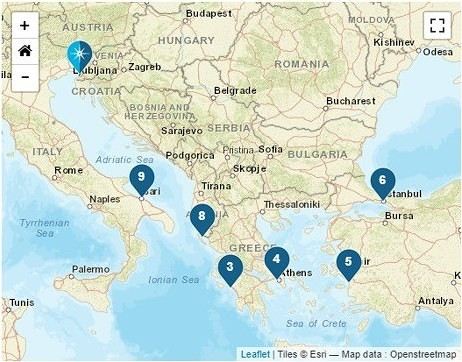
We left home at 6:15 AM—our first cruise departure since moving to Normandy. What I miss most about living in the Gard is how close we were to Marseille Airport. No more hopping over to Marignane in an hour; now we have to plan for a three-hour trip to CDG, even under the best conditions on an early Sunday morning.
It was impossible to book a hotel night before our flight because, starting in April, the Ibis was priced at 450 € per night, and the Mercure was flirting with 800 €—breakfast not included, of course. 😏
I had a feeling there must’ve been a conference or something going on… Turns out, it was just the auto show. They simply adjusted the room prices to match the cost of the cars. 😛
Our flight took us to Venice, where we caught a FlixBus to Trieste. We arrived at Trieste’s train station in the afternoon and walked to our hotel in the city center.
After treating ourselves to an amazing pizza at a restaurant (Di Napoli Maestri Pizzaioli, Via Armando Diaz 10) for a very reasonable price, we enjoyed the mild evening temperature while exploring the stunning buildings of this charming city by night. These magnificent structures are a testament to the city’s past. Trieste became Austrian in 1382 due to its complicated relationship with Venice, and it wasn’t until 1918, at the end of World War I, that it became Italian again. The city’s lighting beautifully highlights the architecture of the buildings.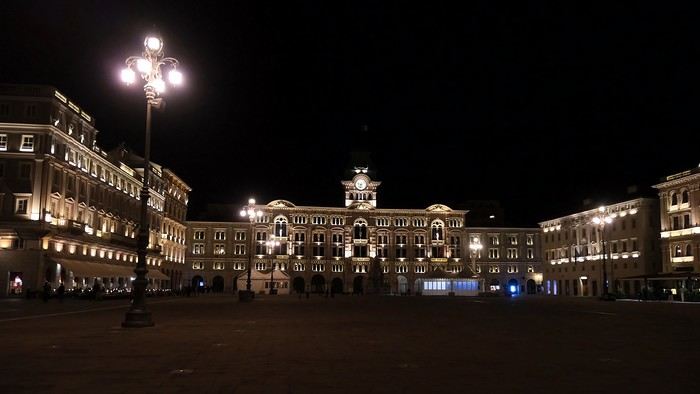
The terraces were lively, and the atmosphere was so warm and inviting that we wanted to stay out even longer.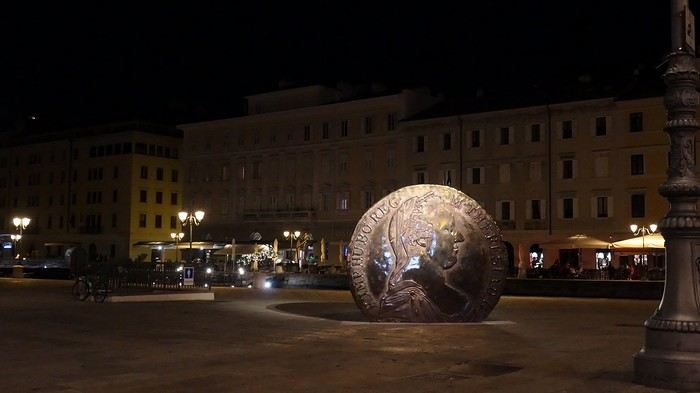
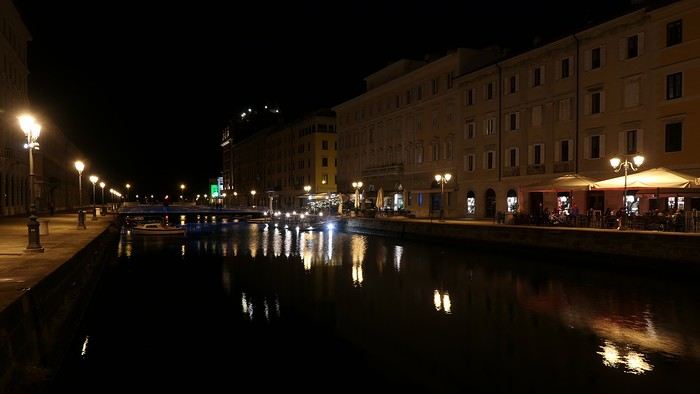
But we’d been up since 4 AM, so we were happy to retreat to the quiet of our hotel, located in the pedestrian center just a few steps from the port (Urban Hotel Design—highly recommended).
More to come soon.
What a joy to be back here and pick up where we left off after all these months of hiatus.
I hope you’ll enjoy the story of this little trip around the Eastern Mediterranean. This cruise was the perfect way to satisfy our longing to return to Greece and Istanbul. The end of the season, until late November, is the best time to visit the Mediterranean in my opinion—when climate disruptions don’t get in the way.
Departing from Trieste, our stops were Katakolon, Piraeus, Kusadasi, Istanbul, Corfu, and Bari, before returning to Trieste and then Venice, where we planned a very short 24-hour stay.
We left home at 6:15 AM—our first cruise departure since moving to Normandy. What I miss most about living in the Gard is how close we were to Marseille Airport. No more hopping over to Marignane in an hour; now we have to plan for a three-hour trip to CDG, even under the best conditions on an early Sunday morning.
It was impossible to book a hotel night before our flight because, starting in April, the Ibis was priced at 450 € per night, and the Mercure was flirting with 800 €—breakfast not included, of course. 😏
I had a feeling there must’ve been a conference or something going on… Turns out, it was just the auto show. They simply adjusted the room prices to match the cost of the cars. 😛
Our flight took us to Venice, where we caught a FlixBus to Trieste. We arrived at Trieste’s train station in the afternoon and walked to our hotel in the city center.
After treating ourselves to an amazing pizza at a restaurant (Di Napoli Maestri Pizzaioli, Via Armando Diaz 10) for a very reasonable price, we enjoyed the mild evening temperature while exploring the stunning buildings of this charming city by night. These magnificent structures are a testament to the city’s past. Trieste became Austrian in 1382 due to its complicated relationship with Venice, and it wasn’t until 1918, at the end of World War I, that it became Italian again. The city’s lighting beautifully highlights the architecture of the buildings.
The terraces were lively, and the atmosphere was so warm and inviting that we wanted to stay out even longer.
But we’d been up since 4 AM, so we were happy to retreat to the quiet of our hotel, located in the pedestrian center just a few steps from the port (Urban Hotel Design—highly recommended).
More to come soon.
Eastern Crete in September 2024
Travel journal in Eastern Crete from September 8th to 29th, 2024
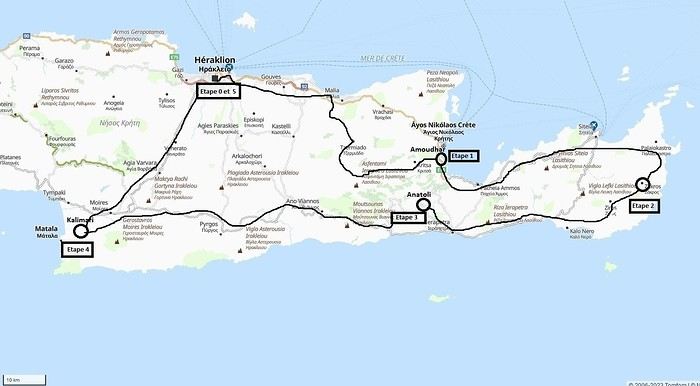 Our 21-day itinerary
Sunday, 08/09: Once again—and this is the eighth time—we’re setting off, the four of us: Patrick, Michelle, Jacques, and Monique, for the Greek islands. This time, we’ve chosen Crete. No need to wake up at 3 or 4 a.m. to reach Basel-Mulhouse Airport at dawn to catch the first flight to Greece at 6 a.m.! Given the prohibitive prices charged by EasyJet, we found flights that were half the price from Zurich Airport, which is accessible in 3 hours by train from Colmar. Pierre-Paul drives all four of us to Colmar train station, where we take the train to Basel and then, 20 minutes later, the direct train to Zurich Airport. After wandering around the airport, we go for a coffee at 6 € each! We’re in Switzerland, after all. The other dining areas all have vending machines for selecting and paying for meals—soon, there won’t be anyone left to serve you! After a short wait, we take off at 7:45 p.m. (20 minutes late) in an Aegean Airbus A321. Free in-flight meal service isn’t bad either! We land in Heraklion around 11:15 p.m. We pick up our rental car (a red Seat Ibiza) at the airport and head straight to our apartment, located 2 km from the city center. Thanks to the GPS, we find it quickly. It’s a beautiful, fully renovated apartment with all the comforts and well-equipped. On the table, there’s wine, bottles of water, jam, coffee, etc. Given the late hour, we won’t stay up long.
Monday, 09/09: To enhance our breakfast, Michelle and Monique set off to find a bakery nearby. They return with croissants and donuts—yum... Then we head to the west coast. The highway follows the coastline, but we prefer taking the old road to Malia, our first stop. We visit the major archaeological site of this Minoan city under the hot sun. The site covers a vast area, but the ruins aren’t very evocative except for a few beautiful amphorae scattered around. The explanations in a small house at the entrance are interesting and help us better understand the organization of the ancient city with its different districts. From there, we head toward the nearby mountains to see the thousand-year-old plane tree in the village of Krasi. We take the opportunity to enjoy an excellent lunch of moussaka and delicious gemista at the Krassopsychia taverna in the village center. Pleasant surprise: the prices are still reasonable, with a bill of 70 € for four, including wine and water. The friendly tradition of complimentary dessert and glasses of raki continues—great! We’ve set the bar high right away! Let’s hope the rest lives up to it! On the way back toward the Lassithi Plateau, we stop at the Kardiotisa Monastery perched high on the mountain to enjoy a magnificent view of the entire region. Just a little further, we arrive at the Lassithi Plateau: the presence of small windmills used to pump water from the ground is the typical feature of this plateau. We complete a full loop around the plateau, passing by numerous orchards and vegetable gardens that occupy the entire space. At the end of the plateau, we once again cross mountain passes via winding roads that bring us near Agios Nikolaos. Our apartment is located about ten kilometers further south in Amoudhara. The owner, who was notified, waits for us and shows us her superb apartment, whose large terrace overlooks the entire Mirabello Bay. She then gives us valuable information about the different beaches in the area. Dinner will be frugal, given our hearty lunch in Krasi!
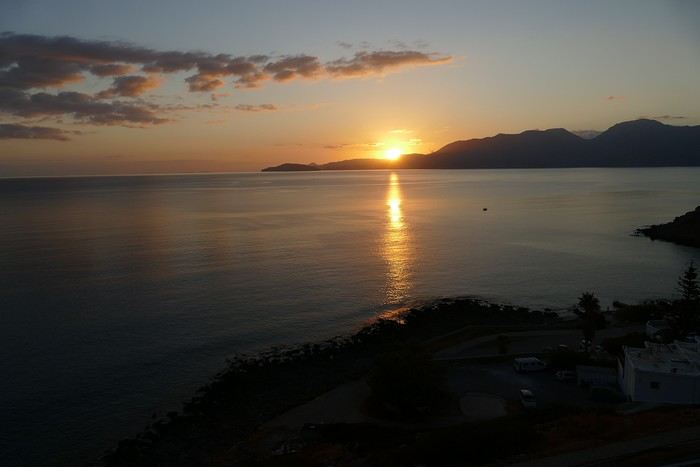 Sunset over Mirabello Bay
Tuesday, 10/09: A bit of a gray sky when we wake up around 8 a.m., but the sun will soon triumph over the scattered clouds. For our first swim, we opt for Voulisma Beach, even though our host warned us it was a bit “crowdy.” That’s understandable given the beautiful emerald color of the sea and the lovely curve of the beach. To avoid the big crowds, we move toward the eastern part of the beach, accessible via a steep staircase. The water is very warm, and this first dip is very pleasant. Before returning to the apartment, we stop at the bakery to buy spinach pies, essential ingredients to accompany our Greek salad for lunch. Of course, everything will be washed down with ouzo, which will remain our favorite drink for the next three weeks—but in moderation!!! A nap is in order after all that effort. In the late afternoon, we drive to Agios Nikolaos, the main seaside resort in Crete. We’re not too enthusiastic about visiting this mass-tourism resort, but the center of Agios, concentrated around the small inner harbor, is pleasant to see despite the plethora of shops and restaurants. We dine a little outside the harbor in the shaded courtyard of the Avli taverna: the oven-baked lamb, squid with spinach, and cuttlefish ink orzo pasta are all highly appreciated. We still stay under a 75 € bill for four.
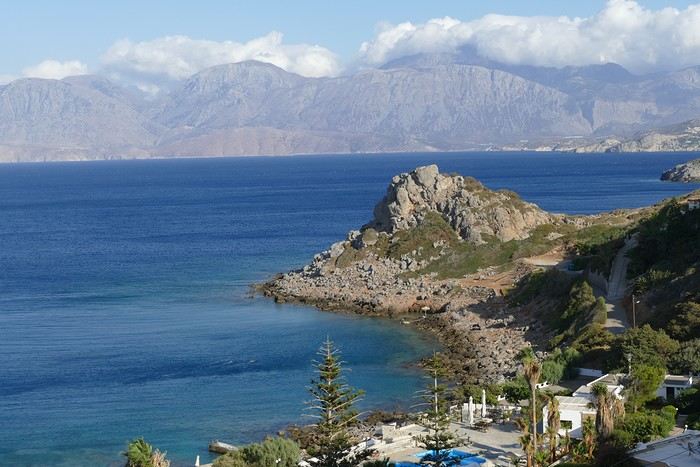 Mirabello Bay seen from our terrace
Wednesday, 11/09: At 8 a.m., the terrace is already bathed in sunlight, and it’s already quite hot. The small parasol barely gives us enough shade, but we’re not complaining! For our second swim, we head to a tiny beach recommended by our host, just 3 minutes by car from our place. The path leading to it is very discreet, and we don’t find it right away! It’s a small sandy cove with a few welcome tamarisk trees for shade. When we arrive, there are two swimmers, and there won’t be more than five or six in the morning. After lunch and a nap, we head to the beautiful village of Kritsa, just a few kilometers away. It’s too late to visit the beautiful church of Kera Panagia, which is already closed. We settle for the exterior, which is worth a look. The weather is clouding over, and big clouds are gathering. Upon arriving in Kritsa, a heavy shower forces us to take shelter in the Platanos taverna in the village center, and since it’s nearly 7 p.m., we decide to stay and dine there. Good choice—excellent meze: croquettes and stuffed zucchini flowers, gigantes beans, grilled tomatoes and feta, and pancetta as the main dish. The rain stops just as we decide to head back.
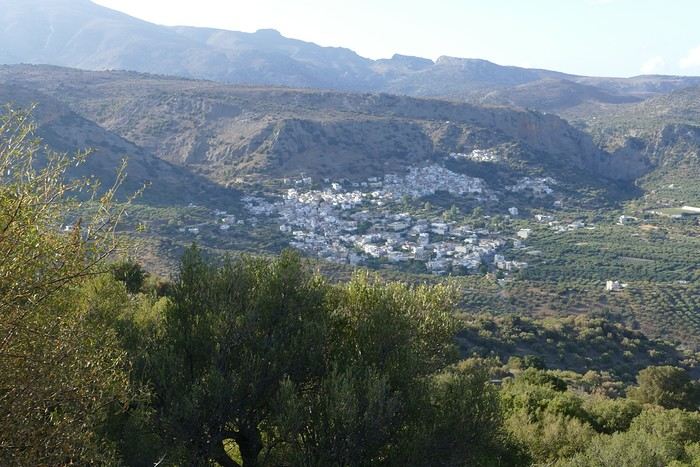 Village of Kritsa
Thursday, 12/09: Our terrace faces east, so we get to watch the sunrise around 7 a.m.—it’s truly a beautiful sight we never tire of. Around 9 a.m., we head to the village of Plaka, where boats depart for the island of Spinalonga, located north of Agios Nikolaos. We board the first boat, which sets sail at 10 a.m., and we’re not alone—the boat is practically full. After 10 minutes, we land on the island at the same time as several other boats from Elounda or Agios. Needless to say, there are already quite a few people walking through the streets of the leper village. The visit remains interesting and moving as we read the explanatory panels recounting the island’s history under Byzantine and then Turkish rule, followed by its transformation into a leper colony. As soon as we climb toward the top of the island via more or less maintained paths, there’s almost no one left. The 360° view from up there is stunning.
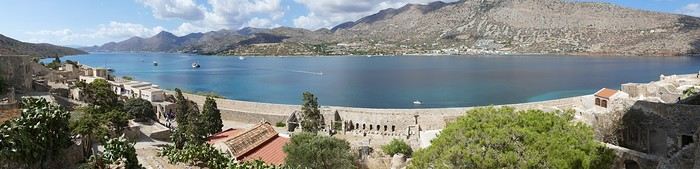
Spinalonga Island
The heat is now unbearable, and we can’t wait to get back home to have lunch on our terrace and rest. In the late afternoon, we go grocery shopping at the AB supermarket at the entrance of Agios. We had spotted another nice restaurant in our guide, but unfortunately, there’s a different one at the indicated location that doesn’t inspire us. So, we return to the Avli taverna for another dinner just as good as the first.
Friday, 13/09: We repeat yesterday’s successful program: a swim in our little cove, lunch on the terrace, a nap, and then, in the late afternoon, we discover another nearby village, Kroustas, nestled in the olive groves near Kritsa. Much less touristy than Kritsa, it’s mostly inhabited by locals, especially the elderly who are enjoying the cool air on their chairs—if you can call it cool given the still-high temperatures in the late afternoon! We then return to visit Kritsa, which we hadn’t been able to explore due to the rain. Dinner at a taverna in the village center at a very reasonable price.
Saturday, 14/09: Today, we move to our new base further east. We start with a high viewpoint at the Faneromeni Monastery, which overlooks Mirabello Bay. The monastery itself is of little interest as it’s under renovation with excessive concrete work. We continue to the village of Kavoussi to see another exceptional tree after a few kilometers on a dusty, bumpy track. It’s an olive tree said to be about 3,200 years old—impressive, and the countryside is very beautiful. It’s time to find a place for lunch. We find one in the charming little port of Mohlos, where a few tavernas surround a very nice small beach. Our choice falls on the Bogazzi taverna, where we enjoy fried fish. To reach our new base in Zakros, we still have to drive through the mountains before reaching Sitia, Paleokastro, and finally Zakros. The region is beautiful, with olive groves and rows of wind turbines taking advantage of the strong wind near the northern tip of the island. In Zakros, we’re greeted by our very friendly host. Here too, we have all the comforts and a beautiful terrace overlooking the village. The apartment has reversible air conditioners, but the overly simple instructions leave us puzzled. Thinking we’ve set it correctly, we realize a little too late that it’s blowing hot air over 30°C! After numerous attempts and testing several confusing programs, we finally succeed! Dinner on our new terrace.
Sunday, 15/09: This morning, we get up early to hike in the “Gorge of the Dead” while it’s still cool. The sky is blue as usual! We park in the nearest parking lot and start our descent via a beautiful path winding through the olive groves. A little further on, the landscape opens up, and the path, now a stony trail, begins the descent to the dry riverbed. On either side of the riverbed rise beautiful reddish cliffs.
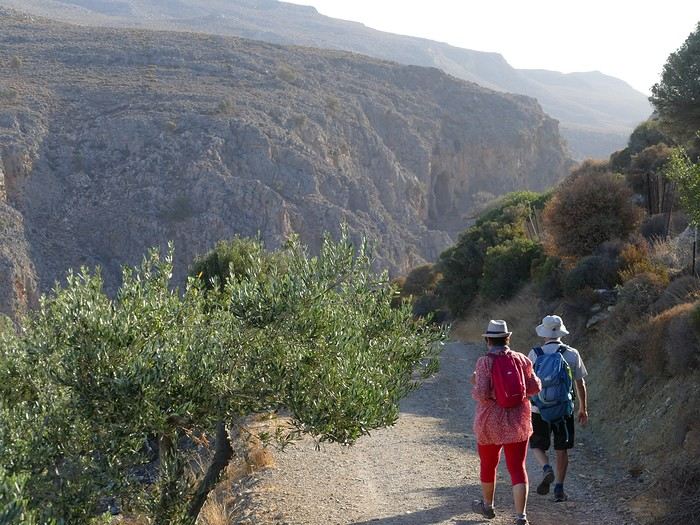
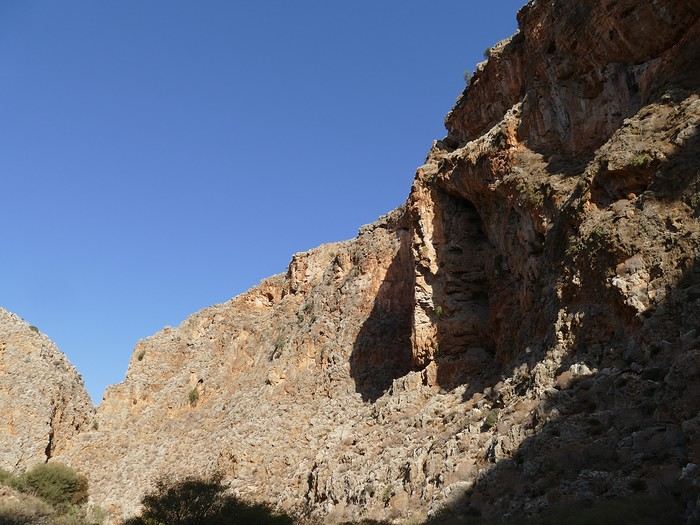
Gorge of the Dead
The trail winds its way through this narrow gorge with difficulty. It was in the many caves visible halfway up the slope that the Minoans buried their dead, hence the name “Gorge of the Dead.” The gorge opens onto a beautiful small pebble beach. A swim is welcome after this hike that made us sweat. The hike took us 1 hour and 25 minutes, and a little less on the way back. Meanwhile, Monique did some shopping and prepared an excellent lunch. In the late afternoon, we go down to dine at Platanakis, a taverna in the small village of Kato Zakros.
Monday, 16/09: This morning, we explore the northern part of the east coast near Palekastro. We start with a dip at the beautiful Hionia Beach near Palekastro. The water is still just as nice, but a light breeze is blowing—not enough to spoil our fun! Seeing all the wind turbines lining the ridges, it’s no surprise.
 Grocery shopping in Palekastro and return to Zakros. A little rain in the late afternoon and an excellent dinner at Iannis Mitsakakis’ Taverna in Adravastis. These are the kind of small tavernas we love—unpretentious, a few tables on a terrace, a warm welcome, a short menu guaranteeing freshness, tasty dishes prepared by the server’s mom, and a light bill. What more could you ask for!
Tuesday, 17/09: We head back toward Palekastro to do some shopping, but it’s also the road to the Toplou Monastery. There, we see a collection of magnificent icons dating from the 15th to the 20th century. We can also admire drawings of Orthodox religious architecture. We continue toward the Mavros Akrotiri headland to enjoy the view of the sea and rocky capes. On the way back to our place, we make a small detour to see the famous Vai palm grove. Meh... As for Vai Beach, it’s filled with paid umbrellas and sunbeds, and there are so many people that we flee. Plus, having to pay for parking is another reason to snub this trendy beach. We prefer our Hionia Beach, which we already appreciated the other day. In the late afternoon, Pat and I start the trail that begins at Kato Zakros Beach heading south. The poorly marked path crosses a plateau of sharp limestone. The paint and cairn markings are no longer very visible, and with dusk approaching, we turn back toward Kato Zakros. Dinner at the Platanakis taverna—less good than last time.
Wednesday, 18/09: To avoid the scorching sun, Pat, Mimi, and I get up earlier than usual to hike the Hohlakies Gorge. At this early hour, the sky is quite cloudy, and it’s drizzling. When we arrive in the village of Hohlakies, we park in front of a small chapel, the start of the hike. The sky is now completely clear. The trail starts among the olive groves, then after passing through a gate, we descend into the gorge filled with large rocks. We’re alone in the world, and the landscape is magnificent. A few wild goats clinging to the cliff watch us from above. After 1 hour and 15 minutes, we emerge onto the wonderful Karoumès Beach. A pleasant swim, then back to civilization! A walk in the late afternoon in Zakros to discover the beautiful springs route. Dinner in Adravastis.
Thursday, 19/09: Another move: Before heading to our next stop, we make a detour to see the beautiful Keratokampos Beach and can’t resist a swim in the still-warm, clear water. We continue our journey via Ziros, then reach the south coast and have lunch at the Stephi taverna in Ferma—excellent meal! The south coast is quite urbanized and has much less charm than the east coast we’ve just left! The numerous plastic greenhouses are partly to blame. We stop for groceries in Ierapetra. Around 3 p.m., we arrive at our destination in the small perched village of Anatoli. Our lodging is at the top of the village, and from the path leading to it, we have a magnificent view of the coastal plain, unfortunately overloaded with plastic greenhouses. It reminds us of the landscapes of El Ejido in Andalusia.
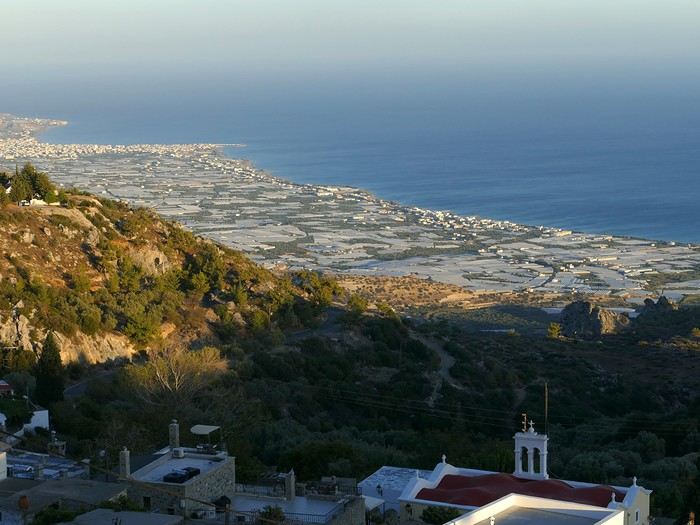 View of the Ierapetra coast from Anatoli
Friday, 20/09: A walk and discovery of the hamlet of Anatoli. There are few services—a tiny grocery store, a taverna, and that’s it. Fortunately, the traveling baker arrives and honks. We take the opportunity to buy fresh bread. Leaving the village, we take a path that should lead us to the hamlet of Drygies. The landscape is beautiful. We walk through a lovely pine forest before arriving at the hamlet. The path continues to a taverna that’s closed today, with a superb terrace overlooking the coast. Luckily, the owner arrives and informs us that the taverna will be open next Sunday and that we can enjoy barbecued meat. Noted! We head back to Anatoli via the small paved road with, fortunately, very limited traffic. Lunch on our terrace, then a dip in our private pool! The water is noticeably cooler than at the beach. Dinner at the village taverna: there’s only one menu—meze starters, souvlaki, water, wine, and bread—all for 35 €! We think we’re dreaming—was there a mistake? No.
Saturday, 21/09: We discover the beach of the village of Myrtos, a small seaside resort that’s quite touristy but on a human scale. We swim in the western part of the beach, and once again, we’re alone in the water. The best part: warm water and tamarisk trees for welcome shade. There’s even a shower to rinse off! In the late afternoon, Pat and I decide to go for a hike in the Selakano pine forest. To get there, we take a narrow, winding, and poorly paved road after the village of Christos. Plus, at this altitude, we encounter clouds clinging to the mountain, so it’s drizzling, and visibility is reduced. We decide to turn back and return to Anatoli. As compensation, we take the path that passes in front of the lodging and leads us to the Timios Stavros chapel, which crowns the summit of the nearby mountain. We arrive at the summit just in time for the sunset at 7 p.m. Breathtaking 360° panorama and magnificent colors!
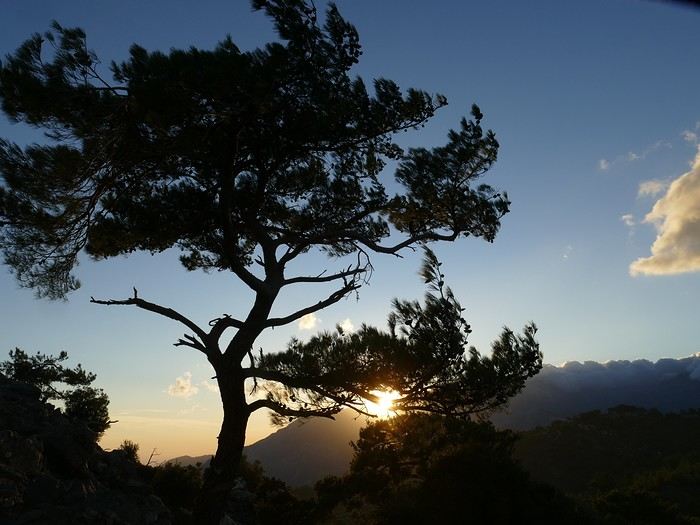 Sunset from Anatoli
Sunday, 22/09: This morning, Pat, Mimi, and I go for a hike in the Sarakina Gorge, located about 12 km from Anatoli via a beautiful road winding through irrigated olive groves. We park in the small parking lot before the trail. At the start, the path follows a levada (small irrigation canal) and quickly enters a very narrow gorge flanked by high cliffs. The riverbed is cluttered with huge rocks blocking the passage. No matter—in the technical sections, ropes or ladders allow us to overcome these obstacles with a bit of skill. You can imagine how quickly the riverbed must rise during a storm, given the narrowness of the gorge!
We progress slowly through this magnificent and impressive rocky chaos. At the exit of the gorge, we take another return path that partly follows the paved road. Back in Anatoli, we go to lunch at the Drygies taverna. We sit at the edge of the terrace under a huge tree that covers almost the entire terrace and order grilled lamb dishes prepared according to the ancient “antikristo” method.
Monday, 23/09: Departure for our last stop before Heraklion. We thought about swimming at Tertsa Beach, but it turns out to be less pleasant than expected, with pebbles and an uneven rocky plateau. So, we return to Myrtos Beach, which we know well and suits us perfectly. We head west, leaving the coast a bit. Around 3:30 p.m., we arrive at our destination in the village of Kamilari, near the famous Matala spot. We’ve rented a beautiful, modern, well-equipped apartment with a lovely shaded terrace. The owner is very friendly and explains everything necessary for a good stay. We explore the quite touristy village with its few tavernas, all full of tourists, mostly Germans.
Tuesday, 24/09: Visit to the village of Sivas, well restored thanks to the Germans, who have invested a lot here. We take the opportunity to scout out “friendly” tavernas, then go for a swim at Kalamaki Beach. Apart from a small sandy access, you have to enter the water via a chaotic limestone plateau—proof of this is that Monique trips slightly when entering the water. A group of very unfriendly German women blocks the sandy passage and doesn’t hesitate to push swimmers they deem too close. Back home, lunch, and a nap. In the late afternoon, we drive to visit the nearby Phaistos site. We benefit from very beautiful lighting. From the elevated site, we overlook the Messara Plain with a beautiful view of the olive grove checkerboards highlighted by the late afternoon sun. The site itself is quite vast, but to appreciate it, it’s better to read the explanatory panels placed throughout the different quarters. At this hour, the site is almost empty, and the beautiful light adds charm to the visit.
Wednesday, 25/09: Departure for the village of Matala, which doesn’t interest us in itself, having been there during the “hippie” era in 1976. However, going to Red Beach, only accessible by taking a path overlooking this area, appeals to us much more. We park in the large parking lot just outside the village and start our climb, which brings us to a pass from where we can admire this beautiful red-sand beach framed by beautiful cliffs plunging into the sea. The weather is magnificent, and at this early hour, there aren’t many people yet. We swim in the free part located near the cliff on the right when arriving at the beach. The sea is like glass, warm, and without a single ripple—a real treat! After half an hour, we turn back, and now there are many people rushing on this path, not at all made for feet in sandals or flip-flops, yet many vacationers venture out like this! Matala lives up to its image—a trendy place, full of shops, bars, and restaurants. You could be in any seaside resort with a standard global urbanism, lacking particular charm. Back home. In the late afternoon, a walk through the olive groves surrounding Kamilari, then dinner at Evangelina’s, who runs the Minoan Parassies taverna in the middle of the olive groves. Evangelina is quite a character: we came to reserve a table for 8 p.m. when it was only 7 p.m., but since we lingered near her restaurant, she prepares a table for us and urges us to sit down! And there she takes our order, and a little later, the meze arrive, followed by the main dishes. We finish this good dinner with several generous glasses of raki, accompanied by Evangelina’s encouragements, repeating “poya poya bravo bravo” in a loop. We’re in great shape too, by the way! We return in the middle of the night, on foot, fortunately, with the path vaguely lit by our phones...
Thursday, 26/09: This morning, we discover a new beach, Kommos Beach, not far from Kamilari either. It’s a long sandy beach, a small part of which is dedicated to paid umbrellas and sunbeds, and the rest is free. We spot a tamarisk tree to take shelter from the still-hot sun, and once again, we enjoy clear, warm water. The few swimmers spread out easily over nearly 500 meters of beach. In the late afternoon, Pat and I go to admire the sunset from the hill near our lodging. The hill, covered with olive trees, is threatened by a planned housing development of large cubic villas—trends dictate. Concrete never stops...
Friday, 27/09: We thought about leaving the car at the Odiyitria Monastery, the end of the paved road, but since the track descending to the cave remains drivable, we park 3 km further at the junction of the track leading to Kali Limenes Beach. We still have to walk for half an hour on a less drivable track, and then we’re at the entrance of the Farango Gorge. It’s a beautiful, easy hike since we follow the dry pebble riverbed. Before arriving at the beach, there’s a very beautiful small chapel sheltered under a large cliff, beautifully lit at this early hour.
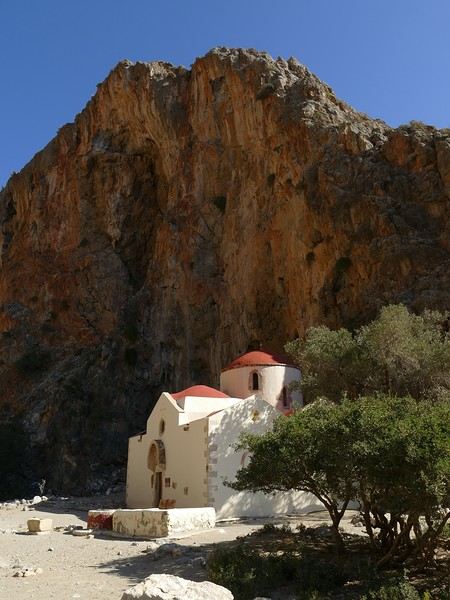
Agio Farango Chapel
A few climbers are scaling the cliff, and about ten swimmers are enjoying the sea. Return to the car under the hot sun. In the late afternoon, we all return to visit the interesting Odiyitria Monastery. Last swim at Kommos Beach and an excellent dinner at the Sigelakis taverna in Sivas.
Saturday, 28/09: There’s an end-of-vacation atmosphere... We pack our bags and head north. A short stop to see the village of Vorri, and a little over an hour later, we arrive in the big city of Heraklion. Since it’s too early to check into the apartment, we park in the city center to visit the famous archaeological museum. It’s indeed a must-see highlight of our stay in Crete. All four of us are amazed by the quantity and quality of the objects presented from the Minoan civilization. After more than 2 hours, we come out without having seen everything, but we’re a bit overwhelmed by all these wonders. Lunch at a nice little taverna very close to the Titus Church. We go to take possession of our apartment—the same as on the way there, still just as satisfying. In the late afternoon, I go alone for a walk in the historic district of the city, passing by the Morosini Fountain, which is bustling with people—some seated at café terraces, others standing and chatting. There’s a lively atmosphere here. A little further on are the Venetian loggia and the Agios Titos Church. I walk down to the old Venetian port to stroll along the jetty and admire the fortifications under beautiful late-afternoon lighting, then return to the apartment. Dinner near our place at Kiriakis, a “chic” restaurant but with very reasonable prices and excellent cuisine.
Sunday, 29/09: Wake-up at 3:30 a.m., quick coffee, and drive to the nearby airport. We leave the car in the parking lot. Already a lot of people at this early hour. Since we don’t have checked luggage, we go straight to security, which goes fairly quickly, then it’s waiting time and takeoff on time in an Airbus A321 for a 45-minute flight to Athens. We take off again in another Airbus A321 with a 50-minute delay to arrive in Zurich at 11:10 a.m. local time. Then we have to take the train to Basel and then the one to Colmar. With fewer Sunday services, we won’t arrive in Colmar until around 4 p.m.
Conclusion All four of us returned very satisfied with this stay in Crete for several reasons: - We found superb beaches with clear, warm water and often very few vacationers. - The few hikes we did were magnificent, especially those where the trails went through gorges leading to deserted beaches. - We greatly appreciated Cretan gastronomy—there were so few disappointments that we can count them on one hand. - All the accommodations we booked turned out to be superb, with the icing on the cake being the very friendly welcome from our hosts. - Generally, contacts with Cretans were always very warm despite the language barrier—we speak a little Greek. - We also appreciated the diversity of landscapes in this eastern part of Crete, with plateaus and mountains with splendid rugged reliefs.
Note: The photo album is available by clicking on this link: https://photos.app.goo.gl/hfdjQndA5eXkL5k7 Captions are only visible per photo by clicking on the circled “i” in the top right. Budget: approximately 3,300 € per couple for 21 days, including train and flights Budget details per couple: - Flight Zurich-Heraklion: 440 € - Trains Colmar-Basel-Zurich round trip for 4: 442.40 € (221 € per couple) - Accommodation: 2,431 € / 21 = 115.80 € per night for 4 (1,216 € per couple) - Car rental for 21 days: 684 € + 145 € fuel (1,150 km) (414 € per couple) - Restaurants, food, etc.: 1,009 €
Our 21-day itinerarySunday, 08/09: Once again—and this is the eighth time—we’re setting off, the four of us: Patrick, Michelle, Jacques, and Monique, for the Greek islands. This time, we’ve chosen Crete. No need to wake up at 3 or 4 a.m. to reach Basel-Mulhouse Airport at dawn to catch the first flight to Greece at 6 a.m.! Given the prohibitive prices charged by EasyJet, we found flights that were half the price from Zurich Airport, which is accessible in 3 hours by train from Colmar. Pierre-Paul drives all four of us to Colmar train station, where we take the train to Basel and then, 20 minutes later, the direct train to Zurich Airport. After wandering around the airport, we go for a coffee at 6 € each! We’re in Switzerland, after all. The other dining areas all have vending machines for selecting and paying for meals—soon, there won’t be anyone left to serve you! After a short wait, we take off at 7:45 p.m. (20 minutes late) in an Aegean Airbus A321. Free in-flight meal service isn’t bad either! We land in Heraklion around 11:15 p.m. We pick up our rental car (a red Seat Ibiza) at the airport and head straight to our apartment, located 2 km from the city center. Thanks to the GPS, we find it quickly. It’s a beautiful, fully renovated apartment with all the comforts and well-equipped. On the table, there’s wine, bottles of water, jam, coffee, etc. Given the late hour, we won’t stay up long.
Monday, 09/09: To enhance our breakfast, Michelle and Monique set off to find a bakery nearby. They return with croissants and donuts—yum... Then we head to the west coast. The highway follows the coastline, but we prefer taking the old road to Malia, our first stop. We visit the major archaeological site of this Minoan city under the hot sun. The site covers a vast area, but the ruins aren’t very evocative except for a few beautiful amphorae scattered around. The explanations in a small house at the entrance are interesting and help us better understand the organization of the ancient city with its different districts. From there, we head toward the nearby mountains to see the thousand-year-old plane tree in the village of Krasi. We take the opportunity to enjoy an excellent lunch of moussaka and delicious gemista at the Krassopsychia taverna in the village center. Pleasant surprise: the prices are still reasonable, with a bill of 70 € for four, including wine and water. The friendly tradition of complimentary dessert and glasses of raki continues—great! We’ve set the bar high right away! Let’s hope the rest lives up to it! On the way back toward the Lassithi Plateau, we stop at the Kardiotisa Monastery perched high on the mountain to enjoy a magnificent view of the entire region. Just a little further, we arrive at the Lassithi Plateau: the presence of small windmills used to pump water from the ground is the typical feature of this plateau. We complete a full loop around the plateau, passing by numerous orchards and vegetable gardens that occupy the entire space. At the end of the plateau, we once again cross mountain passes via winding roads that bring us near Agios Nikolaos. Our apartment is located about ten kilometers further south in Amoudhara. The owner, who was notified, waits for us and shows us her superb apartment, whose large terrace overlooks the entire Mirabello Bay. She then gives us valuable information about the different beaches in the area. Dinner will be frugal, given our hearty lunch in Krasi!
Sunset over Mirabello BayTuesday, 10/09: A bit of a gray sky when we wake up around 8 a.m., but the sun will soon triumph over the scattered clouds. For our first swim, we opt for Voulisma Beach, even though our host warned us it was a bit “crowdy.” That’s understandable given the beautiful emerald color of the sea and the lovely curve of the beach. To avoid the big crowds, we move toward the eastern part of the beach, accessible via a steep staircase. The water is very warm, and this first dip is very pleasant. Before returning to the apartment, we stop at the bakery to buy spinach pies, essential ingredients to accompany our Greek salad for lunch. Of course, everything will be washed down with ouzo, which will remain our favorite drink for the next three weeks—but in moderation!!! A nap is in order after all that effort. In the late afternoon, we drive to Agios Nikolaos, the main seaside resort in Crete. We’re not too enthusiastic about visiting this mass-tourism resort, but the center of Agios, concentrated around the small inner harbor, is pleasant to see despite the plethora of shops and restaurants. We dine a little outside the harbor in the shaded courtyard of the Avli taverna: the oven-baked lamb, squid with spinach, and cuttlefish ink orzo pasta are all highly appreciated. We still stay under a 75 € bill for four.
Mirabello Bay seen from our terraceWednesday, 11/09: At 8 a.m., the terrace is already bathed in sunlight, and it’s already quite hot. The small parasol barely gives us enough shade, but we’re not complaining! For our second swim, we head to a tiny beach recommended by our host, just 3 minutes by car from our place. The path leading to it is very discreet, and we don’t find it right away! It’s a small sandy cove with a few welcome tamarisk trees for shade. When we arrive, there are two swimmers, and there won’t be more than five or six in the morning. After lunch and a nap, we head to the beautiful village of Kritsa, just a few kilometers away. It’s too late to visit the beautiful church of Kera Panagia, which is already closed. We settle for the exterior, which is worth a look. The weather is clouding over, and big clouds are gathering. Upon arriving in Kritsa, a heavy shower forces us to take shelter in the Platanos taverna in the village center, and since it’s nearly 7 p.m., we decide to stay and dine there. Good choice—excellent meze: croquettes and stuffed zucchini flowers, gigantes beans, grilled tomatoes and feta, and pancetta as the main dish. The rain stops just as we decide to head back.
Village of KritsaThursday, 12/09: Our terrace faces east, so we get to watch the sunrise around 7 a.m.—it’s truly a beautiful sight we never tire of. Around 9 a.m., we head to the village of Plaka, where boats depart for the island of Spinalonga, located north of Agios Nikolaos. We board the first boat, which sets sail at 10 a.m., and we’re not alone—the boat is practically full. After 10 minutes, we land on the island at the same time as several other boats from Elounda or Agios. Needless to say, there are already quite a few people walking through the streets of the leper village. The visit remains interesting and moving as we read the explanatory panels recounting the island’s history under Byzantine and then Turkish rule, followed by its transformation into a leper colony. As soon as we climb toward the top of the island via more or less maintained paths, there’s almost no one left. The 360° view from up there is stunning.
Spinalonga Island
The heat is now unbearable, and we can’t wait to get back home to have lunch on our terrace and rest. In the late afternoon, we go grocery shopping at the AB supermarket at the entrance of Agios. We had spotted another nice restaurant in our guide, but unfortunately, there’s a different one at the indicated location that doesn’t inspire us. So, we return to the Avli taverna for another dinner just as good as the first.
Friday, 13/09: We repeat yesterday’s successful program: a swim in our little cove, lunch on the terrace, a nap, and then, in the late afternoon, we discover another nearby village, Kroustas, nestled in the olive groves near Kritsa. Much less touristy than Kritsa, it’s mostly inhabited by locals, especially the elderly who are enjoying the cool air on their chairs—if you can call it cool given the still-high temperatures in the late afternoon! We then return to visit Kritsa, which we hadn’t been able to explore due to the rain. Dinner at a taverna in the village center at a very reasonable price.
Saturday, 14/09: Today, we move to our new base further east. We start with a high viewpoint at the Faneromeni Monastery, which overlooks Mirabello Bay. The monastery itself is of little interest as it’s under renovation with excessive concrete work. We continue to the village of Kavoussi to see another exceptional tree after a few kilometers on a dusty, bumpy track. It’s an olive tree said to be about 3,200 years old—impressive, and the countryside is very beautiful. It’s time to find a place for lunch. We find one in the charming little port of Mohlos, where a few tavernas surround a very nice small beach. Our choice falls on the Bogazzi taverna, where we enjoy fried fish. To reach our new base in Zakros, we still have to drive through the mountains before reaching Sitia, Paleokastro, and finally Zakros. The region is beautiful, with olive groves and rows of wind turbines taking advantage of the strong wind near the northern tip of the island. In Zakros, we’re greeted by our very friendly host. Here too, we have all the comforts and a beautiful terrace overlooking the village. The apartment has reversible air conditioners, but the overly simple instructions leave us puzzled. Thinking we’ve set it correctly, we realize a little too late that it’s blowing hot air over 30°C! After numerous attempts and testing several confusing programs, we finally succeed! Dinner on our new terrace.
Sunday, 15/09: This morning, we get up early to hike in the “Gorge of the Dead” while it’s still cool. The sky is blue as usual! We park in the nearest parking lot and start our descent via a beautiful path winding through the olive groves. A little further on, the landscape opens up, and the path, now a stony trail, begins the descent to the dry riverbed. On either side of the riverbed rise beautiful reddish cliffs.
Gorge of the Dead
The trail winds its way through this narrow gorge with difficulty. It was in the many caves visible halfway up the slope that the Minoans buried their dead, hence the name “Gorge of the Dead.” The gorge opens onto a beautiful small pebble beach. A swim is welcome after this hike that made us sweat. The hike took us 1 hour and 25 minutes, and a little less on the way back. Meanwhile, Monique did some shopping and prepared an excellent lunch. In the late afternoon, we go down to dine at Platanakis, a taverna in the small village of Kato Zakros.
Monday, 16/09: This morning, we explore the northern part of the east coast near Palekastro. We start with a dip at the beautiful Hionia Beach near Palekastro. The water is still just as nice, but a light breeze is blowing—not enough to spoil our fun! Seeing all the wind turbines lining the ridges, it’s no surprise.
Grocery shopping in Palekastro and return to Zakros. A little rain in the late afternoon and an excellent dinner at Iannis Mitsakakis’ Taverna in Adravastis. These are the kind of small tavernas we love—unpretentious, a few tables on a terrace, a warm welcome, a short menu guaranteeing freshness, tasty dishes prepared by the server’s mom, and a light bill. What more could you ask for!Tuesday, 17/09: We head back toward Palekastro to do some shopping, but it’s also the road to the Toplou Monastery. There, we see a collection of magnificent icons dating from the 15th to the 20th century. We can also admire drawings of Orthodox religious architecture. We continue toward the Mavros Akrotiri headland to enjoy the view of the sea and rocky capes. On the way back to our place, we make a small detour to see the famous Vai palm grove. Meh... As for Vai Beach, it’s filled with paid umbrellas and sunbeds, and there are so many people that we flee. Plus, having to pay for parking is another reason to snub this trendy beach. We prefer our Hionia Beach, which we already appreciated the other day. In the late afternoon, Pat and I start the trail that begins at Kato Zakros Beach heading south. The poorly marked path crosses a plateau of sharp limestone. The paint and cairn markings are no longer very visible, and with dusk approaching, we turn back toward Kato Zakros. Dinner at the Platanakis taverna—less good than last time.
Wednesday, 18/09: To avoid the scorching sun, Pat, Mimi, and I get up earlier than usual to hike the Hohlakies Gorge. At this early hour, the sky is quite cloudy, and it’s drizzling. When we arrive in the village of Hohlakies, we park in front of a small chapel, the start of the hike. The sky is now completely clear. The trail starts among the olive groves, then after passing through a gate, we descend into the gorge filled with large rocks. We’re alone in the world, and the landscape is magnificent. A few wild goats clinging to the cliff watch us from above. After 1 hour and 15 minutes, we emerge onto the wonderful Karoumès Beach. A pleasant swim, then back to civilization! A walk in the late afternoon in Zakros to discover the beautiful springs route. Dinner in Adravastis.
Thursday, 19/09: Another move: Before heading to our next stop, we make a detour to see the beautiful Keratokampos Beach and can’t resist a swim in the still-warm, clear water. We continue our journey via Ziros, then reach the south coast and have lunch at the Stephi taverna in Ferma—excellent meal! The south coast is quite urbanized and has much less charm than the east coast we’ve just left! The numerous plastic greenhouses are partly to blame. We stop for groceries in Ierapetra. Around 3 p.m., we arrive at our destination in the small perched village of Anatoli. Our lodging is at the top of the village, and from the path leading to it, we have a magnificent view of the coastal plain, unfortunately overloaded with plastic greenhouses. It reminds us of the landscapes of El Ejido in Andalusia.
View of the Ierapetra coast from AnatoliFriday, 20/09: A walk and discovery of the hamlet of Anatoli. There are few services—a tiny grocery store, a taverna, and that’s it. Fortunately, the traveling baker arrives and honks. We take the opportunity to buy fresh bread. Leaving the village, we take a path that should lead us to the hamlet of Drygies. The landscape is beautiful. We walk through a lovely pine forest before arriving at the hamlet. The path continues to a taverna that’s closed today, with a superb terrace overlooking the coast. Luckily, the owner arrives and informs us that the taverna will be open next Sunday and that we can enjoy barbecued meat. Noted! We head back to Anatoli via the small paved road with, fortunately, very limited traffic. Lunch on our terrace, then a dip in our private pool! The water is noticeably cooler than at the beach. Dinner at the village taverna: there’s only one menu—meze starters, souvlaki, water, wine, and bread—all for 35 €! We think we’re dreaming—was there a mistake? No.
Saturday, 21/09: We discover the beach of the village of Myrtos, a small seaside resort that’s quite touristy but on a human scale. We swim in the western part of the beach, and once again, we’re alone in the water. The best part: warm water and tamarisk trees for welcome shade. There’s even a shower to rinse off! In the late afternoon, Pat and I decide to go for a hike in the Selakano pine forest. To get there, we take a narrow, winding, and poorly paved road after the village of Christos. Plus, at this altitude, we encounter clouds clinging to the mountain, so it’s drizzling, and visibility is reduced. We decide to turn back and return to Anatoli. As compensation, we take the path that passes in front of the lodging and leads us to the Timios Stavros chapel, which crowns the summit of the nearby mountain. We arrive at the summit just in time for the sunset at 7 p.m. Breathtaking 360° panorama and magnificent colors!
Sunset from AnatoliSunday, 22/09: This morning, Pat, Mimi, and I go for a hike in the Sarakina Gorge, located about 12 km from Anatoli via a beautiful road winding through irrigated olive groves. We park in the small parking lot before the trail. At the start, the path follows a levada (small irrigation canal) and quickly enters a very narrow gorge flanked by high cliffs. The riverbed is cluttered with huge rocks blocking the passage. No matter—in the technical sections, ropes or ladders allow us to overcome these obstacles with a bit of skill. You can imagine how quickly the riverbed must rise during a storm, given the narrowness of the gorge!
We progress slowly through this magnificent and impressive rocky chaos. At the exit of the gorge, we take another return path that partly follows the paved road. Back in Anatoli, we go to lunch at the Drygies taverna. We sit at the edge of the terrace under a huge tree that covers almost the entire terrace and order grilled lamb dishes prepared according to the ancient “antikristo” method.
Monday, 23/09: Departure for our last stop before Heraklion. We thought about swimming at Tertsa Beach, but it turns out to be less pleasant than expected, with pebbles and an uneven rocky plateau. So, we return to Myrtos Beach, which we know well and suits us perfectly. We head west, leaving the coast a bit. Around 3:30 p.m., we arrive at our destination in the village of Kamilari, near the famous Matala spot. We’ve rented a beautiful, modern, well-equipped apartment with a lovely shaded terrace. The owner is very friendly and explains everything necessary for a good stay. We explore the quite touristy village with its few tavernas, all full of tourists, mostly Germans.
Tuesday, 24/09: Visit to the village of Sivas, well restored thanks to the Germans, who have invested a lot here. We take the opportunity to scout out “friendly” tavernas, then go for a swim at Kalamaki Beach. Apart from a small sandy access, you have to enter the water via a chaotic limestone plateau—proof of this is that Monique trips slightly when entering the water. A group of very unfriendly German women blocks the sandy passage and doesn’t hesitate to push swimmers they deem too close. Back home, lunch, and a nap. In the late afternoon, we drive to visit the nearby Phaistos site. We benefit from very beautiful lighting. From the elevated site, we overlook the Messara Plain with a beautiful view of the olive grove checkerboards highlighted by the late afternoon sun. The site itself is quite vast, but to appreciate it, it’s better to read the explanatory panels placed throughout the different quarters. At this hour, the site is almost empty, and the beautiful light adds charm to the visit.
Wednesday, 25/09: Departure for the village of Matala, which doesn’t interest us in itself, having been there during the “hippie” era in 1976. However, going to Red Beach, only accessible by taking a path overlooking this area, appeals to us much more. We park in the large parking lot just outside the village and start our climb, which brings us to a pass from where we can admire this beautiful red-sand beach framed by beautiful cliffs plunging into the sea. The weather is magnificent, and at this early hour, there aren’t many people yet. We swim in the free part located near the cliff on the right when arriving at the beach. The sea is like glass, warm, and without a single ripple—a real treat! After half an hour, we turn back, and now there are many people rushing on this path, not at all made for feet in sandals or flip-flops, yet many vacationers venture out like this! Matala lives up to its image—a trendy place, full of shops, bars, and restaurants. You could be in any seaside resort with a standard global urbanism, lacking particular charm. Back home. In the late afternoon, a walk through the olive groves surrounding Kamilari, then dinner at Evangelina’s, who runs the Minoan Parassies taverna in the middle of the olive groves. Evangelina is quite a character: we came to reserve a table for 8 p.m. when it was only 7 p.m., but since we lingered near her restaurant, she prepares a table for us and urges us to sit down! And there she takes our order, and a little later, the meze arrive, followed by the main dishes. We finish this good dinner with several generous glasses of raki, accompanied by Evangelina’s encouragements, repeating “poya poya bravo bravo” in a loop. We’re in great shape too, by the way! We return in the middle of the night, on foot, fortunately, with the path vaguely lit by our phones...
Thursday, 26/09: This morning, we discover a new beach, Kommos Beach, not far from Kamilari either. It’s a long sandy beach, a small part of which is dedicated to paid umbrellas and sunbeds, and the rest is free. We spot a tamarisk tree to take shelter from the still-hot sun, and once again, we enjoy clear, warm water. The few swimmers spread out easily over nearly 500 meters of beach. In the late afternoon, Pat and I go to admire the sunset from the hill near our lodging. The hill, covered with olive trees, is threatened by a planned housing development of large cubic villas—trends dictate. Concrete never stops...
Friday, 27/09: We thought about leaving the car at the Odiyitria Monastery, the end of the paved road, but since the track descending to the cave remains drivable, we park 3 km further at the junction of the track leading to Kali Limenes Beach. We still have to walk for half an hour on a less drivable track, and then we’re at the entrance of the Farango Gorge. It’s a beautiful, easy hike since we follow the dry pebble riverbed. Before arriving at the beach, there’s a very beautiful small chapel sheltered under a large cliff, beautifully lit at this early hour.
Agio Farango Chapel
A few climbers are scaling the cliff, and about ten swimmers are enjoying the sea. Return to the car under the hot sun. In the late afternoon, we all return to visit the interesting Odiyitria Monastery. Last swim at Kommos Beach and an excellent dinner at the Sigelakis taverna in Sivas.
Saturday, 28/09: There’s an end-of-vacation atmosphere... We pack our bags and head north. A short stop to see the village of Vorri, and a little over an hour later, we arrive in the big city of Heraklion. Since it’s too early to check into the apartment, we park in the city center to visit the famous archaeological museum. It’s indeed a must-see highlight of our stay in Crete. All four of us are amazed by the quantity and quality of the objects presented from the Minoan civilization. After more than 2 hours, we come out without having seen everything, but we’re a bit overwhelmed by all these wonders. Lunch at a nice little taverna very close to the Titus Church. We go to take possession of our apartment—the same as on the way there, still just as satisfying. In the late afternoon, I go alone for a walk in the historic district of the city, passing by the Morosini Fountain, which is bustling with people—some seated at café terraces, others standing and chatting. There’s a lively atmosphere here. A little further on are the Venetian loggia and the Agios Titos Church. I walk down to the old Venetian port to stroll along the jetty and admire the fortifications under beautiful late-afternoon lighting, then return to the apartment. Dinner near our place at Kiriakis, a “chic” restaurant but with very reasonable prices and excellent cuisine.
Sunday, 29/09: Wake-up at 3:30 a.m., quick coffee, and drive to the nearby airport. We leave the car in the parking lot. Already a lot of people at this early hour. Since we don’t have checked luggage, we go straight to security, which goes fairly quickly, then it’s waiting time and takeoff on time in an Airbus A321 for a 45-minute flight to Athens. We take off again in another Airbus A321 with a 50-minute delay to arrive in Zurich at 11:10 a.m. local time. Then we have to take the train to Basel and then the one to Colmar. With fewer Sunday services, we won’t arrive in Colmar until around 4 p.m.
Conclusion All four of us returned very satisfied with this stay in Crete for several reasons: - We found superb beaches with clear, warm water and often very few vacationers. - The few hikes we did were magnificent, especially those where the trails went through gorges leading to deserted beaches. - We greatly appreciated Cretan gastronomy—there were so few disappointments that we can count them on one hand. - All the accommodations we booked turned out to be superb, with the icing on the cake being the very friendly welcome from our hosts. - Generally, contacts with Cretans were always very warm despite the language barrier—we speak a little Greek. - We also appreciated the diversity of landscapes in this eastern part of Crete, with plateaus and mountains with splendid rugged reliefs.
Note: The photo album is available by clicking on this link: https://photos.app.goo.gl/hfdjQndA5eXkL5k7 Captions are only visible per photo by clicking on the circled “i” in the top right. Budget: approximately 3,300 € per couple for 21 days, including train and flights Budget details per couple: - Flight Zurich-Heraklion: 440 € - Trains Colmar-Basel-Zurich round trip for 4: 442.40 € (221 € per couple) - Accommodation: 2,431 € / 21 = 115.80 € per night for 4 (1,216 € per couple) - Car rental for 21 days: 684 € + 145 € fuel (1,150 km) (414 € per couple) - Restaurants, food, etc.: 1,009 €
Adventure in Morocco
I’m not going back, the trip is in the past. I’m posting it anyway because the country probably hasn’t changed enough to make the story outdated, and the astonishing beauty of the place deserves to be shared here.
Saturday, May 31, 2014 Mulhouse - Marrakech
A flight that drags on for three and a half hours. Everything goes smoothly until immigration. Like almost everywhere, you have to fill out a little form with your details and arrival address. The problem comes when you hand it to the customs officer with your passport. Right away, you see the lines are way too long for the number of officers working. I steer Dom toward a line further to the left that’s clearly moving faster than the middle ones. Then I firmly pull him to the far left where I think I spotted a new counter opening. Big mistake. Huge. Because that line is notorious for how slowly the security agent checks each person. At 10 minutes per person, with about fifteen ahead of us, we’re looking at two and a half hours. The wait becomes torture. Everyone gets edgy. We watch enviously as people who were way behind us initially zip through the other lines. You feel like complaining. My advice? Don’t. You have no idea how much a pissed-off customs officer can ruin your day! The rule: stay calm and suck it up. Once that hurdle’s over, a taxi and boom, we’re at the Gallia, a no-frills but charming hotel just steps from Jemaa El Fna square. This place is insane! It’s teeming with people. You stick out like a sore thumb with your camera—suddenly, a ton of people want to be your best friend! You’re basically a walking wallet!
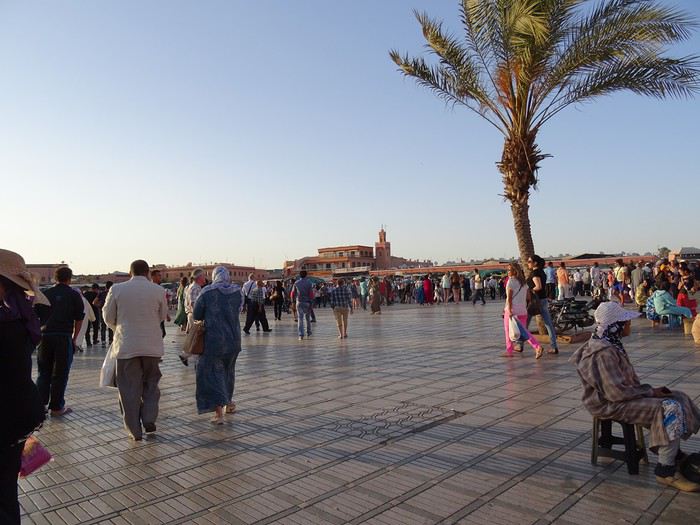
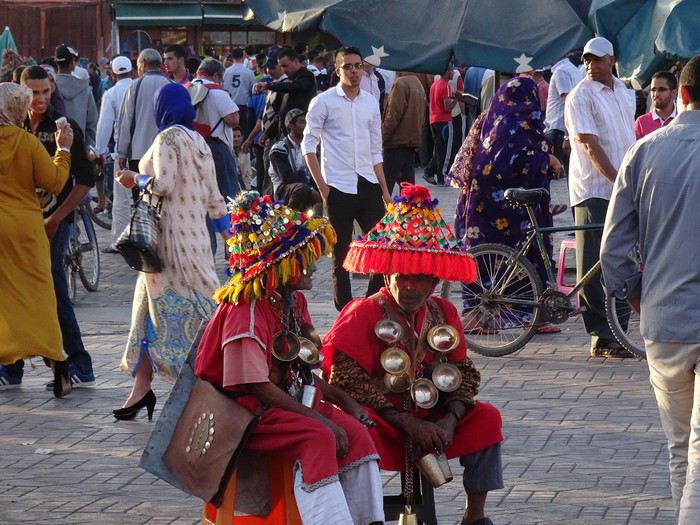
We’ve got a meet-up with friends who are here on a work trip with their company’s social committee.
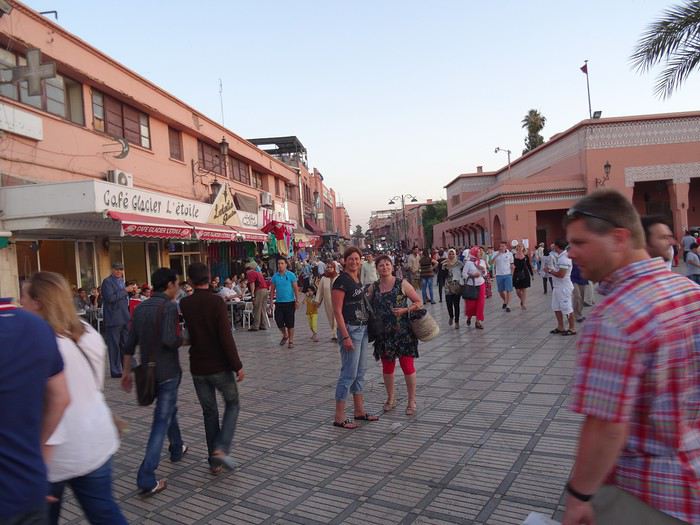
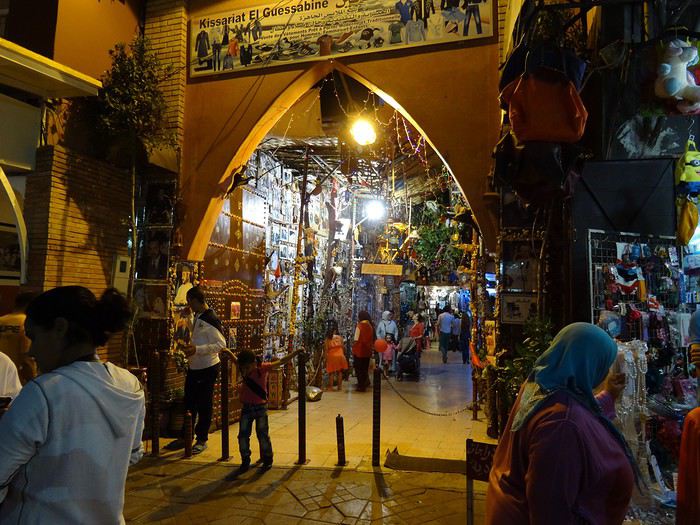
We fully embrace our tourist roles—eating at restaurants made for us, with belly dancers who insist we join in. We go with the flow, we’re not prudes, we have a great evening, no way we’re missing out on the fun...
Sunday, June 1, 2014 Marrakech
Super nice breakfast in the hotel’s patio, a real riad, beautifully decorated.
Originally, we’d planned a trip to the Atlas Mountains, but we ended up wandering around the city instead. Before we knew it, we were in the middle of the central souk’s labyrinth. It’s a feast for the eyes, ears, and especially the nose!
Saturday, May 31, 2014 Mulhouse - Marrakech
A flight that drags on for three and a half hours. Everything goes smoothly until immigration. Like almost everywhere, you have to fill out a little form with your details and arrival address. The problem comes when you hand it to the customs officer with your passport. Right away, you see the lines are way too long for the number of officers working. I steer Dom toward a line further to the left that’s clearly moving faster than the middle ones. Then I firmly pull him to the far left where I think I spotted a new counter opening. Big mistake. Huge. Because that line is notorious for how slowly the security agent checks each person. At 10 minutes per person, with about fifteen ahead of us, we’re looking at two and a half hours. The wait becomes torture. Everyone gets edgy. We watch enviously as people who were way behind us initially zip through the other lines. You feel like complaining. My advice? Don’t. You have no idea how much a pissed-off customs officer can ruin your day! The rule: stay calm and suck it up. Once that hurdle’s over, a taxi and boom, we’re at the Gallia, a no-frills but charming hotel just steps from Jemaa El Fna square. This place is insane! It’s teeming with people. You stick out like a sore thumb with your camera—suddenly, a ton of people want to be your best friend! You’re basically a walking wallet!
We’ve got a meet-up with friends who are here on a work trip with their company’s social committee.
We fully embrace our tourist roles—eating at restaurants made for us, with belly dancers who insist we join in. We go with the flow, we’re not prudes, we have a great evening, no way we’re missing out on the fun...
Sunday, June 1, 2014 Marrakech
Super nice breakfast in the hotel’s patio, a real riad, beautifully decorated.
Originally, we’d planned a trip to the Atlas Mountains, but we ended up wandering around the city instead. Before we knew it, we were in the middle of the central souk’s labyrinth. It’s a feast for the eyes, ears, and especially the nose!
Discussion sur le thème (concours septembre 2020): lieux, scènes de départ ou d'arrivée English translation pending
Rebonjour, 🙂
C'est ici que l'on discute , échange, sur le thème: lieux, scènes de départ ou d'arrivée.
Pour revenir au concours, c'est ici
Cécile découvre Amsterdam, les Pays-Bas et... Metz English translation pending
et hop ! une nouvelle capitale européenne et ses alentours pour Cécile ....
Brel et Béart ont chanté cette charmante ville qui lui tardait de découvrir.. grâce à un CE généreux qui rend accessibles les Adagio Hôtel d'Europe...
11h de route ce dimanche de de retour de vacances... arrivée tardive et nocturne sur place donc dodo le 1er soir
La météo est mouvant mais que rien ne nous arrête... direction Utrecht..
1er choc: des vélos partout !!!! donc vitesse réduite ce qui permet de découvrir des bâtiments insolites

Utrecht centre ses canaux, l'Oudegracht

les touristes n ont pas encore envahi les bars des quais
Même le ramassage des poubelles se fait par péniche!
Pas de chance les 465 marches du Dom sont impossibles d accès
Brel et Béart ont chanté cette charmante ville qui lui tardait de découvrir.. grâce à un CE généreux qui rend accessibles les Adagio Hôtel d'Europe...
11h de route ce dimanche de de retour de vacances... arrivée tardive et nocturne sur place donc dodo le 1er soir
La météo est mouvant mais que rien ne nous arrête... direction Utrecht..
1er choc: des vélos partout !!!! donc vitesse réduite ce qui permet de découvrir des bâtiments insolites
Utrecht centre ses canaux, l'Oudegracht
les touristes n ont pas encore envahi les bars des quais
Même le ramassage des poubelles se fait par péniche!
Pas de chance les 465 marches du Dom sont impossibles d accès
On part en vadrouille au Cambodge! English translation pending
Hello tout le monde !
Vous trouverez ci-dessous mon carnet dédié au voyage que j'ai réalisé l'an passé au Cambodge...
La restriction du nombre de photos imposée par VF m'empêchera de publier ici tous mes clichés. Vous pouvez donc les consulter sur mon site : https://www.onpartenvadrouille.com/ où toutes les journées sont déjà accessibles. Bonne lecture !!!
9 février - Vers un nouveau départ...
L’air de rien, monsieur l’hiver s’est installé confortablement, apportant avec lui dans ses bagages ses amis les nuages grisâtres, nuits tombant à dix-sept heures, gouttes au nez et vieux barbu tout de rouge vêtu. Alors, l’humain lambda boude dans son coin, prétextant une déprime passagère hivernale et une envie d’hibernation foudroyante. Chanceux que je suis, c’est à ce moment précis que chaque année, le génie sort de ma lampe de chevet : « Bonjour maître ! Qu’est-ce qui vous ferait plaisir ?... Un nouveau petit voyage, peut-être ? - Je dis oui, oui et re-oui » ! Chouette, il est temps de préparer les valises et de faire un choix. Choix très difficile entre mes tongs bleues et mes tongs orange. Et puis choix de la destination ! Pique-nique-douille, c’est toi l’andouille de Guéméné ! Suosdei !!! Si je te dis « Salut » dans une langue qui fleure bon l’exotisme, c’est que nous allons ensemble partager un nouveau voyage en direction de l’Asie du sud-est. Et oui, l’Asie du sud-est en hiver, il n’y a rien de mieux pour te requinquer un homme. Et puis l’Asie du sud-est, je l’ai dans la peau, au sens propre comme au sens figuré. Et cette fois-ci, ce sera dans un pays frontalier de la Thaïlande, du Laos et du Vietnam. Pays sous protectorat français jusqu’en 1953, titre d’une chanson de Kim Wilde, pays dont la capitale est Phnom Penh, je suis, je suis, … Ding dong, trop tard !... Le Cambodge !
Qui dit introduction à un nouveau voyage dit aussi interrogatoire. Je mets ma petite robe blanche moulante, je croise, je décroise les jambes, … Oups, j’avais oublié de mettre une culotte… C’est bon, l’interrogatoire peut débuter :
Qui ? Pour m’accompagner, ma femme et mes deux filles qu’on appellera pour cette histoire Sandrine, Anna et Sasha... tout simplement parce que ce sont leurs prénoms ! On devait être accompagné par mes deux parents qui nous ont déjà suivis en Thaïlande il y a maintenant sept ans, mais une petite opération du genou a contraint ma mère à jeter l’éponge dans le visage de son chirurgien au dernier moment. Seul mon père sera de la sauterie en tant que guest star ! On souhaite donc tous ensemble la bienvenue à notre fournisseur d’anecdotes !
Combien ? On part un vendredi et on rentre un dimanche deux semaines plus tard…. Donc si tu comptes bien sur tes dix doigts, ça fait dix-sept jours, voyage compris.
Quoi ? Un voyage mi-routard, mi-pénard. Un circuit optimisé en restant au minimum trois jours par endroit pour éviter de perdre trop de temps dans les transports. De la découverte, des vieilles pierres, de la gastronomie, des rencontres, de la bonne bière, de l’exploration, … Et puis on n’oublie surtout pas de brosser « Martine » dans le bon sens en finissant par quelques jours de repos à l’ombre des cocotiers.
Où ? Pour commencer, le noooooord avec Siem Reap, puis Koh Rong tout au sud. On enchaîne ensuite par Koh Rong Samloem, pour finir tranquillement par Phnom Penh d’où nous regagnerons nos pénates.
Comment ? Scooter, tuk tuk, bus, bateau et tongs. Voilà nos moyens de locomotion ! Come on baby, do the locomooootion...
Bon, je crois avoir répondu à toutes tes questions. Aladin, à la deux, il est donc l’heure d’y aller mon bon génie : Pour tous les amoureux de l’Asie du sud-est ou pour te donner l'envie de le devenir, je déclare donc officiellement ce nouveau voyage ouvert ! Et là, tu te dis peut-être : « Oh, la chance qu’il a !!! » C’est marrant toutes ces personnes qui te répondent systématiquement ça quand tu leur annonces que tu pars en voyage… Premièrement, je ne vois pas ce que la chance vient faire là-dedans puisqu’il suffit de saisir son numéro de carte bancaire sur internet pour gagner un billet d’avion. Crois-moi sur parole, rien de plus simple, on gagne à tous les coups ! Deuxièmement, à tous ceux qui s’imaginent que les voyages, ce n’est que Bisounours et licornes pailletées, je rappelle quand même que la première journée d’un voyage, c’est-à-dire la journée d’aujourd’hui, rime toujours avec aéroport, avion, attente, décalage horaire, fatigue, … Un beau programme à te faire aimer le RER un jour de grève ! Mais rassure-toi, avec moi, inutile d'attacher ta ceinture, ça va être un voyage pépère, hyper rapide, sans zone de turbulences, ni même d’hôtesse à reluquer… puisqu'on est déjà arrivé !! Et oui, moi président, je t’ai exonéré des trois vols qui nous ont menés de Paris à Siem Reap en passant par Amman et Bangkok. Moi président, je t’ai fait grâce de vingt-quatre heures de transport éreintantes. Moi, président, je te dispense solennellement de toutes ces cernes sur ton visage puisque Sandrine se les est toutes accaparées... Seul fait marquant à se mettre sous la dent : Le petit Jésus des avions a sournoisement essayé de nous faire louper notre correspondance à Bangkok ! En direct live rien que pour toi, en voici le récit : On s’installe confortablement dans les sièges en face de notre porte d’embarquement F1A, on s’endort, on se réveille trois heures après, Jean-Michel Ecran au-dessus de notre porte affiche désormais « Shanghai » en lieu et place de « Siem Reap » qui y trônait pourtant fièrement tout à l’heure ! As-tu déjà vu le film « Maman j’ai raté l’avion » ? Et bien voici, « Maman, j’ai presque raté l’avion » ! En voici le scénario… Je m’enquière de la situation auprès d’une gentille hôtesse qui me répond que l’embarquement pour Siem Reap a déménagé en porte D1A à l’autre bout de l’aéroport pendant notre sommeil. « Vite, vite, la porte ferme dans huit minutes !... » S’il te plait, pour la suite de l’histoire, il te faut mettre la musique de Mission impossible... Pan ! C’est partie pour la finale du cent-dix mètres haies en direct de l’aéroport de Bangkok !... Ouf, un brin essoufflé, je remporte la victoire haut la main !... Sauf que, … déconfiture totale ! Du même genre que lorsque tes deux meilleurs attaquants sont forfaits pour la finale de la ligue des champions : En porte D1A, ils embarquent pour un vol pour « Abou Dhabi » !!! « Siem Reap, Siem Reap, please ? - Gate J1A ! » C’est pas possible, l’autre andouillette de tout à l’heure ne sait pas prononcer les « J » correctement ! Nouvelle course folle dans l'aéroport. Je prends de nouveau la tête du convoi, les autres tentant laborieusement de me coller au train. Me voyant arriver en courant, l'hôtesse d’embarquement me fait des signes de loin pour m'indiquer que c'est fini… Horreur, malheur !!! Une fois à sa hauteur, Youhou, champagne, elle m’indiquait en fait qu'il n'était pas nécessaire de courir car le vol a du retard. Allez, Champomy, c’est moi qui régale ! Enfin, … verre d’eau pour tout le monde, quoi !
La description de ce 9 février se termine avec une arrivée tardive à Siem Reap, un passage des formalités administratives bien longuet et rudimentaire, et un transport en tuk tuk affrété par notre hôtel pour traverser pour la première fois cette ville que je découvre enfin ; elle que je connais par procuration grâce à toutes mes innombrables lectures préparatoires d’avant voyage. J’ai un peu l’impression de rencontrer pour la première fois une personne rencontrée virtuellement de longue date sur internet. J’ai aussi l’impression de me sentir comme à la maison. Ça me fait ça à chaque fois avec l’Asie du sud-est. Les odeurs, les bruits, l'ambiance… Je ne saurais comment l'expliquer, mais il n'y a pas de période d'adaptation… Un petit mot sur notre hôtel, La Rose Blanche, établissement un peu excentré mais qui nous ravit les yeux dès notre arrivée. Comme dit l'adage, « avec l'âge, on s'embourgeoise ». Il est possible de trouver à Siem Reap des hôtels vraiment pas chers. Mais en mettant un tout petit peu plus que pas cher, il est possible de trouver de petites perles comme le nôtre dans lequel nous passerons les cinq prochaines nuits bien au chaud.
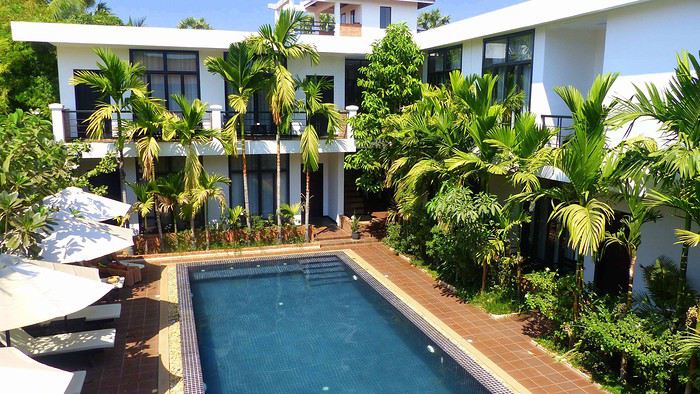
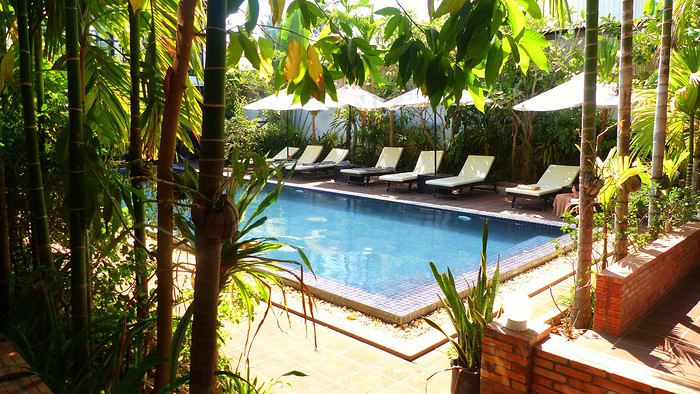
Allez, quelques morceaux de crocodile grillés sur un petit barbecue cambodgien dans un restaurant pas très loin de notre camp de base et c’est déjà l’heure de l’extinction des feux. Je sais que quelques heures seulement nous séparent de nos premières découvertes et il ne faudrait pas qu’on y arrive fatigués. Je te dis donc tout simplement à demain si tu le veux bien, et surtout si tu souhaites nous accompagner dans ce nouveau numéro de Dora l’exploratrice. De toute façon, demain est une autre aventure...
9 février - Vers un nouveau départ...
L’air de rien, monsieur l’hiver s’est installé confortablement, apportant avec lui dans ses bagages ses amis les nuages grisâtres, nuits tombant à dix-sept heures, gouttes au nez et vieux barbu tout de rouge vêtu. Alors, l’humain lambda boude dans son coin, prétextant une déprime passagère hivernale et une envie d’hibernation foudroyante. Chanceux que je suis, c’est à ce moment précis que chaque année, le génie sort de ma lampe de chevet : « Bonjour maître ! Qu’est-ce qui vous ferait plaisir ?... Un nouveau petit voyage, peut-être ? - Je dis oui, oui et re-oui » ! Chouette, il est temps de préparer les valises et de faire un choix. Choix très difficile entre mes tongs bleues et mes tongs orange. Et puis choix de la destination ! Pique-nique-douille, c’est toi l’andouille de Guéméné ! Suosdei !!! Si je te dis « Salut » dans une langue qui fleure bon l’exotisme, c’est que nous allons ensemble partager un nouveau voyage en direction de l’Asie du sud-est. Et oui, l’Asie du sud-est en hiver, il n’y a rien de mieux pour te requinquer un homme. Et puis l’Asie du sud-est, je l’ai dans la peau, au sens propre comme au sens figuré. Et cette fois-ci, ce sera dans un pays frontalier de la Thaïlande, du Laos et du Vietnam. Pays sous protectorat français jusqu’en 1953, titre d’une chanson de Kim Wilde, pays dont la capitale est Phnom Penh, je suis, je suis, … Ding dong, trop tard !... Le Cambodge !
Qui dit introduction à un nouveau voyage dit aussi interrogatoire. Je mets ma petite robe blanche moulante, je croise, je décroise les jambes, … Oups, j’avais oublié de mettre une culotte… C’est bon, l’interrogatoire peut débuter :
Qui ? Pour m’accompagner, ma femme et mes deux filles qu’on appellera pour cette histoire Sandrine, Anna et Sasha... tout simplement parce que ce sont leurs prénoms ! On devait être accompagné par mes deux parents qui nous ont déjà suivis en Thaïlande il y a maintenant sept ans, mais une petite opération du genou a contraint ma mère à jeter l’éponge dans le visage de son chirurgien au dernier moment. Seul mon père sera de la sauterie en tant que guest star ! On souhaite donc tous ensemble la bienvenue à notre fournisseur d’anecdotes !
Combien ? On part un vendredi et on rentre un dimanche deux semaines plus tard…. Donc si tu comptes bien sur tes dix doigts, ça fait dix-sept jours, voyage compris.
Quoi ? Un voyage mi-routard, mi-pénard. Un circuit optimisé en restant au minimum trois jours par endroit pour éviter de perdre trop de temps dans les transports. De la découverte, des vieilles pierres, de la gastronomie, des rencontres, de la bonne bière, de l’exploration, … Et puis on n’oublie surtout pas de brosser « Martine » dans le bon sens en finissant par quelques jours de repos à l’ombre des cocotiers.
Où ? Pour commencer, le noooooord avec Siem Reap, puis Koh Rong tout au sud. On enchaîne ensuite par Koh Rong Samloem, pour finir tranquillement par Phnom Penh d’où nous regagnerons nos pénates.
Comment ? Scooter, tuk tuk, bus, bateau et tongs. Voilà nos moyens de locomotion ! Come on baby, do the locomooootion...
Bon, je crois avoir répondu à toutes tes questions. Aladin, à la deux, il est donc l’heure d’y aller mon bon génie : Pour tous les amoureux de l’Asie du sud-est ou pour te donner l'envie de le devenir, je déclare donc officiellement ce nouveau voyage ouvert ! Et là, tu te dis peut-être : « Oh, la chance qu’il a !!! » C’est marrant toutes ces personnes qui te répondent systématiquement ça quand tu leur annonces que tu pars en voyage… Premièrement, je ne vois pas ce que la chance vient faire là-dedans puisqu’il suffit de saisir son numéro de carte bancaire sur internet pour gagner un billet d’avion. Crois-moi sur parole, rien de plus simple, on gagne à tous les coups ! Deuxièmement, à tous ceux qui s’imaginent que les voyages, ce n’est que Bisounours et licornes pailletées, je rappelle quand même que la première journée d’un voyage, c’est-à-dire la journée d’aujourd’hui, rime toujours avec aéroport, avion, attente, décalage horaire, fatigue, … Un beau programme à te faire aimer le RER un jour de grève ! Mais rassure-toi, avec moi, inutile d'attacher ta ceinture, ça va être un voyage pépère, hyper rapide, sans zone de turbulences, ni même d’hôtesse à reluquer… puisqu'on est déjà arrivé !! Et oui, moi président, je t’ai exonéré des trois vols qui nous ont menés de Paris à Siem Reap en passant par Amman et Bangkok. Moi président, je t’ai fait grâce de vingt-quatre heures de transport éreintantes. Moi, président, je te dispense solennellement de toutes ces cernes sur ton visage puisque Sandrine se les est toutes accaparées... Seul fait marquant à se mettre sous la dent : Le petit Jésus des avions a sournoisement essayé de nous faire louper notre correspondance à Bangkok ! En direct live rien que pour toi, en voici le récit : On s’installe confortablement dans les sièges en face de notre porte d’embarquement F1A, on s’endort, on se réveille trois heures après, Jean-Michel Ecran au-dessus de notre porte affiche désormais « Shanghai » en lieu et place de « Siem Reap » qui y trônait pourtant fièrement tout à l’heure ! As-tu déjà vu le film « Maman j’ai raté l’avion » ? Et bien voici, « Maman, j’ai presque raté l’avion » ! En voici le scénario… Je m’enquière de la situation auprès d’une gentille hôtesse qui me répond que l’embarquement pour Siem Reap a déménagé en porte D1A à l’autre bout de l’aéroport pendant notre sommeil. « Vite, vite, la porte ferme dans huit minutes !... » S’il te plait, pour la suite de l’histoire, il te faut mettre la musique de Mission impossible... Pan ! C’est partie pour la finale du cent-dix mètres haies en direct de l’aéroport de Bangkok !... Ouf, un brin essoufflé, je remporte la victoire haut la main !... Sauf que, … déconfiture totale ! Du même genre que lorsque tes deux meilleurs attaquants sont forfaits pour la finale de la ligue des champions : En porte D1A, ils embarquent pour un vol pour « Abou Dhabi » !!! « Siem Reap, Siem Reap, please ? - Gate J1A ! » C’est pas possible, l’autre andouillette de tout à l’heure ne sait pas prononcer les « J » correctement ! Nouvelle course folle dans l'aéroport. Je prends de nouveau la tête du convoi, les autres tentant laborieusement de me coller au train. Me voyant arriver en courant, l'hôtesse d’embarquement me fait des signes de loin pour m'indiquer que c'est fini… Horreur, malheur !!! Une fois à sa hauteur, Youhou, champagne, elle m’indiquait en fait qu'il n'était pas nécessaire de courir car le vol a du retard. Allez, Champomy, c’est moi qui régale ! Enfin, … verre d’eau pour tout le monde, quoi !
La description de ce 9 février se termine avec une arrivée tardive à Siem Reap, un passage des formalités administratives bien longuet et rudimentaire, et un transport en tuk tuk affrété par notre hôtel pour traverser pour la première fois cette ville que je découvre enfin ; elle que je connais par procuration grâce à toutes mes innombrables lectures préparatoires d’avant voyage. J’ai un peu l’impression de rencontrer pour la première fois une personne rencontrée virtuellement de longue date sur internet. J’ai aussi l’impression de me sentir comme à la maison. Ça me fait ça à chaque fois avec l’Asie du sud-est. Les odeurs, les bruits, l'ambiance… Je ne saurais comment l'expliquer, mais il n'y a pas de période d'adaptation… Un petit mot sur notre hôtel, La Rose Blanche, établissement un peu excentré mais qui nous ravit les yeux dès notre arrivée. Comme dit l'adage, « avec l'âge, on s'embourgeoise ». Il est possible de trouver à Siem Reap des hôtels vraiment pas chers. Mais en mettant un tout petit peu plus que pas cher, il est possible de trouver de petites perles comme le nôtre dans lequel nous passerons les cinq prochaines nuits bien au chaud.
Allez, quelques morceaux de crocodile grillés sur un petit barbecue cambodgien dans un restaurant pas très loin de notre camp de base et c’est déjà l’heure de l’extinction des feux. Je sais que quelques heures seulement nous séparent de nos premières découvertes et il ne faudrait pas qu’on y arrive fatigués. Je te dis donc tout simplement à demain si tu le veux bien, et surtout si tu souhaites nous accompagner dans ce nouveau numéro de Dora l’exploratrice. De toute façon, demain est une autre aventure...
S'il y a un prochain voyage, comment utiliser ses finances? English translation pending
bonjour les gens qui voyagent
supposons qu on repart à l etranger en 2021 ou 2022. Comment utiliser vos finances ? Vous mettez tout l argent économisé dans un gros voyage genre luxe ou vous ne changez rien ou vous avez trop crainte et ne partirez plus ? je suis curieux de savoir
supposons qu on repart à l etranger en 2021 ou 2022. Comment utiliser vos finances ? Vous mettez tout l argent économisé dans un gros voyage genre luxe ou vous ne changez rien ou vous avez trop crainte et ne partirez plus ? je suis curieux de savoir
Roadtrip côte ouest des USA English translation pending
Hello à vous tous cher Voyagiste, me voilà en prévision d'un voyage sur la COTES OUEST DES USA en Juillet 2021.
Je suis en fauteuil roulant électrique (j'aurais 31 ans à la période du séjour) et je part avec ma mère (qui aura elle 59 ans).
Je vous présente un première idée du Road Trip.
Je voudrais avoir vos avis concernant le temps de trajet, l'itinéraire, et si vous aviez des recommandations aux niveaux des hôtels (accessible bien entendu), des sociétés de location de véhicule accessible !
Arrivée à Los Angeles : Dodo sur place !
Lendemain : Départ direction Parc national de Joshua Tree (yucca à gogoooooo) (Los Angeles à Parc national de Joshua Tree = 2H10)
Dodo vers Needles (Parc national de Joshua Tree à Needles = 2H10)
Direction Grand Canyon (Needles à Grand Canyon Village = 3H45)
Dodo sur place
Visite du Grand Canyon (hélicoptères ?)
Dodo sur place
Direction Monument Valley (Grand Canyon Village à Monument Valley = 4H30)
Dodo sur place
Découverte des lieux plus plus plus
Direction Antelope Canyon – Upper (Monument Valley à Antelope Canyon = 1H50)
Visite du lieu
Direction Page (Antelope Canyon à Page 15 minutes)
Dodo sur place
Visite du lac Powel + barrage
Direction Las Vegas (Page à Las Vegas = 4H30)
Dodo sur place
Aller voir : ATM aquarium télé. (3451 W Martin Ave C, Las Vegas)
Visite de Las Vegas
Dodo sur place
Visite de Las Vegas
Dodo sur place
Direction San Francisco
Las Vegas à Death Valley à Olancha = 4H00
Dodo sur place
Olancha à Lee Vining à Traversée du parc de Yosemite à Groveland = 4H40
Dodo sur place
Groveland à San Francisco = 3H00
Visite de San Francisco
Dodo sur place
Visite de San Francisco
Dodo sur place
Visite de San Francisco
Dodo sur place
Visite de San Francisco
Dodo sur place
Visite de San Francisco
Dodo sur place
Direction San Simeon par la Pacific Coast Highway, également appelée Highway 1.
Bixby Creek Bridge (gros pont en arche), on y passe dessus par la route Cabrillo Hwy. (Depuis San Francisco 2H30)
McWay Waterfall (chute d’eau / cascade dans l’océan pacifique) accès PMR ! (Depuis San Francisco 3H00)
Friends Of The Elephant Seal (éléphants de mer) route Cabrillo Hwy, parking gratuit. (Plaza del Cavalier, 250 San Simeon Ave Suite 3B, San Simeon). (Depuis San Francisco 4H30)
Dodo sur place
Direction Sequoia National Park's Tunnel Log (tunnel à travers un séquoia) / (Crescent Meadow Rd, Sequoia National Park)
General Sherman (plus grand séquoia) / (route – 198 - General Hwy) (San Simeon à Sequoia = 3H50)
Dodo sur place
Direction Los Angeles (Sequoia à Los Angeles = 4H20)
Visite de Los Angeles
Dodo sur place
Visite de Los Angeles
Dodo sur place
Visite de Los Angeles
Dodo sur place
Visite de Los Angeles
Dodo sur place
Visite de Los Angeles
Dodo sur place
Visite de Los Angeles
Dodo sur place
à Départ France !!!
Je vous remercie pour vos conseil / suggestions ! Voyagement vôtre.
Je suis en fauteuil roulant électrique (j'aurais 31 ans à la période du séjour) et je part avec ma mère (qui aura elle 59 ans).
Je vous présente un première idée du Road Trip.
Je voudrais avoir vos avis concernant le temps de trajet, l'itinéraire, et si vous aviez des recommandations aux niveaux des hôtels (accessible bien entendu), des sociétés de location de véhicule accessible !
Arrivée à Los Angeles : Dodo sur place !
Lendemain : Départ direction Parc national de Joshua Tree (yucca à gogoooooo) (Los Angeles à Parc national de Joshua Tree = 2H10)
Dodo vers Needles (Parc national de Joshua Tree à Needles = 2H10)
Direction Grand Canyon (Needles à Grand Canyon Village = 3H45)
Dodo sur place
Visite du Grand Canyon (hélicoptères ?)
Dodo sur place
Direction Monument Valley (Grand Canyon Village à Monument Valley = 4H30)
Dodo sur place
Découverte des lieux plus plus plus
Direction Antelope Canyon – Upper (Monument Valley à Antelope Canyon = 1H50)
Visite du lieu
Direction Page (Antelope Canyon à Page 15 minutes)
Dodo sur place
Visite du lac Powel + barrage
Direction Las Vegas (Page à Las Vegas = 4H30)
Dodo sur place
Aller voir : ATM aquarium télé. (3451 W Martin Ave C, Las Vegas)
Visite de Las Vegas
Dodo sur place
Visite de Las Vegas
Dodo sur place
Direction San Francisco
Las Vegas à Death Valley à Olancha = 4H00
Dodo sur place
Olancha à Lee Vining à Traversée du parc de Yosemite à Groveland = 4H40
Dodo sur place
Groveland à San Francisco = 3H00
Visite de San Francisco
Dodo sur place
Visite de San Francisco
Dodo sur place
Visite de San Francisco
Dodo sur place
Visite de San Francisco
Dodo sur place
Visite de San Francisco
Dodo sur place
Direction San Simeon par la Pacific Coast Highway, également appelée Highway 1.
Bixby Creek Bridge (gros pont en arche), on y passe dessus par la route Cabrillo Hwy. (Depuis San Francisco 2H30)
McWay Waterfall (chute d’eau / cascade dans l’océan pacifique) accès PMR ! (Depuis San Francisco 3H00)
Friends Of The Elephant Seal (éléphants de mer) route Cabrillo Hwy, parking gratuit. (Plaza del Cavalier, 250 San Simeon Ave Suite 3B, San Simeon). (Depuis San Francisco 4H30)
Dodo sur place
Direction Sequoia National Park's Tunnel Log (tunnel à travers un séquoia) / (Crescent Meadow Rd, Sequoia National Park)
General Sherman (plus grand séquoia) / (route – 198 - General Hwy) (San Simeon à Sequoia = 3H50)
Dodo sur place
Direction Los Angeles (Sequoia à Los Angeles = 4H20)
Visite de Los Angeles
Dodo sur place
Visite de Los Angeles
Dodo sur place
Visite de Los Angeles
Dodo sur place
Visite de Los Angeles
Dodo sur place
Visite de Los Angeles
Dodo sur place
Visite de Los Angeles
Dodo sur place
à Départ France !!!
Je vous remercie pour vos conseil / suggestions ! Voyagement vôtre.
Quel vélo Gravel choisir en 2020? English translation pending
Bonjour,
J'ai acheté il y a 4 jours un gravel croix de fer Genesis 20, que je me suis fait vélo hier !!! J'avoue avoir eu un coup de coeur pour ce vélo.... mais depuis ce vol je me suis mise à nouveau en quête de recherche car j'ai à nouveau comparé les prix et les équipements et à nouveau le doute plane. Le problème du croix de fer c'est la dimension du cadre il faut avoir un buste assez long pour avoir un minimum de confort ou alors raccourcir la potence mais le guidon devient nerveux et la tenue de route se dégrade selon avis d'expert ! Alors toutes les questions sont là pour un budget entre 1000 et 1500e grand max car l'assurance heureusement va me rembourser mais je vais perdre de billes ! : - cadre acier ou alu - choisir un cadre et faire monter son vélo // cadre ll city par exemple // - choix de la transition - choix des freins - pneu en 700 de quelle marque ? car il paraît qu'on ne fait pas assez attention aux pneus quand on achète son vélo alors que ce sont eux qui après le cadre offre une belle adhérence et confort route
déjà une bonne base si je pouvais avoir vos avis d'expert ....! voire quelques modèles en exemple ....
Bonne journée à tous, Anne
J'ai acheté il y a 4 jours un gravel croix de fer Genesis 20, que je me suis fait vélo hier !!! J'avoue avoir eu un coup de coeur pour ce vélo.... mais depuis ce vol je me suis mise à nouveau en quête de recherche car j'ai à nouveau comparé les prix et les équipements et à nouveau le doute plane. Le problème du croix de fer c'est la dimension du cadre il faut avoir un buste assez long pour avoir un minimum de confort ou alors raccourcir la potence mais le guidon devient nerveux et la tenue de route se dégrade selon avis d'expert ! Alors toutes les questions sont là pour un budget entre 1000 et 1500e grand max car l'assurance heureusement va me rembourser mais je vais perdre de billes ! : - cadre acier ou alu - choisir un cadre et faire monter son vélo // cadre ll city par exemple // - choix de la transition - choix des freins - pneu en 700 de quelle marque ? car il paraît qu'on ne fait pas assez attention aux pneus quand on achète son vélo alors que ce sont eux qui après le cadre offre une belle adhérence et confort route
déjà une bonne base si je pouvais avoir vos avis d'expert ....! voire quelques modèles en exemple ....
Bonne journée à tous, Anne
Plan de reprise des croisières Costa English translation pending
Bonjour
Voilà ce qui serait prévu à partir de la mi-août :
http://crew-center.com/costa-cruises-plans-re-start-voyages-7-ships-5-phases
Cordialement
Voilà ce qui serait prévu à partir de la mi-août :
http://crew-center.com/costa-cruises-plans-re-start-voyages-7-ships-5-phases
Cordialement
Problème cintre (à vélo) English translation pending
bonjour, je fais appel une fois de plus à vos compétences et conseils. je viens de partir 2 semaines avec le vélo ci dessous (Focus Mares) et j'ai eu les mains, la gauche notamment avec d'abord des "fourmis" puis paralysie, plus de sensibilité, plus de force. je précise aussi qu'ayant de petites mains le passage des vitesses n'est pas évident. je souhaiterais, si c'est possible remplacer par un cintre plat recourbé avec bar ends. je suppose que ce sera couteux mais ce vélo est neuf et par ailleurs fonctionne très bien. je n'ai pas souvenir d'avoir eu ce pb avec mon ancien vtc. merci d'avance pour votre avis. cdt
Discussion autour du concours de juillet 2020: Verticale(s) English translation pending
Pour discuter autour du concours de juillet 2020, Verticale(s), ça se passe ici.
Concours photo de juillet 2020: Verticale(s) English translation pending
Bonjour 🙂
Après déjà dix ans depuis la première édition, nous voici au lancement du 120ème concours.
J’aime l'idée de garder la surprise des photos qui pourront être proposées, c’est pourquoi j’ai choisi un thème ouvert : Verticale(s). Il n’y aura pas de contrôle au fil à plomb, ça pourra pencher un peu mais raisonnablement. Pour accompagner le démarrage du concours, vous trouverez quelques pistes en bas de ce message.
Vous pourrez participer jusqu’au samedi 25 juillet à 23h59, heure de Paris. Chaque participant est autorisé à poster jusqu’à trois photos, numérotées de 1 à 3, en précisant le lieu de prise de vue. N’hésitez pas à accompagner vos photos de quelques lignes.
Le vote aura lieu du dimanche 26 juillet 0h01 au jeudi 30 juillet à 22h. Il est accessible à tous, participants ou non, dans la limite d’un vote, et se fera par l’attribution d’un total de six points répartis sur 3 ou 4 photos : Photo n°1 : 3 points Photo n°2 : 2 points Photo n°3 : 1 point - OU - Photo n°3A et photo n°3B : 1/2 point chacune
La photo gagnante sera celle qui aura remporté le plus de points. En cas d’égalité pour la première position, les photos seront départagées par le nombre de votes à 3 points, puis , si l'égalité persiste, par le nombre de votes à 2 points, etc.
Le ou la gagnant(e) aura le privilège d’organiser le concours suivant.
Ce fil est réservé aux photos participantes et aux votes. Pour le blabla ça se passe ici ! Le diaporama arrivera dans quelques jours et figurera dans ma signature.
C’est parti 🙂
Après déjà dix ans depuis la première édition, nous voici au lancement du 120ème concours.
J’aime l'idée de garder la surprise des photos qui pourront être proposées, c’est pourquoi j’ai choisi un thème ouvert : Verticale(s). Il n’y aura pas de contrôle au fil à plomb, ça pourra pencher un peu mais raisonnablement. Pour accompagner le démarrage du concours, vous trouverez quelques pistes en bas de ce message.
Vous pourrez participer jusqu’au samedi 25 juillet à 23h59, heure de Paris. Chaque participant est autorisé à poster jusqu’à trois photos, numérotées de 1 à 3, en précisant le lieu de prise de vue. N’hésitez pas à accompagner vos photos de quelques lignes.
Le vote aura lieu du dimanche 26 juillet 0h01 au jeudi 30 juillet à 22h. Il est accessible à tous, participants ou non, dans la limite d’un vote, et se fera par l’attribution d’un total de six points répartis sur 3 ou 4 photos : Photo n°1 : 3 points Photo n°2 : 2 points Photo n°3 : 1 point - OU - Photo n°3A et photo n°3B : 1/2 point chacune
La photo gagnante sera celle qui aura remporté le plus de points. En cas d’égalité pour la première position, les photos seront départagées par le nombre de votes à 3 points, puis , si l'égalité persiste, par le nombre de votes à 2 points, etc.
Le ou la gagnant(e) aura le privilège d’organiser le concours suivant.
Ce fil est réservé aux photos participantes et aux votes. Pour le blabla ça se passe ici ! Le diaporama arrivera dans quelques jours et figurera dans ma signature.
C’est parti 🙂
Titres de transport pour Paris English translation pending
Je sais que l'on peut acheter une passe pour le train RER, l'autobus etc. pour 1,3, où 5 jours consécutifs mais y a t'il une passe pour une semaine pour les zones 1 à 5 pour touristes que l'on peut acheter et à quel prix? C'est pour une semaine au mois d'octobre
Discussion au sujet du concours photo de juin 2020: "Multicolore" English translation pending
Hello,
C'est ici qu'on en parle.
Philippe
C'est ici qu'on en parle.
Philippe
Wild Camping in Southern Africa
Hey everyone,
I’m sharing a slightly unusual travel journal with three goals. To make it work, this discussion should stay in the travel journal section so we can find it easily and keep adding info to existing posts.
This journal is meant to help "newbies" discover these magical places.
We go to Southern Africa not just for the animals, but also for that soft light, the atmosphere, and those incredible wild campsites where you feel so at home... I’d love for you all to share your favorite spots here—those we miss so much.
The last goal is figuring out how to photograph them. Honestly, I’m not happy with my photos because they don’t capture the feeling I get when I’m there or that unique atmosphere.
I’ll start with one of the first spots that, for me, is one of the most beautiful in Southern Africa: Passarge Valley 2 in the Central Kalahari. There, you’re alone—completely alone. The next campsite is over 25 km away, and that’s a half-day of 4x4 driving. In front of you, there’s nothing but the CKGR plains with herds of springboks... absolutely stunning 😎

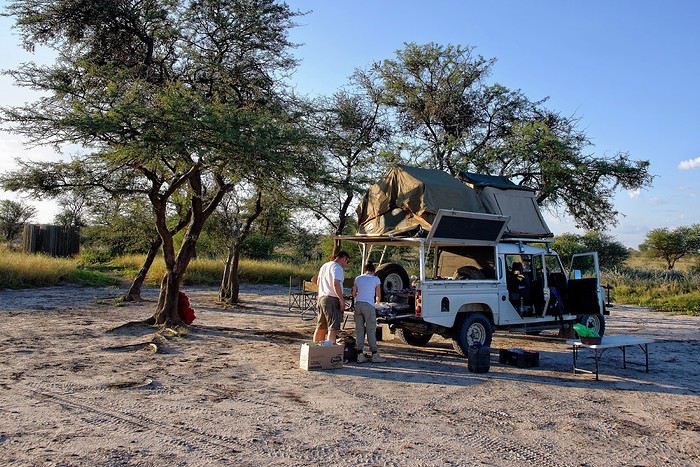
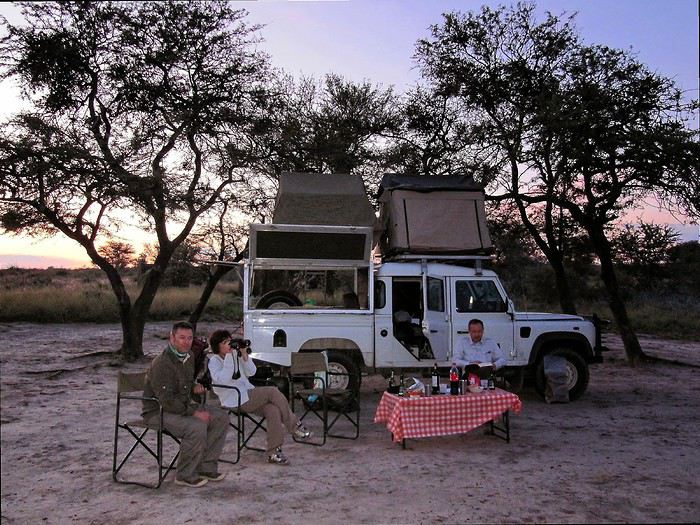
I’m sharing a slightly unusual travel journal with three goals. To make it work, this discussion should stay in the travel journal section so we can find it easily and keep adding info to existing posts.
This journal is meant to help "newbies" discover these magical places.
We go to Southern Africa not just for the animals, but also for that soft light, the atmosphere, and those incredible wild campsites where you feel so at home... I’d love for you all to share your favorite spots here—those we miss so much.
The last goal is figuring out how to photograph them. Honestly, I’m not happy with my photos because they don’t capture the feeling I get when I’m there or that unique atmosphere.
I’ll start with one of the first spots that, for me, is one of the most beautiful in Southern Africa: Passarge Valley 2 in the Central Kalahari. There, you’re alone—completely alone. The next campsite is over 25 km away, and that’s a half-day of 4x4 driving. In front of you, there’s nothing but the CKGR plains with herds of springboks... absolutely stunning 😎
En Inde du Sud juste avant le confinement English translation pending
Bonjour à tous,
Nous étions en Inde du Sud en février-mars 2020 (25 jours sur place). Comme nous avons passé les 70 ans nous avons pensé que nous ne reviendrons plus en Inde (il y a encore tant d'autres pays encore à aller visiter et il nous reste finalement assez peu d'années pour cela). Du coup à l'Inde du Sud nous avons rajouté Hampi ainsi que les sites d'Ajanta et Ellora. Programme ambitieux !
Le plus difficile en Inde c'est de décider de ce que l'on ne pourra pas voir parmi les "incontournables" en tous genres qui sont annoncés dans tous les guides, forums et carnets de voyage divers. Que les adeptes des "hors des sentiers battus" se rassurent, s'ils veulent aller en Inde il n'y a que ça dans tout le pays aussi.
Donc après une première liste de ce qu'il fallait absolument ne pas rater, mon estimation de la durée du voyage s'est établie à 35 jours. Trop pour nous. Deuxième liste réduite avec beaucoup de difficulté : 25 jours sur place. OK ! Il n'y a plus qu'à organiser le circuit et vérifier sa faisabilité car l'Inde du Sud c'est très grand et les endroits que nous avons choisis sont répartis sur une vaste zone :
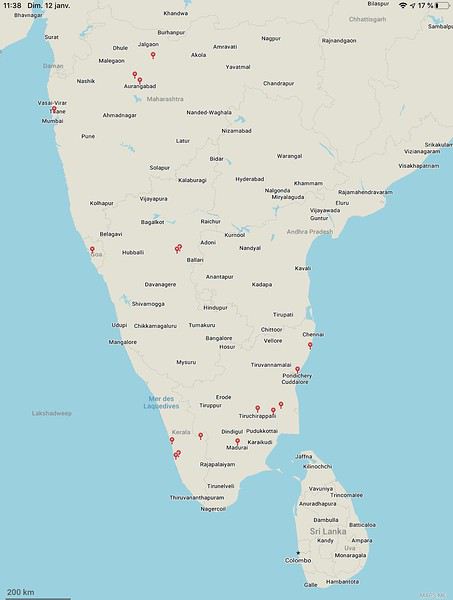
Moyens de transports : dans un premier temps j'avais pensé combiner bus de luxe, train et taxi. Compte tenu désormais de notre âge mon épouse a été catégorique : ce sera voiture avec chauffeur et si besoin avion (lignes intérieures). Effectivement les trajets en bus et en train relatés dans différents carnets de voyage le sont par des gens qui ont 15 à 20 ans de moins que nous. Et des bus et trains de toutes sortes nous les avons pratiqués un peu partout dans le monde ces dernières décennies - nous connaissons donc bien et ne le regrettons pas. Par ailleurs la formule voiture avec chauffeur est finalement assez courante en Inde et financièrement abordable.
Merci aux différents carnets de voyage de VoyageForum pour l'aide précieuse apportée, et particulièrement merci à Xiongmao, que je salue, qui nous a bien aidé à choisir notre principal prestataire. Le circuit fut donc choisi comme suit :
Arrivés à CHENNAI le 14 février 2020 (vol Air India avec escale à Delhi), Repartis de BOMBAY le 10 mars 2020 (vol Air India avec escale et contrôle immigration à Delhi), et arrivés ce même 10 mars chez nous à 21h00 . . . et confinés le 17 mars à 12h00
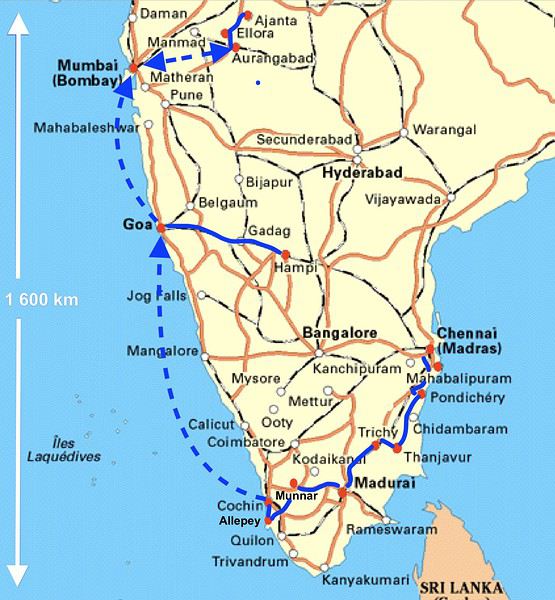
NOTA : 4 400 photos prises par ma femme et moi (un vrai délire !). On a beau se dire qu'il faut se limiter à l'essentiel, comme du temps où chaque photo était payante, il est tellement facile d'en faire avec les appareils numériques et les smartphones qui maintenant sont très corrects qu'on se laisse aller. Choix drastique, nous n'avons retenu que 250 photos pour ce carnet de voyage (et c'est déjà trop, je m'en excuse par avance).
Formalités : e-visas envoyés le 20 janvier et reçus "granted" le 21 ! Super rapide donc, mais par contre la rédaction extrêmement minutieuse du formulaire en ligne ainsi que la confection des pièces jointes selon les normes très strictes nécessite environ deux heures pour chaque demande.
Températures : pendant ces 3 ½ semaines la température moyenne en journée a été de 30°C, sauf à MUNNAR où elle est descendue vers 24°C et à HAMPI où elle était de 34°C.
Vendredi 14 février et samedi 15 Février 2020 Nous ne nous sommes pas arrêtés à CHENNAI. Nous avons immédiatement pris un taxi pour MAHABALIPURAM (nous avions demandé ce service à l'hôtel déjà réservé mais il aurait été possible facilement de prendre un "pré-paid taxi" juste à la sortie de l'aéroport). 15h15 : atterrissage à CHENNAI 16h20 : départ de notre taxi 18h00 : arrivée à l'hôtel à MAHABALIPURAM De 18h15 à 19h30 : change dans un bureau de change ( 100 € contre 7 750 INR soit 100 INR = 1,3 €) puis achat et mise en service d'une carte SIM indienne (valable dans toute l'Inde, pour appels en Inde pendant 28 jours avec 1,5 Go/jour de données internet, le tout pour 550 roupies, soit 7 € : autant dire rien pour un internet quasi illimité et une durée d'appels largement suffisante pour l'utilisation en local).
MAHABALIPURAM : Centre-ville sympa bien que très touristique. Tout peut se faire à pied (éventuellement retour en tuk-tuk de l'ensemble de temples des Cinq Rathas). Dès notre première visite au Shore Temple (Temple du rivage) nous découvrons la règle que nous verrons systématiquement par la suite : les indiens paient 15 fois moins cher que les étrangers :
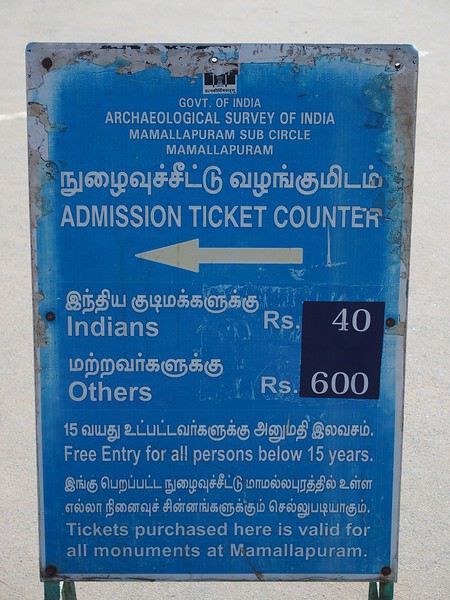
Vu notre niveau de vie comparé à celui moyen des indiens on ne va pas se plaindre. C'est juste qu'on n'est pas habitué à cette distinction (discrimination ?) en France. Le Shore Temple (temple du rivage) a un intérêt limité mais intéressant pour un premier contact avec cette culture et architecture :
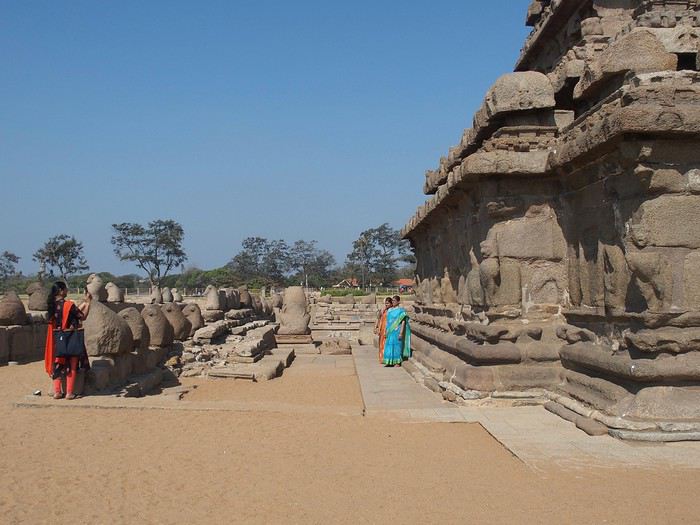
En revanche l'ensemble de temples des Cinq Rathas est vraiment intéressant. Beaucoup de touristes indiens d'ailleurs. Sur le chemin, beaucoup de magasins de sculpteurs sur pierre. C'est apparemment une activité importante de cette ville:
et activités touristique et scolaire importantes aussi :
L'ensemble des temples des Cinq Rathas est assez compact mais riche en sculptures :
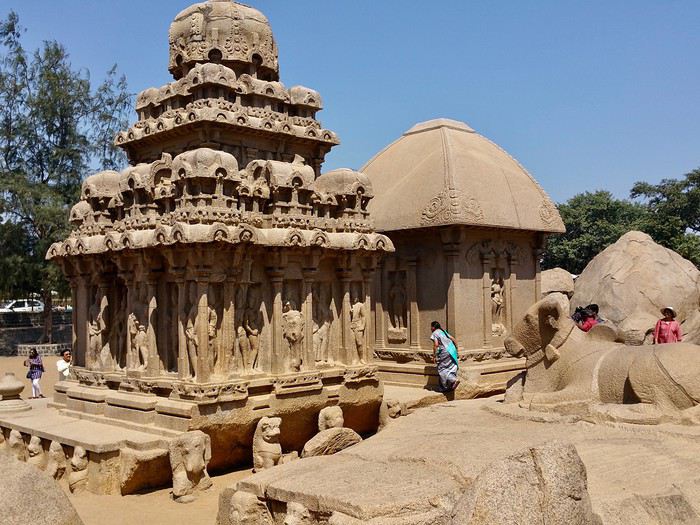
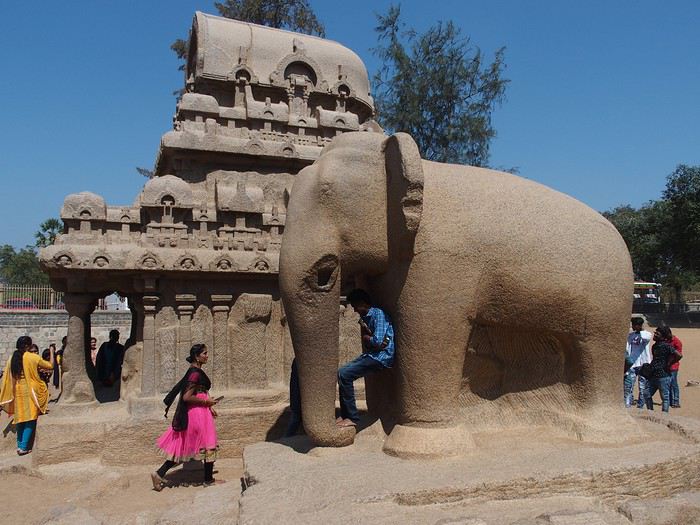
Nous étions en Inde du Sud en février-mars 2020 (25 jours sur place). Comme nous avons passé les 70 ans nous avons pensé que nous ne reviendrons plus en Inde (il y a encore tant d'autres pays encore à aller visiter et il nous reste finalement assez peu d'années pour cela). Du coup à l'Inde du Sud nous avons rajouté Hampi ainsi que les sites d'Ajanta et Ellora. Programme ambitieux !
Le plus difficile en Inde c'est de décider de ce que l'on ne pourra pas voir parmi les "incontournables" en tous genres qui sont annoncés dans tous les guides, forums et carnets de voyage divers. Que les adeptes des "hors des sentiers battus" se rassurent, s'ils veulent aller en Inde il n'y a que ça dans tout le pays aussi.
Donc après une première liste de ce qu'il fallait absolument ne pas rater, mon estimation de la durée du voyage s'est établie à 35 jours. Trop pour nous. Deuxième liste réduite avec beaucoup de difficulté : 25 jours sur place. OK ! Il n'y a plus qu'à organiser le circuit et vérifier sa faisabilité car l'Inde du Sud c'est très grand et les endroits que nous avons choisis sont répartis sur une vaste zone :
Moyens de transports : dans un premier temps j'avais pensé combiner bus de luxe, train et taxi. Compte tenu désormais de notre âge mon épouse a été catégorique : ce sera voiture avec chauffeur et si besoin avion (lignes intérieures). Effectivement les trajets en bus et en train relatés dans différents carnets de voyage le sont par des gens qui ont 15 à 20 ans de moins que nous. Et des bus et trains de toutes sortes nous les avons pratiqués un peu partout dans le monde ces dernières décennies - nous connaissons donc bien et ne le regrettons pas. Par ailleurs la formule voiture avec chauffeur est finalement assez courante en Inde et financièrement abordable.
Merci aux différents carnets de voyage de VoyageForum pour l'aide précieuse apportée, et particulièrement merci à Xiongmao, que je salue, qui nous a bien aidé à choisir notre principal prestataire. Le circuit fut donc choisi comme suit :
Arrivés à CHENNAI le 14 février 2020 (vol Air India avec escale à Delhi), Repartis de BOMBAY le 10 mars 2020 (vol Air India avec escale et contrôle immigration à Delhi), et arrivés ce même 10 mars chez nous à 21h00 . . . et confinés le 17 mars à 12h00
NOTA : 4 400 photos prises par ma femme et moi (un vrai délire !). On a beau se dire qu'il faut se limiter à l'essentiel, comme du temps où chaque photo était payante, il est tellement facile d'en faire avec les appareils numériques et les smartphones qui maintenant sont très corrects qu'on se laisse aller. Choix drastique, nous n'avons retenu que 250 photos pour ce carnet de voyage (et c'est déjà trop, je m'en excuse par avance).
Formalités : e-visas envoyés le 20 janvier et reçus "granted" le 21 ! Super rapide donc, mais par contre la rédaction extrêmement minutieuse du formulaire en ligne ainsi que la confection des pièces jointes selon les normes très strictes nécessite environ deux heures pour chaque demande.
Températures : pendant ces 3 ½ semaines la température moyenne en journée a été de 30°C, sauf à MUNNAR où elle est descendue vers 24°C et à HAMPI où elle était de 34°C.
Vendredi 14 février et samedi 15 Février 2020 Nous ne nous sommes pas arrêtés à CHENNAI. Nous avons immédiatement pris un taxi pour MAHABALIPURAM (nous avions demandé ce service à l'hôtel déjà réservé mais il aurait été possible facilement de prendre un "pré-paid taxi" juste à la sortie de l'aéroport). 15h15 : atterrissage à CHENNAI 16h20 : départ de notre taxi 18h00 : arrivée à l'hôtel à MAHABALIPURAM De 18h15 à 19h30 : change dans un bureau de change ( 100 € contre 7 750 INR soit 100 INR = 1,3 €) puis achat et mise en service d'une carte SIM indienne (valable dans toute l'Inde, pour appels en Inde pendant 28 jours avec 1,5 Go/jour de données internet, le tout pour 550 roupies, soit 7 € : autant dire rien pour un internet quasi illimité et une durée d'appels largement suffisante pour l'utilisation en local).
MAHABALIPURAM : Centre-ville sympa bien que très touristique. Tout peut se faire à pied (éventuellement retour en tuk-tuk de l'ensemble de temples des Cinq Rathas). Dès notre première visite au Shore Temple (Temple du rivage) nous découvrons la règle que nous verrons systématiquement par la suite : les indiens paient 15 fois moins cher que les étrangers :
Vu notre niveau de vie comparé à celui moyen des indiens on ne va pas se plaindre. C'est juste qu'on n'est pas habitué à cette distinction (discrimination ?) en France. Le Shore Temple (temple du rivage) a un intérêt limité mais intéressant pour un premier contact avec cette culture et architecture :
En revanche l'ensemble de temples des Cinq Rathas est vraiment intéressant. Beaucoup de touristes indiens d'ailleurs. Sur le chemin, beaucoup de magasins de sculpteurs sur pierre. C'est apparemment une activité importante de cette ville:
et activités touristique et scolaire importantes aussi :
L'ensemble des temples des Cinq Rathas est assez compact mais riche en sculptures :
Touristikis à la crème de solaris English translation pending
Comme j'ai un peu de temps, je vous livre le récit d'un voyage de 2018 qui traînait sur mon ordinateur :
Il était une fois, par delà les pandémies et les crises économiques, un temps où nous pouvions voyager : 2018. En cette année béni(t)e, il n’y eut pour nous point de virée nord-atlantique dans la chaleur estivale au programme, point de douches gratuites rafraîchissantes, point de températures vivifiantes, point de gastronomie douteuse et point de prix déments. En passant, félicitations à l’Islande et ses pizzas caoutchouteuse à 30 euros. En 2018, non, on va dans un vrai pays où l’on sait ce que signifie avoir chaud, manger et glander à une terrasse : la Grèce. Et comme nous ne sommes quand même pas des stakhanovistes du 40° à l’ombre, nous avons choisi le printemps, avril plus précisément. Pour le terrain de jeu, il s'agira d'Athènes et du Péloponnèse sur un peu plus de deux semaines. A nous, les petites églises, les ruines romantiques et les oliviers scintillants !
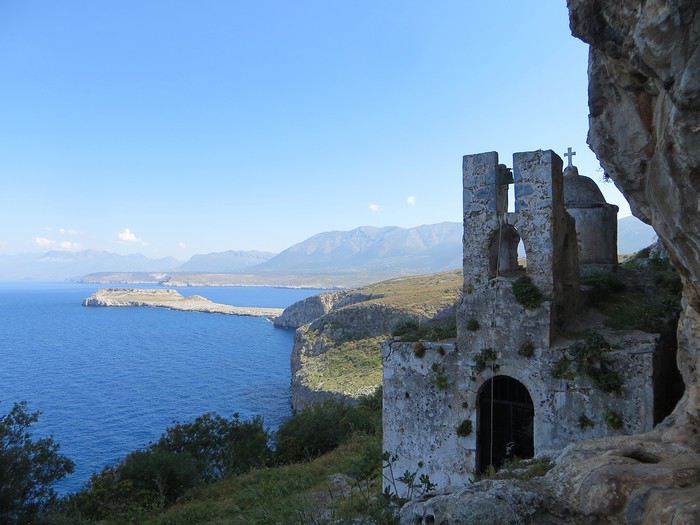 Bien choisir sa photo d'appel pour attirer le chaland. Un bon point et toute mon estime pour celui qui devine où c'est.
Avec la Grèce - pour ceux qui ont lu mes autres carnets qui sont tellement merveilleux qu’il faut les lire immédiatement et que votre vie s’en trouvera changée et éblouie - tout est chamboulé : fini les campings, les dortoirs et les piques-niques miteux de nos voyages dans le nord, place aux hôtels, aux b&b et aux restos. Et en plus, les Grecs ont le bon goût d’être accueillants.
Laissons la parole à du Ballay, parrainé par Alain Deloin et Jean-Michel Apeupré :
Heureux qui comme Ulysse a fait un beau voyage (en Grèce), Ou comme celui-là qui vit le Parthénon, Et puis est retourné, plein d'image et pâmoison, Vivre exubérant le reste de son âge
Et avant d'attaquer le vif du sujet, quelques annonces pour le public innocent : Avertissement : vous lisez ce compte-rendu à vos risques et périls. Toute indignation n’est pas de ma responsabilité. Avertissement bis : non je ne suis pas raciste non je n’ai rien contre les Néerlandais, j’ai d’ailleurs un ami néerlandais non les Grecs ne sont pas des feignants oui les Allemands ont pour passe-temps l’invasion… Ah mince une rechute.
Jour 1
Ayé, c’est parti pour une journée de transport translation Lyon-Athènes via Munich en empruntant la Lufthansa. Le vol est sans encombre, une conversation s’engage avec un voisin grec sympathique autour de la qualité douteuse de la bouffe allemande. J'en profite pour avoir une illumination : la nourriture, voilà ce qui unit les Européens (enfin ceux du sud) ! Eclair de génie, j’ai trouvé comment sauver l’Union européenne « tous unis contre la vie beurk ». Malheureusement, ça risque d’exclure les riches du nord. D’ailleurs c’est peut-être un signe : faut-il mal manger pour être riche ? Faudrait exclure les Japonais de l’équation mais sinon ça marche (pays germaniques, scandinaves et anglo-saxons même combat). Revenons au voisin grec, je tente de donner un tour sportif à la conversation mais malheureusement il n’aime pas le foot « football is shit »… Arrgghh, de quoi vais-je bien pouvoir parler alors ?! Du coup, je parle plus. Alors qu’un petit débat sur le scandale du moment, le président du PAOK Salonique et son flingue, ça, ça aurait été fun .
L’atterrissage se passe sans encombre dans cet aéroport d’Athènes qui a changé de place depuis mon unique passage dans le coin et s’est éloigné du centre-ville. Première prise de contact avec l’alphabet grec, on avait essayé pour le fun de potasser les équivalences mais c’est loin d’être évident ! Combien d'équivalents du O ont-ils dans cet alphabet ?!
Le trajet jusqu’au centre d’Athènes est long, très long et le métro/train se remplit progressivement jusqu’à être bondé à ras bord. Nous sommes tassés, compressés et pour sortir de cette fournaise, c’est la lutte finale, poussons-nous et demain, l’air sera le sauveur du genre humain (note à moi-même : éviter la prochaine fois d’arriver au moment de la sortie du travail)
La chambre chez l’habitant est bien placée, en plein centre sans être très bruyante. On profite de notre premier soir pour une approche de la cuisine grecque et un mauvais choix de commande (que de la friture…). On enchaîne sur une petite balade nocturne pour revenir sur l’impression née du voyage précédent (ie dans les années 90 la voiture reine, une ville bruyante et désagréable). Eh bien en fait, une partie du centre-ville s’est piétonnisé, il y a de la vie, des restos et des cafés avec des terrasses partout, c’est très agréable finalement.
Il était une fois, par delà les pandémies et les crises économiques, un temps où nous pouvions voyager : 2018. En cette année béni(t)e, il n’y eut pour nous point de virée nord-atlantique dans la chaleur estivale au programme, point de douches gratuites rafraîchissantes, point de températures vivifiantes, point de gastronomie douteuse et point de prix déments. En passant, félicitations à l’Islande et ses pizzas caoutchouteuse à 30 euros. En 2018, non, on va dans un vrai pays où l’on sait ce que signifie avoir chaud, manger et glander à une terrasse : la Grèce. Et comme nous ne sommes quand même pas des stakhanovistes du 40° à l’ombre, nous avons choisi le printemps, avril plus précisément. Pour le terrain de jeu, il s'agira d'Athènes et du Péloponnèse sur un peu plus de deux semaines. A nous, les petites églises, les ruines romantiques et les oliviers scintillants !
Bien choisir sa photo d'appel pour attirer le chaland. Un bon point et toute mon estime pour celui qui devine où c'est.Avec la Grèce - pour ceux qui ont lu mes autres carnets qui sont tellement merveilleux qu’il faut les lire immédiatement et que votre vie s’en trouvera changée et éblouie - tout est chamboulé : fini les campings, les dortoirs et les piques-niques miteux de nos voyages dans le nord, place aux hôtels, aux b&b et aux restos. Et en plus, les Grecs ont le bon goût d’être accueillants.
Laissons la parole à du Ballay, parrainé par Alain Deloin et Jean-Michel Apeupré :
Heureux qui comme Ulysse a fait un beau voyage (en Grèce), Ou comme celui-là qui vit le Parthénon, Et puis est retourné, plein d'image et pâmoison, Vivre exubérant le reste de son âge
Et avant d'attaquer le vif du sujet, quelques annonces pour le public innocent : Avertissement : vous lisez ce compte-rendu à vos risques et périls. Toute indignation n’est pas de ma responsabilité. Avertissement bis : non je ne suis pas raciste non je n’ai rien contre les Néerlandais, j’ai d’ailleurs un ami néerlandais non les Grecs ne sont pas des feignants oui les Allemands ont pour passe-temps l’invasion… Ah mince une rechute.
Jour 1
Ayé, c’est parti pour une journée de transport translation Lyon-Athènes via Munich en empruntant la Lufthansa. Le vol est sans encombre, une conversation s’engage avec un voisin grec sympathique autour de la qualité douteuse de la bouffe allemande. J'en profite pour avoir une illumination : la nourriture, voilà ce qui unit les Européens (enfin ceux du sud) ! Eclair de génie, j’ai trouvé comment sauver l’Union européenne « tous unis contre la vie beurk ». Malheureusement, ça risque d’exclure les riches du nord. D’ailleurs c’est peut-être un signe : faut-il mal manger pour être riche ? Faudrait exclure les Japonais de l’équation mais sinon ça marche (pays germaniques, scandinaves et anglo-saxons même combat). Revenons au voisin grec, je tente de donner un tour sportif à la conversation mais malheureusement il n’aime pas le foot « football is shit »… Arrgghh, de quoi vais-je bien pouvoir parler alors ?! Du coup, je parle plus. Alors qu’un petit débat sur le scandale du moment, le président du PAOK Salonique et son flingue, ça, ça aurait été fun .
L’atterrissage se passe sans encombre dans cet aéroport d’Athènes qui a changé de place depuis mon unique passage dans le coin et s’est éloigné du centre-ville. Première prise de contact avec l’alphabet grec, on avait essayé pour le fun de potasser les équivalences mais c’est loin d’être évident ! Combien d'équivalents du O ont-ils dans cet alphabet ?!
Le trajet jusqu’au centre d’Athènes est long, très long et le métro/train se remplit progressivement jusqu’à être bondé à ras bord. Nous sommes tassés, compressés et pour sortir de cette fournaise, c’est la lutte finale, poussons-nous et demain, l’air sera le sauveur du genre humain (note à moi-même : éviter la prochaine fois d’arriver au moment de la sortie du travail)
La chambre chez l’habitant est bien placée, en plein centre sans être très bruyante. On profite de notre premier soir pour une approche de la cuisine grecque et un mauvais choix de commande (que de la friture…). On enchaîne sur une petite balade nocturne pour revenir sur l’impression née du voyage précédent (ie dans les années 90 la voiture reine, une ville bruyante et désagréable). Eh bien en fait, une partie du centre-ville s’est piétonnisé, il y a de la vie, des restos et des cafés avec des terrasses partout, c’est très agréable finalement.
Trois mois de randonnée à deux à Madagascar English translation pending
Bonjour !
Mon amis et moi avons comme projet de voyager à pied au sein de Madagascar durant 3 mois. Nous aimerons commencer par la côte Nord est, remonter jusqu'à Antsiranana pour descendre par la cote ouest jusqu'à Belo-sur-mer. Si possible nous aimerions finir par Isalo et remonter a Tana par Andringitra et Fianarantsoa.
Nos questions sont donc les suivantesm :
Sur ce circuit que pouvons nous faire à pied ?
Ensuite, est-ce que c'est possible et envisageable sans prendre de guide ? Tous en restant dans les délais et en prenant des taxis pour éviter les zones dangereuses ou infranchissables.
Ensuite, auriez-vous des conseils à nous fournir selon certains ville où quartier à éviter ? Ou certains lieu à ne pas manqué !
Nous somme friands de tous conseils !
PS : On veut surtout voir un maximum de chose grâce à la force de nos jambes. Mais on veut pas partir sans tous avoir vue ! On ne souhaite pas prendre de risque inconsidérée non plus donc soyez prévenant.
Mon amis et moi avons comme projet de voyager à pied au sein de Madagascar durant 3 mois. Nous aimerons commencer par la côte Nord est, remonter jusqu'à Antsiranana pour descendre par la cote ouest jusqu'à Belo-sur-mer. Si possible nous aimerions finir par Isalo et remonter a Tana par Andringitra et Fianarantsoa.
Nos questions sont donc les suivantesm :
Sur ce circuit que pouvons nous faire à pied ?
Ensuite, est-ce que c'est possible et envisageable sans prendre de guide ? Tous en restant dans les délais et en prenant des taxis pour éviter les zones dangereuses ou infranchissables.
Ensuite, auriez-vous des conseils à nous fournir selon certains ville où quartier à éviter ? Ou certains lieu à ne pas manqué !
Nous somme friands de tous conseils !
PS : On veut surtout voir un maximum de chose grâce à la force de nos jambes. Mais on veut pas partir sans tous avoir vue ! On ne souhaite pas prendre de risque inconsidérée non plus donc soyez prévenant.
Atoll de Fakarava (Polynésie Française) English translation pending
Bonjour,
Je n'arrête pas de changer d'avis mais comme je veux rester 3 semaines au même endroit, il faut que je vise juste.
J'étais restée sur le choix de Hiva Oa mais ce qui m'embête c'est d'une part le prix du vol Papeeti-Hiva Oa et le fait que cette île n'est pas propice à la baignade. Or, aller dans ces sublimes lagons sans pouvoir se baigner.... J'en serais frustrée. Je ne pratique pas la plongée.
Deux d'entre vous qui avez échangé m'ont poussée à retourner voir dans mes guides. Il s'agit de Fakarava. Là bas, ça semble l'idéal pour nager. Plages plages et plages....
Une pension me fait de l'oeil, vaiama village. Si certains d'entre vous y sont allés quelques jours, j'aimerais bien avoir un retour. Je suis allée sur trip advisor. A priori, les critiques sont très bonnes.
Y a t-il des randos à faire à Fakarava ?
Vous remerciant de votre patience.
Nathalie
Je n'arrête pas de changer d'avis mais comme je veux rester 3 semaines au même endroit, il faut que je vise juste.
J'étais restée sur le choix de Hiva Oa mais ce qui m'embête c'est d'une part le prix du vol Papeeti-Hiva Oa et le fait que cette île n'est pas propice à la baignade. Or, aller dans ces sublimes lagons sans pouvoir se baigner.... J'en serais frustrée. Je ne pratique pas la plongée.
Deux d'entre vous qui avez échangé m'ont poussée à retourner voir dans mes guides. Il s'agit de Fakarava. Là bas, ça semble l'idéal pour nager. Plages plages et plages....
Une pension me fait de l'oeil, vaiama village. Si certains d'entre vous y sont allés quelques jours, j'aimerais bien avoir un retour. Je suis allée sur trip advisor. A priori, les critiques sont très bonnes.
Y a t-il des randos à faire à Fakarava ?
Vous remerciant de votre patience.
Nathalie
On part en vadrouille dans les Balkans! English translation pending
Et bien le confinement a de beaux jours devant lui ! Chose promise, chose due (publier une journée de vadrouille par jour de confinement) ! Après le carnet sur un voyage aux Etats-Unis (voyageforum.com/...-americain-d9943984/), après le carnet sur une vadrouille en Jordanie (https://voyageforum.com/discussion/on-part-en-vadrouille-en-jordanie-d9991360/), voici maintenant un carnet dans les balkans, voyage réalisé il y a maintenant quelques années :
Et on garde les bonnes habitudes, publication d'une journée par jour, à chaque fois à 17h30 ! Bonne lecture et n'hésite pas à laisser un commentaire, une question, une remarque, ...
Franck
Et on garde les bonnes habitudes, publication d'une journée par jour, à chaque fois à 17h30 ! Bonne lecture et n'hésite pas à laisser un commentaire, une question, une remarque, ...
Franck