last edited Dec 11, 2019
Other Practical Information for Morocco
Location Map of Morocco
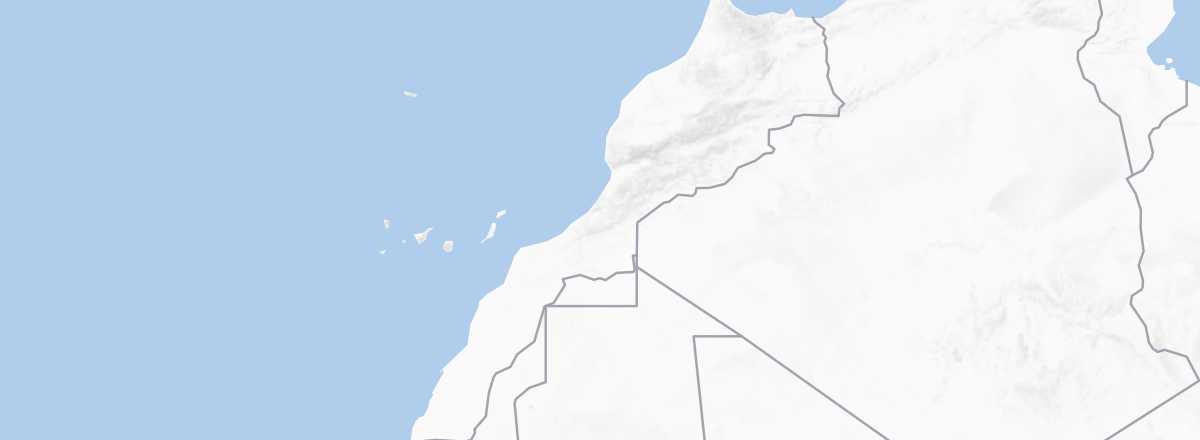 Morocco
Open the interactive map
Morocco
Open the interactive map
Luggage and Equipment to Bring
From spring to autumn, pack light clothing plus a woollen layer for evenings and higher altitudes. In winter, however, warmer clothes are useful if you’re not staying only on the coast or in the far south. Winter is also the rainy season in the north of the country.
For the desert, sunglasses, sun protection, a hat, and optionally a *cheich* (a long local scarf) are essential. Also bring a good woollen layer for the evenings.
Otherwise, a torch can be useful in the evenings for poorly lit alleys or for nights in the desert, as can earplugs (for the muezzin and other early-morning noises). If you’re staying in budget hotels, consider bringing a towel, toilet paper, and a lightweight sleeping bag liner for questionable bedding.
However, Morocco is generally well-stocked, and you’ll find all the equipment and supplies you might need in the major cities.
Communications
Telephone
Country code: (00 +) 212.
The Moroccan telephone system works well, with a 10-digit numbering system in place since 2009.
In all urban areas, you’ll easily find coin-operated or prepaid card phone booths, and especially *téléboutiques*. You can also use your mobile via your home operator or, after buying a local SIM card and top-ups, via a local provider. Note that domestic and international calls are more expensive in Morocco than in Europe.
Internet
There’s no problem finding an internet café anywhere, with good connections at an affordable price. Wi-Fi is also widely available across the country, including in hotels.
Post
The Moroccan postal service is fairly efficient. Offices are generally open Monday to Friday from 8:30 AM to 4:30 PM.
To speed up mail delivery, use the post office boxes. You can buy stamps at these offices, newsstands, and occasionally at some hotel receptions. Allow about a week for mail to reach Europe.
Time Difference
Local time: .
Morocco has been on UTC+1 year-round since the end of 2018, when the government decided to permanently adopt what was previously its "summer time." This means there’s one hour less than in France in winter and no time difference the rest of the year.
Note that the Spanish enclaves of Ceuta and Melilla follow the time of Spain, resulting in a one-hour difference between these cities and the rest of Morocco in winter.
Electricity
220 volts (50 Hz) with "French" plugs (officially types C and E), which will require an adapter for North American plugs.
Opening Hours
The working week in Morocco is the same as in Europe, from Monday to Friday. Most government offices open from 8:30 AM to 12:00 PM and from 2:30 PM to 6:30 PM, with a longer break on Fridays for midday prayers. The same generally applies to banks (though exchange bureaus in tourist areas have more flexible hours). Museums have varying schedules, but most close for the midday break.
In the medinas, shops typically operate from 8:00 AM to 9:00 PM every day, with a break for Friday prayers. In newer cities, shops usually close from 12:00 PM to 3:00 PM.
During Ramadan, all these hours change, and work generally starts earlier, around 8:00 AM, ending around 3:00 PM or 4:00 PM.
Laundries
Self-service laundries and dry cleaners have become widespread in cities and tourist areas. So, in principle, there’s no problem finding a place to wash your clothes affordably. Another option is to use your hotel, where laundry can be washed and hung out to dry on the terrace.
Local Tourist Offices
The main tourist cities in Morocco have at least one tourist information office, offering some documentation and often a website.
Weights and Measures
Morocco uses the metric and decimal system, like France.
Use of French
French is widely spoken in Morocco and is the country’s primary foreign language. You’ll never really have a communication problem in this regard.
Press and Media
Whether it’s radio, television, or print, a large portion of Moroccan media uses French. Note that, according to RSF, press freedom in Morocco is fairly limited—the country was ranked 136th out of 180 in this area in 2014.
Otherwise, you’ll find the main French newspapers and magazines without much difficulty in tourist areas.