last edited Jul 17, 2026
Getting Around the Dominican Republic
Location Map of Dominican Republic
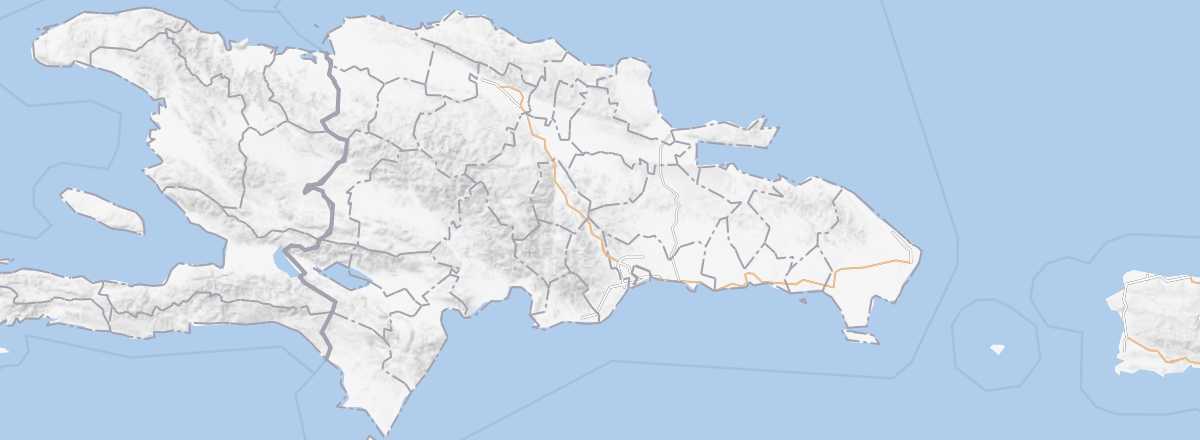 Dominican Republic
Open the interactive map
Dominican Republic
Open the interactive map
Road Network and Traffic
As in many countries, while the main road network between major cities in the Dominican Republic is good and constantly improving, secondary roads are much less reliable and usually require driving slowly. With often minimal signage, numerous speed bumps that are barely indicated, unpredictable traffic rules, and the driving habits of Dominicans—along with the accidents that come with them—getting around demands caution and constant attention. In any case, outside urban areas, it’s best to avoid driving at night.
Note that there are several toll highways in the Dominican Republic (see rates and network), where tolls can be paid in pesos or occasionally in dollars (though change is given in pesos).
Car Rental
While many visitors come to the Dominican Republic on all-inclusive packages without worrying about transport, it’s still easy to find rental companies—both international and local (usually more affordable but with fewer guarantees)—at major airports, cities, and tourist spots. This can be a good option for exploring the country, especially if you’re traveling in a group, aren’t keen on using public transport, or prefer to avoid organized excursions from agencies and large hotels.
Price-wise, expect around 40 € for a small city car as a starting offer and 60 €–70 for a small 4x4, which isn’t always necessary if you stick to main roads. Booking in advance can be useful during peak season. In any case, before committing, it’s essential to check for additional fees, insurance deductibles, and coverage. To rent a vehicle, you must be at least 25 years old and have a valid driver’s license from your home country (or an international one).
That said, driving in the Dominican Republic isn’t necessarily "easy" for many visitors and is even discouraged by some. The country’s roads have one of the highest mortality rates in the world, traffic laws are inconsistent, and driving habits can be unpredictable. Some roads are far from ideal. On top of that, in case of trouble (or even police extortion) or accidents, it’s not always straightforward for tourists to assert their rights. Ultimately, it depends on your experience driving at home or abroad. If you don’t feel comfortable behind the wheel, renting a car in the Dominican Republic is not recommended. However, for everyone, it’s crucial to stay vigilant and avoid driving at night outside urban areas.
Buses and Shared Vehicles
Buses
Several companies offer good coverage across the country with frequent services. As usual, you can choose between "premium" options (comfort, air conditioning, well-maintained vehicles) and "local" services that are slower and less reliable. In any case, prices remain very affordable compared to Europe or North America, so you can opt for the best without breaking the bank. Expect roughly 4 €–5 per 100 km with the main companies.
Key carriers commonly used by visitors:
- Caribe Tours: The leading bus company with extensive routes, including to/from the capital, even for those heading to Haiti.
- Expreso Bavaro: Mainly for Santo Domingo – Punta Cana.
- Metro: Well-established on the Santo Domingo – Puerto Plata route and surrounding areas.
- Transporte Espinal: For Santo Domingo – Santiago.
Minibuses (guagua)
These shared minibuses, locally called guagua, are a staple of Dominican life. They leave when full, stop on demand, and are a very economical—though not always comfortable (though long-distance services are improving)—way to get around cities and beyond for short to medium distances. Expect roughly 1.5 €–2.5 per 50 km. Alongside these, you’ll also find shared taxis (conchos) operating on the same principle.
Motorcycle Taxis
These are called motoconchos. You’ll find them almost everywhere, along with tuk-tuks from other regions. They’re widely used by locals for short trips. However, don’t expect a helmet, even though they’re legally required. Fares are always negotiated upfront but remain very affordable. Expect a maximum of 2 € for the longest trips.
Two-Wheelers
You’ll find motorcycle, scooter, and quad rental shops in most beach resorts. If you’re careful with traffic and drive cautiously, this can be a good way to explore small areas. Expect around 25 €–30 per day for the cheapest options.
Bicycles
Mostly useful for seaside rides or around your hotel, rather than for exploring the country, which isn’t particularly bike-friendly...
Hitchhiking
Unless you’re stranded with no transport, this isn’t a common practice in the Dominican Republic. And given the low cost of local transport, there are better ways to get around.
Trains and Boats
There are no passenger train lines in the country. Similarly, there are no regular ferries to the few small islands off the coast, including the most "famous" one, Saona, which can only be reached via organized excursions or by chartering a boat.
Domestic Flights
Of the thirty or so airports in the country, around ten handle regular or charter domestic flights operated by five or six Dominican airlines. Many routes, often short, are served by small planes with no more than 20 seats. Fares aren’t too steep ($40–60 for a flight between Santiago and the capital, for example), making air travel a potentially interesting option in terms of speed and price for certain routes, including even air-taxi services that can be chartered for groups.
In Town
Taxis
You’ll find plenty of taxis—and sometimes ride-hailing services—around cities, at airport exits, and in front of hotel complexes. Logically, the more touristy the area, the higher the fare is likely to be. In any case, always agree on the price upfront, as meters are rare or don’t always "work." That said, taxis in the Dominican Republic are expensive, even very expensive for trips outside urban areas, especially when tourists are the customers...
Urban Buses
Santiago and the capital have urban bus services running from 7:00 AM to 9:00 PM in the city and surrounding areas. A ticket costs around 10–12 RD$ at most. Otherwise, in cities without urban networks, you’ll find guaguas, shared taxis, tuk-tuks, or motoconchos providing very affordable services.
Metro
For a few years now, Santo Domingo’s municipality has had a two-line metro system covering the city and serving key activity centers. A ticket costs 20 RD$.
What to Choose for Getting Around?
If you want a simple and economical option, buses are best for long distances, while guaguas work well for shorter trips. As for car rental (for those who feel up to it), it can be a great way to explore the country freely, especially if you want to venture beyond the main roads.
Distances Between Cities
Distances (km) between the main cities in the country:
| Barah. | Jarab. | La Rom. | Las Ter. | Puerto P. | Punta C. | Samana | Santiago | S. Domingo | |
|---|---|---|---|---|---|---|---|---|---|
| Barahona | 245 | 305 | 330 | 365 | 375 | 350 | 305 | 200 | |
| Jarabacoa | 245 | 265 | 170 | 95 | 365 | 190 | 50 | 155 | |
| La Romana | 305 | 265 | 220 | 320 | 105 | 240 | 255 | 110 | |
| Las Terrenas | 330 | 170 | 220 | 195 | 270 | 40 | 160 | 150 | |
| Puerto Plata | 365 | 95 | 320 | 195 | 425 | 215 | 70 | 215 | |
| Punta Cana | 375 | 365 | 105 | 270 | 425 | 290 | 365 | 205 | |
| Samana | 350 | 190 | 240 | 40 | 215 | 290 | 180 | 170 | |
| Santiago | 305 | 50 | 255 | 160 | 70 | 365 | 180 | 155 | |
| Sto Domingo | 200 | 155 | 110 | 150 | 215 | 205 | 170 | 155 |