last edited Dec 11, 2019
Flying to the Canary Islands
Location Map of Canary Islands
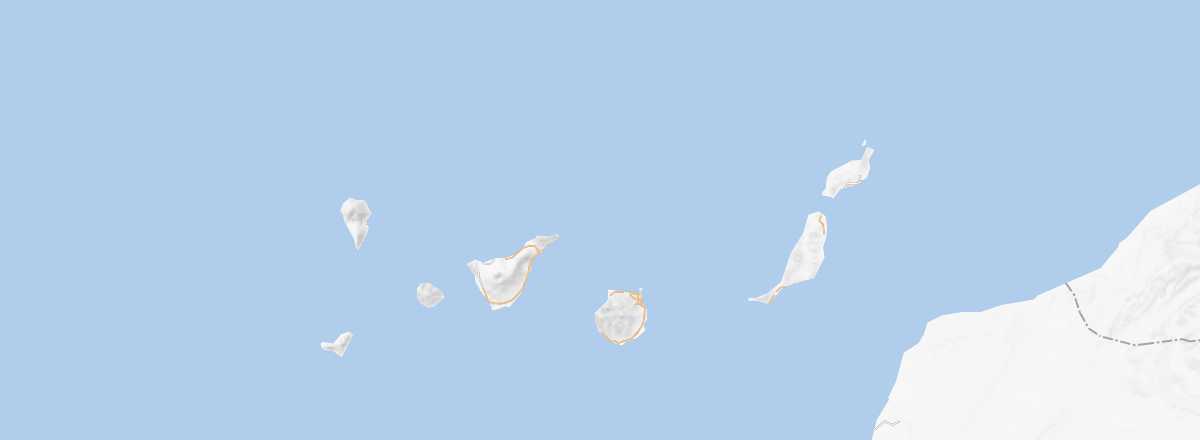 Canary Islands
Open the interactive map
Canary Islands
Open the interactive map
General Information
All seven main islands of the Canary Islands have an airport, with Tenerife even having two. Overall, five of them welcome international flights and the millions of holidaymakers who visit the archipelago each year. However, each airport also has its own specific characteristics when it comes to air travel.
International Airports
Fuerteventura
Nearly 5 million people pass through El Matorral Airport each year. It primarily handles charters, a large number of low-cost flights, and some more or less regular flights for travelers mainly from Germany, the United Kingdom, Scandinavia, Italy, mainland Spain, and France.
Gran Canaria
This is the most important airport in the Canary Islands, with 10 million passengers per year, and the main base for the three local airlines (Binter Canarias, CanarFly, and Naysa). Traffic consists of charter flights, seasonal flights, and low-cost flights (Ryanair has a base here for around thirty destinations). Beyond connections with Europe (Germany, the United Kingdom, Benelux, Scandinavia, etc.), you can also fly to Morocco, the Azores, or Cape Verde.
La Palma
Just a few international flights, particularly to Germany, England, or Benelux.
Lanzarote
The third busiest airport in terms of traffic, with almost 6 million passengers per year. Arrecife Airport also handles charters, seasonal flights, low-cost flights, and regular flights. Its clientele mainly comes from the United Kingdom, Germany, Scandinavia, and mainland Spain.
Tenerife
The island has two airports: Tenerife North and Tenerife South.
- Tenerife North: The airport primarily serves mainland Spain (especially low-cost flights), local carriers, and a few flights to Morocco or Dakar.
- Tenerife South: Reina Sofia Airport is the second largest in the Canary Islands (and the main one on Tenerife), with over 9 million passengers per year. Here too, traffic consists of all types of flights from numerous European countries, including France.
Types of Flights
Local Airlines
The Canary Islands have three local airlines:
- Binter Canarias: The main Canarian carrier. It operates domestic flights but also connects the archipelago to Morocco, Dakar, Gambia, Cape Verde, the Azores, and Madeira, as well as Lisbon.
- CanaryFly: Morocco, Mauritania, and a domestic network within the Canary Islands for Binter’s competitor.
- Naysa: This airline actually operates on behalf of Binter Canarias.
Charters, Scheduled, and Low-Cost Flights
Since the Canary Islands are a major holiday destination for Europeans, traffic is primarily charters or seasonal flights, along with a strong presence of low-cost airlines from across Europe. Scheduled flights by "traditional" airlines are actually quite rare.
Promotions and Special Offers
As with any tourist destination served by charters or low-cost flights, promotions and special offers are frequent and regular for the Canary Islands. These can be found through airlines or travel agencies, often including additional services alongside airfare.
From France
From Paris
Year-round or seasonally, there are quite a few direct connections from Paris airports. These take between 3 hours 40 minutes and 4 hours 30 minutes, depending on the destination island. Prices range from 180 to 400 € round trip.
- Fuerteventura: Aigle Azur, Jetairfly, Transavia, and Vueling from Orly. Jetairfly, XL Airways, and charters from Charles de Gaulle.
- Gran Canaria: Transavia, Vueling, and charters from Orly. XL Airways and charters from Charles de Gaulle.
- Lanzarote: Vueling from Orly. Plus Ryanair from Beauvais Airport.
- Tenerife North: Iberia and Vueling from Orly.
- Tenerife South: Air Europa, Iberia, and Transavia from Orly. EasyJet and charters from Charles de Gaulle. Plus Ryanair from Beauvais Airport.
From the Provinces
A wide range of more or less seasonal flights, primarily to Fuerteventura and Tenerife.
- Biarritz: Fuerteventura (charters).
- Beauvais: Lanzarote (Ryanair); Tenerife South (Ryanair).
- Bordeaux: Fuerteventura (Volotea + charters); Tenerife South (Volotea).
- Brest: Fuerteventura (charters).
- Clermont-Ferrand: Fuerteventura (charters).
- Lille: Fuerteventura (Jetairfly + XL Airways + charters); Tenerife South (XL Airways).
- Lyon: Fuerteventura (Jetairfly + charters); Tenerife South (charters).
- Marseille: Fuerteventura (charters).
- Mulhouse/Basel: Fuerteventura (easyJet + TUIfly); Gran Canaria (easyJet + TUIfly); Lanzarote (easyJet); Tenerife South (Air Berlin + easyJet + TUIfly).
- Nantes: Fuerteventura (Jetairfly + Volotea + charters); Gran Canaria (Volotea); Tenerife South (Volotea).
- Nice: Fuerteventura (charters).
- Saint-Étienne: Fuerteventura (charters).
- Strasbourg: Tenerife South (charters).
- Tarbes/Lourdes: Fuerteventura (charters).
- Toulouse: Fuerteventura (Jetairfly + charters); Tenerife South (Volotea).
Selection Criteria
Given the extensive options and price range for this destination, the first priority is to choose direct flights whenever they are available. These generally offer a good balance of quality, duration, and price, unlike some connecting flights that can take almost a full day to reach the destination. Additionally, since the Canary Islands are a destination that almost always has promotions and special offers, it’s worth checking opportunities from both airlines and travel agencies. Some offers also include customizable services (hotel, car, etc.) or all-inclusive packages, so comparisons can be made there as well.
As for choosing the arrival island, it all depends on your travel plans and whether your stay will be "sedentary" or itinerant. However, inter-island connections, whether by ferry or domestic flights, are not very expensive. You can therefore consider continuing your journey from your arrival island if needed. For those who want to visit multiple islands, there’s also the option of combining two of them for arrival and departure from the archipelago. As long as an airline or its partners include several in their network, this is easily achievable.
From the Rest of Europe
Almost all European countries have at least one seasonal connection, and often more, to one or another of the Canary Islands.
Belgium & Luxembourg
- Bruges: Gran Canaria (Jetairfly + Thomas Cook); Tenerife South (Jetairfly).
- Brussels: Fuerteventura (Jetairfly + Thomas Cook); Gran Canaria (Brussels Airlines + Jetairfly + Thomas Cook); La Palma (Jetairfly + Thomas Cook); Lanzarote (Jetairfly); Tenerife South (Brussels Airlines + Jetairfly).
- Charleroi: Fuerteventura (Ryanair); Gran Canaria (Jetairfly + Ryanair); Lanzarote (Ryanair); Tenerife South (Jetairfly + Ryanair).
- Liège: Gran Canaria (Jetairfly + Thomas Cook); Tenerife South (Jetairfly).
- Luxembourg: Fuerteventura (Luxair); Gran Canaria (Luxair); Lanzarote (Luxair); Tenerife South (Luxair).
Switzerland
- Basel/Mulhouse: Fuerteventura (easyJet + TUIfly); Gran Canaria (easyJet + TUIfly); Lanzarote (easyJet); Tenerife South (Air Berlin + easyJet + TUIfly).
- Geneva: Fuerteventura (Helvetic Airways); Tenerife South (easyJet).
- Zurich: Fuerteventura (Edelweiss Air + Helvetic Airways); Gran Canaria (Edelweiss Air); Lanzarote (Air Berlin + Edelweiss Air); Tenerife South (Air Berlin + Edelweiss Air).
From Another Country
Outside Europe, only the Portuguese-speaking Atlantic islands (Azores, Madeira, Cape Verde), Morocco (Agadir, Casablanca, Marrakech, etc.), and a few other cities on the West African coast (Banjul, Dakar, Nouadhibou) have connections, primarily with Binter and CanaryFly.