last edited Dec 11, 2019
Introduction to Albania
Location Map of Albania
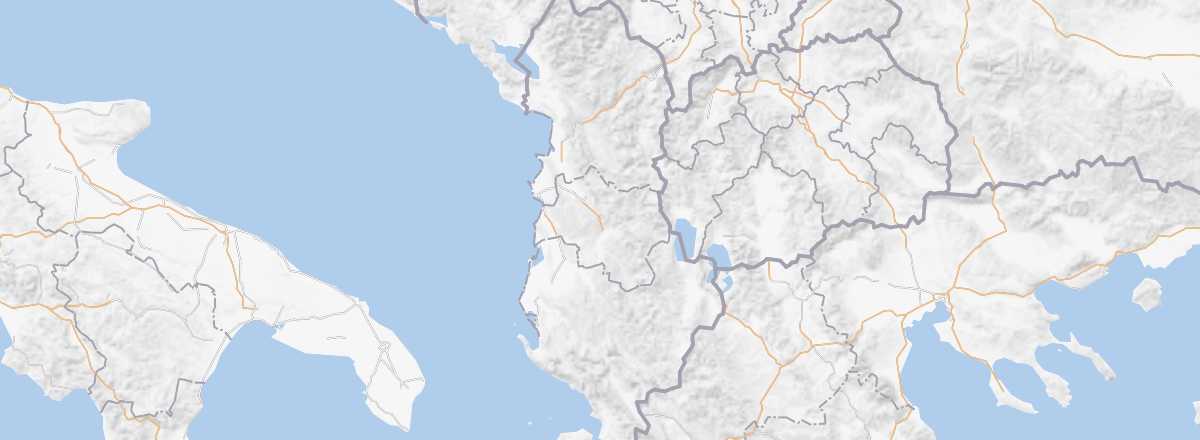 Albania
Open the interactive map
Albania
Open the interactive map
Quick Overview
Located in the western part of the Balkan Peninsula, Albania has a coastline on the Adriatic and Ionian Seas.
Key Facts
- Type of place: country.
- Latitude/longitude: 41.20' N, 19.48' E.
- Local time:
- Capital: Tirana
- Nature of the state: Parliamentary republic.
- Official language: Albanian.
- Currency: Lek.
- Population: 3,057,220 inhabitants (2012)
- Area: 28,748 km².
- Density: 106 inhabitants/km².
- Highest point: Mount Korab (2,764 m).
- Lowest point: sea level.
- Coastline: 362 km.
- Driving: on the right.
Tourism
Though not widely known, Albania is a destination that attracts quite a few visitors—and increasingly so—thanks to its historical and ancient sites, but above all its beaches and seaside resorts, which delight tourists mostly from neighboring countries or more broadly from Eastern Europe. The cost of living or expenses for a stay, even when compared to close competitors like Greece or Montenegro, also plays a role, though Albania’s tourism sector can still be somewhat "chaotic" or not always well-organized.
In 2018, 5.34 million tourists visited the country (up from 2.2 million in 2010), including tens of thousands of French travelers.
Travel Essentials
- Destination: for beginner or slightly experienced travelers.
- By air: Paris-Tirana for 180 € to 300 € round trip.
- Entry requirements: passport or ID card.
- Currency to bring: euros.
- Exchange rate:
- Backpacker daily budget: from 30 € to 45 € per person.
- Accommodation: mid-range hotels or homestays.
- Getting around: car or occasionally bus.
- Risks: relatively low in terms of health and safety.
- Best time for climate/crowds/prices: from late April to late June and September-October.
- Interests (out of ): Nature ; Adventure ; Culture ; Relaxation/Holidays .
Addresses in France
Tourist Office: available online and in English.
Addresses in Belgium, Switzerland, and Quebec
Socio-Economic Statistics
- "Quality of life": 68/188 (2018 ranking)
- GDP per capita: $12,500 (2017)
- Average monthly income: $340 (2012)
- Inflation: +2% (2017)
- "Official" unemployment: 13.8% (2017)
- Population below poverty line: 14.3% (2012)
- Life expectancy: 78.6 years (2018)
- Migration rate per 1,000 inhabitants: -3.3 (2017)
- Population growth: +0.3% (2018)
- Literacy rate: 97.6% (2015)
- Urban population: 60.3% (2018)
- Press freedom: 75/180 (2018 ranking)
- Political regime: hybrid regime (76/167 in 2018)
Sources: World Bank, Human Development Indicators, RSF, The Economist, The World Factbook