last edited Dec 11, 2019
Overview of the United States
Location Map of United States
 United States
Open the interactive map
United States
Open the interactive map
Quick Overview
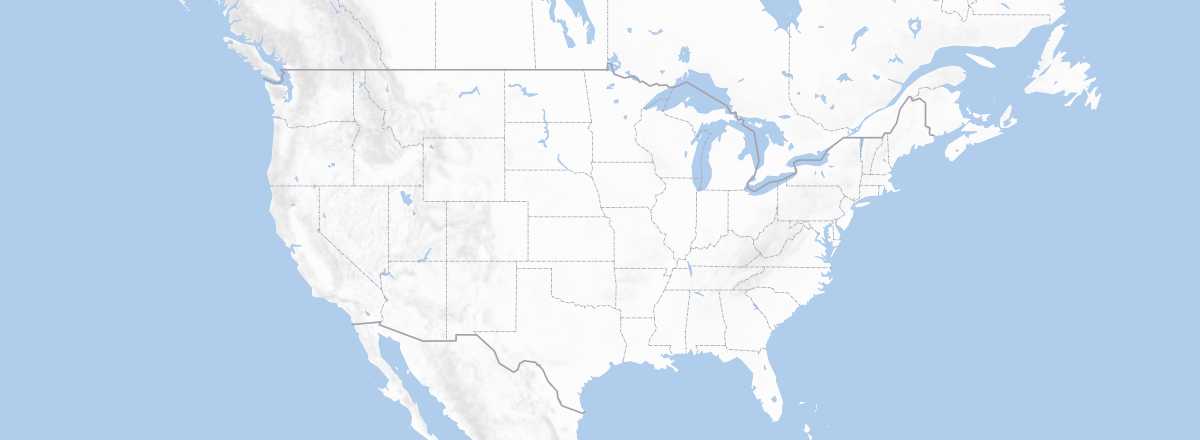
As vast as a continent, the United States stretches from the Atlantic to the Pacific and from Canada to Mexico. It consists of 50 states (48 "continental" + Alaska and Hawaii) and various "overseas territories" (Puerto Rico and the Virgin Islands, Guam...).
The country can roughly be divided into three parts: in the East, the mountainous and forested Appalachians (Mount Mitchell: 2,037 m); in the center, the Great Plains and the Great Lakes with the Mississippi River flowing into the Gulf of Mexico; and in the West, the Rockies (Mount Elbert: 4,400 m) with its rugged plateaus and deep valleys.
The United States in Eleven Tourist Regions
- New England: six small northeastern states on the Canadian border. This is where the history of what would one day become the United States of America began. Beyond Boston, the major metropolis, lies a rugged land of mountains and forests, sparsely populated and not heavily frequented by foreign tourists.
- East Coast: home to New York, Washington D.C., and other "mega-agglomerations" in this part of the country, also known as "The Mid-Atlantic." A major tourist hub that isn’t just about cities...
- Florida: sometimes very close to the Caribbean or Latin America, Florida maintains its tourist image with beach resorts and theme parks. But it’s also a wild nature with forests and swamps (the famous Everglades), home to rich and diverse wildlife.
- The South: nicknamed "Dixie," this part of the country has a heritage and culture quite distinct from other regions. That doesn’t make it any less of a tourist destination.
- Texas: the second-largest state in the Union and also the second-most populous. Here, at the crossroads of the South, Mexico, and the American West, the "Lone Star State"—as it calls itself—boasts a unique and distinctive setting, including for tourism.
- Midwest and the Great Plains: the vast region between the East and West of the United States. Flat and monotonous overall, it’s often seen as just a transit zone, though a few spots (starting with Chicago) are worth stopping for.
- The American West: Southwest, Rockies... this is the America of wide-open spaces, deserts, mountains, and forests. It’s home to some of the country’s most beautiful natural parks and sites, which have made its reputation.
- California: part of the American West, California is nevertheless a world apart in many ways, including tourism. This must-visit state offers a perfect blend of nature, adventure, culture, and relaxation that can satisfy every type of traveler...
- Pacific Northwest: between California and Canada, facing the ocean, the "Pacific Northwest" is a wild land of mountains, forests, and rugged coasts. An ideal spot for nature lovers who don’t mind its sometimes harsh and demanding conditions...
- Alaska: undeniably, "The Last Frontier" has nothing in common with the rest of the country. Beyond its unique history and culture, Alaska remains a fantastic nature-adventure destination that will delight lovers of wide-open spaces and outdoor activities—despite the budget needed to fully enjoy the territory on your own.
- Hawaii: here, nature—and especially volcanoes—has created stunning landscapes, while the ocean has become the playground of choice for surfers from around the world. For many, Hawaii is also synonymous with relaxation and vacations in a more than pleasant setting...
Key Facts
- Type of place: country.
- Latitude/longitude: 38.00' N, 97.00' W.
- Local time: there are 4 time zones in the continental part of the country (excluding Alaska).
-- "Eastern Time": for Boston and New England, New York, the East Coast, or most of Florida.
-- "Central Time": for Chicago, St. Louis, the Midwest, Texas, or Louisiana.
-- "Mountain Time": for the entire Rocky Mountains region and much of the Southwest, from New Mexico to Montana.
-- "Pacific Time": for California, Nevada, or the Northwest states.
- Capital: Washington D.C.
- Nature of the state: federal presidential republic
- Official language: there is no official language at the national level, only at the federal level. However, English is *de facto* recognized as such for the entire country.
- Currency: US dollar.
- Population: 329,256,465 inhabitants (2018).
- Area: 9,833,517 km².
- Density: 33.5 inhabitants/km².
- Highest point: Denali (6,190 m) in Alaska.
- Lowest point: Death Valley (-86 m) in California.
- Coastline: 19,924 km.
- Driving: on the right.
Tourism
Consistently among the top three most visited countries in the world, the United States is one of the most comprehensive destinations around. Nature, adventure, culture, relaxation, or nightlife—there’s something for every taste, though it’s rarely all in one place, given how vast and diverse the country is.
In terms of visitation, the country welcomed 79.618 million foreign tourists in 2018, with regions like New York, California, the American West, and Florida being particularly dynamic. In terms of origin, Canada, Mexico, the United Kingdom, Japan, China, South Korea, Brazil, Germany, and France (1.767 million in 2018) are the top sources of visitors.
Travel Essentials
- Destination: for beginner travelers.
- By plane:
-- France-Los Angeles or San Francisco: 500 to 1,000 € round trip.
-- France-Miami: 400 to 800 € round trip.
-- France-New York: 350 to 800 € round trip.
- Entry requirements: biometric or electronic passport + return or onward ticket + ESTA electronic authorization.
- Currency to bring: US dollar.
- Exchange rate:
- Daily "backpacker" budget:
- Best for accommodation:
- Best for getting around:
- Risks: low health risks and relatively low security risks.
- Best time for climate/crowds/prices:
- Interests (out of ): Nature ; Adventure ; Culture ; Relaxation
Useful Addresses
Visit USA Committee: not open to the public, accessible online or at 0899 702 470 on weekdays from 9:30 AM to 1:00 PM and 2:00 PM to 5:30 PM. Several US cities or states also have tourism representation via French-language websites, though they are also not open to the public (see regional guides).
Socio-Economic Statistics
- "Quality of life": 13/188 (rank in 2018)
- GDP per capita: $59,800 (2017)
- Average monthly income:
- Inflation: +2.1% (2017)
- "Official" unemployment: 4.4% (2017)
- Population below the poverty line: 15.1% (2011)
- Life expectancy: 80.1 years (2018)
- Migration rate per 1,000 inhabitants: +3.9 (2017)
- Population growth: +0.8% (2018)
- Literacy rate:
- Urban population: 82.3% (2018)
- Press freedom: 45/180 (rank in 2018)
- Political regime: flawed democracy (25/167 in 2018)
Sources: World Bank, Human Development Indicators, RSF, The Economist, The World Factbook