last edited Dec 11, 2019
History of Puerto Rico
Location Map of Puerto Rico
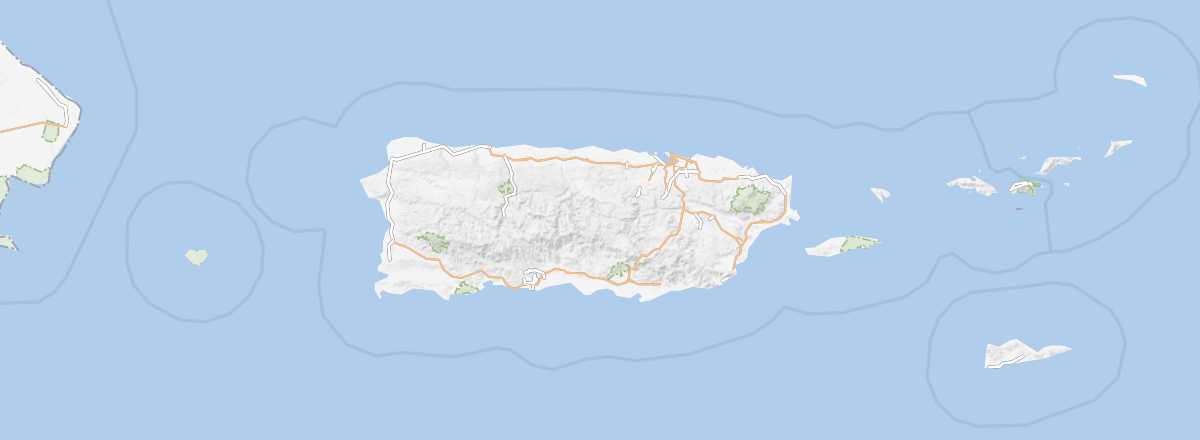 Puerto Rico
Open the interactive map
Puerto Rico
Open the interactive map
History of Puerto Rico
Key Dates
- Pre-Columbian era: While the island had been inhabited by various populations for two or three thousand years, it was the Taíno society that dominated the territory and even the entire region when Christopher Columbus discovered the Americas.
- 1493: Christopher Columbus arrives on the island during his second voyage.
- Early 16th century: After the first permanent settlement in 1508, the island officially becomes a Spanish colony, taking the name Puerto Rico in 1520. With the arrival of the Spanish and settlers, the enslavement and gradual disappearance of the Taínos begins, quickly replaced by African slaves.
- Late 16th–18th century: This is the era of rivalries between European powers in the Caribbean, leading to Puerto Rico being attacked and/or occupied several times, particularly by the English.
- Early 19th century: Following the Napoleonic Wars, the island gains (temporary) "autonomy" while remaining under Spanish rule. Puerto Rico then sees the beginning of modest economic growth based on agriculture and the arrival of new migrants from Spain and other European countries.
- 1860–70: Poverty and socio-economic problems push the island’s inhabitants to revolt and demand independence, which is refused by the Spanish, who quickly reassert control over the territory.
- 1873: Among the few reforms undertaken by the Spanish, slavery is abolished in Puerto Rico.
- 1898: Following the Spanish-American War, the defeated Spanish cede several of their colonies to the USA, including Puerto Rico.
- Early 20th century: The island benefits from American-style development and governance, leading in 1917 to it becoming a "Territory of the United States," with its inhabitants granted a "limited American citizenship" that notably does not allow voting in US presidential elections.
- 1920s–30s: The rise of the Puerto Rican Nationalist Party, aiming for the island’s independence, and violent American repression.
- 1940s: For economic reasons, as well as employment by the military, a significant Puerto Rican migration to the United States begins, particularly to New York.
- 1952: Amid conflict between Americans and independence advocates, the USA grants the island a new constitution, providing a degree of autonomy with the status of a "commonwealth associated with the United States," which satisfies neither side.
- 1950s–70s: Thanks to American financial aid and the Puerto Rican diaspora, the island experiences strong economic growth, making it one of the leading economies in Latin America.
- 1991: Spanish is recognized as the sole official language of Puerto Rico before English is also (re)recognized as such two years later.
- 1993: Puerto Rico rejects by referendum the option of becoming the 51st state of the USA (the same outcome occurs in 1998). Increasingly, full independence or total integration into the USA appears to be the only viable choices for the island.
- 2000s: Tensions with the United States, which in 2003 abandon their military base on Vieques, already occupied by numerous civil disobedience camps.
- 2005: Several American interventions on the island against independence movements further escalate tensions, which the UN condemns in 2006, along with the denial of the Puerto Rican people’s right to self-determination by the US government.
- 2012: In a new referendum, the island’s population rejects the current "associated state" status in favor of full integration as the 51st state of the United States (primarily for economic reasons). For now, this has only been "acknowledged" by the US government.
- 2017: Severely affected in September by Hurricane Maria, the island sees its socio-economic situation worsen, further accelerating the migration of its population to the United States, which began the previous decade.