Au Vietnam il n'est pas rare qu'une légende se rattache à un événement de la vie courante, à une situation géographique, un événement historique ou tout simplement à un met.
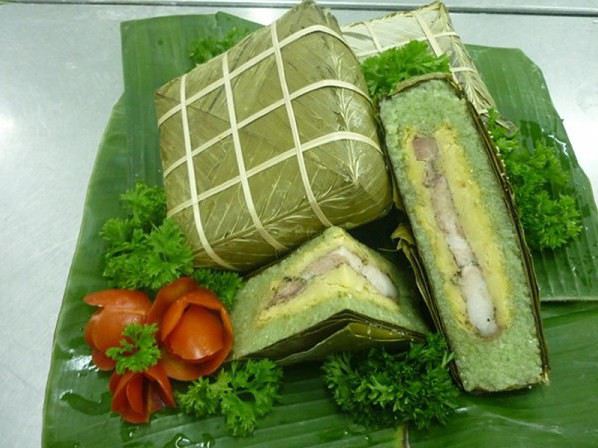
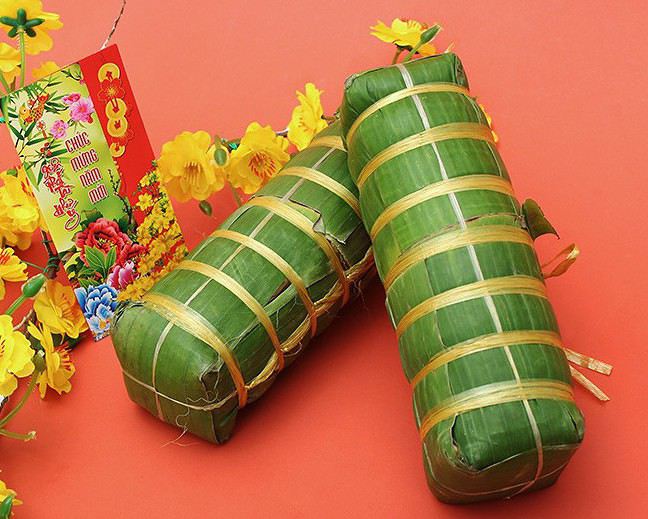
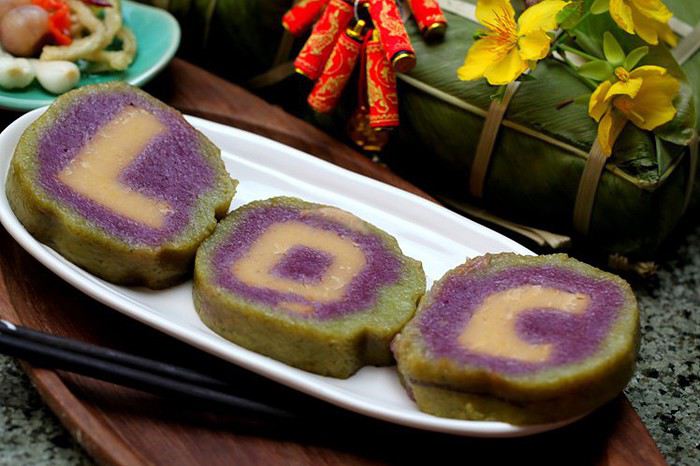
Le gâteau de riz gluant Banh Chung en vietnamien, est l'une des friandises traditionnelles des vietnamiens lors de la fête du Têt. On le sert souvent avec du porc au caramel.
La Légende:
Le fils du premier roi Van-Lang, le Viêt-Nam d'autrefois, régnait sous le nom de Hùng-Vuong. Il avait trois épouses, chacune d'elles donnant naissance à un garçon. Le fils de la première, Long, épousa Kim, orgueilleuse et jalouse. Le fils de la seconde, Hô`, épousa Ngoc, méchante et acariâtre envers son mari. Le fils de la troisième décédée, Van, vivait avec sa grand'mère maternelle et s'occupait des travaux agricoles. Il pratiquait la culture sur brûlis, cultivait les légumes ou allait pêcher aux heures de loisir. La grand'mère maria Van à Xuân, une demoiselle sage et laborieuse du village. Le couple menait une vie modeste mais heureuse.
Un jour, convoqués par le roi, Van à Xuân devaient vendre leurs deux buffles pour préparer le voyage. A la cour, ils virent leurs aînés et leurs épouses habillés élégamment et parés de bijoux. Van et Xuân se sentaient confus. Tout le monde se moquait d'eux en leur reprochant de se présenter au roi sous une simple apparence. Par contre, le roi se montrait affectueux pour Van, orphelin de mère. Accablé par la vieillesse et en règne de 50 ans, le roi voulait céder le trône à celui qui pouvait préparer les mets les plus savoureux. Les épouses des deux grands , confiantes de leur talent, rivalisaient pour gagner le trône pour leur mari. Seuls, Van et Xuân étaient très inquiets car ils étaient très pauvres.
Une nuit, dans un songe, Van vit sa mère qui lui fit savoir qu'il serait l'élu du trône. Il lui suffisait de faire un gâteau de riz gluant, en forme de carré avec de la viande, de la graisse au milieu pour symboliser le cœur, le Banh Chung.
Le gâteau carré représentait la terre car on croyait à cette époque que la terre était carrée. Van se réveilla et raconta le songe à sa femme. Le couple décida de suivre les conseils de leur mère pour confectionner les gâteaux, puis les faire bouillir dans une marmite en terre cuite. Au jour fixé, les deux brus Kim et Ngoc offrirent au roi des plats coûteux. Mais ce dernier n'y trouva rien d'exceptionnel. Quant aux gâteaux offerts par Van et Xuân, il fut ravi par leur délicatesse et par leur signification: "Il fallait gouverner le pays avec sagesse". Il combla Van de louanges et le désigna comme son successeur.
Par générosité, Van n’hésita à élever au titre de vicomtes ses frères.
Pour bien aimer un pays il faut le manger, le boire et l’entendre chanter. (Michel Déon)
Il est vrai que je ne connais que le carré voyageant plus au nord, mes amis le préparent ainsi.
Bon, pour la recette, je ne me sens pas encore tout à fait prête...., c'est encore trop éloigné de mes compétences 😉 , je vais me cantonner au porc au caramel et acheter le gâteau (si je trouve).
Belle journée.
Pour bien aimer un pays il faut le manger, le boire et l’entendre chanter. (Michel Déon)
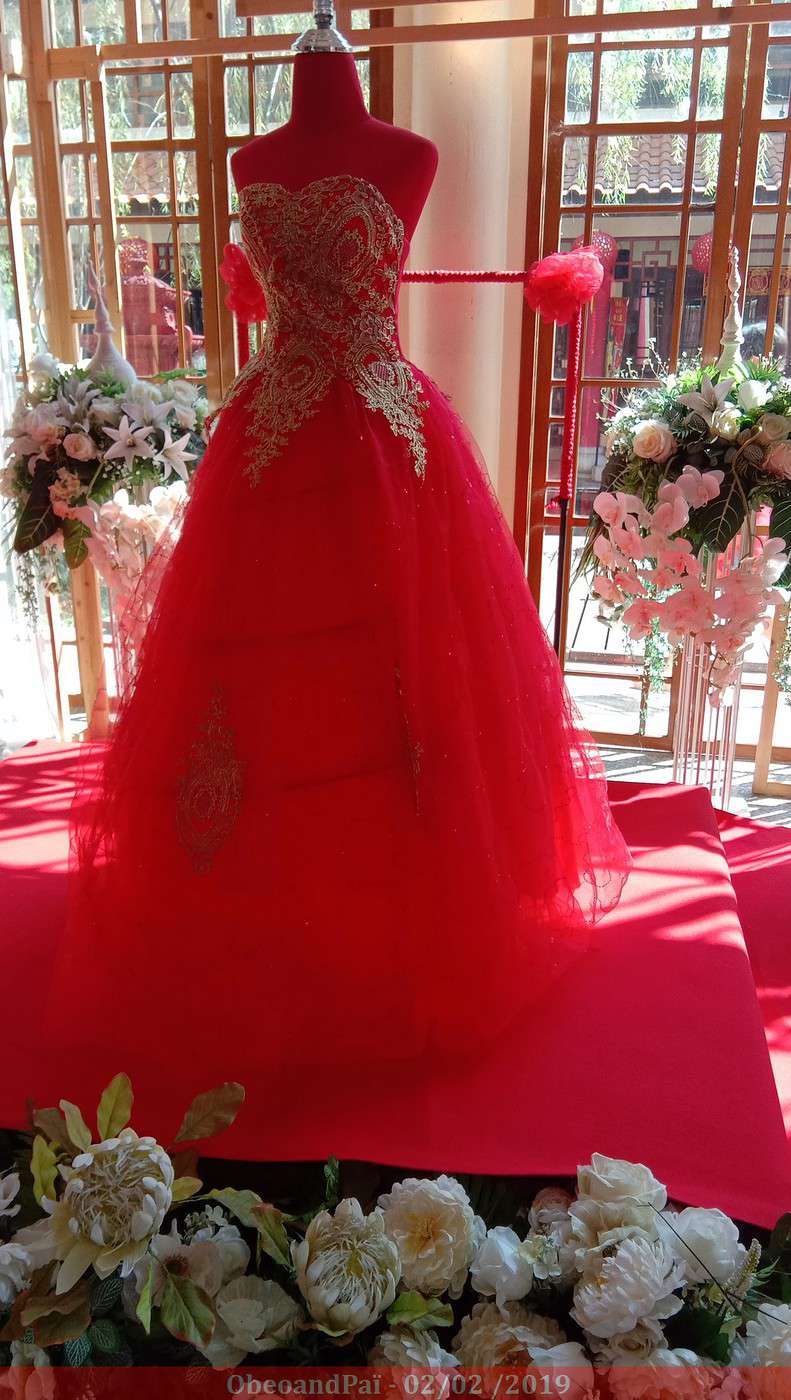
Et avec le rouge les belles couleurs de toutes les fleurs du Têt.
J'imagine l’effervescence dans les chaumières pour la préparation de cette grande fête...
Belle journée à vous
Pour bien aimer un pays il faut le manger, le boire et l’entendre chanter. (Michel Déon)
Et ici une recette 😉 : misstamkitchenette.com/...vel-an/#.XErA_s9Kgsk
Merci pour la recette,
Paï adore sortir du classique siamois, elle est partante pour un essai
reste a trouver les feuilles de pandanus
elle innove régulièrement,
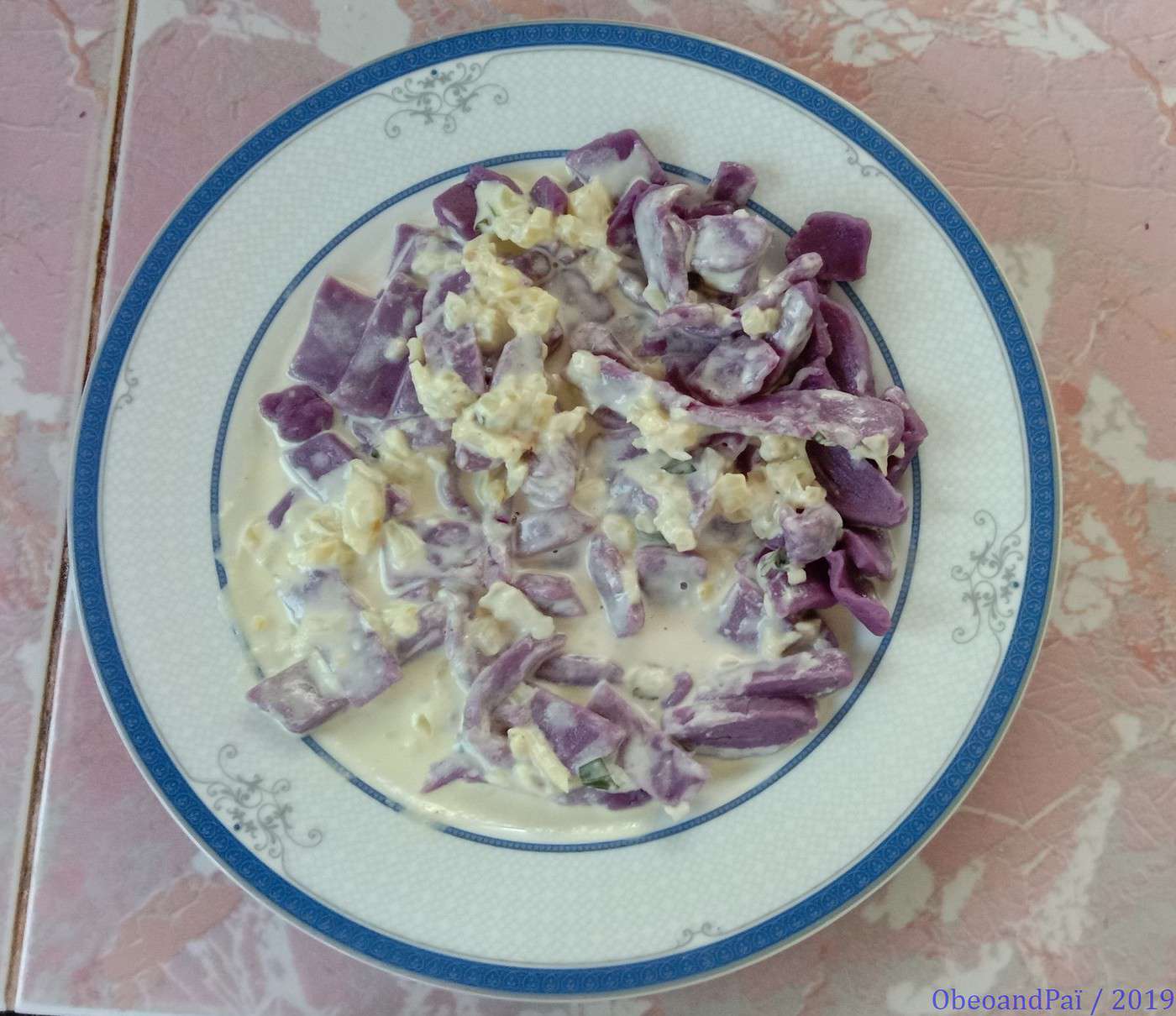
par exemple ce midi, elle s'est lancé dans la cuisine "mixte":
patate douce sauce au bleu Danois, pas spécialement esthétique mais savoureux
😉
L'abricotier,
Au Vietnam, deux espèces sont identifiées sous les noms scientifiques d’Ochna integerrima et Ochna atropurpurea. Elles poussent dans les forêts de la chaîne de montagnes de Truong Son et à Quang Nam, Dà Nang, Khanh Hoà (Centre). Elles sont également abondantes dans les collines du delta du Mékong.
Pour bien aimer un pays il faut le manger, le boire et l’entendre chanter. (Michel Déon)
Hors Asie, ça me parait bien aléatoire... 😏 Mais rassure Paï, elle peut s'en passer
patate douce sauce au bleu Danois
Dis donc, le palais de Paï s'est sacrément bien adapté aux saveurs européennes 😉
On trouve en France, chez les frères Tang et autres des feuilles de Pandanus, fraîches en ce moment et ou surgelées.
Quel est le goût du pandanus, ce serait proche de quoi que l'on puisse connaitre?
patate douce sauce au bleu Danois..c'est osé en effet , bravo Paï!😉
Pour bien aimer un pays il faut le manger, le boire et l’entendre chanter. (Michel Déon)
Au Vietnam il n'est pas rare qu'une légende se rattache à un événement de la vie courante, à une situation géographique, un événement historique ou tout simplement à un met.
Le gâteau de riz gluant Banh Chung en vietnamien, est l'une des friandises traditionnelles des vietnamiens lors de la fête du Têt. On le sert souvent avec du porc au caramel.
Roohh ! Une friandise !! ( pour moi une friandise c'est un bonbon, un gâteau au chocolat, un quatre quart 😉 )
C'est bourratif au possible et pas sucré du tout vu que c'est fourré à la viande de porc.
En tous cas ça fait boire ..😛.😎
Friandise parce que c'en est une pour les vietnamien, çà s'offre, çà se mange du bout des doigts, c'est légèrement sucré quand fait avec le riz gluant et c'est tout un symbole.
Avec le porc au caramel c'est bon, seul, un peu bourratif comme le serait aussi certains gâteaux sucrés
Pour bien aimer un pays il faut le manger, le boire et l’entendre chanter. (Michel Déon)
J'en ai mange plus d'une fois, aussi bien à Hanoï qu'à Saïgon ou à Huê et aussi en France, je n'ai jamais trouve ça bon .
chacun ses goûts, n'est-il pas ?
par contre sur cette page Google tu as un tas de friandises vietnamiennes
Les bánh nuong,
Si les desserts vietnamiens , ne me font pas tomber en pâmoison, les gâteaux de lune, je me damnerai pour çà (enfin presque😉), j'adore!!
Pour bien aimer un pays il faut le manger, le boire et l’entendre chanter. (Michel Déon)
Sujet sympa et dans l'air du temps...
Les gateaux de lune Bánh Nướng, à base de farine de blé, ou Bánh Deo, à base de farine de riz, se mangent principalement pendant la période de la fête de la Lune (Têt Trung Thu) qui a lieu chaque année à la mi automne du calendrier lunaire. L'année dernière, elle s'est déroulée le 24 septembre.
Des légendes entourent aussi ce gâteau très prisé par les enfants et je suis sûre que vous nous les trouverez.
Il existe d'ailleurs à Hanoi, le dernier artisan de moule à gâteaux de lune en bois. Si vous avez l'occasion de passer à son atelier au 59, rue Hàng Quat, discuter avec Mr Pham n'est pas une heure de perdue. C'est un monsieur passionné et passionnant.
Pour revenir au Têt, les gens s'offrent aussi pendant cette période un assortiment de fruits confits Mức ( graines de lotus, noix de coco, patates douces, pomme étoilée, gingembre etc..), toujours emballé dans de jolies boites qu'ils dégustent avec le thé. On en trouve un peu partout dans les supermarchés asiatiques du XIII eme arrondissement en ce moment. Je ne suis pas très fan de sucreries ou pâtisseries vietnamiennes mais ça plait beaucoup apparemment.
On trouve aussi à Paris quelques branches de bông Mai (Sud) ou hoa Mai (Nord), fleurs jaunes de l'abricotier. Les vietnamiens racontent que l’Ochna integerrima doit fleurir au moment même où commence le Nouvel An, le matin du premier jour, ce qui apporte chance, prospérité et bonheur pour toute l’année.
Je vous souhaite beaucoup de bông Mai au matin du 5 Fevrier...
Le gâteau de riz gluant Banh Chung en vietnamien, est l'une des friandises traditionnelles des vietnamiens lors de la fête du Têt. On le sert souvent avec du porc au caramel..
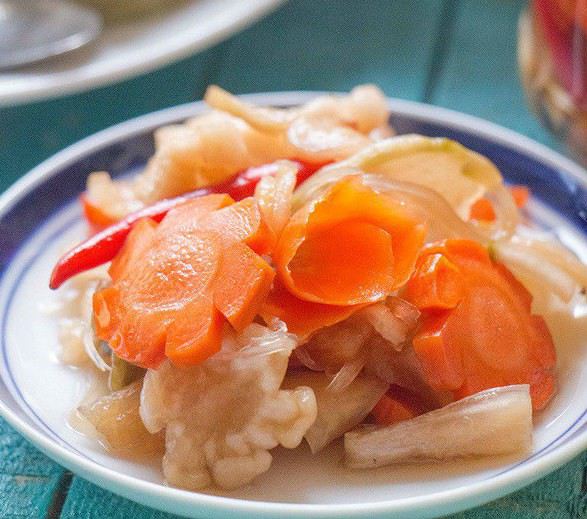
Le banh chung accompagné les condiments "dua mon" comme échalotte vinaigrée est le standard. 😏
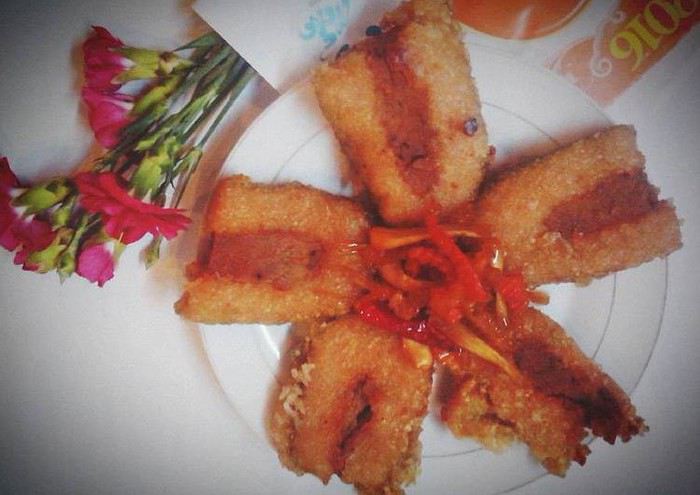
Une autre méthode pour mieux apprécier, vous pouvez frire les 2 faces des morceaux découpés en rectangle de 2cm d'épaisseur. Evitez de mettre les morceaux collés les uns aux autres.
Mais je le connais bien Mr Pham, je m'y rends quand je suis à Hanoï pour lui acheter des tampons de signature que j'offre à mes amis à mon retour...
C'est une toute petite boutique atelier, les moule à gâteaux plus beaux les uns que les autres tapissent entièrement son échoppe, ils sont fabriqués sur place. Il se situe en début de rue et jouxte le petit temple, là où il y a des jeunes gens assis sur des tabourets bleus et rouges😏
www.google.fr/...2!2e10!7i2508!8i1254
Par contre au 59 c'est maintenant un marchant de votifs et magasin quasi neuf...
Au Viêt Nam, il existe deux légendes populaires associées a la fête de la lune.
La première décrit l’histoire de Thang Cuội, le gardien de buffles qui flotta malencontreusement vers la Lune en essayant de retenir un arbre banian sacré. Chaque année en allumant leurs lanternes et en participant à la procession, les enfants montrent ainsi le chemin du retour vers la Terre à Cuội.
Jadis, un jeune bûcheron nommé Cuoi avait l'habitude de partir couper du bois avant l'aube
Un matin ou il avançait dans la semi-obscurité, il entendit à ses pieds des miaulements étranges. Pris de peur, il abattit sa cogné au hasard.
Aussitôt, un rugissement terrible se mit à retentir, Cuoi n'eut que le temps de grimper jusqu'au fait de l'arbre.
Au jour il vit que sa cogné avait frappé à mort quatre petits tigres. La mère bondissait en hurlant de douleur. Cuoi se garda bien de descendre et continua d'observer l'animal. Il vit alors la tigresse se diriger vers un arbre proche, arracher quelques feuilles d'une plante, les mâcher et, revenant vers les petits inanimés, introduire cette pâte entre leur leurs dents. O miracle ! Les petits agitèrent leur queue et se redressèrent.
Cuoi attendit que la mère les ait emporté pour descendre. Il déterra la plante et l'emmena chez lui. Sur son chemin il vit un vieux mendiant qui venait de mourir. Cuoi mâcha quelques feuilles qu'il introduisit dans la bouche du vieillard. Aussitôt celui-ci fut sur son séant et questionna Cuôi.
L'ayant écouté il dit :
- Terre, Ciel ! C'est la plante qui ressuscité les morts. Le Ciel vous la donne mon enfant pour aider vos semblables, faites en bon usage. Veillez seulement à ne lui donner que de l'eau pure, sinon elle s'envolera ...
Et le vieil homme disparut. Cuôi repiqua la plante à l'Est, dans son jardin et l'arrosa avec de l'eau clair de son puits. Dès lors il ne cessa de sauver ses semblables jeunes et vieux. Sa réputation s'étendit à tous le pays, mais il restait solitaire.
Un jour Cuôi vit le cadavre d'un chien flottant sur la rivière. Il prit une feuille qu'il avait dans sa poche et le ranima, il n'eut pas de meilleurs amis.
A quelques temps de là, un notable du village voisin vint trouver Cuôi pour sa fille qui venait de se noyer : Cuôi se précipita. Bientôt, les roses de la vie remplacèrent la pâleur de la mort sur le visage de la jeune fille.
Reconnaissante, elle voulu bien épouser Cuôi et le notable accepta. Cuôi, sa femme et son chien étaient heureux quand de mauvais gens tuèrent la jeune femme, lui arrachèrent les entrailles qu'ils jetèrent dans le fleuve.
Cuôi rentrant de la forêt devint fou de douleur, il eseya de ranimer sa femme, mais comment vivre sans ses intestins ? Alors le brave chien dit "Prend les miens" ce que fit Cuôi. L'opération réussit et la femme revint à la vie. Ému de la fidélité de son chien Cuôi lui modela des intestins de terre.
Toute la famille vivait à nouveau dans la paix quand, une après midi ou Cuôi était allé couper du bois, la jeune femme éprouva le besoin d'aller se soulager et malencontreusement alla vers la plante. Aussitôt un vent violent souffla en rafale et la plante miraculeuse arraché du sol s'envola.
Cuôi qui rentait eu juste le temps d'accrocher sa cogné à l'une des racines, mais la plante était plus forte que lui et l'entraîna à travers le ciel jusqu'à la lune.
Depuis ce jour Cuôi vit dans la lune avec la plante miraculeuse qui chaque année laisse tomber une seule feuille, que se disputent les poissons.
Regardez les jours de pleines lunes et vous verrez auprès d'une tache noir en forme de vieil arbre, une silhouette humaine : C'est "Cuôi au pied d'un banian".
L’autre légende met en scène une carpe qui voulait devenir un dragon, et qui pour y arriver travailla dur toute l’année jusqu’à être capable de se transformer en dragon.
Chaque année la saison des pluies, l'Empereur de Jade ordonnait aux dragons de faire jaillir de l'eau sur la terre pour permettre aux paysans de planter du riz. Comme les dragons n'étaient pas nombreux, ils ne pouvaient bien accomplir leur devoir.
C'est ainsi que les Mille êtres durent plusieurs fois supporter des sécheresses de plusieurs années. L'Empereur de Jade décida alors organiser un concours entre tous les animaux, et particulièrement entre les poissons et les crevettes, pour qu'ils puissent se transformer en dragons.
Chaque animal devait franchir trois échelons de vagues. La tanche réussit à franchir la première vague mais échoua à la seconde. La crevette fut plus talentueuse, elle passa sans encombre les deux premiers effets de la transformation en dragon se firent sentir.
Les écailles lui couvrirent le corps, des pinces lui poussèrent sur la tête, mais lors du troisième saut elle échoua et retomba à la renverse si durement qu'elle planta la tête dans le sol, que les entrailles lui remontèrent à la tête et son dos resta courbé à tout jamais. Puis vint le tour de la carpe.
Elle prit son élan et franchit d'un seul trait les trois échelons de vagues. Alors elle traversa en vainqueur la Porte de Vu Mon et se transforma en dragon comme promis.
Depuis lors toute personne qui a une bonne chance est comparée à cette carpe victorieuse.
(légende empruntée au blog de mon très cher ami Pierre).
Merci de vos bons vœux, nous vous retournons tous les notres.
Pour bien aimer un pays il faut le manger, le boire et l’entendre chanter. (Michel Déon)
Il y a 4 marchés aux fleurs importants pour cette période à Hanoï , désolée, je ne connais pas ceux de Saigon...
Le plus éloigné se trouve dans un village, Tai Tuu, celui de Quang Ba est plus nocturne et de gros, les 2 autres sont dans la ville de Hanoï
https://goo.gl/maps/583o7e5e5Hv
Pour bien aimer un pays il faut le manger, le boire et l’entendre chanter. (Michel Déon)
Avec les "gourmandises", les fleurs, la calligraphie occupe une place importante dans le Têt.
On se doit de décorer sa maison, acheter et accrocher au mur des estampes populaires et des calligraphies est une tradition qui ne peut être ignorée à l’occasion du Têt traditionnel.
L’activité comme son objet sont en effet censés apporter chance et prospérité pour toute l’année à venir.
Le village des estampes, Dong Hô est un lieu à vraiment visiter et pas que pour le Têt.
https://goo.gl/maps/iBfXorBG6k92
A Hanoï dans la rue Van Mieu vous pourrez demander aux lettrés des calligraphies de rédiger des sentences parallèles, des vœux du Nouvel An, dans l’idée d'attirer la bonne fortune.https://goo.gl/maps/bxRx64y3ZU52
Pour bien aimer un pays il faut le manger, le boire et l’entendre chanter. (Michel Déon)
Tout d’abord, il faut préparer un vrai repas pour les morts, qu’on met sur l’autel des ancêtres : 5 fruits différents, le gâteau au riz gluant vert (bánh chưng), un coq cuit avec les pattes (un coq, pas une poule, très important !).
Il faut aussi acheter puis brûler des offrandes en papier, les fausses monnaies… pour les ancêtres et les « dieux » de la maison.
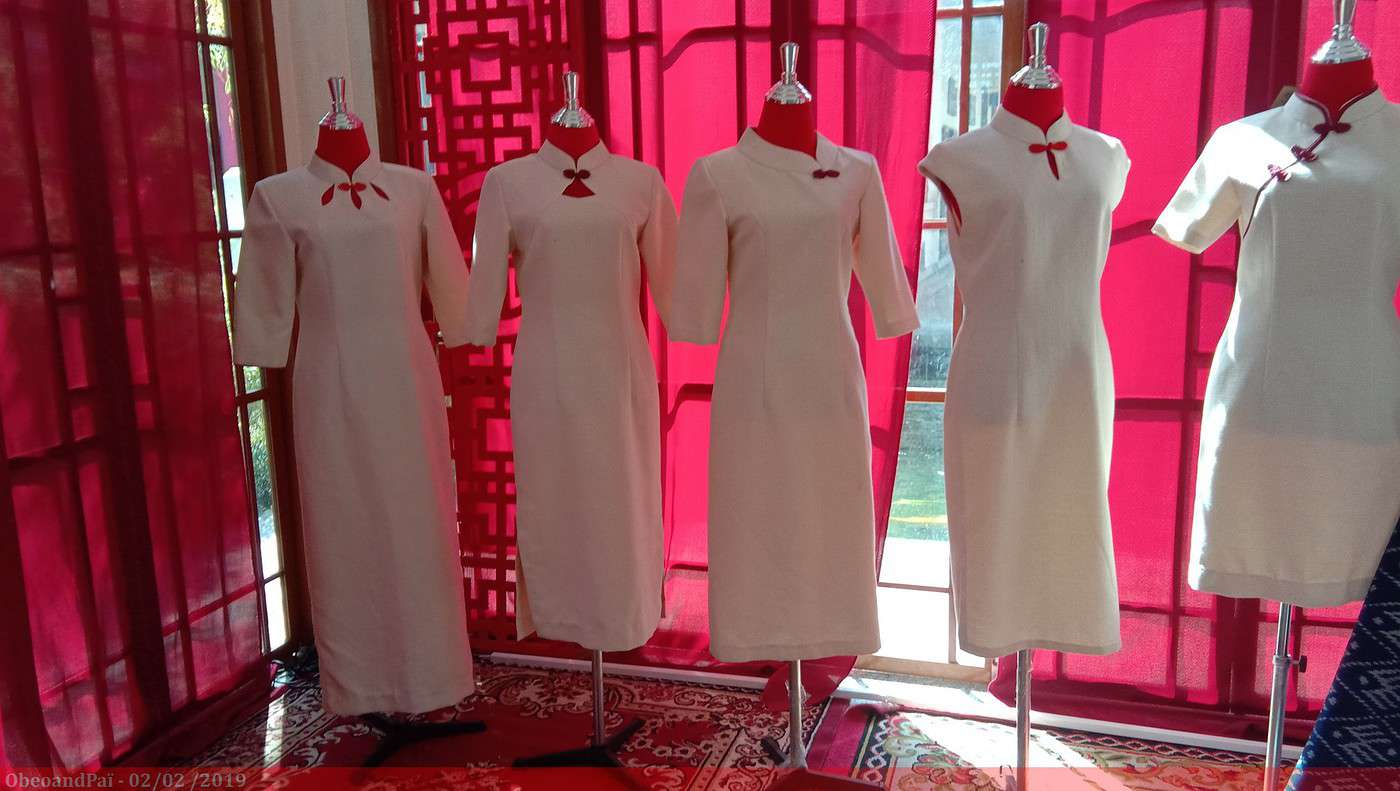
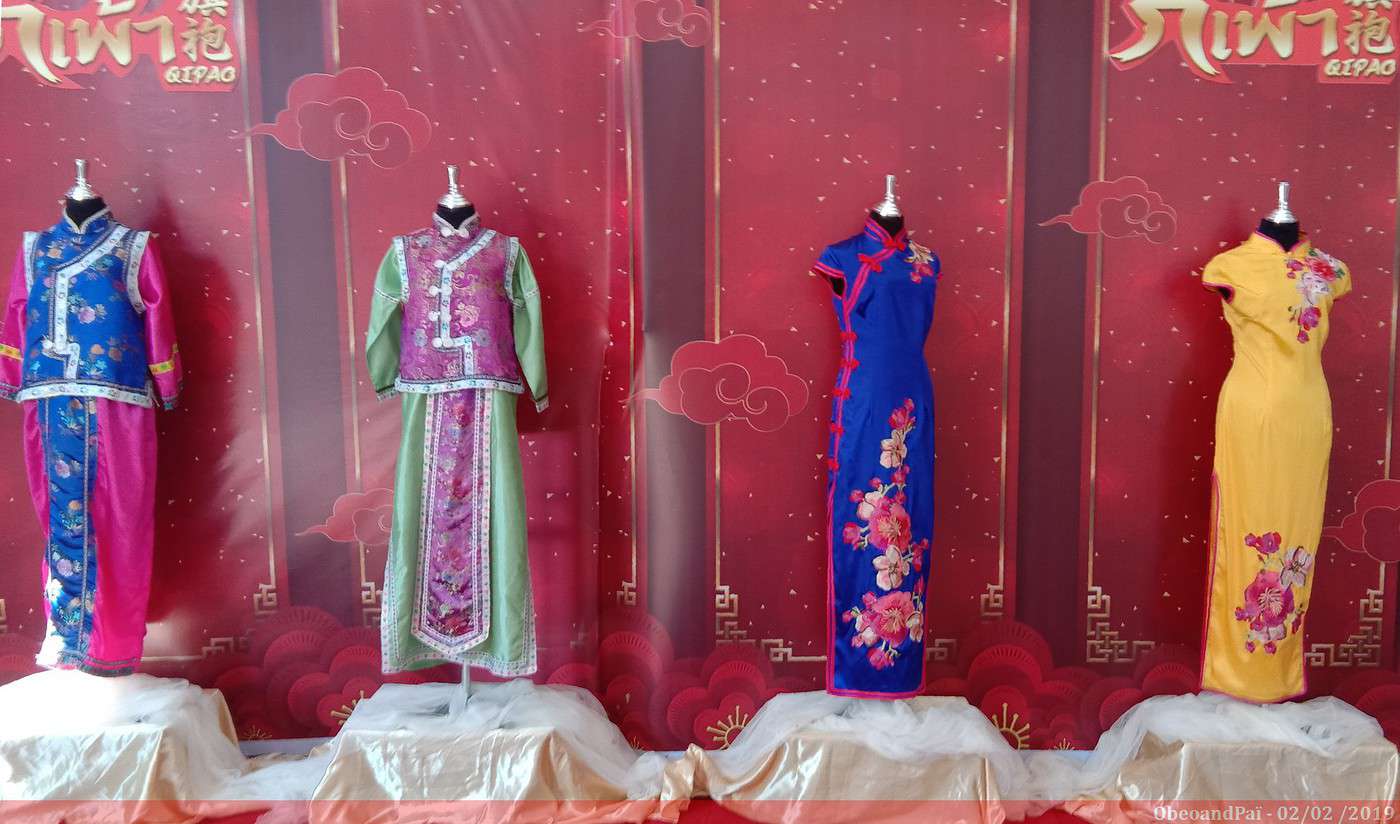
Des vêtements neufs pour le Têt..
Les vêtements neufs que l'on porte ce jour là et le comportement à l'égard des autres traduisent le nouvel état d’âme pour l'année à venir.
Plus en confidence😉
Les femmes, doivent être belles ces jours là, c’est le moment de revoir toute la famille – même lointaine – certains n’hésiteront pas à leur demander pourquoi elles sont plus "moches" que l’année dernière😏.
Il faut aussi décorer la maison avec un arbre de cerisier, un arbre de kumquat.
Il faut aussi acheter de quoi manger parce que pendant les 1ers jours de l’an, difficile de s’approvisionner. Il faut faire le ménage car le ménage est interdit pendant les 3 premiers jours de l’an…
Il faut acheter un poisson et le libérer.
Le 23ème jour du dernier mois de l’année, la divinité de la Cuisine retourne au ciel .
La légende raconte qu’il prendra son envol vers le ciel sur le dos d’un poisson rouge. C’est pourquoi ce jour-là, ou quelques jours avant, vous verrez sur les marchés des bassines pleines de poissons rouges : la tradition veut qu’on achète des poissons pour rendre hommage au dieu de la Cuisine, avant de les relâcher dans la rivière ou dans un lac. C’est une façon de souhaiter bon voyage au dieu de la Cuisine…
Pour bien aimer un pays il faut le manger, le boire et l’entendre chanter. (Michel Déon)
Pendant les congés du Têt, Fête printanière de la calligraphie au Temple de la Littérature.
Du 29 janvier au 17 février (24e jour du 12e mois lunaire de l’Année du Chien au 13e jour du premier mois lunaire de l’Année du Cochon).
Entrée gratuite entre 08h00 et 20h00.
Le 4 février (le 30e jour du 12e mois lunaire), la fête sera ouverte toute la nuit....
Si j'ai vu à Sai Gon des fleurs d'abricotier pour le Têt, j'ai surtout vu à cette même époque des
Fleurs de Chrysanthème (immenses )
fleurs d'Orchidée
fleurs de Dahlia , bégonias et Gerbéria
avec parait-il des significations différentes ; Santé et longévité, Bonheur et Chance, Prospérité etc...
Tout au long de l’année, les Vietnamiens ont à coeur de décorer et fleurir leur maison.
Mais la fête du Têt est l’occasion d’embellir et rendre encore plus accueillant leur foyer afin d’attirer sur toute la famille, chance et bonne fortune pour l’année à venir.
Acheter plantes et fleurs traditionnelles (pêcher, abricotier, chrysanthèmes, orchidées, oeillets d’Inde, poinsettia et d’autres qui ont effectivement toutes une signification différente) est un geste profondément culturel au Vietnam. Il y a toujours foule pour visiter les innombrables marchés floraux de cette époque de l’année ; et du N au S du pays, ils sont tous plus beaux les uns que les autres car il s'agit de trouver la plante qui amènera la prospérité ! 😉
http://fr.nhandan.com.vn/photonews/item/980271-tet-traditionnel-vietnamien-les-marches-de-fleurs-bondes-de-monde.html
Jadis, un diable était souvent présent dans la nuit du Réveillon.
Il aimait bien taquiner les petits enfants qui dormaient en caressant leur tête leur provoquant des fièvres ou les rendant stupides.
Pour éviter cette malchance, les parents devaient veiller toute la nuit et empêcher le diable.
Un vieux couple était très inquiet pour leur fils et ne savait pas comment faire tandis que le Têt approchait.
Un jour, 8 gentilles fées les visitèrent.
Elles se transformèrent en 8 pièces de monnaies en demandant aux parents d'emballer ces dernières dans un papier rouge et de les mettre à côté des enfants pour éloigner le diable..
Quand le diable apparut dans la nuit, ces pièces fortement brillantes lui firent très peur et il s'en fuit à toute jambe.
Ayant eu vent de cette histoire, tous les autres parents du village préparèrent 8 pièces de monnaies couvertes d’un papier rouge pour le mettre à côté de leurs enfants en espérant que celles-ci chasseraient le diable et les protégeraient.
On offre encore aujourd'hui des enveloppes rouges aux enfants et aux aînés les pièces sont remplacées par des billets tout neufs.
Pour bien aimer un pays il faut le manger, le boire et l’entendre chanter. (Michel Déon)
Merci pour ces commentaires "fleuris" de photos . Effectivement avant d'assister au Têt à Sai Gon
nous avions visité les nombreuses serres de la région de Da Lat .
Bonne journée
Eric
@ASIA7 et autres
Merci à vous tous aussi pour les renseignements complémentaires sur le déroulé du Têt .
Par contre il me semble qu'il manque un chapitre , après les gâteaux, les fleurs, les friandises rien sur ce que les gens boivent, boivent , boivent ....et pas que du Thé !!
On fait des offrandes à l'autel des ancêtres et l'enveloppe rouge est le seul vrai cadeau que l'on s'offre.
Les aines donnent aux plus jeunes après avoir reçu les vœux de ces derniers.
La hiérarchie étant très importante, on reçoit toujours une enveloppe de ses aînés (parents oncles tantes cousins).
Quand on rend visite à la famille, on apporte surtout quelque chose à manger et à boire, soit des plateaux de fruits frais ou confits, des gâteaux de riz gluant, un coq (à la campagne), une bouteille d'alcool (l'alcool est surtout une affaire d'hommes, les femmes boivent peu au Vietnam).
La signification de l'alcool comme cadeau de nouvel an est restée inchangée, comme Il faut beaucoup de temps pour distiller çà rend le présent important, de plus boire donne une sensation de chaud et d'énergique et c'est ce que les gens souhaitent pour leur prochaine année.
On offre aussi des fleurs, elles sont destinées à la maison, sont le symboles du changement de saisons et apportent chance et bonheur.
On se fait aussi des cadeaux entre collègues ou partenaires d’affaires.
Aujourd’hui, les gens sont prêts à payer cher pour les «paniers cadeaux" d'alcool local ou de marques étrangères (très apprécié) destinés à leurs patrons s'ils souhaitent un soutien pour la future carrière.
Le dernier jour de l'année Toute la famille se réunit et prend un repas , soit le déjeuner, soit le dîner. On l’appelle “bữa cơm tất niên” (repas du dernier jour de l’année).
Le premier jour – Tet Cua Cha (Tet du Père): Les gens visitent le côté paternel de la famille.
Le deuxième jour – Tet Cua Me (Tet de la mère): visite du côté maternel de la famille et amis , voisins
Le troisième jour – Tet Cua Thay (Tet des professeurs): Selon la tradition, celui des professeurs
Le quatrième jour ou le cinquième, on fait un plateau d’offrandes aux ancêtres pour les remercier d’être revenus à la maison pendant le Têt et leur dire au revoir. On brûle des encens et des vêtements en papiers considérés comme des cadeaux envoyés aux ancêtres au ciel.
Le 6ème ou le 7ème jour est le dernier jour du Têt. On enlèvera le Cây Nêu comme signe de fin du Têt (si l'on a mis une, cette tradition se perd) . Puis on retourne au travail
Cây nêu
On enfonce une perche rituelle au dernier jour de l’an. Au septième jour du Têt, on la retire et on fait ses adieux aux ancêtres », disent les Vietnamiens depuis des générations. En plus d’être un objet sacré supposé chasser les âmes maléfiques, cette perche rituelle que l’on appelle en vietnamien « cây nêu » est un emblème du Têt, signe de tranquillité pour les premiers jours de l’an lunaire.
Bien que la coutume se perde dans les grandes villes, elle perdure à la campagne.
La tradition vietnamienne veut que cette fameuse perche en bambou, à laquelle on va fixer des objets apportant du bonheur à son extrémité, soit fixé devant les maisons la veille du Têt pour conjurer les âmes maléfiques et les démons.
Ce rituel est accompli du dernier jour de l’année au septième jour du Nouvel an lunaire. Vu Hong Thuat, un ethnologue : « Chez les Vietnamiens, la perche rituelle du Têt symbolise le pont reliant le ciel et la terre. Elle délimite les frontières entre le monde des êtres vivants et celui des démons Elle les tient à distance et les empêche de franchir la limite. Elle annonce aussi l’arrivé du printemps et du Têt.! »
Marchés du sud:
Entre autres
Marché de Phu My Hung, dans le 7e arrondissement
Celui du Parc Tao Dan dans le 1er arrondissement est payant ( 30 000 VND, soit à peine 1.15€, gratuit pour les enfants de moins de 12 ans) mais magnifique qui fermera le 10 Fevrier;
www.lecourrier.vn/...nh-ville/588047.html
Chúc mừng năm mới à tous 😏
www.voyagevietnam.co/...nnee-du-cochon-1.jpg
vovworld.vn/...le-du-tet-313060.vov
* merci à mon amie vietnamienne pour ses informations sur les cadeaux
Pour bien aimer un pays il faut le manger, le boire et l’entendre chanter. (Michel Déon)
Merci beaucoup Fabienne pour tous ces renseignements sur les festivités du Têt.
Trés agréable imprégnation avant de nous envoler à nouveau la semaine prochaine pour ce beau pays.
Nicole
L'année du cochon de terre est placée sous les meilleurs auspices, elle sera, abondance, prospérité, joie de vivre!
le Cochon de Terre nous encourage à suivre notre cœur et nos envies les plus profondes à la recherche du bonheur pour nous et pour les autres.
Tout ira donc pour le mieux pour tout le monde! 😉
Je vous souhaite un très bon nouveau voyage avec de belles rencontres sur vos routes ainsi que de belles découvertes.
Bien à vous
Fabienne
Pour bien aimer un pays il faut le manger, le boire et l’entendre chanter. (Michel Déon)
L'année du cochon de terre est placée sous les meilleurs auspices, elle sera, abondance, prospérité, joie de vivre!
le Cochon de Terre nous encourage à suivre notre cœur et nos envies les plus profondes à la recherche du bonheur pour nous et pour les autres
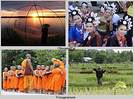
Un coucou d'Udon-Thani
Ce matin, en allant prendre mon expresso
quelques clichés et, un montage vite fait
Je n'avais encore jamais vu:
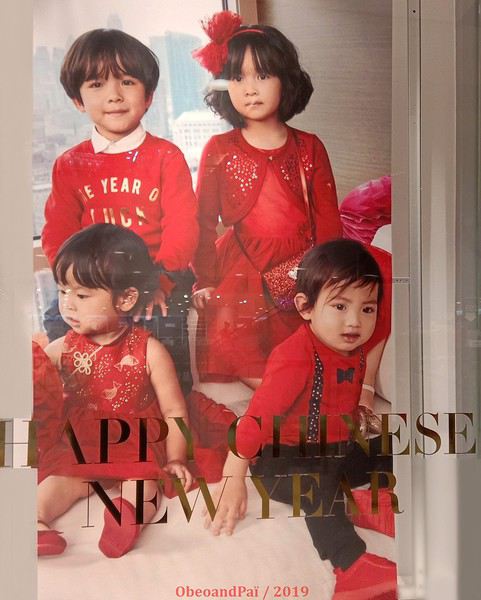
Les personnages miniatures
Si quelqu'un en connait la signification, je suis preneur
Sawatdee kha Obéo 😉
Il était bon cet expresso?
Merci de ces belles images!
En effet étranges ces personnages...😮
Les parades qui datent de la fin du 19° siècles, hors de Chine pour les débuts, initiées par la diaspora chinoise (San Francisco pour la 1°) font intervenir des dragons et autres artifices chargés d'effrayer le Nian animal maléfique à tête de lion et corps de taureau.
Le modernisme fait que nous voyons aujourd'hui de nombreuses variantes, là ce sont des figurines, ailleurs ce pourra être de belles jeunes personnes...on n'arrête pas le progrès, haha ..
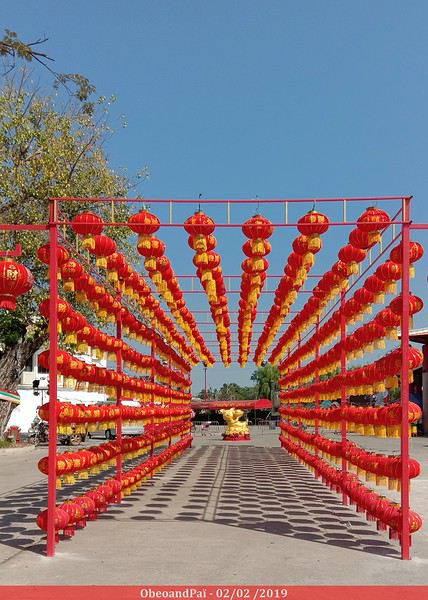
Le principal reste qu'il faut faire du bruit, afficher du rouge et des couleurs vives pour effrayer la bête.
LEGENDE DU NIAN
Selon une légende, il y avait dans l'antiquité un animal étrange et particulièrement féroce avec des cornes sur la tête, nommé Nian. L'animal vivait au fond de la mer et mettait pied à terre à la veille du Nouvel An pour dévorer le bétail et les gens. Chaque année, par conséquent, les villageois emmenaient les vieillards et les enfants dans les montagnes désertes pour y fuir la férocité de l'animal.
Une veille du Nouvel An, un mendiant âgé arrive au village de Taohua, une canne à la main, un sac à l'épaule, à la barbe blanche et aux yeux brillants. Une vieille dame de l'est du village l'a persuadé de fuir le Nian dans les montagnes. Le vieux monsieur éclate de rire, la main à la barbe : "Si Madame me permet de rester une nuit chez vous, je chasserai l'animal".
A minuit, le Nian entre dans le village. S'apercevant que dans la famille de la vieille dame à l'est du village, des papiers rouges ont été collés à la porte et que la maison est particulièrement éclairée, l'animal se jette sur la maison en poussant un cri sauvage. Près de la porte, tout d'un coup s'élèvent des sons dans la cour. Pris de frissons des pieds à la tête, l'animal se sauve à toutes jambes. En effet, le Nian a peur du rouge, des flammes et des détonations.
Le lendemain, le 1er janvier, les réfugiés sont rentrés au village. Voyant que tout est intact, ils se ruent vers la famille de la vieille dame et ils voient des papiers rouges à la porte, des bouts de bambous qui émettent encore des sons dans la cour et quelques bouts de bougies encore en train de brûler dans la maison ...
Fous de joie, les villageois changent d'habit et de chapeau pour célébrer l'avènement du bon augure et vont présenter leurs félicitations à leurs parents et amis. L'affaire est rapidement connue dans les villages voisins. On connaît ainsi la façon de chasser le Nian.
Désormais, une fois à la veille du Nouvel An, toutes les familles collent des papiers rouges parallèles à la porte, tirent des pétards, allument des bougies toute la nuit et restent éveillées jusqu'au lever du soleil. Au petit matin du 1er janvier, on va se souhaiter la bonne année dans les familles.
Pour bien aimer un pays il faut le manger, le boire et l’entendre chanter. (Michel Déon)
Toujours captivant ces récits et des recoupements sans frontières
j'ai correspondu un certain temps avec une étudiante chinoise faisant des études de français
qui relatait le Nian terrestre, les bambous et les pétards sur son blog
voir > ICI <
Le rouge
Pas l'exclusivité des chinois, voir l'article récent que j'ai repris sur mon blog de la TV et presse écrite Thaïlandaise:
tissus rouge et annexes, pour chasser le fantôme de la veuve
Hi everyone,
Could you share your thoughts on my 3-week itinerary?
We’re a small group (family + friends) of 12 people, planning to leave around January 21, 2027.
Here’s my itinerary:
3 nights in Bangkok
4 nights in Chiang Mai
3 nights on Koh Samui
3 nights on Koh Phangan
4 nights in Krabi
4 nights in Phuket
I’m also open to any great tips you might have...
Thanks, everyone! Alain.
Hi,
On September 1st, we're heading to Kalimantan for six weeks, probably from Pontianak to the Derawan Islands.
I've scoured this site, which is usually my go-to 😉, and others like VoyageForum, but recent info is pretty scarce.
I'd love any tips on places you've visited—our itinerary is still a work in progress.
We're two couples traveling with backpacks, using buses, boats, guesthouses, and homestays.
Thanks in advance!
Hi,
From Malacca to get to Jerantut, is it better to go back to KL and take a bus from there, or take a bus to Tampin and then a train? Any feedback on the "Jungle Train"? (duration, price, comfort, etc.). Thanks
Hi there,
We’re planning a 3-week family trip next summer with our three kids, who’ll be 8, 8, and 7 years old.
After some research, we’re leaning toward Malaysia to combine nature/forests and paradise beaches. The idea is to introduce our kids to the country’s culture, nature, and wildlife.
We want a great trip but without splurging on luxury options like high-end lodges and resorts. We’re looking for comfort with a touch of authenticity—basically, a good middle ground.
I’ve started putting together an itinerary and would love your expert advice and tips to help us build this amazing trip with our little ones.
Day 1: Departure from France
Day 2: Kuala Lumpur
Stay at a hotel near the airport or KL Sentral.
Just one night.
Day 3: Morning flight to Sandakan (Borneo).
Stay in Sepilok
Day 4: Sepilok:
* Orangutan Center
* Malayan Sun Bear Center
* Rainforest Discovery Centre
Day 5: Depart for Kinabatangan.
Boat safari in the late afternoon.
Day 6: Sunrise safari.
Jungle walk.
Evening safari.
Day 7: Final safari.
Return to Sandakan.
Flight to Kuala Lumpur, then to Kota Bharu (or overnight transit depending on schedules).
Day 8: Transfer to the port.
Boat to the Perhentian Islands.
Days 9 to 13: Perhentian Besar
5 full days.
* Snorkeling
* Hiking
* Turtle watching
* Wild beaches
* Relaxation
Day 14: Return to the mainland.
Bus or private car to Taman Negara.
Hi there,
I’m planning a family trip (my wife and I, both 47, and our two sons, aged 5 and 12) to Malaysia for the last week of June and the first two weeks of July 2027.
We used to love road trips as a couple, then as a trio, but since our second child arrived, we’ve taken a break with "camping village" style trips.
Now feels like the right time to get back to our old habits, while adjusting the pace for the kids.
We’re craving Asia. We’ve been lucky enough to visit Thailand, Indonesia (Bali and Lombok), and Sri Lanka before.
Friends have raved about Malaysia, so we’re definitely tempted.
For those who know and love Malaysia, what would be a good itinerary starting from Kuala Lumpur, with a maximum of 3-4 stops? We’d like a mix of culture, nature, and relaxation (just to clarify, we’re not big beach fans). All of this without rushing, of course.
Hi everyone,
We’re heading to Flores and then Bali at the end of September.
We’ve already visited both but this time, once we’re in Labuan Bajo, we’d like to take a boat to the Komodo Islands to see the famous Komodo dragons.
I don’t want to sleep on the boat—just a day trip would be perfect.
Does anyone know a reliable and friendly provider to recommend?
Thanks in advance, and have a great summer!
Summer seems to be the best time weather-wise for Bali.
And since summer’s when we can take a long trip, let’s go for Bali... even though we know it’ll be *packed* with people!
So we’ll steer clear of the island’s south...
Our current plan (19 days on the ground, 7 stops):
- 4 Nights (3 days) in Ubud
2 days for rice terraces / activities (Tegallalang, Campuhan Ridge, Monkey Forest, Bird Park, coffee plantation, market (?), dance "pestacle," cooking class and/or spa)
1 day with a driver for the Temples (Pura Gunung Kawi, Tirta Empul Spring, Pura Mengening, Goa Gajah...)
- 2 nights in Sidemen (1 day for Pura Kehen + Batur Caldera + Pura Besakih and 1 day to relax in the rice terraces)
- 3 nights on Gili Meno (Rest and beaches) from Padangbai
- 2 nights in Amed (1 day from Padangbai with the Abang rice terrace and Tirta Gangga baths, and the next day a boat tour in Amed)
- 4 nights in Pemuteran (1 day for transfer and rest, 1 day to visit Kawah Ijen, and 2 days of snorkeling at Menjangan Island)
- 2 nights in Munduk (1 day with the Dayang rice terrace and the 3-waterfall hike, 1 day at Pura Ulun Danu Bratan)
- 2 nights in Jatiluwih (1 day in the rice terraces, and on the last day, we’ll stop by Pura Taman Ayun in Mengwi and Pura Tanah Lot before catching our red-eye flight).
Accommodations in homestays or hotels.
Transportation to be arranged on-site with the lodgings (?)
Boat to Gili Meno to book in advance (?)
Kawah Ijen excursion to plan ahead (?)—check with the homestay (?)
Thanks for your thoughts/comments to help us explore this destination...
After reading and researching, we're planning the following stops in Cambodia in January 2027:
- Phnom Penh
- Kampong Cham
- Kratie
- Siem Reap
- Battambang
- Kampot (round trip)
I'm wondering about the direction of these stops, which could also influence our international flights.
Either a round trip from Phnom Penh in the order above.
Or landing in Siem Reap with the following order:
This second option would save us the Battambang - PP - Kampot trip but means doing a round trip to Battambang from Siem Reap and placing the "highlight of the trip" (Angkor) at the beginning of our stay.
We’ll be arriving in Phnom Penh this coming January and we’re thinking of starting our trip with a stop in Kampong Cham, then Kratie.
After Kratie, we’re considering heading toward Siem Reap with a stop in Kampong Thom.
That said, I’m not really sure how long the Kratie–Kampong Thom journey might take or how complicated it is.
Does this stop on the way to Siem Reap seem like a good idea to you?
If we don’t visit the Sambor Prei Kuk site, are there still any walks or sights worth checking out in Kampong Thom?
We’ll be arriving in Phnom Penh this coming January and we’re thinking of starting our trip with a stop in Kampong Cham, then Kratie.
After Kratie, we’re considering heading toward Siem Reap with a stop in Kampong Thom.
However, I’m not quite sure how long the Kratie–Kampong Thom journey might take or how complicated it is.
Does this stop on the way to Siem Reap seem like a good idea to you?
If we don’t visit the Sambor Prei Kuk site, are there still some walks and/or things to see in Kampong Thom?
Hi there,
We’re planning to travel from Chiang Rai to Luang Prabang next November.
We’d like to take a slow boat from Chiang Khong—or rather from Huay Xai in Laos—with an overnight stop in Pakbeng.
Could you let us know if the boat still leaves Huay Xai in the late morning? If so, what time roughly, and what’s the price for the trip?
Thanks for your help!
Alod
We (3 adults: 68, 65, and 25 years old) are just back from a short trip to the Philippines, and I’d like to share a little summary of our journey. First of all, I’d like to thank everyone who contributes to this forum about this destination and answers the questions of those who aren’t familiar with it. I should also mention that my comments are personal and don’t reflect anyone else’s opinions. Since I don’t have any literary or photographic talent, I’ll stick to the facts and share a few details about the sights, hotels, and restaurants.
Preparations:
We chose this destination in December and quickly booked our flight tickets (540 € with Turkish Airlines) for a departure on February 16 and return on March 5, 2019. We then contacted two French-speaking tour operators based in Manila, asking them to put together an itinerary based on our wishes (places to visit, type of accommodation) and our budget. We wanted to see the rice terraces in northern Luzon, the hanging coffins in Sagada, before flying to the Visayas (Bohol, Siquijor, etc.), and the Taal Volcano, while limiting our nights in Manila as much as possible. In the end, we opted for Alize, whose itinerary and quote matched our request almost perfectly. Our exchanges helped us refine our circuit.
International flights:
The round-trip flights went smoothly. Turkish Airlines, while not at the level of Asian or Gulf airlines, does the job just fine.
Day 1:
We landed on time (6:15 PM) on Monday, February 16, at Terminal 3. We exchanged our euros (near the car rental counters), and I can confirm the exchange rate was very good. On the way to the St. Giles Hotel (decent and affordable for a transit night), we got our first glimpse of Manila’s dense traffic. The Makati district, where our hotel was located, offers a wide choice of restaurants, so we grabbed a quick bite to recover from the trip.
Day 2:
This day was dedicated to transferring to Banaue. Fortunately, we had a comfortable van and an excellent driver for this journey, which took all day (8 to 9 hours with stops). We got a taste of driving in the Philippines—and it’s terrifying. You wouldn’t want to drive on these roads. The first thing that struck us was the relatively good condition of the roads and the cleanliness (a change from other Southeast Asian countries). This impression lasted throughout our trip. Around 6 PM, we checked into our room at the Banaue Hotel (large, charm-free, but with a beautiful view of the rice terraces).
Day 3:
With the help of a local guide, we took a jeepney to Batad. And then—wow! The rice terraces form an amphitheater overlooking the small village. Under the sun, it’s simply spectacular and breathtaking! Even though we’re familiar with rice terraces (Sapa, Bali, Thailand, etc.), we were dazzled by so much beauty. We spent the day walking along the terrace walls. This place is timeless and fully deserves its UNESCO World Heritage status. However, we returned to the hotel exhausted (due to our ages and lack of exercise). We had dinner with our driver at the Las Vegas restaurant in the center of Banaue. The meal was decent, cheap, and the Filipino owner played the guitar to accompany our dinner.
Day 4:
Today, our driver took us to Sagada. The mountain road offered spectacular landscapes (about 1.5 to 2 hours). Along the way, we stopped in Bontoc to visit the small but interesting anthropological museum. It features old photos and various objects from the Ifugao tribes, as well as a reconstruction of primitive dwellings.
We then went on a short hike in Sagada with a very friendly local guide who explained the region’s funeral rites. The walk started at the communal cemetery before reaching “Echo Valley,” where we saw the first coffins hanging on the cliff. We continued to the “Underground River” and a small waterfall, ending our journey in the “Lumiang Cave” burial cave. All in all, this day was very interesting. On the way back, we made a few photo stops.
In the evening, on our driver’s recommendation, we ate at the “Bistro,” a French enclave in the center of Banaue (good pizza, roasted quail, homemade fries).
Day 5:
Today was a transfer day. To limit fatigue and nights in Manila, our tour operator arranged a flight from Clark to Tagbilaran (Bohol), saving us 2 to 3 hours of driving. But to catch our flight, we had to leave very early: 5:30 AM. Our kind driver dropped us off on time at the airport. To use it, we had to pay a 150 PHP tax per person. The Philippine Airlines flight (15 minutes) left early and was far from full. Upon arrival, we were taken to the Loboc River Hotel, on the banks of the river of the same name. A very charming lodge lost in a tropical garden. We stayed in a stilt cottage overlooking the river. We relaxed a bit in the lovely pool. This place is really great—the staff is charming, and the food is excellent for a reasonable price.
Day 6:
This day was dedicated to exploring Bohol. The program was classic, starting with the tarsier sanctuary. We saw a few specimens in a small garden, each pointed out by a staff member. It was both good and disappointing because the animals were in pseudo-freedom in a small enclosure. Then we went to the “Chocolate Hills” and climbed 240 steps to admire the panoramic view of the hills—but by 10 AM, it was crowded. On the way back, we stopped at the butterfly garden, which was uninteresting: tiny, with few butterflies. We consoled ourselves by photographing beautiful flowers. To please our teen, we stopped at the Loboc Eco Tourism Adventure Park and crossed the river lying down, suspended from a steel cable (300 PHP). Finally, we had the traditional lunch-cruise on the Loboc River. It was a factory-like experience, and the meal was unremarkable. The only good thing was the singer on each boat and the lush vegetation. Afterward, we visited colonial churches and the cathedral, remnants of the Spanish presence, before returning to the hotel for a well-deserved dip in the pool. Note that for those interested, there’s an arena near the hotel where cockfights are held every Sunday—something Filipinos are passionate (if not obsessed) about.
Day 8:
Very early departure for the port. We boarded a *banca* in search of dolphins. After about an hour of sailing, we were lucky enough to spot around a hundred dolphins. Our boat then headed to the small and charming island of Pamilacan. After a walk through the little village, we came across locals traditionally building a boat. They told us it takes about a month to finish their outrigger boat. Then we had to choose our snorkeling spot between the coral garden, the fish park, and the turtle enclosure. Note that a fee is charged for each spot: 150 PHP per place and per person. It felt a bit like we were being ripped off, especially since the spots weren’t amazing—we’d see much better on Apo for much less. We had lunch on the island at one of the many small eateries (350 PHP per person).
Days 9 and 10:
On our return, we were taken to the Bohol Sea Resort on Panglao Island, where we stayed for 2 nights. It’s a small, recent establishment in a quiet corner of the island. It’s relaxing—maybe a bit too much. It has a nice pool and access to Danao Beach, but the view is blocked by a flotilla of boats. We didn’t try their diving school. The meals were good. If we had to do it again, we’d skip this stop to spend more time in Negros.
Days 11 and 12:
We took a fast ferry (Ocean Jet) from Tagbilaran port to Dumaguete and were taken to the Thalatta Resort, about 20 km away near Zamboanguita. We stayed there for 2 nights. Let’s just say it was our favorite. It’s a small place facing Apo Island. The rooms are simple, and the pool, nestled in a magnificent tropical garden, is fantastic. The staff is friendly, and the meals are very good. The hotel has its own diving center (snorkeling gear provided) and its own boats. We booked the Apo Island excursion: 1,350 PHP per person, including lunch. It was incredible: magnificent corals, colorful fish, and turtles of all sizes. The crew was endlessly kind and didn’t hesitate to dive to guide us to the best spots. In short, a perfect day. This site is ranked among the top 5 diving spots in the Philippines.
Since we were lucky enough to be there on a Wednesday morning, we explored the surprising Malapay Market, a 10-minute walk from our hotel. You’ll find numerous stalls selling vegetables, fruits, live or dried fish, and handicrafts. Enclosures are set up for selling livestock (calves, zebu, pigs). There are also restaurants. We were lucky to see two pigs roasted traditionally on a spit. There are few Europeans, and the people are warm. A great moment.
We left this beautiful place with regret because we didn’t have time to visit the island or go swimming with whale sharks.
Days 12 to 15:
From Dumaguete port, we took a short crossing (1 hour with Ocean Jet) to Siquijor Island to reach the Coco Grove Beach Resort. A beautiful hotel nestled in a spacious tropical garden. Several restaurants and bars, 4 pools. Despite the size of the place, it remains intimate. You can snorkel (corals and fish) right in front of the beautiful beach. We stayed in a very pleasant duplex suite. For those interested, there’s a spa and a diving center. You can also take the Apo Island excursion (offered at 1,950 PHP).
We spent our days relaxing between the pool and the beach. In the evening, the sunsets over Negros and Apo were stunning.
We booked an island tour with a comfortable tricycle from the hotel (1,500 PHP). The circuit was classic and allowed us to go around the island. We discovered beaches, the famous 400-year-old ficus tree with its enormous roots, and its equally famous foot bath with its cleaning fish. Then we visited the St. Isidore Convent before heading to the Cambugahay waterfalls and their four pools. The setting is idyllic, and the water is surprisingly good—we had a lot of fun swimming. We had dinner at a restaurant overlooking the island, where you can see Apo, Cebu, and Negros. In the end, Siquijor turned out to be a real little tropical paradise.
Since the hotel restaurants were expensive, we dined at nearby establishments: Fuego (clean, good—excellent raw fish—and quiet), Chekesch (louder), and the very pleasant Baha Bar, which brews its own beer and offers more refined cuisine.
Days 15 to 16:
We left at dawn to return to Dumaguete and its airport by ferry. We had breakfast at the Coco Grande Hotel, an annex of the previous one. The Philippine Airlines flight went smoothly. A driver took us to the town of Taal. We stayed at Paradores Del Castillo, right in the heart of the old town. It’s a charming old house with only 6 rooms. The various rooms are decorated with antiques—a real little museum. The garden is pleasant and opens onto the town.
It’s an old early 19th-century house converted into a hotel, beautifully arranged with 6 rooms in the heart of the city. The restaurant in the garden is very pleasant and offers a panoramic view.
We visited an old Spanish house before heading to the beautiful Basilica of St. Martin of Tours, one of the most beautiful religious buildings in the Philippines. A mass was in progress, allowing us to gauge the Filipinos’ fervor before we could visit. When we left, it was dark, and we could admire the illuminated building. We ended our evening by exploring the night market with its many fruit and skewer stalls. A nice surprise.
In the morning, we were taken to the shores of Taal Lake, an ancient caldera where a second volcano has formed in the middle of the lake, which in turn contains another lake. We boarded a *banca* to reach the island in the middle of the lake. This was followed by an uphill walk, made difficult by the high temperature (36°C) and the dust on the path. The dust was worsened by the many horses carrying (or bringing back) the less courageous. To illustrate the difficulty of the climb, the trail is marked by the Stations of the Cross and its 14 stations. We were panting while our guide trotted far ahead. Our effort was rewarded when we reached the summit and its viewpoints over the inner lake and the surroundings. The wisps of smoke seen here and there confirmed we were on an active volcano. Inside the lake, there are supposedly 45 small volcanoes, one of which emerged during its last eruption in 1911.
On the way back, we had lunch by the lake before returning to Manila and the Bayleaf Hotel, whose main merit is its location in the Intramuros district. In the late afternoon, we walked along the walls of the old city.
We had dinner on the hotel’s panoramic terrace overlooking the city and the bay.
Day 17:
Last day! Our tour operator joined us for a tour of the Intramuros district. He enriched the visit with comments on the history, geopolitics, and economy of the Philippines. We visited the Manila Cathedral, destroyed 7 times in the past (6 earthquakes and the 1945 bombing). It’s beautiful, and its stained glass is magnificent. We couldn’t enter the San Agustin Church, the oldest Catholic building in Manila. We passed by the memorial to the Battle of Manila, which claimed over 100,000 lives. We visited the area around Casa Manila, which was closed on Monday, and had a drink at Barbara’s cabaret, located in a historic house. A very enriching morning.
Then we went to the Mall of Asia, the world’s largest shopping mall, to buy some souvenirs (Kultura store) before being taken to the airport. We exchanged our last pesos at the buying rate right after check-in.
The return flight went smoothly. We regretted not being able to use the facilities of Istanbul’s new airport, as its opening was delayed by another month.
Finances:
In the end, we spent 1,640 € for the international flights, 4,200 € for the stay (hotels, visits, various transports) with the agency (whose professionalism we can only praise), and about 700 € for meals, tips, and souvenirs.
Summary:
Luckily, we had beautiful weather throughout our stay, with temperatures between 26 and 35°C. Discovering the Philippines was a wonderful experience. The diversity of the landscapes, the kindness of the Filipinos, the cleanliness, and the truly delicious fruits (especially pineapples and mangoes). We were never harassed, unlike in many touristy countries. On the other hand, the food, though generally cheap, wasn’t exceptional.
Since this country is so vast, we might return in the near future.
Though I’m not a specialist on this destination, I’m happy to answer your questions based on my experience.
So, my flight tickets have just been booked for a trip to Cambodia from November 4th to 27th, 2025.
I’ll be traveling solo and want to explore this amazing country while getting a bit off the beaten path.
I’m arriving in Phnom Penh and also departing from Phnom Penh.
My goal is to travel as much as possible by bus and scooter.
What itinerary would you recommend?
What are the must-do things?
I’m open to all tips and info.
Thanks in advance for your help and responses.
We got back enchanted from a 6-week trip to Cambodia!
Our itinerary: Kampot - Kampong Chhnang - Battambang - Siem Reap - Kampong Cham - Sen Monorom (Mondulkiri) - Banlung (Ratanakiri) - Kratie - Kampong Thom - Phnom Penh.
We traveled by bus, minivan, boat (between Battambang and Siem Reap), overnight bus, scooter, tuk-tuk, and rickshaw for shorter distances. We stayed in guesthouses, homestays, and even in the jungle during a trek.
While the Angkor temples are fabulous, it’s the people you should visit Cambodia for—the "Land of Smiles" truly lives up to its nickname! Tourists gather in Angkor but are quite rare elsewhere, even though the country is easy to travel around.
I won’t describe our trip in detail but instead highlight a few favorite moments.
From Kampot, don’t hesitate to head out around 6 AM to see the fishermen return and their wives selling their catch (just 10 minutes away by the coast). Guaranteed picturesque!
In Battambang, known for its food scene, we discovered a cooking class with Smokin’ Pot (authentic Khmer cooking class). They pick you up from your guesthouse to shop for ingredients (we made fish amok and beef lok lak) at their village market, then cook and eat together. A private class—just the two of us! They also send the recipes via WhatsApp as a PDF. +855 12 821 400
In Siem Reap, I can recommend a francophone tuk-tuk driver who was very attentive to our wishes. We visited tourist spots but also more remote villages and local grilled-pork restaurants with him. He’s a wealth of information about local life, and chatting with him was a real pleasure—we left with regret! You can reach him on WhatsApp: Vung Hem, +855 96 614 0146.
We did a 2-day, 1-night trek in Mondulkiri. Don’t expect a super dense jungle—it looks more like a forest similar to ours. But Nara, our Bunong ethnic guide, made the experience adventurous and ultimately very immersive! WhatsApp +855 86 630 489
Bee Bee’s Chalets homestay: If you pass through Banlung in Ratanakiri, we *loved* this family and their budget-friendly bungalows. Playing Uno, enjoying Nita’s cooking (ask for her fish amok—amazing!), it was a true homestay experience! Contact Nita on WhatsApp: +855 88 818 5525.
In Kratie, rent a scooter and follow the Mekong north for 40 km at your own pace. Being so close to the locals was a treat! Same goes for heading south if you have time.
Kampong Thom: Head 25 km out to visit the pre-Angkorian temples of Sambor Prei Kuk. Around a hundred monuments spread across three sites… and hardly anyone there!
A few practical tips:
Though prices are often listed in dollars, you can always pay in riels (1 USD = 4000 riels), which is what we preferred.
PassApp: An app to book tuk-tuks or rickshaws (and most importantly, know the price upfront).
Virak Buntham: A bus company connecting several cities, bookable online.
Feel free to ask me questions about places, accommodations, etc.—I’d be happy to answer!
We’re planning our second trip to Thailand (2 weeks on-site, late April/early May) as a family with our 5- and 7-year-olds.
On our first trip, we visited Bangkok, Ayutthaya, the River Kwai, Koh Lipe, Koh Phi Phi, and Khao Lak. We especially loved Koh Phi Phi for its limestone cliffs and lush vegetation, as well as Koh Lipe for its crystal-clear waters and snorkeling.
This time, I’m thinking of spending 7 days on the islands. I was considering Koh Tao and Koh Phangan. We’d like some scenery, snorkeling right from the beach, and a bit of atmosphere—but not too much (just enough to grab dinner in the evening).
For the other part of the trip, we’re torn between Chiang Mai and Khao Sok. One or the other… or both? We don’t want to rush, but we’re really nature-focused, so we won’t be hitting too many temples…
Hi there, I’ll be on vacation in Malaysia in November and plan to spend 5 days in Penang. After that, I’d like to visit some temples and places in Butterworth or nearby, and also explore the city. Since I usually get around on foot, which neighborhood would be best for me—meaning within a 30-minute walk of attractions, street food stalls, bus lines, etc.? Thanks in advance for your help!
Françoise
Hello, it’s been a while since I last asked for your help on this forum—I’ve really missed it! I hope you’re all doing well, whether you're new or returning members.
I’m planning a trip from February 6 to 18, 2027, with my sister (we’re 47 and 50—time flies!). I’ve got my eye on a flight from Paris that lands in Bangkok on February 7 at 3 PM, with a return flight from Bangkok on February 18 at noon.
My sister has never been to this destination, and it’ll be her first time in Asia. Her priorities: beaches, sunshine, and cocktails by the shore. For me, I love that too, but I also enjoy exploring, nature, forests, and a bit of comfort (mixing guesthouses and higher-end hotels with pools). A little evening entertainment would be great, but not too much—good cocktails in a nice atmosphere rather than a rave party ;-). And I can’t help but dream of taking her on a little trek through a tropical forest (guaranteed memories and laughs, though she might curse me at the time) and showing her some karst landscapes.
I’ve been to Thailand before, but it was 15 years ago...
The idea is to give her a taste of Bangkok for 1 or 2 nights, a few days on an island (but which one...?), a tropical forest excursion with 1 or 2 nights on-site (Khao Sok?), and then back to Bangkok.
For the "main" island, even after reading the *Guide du Routard*, I’m still undecided. It’s hard to find a place that ticks all the boxes without feeling as crowded as the French Riviera in August: Koh Lanta? Khao Lak (though it’s not an island)? Koh Tao (I could maybe get my PADI certification, but I’m afraid she’d get bored, and it might be better to save that for a solo trip)? Koh Yao Yai (I worry we’d be bored in the evenings)? What a dilemma!
Thank you if you’ve read this far! Feel free to share any advice—it’ll all be warmly welcomed.
Here’s a rough outline of the itinerary (I’d rather skip a night in Bangkok if needed):
· Saturday, February 6, 2027: departure (overnight flight)
· Sunday, February 7, 2027: arrival at 3 PM, probably at the hotel by 6 PM, evening in Bangkok (overnight in Bangkok)
· Monday, February 8, 2027: day in Bangkok (Wat Pho and a floating market?) (overnight in Bangkok)
· Tuesday, February 9, 2027: travel to Koh Lanta or another island (flight to Phuket or Krabi?) (overnight on island "x")
· Wednesday, February 10, 2027: beach and walks (overnight on island "x")
· Thursday, February 11, 2027: beach and walks (overnight on island "x")
· Friday, February 12, 2027: beach and walks (overnight on island "x")
· Saturday, February 13, 2027: beach and walks (overnight on island "x")
· Sunday, February 14, 2027: beach and walks (overnight on island "x")
· Monday, February 15, 2027: travel to Khao Sok—nighttime excursion to Khao Sok (overnight in Khao Sok)
· Tuesday, February 16, 2027: exploration and hike in Khao Sok (overnight in Khao Sok)
· Wednesday, February 17, 2027: return trip to Bangkok (overnight in Bangkok)
· Thursday, February 18, 2027: return flight to Paris at noon
I’m planning a trip to Cambodia and was set on visiting the Ratanakiri region, which seemed to match what we love most in terms of landscapes: forests, jungle, greenery...
However, as I started looking into the area, I read that deforestation there is massive, and some of the info on the topic is years old—the situation hasn’t improved since, unfortunately.
So my question is: is Ratanakiri still worth visiting, and does it justify the long travel time and distance to get there?
I’ve seen that jungle treks are possible, but from experience, I know guides sometimes hesitate to venture deep into the forest and stick to shorter walks along the edges of parks.
Hi there,
I’ve found so many tips and reviews on this forum, so it’s my turn to contribute a little.
We spent just over two weeks with our family, with the following itinerary:
- Hanoi: 5 days
- Halong Bay: 3 days and 2 nights
- Tam Coc: 3 days
- Mai Chau: 2 days
- Sapa: 3 days
We got around by bike, scooter, Grab, and bus.
Our main accommodations were homestays and hotels in Hanoi.
We visited lots of museums, temples, and neighborhoods in Hanoi.
We did a 2-day, 1-night trek in Sapa with May, a Hmong local, without going through an agency.
A few small regrets: the weather was overcast, and we couldn’t make it to Fansipan, but nothing major 😅. We also couldn’t find transport to get from Sapa to Mu Cang Chai.
Other than that, this trip will stay in our memories for the kindness of the Vietnamese people, the connections we made, the food (street food, homestays...), the coffee 😋, the landscapes, and how easy it was to get around...
Our goal was to take our time and focus only on a small part of northern Vietnam.
If you need any tips or recommendations, don’t hesitate to ask.
Looking forward to hearing from you.
Cédric.
Hi there, we’re landing at Hanoi Airport and would like to head straight to Cao Bang without going into Hanoi. Does anyone know if there are buses that go directly from the airport to Cao Bang (especially in the early afternoon)? Thanks in advance!
Hi everyone,
I’m currently working on a 30-day itinerary for May/June 2027.
10 days in eastern Java (Malang, Bromo, waterfalls, Meru Beriti Park, Banyuwangi, and Ijen), a short transit in Ubud for a few days, then Flores before heading back to Jakarta.
We’ll spend 15 days in Flores (the classic route: Moni, Bajawa, Riung, Ruteng, ending in Labuan Bajo).
I’d love some firsthand feedback on flights to Maumere or Ende from Bali Denpasar. I know there are no direct routes and that you have to connect through Labuan Bajo or Timor (I think), which isn’t an issue in itself.
But I’ve read here and there that flights to these destinations can be delayed—or worse, canceled—and that it’s better to fly in and out of Labuan Bajo, which isn’t exactly ideal...
Thanks for any tips or experiences you can share!
hi everyone,
I want to travel in the north for 3 weeks in September-October 2026 to meet ethnic minorities, photograph mountain rice terraces and their harvest, and revisit Halong Bay—but maybe Lan Ha Bay instead. Can you recommend one or more local agencies?
Thanks, and happy holidays!
I need some expert advice on these two destinations for a 15-day trip. We land in KL and plan to stay for 2 days before heading to Borneo and finishing with an island for snorkeling.
For those who’ve been, what are your must-sees?
We were thinking of spending the last 3 days on the Perhentian Islands, unless you’ve got another island to recommend near Borneo.
Thanks for your tips and help!
I’d love to get some feedback on our itinerary—it’s probably pretty basic! This is our second trip to Asia and our first to Indonesia. We have three kids aged 20, 18, and 12. We land in Jakarta at 4 PM, spend 3 nights/2 days there, then take the train to Yogyakarta for 3 nights/2 days, followed by the train to Surabaya for 2 nights/1 day, then the train to Bromo for 1 day/1 night, a private driver to Ijen for 2 nights/2 days, then on to Bali (Ubud) for 4 nights/3 days, followed by Gili Air for 3 nights/2 days, Senggigi (Lombok) for 2 nights, and finally 5 nights in Kuta. I’m considering cutting the 2 nights in Senggigi to just keep Kuta and extend it to 7 nights. In Lombok, I’m not sure how to get around since I’m not comfortable with scooters... Your thoughts on all of this, and any advice, are more than welcome—don’t hesitate!
For those wondering why cities like Jakarta and Surabaya: we don’t often get the chance to visit big Asian cities, so we wanted to include that discovery in our trip. The trains between Jakarta and Yogyakarta, Surabaya and Probolinggo are booked. The return flight from Lombok to Jakarta is also set. Accommodations are booked but flexible (same for the trains).
Hi everyone,
I’m looking for addresses for guesthouses or, even better, houseboats or rafting houses on the River Kwai, between Kanchanaburi and Sangkhlaburi, to spend a few weeks contemplating this beautiful river.
Thanks for your suggestions!
Premaria
Hi there,
we’re currently in Mai Chau and tomorrow we’re hitting the road back to Hanoi to head up toward Bac Ha and Sapa.
We haven’t really had a set plan since we arrived—we’ve already done the Halong Bay on land and by sea.
I’ve got 2 free days before heading to Bac Ha and Sapa.
Any tips?
Thanks, and looking forward to hearing from you.
Hi fellow travelers,
First trip to Vietnam.
We’ll be arriving in Ho Chi Minh City during Tet.
Is it complicated to find accommodation and get around during this period?
Any tips would be welcome.
Thanks for your replies.