As a tea enthusiast, I’m a bit frustrated that I can’t find anything on this topic in the forum.
I’m familiar with the concept of Chinese tea shops where you can stay a while and sample, but are there any travelers here who have experience or tips to share for finding, buying, and bringing back good tea at fair prices? Tourist traps to avoid, expected level of negotiation, good/bad spots (for tea and maybe even equipment), reasonable prices, visiting gardens independently, etc.
Just to clarify: my budget is limited. I usually spend between 10 and 15 € per 100g on Chinese websites.
For my part, I’d love a closer look at these areas:
Hangzhou and the entire West Lake area for Longjing and maybe Anji bai cha
Huangshan and Tangkou for Huangshan mao feng and Qimen/Keemun.
Wuyi for yan cha (oolong rock teas) and jin jun mei
Xiamen and Anxi for Tie guan yin and white teas (Yin zhen, Bai mu dan, and Shou mei)
Shanghai for… everything!
This is just a little anecdote, but during my trip to China—way back in 1986—I still remember the tea that was routinely offered in every Chinese hotel, especially in Yunnan. It was a dreadful herbal brew, basically hot water with a bunch of twigs floating in it! !
Dear Faiyech, thank you for the invitation to share my thoughts on this topic.
I can't help but say that you describe the type and origin of Chinese tea better than I could. Actually, I should have done some research beforehand to cover these aspects more thoroughly. Thanks for appreciating our tea.
I’m really drawn to coffee and drink it regularly in my daily life. I get the chance to enjoy tea when visiting friends or during business meetings. Hosts often offer me different types of tea, and every time, I’m impressed by their incredible flavor and how they refresh the mind. That feeling of freshness from tea is quite different from what I get with coffee. It has nothing to do with British tea or tea from other countries.
When it comes to tea, as you so rightly said, you need in-depth knowledge to distinguish a good, fresh, high-quality tea. In China, there’s an incredible variety of teas. You’ve got red tea, black tea, white tea, light teas, strong teas, semi-fermented teas, and fully fermented teas. Some teas are best enjoyed fresh, while others improve with age and are better after being stored for several years.
When I decide to buy tea, I prefer going to a large store and choosing a well-known brand. That way, I’m more confident I’ll find a quality product.
J’espère que les informations que je partage pourront vous aider à mieux découvrir la Chine, alliant authenticité et échanges culturels. lena.chinatour@outlook.com
Jeune créatrice de bijoux et accessoires textiles Je pars en Chine 3 semaines du 1er au 20 aout 2009 je fais pekin shanghai guilin canton hong kong. Je…
J'ai entendu parler d'un site payant où l'on communique sa destination, ses dates et dans un délai de 24 heures, nous avons une réponse avec le meilleur tarif.…
Many of us have noticed that bugs have been making it difficult to navigate the forum lately.
I’ll let Kate and Ticapi explain the issue:
I went to your profile to check out the Thailand travel journal, and when I clicked on it, it brought me back here again. All week, I’ve been dealing with bugs like this—it’s really discouraging from continuing on VF.🙁
I had the same thing happen, and multiple times. For me, it was Montagnard’s latest journal that kept coming up no matter which discussion I clicked on.
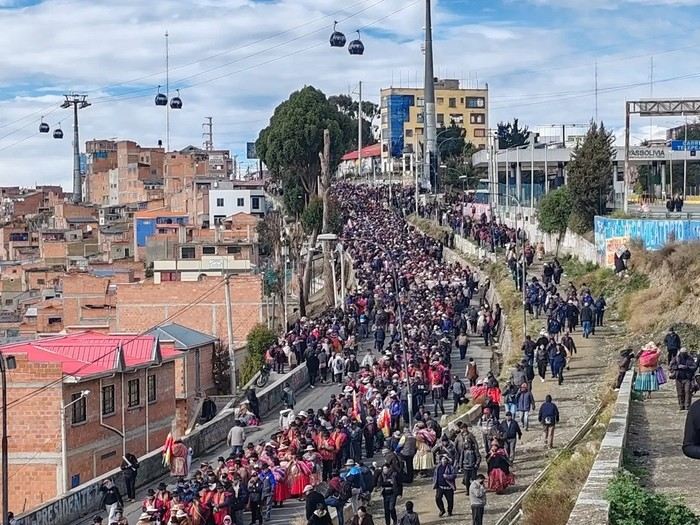
BOLIVIA: THE COUNTRY ON THE BRINK (What's Really Happening)
A dramatic saga is unfolding before our eyes in the Andes. Between suffocating blockades, clashes, an international airlift, and historic political decisions, Bolivia has just experienced 48 hours of rare intensity.
Here’s the full breakdown (economic, social, and political) of the last 48 hours:
For travelers and tourists: the article also includes an important note about the upcoming publication (starting tomorrow) of the precise status of roadblocks, route by route.
I’ll post the full update here on Voyage Forum!
Don’t miss this in-depth analysis. History is being written before our eyes! https://www.petitherge.com/bolivie-paralysie-et-ultimatum
I just discovered a great show on Arte.
It's called "7 en route": seven young European journalists travel around Europe in a fully converted bus, making reports on every city they visit. It's amazing! 🙂
Yesterday, for example, they were in Rome, Italy, and the reports included things like the world's smallest restaurant—a super romantic spot for two. There was also a report on the king of paparazzi in Italy.
They have to pick topics that let us discover the little quirks of each country. And at the end of each episode, we get to see the finished report.
It's such a great show, mixing journalism, travel, and discovery—basically, a must-watch!
It airs in the evening starting at 6:50 PM (I think), and it started this past Monday, July 14th.
If you watch it, let me know—we can chat about it!
I left my heart’s country eight days ago and returned to my adopted one—or was it the other way around? Scotland-Morvan, Morvan-Scotland, I’m not quite sure anymore.
After a quarter without dragging my slippers around here, even though I’d loudly declared I had no interest left in this site, here I am again!
My imagination never stays fallow for long. Just enough time for my inner land to rest. It gets overgrown with fresh nettles, the kind you can pick without getting stung. Then, it’s time to till the fragrant earth and let the story grow.
I hesitated over where to set this story.
Maybe the Highlands, maybe the Hebrides, maybe the Orkney Islands, maybe the Shetland Islands. All of Scotland is myth—easy to embroider.
But in the end, no. I’d almost be too afraid to bare my soul.
The story will take place at home. Simple, practical.
1)
This morning, I was up well before dawn, feeling a bit grumpy, but nothing a bowl of coffee won’t fix. I love my bowl, and no one dares take it. It’s porcelain, edged with intertwined blue flowers. On the bottom, it says "Revol." The factory has existed long before the Revolution. It was my great-grandmother’s bowl. She drank roasted barley from it during the war, then her Leroux chicory.
Last year, a little guy dropped it. My bowl broke into three pieces. A black anger vibrated deep inside me. The little boy was so upset, on the verge of tears. How could I scold him!
I picked up the three pieces and took Little Boy in my arms. His hair smelled of the light, sweet sweat of toddlers. A gentle hug that healed—his budding sorrow and my anger—everything vanished, and time carried on.
Today, my bowl is even prettier. Man fixed it using the traditional kintsugi technique, except he didn’t use gold powder or lacquer but superglue, and he delicately painted the cracks with woad blue. And my bowl is even more beautiful now.
I’m lingering, I can tell—it’s just that a story wraps itself in life, and life can’t be told in the snap of a finger. Life is long. Like in architecture, you start with a rough sketch, called a "sous-cul" (the initial pencil drawing), then you make a tracing, which is the work itself, the one you later carefully roll up in a wooden tube.
Life is like that: you erase, you start over, you use the nub of the pencil until it’s tiny, but you keep going—dreaming, loving.
"Living is a full-time occupation, a unique adventure. Always a surprise and a wonder, which sometimes turns into astonishment. And, from time to time, happiness."*
Alright, enough digressing—this introduction is definitely too long.
Tomorrow, I’ll get to the heart of the matter.
(I hate that expression; it feels like I’m cutting into someone’s skin.)
I’m Yann, a 28-year-old TikToker who loves traveling!
Since I’ve been to several destinations, I’d love to get a flag from each one as a sort of trophy. But from what I’ve seen online, a lot of sites sell them with what looks like really poor quality...
So I’m reaching out to you all to share a site you usually use—help me start my collection! :)
hi there
I’d love to get some opinions—I’ve never used Airbnb before.
They’re offering a key handover via lockbox.
Any tips or advice?
Is it reliable?
Best,
Hi there, I’m Laura, and I’m looking for a few people to answer some questions so I can understand your travel wishes and challenges. It won’t take long—I can chat here, by email, or by phone. Don’t worry, I’m not selling anything! 😊
On this forum, we talk a lot about trekking in the Himalayas, but I’d love to share another side of Nepal: its spiritual, cultural, and religious atmosphere, especially in Kathmandu.
Nepal, much like Tibet and Bhutan, is deeply connected to the Himalayas—the ultimate sacred mountain range. This small country exudes a calming vibe, shaped by a strong spiritual dimension. What I loved most was the unique sensory experience you get there. Walking around temples and tantric monasteries, a distinct scent fills the air—aromatic plants used for ritual fumigation. Locals mainly burn Himalayan juniper, cedar, sandalwood, and other local essences. This fragrant smoke is a way to purify the space and reach the deities, and you’re constantly enveloped in these aromas.
Another striking aspect is the sound. As soon as you step outside, you hear bells ringing in front of temples. People ring them three times before praying to announce their presence to the deities. Nepal is also the birthplace of singing bowls and sound meditation practices. In Kathmandu, you can easily find meditation sessions or "sound baths."
The spiritual dimension is everywhere: a Hindu sadhu practicing asceticism, a lama in deep red robes with his mala, turning a prayer wheel while murmuring "Om mani padme hum." Newar Buddhism, Tantrism, and Hinduism coexist harmoniously in daily life.
For those who love exploring a destination through its culture and spirituality, Nepal is an unforgettable place. What was your spiritual experience in Nepal like?
Hi,
I’m landing in Quebec and then heading to New Brunswick and Nova Scotia. I’d like to rent a pick-up. My question is: does this vehicle come with a cover and is it secure enough to store luggage in? I’ve heard two conflicting opinions. Thanks
I just installed the Maps.Me app on my phone. I only recently found out about this app. I’m traveling in 2 weeks and a few days, and I’m a bit stuck on how to use it.
I’m from the Montreal (Quebec) area, and I’d love to know if there’s a kind soul out there who could help me get started and use the app at least minimally.
If there are private lessons available, I’d be interested in those too.
Like many others, I’m overjoyed to hear that VoyageForum is reopening! I’ve been waiting hopefully for this, and it’s wonderful that it’s finally happening!
I just couldn’t bring myself to actively participate in other French-language travel forums—their format and way of doing things never appealed to me as much. I really hope that VF’s structure, categories, and interface won’t change too much despite the handover, because I’m very attached to them. Through thick and thin, the site has held strong—it’s amazing!
In a previous message, François mentioned that there were positions to fill ahead of the reopening, including moderators...
I’ve been eagerly waiting for this and hoping to send in my CV.
Now, after reading the latest message, it seems like the team is already fully formed. But are there still a few spots left to fill?
I’ve been a VF member for 20 years (since 2004). I’d love to contribute to this wonderful adventure as a moderator if VF would trust me with the role. If the team is open to reviewing it, I’m ready to send my CV. Could you let me know the next steps?
I’m planning a 3-week trip to Japan in May with Voyage Privé. The package includes a 5 GB eSIM, but my phone isn’t new enough to support it. VP told me I could buy a SIM card when I arrive at the airport.
Sure enough, I’ve seen online that this is possible with different providers.
I only need it for checking routes, looking up addresses, train schedules, etc.—basically using Google Maps, TripAdvisor, and similar apps. No heavy downloads or major internet use. All hotels should provide free Wi-Fi for that, right?
Has anyone got any tips for me on this? What have you tried, and how much did it cost?
Thanks for your help!
I’d like to know if you can buy reef-safe sunscreen sprays at 7-Eleven. If so, how much do they cost? We’re traveling with backpacks, so we’ll either buy 100ml here or in Thailand.
I wanted to share a really unpleasant experience from our last trip booked with Promoséjours and organized by FTI.
We booked an 8-day/7-night stay in Egypt, from June 8 to 15.
The flight initially scheduled was changed a week before departure to take off at 10 PM from Paris CDG.
In the end, it took off with a 1-hour delay and included an unmentioned stopover in Marsa Alam.
We landed in Hurghada at 4 AM and arrived at the hotel at 6 AM.
So, we spent our first night on the plane.
For the return trip, surprise—the flight was moved up. We left the hotel at 10:30 PM on Friday the 14th to take off at 2 AM and land at 7 AM at Paris CDG.
So, we spent our last night on the plane too.
After sending a complaint letter to Promoséjours / FTI, they replied that the first and last days can be dedicated to transport (which I already knew) and that no matter how many nights you book, you’re not guaranteed to spend them in the hotel—it could just as well be on the plane.
I’m really questioning this.
Isn’t there a law that protects customers in cases like this?
Because when I do the math, the first and part of the second day were spent on transport, same for the second-to-last and last day. And I paid for 7 nights for a stay that only lasted 5.
Anyway, I just want to say thanks to them—thanks to their two sleepless nights in transit, I’m coming back even more exhausted from a trip that was supposed to be restful!
I also want to warn anyone booking through this agency about visas for Egypt.
At booking, they told me the visa was included in the price, then they sent me an email saying I’d have to pay for it on-site at 25 €.
Once there, we were directed to a special line for FTI customers, and guess what? They charged us 30 €!
Basically, they’re great at making sure you *enjoy* your vacation—mostly by enjoying your wallet!
If anyone has dealt with this kind of situation and won their case, I’m all ears.
Hi there!
I’m heading to Thailand for two months.
So I thought I’d get a Thai SIM card to use Google Maps for getting around cities, mostly.
Here’s my question: will this SIM affect my apps? Or will they work the same as with my Orange SIM?
Is there any setup I need to do, or can I just pop in the Thai SIM?
I’d also like to switch back to my Orange SIM now and then while I’m in Thailand—on the same phone. Will I need to reset the phone, or will it reconnect without any issues?
Thanks in advance for your tips!
Best,
Huiclos
Hi, I’d like to know where we can buy beer or wine in Chefchaouen and around Merzouga. We’ll be doing a circuit and staying at the Parador Hotel in Chefchaouen and in a bivouac in Merzouga.
Thanks for any info you can share!
Hello everyone,
I’m reaching out to all travelers and globe-trotters on this forum. I’m a teacher in Creuse working in a ULIS program (which welcomes children aged 6 to 12 with disabilities into a mainstream school). This year, I’m launching a school journal project that will involve the kids in many different topics. A big part of this journal will focus on opening up to the world, embracing differences, travel, global cultures, and more.
I’m putting out a call to invite as many of you as possible to send us a postcard (from France or anywhere in the world)! The goal is to help us "travel" and discover new places, countries, and horizons in a way that’s much more fun and exciting than a geography textbook. One section of our journal could be called "We received a letter from ," where we’d research the location and share what we learn with our readers—a really enriching activity for the classroom.
The project starts in September 2025 but doesn’t have a strict end date, since this journal and world-discovery initiative will span several school years (the kids stay in the ULIS program for multiple years). Postcards can be sent anytime—throughout the year, across seasons, even during holidays! The kids will find them when they return.
I hope this idea appeals to as many of you as possible, and that you’ll spread the word to your fellow travelers. Help us dream and explore!
For those who’d like to write to us in a language other than French, no problem—quite the opposite!
Thank you in advance for your participation! Below is our address. If you’d like us to write back, feel free to leave your address on a corner of the postcard! 😊
ULIS program students
Bonnat Elementary School
12 rue Georges Sand
23220 BONNAT
Thank you, and I hope to hear from you soon! 😊
Julien
🙂
Hi there! I have to leave Ivato/Antananarivo on December 16th. I have a lot of ariary that I’d like to exchange for euros since I might not be coming back to Madagascar (after this 21st trip). I think the exchange office at Ivato also buys ariary back. If any of you have seen the rate for this buyback in advance, thanks a million!
Hi everyone,
I’m looking for a website that would let me plot my travel route in advance so I can print it out. The idea is to create a map with a little “me” on a bike that my parents can move along as I progress, since I’m planning to cycle all the way to Nepal.
If any of you have done something similar or know of a good tool, I’d love to hear your tips!
Thanks in advance! 😊
I'm looking to buy an ultra-lightweight 50/55L travel backpack with a suitcase or front opening.
Does anyone have any brand and/or model recommendations?
Thanks,
Emma
Hello. We’re a retired couple heading to Sri Lanka from January to March. After the November floods, I’d like to know if we can offer hands-on help to the locals, maybe pack some clothes or other items people might need in our luggage, and who we could give them to. Thanks for any info from those on the ground.
Be careful when sailing between Somalia and northern Madagascar.
It appears to be Somali pirates who have widened their search in the Mozambique Channel, far from their usual attack zone, since, to my knowledge, there are no Malagasy pirates.
Not sure if this is the right section, but just wanted to warn future travelers...
Where’s Cape Vidal?
It’s in iSimangaliso, an independent park in KZN Wildlife, stunning and just a stone’s throw from St Lucia (KwaZulu-Natal, Maputaland).
It’s the beach spot at the end of the Eastern Shores road. You can swim, fish... but watch out for waves, currents, and sharks...
There’s a really nice game drive where you can get out of your car at certain points, especially at Cape Vidal.
That’s where the camp with bungalows and campsites is.
The vervets and samango monkeys (endemic to the area, and the males are pretty big) can be a bit of a nuisance if you’re trying to braai...
They’re super persistent and not shy at all—don’t let them intimidate you, and stay alert because their speed at snatching food is impressive.
Anyway...
I’m reporting two recent attacks by these hyenas... who were *not* in a playful mood...
The first one happened at night—a hyena tried to bite a camper’s nose off in their tent... and succeeded.
The other night, a camper returning to their tent in the early hours was violently attacked by two hyenas... and they had a close call!
So, if you’re camping there, be careful...
Measures are being taken, but for now, it’s a bit risky.
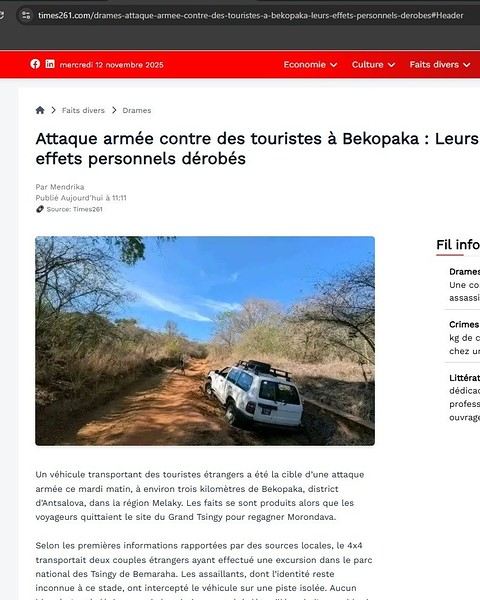
A white rental Toyota Land Cruiser 4x4 carrying foreign tourists was attacked at the entrance of Tsingy de Bemaraha National Park in the village of Bekopaka, western Madagascar, yesterday. So far, there’s been no response from the central government to curb these repeated armed attacks—usually between Malagasy people, but this time targeting foreign tourists.
After an engine failure in mid-2016 on a long-haul flight from BRISBANE to LYON, I developed a persistent aviophobia that I’m struggling to shake off. It’s becoming more and more of a hindrance.
Up until now, I’ve been using an avoidance strategy (for example, avoiding destinations that would require any other mode of transport than a car or train), but lately, it’s become really limiting.
I’m looking for a therapist—either in-person or via video call—who could help me get past this hurdle.