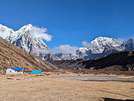
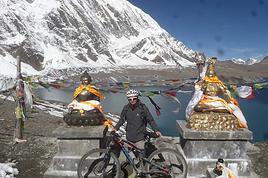
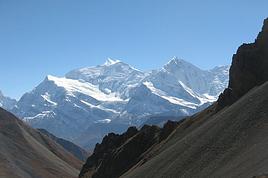
I’m heading to Nepal very soon to do the Three Passes Trek, among other things.
Could anyone tell me what the average daily budget is for this trek?
From what I’ve heard, this area seems more expensive than others.
Hi,
The rates will depend on the "level" of accommodation quality... In Namche, there's a standardized rate. Watch out... If you don't eat at the lodge, the room price changes...
Above that, budget 2000 to 3000 rupees per day. Always more expensive when there's little or no choice!
Dominique
Can anyone tell me what the average daily budget is?
Hi,
I assume you’ll be doing the trek independently? I mean without a guide or porter?
Here are the 2016 rates (February/March)—prices have probably changed, so someone can confirm...
Accommodation ranged from free to 2 € (200 rupees), as long as you ate your meals at the lodge where you spent the night.
A meal cost around 5 € per person, not including drinks.
The price of a beer varied between 3 and 5 € depending on the location. The higher the altitude, the more expensive it gets.
You’ll need to buy the TIMS or equivalent for 20 or 30 €, plus the national park entry fee, which was around 2000 rupees if I remember correctly.
We had a porter for my wife: 15 € per day.
You’ll also need to factor in the round-trip flight to Lukla if you’re not starting from Jiri.
Prices are skyrocketing in the Khumbu. Right now (peak season), it's 500 NPR per night above Namche (except maybe in the Thame Valley—I haven’t stayed there). Lobuche and Gorakshep are 700 NPR. For food, I tried to keep it to a minimum (tight budget), but man, those Three Passes make you hungry... I was spending at least 2000 NPR a day on food (mostly eggs, noodles, and a few Snickers).
So I’d say budget at least 3000–3500 NPR above Namche. Way more if you want showers, beer, soda, or other Western products. I was there in March and November 2018.
Prices are skyrocketing in the Khumbu. Right now (peak season), it's 500 NPR per night above Namche (except maybe in the Thame Valley—I haven’t stayed there). Lobuche and Gorakshep are 700 NPR.
Since late 2018 (at least November), minimum threshold rates for a lodge room have been set. So, the 500 NPR (also valid in Dingboche and Chhukhung) and the 700 NPR mentioned. Charged whether there’s 1 or 2 occupants. A sign of an oligopoly, formed under the local Khumbu government’s guidance (according to what a Dingboche hotelier told me), even if it’s under the guise of a hoteliers’ association. From what I read on TripAdvisor, this oligopolistic pricing was renewed for 2019. I’d noticed a similar policy in November 2017 at Machhapuchare Base Camp, with uniform rates extending to menus.
In Thame, on 12/10/18, prices varied by lodge for those still open.
No uniform rate in Namche Bazaar, at least not when I stayed there on 11/28/18.
Since I was trekking solo, I tried to share rooms everywhere beyond Namche Bazaar, but in early December, there weren’t many takers, and I only managed it for 2 nights. Beyond splitting costs, I actually wanted to do it for safety—just in case I had a sudden bout of altitude sickness at night. (But I never had any symptoms during the trek.)
When I asked to pay a per-bed rate (half the room) instead of the full room rate (while expressing my need to share), most hoteliers stayed inflexible, even though their lodges were nearly empty at that time of year. Inflexible for most... but not all. In the end, I always paid the per-bed price, not the full room rate. The room was even comped for me 3 times (Chhukhung, Dzonglha, Gokyo).
In Chhukhung, I shared a room with a young French guy, but the second night (12/03/18), I was the only guest in the lodge. The owner comped my stay, and I got the winter discount (almost 10% off). That evening, she was handing out bonuses to her staff, and the next morning, she left by helicopter with the cash (expensive but secure transport 😉).
In Gokyo, the free room seemed to be part of the lodge’s pricing policy (including free electricity charging). Logically, the 500 NPR room rate should’ve applied...
Note that I was the only guest at the lodges in Phortse, Upper Pangboche, Chhukhung (second night), Dzonglha, Lungden, Thame, and Bengkar. Even in Namche Bazaar, there were only 2 of us.
Fabrice
S'exposer à l'Etranger lointain amène à mieux connaître et comprendre sa propre Culture.
I did the Three Passes Trek after Pikey Peak and Junbesi - Paiya (just below Lukla), and before Paiya - Tumlingtar. The Three Passes section is significantly more expensive (2 to 2.5 times pricier), and several factors explain this:
- transport costs (pack animals, porters, helicopter),
- intense commercialization in a very popular area during peak season,
- clientele often not price-sensitive or unaware of the cost within an agency package.
From Paiya to Paiya, "my" Three Passes Trek took 17 days, as it included many side trips beyond the direct route. Over those 17 days, I spent 28,780 Rs, or 1,693 Rs/day. However, this doesn’t include my food supplies bought in Kathmandu (110 Rs for 550 g of Nepali muesli, 420 Rs for 600 g of yellow raisins, 890 g for 638 g of nak cheese). Plus 2 bars of chocolate imported from France. These supplies lasted me through my 25-day trek.
Naturally, my 28,780 Rs expenses broke down as follows:
- accommodation: 2,250 Rs.
- food: 17,150 Rs.
- entry fees: 5,000 Rs (2,000 Rs for the Khumbu local tax, 3,000 Rs for Sagarmatha National Park).
- EverestLink wifi package: 2,000 Rs for 10 GB (to be used within 30 days).
- other: 2,380 Rs (2 hot showers, 4 paid electric charges, 1 laundry).
Paid electric charges cost me between 300 and 500 Rs, but even more in Lobuche and Gorakshep.
I only drank water, disinfected with Piyush bought in Kathmandu (25 Rs for 60 ml).
My food expenses deserve a special mention, as they really depend on your consumption habits.
Fabrice
S'exposer à l'Etranger lointain amène à mieux connaître et comprendre sa propre Culture.
I'm really interested in that part about your food expenses. I felt like I wasn't eating anything, yet I still ended up with bills around 3000 NPR, even though—as I mentioned—I was living on instant noodles 😵 (in my defense, I'd been trekking for 8 months and was starting to really suffer from long-term food deprivation, but still...)
I'd love to know how many calories you managed to pack away near Gokyo, Lobuche, and Chukhung for so little money—it'll help me plan for my next visit to the Khumbu... 😵
As mentioned above, my food expenses amounted to 17,150 Rs for 17 days, which is 1,009 Rs per day. But the daily average doesn’t mean much because prices vary a lot depending on how far you are from the road delivery point (Adheri in 2018, downstream from Jubing, but this might be replaced in 2020 by Kharikhola when the road via Taksindu/Nunthala becomes operational).
For example, here’s how the price of daal bhat I ate changed (from 11/29/18 to 12/12/18):
- 450 Rs in Khumjung (without vegetable curry).
- 500 Rs in Upper Pangboche (without vegetable curry).
- 530 Rs in Chhukhung (in the porters' canteen).
- 550 Rs in Chhukung (-55 Rs = 495 Rs, 10% winter discount).
- 850 Rs in Gorak Shep (-150 Rs = 700 Rs, negotiated discount when booking the room).
- 600 Rs in Dzonglha (reasonable price since the night was free).
- 500 Rs in Gokyo (reasonable price since the night and phone charging were free).
- 550 Rs in Thame.
- 400 Rs in Namche (without daal but with curry, low price for Namche because it was in one of the porters' canteens).
- 450 Rs in Bengkar (reasonable since the night was free).
- 350 Rs in Paiya (cheap since the night was free).
Note that the very first lodge in Junbesi (when coming from Jiri) charges 700 Rs for its daal bhat while also charging for the room. Now that the road reaches the foot of Junbesi, just on the opposite bank of the Junbesi Khola, it takes advantage of trekkers’ ignorance. The same goes for Ringmo, where I paid 400 Rs. It’s also the case in Namche Bazar, where hotel owners take advantage of trekkers who’ve just arrived from Lukla. Many daal bhat there are priced at 700 Rs or more... In the porters' canteen (at the entrance of Namche), the daal bhat was around 450 Rs, I think, but I skipped the daal because it took longer to prepare.
For comparison, in roadside restaurants (obviously not on the trek), daal bhat is usually offered for 150 Rs.
Next up, what I ate—I survived on just walking and daal bhat. 😄
Fabrice
S'exposer à l'Etranger lointain amène à mieux connaître et comprendre sa propre Culture.
As I do everywhere I travel, I follow the British adage: "When in Rome, do as the Romans do" (a phrase actually originating from Saint Augustine).
During my treks in Nepal, I eat exclusively Nepali food—meaning daal bhat, veg chowmein, veg fried rice, thukpa, fried potatoes, momos, various broths (including thantuk and Sherpa Stew), and rigi kur (a Sherpa specialty)...
Not a single Western dish, and no drinks other than water (disinfected with Piyush).
For breakfast, I always had thukpa (a hot, slow-digesting liquid with some vegetables) or Rara noodle soup as a backup. Another advantage is that it’s quick to prepare, allowing me to set off shortly after sunrise. The breakfast options on offer tend to have a poor quality-to-price ratio, as I’d already noticed in the Annapurna region in November 2017.
For lunch, I usually had daal bhat. It’s all about the prep time. Unlike on the Annapurna Circuit (November 2017), I never found daal bhat ready to serve, except in Ringmo (served in 5 minutes). Every time, I happily went for seconds—or even thirds.
For dinner, I’d choose between veg chowmein, veg fried rice, or momos.
I never ate meat because the transport and storage conditions made me wary of its safety. The one exception was in Lungden, where I took the risk of joining the yak momo party at the family-run lodge—I was their only guest.
Every meal was rounded off with a serving of raisins (for a sweet finish) and sometimes a square of chocolate.
On days without teahouses along the route (like when crossing a pass), I relied on my Kathmandu supplies: Nepali muesli and nak cheese.
The Thame region is a major potato producer, so that’s where I ate them—fried and served generously.
In Lobuche and Gorakshep, prices do skyrocket, so I cut back a bit. In Lobuche, I settled for mushroom soup (450 Rs) in the evening because I thought the menu prices were really over the top. Luckily, I’d had daal bhat for breakfast in Chhukhung, anticipating a long day. In Gorakshep, I negotiated the room rates when booking, making them more reasonable (though I’m still aware of the supply costs).
Fabrice
S'exposer à l'Etranger lointain amène à mieux connaître et comprendre sa propre Culture.
I'd love to know how many calories you could pack away around Gokyo, Lobuche, and Chukkung for such little spending—it’ll help for my next visit to the Khumbu... 🤪
I have absolutely no idea, because in my life I’ve never counted calories, and I don’t even know the calorie content of foods.
I came back lighter than when I left—probably 6-7 kg less compared to my usual weight of 73 kg—but that’s the case on all my trips, usually without any trekking at all.
Except for exceptions (e.g., trekking in Nepal), I travel in high temperatures (e.g., India and Southeast Asia in spring, Iran, the Chinese Silk Road in summer), which is why I drink a lot, reducing my appetite. Plus, I tend to walk a lot (city sightseeing), while I don’t do any sports the rest of the year. Enough to shed some unnecessary kg.
Still, both in 2017 (28 days of trekking) and 2018 (25 days of trekking), I came back with my ribs showing, which isn’t the case on my other trips. Since I always ate my fill without restrictions (except at Lobuche, as a matter of principle), this must be a particular effect of long-distance trekking.
Fabrice
S'exposer à l'Etranger lointain amène à mieux connaître et comprendre sa propre Culture.
Interesting, thanks! Lots of Dhaal Bhat, huh? 🙂 I definitely overdid it in the first four months—ate so much I got completely sick of it. Still, it seems way too low in calories for days of hiking at 5000m!
Yeah, below Namche it’s relatively easy to stick to a tight budget while still stuffing your face. For me, the problems started above that. My mistake was not bringing anything from Kathmandu—such a beginner’s error . Bounty bars at 400 NPR when I could’ve gotten them for 70 NPR in KTM or even Jiri.
Next time, I’ll also bring a small stove and gas to heat up my own raras—those cost several hundred rupees above 4000m... (Raw raras are like DB, I overdid them the first few weeks, and now I can’t stomach them anymore. They’re not bad, though!)
The big advantage of DB is definitely the unlimited refills. Maybe we’ll have made up by then. 🙂
The big advantage of the DB is indeed being able to get seconds as much as you want. Maybe we’ll have made up by then. 🙂
As a kid, I really didn’t like rice. We made up during my travels in Asia. Still, I’m not a fan of plain rice. In Nepal, I generously add their tomato sauce that’s left on the table. I like the mix, even if I could do without the added sugar to make it taste like ketchup.
Some days in France, I’d love to eat a good daal bhat. Because it really depends on the cook (more often men than women, even in homestays).
So far, the best daal bhat I’ve had was in Chyawabesi. Especially because the curry was eggplant-based. I went overboard: 3 times, 4 times? 🙂 The owner was happy, and I went to compliment his wife in the kitchen.
The Bountys at 400 NPR when I could’ve gotten them for 70 in KTM or even in Jiri.
In Kathmandu, you can already save money by shopping outside Thamel. In 2017, I stumbled upon a small shop where guides and porters stock up. It’s just at the start of Talachhi Marg, just south of Amrit Marg, so a few steps from Thamel. On the left side when coming from Amrit Marg, heading south. According to Google Maps, it seems to match DDC PRODUCTS, at 27°42'35.6"N 85°18'44.0"E.
For example, 500 g of Nepali muesli for 110 NPR vs 140 NPR in a Thamel minimarket. Similar price differences for other products.
Fabrice
S'exposer à l'Etranger lointain amène à mieux connaître et comprendre sa propre Culture.
I knew the cost of living had gone up in the Khumbu, just like it probably has elsewhere in Nepal, but still—not *this* much!
Doing a trek in the Khumbu is about to become as expensive as hiking the Tour du Mont Blanc or the Matterhorn!
Thanks to everyone for your replies.
This really helps me see things more clearly 🙂
And I’ll probably do as you suggest and bring some snacks along 😉
I was also thinking, like Fabrice mentioned, to eat pretty much only DB so I can be sure to eat my fill without breaking the bank 😛
I knew the cost of living had gone up in the Khumbu, just like it probably has elsewhere in Nepal, but still—not *that* much!
Because it’s so remote from any road, the Khumbu is understandably pricier than other popular treks in Nepal.
But the difference is smaller than I expected. For comparison, my Annapurna Circuit (19 days from Dharapani, including the descent from Jomsom, then Khopra Danda, ABC, and Mardi Himal BC) cost me around 1,200 Rs per day (excluding access permits since I’d already paid for the Manaslu Circuit). Same spending habits for my Three Passes Trek.
So the Khumbu is about 30% more expensive than the Annapurna region. But for food alone, my spending was very similar—just under 1,100 Rs per day.
The big price hike since late 2018 has been the minimum set prices for lodge stays. That’s what makes the difference compared to the Annapurna region.
Trekking in the Khumbu is about to get as expensive as doing the Tour du Mont Blanc or the Matterhorn Circuit!
For the Matterhorn Circuit, there’s still a noticeable gap. A simple Valaisanne salad costs around 15 CHF in a village restaurant—even more in a mountain hut.
What seems most expensive in the Khumbu is the flight to Lukla. If you take a land route (e.g., Salleri/Phaplu), it’s *way* cheaper, even with the extra trekking days.
Fabrice
S'exposer à l'Etranger lointain amène à mieux connaître et comprendre sa propre Culture.
I was also considering, like Fabrice said, eating almost exclusively DB to make sure I had enough to eat without breaking the bank
Daal bhat was definitely my go-to for lunch, but I ate other dishes for breakfasts (except before crossing a pass) and dinners. So no exclusivity for daal bhat.
To keep expenses under control, avoid drinks—especially alcohol. I also saved a lot by skipping classic breakfasts. Plus, I didn’t buy any desserts, opting for my dried raisins instead.
In my food supplies list, I forgot to mention a bag of soft dried apricots (300 or 500 g?) I brought from France (no equivalent in Nepal, not even dried apricots). A treat every night for dinner. I ate the very last apricot the evening I arrived in Chyawabesi, after 25 days of trekking. Last square of chocolate the next morning.
Another perk of dipping into my food supplies was that it lightened my backpack. 😎
Fabrice
S'exposer à l'Etranger lointain amène à mieux connaître et comprendre sa propre Culture.
The Khumbu is about 30% more expensive than the Annapurna region.
Hi everyone,
I can confirm that. My husband just finished the big Three Passes loop (from Jiri to Jiri, so no flight). Lodge prices have gone up again. (He was there 2 years ago, and we were there together almost 4 years ago.) Porter services cost him 20 €.
As I mentioned earlier, it's the accommodation that accounts for the cost difference.
When it comes to food alone, prices in the Khumbu are in line with those in the Annapurnas. Despite the increased remoteness from a road (see delivery logistics). Likely due to the economies of scale from trekkers being concentrated on the same route.
Downside: a really unpleasant density of pack-animal caravans. Especially downstream, between Jubing and Phakding. The worst is around Kharikhola, where mule caravans have turned the trail into an open-air dump. Particularly nauseating in the sun.
The almost constant drone of planes and helicopters becomes secondary in this particular area.
Fabrice
S'exposer à l'Etranger lointain amène à mieux connaître et comprendre sa propre Culture.
I forgot to mention a money-saving strategy I already used back in 2017 around the Annapurnas: choosing the lodge based on the total cost (including meals and services), not just the nightly rate, the dining room’s vibe, or even the hostess’s smile...
On stages where the nightly rate is the same no matter the lodge, you just need to compare the menus.
Easy when you're solo, but impossible with 4 or more people unless you standardize your choices every day.
Fabrice
S'exposer à l'Etranger lointain amène à mieux connaître et comprendre sa propre Culture.
Hi Fabrice,
Thanks for sharing your experiences 😊.
Another question just popped into my mind—do you think a rain cover is essential? Even if we have Gore-Tex gear?
Since December is the driest month in the Khumbu, I decided not to bother with my rain poncho. My Gore-Tex jacket was enough during the hail (though I had to stop at the first teashop I came across after a nasty fall on the trail caused by slipping on a small rock).
For early November, I probably would’ve taken my rain poncho, just to be safe.
Fabrice
S'exposer à l'Etranger lointain amène à mieux connaître et comprendre sa propre Culture.
Hi Fabrice,
I think I’m gonna get myself a rain cape, haha 😄.
Another question just popped into my head—are there regular water points along the way to refill my water bottle? Or should I start the day with 2L of water in my pack?
I've done the Three Passes trek twice. In autumn 2014, I never had to pay for the room—just for meals (when I asked, they’d just say "okay." You couldn’t even call it a negotiation). In spring 2017, we had to pay half, but never more than 200 rupees...
Those room rates make a big difference in the budget!
Pour des topos de treks et des informations précises sur les pays que j'ai visités, rendez-vous sur mon blog : https://treketvoyages.com/.
Il fonctionne comme un modeste guide de voyage et non comme un récit de voyage.
You can find water easily, but you’ll need to treat it.
Pour des topos de treks et des informations précises sur les pays que j'ai visités, rendez-vous sur mon blog : https://treketvoyages.com/.
Il fonctionne comme un modeste guide de voyage et non comme un récit de voyage.
Hi Julien,
That’s great news because my filtering water bottle only holds 750ml. I’ll still take a small extra bottle, but at least I won’t need to start each day with 2 liters of water in my pack. 😊
Generally, water is indeed quite accessible in the Khumbu region. Below Namche, there are many villages or hamlets, all at least equipped with a fountain (some dried up since the 2015 earthquake, but a new supply system was installed with a simple plastic pipe). However, above Namche Bazaar, there are far fewer villages, even though teashops are frequent along the EBC trail.
Off the EBC trail, there are a few exceptions.
For example, I don’t recall crossing any streams between Chhukhung and the Khumbu Glacier via the Kongma La. There are lakes, but that’s not my preferred water source.
Similarly, I don’t remember any streams between Pangboche and the Ama Dablam base camp. Or between Tabuche Kharka (off the beaten path) and the Khumbu Khola before Pheriche.
Additionally, at high altitudes, streams can be frozen, for example, above Gokyo toward the upper lakes. Even at my lodge in Gokyo, water supply wasn’t straightforward because all the pipes were frozen during the two days I was there. Same for Gokyo Lake. It’s tricky, especially for toilets.
Gorakshep is known for its lack of water sources, and indeed, I saw an employee breaking up a block of ice and bringing it back to his lodge.
Throughout my trek in the region, every morning, I set off with 2 x 1L bottles and a ½L bottle (easier to refill with a trickle of hard-to-reach water). I’d also hydrate well at breakfast (VG thukpa = noodle soup with vegetables).
gourde filtrante ne fait que 750ml
In my opinion, this doesn’t eliminate the need for water purification. Typically, tablets or drops (like Piyush) are recommended for 1L quantities.
Fabrice
P.S.: My 3 plastic bottles (2 x 1L + ½L) came from Paris and returned to Paris 😉
S'exposer à l'Etranger lointain amène à mieux connaître et comprendre sa propre Culture.
Thanks for your replies.
Just FYI, I already tried the filtering water bottle on the Annapurna Circuit two years ago and had no issues at all 😊.
But I’ll still bring a few purification tablets just in case.
Does this basically mean we have to pay for the room (for 2 people) each time, either 500 or 700 Rs, and then add the meal costs?
Yes, that’s exactly it. And menu prices haven’t been lowered at all.
What’s more, if you’re a solo trekker like I was, you’re charged the full room price, which adds a hefty extra cost.
I was ready—and even eager—to share a room, but at the end of the season, there weren’t many takers. Don’t count on the hotel owner to play matchmaker; you’ll have to find a roommate yourself, which I managed for my first night in Chhukhung and the one in Lobuche. Only two nights, though.
Does this mean there’s no way to negotiate anymore?
At the end of the season, early December 2018, I *did* manage to negotiate a few times, usually by being *very* persistent. I wasn’t asking for freebies—just to pay for one bed, agreeing to share the room if needed. But most lodge owners flat-out refused.
Here’s what you should know about peak season:
- There are checkpoints set up at strategic spots controlling access to higher areas (e.g., Shomare for Pheriche and Dingboche), where young staff enforce the room fee for every trekker in exchange for an official voucher from the Khumbu lodge owners’ association.
- In the evenings, the same staff come around to check that every guest has a voucher. If not, they collect the room fee on the spot. The atmosphere got pretty heated, and apparently, things escalated in October/November 2018.
When this practice was reported on TripAdvisor in early November 2018, most experienced forum users assumed it was a new scam targeting novice trekkers... implying they’d never fall for it. But a young Sherpa lodge owner in Dingboche confirmed that the local government had initiated this system, and there were inter-professional meetings to evaluate and adjust it.
I’d noticed a similar price-fixing agreement at Machhapuchare Base Camp in late November 2017, maybe even in the previous hamlet. In 2017, the local government tried to extend this agreement to all accommodations on the ABC trek but had to backtrack after protests from trekking agencies worried about losing customers. But in the Khumbu, overcrowding is so bad that lodge owners aren’t afraid of losing business.
Of the money collected, half goes to the lodges where guests stay (identified during the evening voucher checks), and the other half is kept centrally—partly to fund the collection and control system.
In early December 2018, I didn’t see those staff operating, probably because there weren’t enough trekkers left to justify keeping the system in place.
Also, after Namche Bazar, I always avoided the classic EBC trail:
- Stayed in Phortse before sleeping in Upper Pangboche.
- Walked to Tabuche Kharka, then continued to Pheriche/Dingboche—so I didn’t pass through Shomare.
- Then carried on via the Three Passes.
That was my plan to escape the overcrowding on the EBC trek.
By the way, is it possible to cook your own food in the lodges (with our own stove)?
Typically in Nepal, if you cook your own meals, the room price skyrockets—like 2000 Rs or more. I’ve seen it explicitly stated on menus.
Fabrice
S'exposer à l'Etranger lointain amène à mieux connaître et comprendre sa propre Culture.
And by the way, is it possible to cook your own food in the lodges (with our own stove?)
Typically in Nepal, if you cook your own meals, the room price is heavily increased. Like 2000 Rs and up. I’ve seen it explicitly mentioned on menus.
Fabrice
So, I was thinking that this threshold price might still be good news for those who don’t mind carrying their own food for the whole trek!
Like paying 500 Rs but "saving" on meal costs...
My daydream only lasted 5 minutes!
Good news for those who don’t mind carrying their own food for the entire trek!
As of now, fully independent trekking is still possible in the Khumbu region, and no guide is mandatory (except in the Bothe Kosi Valley toward Nangpa La, as it’s a restricted-access zone upstream from Lungden).
However, some Nepalis are envious of Bhutan’s policy requiring tourists to spend a minimum of $100/day. Such a premium-niche strategy is unrealistic for Nepal as a whole, since it caters to mass tourism (even if not on the same scale as beach tourism in some countries). The increase in daily spending per tourist wouldn’t offset the sharp drop in visitor numbers.
That said, a premium strategy *could* work in limited, easily controlled geographic zones. In a way, this is already the case for Upper Mustang and Upper Dolpo (with a $50/day permit). I’ve met several Sherpas who want a Bhutan-style policy for the Khumbu. Since the 2017 decentralization law, the local Khumbu government might have the authority to implement it—just as they already collect the local 2,000 Rs tax that replaced the TIMS.
Plus, it would help manage overcrowding at peak season.
Fabrice
P.S.: Between Thame and Namche Bazar, I saw an ad for wealth management and tax optimization consulting. Makes sense—the Khumbu has the highest per capita income in all of Nepal.
S'exposer à l'Etranger lointain amène à mieux connaître et comprendre sa propre Culture.
This is absolutely not the Nepalese government's goal—they're planning for 500,000 visitors a year in the Khumbu, 10 times more than today, mainly thanks to the new road to Lukla, which will bring lots of Nepalese and Indian tourists by 4x4 and motorbike.
Actuellement au Nepal nous nous préparons pour le trek des Annapurnas. Combien d'argent doit on prévoir pour monter? Sachant que nous partons sans guise ni…
Nous sommes un jeune couple qui s'apprête à partir dans un peu plus d'un mois pour le Népal et ses Annapurnas! Etant étudiants, le budget est limité ++ et nous…
Je pars au Népal pour le mois de mars 2011. J'ai deja reserve pas mal de choses... Mais, une reservation me pose pb, celle du trek Poon Hill Ghorepani (environ…
Nous sommes deux jeunes adultes de 20 et 24 ans. Nous aimerions partir 1 mois au Népal (départ le 15 juillet 2009 de Suisse, retour le 17 août 2009 du Népal)…
Pourriez vous me renseigner sur le budget à prévoir pour le tour + sanctuaire des Annapurnas sans passer par une agence. A savoir combien faut il compter pour…
New to this forum, I’m planning a pretty big project for 2028.
I’m heading to Nepal to do a trek from Kathmandu all the way to Everest Base Camp (a cool 5,300 m 😄).
This trek is a bit special because even though I’ll be part of a group, I’m going solo (so far, no problem—I’m used to it). But it’s my first real trek, and it’s also a humanitarian one: once I reach base camp, I’ll stay an extra week to help clean up the waste left by tens of thousands of climbers! Since I’m originally from South America, from two countries that share the Andes, I have a deep respect for mountains—they fascinate me. So Everest… it’s kind of the trip of a lifetime!
So, a little question for those who’ve done treks to Everest before… any tips for good mental preparation (I’m already working on the physical side)?
Hi,
We’re planning to do the 4-day trek from Mestia to Ushguli without an agency. The descriptions mention that there are accommodations at each stop, but we can’t find any details about them. Has anyone got info or feedback on this route?
We're planning to trek in Peru and Bolivia and would love to find some local agencies.
If you know any, could you share details on prices and, of course, the names of the agencies?
Which trek would you recommend?
Elocine
I'm heading out on a fully self-sufficient trek in Morocco (10 days) from Imilchil to Aghbalou.
Can I find screw-on gas canisters (Coleman, Primus) in Marrakech (any addresses?) or in villages between Imilchil and Aghbalou?
If not, are Butagaz canisters for camping gas (small 230g size) available?
Thanks in advance for your tips!
Hello, I’d like to embark on a little trip in my home country, Switzerland. I’ll start walking from La Cure, heading toward Le Noirmont first, then I’ll improvise my route—but it’ll probably follow the French border... at least as far as Lac de Joux.
I’ll decide day by day how much farther to go after that. My goal is to stay in nature as much as possible, wander around for as long as I can, and restock food in villages or towns along the way.
I’m thinking of mostly camping, but we’ll see if I end up in a hotel or another campsite depending on my route.
I’d love to reach La Chaux-de-Fonds on foot... maybe even Delémont.
The whole thing should take about a week, give or take.
I’ll be bringing my dog, and I’m preparing for this as soon as I’m ready.
Any tips to make sure everything goes smoothly for us? Things I should know—or avoid? What about shepherds with their flocks of sheep? And isn’t hunting season open right now?
I’m not sure if what I’m planning is even doable, which is why I’m asking around.
This’ll be my first time doing something like this—wandering in nature *and* with a dog. I’m really excited for this adventure... and I need it. Thanks!
We’re really keen on ecosystems and want to hike in "natural" ancient forests—not planted woods or areas heavily degraded by human activity. Travel guides (like Lonely Planet) don’t provide much info on this. Could you point us to the most interesting spots?
Thanks in advance for your tips.
We wish you happy holidays and a fantastic 2026, full of discoveries!
Claire and Albert
Hi, this might not be the right section, but I’d like to know if it’s possible to start mountaineering with another person without necessarily hiring a guide. We’ve done quite a bit of hiking but not mountaineering—we’ll just do a half-day glacier course. After that, we were thinking of starting with La Grande Motte and the Pointe de la Traversière, which were recommended to us. Honestly, for things like roping up and knots, I’ll learn at home with lots of videos and a book.
I’d love to know if anyone has done treks in the Rwenzori Mountains and how much it costs on average, what the infrastructure is like, the landscapes, and safety in the area. Thanks so much! I’m really looking forward to your replies.
We’re leaving in 9 days for a two-week trip to Madeira, mainly to hike.
From my research, I’ve found that since last year, access to most trails—and systematically for the most popular ones—is now paid. You have to pay an access fee of 4.50 € per person per classified hike in 2026, and even 10.50 € for the most iconic hike: Pico Arieiro to Pico Ruivo. When paying, you also have to choose a day and a 30-minute time slot for your start time. Of course, this reservation is neither changeable nor refundable, even if the weather that day is terrible.
Personally, given the massive influx of tourists to the island in recent years, I don’t mind paying a fee to help maintain the trails. Similarly, setting a limit on the number of people who can hike them per day is certainly preferable to preserve this priceless heritage.
However, what’s much less fair is that in reality, most of the available spots are reserved: 1/ for Madeira residents (which is normal); 2/ for "economic operators" (meaning local tour operators). For example, if you’re a non-resident (independent tourist), no booking is possible for the Pico Arieiro hike for an early morning start before September! So, unfortunately, we’ll have to skip this hike.
It’s the same issue for Ponta de São Lourenço, the 25 Fontes, Pico Ruivo... in short, all the most popular hikes. Oh well, we’ll skip those too!
So my question is: which hikes do you recommend where we won’t face the huge crowds that the others get? And where we can book the day before for the next day, taking the weather into account?
Finally, a quick accommodation question: we’ve booked the first week in Funchal, but I haven’t decided yet for the second week. Do you have any advice on where to stay in the south or north, preferably avoiding overly concrete-heavy and touristy spots?
I’m reposting about the logistics for Samaria Gorge.
I’d love to get recent info, especially about whether it’s possible to park my car in Omalos, do the hike, and then catch a bus back to my vehicle.
In theory, it’s doable, but when you check the KTEL website, there aren’t any feasible schedules listed. If anyone has recently organized this with reliable, verified details, I’d really appreciate it. Thanks in advance!
Hi there,
We’re flying from Montreal to Lyon this August to go hiking in the French Alps. We’ve rented a car and will be staying at campgrounds. We’re planning to do day hikes and want to stay a few days in one spot, do a few hikes, then move on to our next camping spot. Could you share your favorite spots or any recommendations for places to spend a few days with great hikes?
A few details:
We arrive in early August and leave in early September.
We’re looking for day hikes (or shorter), moderate difficulty, with a cumulative elevation gain of no more than 1000m, and of course, beautiful scenery!
We’d prefer not to drive too much—maybe it’s best not to head too far south and deal with unnecessary heat?
Along the same lines, if you know of any great campgrounds where we can start our hike directly without needing the car, we’d love to hear your suggestions!
Hi there,
I’m planning to go hiking on this island and would like to know the best time to do it. I visited for a few days in November 2018—not for hiking but just to explore—and the weather wasn’t great, especially in the mountains. So, is a star-shaped itinerary doable if I rent a car and maybe use two different accommodations?
I’m not planning to join an organized group—just traveling with one other person and organizing things ourselves—unless you’d recommend a local agency or guide. Finally, even though I’ll be getting maps, a topo guide, and a GPS, I’d really appreciate your top hiking recommendations.
Thanks so much for your tips!
I’m planning to do the Mercantour crossing following the Randoxygène route in mid-July.
I’m used to hiking in the mountains, but I sometimes get vertigo, for example on ridges with drops on both sides. I wanted to check if there are any T4 or T3-T4 sections and find out if there are any very exposed passages—and if so, where—so I can plan an alternative route.
Can anyone give me some info on this?
Thanks!
I’m planning a trip around Cap Corse and the AGRIATES in 2026, from May 8th to 15th (there are still 2 spots left, by the way! Just DM me if you're interested).
I’d love to know which hikes are worth prioritizing in the AGRIATES. We’ll be staying in SALECCIA for two days as our base—what should we focus on from there?
A round trip to IGNHU beach? Any other suggestions?
For Ostricano, I think it’s too far for a round trip...
Thanks for your tips!
Have a great day,
Anie, Toulouse
I’d like to get some info about the GR10 Pyrenees traverse. I need help planning the daily stages and accommodations—my wife isn’t an experienced hiker but walks a lot, so I’d like to schedule shorter walking days and thus a longer overall trip in terms of number of days.
Could anyone give me some help and advice?
Best regards,
Hi there, I’m planning the Annapurna Circuit for March 2027 and I’m looking for a local agency with a local guide—preferably French-speaking—to arrange this trek for us. Any suggestions? Thanks
Hello!
We’re spending a few days in Toraja country at the end of May. We’d love to do a day trek—taking our time—on a route that’s stunning in terms of scenery, but not a level 5 in difficulty!
Any suggestions you can share, please?
Thanks in advance
I’d like to do the Mare a Mare Sud in May over 4 days. I’ve found quite a few places to stay along the route, but I’m stuck on the start and finish.
I’ll be arriving by plane on Sunday evening and would like to start pretty early on Monday morning. Ideally, accommodation right at the trailhead (Alzu di Gallina) would be amazing, but I can’t find anything. Any tips?
Also, for the transfer from Figari Airport to Porto Vecchio or Alzu di Gallina?
At the end, I’d like to pick up a rental car—any advice on that too?
I’m traveling solo by plane to Catania in May and plan to hike the northern side of Etna, starting from Linguaglossa where I’ll arrive by bus. After that, I’d love some info on how to get up to Piano Provenzana (shuttles or hitchhiking), since it seems there’s no public transport except in the summer. Can you sleep there in a free or cheap refuge, or camp? And how far up can you go without having to hire a guide? Thanks in advance. Bernard.
Hi everyone,
I’m heading to Morocco in August and we’ll start with a stop in Chefchaouen (we’re driving).
My question: can anyone suggest a 5-to-7-day loop hiking route from Chefchaouen in Talassemtane Park, ideally passing by the God’s Bridge? Or a paper guidebook that covers a few options?
We prefer wild camping and guesthouses.
Thanks in advance
Hi there, for those who’ve been recently—is it possible to find other solo travelers in March on the island to share transport or room costs? It doesn’t seem easy to travel on a budget.
If you have any recommendations for simple lodgings or places with dorms, I’d love to hear them.
For those who’ve done multi-day treks while moving around: do you need to bring your own sleeping bag? I’d love to hear about itineraries you’ve done without a guide, just with a map and GPS.
Thanks, and have a great day!
Hi everyone!
We’re planning a 15-day road trip to Scotland this summer, specifically to explore and hike on Lewis and Harris—places we’ve never been before. We’ve visited other islands on previous road trips in Scotland (we usually go in April for a week). This would be our first time in Scotland in the summer and for 15 days. We’re looking at late August to early September.
I’m currently drafting the itinerary. We’d be crossing from Ullapool and were thinking of spending 3 nights on Harris and 4 nights on Lewis.
Does that sound balanced to you? Is it better to keep the same accommodation on Harris and the same on Lewis to explore the area? I’d love to hear about any past experiences you’ve had on these islands.
Thanks!
Hi there, I’m trying to leave for 15 days very soon to São Vicente. I’m either looking to join an agency or figure things out on my own to go hiking on one of these islands or both. From what I’ve seen, it’s not easy to organize with local transport, so it gets expensive. Can I use the services of a small local agency? I’m looking for the simplest way to hike for several days. Also, how do you get from São Vicente to São Nicolau? Thanks in advance and have a great day!
Aichatou
I’ve been wanting to do this for several years, and this year’s the one. Next September, I’ll be trekking in Tusheti (Georgia), from Omalo to Shatili.
Of course, I won’t be renting a vehicle that’d just sit unused. No problem getting to Pshaveli, but from there to Omalo, it’s a dirt road (still the case?)
There must be some form of public transport since there are so many guesthouses, and not all travelers come in a 4x4.
If any of you have been to Omalo, could you confirm that these shared transports exist and how often they run?
we’re planning a trip to Yellowstone and hoping to do a three-day backcountry hike if we get a permit.
if any of you have done this before, could you let me know if it’s possible to find water along the way? And if we can transport it, are we allowed to use a stove?
Hello,
I’ll be in Nepal from March 6th to 29th (we’re flying into Kathmandu via Varanasi and leaving via Delhi).
I’m a bit confused about the regulations requiring a guide.
My wife and I (we’re 63 and 64) aren’t experienced trekkers—we’re more used to walking on terrain with very moderate elevation changes. I’m looking for fairly easy hikes, possibly day trips.
Here are my questions:
- Does the Poon Hill trek from Pokhara require a guide, or is it better to go through a local agency? (I’ve seen a lot of them offering 4-day packages)
- I’d like to do a few multi-day hikes around Jomsom (Kagbeni, Mukitinath, Lupra, Marpha)... Do you need a guide for those, and can you find accommodations easily without booking in advance?
Last question—I’m really hesitant to lug around a sleeping bag or down jacket during our 6 weeks in India. Can you easily find these kinds of items at reasonable prices in Pokhara?
Thanks in advance for any tips you can share!
Yann
I’m a 56-year-old man who’s done several treks in Nepal and elsewhere. Also passionate about photography.
I’m looking for one or more people to form a group for a trek in Nepal. The trek is the Annapurna and Manaslu circuit (24 days), including a stop at Tilicho Lake. I’ve got a great itinerary and the local company seems solid. The price is around $1600.
I’ll be in Nepal from April 5 to May 12, 2026, so the trek would need to happen within those dates.