Nous souhaitons partir en Chine cet été en "routard". En lisant les discutions nous nous sommes rendu compte que la barrière de la langue est un réel problème. L'an dernier nous avons été en thailande, tout s'est tres bien passé, mais tout le monde parle anglais.
En chine est-il possible de faire un voyage en ne parlant pas un mot de chinois ?
La langue est-elle un obstacle pour se déplacer, prendre un train, trouver un hotel...?
En attente de vos réactions et de votre expérience sur ce sujet.
Merci d'avance.
Salut,
L'an dernier on a pris nos billets d'avion secs pour Pékin 4 jours avant le départ (super promo), et on a acheté le petit futé + un dico français-chinois. Du coup, on a fait tout ce que nous disait le guide du petit futé, sans parler un seul mot de chinois.
En fait, c'est beaucoup mieux et authetique. Prendre le bus à 0, 10€ pour le trajet, le métro c'est 0, 30€ et tu peux tout faire toi même. Prendre le temps. Pour négocier, faut TOUT négocier, même les prix affichés en magasin, le seul dictionnaire dont tu auras besoin, c'est leur calculatrice...
Te prends pas a tête, prend un dico de poche et fonce vers la Chine...
Si t'as des questons, n'hésites pas...
la langue est un reel probleme car tres peu de chinois parle anglais.
Si tu ne changes pas trop de villes cela peut etre possible avec un phrasebook et un peu de patience.
Si tu veux faire de nombreuses regions et ville cela devient un peu plus sportif tant que tu n'as pas de probleme a gerer.
Juste une derniere chose, l'été n'est pas la bonne saison pour aller en chine car trop chaud et trop humide et aussi cette année il y a les JO de pekin au mois de mai.
Experience personnelle : 15 jours dans une ville moyenne au fin fond du Shanxi
Achéte le petit guide de conversation Berlitz Fr-chinois .
Tu montres les phrases/mots ecrits en chinois, les gens t'aideront.
j'habite en Chine depuis six mois, donc je te laisse un avis parmis d'autres...
le problème de la langue... tout dépend de la façon dont tu voyagera. si tu es seul ou accompagné d'une personne qui ne parle pas non plus chinois ça risque de vous handicaper un peu. à savoir qu'ici il est très difficile de trouver des anglophones (je parle pour la communauté chinoise bien sur !) et les rares y prétendant ne baraguinent souvent que deux ou trois mots... de plus en Chine les choses simples comme demander une chambre d'hotel ou acheter un billet de train sont bien souvent compliquées au possible !
mais ne t'en fait pas, quand je suis arrivée ici je parlais à peine anglais et je suis toujours en un morceau ! les chinois sont souvent curieux des occidentaux et viennent par eux mêmes à leur rencontre. je ne doute donc pas qu'à chaque problème tu trouvera un ou deux autochtones pour s'y interesser et t'aider. par contre pour les routards attends toi à un pays ou tu dois te battre partout (c'est une expression !), ou tout se gagne à l'énergie dont tu fera preuve fasse au problème et aux gens. donc même sans parler chinois un point important est de montrer ta volonté et d'être... patient !
la Chine à visiter est vraiment géniale, alors ne renonce pas à ce beau voyage pour le seul problème de la langue. même si les chinois sont rentre dedans il y a toujours une solution à chaque problème ici. :)
"Il n'y a d'homme plus complet que celui qui a beaucoup voyagé, qui a changé vingt fois la forme de sa pensée et de sa vie."
(Lamartine)
merci pour... "la confirmation de mes dires" !
au début je trimbalais toujours un dico de poche et j'ai du l'utiliser quatre ou cinq fois... emmène juste de quoi écrire, c'est plus pratique (je leur fait des petits dessins... ) :)
"Il n'y a d'homme plus complet que celui qui a beaucoup voyagé, qui a changé vingt fois la forme de sa pensée et de sa vie."
(Lamartine)
J'ai passé 3 semaines en Chine en mai dernier sans connaitre ni le chinois, ni l'anglais. Je n'ai rencontré aucun problème. je voyagé seul, en routard, en train de Pékin à Shanghaï via Pingyao et Xian. Beaucoup de jeunes parlent anglais et tous cherchent a t'aider. Merveilleux voyage que je vous recommande.
Ce n'est pas parce que les choses sont difficiles que nous n'osons pas, c'est parce que nous n'osons pas qu'elles sont difficiles. (Seneque)
Merci de toutes vos réactions.
Comme je le pensais les avis sont un peu partagés mais comme vous l'avez tous dit : il ne faut pas reculer. Alors fonçons.
Si vous avez d'autres commentaires ou astuces à transmettre, surtout n'hésitez pas : elles nous seront sûrement d'une utilité précieuse.
Merci encore.
Bien sûr, pas de problème pour demander son chemin, une auberge, au restaurant on a souvent des photos, on mange dans la rue pas de souci, le bus pas compliqué, le train encore moins, au taxi on montre l'adresse imprimée par la réception de la guesthouse ou dans un guide, tous les sites ont des explications en anglais, etc.
Mais avoir un quelconque échange avec les autochtones, ça c'est autre chose et il y a un moment où les sourires et les gestes ne suffisent plus.
C'est clair que vous allez faire un très beau voyage, rencontrer un tas de gens, mais ne vous faites pas d'illusions sur le contact avec les locaux, vous risqueriez d'être très déçus.
Bon voyage !
Danielle
A man, a plan, a canal, Panama - palindrome, auteur inconnu
Bcp de choses ont déjà étaient dites, je rajoute qq conseils tirés de mon experience...
bien choisir son guide de voyage (Lonely, routard...) en s'assurant d'y trouver les noms des sites que vous voulez visiter écrits en idéogramme. (ca permet de le montrer au chauffeur de taxi ou du bus! pour ca le Lonely n'est pas tjs genial...), j'utilise un guide de conversation, tout petit qui se glisse dans la poche et je l'ai tjs sur moi, c'est très pratique (Harrap's Parler le chinois) : il y a a la fois le pinyin, la prononciation en phonetique si vous voulez vous essayer à parler ou les idéogrammes, avoir un papier et un crayon sur soi pour faire des dessins ou écrire les chiffres (en général, les vendeurs sortent la calculette qd ils voient un étranger à coté de leur étale, y'a pas de souci la dessus...), tjs prendre la carte de l'hotel ou vous descendez en arrivant, ça permettra de rentrer plus facilement après une excursion, et surtout s'armer de beaucoup de patience et d'un large sourire et tout ira bien!
... derniers conseils, les Chinois ne disent quasiment jamais non (perte de face etc ....) donc ils prefereront te dire n'importe quoi que: '' je ne sais pas'' 😄
"Ne croyez pas en ce qu'ils disent. Croyez en ce qu'ils font." "Bu yao xiang xing ta men suo xiang de, yao xiang xing ta men suo shuo de."
"... derniers conseils, les Chinois ne disent quasiment jamais non (perte de face etc ....) donc ils prefereront te dire n'importe quoi que: '' je ne sais pas'' 😄 "
oui c'est vrai, c'est pour ca que des fois il est preferable de demander son chemin a 2 ou 3 personnes pour avoir le bon itineraire....😉
Parti le mardi 8 mai 2007 de Roissy à 18h55 par le vol AF 126, je suis arrivé à Pekin le 9 vers 11h30.
Mercredi 9 mai Pékin - 14 millions d'hab.
Je change des Euros pour des Yuans environ 10 yuans pour 1 euro. Facile ! il suffira de diviser par 10.
Puis je prends un bus navette pour rejoindre une station de métro ( Chaoyangmen). Métro facile. A la sortie (Hepingmen) je prends un cyclo pousse qui m'emmène à l'hôtel que j'avais repéré sur le Routard. Bien situé le Far East Hôtel and Youth Hostel est à 20 mn de la place Tian'anmen dans un quartier de hutong. La nuit est à 45 Y en chambre de 4. Il est très propre, très bien tenu. Il dispose d'un buffet en libre service pour le petit dej à 35 Y et l'accès à internet est gratuit.
Après avoir posé mon sac je file à pied vers Tian'anmen. Immense, grande émotion.
Jeudi 10 mai Pékin
Visite de la Cité interdite 60 Y. J'y passe de nombreuses heures. Beaucoup plus grand que je ne l'imaginais. Je ne rate aucun bâtiment, aucune cour, je me perds presque dans ce dédale de passages. Je m'imagine le temps où il y avait là jusqu'à 20 000 eunuques au service de l'empereur.
Je ressors par la porte nord pour rejoindre ensuite "la" rue piétonne de Pékin avec ses grands magasins.
Vendredi 11 mai Pékin
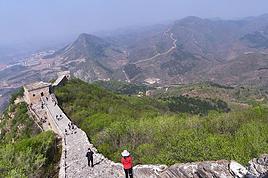
Lever 6h. Bus pour Simatai à 110 km de Pékin arrivée vers 11h. Ici la Grande muraille est plus sauvage, plus authentique. Il n'y a presque pas de touristes. Il faut gravir la montagne pour atteindre la Muraille qui se trouve sur les crêtes. J'utilise un télébenne pour réduire une partie de la montée. Des tours de guets, des à-pics impressionnants, un régal pour les yeux. Petit rappel, elle fait 6 700 km, commencée au 7ème siècle avant JC mais édifiée en briques au 14eme siècle, elle était défendue par 1 million de soldats.
Retour à Pékin en fin de journée.
Samedi 12 mai Pékin
Visite du Temple du Ciel, symbole de Pékin.
Visite de la gare Centrale.
Puis je me rends en métro au nord de la ville pour une balade au bord des lacs. Super endroit.
Dimanche 13 mai Pékin
Je loue un vélo pour 10 Y. Je traverse la ville pour aller au nord des lacs, sillonner les hutongs, visiter les tours de la Cloche et celle du Tambour, visiter le Temple des Lamas, me rendre au marché aux puces de Panjiayuan, et parcourir d'autres hutongs au retour.
Lundi 14 mai Pékin
Je me rends en bus ne 726 au départ de Qianmen vers le Palais d'été situé à une vingtaine de km de Pékin. Environ 1h de bus pour 2 Y. L'entrée est de 30 Y. Il fait très chaud, aussi la fraîcheur relative de l'ombre des arbres et de l'eau du lac est elle appréciable. C'est un vrai parc pour empereur. J'ai aimé.
Mardi 15 mai Pékin
Temps couvert. Le mausolée de Ma est fermé pour plusieurs mois pour réfection. Rues pitonnes, shopping. Visite de la Colline de Charbon, au nord de la Cité interdite avec vue sur celle-ci.
Mercredi 16 mai Pékin-Datong
Je prends un taxi (27 Y) pour me rendre à la gare de l'ouest (Xizhan) pour prendre le train K613 de 10h14 pour Datong (56 Y) en place assise.
Arrivée vers 17h. Feitian Hôtel près de la gare à 35 Y la nuit en chambre de 4.
Presto avec un jeune instit chinois de 27 ans avec qui j'ai fait commaissance dans le train. C'est lui qui paye la bière.
Jeudi 17 mai Datong - 3 millions d'hab.
Vent fort.
Aujourd'hui visite des grottes de Yungang. A 1 h en bus le 4 puis le 3 pour 2, 5 Y.
Entrée 60 Y. 21 grottes, des milliers de statues de Bouddhas dont certaines de plus de 15 mètres.
Au retour visite de la ville, sans grand intérêt.
Vendredi 18 mai Datons
Balade dans la ville jusqu'au soir.
Train 2463 à 22h56 en couchette pour 75 Y
Samedi 19 mai Pingyao - 50 000 hab.
Arrivée vers 7h30
Jiinjinglou Hôtel au pied de la tour du marché qui ce trouve en plein centre de la ville. 110 Y pour 2 nuits en chambre seul. Ville classée par l'Unesco. Ceinte de 6 km de remparts très bien conservés, et remplie de vieilles maisons à visiter pour 120 Y. Nombreux achats car ici le choix est grand et les prix tout petits.
Dimanche 20 mai Pingyao
Visite de la ville.
Lundi 21 mai Pingyao
Visite de la ville, suite.
20h06 train 2535 pour Tian pour 39 Y en place assise non réservée. Trajet mémorable au milieu des chinois, fumant comme des pompiers dans un wagon bondé.
Mardi 22 mai Tian
Arrivé vers 8h45, je choisi un hôtel près de la gare. Le Xi an Ludao Bin Guan a des chambres à 160 Y. Salle de bain, télé, clim tout compris. Aussitôt installé je retourne place de la gare d'où je prends un bus le 306 et pour 7 Y je me rends à Bingmayong voir l'armée enterrée des soldats en terre cuite.
Entrée 90 Y. Grandiose ! Plusieurs sites, plusieurs niveaux de conservation, mais toujours beaucoup d'émotion. Ils sont des centaines et là depuis 22 siècles.
Ensuite visite de Xi'an.
Mercredi 23 mai Xi'an - 7 millions d'hab.
Pluie
J'achète un jean pour 140 Y et continue la visite de la ville.
Le soir, le train T140 part à 19h53. Je suis en couchette (323 Y).
Jeudi 24 mai Shanghai - 18 millions d'hab.
Arrivée vers 11h45
Très chaud. Métro 3 Y. Hiker Youth Hostel, à 2 pas de Nanjing Road. 50 Y la nuit en chambre de 6.
Balade rue de Nankin, "la" rue piétonne de Shanghai. Le Bund, Promenade sur les bords de la rivière Huangpu.
Vendredi 25 mai Shanghai
Balade dans l'ancienne concession française.
H&M comme à Bordeaux
Le parc Fuxing
La Place du Peuple
Samedi 26 mai Shanghai
Métro ligne 2 jusqu'à Longyang Rd où l'on trouve le magasin Décathlon. Le même qu'en France mais à petits prix.
Retour en métro pour monter dans la 4ème plus haute tour du monde (420 mètres) 70 Y
Ascenseur à 9 mètres/a. 88 ème étage. Vue panoramique impressionnante.
Traversée de la rivière en ferry 1 Y.
Dimanche 27 mai Shanghai
Visite de la vieille ville chinoise, ses marchés.
A midi je mange les meilleurs raviolis de Chine (16 pour 10 Y).
Rencontre de deux gay chinois avec qui je vais boire un verre.
Lundi 28 mai Shanghai
Train Maglev (Magnétique lévitation) pour 40 Y je file à 431 km/h vers l'aéroport.
Vol AF 115 en A340-600 assuré par Chinaeastern à 23h55.
Mardi 29 mai 2007 Roissy
Arrivée vers 6h30, après 13 h de vol.
7h39 TGV arrivée Bordeaux 11h56.
Budget:
Transport: 69 € pour 2500 km environ en train
Nourriture: 107 € pour 21 jours
Hébergement: 87 € pour 16 nuits
Visites: 156 €
Achats: 160 € pour 9 kg
soit: 2 thés ronds Puer, 2 chapeaux chinois, 1 boucle d'oreille, 1 éventail, 2 paires de chaussettes, 1 grosse boite d'allumettes et 5 petites, 1 paire de pantoufles, 2 ceintures, 2 coussins, 1 broderie sur soie, 1 peigne en corne, 1 rasoir et sa mousse à raser, 1 jean, 1 tasse, 3 thés verts, 1 lampe frontale, 10 timbres, 1 tampon gravé à mon nom, 4 chemins de table en soie, 1 saché de thé au jasmin, 4 boites de thé verts.
Ce n'est pas parce que les choses sont difficiles que nous n'osons pas, c'est parce que nous n'osons pas qu'elles sont difficiles. (Seneque)
- -
Dimanche 13 mai Pékin
Je loue un vélo pour 10 Y. Je traverse la ville pour aller au nord des lacs, sillonner les hutongs, visiter les tours de la Cloche et celle du Tambour, visiter le Temple des Lamas, me rendre au marché aux puces de Panjiayuan, et parcourir d'autres hutongs au retour.--
tu as fait en une journee! 😏 en sachant que le marché aux puces se trouve au sud-est de pekin sur la 3eme ring.
Ca fait bcp de km... Bravo
Pour Xi'an on a du se croiser car moi aussi j'y etais mardi+mercredi+ jeudi avec la journee pluvieuse le mardi et mercredi mais tres beau temps le jeudi.
Salut,
je suis allée en Chine il y a 2ans je n'ai pas rencontré de pb particulier à cause de la langue, la langue des signes marchant plutôt bien.
Mais si tu as besoin le guide du routard a sorti un petit bouquin qui s'appelle Gépalémo. En fait ils ont dessiné tout ce dont on peut avoir besoin pendant ses vacances, tout y passe, c'est génial et vraiment international.
Ca dépend ou tu vas
Je suis allé de Hong Kong à Shanghai en passant par Canton, Kunming, le fleuve de Yan tsé Jian, Chengdu, Xi'an, FLeuve jaune, Pékin, Dalian..... c'est en fait du sudEst- Sud-ouest -ouest Nord-Ouest Nord Est-Nord... jusqu'a l'arrivé à Shanghai.
Et j'ai remarqué les villes cotieres chinoisnes on a plus de chance de rencontrer les habitants qui parlent anglais qu'à l'interieur de pays. A l'interieur de pays, beaucoups chinois parlent le dialecte plutot que le mandarin.
MEme sils parlent le mandarin, ils parlent pas la meme chose selon la région ou ils vivent....
j'ai tjs des blocs de papier, comme ca si les locaux ne me comprennent pas, j'écris un mot ou je fais un dessin, j'essaie de communiquer avec les jeunes plutot que les vieux. les jeunes sont plus ouvert et moins curiosité
alors que les vieux ont tendance de te mater insistant et te répondent pas !
POur moi la barriere des langues n'est pas un handicap du moment qu'on se débrouille
Il faut faire attention aux camions, ils conduisent à vive allure sur la route de campagne et ils font souvent des accidents !
le plus gros problème en CHine est :
Il faut savoir garder calme, les chinois à l'interieur du pays aiment te regarder avec l'insistance....ce n'est pas un ou deux mais une vngtaine !!!!
c'est lourd à a longue
Même si ça date et que sûrement personne va lire ça, pas grave je réponds.
Pas besoin de parler chinois, y a toujours moyen de se démerder avec des geste ou avec des petits dessins (comme moi quand je voulais acheter une passoire à thé l'autre jour)...en plus c'est marrant!
Ah ouais, si tu veux pas qu'on te prenne pour un américain, prends quand même un guide de conversation, histoire de savoir dire que t'es français!
:)
Ah ouais, pis c'est pas mal de savoir dire bonjour, au revoir et merci...mais bon, si tu dis ça en français avec un sourire ils comprennent quand même!
Perso je trouve ça plus cool en fait: chacun parle dans sa langue mais on se comprend quand même!
Je me prenais mon petit déj dans ma chambre d'hôtel : thé noir en sachet style Lipton, sucre et lait condensé en tube avec quelques petites viennoiseries achetées la veille dans les nombreuses pâtisseries qu'on peut trouver dans toutes les villes. Mais donc le plus dur ce fut ... le tube de lait concentré. En fait il y en a dans les grand magasins Carrefour. Mais ce fut dur de me faire comprendre des vendeurs. Tout s'est terminé dans une grande rigolade.
c'est pas mal de savoir dire bonjour, au revoir et merci
Bonjour : ni hao (ni how)
Au revoir : zaijian (tzaï tzienne)
Merci : xiéxie (chichié)
Je ne parle pas chinois mais j'ai appris à rigoler chinois 😉
Je ne comprends pas (wo tingbudong) le chinois
"Nous ne sommes plus une communauté d'être humains qui se parlent mais un conglomérat de grappes de consommateurs en niches, séparés les uns des autres par des obsessions diverses et innombrables. Nous sommes de l'ère de la désintégration." Marc Moulin (1942-2008) in Humoeurs
Hin hin...je vois qu'on est sur la même longueur d'onde: tu trouves aussi que c'est bien plus sympa et marrant de se faire comprendre sans parler un mot que d'utiliser bêtement un guide de conversation!
Déjà que le sucre dans le thé, c'est bizarre en Chine...alors du lait condensé, ça devait pas être évident!
:)
Si t'as réussi à trouver ça sans parler chinois, tu es la preuve vivante qu'on a pas besoin de parler chinois en Chine!
Bref...ni bu xianggai shuo hanyu, ni shi zai shongguo de shihou!
Je prépare mon premier voyage en Chine pour l'été prochain, et ma première question est simple: comment est-ce de voyager en Chine sans parler un traître mot…
Je souhaiterais passer en Chine depuis le Laos et visiter les coins plus ou moins reculés du Yunnan et j'ai donc plusieurs questions à ce sujet: 1 - Je vais…
Nous sommes expat (famille de 5) en Asie nous souhaitons faire 1 voyage en Chine mais l'obtention du visa me semble non seulement tres coûteux mais également…
Et voilà ça arrive aux pressés, au Xinjiang sans carte il me faudrait une carte, mais Google passe très mal ici, mappy injoignable, quelqu'un pourrait il…
Je compte me rendre à Pékin en avion et de là prendre un bus ou le train pour aller en Mongolie, je souhaiterai savoir comment procéder pour le visa puisque je…
Bonjour,
Avec ma copine (23 ans et 24 ans) nous partons au Japon pour la première fois du 20 Octobre au 6 Novembre prochain. Notre itinéraire est le suivant :
6 nuits Tokyo
1 nuit Hakone (ryokan déjà réservé)
4 nuits Kyoto (hôtel déjà réservé)
2 nuits Osaka
4 nuits Tokyo
Je souhaite réserver l’hôtel pour Tokyo (enfin les deux hôtels) et Osaka, mais j’ai beaucoup de recommandations différentes.
J’ai lu que Shinjuku était là où il y avait le grand hub / accessibilité / choses à faire, mais on m’a aussi parlé de Shibuya, Asakusa, Ueno.
J’ai regardé les hôtels et premièrement je suis étonné du prix par rapport à ce que j’ai lu sur les forums (l’inflation est passé par là aussi j’imagine…, et peut-être que je suis en retard sur les réservations ?), et je me perds un peu dans les recherches avec toutes les propositions.
Pour le premier logement à Tokyo je souhaiterai être en hôtel (pas résidence ou AirBnB) car nous arriverons pendant la nuit et c’est notre première fois au Japon donc si on peut arriver dans un endroit avec un accueil, des gens qui parlent (même un minimum) anglais et qui nous guident, ce serait top. Pour le second logement on pourra faire autrement si c’est mieux.
Niveau budget nous pouvons nous permettre de mettre 150e-180e par nuit mais si on peut faire des économies pour mettre les sous ailleurs ce serait vraiment vraiment pas de refus!
Je suis preneur de toutes les recommandations, suggestions d’hôtels, ou autre, pour Tokyo 1, Osaka, et Tokyo 2.
Nous nous envolons pour la Chine dans quelques jours pour un voyage de quatre semaines, une première pour nous dans ce pays fascinant. 🇨🇳
Nous partagerons notre aventure en direct sur notre carnet de voyage, avec des photos et des récits écrits au jour le jour. Notre itinéraire, bien que classique, nous permettra de découvrir les merveilles de ce vaste pays :
I’m starting to look at neighborhoods in Seoul, and I’m leaning toward staying in a hotel in Insa-Dong—I’ve spotted one really close to Unhyeongung.
Is this a good area—nice and convenient for exploring the city?
Otherwise, I’ve also found another hotel in Yongsan-Gu, right near the station of the same name. Is that station useful for getting around Seoul?
Since I’ll be in South Korea for nearly two months, I plan to spend at least a week in Seoul to recover from jet lag (it takes me a while to adjust...). So, I’d love a neighborhood that’s pleasant and a hotel not too far from a subway station.
Hi there,
I’m getting ready for a classic tourist trip to China in May 2026.
The "Terres Lointaines" itinerary looks good to me, and the price is interesting.
Has anyone traveled with them before? Any feedback?
Is there a better option?
Thanks so much for sharing your experiences on this!
Michel
I just booked my hotel in Seoul—it’ll be near Unhyeongung, on Samil-Daero 30-Gil—and I’m wondering if there’s public transport from the airport to this address (bus or subway)? If not, what’s the taxi fare? I read it’s around 50 or 60 €.
I’m traveling to Japan with a young adult with autism (ASD) from July 28 to August 8, following a pretty classic route: Osaka, Hiroshima, Kyoto, and Tokyo. I’m looking for a schedule of the most spectacular fireworks displays during that time. So far, the dates for the major *hanabi* events aren’t available online yet. If anyone has them, I’d really appreciate it if you could share!
We’ll be doing a self-drive trip using public transport in May 2026.
On Day 6, we’ll arrive in Hakone by train from Tokyo in late morning. We’ll spend the night in Hakone before heading to Kyoto.
The main goal of this stop is clearly the view (no hiking) of Mount Fuji, not so much exploring Hakone, where the sights seem limited.
I’ve read on the forum that the view is great from Gotemba, but it also takes a good hour by bus to get there. And, apart from that view, there’s nothing else to see in Gotemba!
So, I’m not sure what to choose. Any thoughts? Or alternatives to suggest?
Maybe some spots in Hakone or Gotemba for a great view?
Hi everyone, I’m Julien!
This summer, from late June to late July, I’m planning a one-month solo trip to Japan—my first time!
I’d love to hear your thoughts and advice on the itinerary I’ve put together to explore this amazing country.
Here are the routes I’m considering:
**Option 1: More mountain and nature-focused**
Tokyo: 8 nights, with day trips to Nikko and maybe the Izu Peninsula
Kawaguchiko (Lake Kawaguchi/Mt. Fuji): 1 night. The place looks stunning, but I’m worried Mt. Fuji might not be visible due to the weather
Kyoto: 6–7 nights (including a trip to Nara)
Osaka: 1–2 nights, where I’d like to drop off my things to make the Kumano Kodo easier
Kumano Kodo: 3 nights—an experience I haven’t seen much elsewhere, but I thought it sounded really interesting
Hiroshima: 2 nights
Miyajima: 1 night
Takayama: 3 days
Kanazawa: 3 days (From what I understand, the Osaka–Takayama–Kanazawa–Tokyo route is convenient for transport)
Tokyo: 1 night (return)
**Option 2: More varied but a bit vague in parts**
Tokyo: 8 nights
Kyoto: 7 nights (+ Nara)
Osaka: 2 nights
Kobe + Himeji: just passing through—I’m not sure if it’s worth a night
Naoshima: 1 night—still pretty unclear for me
Takamatsu: 2 nights. An interesting city, but I’m not sure how long to stay
Shimanami Kaido: biking from Imabari to Onomichi, then heading to Hiroshima
Hiroshima: 2 nights
Miyajima: 1 night
Kyushu road trip (Aso + onsens + Fukuoka): 5 nights (also pretty vague—I could fly from Fukuoka back to Tokyo)
Tokyo: 1 night
**Option 3: More balanced/simplified**
Tokyo: 8 nights
Kawaguchiko: 1 night
Kyoto: 7 nights (+ Nara)
Osaka: 2 nights
Koya-san: 1 night
Kumano Kodo: 3 nights
Takayama: 3 nights
Kanazawa: 3 nights
Tokyo: 1 night
A few key points:
I haven’t made any reservations yet, except for the flight tickets.
I know my plans are too packed and will need to be adjusted.
I’m specifically looking for advice on which stops to cut or shorten.
Hello everyone,
Like Cedric13600, I’ve booked a flight ticket for 30 days / 29 nights in September 2026, from Beijing to Shanghai. We’re a couple in our sixties who love independent road trips.
I’d like to draw inspiration from the following private itinerary suggested by a travel agency:
Day 1: Arrival in Beijing
Day 2 to 4: Beijing
Day 5: Datong
Day 6 & 7: Pingyao
Day 8 to 10: Xi'an
Day 11: Luoyang
Day 12: Dengfeng
flight
Day 13 & 14: Chongqing
flight
Day 15 & 16: Lijiang
Day 17: Dali
Day 18: Kunming
Day 19: Jianshui
Day 20 & 21: Yuanyang
Day 22: Travel via Guilin
Day 23 & 24: Yangshuo
Day 25: Guilin
Day 26 & 27: Zhangjiajie
flight
Day 28 & 29: Shanghai
Day 30: Departure from Shanghai
But to do this itinerary independently:
1. This schedule seems very ambitious to me—what do you think?
2. If it’s too packed, what would you remove as a priority?
Thanks so much in advance for your help.
I’m planning a 5-week trip between Yunnan and Sichuan from mid-October to the end of November 2026:
Arriving in Kunming, I’ll do a loop in the far south of Yunnan via Thonghai, Jhiansu, Zhemi, Yuanyang, Nafa, Jinping, Mengzi, and Shilin (visiting markets, villages, and hiking), then head to northern Yunnan/southern Sichuan on the same theme (passing through Kunming again) via Dongchuan, Huize, Qiaojia, Puge, Xichang, Lanba, Butuo, Huolie, Dimo, Riha, Niuniuba, Meigu, Mabian, and Leshan, before arriving in Chengdu (where I’ll take my return flight to Paris).
This would be a trip with a strong ethnic/rural focus. Since I’ve never traveled in China, I’d love to hear your thoughts on doing this solo. Are there public transport options in the region? What tips do you have for traveling through this area as smoothly and enjoyably as possible? I’ve done quite a bit of backpacking in the mountains of northern Vietnam and really enjoyed using local motorbike drivers. Is something like that available in this region (through local tourist agencies or hotels)?
What should I be cautious about? Are local tourist agencies (or hotels) offering tours and guides reliable? If you know of any specialized sites sharing tips or experiences, or names of local agencies, hotels, etc., please don’t hesitate to share them! :)
In short, all your advice (on any topic that comes to mind!) is very welcome.
Thanks so much!
While researching South Korea, I came across the term "templestay," which refers to a Korean program that lets you stay in a traditional temple to discover Buddhism and Korean culture by living like the temple residents and doing activities like making lanterns.
A templestay isn’t just for foreign tourists—on the booking site, I saw that some temples are more geared toward foreigners, with English-speaking monks.
I was wondering if it’s still worth it, especially in temples where the monks don’t speak English?
I'm 69 years old and heading to China, where most tourist sites are free or discounted for me. However, trip.com either refuses to let me book because the sites are free or doesn’t apply the discount. Does WeChat apply this discount if I book through them? How can I just reserve without paying and pay on-site? Is that possible?
I’d love to get some feedback on our 30-day / 29-night itinerary in China. We’ll be there in September as a family with two kids (6 and 10 years old).
Do you think I should cut a few nights between Wulingyuan (Avatar Mountain) and Yangshuo? I’ve planned 15 nights total there.
We’ll be on a round-the-world trip starting May 2026 and will need to do schoolwork with the kids. Hoping to fit it in during train rides!!
Ever since I started planning this China itinerary, I’ve been discovering completely mind-blowing places I’d never heard of before—30 days feels way too short for China!!!
Here’s our itinerary:
Beijing - 4 nights
Forbidden City
Great Wall of China
Temple of Heaven
Xi’an - 3 nights
Terracotta Army
Muslim Quarter & Great Mosque
Chengdu - 3 nights
Zoo - Research Base of Giant Panda Breeding
Wenshu Yuan Temple
Hi there,
We just got back from a 2-week trip to China as a couple, and before we left, the budget was the hardest thing to picture concretely. We found plenty of info on visas, apps, transport, and itineraries, but way fewer detailed breakdowns of what you *actually* spend on the ground.
So, we took the time to share our real budget for 14 days. In our case, we spent around 1,800 € per person, with a big chunk of that going toward round-trip flights at about 600 € per person. We were also pretty surprised by how affordable China can be once you’re there—transport is often cheap, and a lot of everyday expenses stay reasonable.
The trickiest part, in the end, was figuring out how to pay while you’re there, since it’s not always obvious if you’re not prepared. But once everything’s set up and you get the hang of it, it’s really smooth.
If this can help other travelers get a better idea before they go, we’ve broken it all down here:
https://aventures-sans-mesaventure.com/budget-2-semaines-de-voyage-en-chine/
Hi everyone,
I’ve been planning several itineraries for a trip to Japan with my wife but would love your insights before we start booking!
In short, we want to go during Golden Week, see late-blooming cherry trees, and have the freedom to get around with a rental car.
Here’s the plan:
18-day itinerary in Japan (April 25 → May 12)
Goal: freedom, late cherry blossoms, culture & nature
---
Days 1–3: Tokyo (April 25–27)
Arrival and adjustment (no car needed yet).
Neighborhoods to visit: Shinjuku, Asakusa, Meiji Jingu, Shibuya, Odaiba.
Suggested activities: Ghibli Museum, Sumida River cruise, izakaya meals.
Late cherry blossoms (yaezakura) possible at Shinjuku Gyoen.
Pick up the rental car on the morning of April 27.
---
Days 4–5: Mount Fuji & Hakone (April 27–28)
Route: Tokyo → Kawaguchiko/Hakone (~2 h).
Activities:
Lake Kawaguchi, Chureito Pagoda (Fuji views + late cherry blossoms)
Onsen baths, Hakone Open-Air Museum.
Stay: ryokan with onsen and views of Mount Fuji.
Activities:
Preserved old town, sake breweries, UNESCO village of Shirakawa-go.
Stay: traditional minshuku (thatched-roof house).
Cherry blossoms are finishing at this altitude — beautiful mountain/nature contrasts.
---
Days 8–10: Kyoto & Nara (May 1–3)
Route: Takayama → Kyoto (~4 h 30).
Activities in Kyoto:
Fushimi Inari (red torii gates), Golden Pavilion, Arashiyama, Gion (geisha district).
Day trip to Nara:
Free-roaming deer in Nara Park, Todai-ji Temple, Kasuga Taisha Shrine.
Stay: Kyoto (3 nights).
---
Day 11: Osaka or Himeji (May 4)
Route: Kyoto → Osaka (~1 h) or Himeji (~1 h 30).
Option 1: Osaka → modern vibe, street food, castle.
Option 2: Himeji → stunning UNESCO-listed castle.
Stay: Osaka.
---
Days 12–13: Kanazawa (May 5–6)
Route: Osaka → Kanazawa (~4 h 30).
hi! Is it easy to use for paying for all the small purchases at the markets? INSTALLATION AND USE WITHOUT ISSUES—do you also need a VPN for China?
Secondly, for using phone and internet, I have Orange—is it reliable, or should I go with Airalo instead?
The info I found on the forum is a bit outdated, so I’m asking again!
1) What budget should I plan for 15 days, given that hotels with breakfast, transfers, and transport are already paid for? I know it depends on the person, but I’d love a rough idea. For meals, we’re thinking simple street food or small local restaurants.
2) I’ve heard that credit cards (we each have a Revolut + 1 Visa Premier) aren’t widely used and that it’s better to have cash. Can you confirm?
3) Are foreign credit cards still not accepted at bank ATMs? Still 7-Eleven or the Post Office? And what about American Express?
I'm planning a 19-day itinerary in Japan this summer.
For a first trip, Kyoto seems like a must. For the rest, I'm torn between:
- Matsumoto, Takayama, Kanazawa for 5 to 6 days
- Kyoto 4 days
- Nara 2 days
- Koyasan 1 day
- Hakone/Mount Fuji 2 to 3 days
- Tokyo 3 days
Or dedicating the first 6 days to Kyushu.
Maybe there’s less traditional Japan in Kyushu compared to the Japanese Alps?
Maybe Kyushu is less crowded?
Thanks for your thoughts!
We’re planning a 17-day trip to South Korea in October 2026 with my husband and our daughters, who’ll be 9 years old.
I’d love to get your thoughts on our draft itinerary.
First, some key details:
1/ Jeju Island is a must for us. I’ve personally dreamed of going there for years after reading a novel about it.
2/ Our girls are used to road-trip style travel since they were born, so this kind of trip won’t be an issue for them.
3/ We plan to travel by train, except on Jeju where we’ll rent a car (we already have an international driver’s permit).
Itinerary:
Seoul: 1 arrival day at 10 AM + 4 full days
Gyeongju: 2 days
Busan: 3 days
Jeju: 4 days
Seoul: 2 days
I’ll be in Hong Kong from December 31 to January 3, 2027.
Any recommendations for things to see or do?
I’ll be staying in the Kowloon district.
I’d love to visit Lantau Island—what’s the best way to get there? And would you recommend buying a skip-the-line ticket for the cable car? Also, is there an entry fee for the Big Buddha?
I’m heading to Taiwan soon and would love some up-to-date info on Wi-Fi.
From what I’ve gathered, Taiwan offers it for free, but I’ve heard it’s not secure since it’s not protected by a "password." Since I’ve been traveling outside the EU for years without a local SIM card, I only use Wi-Fi in hotels, restaurants, and cafés. For me, that’s more than enough. So, my question is: Do these places secure their Wi-Fi with a "password"? If not, does buying a SIM card or eSIM seem like the only alternative?
Also, if any of you have recommendations for budget-friendly hotels in the main "cities," I’d love to hear them!
We’re planning a trip to China for two at the beginning of April and want to spend 2 nights in the Longji Rice Terraces—either in Dazhai, Tiantouzhaï, or Ping'an. I’ve seen that most of the hotels are made of bamboo, and you can hear every little noise. Since my husband is a very light sleeper, he’d really like to be sure he’ll get a good night’s rest. Can you recommend any quiet, well-soundproofed hotels in the area?
I’m reaching out to you because I’m planning our next big trip (Japan is really tempting us for the autumn!) and I have to admit, I’m feeling a bit overwhelmed.
My husband and I have always loved traveling, and at 75, we have no intention of stopping... But I find that everything’s getting so complicated. I try to be "modern" by booking online, but as soon as there’s a problem, we hit a wall.
A friend nearly missed her departure last year because of a visa issue that wasn’t explained properly on a website... and no one to call for help, just automated messages.
It makes me a little nervous to be alone in front of a screen so far away, especially since at our age, we like knowing there’s real support if our health takes a turn while we’re there.
Anyway, I’m tired of seeing my file passed from one person to another without ever having the same contact... Do you know of any small, trustworthy agencies or people who still work the "old-fashioned" way and really look after their clients? I love my independence, but I need a real face behind my project.
Thanks in advance for your advice, and I look forward to reading your replies,
Catherine
I’m planning our trip to Japan from March 21 to April 11, 2026. We’re planning to travel by plane for long distances (Okinawa) and by train for the rest. I’d like to know if renting a car is easy and, most importantly, if driving with road signs written in Japanese isn’t too complicated. For trains, are there any tips to save money?
hi everyone, and first of all, I wish you all a happy new year and good health!
This coming October or November, we’re planning our first trip to Japan. The only downside is we’ll only have two weeks off.
For this first visit, I’m thinking of sticking to the Kyoto and Osaka area… saving Tokyo for another trip. Do you think that’s a good choice for a first-time visit?
I’ve put together a little itinerary below to get some feedback from those in the know. I’m only counting the days we’re actually there, not travel days.
Day 1: Kyoto
Ginkaku-ji – Philosopher’s Path with stops at a few shrines
temples Eikan-dō and Nanzen-ji
visit to the Samurai Ninja Museum in the late afternoon
Day 2: Kyoto
Fushimi Inari (allow 4 hours for the hike through the park)
visit to Sanjūsangen-dō temple
Shōseien garden
participate in a tea ceremony
Day 3: Kyoto
Kiyomizu-dera temple
stroll through the historic district up to Kennin-ji temple
visit Kennin-ji temple
Yasaka-jinja shrine and Gion district in the late afternoon
return to the hotel via Pontochō Street
Day 4: Kyoto
visit Kinkaku-ji and Nijō Castle
visit the Imperial Palace gardens
end the day in the shopping streets (Shibkyogoku and Teramachi, among others)
Day 5: Kyoto
Arashiyama area
Togetsukyo Bridge, walk along the river, visit the Bamboo Forest
explore the area up to Otagi Nenbutsu-ji temple
Day 6: Kyoto
hike from Kibune to Kurama
Day 7: Kyoto
day trip to Nara (full day)
Day 8:
stroll around Kyoto before heading to Osaka
Day 9: Osaka
Katsuo-ji temple, then head to Minoh Falls and hike back via the Minoh Trail
end the day in the Osaka Castle area
Day 10: Osaka
Himeji Castle and an afternoon in Osaka
Day 11: Osaka
Osaka and return to the airport in the late afternoon for the flight home
Do you think this itinerary is doable? Are some days too relaxed or too packed?
I was thinking of adding a trip to Lake Biwa and Uji, but in that case, I’d have to cut some things. Are those places worth dropping some of the planned spots? And if so, which ones would you recommend cutting or shortening?
Thanks in advance—I’m all ears for both positive and negative feedback!
stephane
Hi there,
I’m planning a trip to Japan in April/May.
I’ll start my journey in Tokyo for 3 to 4 days.
I’d love your advice on accommodation, transportation, an itinerary, and whether a guide would be useful.
I’m traveling solo and could use a little reassurance.
Before I forget... how do payments work?
Hi there,
I’m looking for someone who could help me organize a trip to Japan for my niece and her son. I’ve seen that French-speaking guides are expensive, and the same goes for going through a tour operator.
Airline, local transportation, hotels, etc.
Thanks for your replies!
Betsyl
Hi there, I’m going on an organized trip to Japan in April and will have two free days in Tokyo. I’d love some tips on what to do during those two days.
Thanks