<<< Je suis abasourdi par cette nouvelle!
(Dossier trouvé dans Rue88) Ca sent les élections à plein nez, mais si ils le font, je dis chapôôôô!!
PARIS AMENAGE SECRETEMENT LE SITE DE LA PLUS GRANDE GARE ROUTIERE DU MONDE
* Après Velib’, la ville de Paris s’attaque à un projet dont la simplicité révolutionnaire risque de modifier considérablement notre manière de voyager en France et en Europe. L’idée : un site de « covoiturage longues distances », organisé par Internet et sécurisé grâce à un système d’adhésions. Il permettra de voyager facilement, en toute sécurité, à des prix très réduits et de manière plus écologique !
* Présenté comme un service public à part entière, ce nouveauv site s’impose comme « gagnant gagnant » aussi bien pour les conducteurs que pour les voyageurs à petits budgets, qu’ils soient réguliers ou spontanés.
* La SNCF et les compagnies de cars européennes disent redouter cette initiative à but non-commercial qui pourrait totalement bouleverser le marché des transports des personnes dès 2010.
Un trajet Paris Lille à 10 euros, Marseille Paris à 20 euros, Paris Bordeaux à 15 euros… non, vous ne rêvez pas, il ne s’agit pas de tarifs spéciaux aux conditions quasi-impossibles tels que vous ne cessez de les trouver dans les publicités aguicheuses de la SNCF ou des compagnies aériennes low cost. Car il est bien question de tarifs fixes, non négociables, applicables en toutes saisons et tous les jours de la semaine… ceci grâce à la nouvelle « gare routière » de la ville de Paris, virtuelle mais pourtant bien réelle, qui ouvrira son portail sur la toile avant l’été 2008 !
L’auto devient une cause écolo
L’idée lancée par la ville de Paris repose sur un constat effectué à partir d’une enquête établie de juillet 2006 à mars 2007 auprès de plus de 12.000 automobilistes interrogés au niveau des cinq grands péages autoroutiers situés en bordure de Paris. Celle-ci révèle une réalité toute simple : chaque jour, parmi les 1, 5 millions d’automobilistes qui quittent Paris pour une grande ville de province, 59% se disent tout à fait prêts à transporter un ou plusieurs passagers, moyennant participation aux frais de transport et l’assurance d’une sécurité garantie pendant le voyage.
Fort de ce constat, la ville de Paris a sollicité une quinzaine de personnalités, ainsi que le collectif Demain, afin de travailler pendant tout l’été sur des propositions de projets permettant la mise en place rapide d’un nouveau système de « covoiturage longues distances ». Ce groupement hétéroclite, comprenant des politiques, des ingénieurs experts et des informaticiens proches des mouvements écologistes se revendiquant «de gauche comme de droite», s’est engagé à mettre les hautes technologies au service de causes écologiques pragmatiques et réalistes dans des domaines très variés.
Yves Lethiers, ingénieur en génie civil et porte-parole de Demain, assure que «grâce à Internet, nous avons désormais les moyens techniques d’implémenter de nouvelles idées, simples et peu onéreuses, qui permettent de faciliter la vie des citoyens et de réduire les coûts financiers et écologiques ». Et à Amira Salem, informaticienne membre du collectif, de renchérir : «Le secteur privé n’a pas le monopole de l’innovation liées aux nouvelles technologies. C’est aussi aux politiques de les utiliser dans le but de créer un nouveau lien social et d’impulser de nouvelles ambitions collectives. Vélov’ et Vélib’ n’auraient jamais pu être lancés à grande échelle si les politiques n’avaient pas osé prendre ce risque. »
Des «bornes de covoiturage» aux péages et à l’entrée des villes
Par ce projet, la ville de Paris a tenté de marquer sa singularité tout en parvenant à contourner certains acteurs politiques et économiques nationaux encore récalcitrants devant ce changement de mentalité. «Le combat est difficile: ce n’est pas seulement la direction de la SNCF qui nous met des bâtons dans les roues, beaucoup de hauts fonctionnaires et de préfets n’ont de cesse de présenter ce projet comme incontrôlable» déclare le conseiller en charge du dossier. Ainsi, Paris a préféré se présenter en pionnière au niveau local, quitte à prendre le risque d’être en première ligne en cas d’échec.
Parmi les diverses propositions du collectif Demain, le conseil spécial de la ville de Paris a opté pour la plus novatrice et la plus ambitieuse d’entre elles. Elle consiste à mettre en place un réseau de bornes d’enregistrement et de suivi des voyageurs, disposées au niveau des péages autoroutiers et à l’entrée des villes, afin d’encadrer discrètement et efficacement les déplacements des véhicules dans le cadre de ce covoiturage organisé. Un accord de principe a été signé le 3 septembre dernier entre la Société Nationale des Autoroutes Sud/Nord, la CNIL et les villes de Lille, Grenoble, Strasbourg et Lyon pour la mise en place de 600 bornes test dès janvier 2008.
Les villes de Marseille et Bordeaux malgré le grand intérêt qu’elles ont manifesté jusque là, souhaitent quant à elles attendre le feu vert de Matignon qui semble ne pas vouloir encourager pour le moment un projet considéré comme «politiquement sensible». Les villes de Berlin et Madrid, disposées à suivre le mouvement dans un avenir proche, se sont officiellement déclarées «partenaires observateurs» et se sont engagées à financer le budget des bornes-test à hauteur de 10% (55 millions d’Euros).
Souplesse, sécurité… et convivialité
Il suffit de lire le rapport d’expertise pour comprendre que les modalités de fonctionnement du système de covoiturage seront relativement faciles à mettre en place : afin de garantir un maximum de sécurité, les conducteur et les passagers doivent tous se doter d’une carte nominative en souscrivant à un abonnement mensuel de 10 euros ou un abonnement annuel de 40 euros. Cette carte doit être présentée lors des passages aux péages de départ et d’arrivée.
Pendant la phase test, conducteurs et passagers trouveront 600 bornes sur lesquelles ils pourront indiquer la destination et le numéro d’immatriculation du véhicule. Parvenus au lieu d’arrivée, il suffira de valider le trajet sur les bornes situées au péage final ou à l’entrée de la ville d’arrivée. «Dans un souci de sécurité, il n’y aura aucune transaction monétaire directe entre les acteurs du système, puisque le compte du voyageur est débité automatiquement en fonction de la distance parcourue, et le compte du conducteur crédité après validation collective du trajet» nous déclare Yves Lethiers.
Pour ce qui est des voyageurs réguliers qui sont transportés par le même véhicule et sur le même itinéraire, un système de passage direct et immédiat au péage permettra d’éviter l’arrêt à la borne.
Rendez-vous devant votre Porte…
Amira Salem nous explique avec enthousiasme les modalités pratiques du covoiturage au 21eme siècle : « Pour se donner un rendez-vous, il suffit de se connecter sur le site de la ville, on y trouve une banque de données nationale présentant les demandes voyageurs, les offres conducteurs, les itinéraires et dates de voyages et les places disponibles. Il est alors facile d’entrer en contact (par téléphone ou par Internet) avec votre interlocuteur et de fixer un lieu et une heure de rendez-vous pour le départ. S’il n’y a aucune règle établie, il est coutume d’établir le lieu du rendez-vous dans un café situé près du domicile du conducteur.»
Par ailleurs, la ville de Paris a décidé de se démarquer en prévoyant la création de cinq grands espaces « covoiturage longues distances » de 1000 M2 chacun, situés au niveau de cinq Portes de Paris (Orléans, Chapelle, Maillot, Montreuil et St Cloud). Passagers et conducteurs pourront y trouver des équipes formées spécialement pour faciliter les mises en relation en fonction des itinéraires et des disponibilités. Ainsi, cet espace « auto-stop » sécurisé et géré par les agents de la ville permettra aux plus aventureux de tenter leur chance sans passer par le système de réservation préalable.
Service public ou service privé ?
Yves Lethiers, porte-parole du collectif Demain reconnaît que « ce nouveau système centralisé à l’échelle d’un véritable service public marque la fin rapide de toutes les petites associations de covoiturage qui se sont développées ces 10 dernières années sur le net. Mais de fait, par leur concurrence et leurs petits moyens, elles ne pouvaient répondre que de manière très limitée aux demandes des voyageurs et des conducteurs. Nous espérons mettre en place un système unique, viable et de grande ampleur ». Car les atouts d’un système centralisé sont considérables : grâce à un volume élevé de l’offre et de la demande, les experts du collectif Demain ont estimé qu’une personne qui souhaite effectuer un Paris-Grenoble un lundi matin, en période normale, aurait 80% de chances de trouver un véhicule avec une place disponible dans les 5 jours précédant son voyage (contre 3 à 5% sur les sites de covoiturages actuels).
Si il s’agit bien de mettre en œuvre un nouveau service public du transport des personnes, « au même titre que les bibliothèques démocratisent la lecture ou que vélib facilite les déplacements en ville », dixit Amira Salem, il semblerait que les villes partenaires entendent passer rapidement un contrat avec un groupe privé pour la gestion du système. Pour le conseiller en charge du dossier qui préfère nous parler sous le couvert de l’anonymat: « à partir du moment où le covoiturage centralisé se développe sur l’ensemble du territoire national, les villes engagées devront faire appel à un groupe privé pour la gestion des données, le maintien technique des bornes et du site Internet ainsi que la gestion des contentieux. Il s’agira d’une prestation de sous-traitance au même titre que J.C Decaux pour Vélib.»
De manière plus anecdotique, la Fédération Nationale des Auto-Stoppeurs a tenu à soutenir officiellement «cette initiative citoyenne, écologique et susceptible de créer du lien social» tout en déclarant regretter l’institutionnalisation de la pratique de l’auto-stop, tombée en désuétude depuis les années 80. Sa Présidente, Huguette Sydoine, membre du collectif Demain, remarque avec une pointe de nostalgie et d’humour: «Notre époque n’est plus à la solidarité spontanée et gratuite qui permettait aux auto-stoppeurs de voyager sans souci, gratuitement et n’importe où. C’est donc une page de la société qui se tourne définitivement! Plus personne ne connaîtra le charme poétique des incertitudes du climat et de l’attente au bord des autoroutes!». Reste à savoir si les nouvelles générations sont prêtes à s’engager dans l’aventure, moins aléatoire et moins risquée, du transport partagé!
Sauf qu'il y a une grande différence entre des petits sites de covoiturages internet limités se faisant de la concurrence et un service public de covoiturage, institutionnalisé et généralisé.
Nous prévoyons ma conjointe et moi aller passer une semaine à Paris en septembre prochain (location d'appartement) et on désire passer une autre semaine à…
Événements › France › Paris - Île de France · 0 replies
Génaf, une Génération pour l'Afrique, organise son prochain événement le samedi 25 avril 2009 près de Paris. Pour tous ceux qui voudraient rencontrer des…
Compagnies aériennes › France › Paris - Île de France · 7 replies
Le vol LH1052 arrive a 22H40, souvent à l'heure ou en retard? Le seul moyen est le taxi pour rejoindre orly? (vol partant tôt le lendemain matin) Merci
Dépôt du véhicule le 27 août 2018 en l’absence de la personne responsable de Travel Car. Puis quelques heures après, réception d’un mail m’informant que la…
Compagnies aériennes › France › Paris - Île de France · 7 replies
Après un super séjour de quasi 7 mois en Equateur, je suis rentrée en france après un vol épique: - Quito - caracas: santa barbara airlines - caracas - madrid:…
Hi there,
This question is for a friend who lives in Munich and needs to come to Paris in May 2027.
Could you share any tips on the easiest way to get to Paris (flight or train) and then to La Défense Arena?
I don’t know anything about it, and my friend is just as lost when it comes to planning her trip.
Thanks in advance if you have any advice! :-)
Hello,
I’ve visited Corsica several times with our kids, and we loved the warm welcome and friendliness of the locals as we explored many villages. We’re originally from the JURA region.
Now that we’re retired, we’d like to live somewhere between Bastia and Porto-Vecchio.
Which village or town would you recommend for a peaceful and welcoming lifestyle?
We’re planning to spend a few days in Valencia and the surrounding area. Can you recommend the must-see sights?
PS: If you know any great restaurants, we’re all ears!
It’s official: our Lyon weekend is confirmed from June 12th to 14th (girls only, no kids!). Do you have any must-see spots to recommend? Are there any exhibitions happening around that time?
Which places do you suggest for going out and having a good time?
Hi,
Our son, currently in Central America, will board a sailboat on 04/16 to cross the Atlantic. He’s expected to arrive around 05/31 in Port-Saint-Louis-du-Rhône, and we’d like to welcome him on the day he arrives.
I’m looking for accommodation in the area for a few days around that date, from which we can explore the Camargue. We’ll be bringing our e-bikes.
Could you tell me which towns to look in and which areas to avoid, please? I think Port-Saint-Louis isn’t a great option if we want to avoid the toll for the ferry every time we leave by car.
Thanks for your tips.
Claire
PS: Are there a lot of mosquitoes in late May/early June?
Hi everyone! I’m Loubna, I’m Algerian. My friends and I are planning a trip to France, but we don’t know this region at all. Could you help us out? Thanks in advance!
Hi there, I’m facing a pretty big and important dilemma—I moved to Argentina (Buenos Aires) when I was 20, and now, at 30, I’m coming back to France.
I’m looking for a city to live in and build a life for the next several years. I’m a single guy, so that’s the context.
The thing is, I have quite a few strict criteria...
First and foremost, I *need* a city that’s bustling with people everywhere—I really don’t like quiet, small countryside towns.
Nightlife is super important to me, especially on weekends. It’s crucial that there’s a wide range of options for going out in the evening (mostly bars—I’m not really into nightclubs, but I’d like to be one day if possible).
The social aspect is the *most* important thing (honestly, the *only* thing that matters to me). I don’t care at all about living conditions, safety, cleanliness, or whether things work smoothly.
But I *do* need a place where people are generally "chill"—not cold, rigid, or overly professional, with social norms that don’t make my head spin. I know I’ll never find the same Latin vibe here in France, haha, but I’m trying to survive anyway.
In France, I’ve always lived in Essonne (91), around Bures-sur-Yvette / Les Ulis / Gif / Orsay, etc. I *hate* it—way too quiet, empty streets, and zero activities that suit me. There’s not a single proper bar in any of the surrounding towns, just PMU tobacco shops, and nightlife is nonexistent.
I went to Hossegor once with friends—great vibe, nightlife, bars, beach, etc. But I’m guessing it’s *super* expensive to buy a place there, close to the action (and I’m not even sure if it’s a nice place to live overall).
When I came back to France, I spent 3 months in Paris because I thought it would obviously be the closest to what I was looking for. I still have horrible memories of it—it haunted me so much that I had to escape the capital in a hurry... And I was (I think?) in one of the best neighborhoods for my tastes: Belleville.
So here I am, going in circles because I don’t know enough about French cities. All my friends love quiet, small provincial towns or even living alone in the mountains.
A couple told me about Montreuil, but they were there a long time ago, so I don’t know what it’s like now. They said there was activity, that the city was pretty big, and that there was a good nightlife scene (bars, nightclubs, all kinds of outings), plus the metro (which would make it easy to get to Paris or for people to come to Montreuil from Paris).
So, for now, Montreuil is my only option, but I’m scared and would love other opinions (on Montreuil and other possibilities).
Sorry for the novel, but this is *really* important to me—my future depends on it, in a way ^^'
Thanks so much for reading and for any help you can give!
Hello,
At the beginning of June, we’ll be spending a few days in Sardinia. We’ve decided to return via a detour through Corsica and want to make the crossing from Santa Teresa di Gallura to Bonifacio (2 people and 1 car). There are currently two companies, Moby Lines and Ichnusa Lines, that operate this route. Unfortunately, we don’t know either of them at all. The prices and crossing times are pretty much the same, and we’d like to choose the most reliable one (punctuality/risk of cancellation for a booked crossing) and, if possible, the more comfortable of the two. Could you share your thoughts on either company to help us decide? Thanks in advance for your replies.
Have a great day.
I’m thinking about planning several short trips in France outside peak tourist seasons, especially in spring and autumn.
The idea would be to prioritize:
- fewer crowds at tourist sites
- more affordable accommodation prices
- a more local atmosphere
However, I also have some concerns about:
- attractions or restaurants sometimes being closed
- more unpredictable weather depending on the region
- less frequent transportation in certain areas
For those of you who’ve traveled in France off-season before, what do you think were the main pros and cons?
Are there any regions or specific times that are particularly worth prioritizing?
I’m looking for a ski resort in the Massif Central for a family trip—two adults and three kids (ages 4, 5, and 6)—for a week between late February and early March.
The main goal is to introduce my kids to skiing, so I’m looking for a resort that’s really "family-friendly." But honestly, almost every resort (Super-Besse, Mont-Dore, Lioran, etc.) claims to be family-friendly, so I’m not sure which one to choose. Plus, it’s not always easy to check the location of accommodations on booking sites.
For what I have in mind, we don’t need 30 km of slopes. What would be ideal, though, is a resort that’s mostly pedestrian-friendly, with lodging within a reasonable distance from the base of the slopes and a ski school available.
I’ve read some things here about places like "Chalmazel-Jeansagnière," but the thread is a bit old.
Hi,
We’re heading to Corsica at the end of July, and after a 4-night stay in Zonza, I’d like to head toward Cargèse or Porto to visit the Calanques de Piana. What’s the actual travel time? Maps says 2h40/3h, but I’m wondering if that’s really accurate.
How long does it take to get back to Ajaccio Airport afterward?
Thanks!
I’m planning a trip to Normandy and, after reading quite a few posts here, I still have some questions about the most logical order to avoid spending too much time on the road.
The idea is to have a fairly smooth itinerary, taking the time to enjoy the places, over about ten days (possibly a little more), combining the coast and the inland areas.
I’m particularly wondering about:
– The best starting point (starting with Mont-Saint-Michel or saving it for the end)
– The balance between the coastline and more inland areas
– The areas where it’s really worth slowing down the pace
If any of you have done a route that felt particularly coherent, your feedback would really help me fine-tune the planning.
Hi,
I saw that the first tram from Pont du Garigliano leaves at 5:15 AM, and by taking the RER B at Cité Universitaire afterward, I’d arrive at Roissy at 6:30 AM—2 hours before my international flight.
Is this doable, or not? If anyone’s done this before, I’d love to hear about it.
Thanks
Hi there,
We’re about to finalize a booking for late July near the Pink Granite Coast. We’re wondering about the traffic jams that could make our trip miserable, given how famous the place is—we’re excited to see it too. Could it get pretty bad?
Thanks for sharing your experiences.
In June 2020, my wife and I will be visiting Brittany and Normandy. We’d especially love to explore villages that aren’t part of the usual tourist routes. We enjoy traveling off the beaten path.
We’re reaching out to you all to share which villages we should check out in these two regions.
Thanks.
Here’s the account of the start of our 5/7-day trip in Normandy (then off to the neighbors in... Brittany):
Day 01 from Valenciennes to Mont Saint-Michel: Sunday, September 6, 2020.
After a detour through the south of Lille (picking up our son), we head southwest around 10:00 AM, taking the highways via Amiens, the Pont de Normandie, and Avranches to arrive at "the Mount" around 4:00 PM after 515 km.
Parking P3 (14.20 € for 24 hours) for residents and hotels, located 50 meters from the start of the free round-trip shuttle included in the parking price (not too many tourists at this "late" Sunday hour), and we arrive at the hotel around 4:30 PM.
Triple room with a view of the bay at Hôtel Du Guesclin for 1 night.
From 5:15 PM to 6:30 PM, we tackle the complete tour of the ramparts counterclockwise from the Porte de l’Avancée, via the Tour du Nord (near the abbey entrance), passing in front of the abbey to reach the Tour Gabriel, and back to the start: stunning, not crowded, great weather, and amazing views.
Dinner in the beautiful panoramic restaurant of the hotel, with a bay view at a "window" table (such a nice touch!).
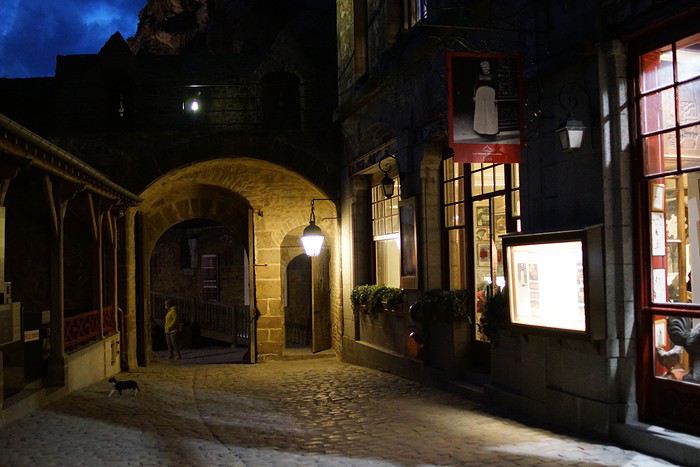
Of course, the day isn’t over, and we can then wander through a deserted main street and its unique atmosphere (photos below labeled "night" even though it’s only 9:15/9:30 PM). What a privilege!
Day 02 from Mont Saint-Michel to Saint-Cast: Monday, September 7, 2020.
After a memorable sunrise over the bay and a sit-down breakfast, we climb the steps to the Abbey for our online-reserved time slot (9:30 AM, 11 € per person).
The "masked group" is quite large, though within normal limits, and the one-way Covid-marked route (with a small brochure) prevents crowds. No need to rush, and 1 hour 15 minutes later, we’re done. Sure, it doesn’t have the charm of a guided tour, but we’re not complaining about being there!
We pick up our bags at the hotel, take the shuttle back, grab the car at Parking P3, and head "south" to Dol-de-Bretagne, 26 km/25 minutes away.
Around noon, the small town is very quiet, and parking in front of the Saint-Samson Cathedral** is free. Across the street, the tourist office is generous with info and gives us a great walking map/circuit: Cathedral, a stroll near the ramparts, the historic center** with its typical shopping streets and half-timbered houses, all covered at a leisurely pace in 45 minutes. Then a picnic on-site.
It’s another 50 km/50 minutes to Saint-Cast-le-Guildo and the Armor Conseil agency for the apartment keys (Résidence du Casino, 72 m², 5th floor, 2 bedrooms, beach 20 meters away, insane morning and evening views, bed linen rental at Ohier 50 meters away, Carrefour City supermarket, and a bakery 200 meters away, plus a town center that hasn’t changed much in 25/30 years. Really, really nice.
After settling in, a short walk is a must up to the heights of the Isle neighborhood behind the seaside residence... memories. Strangely, the well-known Crêperie Bretan’Or seems to be closed, as does the venerable Hôtel du Centre et des Plages (formerly "des Voyageurs")??
And for this reunion evening with the resort, a great crêpe/galette dinner at La Régal’ette, just 100 meters away.
Day’s total: 12 km of walking for sightseeing.
I’m traveling alone from my remote Pyrenees home to Roissy Airport, arriving at Austerlitz Station. I’m a bit nervous about getting to the airport—could you suggest a route?
While you’re at it, maybe you could recommend a budget hotel near the airport?
I’m looking into a trip to Paris around mid-February. I’d love to know more about the temperature (weather) in Paris, museum access (closures or anything else), how easy it is to get around on foot (slippery due to ice?), public transport, etc.
Also, are there any events or activities I absolutely shouldn’t miss? I could adjust my dates based on what you know.
On another note, I’d love to catch a hockey game. Are there any around Paris? I’m happy to watch a few games no matter the level 🏒🥅
FYI, I’m not afraid of the cold since I’m from Quebec 😁😆😆🧑🌾
This summer, we’re planning a family trip to Corsica.
We’ve chosen Sari Solenzara because we want to combine: sea, mountain hikes, natural pools, canyoning, and peace and quiet. Does this choice seem like a good one to you?
Second question: which airport should we prioritize to have the easiest roads to access?
Hi everyone,
We’ve wanted to visit Alsace for a long time to see the famous and well-known "Christmas markets."
Apart from the one in Strasbourg, could you give us some tips on other markets (Sélestat, Colmar, Mulhouse)?
Also, any recommendations for hotels, restaurants, or things to see, etc.?
I know my question is a bit "basic," but we really need some expert advice.
Thanks in advance to all.
I’m planning to spend three days in the Annecy region. What would you recommend visiting? Just so you know, I love nature and enjoy walking, but I prefer hikes that aren’t longer than two hours.
We’ll be back from a river cruise with a stop in Strasbourg for just the afternoon and evening. We’d like to spend the afternoon in either Colmar or Kaysersberg and then return to Strasbourg for dinner and a stroll afterward. I’d love your advice on which spot—Colmar or Kaysersberg—you’d recommend. I’ve noticed there’s a bus line 145 that runs from Colmar to Kaysersberg, taking about 40 minutes and costing around 5 €.
Is there a train or another way to get directly from Strasbourg that’s quick and affordable? I think a taxi would be pretty expensive. The issue is we don’t have much time—our flight is the next morning. We’ve already visited Strasbourg, Colmar, Eguisheim, Ribeauvillé, and Riquewihr about 10 years ago and loved them all. Our river cruise covers the Main, Rhine, and Danube.
We’re really looking forward to seeing places in Germany, like Rothenburg ob der Tauber, among others.
My husband, our 1-year-old son, and I have decided to head to southern France in mid-September.
We don’t know the region at all—it’ll be our first time.
We only have 9 days, and we’re really torn between Provence for its gorgeous villages, its "slow" vibe, Provençal markets, flavors, and colors, and the famous French Riviera for its beaches, ports, and because it’s intrigued us for so long.
I found a beautiful place to stay in a *mas*, but it’s not in the region at all (it’s in the Gard).
My husband found a place he really likes in Saint-Aygulf, but before booking, I’m hesitating and wanted to get some advice.
Obviously, with only 9 days, we clearly have to choose. I thought about splitting the trip in two, but that seems like a bad idea for two reasons: first, we’re traveling with a little one, and second, if we spread ourselves too thin, we risk not seeing anything properly.
Since we don’t know the area at all, I’m worried the coastline might be too built-up with big buildings, etc., like Lloret de Mar (no offense to anyone who loves it—it’s just not what we’re looking for).
Anyway… what would you recommend for a first 9-day trip to the south?
Hi
Does anyone know a reliable and affordable shuttle service from Roissy airport to Lille train station?
I know there are TGVs, but we’d like to avoid a long wait at Roissy station.
Thanks in advance for your tips!
BD
Hi there,
We’re heading to Forcalquier as a couple and would love to explore the Valensole area, including the Verdon Gorge, etc. We’ll be there for 5 days, so I’d like to put together a little rundown of things to see, plus the best tips—what to avoid, what to recommend, restaurants, and so on.
Thanks so much!
Hi everyone, after a stay in the South and one in the North, I’m planning a mini road trip in Corsica (Bastia-Bastia) in June to explore places I haven’t seen yet. Since we’re heading to the mountains later this year, we’ve deliberately skipped the Corsican mountains. Could you share your thoughts and, most importantly, suggest things to see? We love nature, reasonable hikes, peaceful spots, and small villages. No cities. No boat excursions (yes, that includes Piana and Scandola). We already know the area between Bastia and Calvi.
June 7
Flight arrival in Bastia and night at the hotel
June 8
Drive to Calvi (beach and/or fortress)
Meal at Les Boucaniers restaurant
Night in Calvi
June 9
Walk from Calvi fortress to Alga beach
Charcuterie platter at A Casetta Calvi
Night in Calvi
June 10
Drive from Calvi to Piana
Buvette du col de la Croix and visit the orientation table
Chemin des muletiers (Muleteers’ Path)
Or
Sentier de la source des roches bleues (Blue Rocks Spring Trail) counterclockwise
Or (less scenic) Tête du chien (Dog’s Head, starting at the parking lot)
Dinner at Épicerie Castellani in Piana
Night in Piana
June 11
Drive from Piana to Propriano
Arone beach and meal at Le Café de la plage
Drive along the coast, stopping wherever we like
Night in Propriano
June 12
Hike starting from Campomoro in the Jardin du Vent (Wind Garden), and visit the Genoese tower of Campomoro
Meal in Campomoro: restaurant Chez Pierre Paul U spuntinu
Night in Propriano
June 13
Around Propriano (avoid Capu Laurosu beach—sewage treatment plant...)
Night in Propriano
June 14
Drive from Propriano to Bastia airport
Meal at L’Éternisula in Zonza
Aiguilles de Bavella (Hole of the Bomb)
Night at the same hotel as arrival
Hi everyone,
I’m spending two days in Lille. Any places you’d recommend? I was thinking of visiting Vieux Lille, which I’ve been told about.
Would you have any shops, museums, or typical restaurants to suggest for a great time?