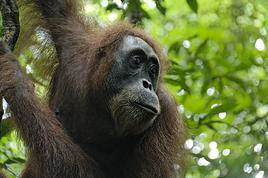
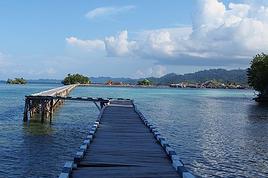
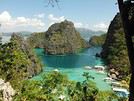
De retour de Sulawesi pour passer quelques jours avec notre fils et sa copine en voyage autour du monde ....
Nous nous sommes retrouvés le 5 mai sur Bali . Nous avons pris ensemble un vol pour Makassar arrivée vers 18h30 . Puis une voiture (Grab) (80 000R) nous à emmené en 1/2 h à la station de bus Bingtang avec couchettes (lits , super confort très belle expérience on dort bien ) pour 210 000R par personne (13euros) réservé 2/3 semaines avant le départ par notre guide en pays Toraja sur sa proposition ( c'est le prix réel de ce type de couchage) . Très beaux bus , neufs décorés entièrement avec des motifs de dessins animés ....départ pour Rantépao vers 21/22 h. C'est une gare uniquement pour cette compagnie de bus ( de nombreux bus dont certains avaient l'indication Toraja également inscrite sur l'avant , ils doivent en remplir un et le faire partir quand il est plein.... , d'autres compagnies existent du même style à proximité. Nous sommes arrivés plutôt bien reposé à 6h du matin . Le guide parlant français que nous avions retenu Anis nous attendait à notre arrivée et nous a emmené en moins de 5 mn à notre hôtel "Duta 88 cottages" qui nous met tout de suite dans l'ambiance avec ses bungalows du style maisons traditionnelles Toraja . Confort simple comme quasi partout dans cette région mais sympa avec le coin terrasse ou nous prenions le petit déjeuner (compris) . L'hôtel nous a été proposé inclus dans le tarif que nous avons négocié pour une visite de 3 jours du pays Toraja .
À savoir notre guide ( trouvé après recherches sur forum) Anis parle français plutôt bien (sur 100 guides en pays Toraja seuls 10 à 12 parlent français) .
Anis , après nous avoir accueilli et conduit à notre hôtel il nous a fait savoir qu'il ne pouvait pas nous accompagner durant les deux premiers jours , qu'il était pris par un événement familial et qu'il nous confiait du coup à son cousin Ferdi.
Au final nous avons préféré Ferdi qui était bien sympathique et plus attentif qu'Anis et qui parlait mieux français qu'Anis (même si c'est Anis qui lui a appris la langue).
Pour le tarif des trois jours de visites complètes avec cérémonie le deuxième jours et nuit sympa dans la famille , nous avons dû bien sûr lui faire revoir à la baisse son tarif .
De 420€ pour nous 4 pour 3 jours nous l'avons réservé finalement à 370 euros compris dans le prix la voiture avec chauffeur , toutes les entrées sur les différents sites , le cadeau pour la cérémonie ( cigarettes) une nuit d'hôtel plus une nuit chez sa tante dans une maison traditionnelle Toraja (Repas du soir compris) .
L'avantage pour nous était de ne pas trop nous prendre la tête , il s'est occupé de la résa du transport Makassar/Rantépao , de nous prendre en charge à l'arrivée du bus , il a réservé notre hôtel et sur notre demande nous à organisé notre trajet Rantépao vers Ampana .
Finalement nous avons fait ce trajet avec la même voiture et le même chauffeur (très bien) qui nous faisait la visite dans les Toraja et il nous a ajouté un deuxième chauffeur .
Nous ne voulions pas faire d'arrêt pour visiter autour de Tentena . Les trajets en bus publics sont longs, laborieux et très inconfortables .Vraiment une grosse galère d'après ce que l'on a entendu dire sur place par des voyageurs ( plus de 15 heures de jour jusqu'à Tentena , nuit dans un hôtel et encore 5 à 6 heures ensuite le lendemain en voiture partagée de Tentena à Ampana . Même si c'est moins cher ainsi , nnous avons fait le choix de faire ces 540 km d'un trait en voiture privée avec 2 chauffeurs . Le prix négocier à 140 euros , Anis nous demandait 170 euros au départ . nous n'avions pas compris que c'était pour une voiture plus grande mais malgré nos 4 immenses sacs à dos , nos 4 sacs bagages cabine et nos grandes tailles tout est rentré dans le véhicule . Les bagages nous ont servi de matelas . Nous avons choisi un voyage de nuit . Départ à 17h le7 mai arrivée à 8 h le 8 mai comme prévu à Ampana .
Arrêt d'une petite heure dans un petit resto à 20 h ( 20 euros au total pour les 6 personnes) et arrêt à 6h ( environ 30mn) pour le café /biscuits . Sinon ils se sont arrêté fréquemment pour prendre de l'essence et/ou voir si nous avions besoin d'aller aux toilettes , changer parfois de chauffeur .
Nous sommes arrivés à dormir !!! Je ne sais pas comment on a fait car la route est en grande partie en montagne et est vraiment sinueuse , les croisements avec les autres véhicules étaient parfois difficiles car la route est étroite , truffée de trous et d'arbres couchés gênant la circulation avec également d'énormes glissements de boue qui heureusement pour nous avaient eu lieu avant notre passage et avaient été dégagés.
En fait nous avons eu beaucoup de chance juste quelques gouttes de pluie durant le trajet . Beaucoup d'autres n'ont pas eu cette chance notamment avec les bus et ont pris facilement plusieurs heures de retard.
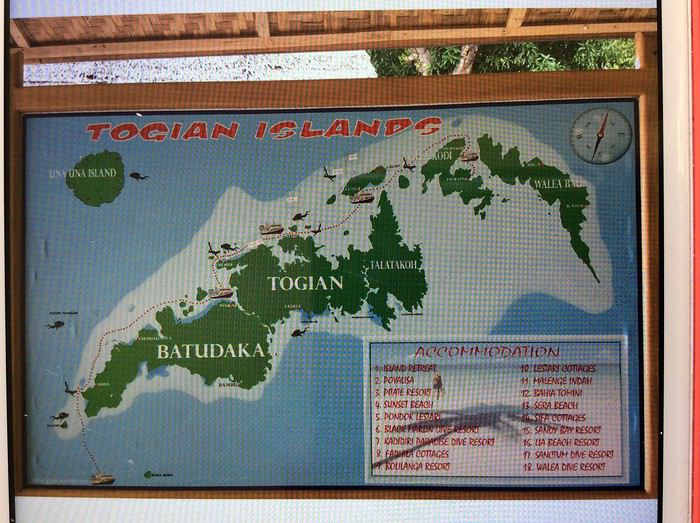
Nos chauffeurs nous ont déposé au port . Nous avons pu choisir un des bateaux qui partait vers 9h/9h30 pour les Togians le matin ( découvert sur place) nous voulions aller sur l'île de Malenge au Sandy Bay Resort (réservé) . Nous avons prix un fast boat Ampana/Malenge 80000R par personne puis un habitant du village de Malenge sur l'île de Malenge nous a proposé de nous emmener en 1h avec sa "banka" au Sandy Bay pour 200000R pour le bateau ( remboursé par l'hôtel) .
Nous étions alors à l'hôtel vers 15h pour profiter d'un endroit vraiment paradisiaque.
En conclusion
Choisir un bus confortable de nuit pour venir dé Makassar à Rantépao est top .
Il est important de choisir un guide pour 2 à 3 jours pour comprendre la culture Toraja et avoir accès aux cérémonies sans se prendre la tête et si on a plus de temps découvrir encore sur un ou deux jours par soi-même . En 3 jours , accompagnés d'un guide on découvre déjà bien le pays Toraja .
Si c'était à refaire nous referions le trajet Rantépao/Ampana de la même façon en voiture privée avec 2 chauffeurs en voyageant de nuit en 15 heures ( il est possible d'organiser un partage de voiture ) c'est un gain de temps et de confort indéniable ,
Notre séjour aux Togians a été super mais quelle galère pour rejoindre l'aéroport de Gorontalo depuis les îles !!!!!!!
Bon voyage
Notre séjour aux Togians a été super mais quelle galère pour rejoindre l'aéroport de Gorontalo depuis les îles !!!!!!!
Bonjour,
D'abord merci pour ce retour d'expérience aux Togian.On n'en trouve pas beaucoup concernant ces îles sur le forum!
Je compte aller aux Togian avec ma femme en mars 2019 . Vu que tu as fait ce voyage récemment je me permets de te poser quelques questions qui m'éviteront de longues recherches sur VF.Si tu as le temps d'y répondre...Je suis déjà allé à Sulawesi mais c'était au milieu des années 80. Mon voyage était essentiellement axé sur le pays Toradja .Depuis les infrastructures ont dû pas mal changer au vu des photos montrant la plupart des toits des maisons en tôle ondulée.A l'époque il n'existait que des toits en palme.
Notre prochain voyage sera surtout axé sur la mer...
A l'époque ( 1984) La piste entre Rantepao et le lac Poso était un véritable enfer.Je me souviens avoir partagé une jeep avec un couple d'Italiens et le voyage nous avait pris une journée entière pour rejoindre le lac Poso.Beaucoup de boue , des fondrières énormes, des glissements de terrain et même des arbres tombés en travers de la piste!...
J'avais déjà lu sur le forum qu'il existe un aérodrome à Gorontalo donc nous irons directement de Ujung Pandang à Gorontalo en avion.De là nous prendrons un bateau pour les Togian , d'où mes questions:
-Le port d'embarquement se situe où par rapport à l'aérodrome? On y va comment? En bus? en taxi? Si la correspondance avion/ bateau ne se fait pas ( ce que j'imagine très bien) on peut trouver à loger facilement dans le coin? Si tu as une adresse...
Fréquence des bateaux vers les îles?
-Quelle île en particulier et/ou quels endroits( avec hébergements) as-tu particulièrement aimé?
On dit que les fonds sous-marins sont particulièrement en bon état dans ces îles ( sans besoin de prendre une embarcation pour aller sur des récifs éloignés de la côte) or j'ai regardé une vidéo en tapant "Togian" dans Google et ça ne m'a pas vraiment inspiré... j'en conclus que le gars qui a réalisé cette vidéo n'est soit pas un spécialiste en la question ou n'a pas été au bon endroit pour cela.. Donc si tu as des spots à me proposer je suis preneur... et aussi des plages baignables ( sans trop de pierres ou rochers ) pour mon épouse qui ne pratique pas le snorkeling et l'apnée...Amateur de pêche sous-marine, J'emporterai un petit fusil harpon.La chasse sous marine est autorisée?
-Pour repartir des îles et dans le but de passer 2 ou 3 jours en pays Toradja( ma femme ne connais pas) nous comptons rejoindre rejoindre Ampana puis tranquillement sur 2 jours par la route vers Rantépao..
Fréquence des bateaux pour Ampana ? de nuit ou de jour?
Bonjour
Le forum m'a déjà beaucoup aidé lors de mes préparations de voyages et donc c'est avec plaisir qu'à mon tour j'essaie d'aider les autres . Finalement tu fais ton voyage dans le sens contraire du mien . Je vais répondre au mieux à vos questions mais tout d'abord quelques infos supplémentaires sur notre séjour sur les Togians ...
Nous n'avons au final pas pu prendre un bateau Wakai pour Gorontalo ( pour prendre ensuite un vol pour Makassar) .... ce qui nous a occasionné beaucoup de soucis et coûté beaucoup d'argent .
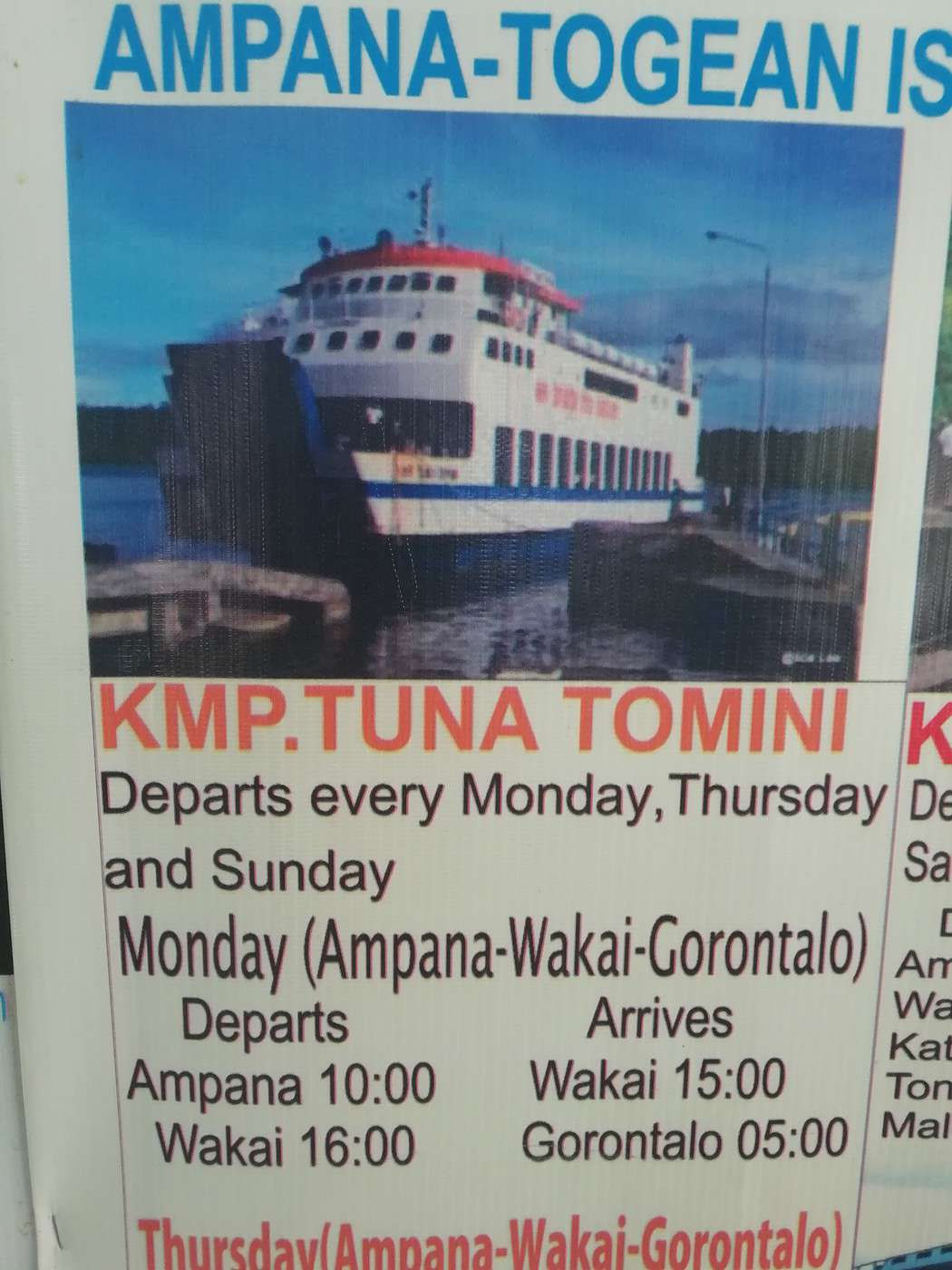
Nous avions appris juste après que le bateau qui nous emmenait d'Ampana sur Malenge (île des Togians) ait pris la mer que le ferry faisant la navette deux fois par semaine Wakai (Togians) / Gorontalo ( le même ferry qui fait deux fois par semaine Wakai /Ampana) était en révision et qu'il ne serait certainement pas encore en état d'assurer son service à la date à laquelle nous envisagions de le prendre ( en réparation depuis un mois déjà !!! ) .
Cette petite parenthèse pour vous dire de vous méfier ce ferry est apparemment en révision chaque année au printemps sans dates précises de remise en service , je pensais que la réparation qu'il avait subit l'année précédente était exceptionnelle et bien non !!!!. On peut alors se retrouver piégés comme nous sur les Togians pour ceux qui ont retenu un avion à Gorontalo car c'est (sauf changement depuis printemps 2018) le seul bateau qui fait la traversée régulièrement. Nous avons dû après bien des soucis nous rabattre pour 240 euros sur la banka de fortune de notre hôtel (Sandy Bay) pour rallier Marissa/Bambulan en presque 8 h ( annoncé 3 h par les "pilotes du bateau " de l'hôtel) avec un guidage grâce à l'application Maps-me de nos téléphones sans provisions , perdus et en accostant sur la plage d'un petit village à la tombée de la nuit .
Puis les villageois nous ont aidé à trouver une voiture qui nous a servi de taxi en 2 h pour nous emmener près de l'aéroport de Gorontalo d'où nous avons pris notre vol le lendemain.
Si un violent orage éclatait brusquement, comme cela arrive souvent , nous aurions pu sombrer ( la barque prenait l'eau , personne n'aurait su où nous chercher et nous n'avons aperçu aucun bateau pendant près de 7h . Il faut se méfier , tout le monde est très gentil en Sulawesi , On voulait juste nous aider . C'est à nous d'être prudents .
Pour vos questions , d'après mes recherches il y a environ une heure de route entre l'aéroport et le port de Gorontalo . Il y aura toujours des taxis ou voitures avec chauffeur qui se proposeront pour t'emmener de l'aéroport à Gorontalo car c'est la route des touristes qui vont aux Togians. Nous avons dormi près de l'aéroport . Nous avons un peu galèré à trouver un hôtel convenable pour une nuit ( Les salles de bain sont quasi inexistantes , pas très propres ( nous en avons visité 3) et le patron nous a au final arnaqué dans ses tarifs et surtout pour nous conduire en moins de 10 mn à l'aéroport pour un tarif exorbitant car nous ne savions pas que nous étions si près de celui-ci . Je ne vous le recommande donc pas . Je ne sais plus si j'en avais repéré près du port .
Les horaires des bateaux sont assez fantaisistes parfois...
Au printemps 2018 (comme les années précédentes) il n'y avait qu'un seul bateau ( ferry) deux fois par semaine depuis Gorontalo pour les îles Togians , les mardis et vendredis .
départ vers 17h/18h pour 12h de voyage dans des conditions assez sommaires .
Après recherches notre choix a été pour l'île de Malenge et l'hôtel Sandy Bay Resort dont nous avons été ravi . Un petit paradis . De beaux bungalows adossés à une végétation luxuriante sur une magnifique plage de sable blanc où l'on a pieds sur une longue distance . Merveilleux fonds marins belle ambiance " seuls au monde" . L'hôtel Serra Beach plus simple de logements est tout à coté , on y va à la nage ou par un chemin à travers la "jungle". ( des personnes y logeant ont rejoint le notre plus sympa selon eux) Depuis les hôtels des excusions vers tous les principaux centres d'intérêt sont organisés au fur et à mesure des demandes ( on se regroupe si on le désire) villages Bajos , lac aux meduses , snorkeling depuis la plage ou après avoir pris une banka pour se rendre sur des sites exceptionnels...
Nous ne restions pas suffisamment longtemps dans les îles Togians pour faire plusieurs îles nous aurions perdu trop de temps en installation . Au final nous avons bien fait de nous positionner sur Malenge , nous avons pu rayonner tout autour très facilement et voir et faire tout cette nous avions envisager lors de la préparation de notre voyage .
Pêche sous-marine.... pas vu , moi plutôt chasse-sous marine avec appareil photo .
Ça fait toujours bizarre de voir tous ces beaux poissons multicolore sur les étals des marchés après les avoir admirés sous l'eau et savoir qu'ils vont finir dans notre assiette .
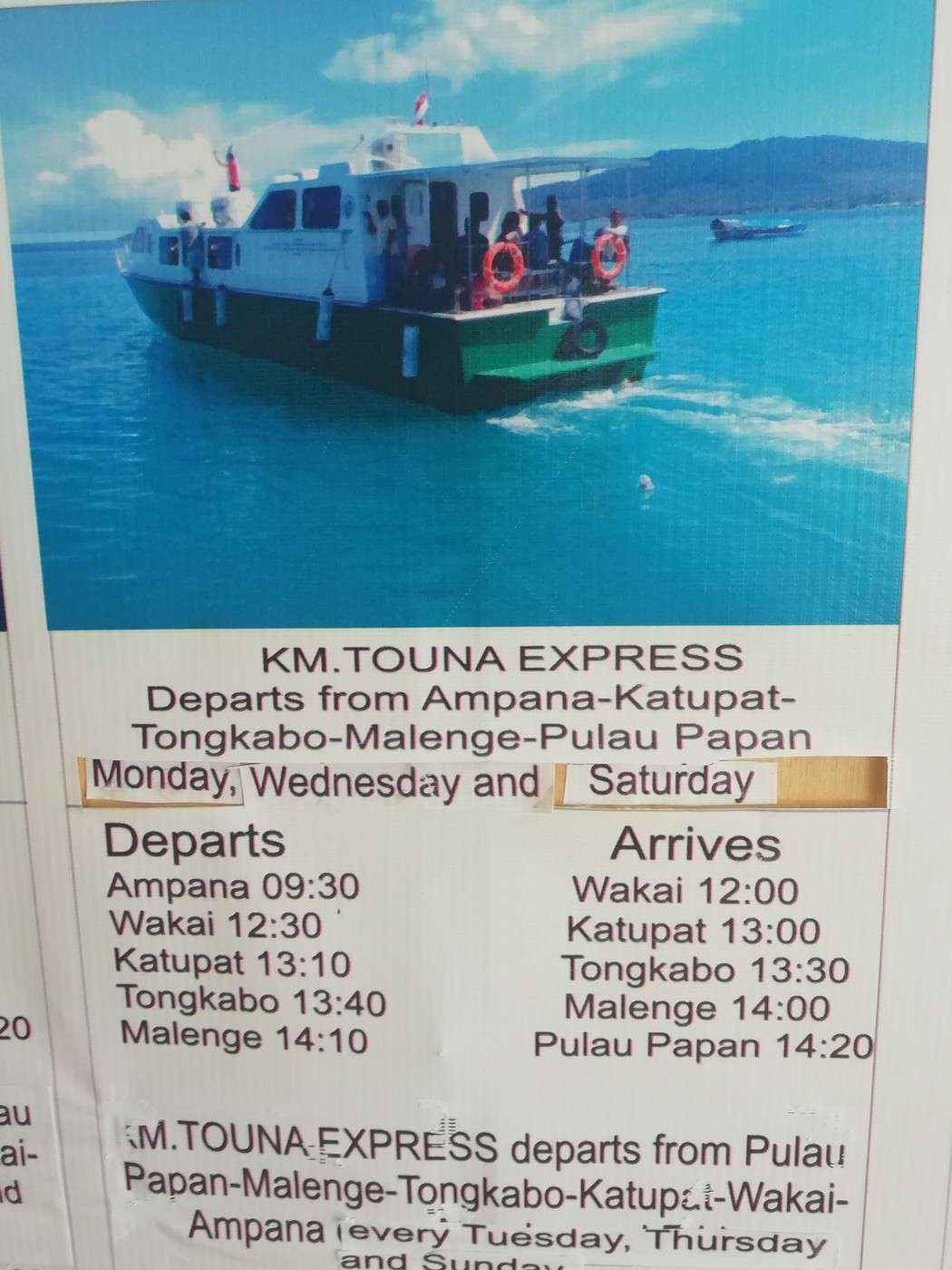
Il y a chaque jour de nombreux bateaux pour repartir (dans ce sens) des Togians vers Ampana ....ferry , speed Boat , fast Boat... à divers horaires . Cherche sur internet , les horaires se trouvent facilement sous forme de tableaux et tu n'auras que l'embarras du choix à tous les prix . Personnellement , nous avons fait Ampana / Malenge en fast Boat départ 9h , 4 billets pris sur place à notre arrivée sur le port à 8 h depuis le pays Toraja pour 80000R/personne en 3h puis un pêcheur nous a proposé de nous emmener au Sandy Bay Resort en un peu plus d'une heure pour 200000R/bateau( banka) , prix banka remboursé par l'hôtel sur demande .
Bon voyage . Nous avons adoré la Sulawesi....
Cette petite parenthèse pour vous dire de vous méfier ce ferry est apparemment en révision chaque année au printemps sans dates précises de remise en service, je pensais que la réparation qu'il avait subit l'année précédente était exceptionnelle et bien non !!!!. On peut alors se retrouver piégés comme nous sur les Togians pour ceux qui ont retenu un avion à Gorontalo car c'est (sauf changement depuis printemps 2018) le seul bateau qui fait la traversée régulièrement
C'est la raison pour laquelle j'ai préféré arriver en avion sur Gorontalo pour ensuite aller dans les Togian ...en partir en bateau (n'importe lequel) pour prendre ensuite la route pour ne pas avoir à réserver un vol que je risquerais de louper si le bateau ne se présentait pas le jour souhaité...J'ai l'habitude de ces aléas du voyage...
Nous avons dû après bien des soucis nous rabattre pour 240 euros sur la banka de fortune de notre hôtel (Sandy Bay) pour rallier Marissa/Bambulan en presque 8 h (annoncé 3 h par les "pilotes du bateau " de l'hôtel) avec un guidage grâce à l'application Maps-me de nos téléphones sans provisions, perdus et en accostant sur la plage d'un petit village à la tombée de la nuit.
Je me suis fait les mêmes frayeurs aux Philippines et à Madagascar sur des bateaux dits "réguliers" sans supplément de tarif!
Pour vos questions, d'après mes recherches il y a environ une heure de route entre l'aéroport et le port de Gorontalo. Il y aura toujours des taxis ou voitures avec chauffeur qui se proposeront pour t'emmener de l'aéroport à Gorontalo car c'est la route des touristes qui vont aux Togians. Nous avons dormi près de l'aéroport. Nous avons un peu galèré à trouver un hôtel convenable pour une nuit (Les salles de bain sont quasi inexistantes, pas très propres (nous en avons visité 3) et le patron nous a au final arnaqué dans ses tarifs et surtout pour nous conduire en moins de 10 mn à l'aéroport pour un tarif exorbitant car nous ne savions pas que nous étions si près de celui-ci. Je ne vous le recommande donc pas. Je ne sais plus si j'en avais repéré près du port.
Merci ce sont des infos qui me seront bien utiles.
Après recherches notre choix a été pour l'île de Malenge et l'hôtel Sandy Bay Resort dont nous avons été ravi. Un petit paradis. De beaux bungalows adossés à une végétation luxuriante sur une magnifique plage de sable blanc où l'on a pieds sur une longue distance. Merveilleux fonds marins belle ambiance " seuls au monde". L'hôtel Serra Beach plus simple de logements est tout à coté, on y va à la nage ou par un chemin à travers la "jungle". (des personnes y logeant ont rejoint le notre plus sympa selon eux)
Merci c'est tout à fait ce que je recherche.
Ça fait toujours bizarre de voir tous ces beaux poissons multicolore sur les étals des marchés après les avoir admirés sous l'eau et savoir qu'ils vont finir dans notre assiette.
En fait je posais la question car j'ai connu des îles( andamans islands) où il y avait beaucoup de poissons dans l'eau mais difficile d'en avoir dans son assiette je pêchais donc mes poissons et les apportais en cuisine pour mon diner en faisant cadeau du surplus ( ça de date pas d'hier!) à la patronne des lieux.
Donc on peut manger du poisson sans trop de problème?
Il y a chaque jour de nombreux bateaux pour repartir (dans ce sens) des Togians vers Ampana....ferry, speed Boat, fast Boat... à divers horaires
Bonne nouvelle! de toutes façon je quitterai les Togian avec une marge de sécurité de manière à ne pas louper l'avion Makassar/Bali. Si on a suffisamment de temps nous passerons quelques jours chez les Toradja sinon ça sera plus direct vers Ujung Pandang
puis un pêcheur nous a proposé de nous emmener au Sandy Bay Resort en un peu plus d'une heure pour 200000R/bateau (banka), prix banka remboursé par l'hôtel sur
demande.
Donc si nous allons à ce resort le patron nous remboursera ( normalement) le prix de la banka locale..
Merci pour tes infos et si tu vas un jour au Népal n'hésite pas à me questionner!
Oui quand on a du temps devant soit c'est plus facile de gérer et de choisir un parcours plus sûr que le notre . Il va falloir attendre la retraite pour nous ...
Nous avions malheureusement des impératifs .... seulement 19 jours devant nous , retrouver notre fils et sa chérie à Bali ( que nous n'avions pas vu depuis 4 mois car en périple autour du monde ) , voir Les Toraja et les îles Togians avec eux puis les laisser poursuivre vers Manodo , Bunaken....et nous partir pour les Philippines où nous devions passer notre open Water sur Coron ( cadeau surprise offert par nos enfants lorsqu'ils ont su que nous rentrions en France en passant par Manille !!!!)
Un casse tête alors pour y aller tout en opitimisant 12 jours en Sulawesi. Mais tout s'est bien passé en passant nos nuit en transport pour optimiser nos journées ...ça va nous avons la forme et l'habitude de voyager parfois très cool parfois speed .
J'ai alors cherché toutes les solutions pour regagner Bali puis Manille et Coron et la seule et unique solution pour ne pas rater nos 3 jours de plonger aux Philippines ( et rentrer en France surtout ) a été un décollage vers 9h de Gorontalo le mardi pour Makassar puis on a enchaîné dans la foulée tous les autres vols , Makassar/ Bali , Bali ( nous y étions en 2017) /Manille et enfin Manille/Coron avec une arrivée le mercredi matin à 8 h ( nous avons dû réserver ces 4 vols 15 jours avant notre départ car on voyait que tout se remplissait rapidement et les tarifs déjà élevés augmentaient beaucoup ) et on a poursuivi aussitôt par une découverte en bateau privé sur la journée ( réservée par notre fils) de tous les lieux magiques autour de l'île et lendemain début des 3 jours de plongées puis retour sur Manille suivi du vol vers Genève avec escale à Doha .... Ouf ! Mais magique la découverte des fonds marins avec un moniteur de plongée français top et un super hôtel pour se reposer , des balades dans les ruelles animées , la gentillesse des philippins , de bons restos , des Paysages magnifiques...
Alors évidemment quand nous nous sommes retrouvés bloqués en Sulawesi sur Malenge sans ferry ni autre bateau pour rejoindre Gorontalo , sans possibilité de réserver un autre vol ( pas de moyen de communiquer depuis les îles) ...panique ....mais cela fait partie d'un voyage et ne fait que le pimenter ( certains voyageurs de notre hôtel et du Serra Beach ont ainsi perdu un vol et ont choisi un retour par Ampana moins cher ou ont choisi d'attendre la remise en service du ferry en annulant un séjour sur une autre île )
Comme il est souvent dit . il est difficile de venir en Sulawesi mais encore plus difficile d'en partir ... nous l'avons vérifié .
L'île n'est pas encore trop ouverte au tourisme car les moyens de transport , routes et hôtels ne sont encore pas trop adaptés à un tourisme de masse et sur les îles , pas de téléphone , internet et électricité que quelques heures par jour grace à un groupe électrogène . Il y aura toujours des imprévus en Sulawesi, il faut donc être dans cet état d'esprit d'aventure quand on vient en Sulawesi ce qui ne convient pas à tout le monde .
En 2019 peut-être Madagascar pour nous....
Nous revenons tout juste de Sulawesi et j'ai relevé les horaires de 2 bateaux qu'on a pris pour faire Ampana - Malenge (on s'est arrêté à Palau Papan ou un bateau de Sandy Bay passe tous les jours vers 14h - 15h) et les horaires du ferry de Wakai à Gorontalo.
Pour le ferry, le personnel du port disait à tout le monde qu'il ne restait plus que des places en economy mais au final on a pris des places en business Class II. On a donc eu le droit a des couchettes en bois pour 72 000 IDR par pers et on a pris un matelas dans le ferry pour 10 000 IDR en +.
L'île n'est pas encore trop ouverte au tourisme car les moyens de transport, routes et hôtels ne sont encore pas trop adaptés à un tourisme de masse et sur les îles, pas de téléphone, internet et électricité que quelques heures par jour grace à un groupe électrogène.Il y aura toujours des imprévus en Sulawesi, il faut donc être dans cet état d'esprit d'aventure quand on vient en Sulawesi ce qui ne convient pas à tout le monde.
Je pense que ça a dû quand même un peu changer depuis 1984 surtout en ce qui concerne l'état des pistes!!
En 2019 peut-être Madagascar pour nous....
J'y suis allé 5 ou 6 fois...je vous recommande l'île Ste Marie et l'île aux nattes!
Bonjour
Oui certainement les routes ont bien changé depuis 84 mais elles restent quand mëme toujours un problème entre Rantépao et Tentena .Il est fréquent de mettre plus de 16 h pour parcourir cette distance . Beaucoup de pannes avec des bus fatigués , les routes sont étroites , défoncées et toujours avec des coulées de boue et des arbres en travers dès qu'il pleut . Nous avons voyagé de nuit en voiture avec nos deux chauffeurs en 15 h avec environ 3/4 d'heure d'arrêts repas pour aller jusqu'à Ampana ...et c'est long 15h quasi non stop à 6 dans une voiture remplie de bagages !!!! mais beaucoup de chance , il ne pleuvait pas mais ça secouait drôlement et mëme si j'ai un peu dormi, fatigue oblige , j'ai vu parfois de sacrées coulées de boue sur des dizaines de mètres et nous avons contourné nombres d'arbres fraîchement coupés pour laisser un passage et les croisements sont parfois délicats .
Ça me faisait penser à l'émission les routes de l'impossible que l'on voit à la TV ...
Pour Madagascar merci pour l'info . Je vous recontacterai si nécessaire .
Je prends enfin le temps de poster ce petit message. Nous avons passé 3 semaines à Sulawesi en Août dernier (avec nos 2 filles de 15 et 12 ans). Ce fut un…
Comme je me suis pas mal servi de ce forum pour faire mon itinéraire sur Sulawesi, j'en profite pour vous faire un petit retour d'expériences. Date: du 15 Juin…
Ayant bien apprécié les informations du forum sur Sulawesi l'an dernier, j'envoie le CR de mon mari sur notre voyage d'un mois dans cette île en octobre 2014…
Nous avons passé 5 semaines merveilleuses à Sulawesi en octobre/novembre 2013. Avant que cette année s'achève, j'aimerais remercier de tout coeur tous ceux et…
Voilà quelques infos (itinéraire, transport, logement...) après un séjour de 6 semaines sur l'île de Sulawesi du 21 septembre au 06 novembre 2013. Sophie…
Hi fellow travelers,
First trip to Vietnam.
We’ll be arriving in Ho Chi Minh City during Tet.
Is it complicated to find accommodation and get around during this period?
Any tips would be welcome.
Thanks for your replies.
Hi, is anyone there in Flores right now? According to some websites, everything is closed and the situation is tough. But our guide says it's fine. Who should we believe? We're supposed to leave on September 2nd. Thanks to anyone in Flores at the moment!
Hi everyone.
I’m planning my trip, and based on all the posts I’ve read, this country is amazing.
Of course, I’ve got a ton of questions for you.
Here’s a possible itinerary: Vientiane - Vang Vieng - Phonsavan - Sam Neua - Nong Khiaw + villages - Phongsali - Luang Namtha and the area - Udomxai - Huay Xai - Luang Prabang and back to Vientiane.
What do you think?
We’re planning to prioritize local transport—is it possible to do this loop?
We’d also love to go kayaking, but I’m not sure if the season’s right or where the best spot is.
For trekking—I read that Phongsali is the most authentic spot to visit villages and see wildlife. Do you know of a reliable agency and a guesthouse with reasonable prices?
Is it worth taking a slow boat for a stretch on the Mekong, and if so, which route?
For accommodations, is it better to book through Booking.com and Agoda or look when we arrive?
Are mosquitoes bad in Laos, and should we take malaria prophylaxis?
What’s the average daily budget (accommodation, food, visits)?
Is renting scooters a good option for exploring towns, and if so, which ones?
From what I’ve read, it’s best to carry cash—euros or dollars? Is it risky to walk around with that much cash?
I’ve still got tons of questions. Thanks to anyone who can help, and I’m open to all tips, info, etc.
Thanks again
Hi there,
I’m planning a trip to Vietnam in February, specifically Da Nang and Hoi An.
Does anyone know a French-speaking guide in the area?
Thanks for your help
Hi there,
I’m planning a family trip (my wife and I, both 47, and our two sons, aged 5 and 12) to Malaysia for the last week of June and the first two weeks of July 2027.
We used to love road trips as a couple, then as a trio, but since our second child arrived, we’ve taken a break with "camping village" style trips.
Now feels like the right time to get back to our old habits, while adjusting the pace for the kids.
We’re craving Asia. We’ve been lucky enough to visit Thailand, Indonesia (Bali and Lombok), and Sri Lanka before.
Friends have raved about Malaysia, so we’re definitely tempted.
For those who know and love Malaysia, what would be a good itinerary starting from Kuala Lumpur, with a maximum of 3-4 stops? We’d like a mix of culture, nature, and relaxation (just to clarify, we’re not big beach fans). All of this without rushing, of course.
Hello,
We’re a family of four with two teens aged 16 and 18. We’re heading to Thailand this summer. We’ll arrive in Bangkok and plan to take a flight to Luang Prabang.
I’ve seen there are some great visits and excursions to do (temples, markets, waterfalls) and maybe even venture a bit north to places like Nong Khiaw, Muang Xay, Muang Ngoy, or Oudom Xay.
But I’ve also heard about the Bokeo region with the Gibbon Experience.
Since we won’t be able to do everything, I’d love to hear about your experiences, impressions, and advice on the two options I’m considering, especially since we’ll be meeting family in Chiang Mai, Thailand, afterward.
Option 1: A loop from Luang Prabang heading slightly north, then a flight from Luang Prabang to Chiang Mai.
Option 2: A few days in Luang Prabang, exploring within a few dozen kilometers around, then heading to Bokeo province for the 2-day/1-night Gibbon Experience. For this option, I saw on Rome2Rio that it’s possible to book a ferry trip on the Mekong from Luang Prabang to Huay Xay—they mention about 8 hours. But is that realistic? What type of boat is it?
Then, to get to Chiang Mai, there aren’t many options—bus or minivan—but how does crossing the border work?
Finally, for those of you who’ve been to Laos in August, what was the weather like?
We’ve already visited Thailand, Vietnam, and Cambodia during the same period over the past four years and weren’t really bothered by bad weather.
I’m starting a discussion about guides in the Mekong Delta because we’ve just finished our trip in this region and had a hard time finding a French-speaking guide. We had Thanh—she speaks French really well and travels all over the delta region, including Ho Chi Minh City. She’s super friendly and flexible. I recommend her wholeheartedly. If it can help someone...
Feel free to contact us for her number.
Hi everyone,
I couldn’t find any recent info on Kuching.
Can anyone recommend a hotel or guesthouse for under 100 RM that’s nice and affordable? No dorms, please.
Also, does it rain a lot in November, and is it still worth visiting Semenggoh or Bako?
We’ll be arriving in Phnom Penh this coming January and we’re thinking of starting our trip with a stop in Kampong Cham, then Kratie.
After Kratie, we’re considering heading toward Siem Reap with a stop in Kampong Thom.
That said, I’m not really sure how long the Kratie–Kampong Thom journey might take or how complicated it is.
Does this stop on the way to Siem Reap seem like a good idea to you?
If we don’t visit the Sambor Prei Kuk site, are there still any walks or sights worth checking out in Kampong Thom?
Silly question—backpack or hard-shell suitcase for the Sepilok, Kinabatangan, Tioman, KL trip?
I’m struggling to fit all my son’s and my stuff into the 70L backpack... and I’m thinking a suitcase would be easier, but I’m not sure if it’ll work for getting around.
Hi there,
I didn’t plan to return to Thailand this year, but my health conditions mean it’ll be the best place for me to stay between two trips to India. The tourism setup there is so well-organized that it’s the most "comfortable" country for a short visit. Thailand feels too sanitized for my taste, and there’s too much religion, Buddha, and the King, but it’s still the best option given how my health has been evolving. I’d considered two weeks in ThaTon for hiking, but I got too sick from the burn-offs during my trips to the mountains around Chiang Rai. So I’m not sure where to go this year. Definitely not the sea, touristy spots, or the mountains with burn-offs...
After a stay on Koh Phayam this coming November, I’d like to spend 2 or 3 days on Koh Phra Thong before heading further south.
Do you think it’s doable to leave Koh Phayam early enough to catch the 10 AM boat from Khura Buri to Koh Phra Thong? The next one isn’t until 4 PM, which would cost me a whole day.
I’m planning a trip to Indonesia, specifically Sulawesi and Java, in September for 10 days.
I don’t know this part of the world at all—any advice is welcome!
I’ll be traveling solo and would also love tips on meeting other travelers or locals.
Hello everyone,
Not long ago, I used to travel as a couple, but my husband has since passed away, and I’ve decided to set off again. The trip I took to Cambodia in January 2025 did me a world of good.
I’m now considering Thailand, a destination we never included in our plans because even 15 years ago, people said it was too touristy. Still, I’m thinking about the itinerary below, but I don’t feel up to arranging buses, trains, or guides on my own while I’m there. I’m looking for one or more drivers and have been in touch with an agency, but their offers are just copy-paste group tours that I don’t want.
So, if you have any contacts, experiences, or advice, I’d be so grateful if you’d share them with me. Here’s my rough plan:
Arrival in Bangkok
Ayutthaya (2 nights)
Kanchanaburi (2 or 3 nights)
Sangkhlaburi/Sai Yok (3 nights)
Sukhothai (2 nights)
Lampang (I’ve planned 3 nights, but that might be a bit much—it depends on what time I arrive in the city)
Chiang Mai
Chiang Dao
Pai
Chiang Rai
I was thinking about the Mae Hong Son loop—thoughts?
What do you think about staying overnight at the Golden Triangle?
When I look online, of course, I can find agencies that organize tours to national parks, etc.
I’m retired but in great physical shape. I’d rather go hiking than sit in hot springs with crowds of tourists who’ve all arranged meet-ups. I don’t want to spend a day at an elephant camp, and I don’t want to visit Karen villages.
I’d love to hear your advice.
Thank you all,
Hi,
On September 1st, we're heading to Kalimantan for six weeks, probably from Pontianak to the Derawan Islands.
I've scoured this site, which is usually my go-to 😉, and others like VoyageForum, but recent info is pretty scarce.
I'd love any tips on places you've visited—our itinerary is still a work in progress.
We're two couples traveling with backpacks, using buses, boats, guesthouses, and homestays.
Thanks in advance!
Hi everyone,
Could you share your thoughts on my 3-week itinerary?
We’re a small group (family + friends) of 12 people, planning to leave around January 21, 2027.
Here’s my itinerary:
3 nights in Bangkok
4 nights in Chiang Mai
3 nights on Koh Samui
3 nights on Koh Phangan
4 nights in Krabi
4 nights in Phuket
I’m also open to any great tips you might have...
Thanks, everyone! Alain.
Hi,
From Malacca to get to Jerantut, is it better to go back to KL and take a bus from there, or take a bus to Tampin and then a train? Any feedback on the "Jungle Train"? (duration, price, comfort, etc.). Thanks
Hi there,
We’re planning a 3-week family trip next summer with our three kids, who’ll be 8, 8, and 7 years old.
After some research, we’re leaning toward Malaysia to combine nature/forests and paradise beaches. The idea is to introduce our kids to the country’s culture, nature, and wildlife.
We want a great trip but without splurging on luxury options like high-end lodges and resorts. We’re looking for comfort with a touch of authenticity—basically, a good middle ground.
I’ve started putting together an itinerary and would love your expert advice and tips to help us build this amazing trip with our little ones.
Day 1: Departure from France
Day 2: Kuala Lumpur
Stay at a hotel near the airport or KL Sentral.
Just one night.
Day 3: Morning flight to Sandakan (Borneo).
Stay in Sepilok
Day 4: Sepilok:
* Orangutan Center
* Malayan Sun Bear Center
* Rainforest Discovery Centre
Day 5: Depart for Kinabatangan.
Boat safari in the late afternoon.
Day 6: Sunrise safari.
Jungle walk.
Evening safari.
Day 7: Final safari.
Return to Sandakan.
Flight to Kuala Lumpur, then to Kota Bharu (or overnight transit depending on schedules).
Day 8: Transfer to the port.
Boat to the Perhentian Islands.
Days 9 to 13: Perhentian Besar
5 full days.
* Snorkeling
* Hiking
* Turtle watching
* Wild beaches
* Relaxation
Day 14: Return to the mainland.
Bus or private car to Taman Negara.
Hi everyone,
We’re heading to Flores and then Bali at the end of September.
We’ve already visited both but this time, once we’re in Labuan Bajo, we’d like to take a boat to the Komodo Islands to see the famous Komodo dragons.
I don’t want to sleep on the boat—just a day trip would be perfect.
Does anyone know a reliable and friendly provider to recommend?
Thanks in advance, and have a great summer!
Summer seems to be the best time weather-wise for Bali.
And since summer’s when we can take a long trip, let’s go for Bali... even though we know it’ll be *packed* with people!
So we’ll steer clear of the island’s south...
Our current plan (19 days on the ground, 7 stops):
- 4 Nights (3 days) in Ubud
2 days for rice terraces / activities (Tegallalang, Campuhan Ridge, Monkey Forest, Bird Park, coffee plantation, market (?), dance "pestacle," cooking class and/or spa)
1 day with a driver for the Temples (Pura Gunung Kawi, Tirta Empul Spring, Pura Mengening, Goa Gajah...)
- 2 nights in Sidemen (1 day for Pura Kehen + Batur Caldera + Pura Besakih and 1 day to relax in the rice terraces)
- 3 nights on Gili Meno (Rest and beaches) from Padangbai
- 2 nights in Amed (1 day from Padangbai with the Abang rice terrace and Tirta Gangga baths, and the next day a boat tour in Amed)
- 4 nights in Pemuteran (1 day for transfer and rest, 1 day to visit Kawah Ijen, and 2 days of snorkeling at Menjangan Island)
- 2 nights in Munduk (1 day with the Dayang rice terrace and the 3-waterfall hike, 1 day at Pura Ulun Danu Bratan)
- 2 nights in Jatiluwih (1 day in the rice terraces, and on the last day, we’ll stop by Pura Taman Ayun in Mengwi and Pura Tanah Lot before catching our red-eye flight).
Accommodations in homestays or hotels.
Transportation to be arranged on-site with the lodgings (?)
Boat to Gili Meno to book in advance (?)
Kawah Ijen excursion to plan ahead (?)—check with the homestay (?)
Thanks for your thoughts/comments to help us explore this destination...
After reading and researching, we're planning the following stops in Cambodia in January 2027:
- Phnom Penh
- Kampong Cham
- Kratie
- Siem Reap
- Battambang
- Kampot (round trip)
I'm wondering about the direction of these stops, which could also influence our international flights.
Either a round trip from Phnom Penh in the order above.
Or landing in Siem Reap with the following order:
This second option would save us the Battambang - PP - Kampot trip but means doing a round trip to Battambang from Siem Reap and placing the "highlight of the trip" (Angkor) at the beginning of our stay.
We’ll be arriving in Phnom Penh this coming January and we’re thinking of starting our trip with a stop in Kampong Cham, then Kratie.
After Kratie, we’re considering heading toward Siem Reap with a stop in Kampong Thom.
However, I’m not quite sure how long the Kratie–Kampong Thom journey might take or how complicated it is.
Does this stop on the way to Siem Reap seem like a good idea to you?
If we don’t visit the Sambor Prei Kuk site, are there still some walks and/or things to see in Kampong Thom?
Hi there,
We’re planning to travel from Chiang Rai to Luang Prabang next November.
We’d like to take a slow boat from Chiang Khong—or rather from Huay Xai in Laos—with an overnight stop in Pakbeng.
Could you let us know if the boat still leaves Huay Xai in the late morning? If so, what time roughly, and what’s the price for the trip?
Thanks for your help!
Alod
We (3 adults: 68, 65, and 25 years old) are just back from a short trip to the Philippines, and I’d like to share a little summary of our journey. First of all, I’d like to thank everyone who contributes to this forum about this destination and answers the questions of those who aren’t familiar with it. I should also mention that my comments are personal and don’t reflect anyone else’s opinions. Since I don’t have any literary or photographic talent, I’ll stick to the facts and share a few details about the sights, hotels, and restaurants.
Preparations:
We chose this destination in December and quickly booked our flight tickets (540 € with Turkish Airlines) for a departure on February 16 and return on March 5, 2019. We then contacted two French-speaking tour operators based in Manila, asking them to put together an itinerary based on our wishes (places to visit, type of accommodation) and our budget. We wanted to see the rice terraces in northern Luzon, the hanging coffins in Sagada, before flying to the Visayas (Bohol, Siquijor, etc.), and the Taal Volcano, while limiting our nights in Manila as much as possible. In the end, we opted for Alize, whose itinerary and quote matched our request almost perfectly. Our exchanges helped us refine our circuit.
International flights:
The round-trip flights went smoothly. Turkish Airlines, while not at the level of Asian or Gulf airlines, does the job just fine.
Day 1:
We landed on time (6:15 PM) on Monday, February 16, at Terminal 3. We exchanged our euros (near the car rental counters), and I can confirm the exchange rate was very good. On the way to the St. Giles Hotel (decent and affordable for a transit night), we got our first glimpse of Manila’s dense traffic. The Makati district, where our hotel was located, offers a wide choice of restaurants, so we grabbed a quick bite to recover from the trip.
Day 2:
This day was dedicated to transferring to Banaue. Fortunately, we had a comfortable van and an excellent driver for this journey, which took all day (8 to 9 hours with stops). We got a taste of driving in the Philippines—and it’s terrifying. You wouldn’t want to drive on these roads. The first thing that struck us was the relatively good condition of the roads and the cleanliness (a change from other Southeast Asian countries). This impression lasted throughout our trip. Around 6 PM, we checked into our room at the Banaue Hotel (large, charm-free, but with a beautiful view of the rice terraces).
Day 3:
With the help of a local guide, we took a jeepney to Batad. And then—wow! The rice terraces form an amphitheater overlooking the small village. Under the sun, it’s simply spectacular and breathtaking! Even though we’re familiar with rice terraces (Sapa, Bali, Thailand, etc.), we were dazzled by so much beauty. We spent the day walking along the terrace walls. This place is timeless and fully deserves its UNESCO World Heritage status. However, we returned to the hotel exhausted (due to our ages and lack of exercise). We had dinner with our driver at the Las Vegas restaurant in the center of Banaue. The meal was decent, cheap, and the Filipino owner played the guitar to accompany our dinner.
Day 4:
Today, our driver took us to Sagada. The mountain road offered spectacular landscapes (about 1.5 to 2 hours). Along the way, we stopped in Bontoc to visit the small but interesting anthropological museum. It features old photos and various objects from the Ifugao tribes, as well as a reconstruction of primitive dwellings.
We then went on a short hike in Sagada with a very friendly local guide who explained the region’s funeral rites. The walk started at the communal cemetery before reaching “Echo Valley,” where we saw the first coffins hanging on the cliff. We continued to the “Underground River” and a small waterfall, ending our journey in the “Lumiang Cave” burial cave. All in all, this day was very interesting. On the way back, we made a few photo stops.
In the evening, on our driver’s recommendation, we ate at the “Bistro,” a French enclave in the center of Banaue (good pizza, roasted quail, homemade fries).
Day 5:
Today was a transfer day. To limit fatigue and nights in Manila, our tour operator arranged a flight from Clark to Tagbilaran (Bohol), saving us 2 to 3 hours of driving. But to catch our flight, we had to leave very early: 5:30 AM. Our kind driver dropped us off on time at the airport. To use it, we had to pay a 150 PHP tax per person. The Philippine Airlines flight (15 minutes) left early and was far from full. Upon arrival, we were taken to the Loboc River Hotel, on the banks of the river of the same name. A very charming lodge lost in a tropical garden. We stayed in a stilt cottage overlooking the river. We relaxed a bit in the lovely pool. This place is really great—the staff is charming, and the food is excellent for a reasonable price.
Day 6:
This day was dedicated to exploring Bohol. The program was classic, starting with the tarsier sanctuary. We saw a few specimens in a small garden, each pointed out by a staff member. It was both good and disappointing because the animals were in pseudo-freedom in a small enclosure. Then we went to the “Chocolate Hills” and climbed 240 steps to admire the panoramic view of the hills—but by 10 AM, it was crowded. On the way back, we stopped at the butterfly garden, which was uninteresting: tiny, with few butterflies. We consoled ourselves by photographing beautiful flowers. To please our teen, we stopped at the Loboc Eco Tourism Adventure Park and crossed the river lying down, suspended from a steel cable (300 PHP). Finally, we had the traditional lunch-cruise on the Loboc River. It was a factory-like experience, and the meal was unremarkable. The only good thing was the singer on each boat and the lush vegetation. Afterward, we visited colonial churches and the cathedral, remnants of the Spanish presence, before returning to the hotel for a well-deserved dip in the pool. Note that for those interested, there’s an arena near the hotel where cockfights are held every Sunday—something Filipinos are passionate (if not obsessed) about.
Day 8:
Very early departure for the port. We boarded a *banca* in search of dolphins. After about an hour of sailing, we were lucky enough to spot around a hundred dolphins. Our boat then headed to the small and charming island of Pamilacan. After a walk through the little village, we came across locals traditionally building a boat. They told us it takes about a month to finish their outrigger boat. Then we had to choose our snorkeling spot between the coral garden, the fish park, and the turtle enclosure. Note that a fee is charged for each spot: 150 PHP per place and per person. It felt a bit like we were being ripped off, especially since the spots weren’t amazing—we’d see much better on Apo for much less. We had lunch on the island at one of the many small eateries (350 PHP per person).
Days 9 and 10:
On our return, we were taken to the Bohol Sea Resort on Panglao Island, where we stayed for 2 nights. It’s a small, recent establishment in a quiet corner of the island. It’s relaxing—maybe a bit too much. It has a nice pool and access to Danao Beach, but the view is blocked by a flotilla of boats. We didn’t try their diving school. The meals were good. If we had to do it again, we’d skip this stop to spend more time in Negros.
Days 11 and 12:
We took a fast ferry (Ocean Jet) from Tagbilaran port to Dumaguete and were taken to the Thalatta Resort, about 20 km away near Zamboanguita. We stayed there for 2 nights. Let’s just say it was our favorite. It’s a small place facing Apo Island. The rooms are simple, and the pool, nestled in a magnificent tropical garden, is fantastic. The staff is friendly, and the meals are very good. The hotel has its own diving center (snorkeling gear provided) and its own boats. We booked the Apo Island excursion: 1,350 PHP per person, including lunch. It was incredible: magnificent corals, colorful fish, and turtles of all sizes. The crew was endlessly kind and didn’t hesitate to dive to guide us to the best spots. In short, a perfect day. This site is ranked among the top 5 diving spots in the Philippines.
Since we were lucky enough to be there on a Wednesday morning, we explored the surprising Malapay Market, a 10-minute walk from our hotel. You’ll find numerous stalls selling vegetables, fruits, live or dried fish, and handicrafts. Enclosures are set up for selling livestock (calves, zebu, pigs). There are also restaurants. We were lucky to see two pigs roasted traditionally on a spit. There are few Europeans, and the people are warm. A great moment.
We left this beautiful place with regret because we didn’t have time to visit the island or go swimming with whale sharks.
Days 12 to 15:
From Dumaguete port, we took a short crossing (1 hour with Ocean Jet) to Siquijor Island to reach the Coco Grove Beach Resort. A beautiful hotel nestled in a spacious tropical garden. Several restaurants and bars, 4 pools. Despite the size of the place, it remains intimate. You can snorkel (corals and fish) right in front of the beautiful beach. We stayed in a very pleasant duplex suite. For those interested, there’s a spa and a diving center. You can also take the Apo Island excursion (offered at 1,950 PHP).
We spent our days relaxing between the pool and the beach. In the evening, the sunsets over Negros and Apo were stunning.
We booked an island tour with a comfortable tricycle from the hotel (1,500 PHP). The circuit was classic and allowed us to go around the island. We discovered beaches, the famous 400-year-old ficus tree with its enormous roots, and its equally famous foot bath with its cleaning fish. Then we visited the St. Isidore Convent before heading to the Cambugahay waterfalls and their four pools. The setting is idyllic, and the water is surprisingly good—we had a lot of fun swimming. We had dinner at a restaurant overlooking the island, where you can see Apo, Cebu, and Negros. In the end, Siquijor turned out to be a real little tropical paradise.
Since the hotel restaurants were expensive, we dined at nearby establishments: Fuego (clean, good—excellent raw fish—and quiet), Chekesch (louder), and the very pleasant Baha Bar, which brews its own beer and offers more refined cuisine.
Days 15 to 16:
We left at dawn to return to Dumaguete and its airport by ferry. We had breakfast at the Coco Grande Hotel, an annex of the previous one. The Philippine Airlines flight went smoothly. A driver took us to the town of Taal. We stayed at Paradores Del Castillo, right in the heart of the old town. It’s a charming old house with only 6 rooms. The various rooms are decorated with antiques—a real little museum. The garden is pleasant and opens onto the town.
It’s an old early 19th-century house converted into a hotel, beautifully arranged with 6 rooms in the heart of the city. The restaurant in the garden is very pleasant and offers a panoramic view.
We visited an old Spanish house before heading to the beautiful Basilica of St. Martin of Tours, one of the most beautiful religious buildings in the Philippines. A mass was in progress, allowing us to gauge the Filipinos’ fervor before we could visit. When we left, it was dark, and we could admire the illuminated building. We ended our evening by exploring the night market with its many fruit and skewer stalls. A nice surprise.
In the morning, we were taken to the shores of Taal Lake, an ancient caldera where a second volcano has formed in the middle of the lake, which in turn contains another lake. We boarded a *banca* to reach the island in the middle of the lake. This was followed by an uphill walk, made difficult by the high temperature (36°C) and the dust on the path. The dust was worsened by the many horses carrying (or bringing back) the less courageous. To illustrate the difficulty of the climb, the trail is marked by the Stations of the Cross and its 14 stations. We were panting while our guide trotted far ahead. Our effort was rewarded when we reached the summit and its viewpoints over the inner lake and the surroundings. The wisps of smoke seen here and there confirmed we were on an active volcano. Inside the lake, there are supposedly 45 small volcanoes, one of which emerged during its last eruption in 1911.
On the way back, we had lunch by the lake before returning to Manila and the Bayleaf Hotel, whose main merit is its location in the Intramuros district. In the late afternoon, we walked along the walls of the old city.
We had dinner on the hotel’s panoramic terrace overlooking the city and the bay.
Day 17:
Last day! Our tour operator joined us for a tour of the Intramuros district. He enriched the visit with comments on the history, geopolitics, and economy of the Philippines. We visited the Manila Cathedral, destroyed 7 times in the past (6 earthquakes and the 1945 bombing). It’s beautiful, and its stained glass is magnificent. We couldn’t enter the San Agustin Church, the oldest Catholic building in Manila. We passed by the memorial to the Battle of Manila, which claimed over 100,000 lives. We visited the area around Casa Manila, which was closed on Monday, and had a drink at Barbara’s cabaret, located in a historic house. A very enriching morning.
Then we went to the Mall of Asia, the world’s largest shopping mall, to buy some souvenirs (Kultura store) before being taken to the airport. We exchanged our last pesos at the buying rate right after check-in.
The return flight went smoothly. We regretted not being able to use the facilities of Istanbul’s new airport, as its opening was delayed by another month.
Finances:
In the end, we spent 1,640 € for the international flights, 4,200 € for the stay (hotels, visits, various transports) with the agency (whose professionalism we can only praise), and about 700 € for meals, tips, and souvenirs.
Summary:
Luckily, we had beautiful weather throughout our stay, with temperatures between 26 and 35°C. Discovering the Philippines was a wonderful experience. The diversity of the landscapes, the kindness of the Filipinos, the cleanliness, and the truly delicious fruits (especially pineapples and mangoes). We were never harassed, unlike in many touristy countries. On the other hand, the food, though generally cheap, wasn’t exceptional.
Since this country is so vast, we might return in the near future.
Though I’m not a specialist on this destination, I’m happy to answer your questions based on my experience.
So, my flight tickets have just been booked for a trip to Cambodia from November 4th to 27th, 2025.
I’ll be traveling solo and want to explore this amazing country while getting a bit off the beaten path.
I’m arriving in Phnom Penh and also departing from Phnom Penh.
My goal is to travel as much as possible by bus and scooter.
What itinerary would you recommend?
What are the must-do things?
I’m open to all tips and info.
Thanks in advance for your help and responses.
We got back enchanted from a 6-week trip to Cambodia!
Our itinerary: Kampot - Kampong Chhnang - Battambang - Siem Reap - Kampong Cham - Sen Monorom (Mondulkiri) - Banlung (Ratanakiri) - Kratie - Kampong Thom - Phnom Penh.
We traveled by bus, minivan, boat (between Battambang and Siem Reap), overnight bus, scooter, tuk-tuk, and rickshaw for shorter distances. We stayed in guesthouses, homestays, and even in the jungle during a trek.
While the Angkor temples are fabulous, it’s the people you should visit Cambodia for—the "Land of Smiles" truly lives up to its nickname! Tourists gather in Angkor but are quite rare elsewhere, even though the country is easy to travel around.
I won’t describe our trip in detail but instead highlight a few favorite moments.
From Kampot, don’t hesitate to head out around 6 AM to see the fishermen return and their wives selling their catch (just 10 minutes away by the coast). Guaranteed picturesque!
In Battambang, known for its food scene, we discovered a cooking class with Smokin’ Pot (authentic Khmer cooking class). They pick you up from your guesthouse to shop for ingredients (we made fish amok and beef lok lak) at their village market, then cook and eat together. A private class—just the two of us! They also send the recipes via WhatsApp as a PDF. +855 12 821 400
In Siem Reap, I can recommend a francophone tuk-tuk driver who was very attentive to our wishes. We visited tourist spots but also more remote villages and local grilled-pork restaurants with him. He’s a wealth of information about local life, and chatting with him was a real pleasure—we left with regret! You can reach him on WhatsApp: Vung Hem, +855 96 614 0146.
We did a 2-day, 1-night trek in Mondulkiri. Don’t expect a super dense jungle—it looks more like a forest similar to ours. But Nara, our Bunong ethnic guide, made the experience adventurous and ultimately very immersive! WhatsApp +855 86 630 489
Bee Bee’s Chalets homestay: If you pass through Banlung in Ratanakiri, we *loved* this family and their budget-friendly bungalows. Playing Uno, enjoying Nita’s cooking (ask for her fish amok—amazing!), it was a true homestay experience! Contact Nita on WhatsApp: +855 88 818 5525.
In Kratie, rent a scooter and follow the Mekong north for 40 km at your own pace. Being so close to the locals was a treat! Same goes for heading south if you have time.
Kampong Thom: Head 25 km out to visit the pre-Angkorian temples of Sambor Prei Kuk. Around a hundred monuments spread across three sites… and hardly anyone there!
A few practical tips:
Though prices are often listed in dollars, you can always pay in riels (1 USD = 4000 riels), which is what we preferred.
PassApp: An app to book tuk-tuks or rickshaws (and most importantly, know the price upfront).
Virak Buntham: A bus company connecting several cities, bookable online.
Feel free to ask me questions about places, accommodations, etc.—I’d be happy to answer!
We’re planning our second trip to Thailand (2 weeks on-site, late April/early May) as a family with our 5- and 7-year-olds.
On our first trip, we visited Bangkok, Ayutthaya, the River Kwai, Koh Lipe, Koh Phi Phi, and Khao Lak. We especially loved Koh Phi Phi for its limestone cliffs and lush vegetation, as well as Koh Lipe for its crystal-clear waters and snorkeling.
This time, I’m thinking of spending 7 days on the islands. I was considering Koh Tao and Koh Phangan. We’d like some scenery, snorkeling right from the beach, and a bit of atmosphere—but not too much (just enough to grab dinner in the evening).
For the other part of the trip, we’re torn between Chiang Mai and Khao Sok. One or the other… or both? We don’t want to rush, but we’re really nature-focused, so we won’t be hitting too many temples…
Hi there, I’ll be on vacation in Malaysia in November and plan to spend 5 days in Penang. After that, I’d like to visit some temples and places in Butterworth or nearby, and also explore the city. Since I usually get around on foot, which neighborhood would be best for me—meaning within a 30-minute walk of attractions, street food stalls, bus lines, etc.? Thanks in advance for your help!
Françoise
 Bonjour
Le forum m'a déjà beaucoup aidé lors de mes préparations de voyages et donc c'est avec plaisir qu'à mon tour j'essaie d'aider les autres . Finalement tu fais ton voyage dans le sens contraire du mien . Je vais répondre au mieux à vos questions mais tout d'abord quelques infos supplémentaires sur notre séjour sur les Togians ...
Nous n'avons au final pas pu prendre un bateau Wakai pour Gorontalo ( pour prendre ensuite un vol pour Makassar) .... ce qui nous a occasionné beaucoup de soucis et coûté beaucoup d'argent .
Nous avions appris juste après que le bateau qui nous emmenait d'Ampana sur Malenge (île des Togians) ait pris la mer que le ferry faisant la navette deux fois par semaine Wakai (Togians) / Gorontalo ( le même ferry qui fait deux fois par semaine Wakai /Ampana) était en révision et qu'il ne serait certainement pas encore en état d'assurer son service à la date à laquelle nous envisagions de le prendre ( en réparation depuis un mois déjà !!! ) .
Cette petite parenthèse pour vous dire de vous méfier ce ferry est apparemment en révision chaque année au printemps sans dates précises de remise en service , je pensais que la réparation qu'il avait subit l'année précédente était exceptionnelle et bien non !!!!. On peut alors se retrouver piégés comme nous sur les Togians pour ceux qui ont retenu un avion à Gorontalo car c'est (sauf changement depuis printemps 2018) le seul bateau qui fait la traversée régulièrement. Nous avons dû après bien des soucis nous rabattre pour 240 euros sur la banka de fortune de notre hôtel (Sandy Bay) pour rallier Marissa/Bambulan en presque 8 h ( annoncé 3 h par les "pilotes du bateau " de l'hôtel) avec un guidage grâce à l'application Maps-me de nos téléphones sans provisions , perdus et en accostant sur la plage d'un petit village à la tombée de la nuit .
Puis les villageois nous ont aidé à trouver une voiture qui nous a servi de taxi en 2 h pour nous emmener près de l'aéroport de Gorontalo d'où nous avons pris notre vol le lendemain.
Si un violent orage éclatait brusquement, comme cela arrive souvent , nous aurions pu sombrer ( la barque prenait l'eau , personne n'aurait su où nous chercher et nous n'avons aperçu aucun bateau pendant près de 7h . Il faut se méfier , tout le monde est très gentil en Sulawesi , On voulait juste nous aider . C'est à nous d'être prudents .
Pour vos questions , d'après mes recherches il y a environ une heure de route entre l'aéroport et le port de Gorontalo . Il y aura toujours des taxis ou voitures avec chauffeur qui se proposeront pour t'emmener de l'aéroport à Gorontalo car c'est la route des touristes qui vont aux Togians. Nous avons dormi près de l'aéroport . Nous avons un peu galèré à trouver un hôtel convenable pour une nuit ( Les salles de bain sont quasi inexistantes , pas très propres ( nous en avons visité 3) et le patron nous a au final arnaqué dans ses tarifs et surtout pour nous conduire en moins de 10 mn à l'aéroport pour un tarif exorbitant car nous ne savions pas que nous étions si près de celui-ci . Je ne vous le recommande donc pas . Je ne sais plus si j'en avais repéré près du port .
Les horaires des bateaux sont assez fantaisistes parfois...
Au printemps 2018 (comme les années précédentes) il n'y avait qu'un seul bateau ( ferry) deux fois par semaine depuis Gorontalo pour les îles Togians , les mardis et vendredis .
départ vers 17h/18h pour 12h de voyage dans des conditions assez sommaires .
Après recherches notre choix a été pour l'île de Malenge et l'hôtel Sandy Bay Resort dont nous avons été ravi . Un petit paradis . De beaux bungalows adossés à une végétation luxuriante sur une magnifique plage de sable blanc où l'on a pieds sur une longue distance . Merveilleux fonds marins belle ambiance " seuls au monde" . L'hôtel Serra Beach plus simple de logements est tout à coté , on y va à la nage ou par un chemin à travers la "jungle". ( des personnes y logeant ont rejoint le notre plus sympa selon eux) Depuis les hôtels des excusions vers tous les principaux centres d'intérêt sont organisés au fur et à mesure des demandes ( on se regroupe si on le désire) villages Bajos , lac aux meduses , snorkeling depuis la plage ou après avoir pris une banka pour se rendre sur des sites exceptionnels...
Nous ne restions pas suffisamment longtemps dans les îles Togians pour faire plusieurs îles nous aurions perdu trop de temps en installation . Au final nous avons bien fait de nous positionner sur Malenge , nous avons pu rayonner tout autour très facilement et voir et faire tout cette nous avions envisager lors de la préparation de notre voyage .
Pêche sous-marine.... pas vu , moi plutôt chasse-sous marine avec appareil photo .
Ça fait toujours bizarre de voir tous ces beaux poissons multicolore sur les étals des marchés après les avoir admirés sous l'eau et savoir qu'ils vont finir dans notre assiette .
Il y a chaque jour de nombreux bateaux pour repartir (dans ce sens) des Togians vers Ampana ....ferry , speed Boat , fast Boat... à divers horaires . Cherche sur internet , les horaires se trouvent facilement sous forme de tableaux et tu n'auras que l'embarras du choix à tous les prix . Personnellement , nous avons fait Ampana / Malenge en fast Boat départ 9h , 4 billets pris sur place à notre arrivée sur le port à 8 h depuis le pays Toraja pour 80000R/personne en 3h puis un pêcheur nous a proposé de nous emmener au Sandy Bay Resort en un peu plus d'une heure pour 200000R/bateau( banka) , prix banka remboursé par l'hôtel sur demande .
Bon voyage . Nous avons adoré la Sulawesi....
Bonjour
Le forum m'a déjà beaucoup aidé lors de mes préparations de voyages et donc c'est avec plaisir qu'à mon tour j'essaie d'aider les autres . Finalement tu fais ton voyage dans le sens contraire du mien . Je vais répondre au mieux à vos questions mais tout d'abord quelques infos supplémentaires sur notre séjour sur les Togians ...
Nous n'avons au final pas pu prendre un bateau Wakai pour Gorontalo ( pour prendre ensuite un vol pour Makassar) .... ce qui nous a occasionné beaucoup de soucis et coûté beaucoup d'argent .
Nous avions appris juste après que le bateau qui nous emmenait d'Ampana sur Malenge (île des Togians) ait pris la mer que le ferry faisant la navette deux fois par semaine Wakai (Togians) / Gorontalo ( le même ferry qui fait deux fois par semaine Wakai /Ampana) était en révision et qu'il ne serait certainement pas encore en état d'assurer son service à la date à laquelle nous envisagions de le prendre ( en réparation depuis un mois déjà !!! ) .
Cette petite parenthèse pour vous dire de vous méfier ce ferry est apparemment en révision chaque année au printemps sans dates précises de remise en service , je pensais que la réparation qu'il avait subit l'année précédente était exceptionnelle et bien non !!!!. On peut alors se retrouver piégés comme nous sur les Togians pour ceux qui ont retenu un avion à Gorontalo car c'est (sauf changement depuis printemps 2018) le seul bateau qui fait la traversée régulièrement. Nous avons dû après bien des soucis nous rabattre pour 240 euros sur la banka de fortune de notre hôtel (Sandy Bay) pour rallier Marissa/Bambulan en presque 8 h ( annoncé 3 h par les "pilotes du bateau " de l'hôtel) avec un guidage grâce à l'application Maps-me de nos téléphones sans provisions , perdus et en accostant sur la plage d'un petit village à la tombée de la nuit .
Puis les villageois nous ont aidé à trouver une voiture qui nous a servi de taxi en 2 h pour nous emmener près de l'aéroport de Gorontalo d'où nous avons pris notre vol le lendemain.
Si un violent orage éclatait brusquement, comme cela arrive souvent , nous aurions pu sombrer ( la barque prenait l'eau , personne n'aurait su où nous chercher et nous n'avons aperçu aucun bateau pendant près de 7h . Il faut se méfier , tout le monde est très gentil en Sulawesi , On voulait juste nous aider . C'est à nous d'être prudents .
Pour vos questions , d'après mes recherches il y a environ une heure de route entre l'aéroport et le port de Gorontalo . Il y aura toujours des taxis ou voitures avec chauffeur qui se proposeront pour t'emmener de l'aéroport à Gorontalo car c'est la route des touristes qui vont aux Togians. Nous avons dormi près de l'aéroport . Nous avons un peu galèré à trouver un hôtel convenable pour une nuit ( Les salles de bain sont quasi inexistantes , pas très propres ( nous en avons visité 3) et le patron nous a au final arnaqué dans ses tarifs et surtout pour nous conduire en moins de 10 mn à l'aéroport pour un tarif exorbitant car nous ne savions pas que nous étions si près de celui-ci . Je ne vous le recommande donc pas . Je ne sais plus si j'en avais repéré près du port .
Les horaires des bateaux sont assez fantaisistes parfois...
Au printemps 2018 (comme les années précédentes) il n'y avait qu'un seul bateau ( ferry) deux fois par semaine depuis Gorontalo pour les îles Togians , les mardis et vendredis .
départ vers 17h/18h pour 12h de voyage dans des conditions assez sommaires .
Après recherches notre choix a été pour l'île de Malenge et l'hôtel Sandy Bay Resort dont nous avons été ravi . Un petit paradis . De beaux bungalows adossés à une végétation luxuriante sur une magnifique plage de sable blanc où l'on a pieds sur une longue distance . Merveilleux fonds marins belle ambiance " seuls au monde" . L'hôtel Serra Beach plus simple de logements est tout à coté , on y va à la nage ou par un chemin à travers la "jungle". ( des personnes y logeant ont rejoint le notre plus sympa selon eux) Depuis les hôtels des excusions vers tous les principaux centres d'intérêt sont organisés au fur et à mesure des demandes ( on se regroupe si on le désire) villages Bajos , lac aux meduses , snorkeling depuis la plage ou après avoir pris une banka pour se rendre sur des sites exceptionnels...
Nous ne restions pas suffisamment longtemps dans les îles Togians pour faire plusieurs îles nous aurions perdu trop de temps en installation . Au final nous avons bien fait de nous positionner sur Malenge , nous avons pu rayonner tout autour très facilement et voir et faire tout cette nous avions envisager lors de la préparation de notre voyage .
Pêche sous-marine.... pas vu , moi plutôt chasse-sous marine avec appareil photo .
Ça fait toujours bizarre de voir tous ces beaux poissons multicolore sur les étals des marchés après les avoir admirés sous l'eau et savoir qu'ils vont finir dans notre assiette .
Il y a chaque jour de nombreux bateaux pour repartir (dans ce sens) des Togians vers Ampana ....ferry , speed Boat , fast Boat... à divers horaires . Cherche sur internet , les horaires se trouvent facilement sous forme de tableaux et tu n'auras que l'embarras du choix à tous les prix . Personnellement , nous avons fait Ampana / Malenge en fast Boat départ 9h , 4 billets pris sur place à notre arrivée sur le port à 8 h depuis le pays Toraja pour 80000R/personne en 3h puis un pêcheur nous a proposé de nous emmener au Sandy Bay Resort en un peu plus d'une heure pour 200000R/bateau( banka) , prix banka remboursé par l'hôtel sur demande .
Bon voyage . Nous avons adoré la Sulawesi....