5 days on Easter Island
by Michael7759
Translated into English.
Original post
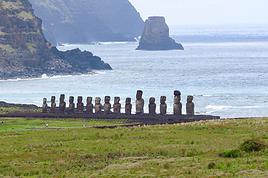
Easter Island, located between Tahiti and Chile, fascinated me with its volcanic landscapes and legendary Moai statues, erected by the first Polynesian inhabitants to honor their ancestors. Mysterious and iconic, this isolated land intrigues with its history and the enigmas that researchers and explorers are still trying to unravel.
To help you prepare for your trip, here’s my five-day itinerary. I was able to explore major sites while leaving room for some free and adventurous moments. Here’s the program I followed:
Day 1: Discovering Hanga Roa and nearby moais
For my arrival, I started slowly by visiting the village of Hanga Roa. I took the time to stroll around, check out some local shops, and especially admire the first moais accessible for free, to ease into the island’s fascinating history.
Day 2: The must-see sites with a guide (Vaihu, Te Pito Kura, Anakena, Tongariki, Rano Raraku)
The second day was dedicated to the highlights. With a guide, I explored the island’s iconic sites, including the imposing aligned moais of Tongariki and the ancient "statue factory" of Rano Raraku. This intense day helped me understand more about the island’s culture and mysterious history, especially with the paradise-like beach of Anakena at the end of the day.
Day 3: Historical sites and museum (Orongo, Rano Kau, Puna Pau, Akivi)
On the third day, I continued with a guided morning, particularly at the ceremonial village of Orongo, perched atop Rano Kau. After visiting Puna Pau and Akivi, I spent the afternoon at the museum to deepen my knowledge of the Rapa Nui civilization.
Day 4: Bike ride in nature
Craving freedom, I devoted this day to a bike ride along the coastline and through the island’s natural spots. It was the perfect opportunity to explore at my own pace and stop at secret coves, enjoying the tranquility of the landscapes.
Day 5: Hike to the summit of Terevaka
For my last day, I set off on a hike to the summit of Terevaka, the island’s highest point. From there, the 360° view of the island and the ocean is breathtaking and gave me a memorable souvenir of this trip.
This five-day stay was a real journey through time, landscapes, and the mysteries of Easter Island!
If you want more details on my favorite spots, accommodation ideas, or practical tips, you can check out my article: https://un-tour-dans-le-sac.fr/ile-de-paques-5-jours/

Hi there, the truth is there was never really any mystery since the island has always been inhabited. All the theories we’ve heard for decades are just nonsense.
Simply put, over the last five centuries, the locals encountered Westerners, who brought them germs and alcohol. The current situation is the result of that.
Toujours une fois. Au moins.
Hello!
Thanks for your perspective. It’s true that the arrival of Westerners had significant consequences for the island’s population, particularly with the introduction of new diseases and alcohol, which unfortunately affected many island peoples at that time. This is part of Easter Island’s history, and it’s important to acknowledge that impact.
However, the history and Rapa Nui culture were already rich and deeply rooted long before those first contacts. Even though the island was continuously inhabited, mysteries remain. For example, the exact way the Moai were transported is still intriguing: some believe logs were used under the statues, while another theory suggests they were rocked side to side to move forward, kind of like a fridge. According to oral tradition, the Moai “walked” to their destination—a fascinating image that continues to captivate researchers and archaeologists.
It seems like you’re saying that because Easter Island was always occupied, there’s no mystery or room for hypotheses... which I disagree with. Even places inhabited for ages hold mysteries! And I’ll share an anecdote I know well since it’s about my own home... In my medieval house, a fresco depicts a spinner, but the face was deliberately erased. Was it an act by the Templars, who rejected female representations? Or a disgruntled husband whose wife dishonored him? Or vandalism from later centuries? Despite expert research, no one knows. It just goes to show that even a long-inhabited place can hide enigmas, especially when memory relies on oral traditions.
It’s that sense of mystery, I think, that makes Easter Island so captivating today—and what drives us to explore, question, and keep learning.
Thanks for the discussion, and have a great day!
Thanks for your perspective. It’s true that the arrival of Westerners had significant consequences for the island’s population, particularly with the introduction of new diseases and alcohol, which unfortunately affected many island peoples at that time. This is part of Easter Island’s history, and it’s important to acknowledge that impact.
However, the history and Rapa Nui culture were already rich and deeply rooted long before those first contacts. Even though the island was continuously inhabited, mysteries remain. For example, the exact way the Moai were transported is still intriguing: some believe logs were used under the statues, while another theory suggests they were rocked side to side to move forward, kind of like a fridge. According to oral tradition, the Moai “walked” to their destination—a fascinating image that continues to captivate researchers and archaeologists.
It seems like you’re saying that because Easter Island was always occupied, there’s no mystery or room for hypotheses... which I disagree with. Even places inhabited for ages hold mysteries! And I’ll share an anecdote I know well since it’s about my own home... In my medieval house, a fresco depicts a spinner, but the face was deliberately erased. Was it an act by the Templars, who rejected female representations? Or a disgruntled husband whose wife dishonored him? Or vandalism from later centuries? Despite expert research, no one knows. It just goes to show that even a long-inhabited place can hide enigmas, especially when memory relies on oral traditions.
It’s that sense of mystery, I think, that makes Easter Island so captivating today—and what drives us to explore, question, and keep learning.
Thanks for the discussion, and have a great day!
FYI: link to the logbook of Jacob Roggeveen, the Dutch explorer who discovered Easter Island in 1722
Jacob Roggeveen's Journal
As for claiming there’s no mystery left about Easter Island, that’s pretty presumptuous. We don’t know much about the culture of the natives who were decimated in the 19th century. And since there are no written records and everything relied on oral tradition, a lot has been lost.
Jacob Roggeveen's Journal
As for claiming there’s no mystery left about Easter Island, that’s pretty presumptuous. We don’t know much about the culture of the natives who were decimated in the 19th century. And since there are no written records and everything relied on oral tradition, a lot has been lost.
Thanks for your interesting and well-reasoned reply.
Toujours une fois. Au moins.
Log in first, then come back to this page.