Well, I must be nearsighted—thanks for the info...
As for me, my search was fruitless... I don’t remember which BTS line, but there’s a Home Pro something-or-other, and it’s not great. That’s mainly why I have to head down to Phuket. The first province I chose was Ranong, and it’s the least populated in Thailand. My research said they sell gypsum in bulk there, but I didn’t see anything about it online. There’s no gypsum board in Thailand, but if you say so...
Actually, on Soi 91 past "On Nut," there’s a gypsum warehouse, but their products are only in bags. I’ll get to the bottom of it tomorrow. But I still need galvanized steel amounts... I’m not touching wood for now, even though I’m a cabinetmaker in my spare time...
During my three-week trip to Phuket, I checked things out, and the big Home Pro center there is really famous for tools, but I didn’t look into certain materials. Here in BKK, it’s all CONCRETE. Even where I’m from, we have 4' x 8' concrete sheets, half an inch thick. And this week, one more time in BKK—exceptionally—I swear I’ll get answers. After that, I’m heading south as fast as possible!!! 🤪
Hi Christian,
Drywall sheets for walls and ceilings, called "placoplatre" in French-speaking Europe, are made in Thailand 😉
You can find them at all major building supply stores.
Hey Henri,
My ceilings are made with that ... (Thai construction)
HomePro specializes mainly in home improvements: kitchens, bathrooms, bedding, paint...
The merchants who sell bricks and cement also sell fiber-cement and plasterboard, which, oddly enough in Thailand, are installed on a wooden frame...
One material that’s really taking off right now is "wood cement." These are boards that work like wood and can be used both indoors and outdoors on metal frames, similar to plasterboard. Here are some manufacturers or resellers in Bangkok:
http://www.mahaphant.com/index.jsphttp://www.diamondtile.com/http://www.siamfibrecement.com/index.php
Hi MengWan,
There are panels designed for use in damp areas that don’t absorb water. It’s clear that if you want to eliminate condensation in the gap behind your false ceiling, you’ll need to create openings to ventilate that space. If your attic is well-ventilated, you shouldn’t have any issues.
Hello Christian,
Drywall sheets for walls and ceilings, called "plasterboard" in English-speaking Europe, are made in Thailand 😉
You can find them at all major building supply stores.
Hey Henri,
My ceilings are made with that ... ("Thai" construction)
Downside: it’s like a moisture reservoir!
🙂
In Quebec, we install a hatch right in the middle of the highest part of the roof so air can circulate... and ventilation happens... like in the attic, for example... but I don’t understand your issue if your roof extends beyond the exterior walls—you should have ventilation between the walls and the overhanging roof... the only word I can think of in English is... we install soffit in that spot... all around; but that’s not enough... it needs to breathe...
What do you mean by a waterproof barrier?
If it's a waterproofing membrane, Sika, which manufactures in Thailand, sells PVC sheets for roofing and vapor barriers.
You can also find liquid waterproofing for concrete and all the additives to make mortar or concrete watertight. You’ll need to carefully control the quality, though, because workers tend to add huge amounts of water to make it easier to apply, which leads to massive shrinkage.
What do you mean by a waterproof barrier?
If it's a waterproofing membrane, Sika, which manufactures in Thailand, sells PVC sheets for roofing and vapor barriers.
You can also find liquid waterproofing for concrete and all the additives to make mortar or concrete watertight. You’ll need to carefully control the quality, though, because workers tend to add huge amounts of water to make it easier to apply, which leads to significant shrinkage.
Thanks...that was a question about a foundation that would sit 5 feet underground, so the slab after pouring and its strength...controlled irrigation with a French drain and a completed Canadian well installation...the waterproofing membrane needs to be installed before framing the basement floor...then afterward, the membrane goes up along the exterior walls that will remain in damp soil...brick could even work with a waterproofing membrane...from memory, it's about 8mm thick...but I'm not sure, I'll have to check...
If this product is also available here, this construction becomes easily feasible and still affordable...this method meets all the desired efficiency for keeping the house cool...
HomePro specializes mainly in home improvements: kitchens, bathrooms, bedding, paint...
The merchants who sell bricks and cement also sell fiber-cement and drywall sheets, which, oddly enough in Thailand, are installed on a wooden frame...
One product that’s really taking off right now is "wood cement." These are boards that work like wood and can be used both indoors and outdoors on metal frames, similar to drywall sheets. Here are some manufacturers or resellers in Bangkok:
http://www.mahaphant.com/index.jsphttp://www.diamondtile.com/http://www.siamfibrecement.com/index.php
Happy researching! 😉
@+
RE Hey Henri-Michel,
My friend, you just saved me from my ignorance... SCG—I had no idea what it stood for! It’s the product I’ve always worked with in Quebec...!!!
And it means... SIAM CEMENT GROUP... well, we’re in business—no doubt in my mind now! I even found what I was looking for!!!😉 ... a gypsum board reinforced with a waterproof core and a fiberglass sheet... AMAZING, right?
So if my SCG drywall box costs me $15 in Quebec...??? and a regular gypsum sheet costs $10 there...??? Then how much will it cost me in Thailand from the manufacturer...??? I can’t believe how clueless I’ve been—I’ve always done renovations and construction with these products without even knowing they came from the country I want to move to!!! 😎😎😎
This just made my day—I bought a flight ticket to Phuket... Samui was too expensive 😛. I’ll be going straight to the island, but I’ll still come see you... and I’ll probably lend a hand to our friend Mengwan with his roof...
You can also find liquid waterproofing for concrete and all kinds of admixtures to make mortar or concrete watertight. But you need to carefully control the quality, because workers tend to add huge amounts of water to make it easier to apply, which leads to massive shrinkage.
Yeah, it’s probably due to the slow application... here with the heat, working with cement can’t be easy. And the thing is, cement "soaks up" water—Quebec slang, haha—so you constantly have to add more water. Then, during the final step, the "floating," to make it smooth and even, you have to bring the water back up... but not too much, or you’ll get "mishaps." Anyway, I think we get each other...
For finishing drywall—what you call "placoplâtre," we say "plastering"—it’s the same deal. I wet my trowel and with a quick, smooth stroke, everything evens out... 😉 ...with water!
MISTAKE!!!
By adding water to concrete or mortar that has naturally started its chemical reaction, you only significantly reduce its strength.
For tropical climates like Thailand, there are plasticizers, setting retarders, etc., that make it easier to use while maintaining optimal quality 😉. Of course, this comes at a cost. The plants in this country are well-equipped, but it's the site managers who insist on the mixer drivers adding water.
As for bringing the fines and cement to the surface, it's a trick, a cover-up that doesn't improve the product's quality.
Building physics, waterproofing in all its forms, concrete, construction materials—that was my job, and it still is because I'm passionate about it. It's my thing, Christian. I fell into it when I was little 🙂
@+
MISTAKE!!!
By adding water to concrete or mortar that has naturally started its chemical reaction, you’re only significantly reducing its strength.
For tropical climates like Thailand, there are plasticizers, set retarders, etc., that make it easier to work with while maintaining optimal quality 😉. Of course, this comes at a cost. Plants in this country are well-equipped, but it’s the site managers who pressure the mixer truck drivers to add water.
As for bringing fines and cement to the surface, that’s just a trick—a cover-up that doesn’t improve the product’s quality.
Building physics, waterproofing in all its forms, concrete, construction materials—it was my job, and it still is because I’m passionate about it. My little world, Christian—I fell into it when I was a kid 🙂
@+
Well ... no doubt about it, we share a passion... Thanks again for the info...😎...
MISTAKE!!!
By adding water to concrete or mortar that has naturally started its chemical reaction, you’re just significantly reducing its strength.
For tropical climates like Thailand, there are plasticizers, set retarders, etc., that make it easier to work with while keeping its optimal qualities 😉. Of course, that comes at a cost. The plants in this country are well-equipped, but it’s the site foremen who insist that the mixer truck drivers add water.
As for bringing the fines and cement to the surface, that’s just a trick, a cover-up that doesn’t improve the quality of the product.
Building physics, waterproofing in all its forms, concrete, construction materials—that was my job, and it still is because I’m passionate about it. My name’s Christian, and I’ve been into this since I was a kid 🙂
@+
That’s what I was saying... I’m definitely not the one who’s gonna mess with concrete!!!😉😉😏
I’m in the early stages of planning to build a 170 m² house. The blueprints are still being drawn up, and obviously, I’d like to move to the next step to get a price based on the plans... I need a precise idea, not just a range of 1 to 2 million baht.
Do you know anyone who could provide a detailed estimate? Of course, I’m happy to pay for their time.
Because I have no clue about the cost of building a 20 cm or 10 cm wall per m², roofing per m², etc.—whether that’s just materials or includes labor.
hi .. it all depends on the location .. the same house isn’t priced the same everywhere in Thailand ..
plus, it’s the contractor you choose who can give you .. more or less the price. 😉.
For the price of a house in Isaan, you’ve got to ask bababobo. He’s building his 900 m² place for half a bike and 14 baht without employing Burmese slaves.... The guy’s a god!
Bababobo for president!!!!!!🙂
Yes, I had no doubt about the master builder: for now, he’s drawing up the plans.
And then I’d like to have the final price checked by two people to cross-reference the information. You can understand that.
The house will need to be built in Soeng Sang. Not too close to Bangkok. However, if you know any great tips for windows, doors, etc., it’s not out of the question that I might consider having them transported...
Where you are, you’re looking at between 20,000 and 30,000 THB/m² depending on the quality of the finishes. I’m talking Farang standard. Thai standard is cheaper.
Good luck!
Okay, thanks! It’ll be a Thai-style finish with a ++ twist—somewhere between Thai and Farang. To be more precise: a house with posts, 20 cm exterior walls, 10 cm interior walls, a standard blue roof, etc. It’s a vacation home (I’m not picky), and it’ll be lived in by Thais year-round.
Next time I’m in Bangkok, I’ll check out the big-ticket items (like windows, etc.) to see if I can save on those.
Okay, thanks. It’ll be a Thai ++ finish—somewhere between Thai and Farang. To be more precise, a house with pillars, 20 cm exterior walls, 10 cm interior walls, standard blue roof, etc. It’s a vacation home (I’m not picky) and will be lived in by Thais year-round.
Next time I’m in Bangkok, I’ll check out the big-ticket items (like windows, etc.) to see if I can save on those...
Stéphane
No need to go to Bangkok—Korat has everything you need. Stores like Global House or even local small contractors.
For a wall, budget around 1,500 baht per meter (smoothed) with a height of 1.80 m (10 cm Thai breeze blocks).
Indeed, in Korat, which is 1.5 hours away by road, it's a big city.... I should find quite a few people there.
Thanks for the info... 1,500 THB for 1.8 m² (10 cm), which comes to 800 baht per m² for the interior. I’ll keep that in mind...
Hi THuan,
I’m getting back to you after a long absence due to a change in assignment. Hope you're doing well.
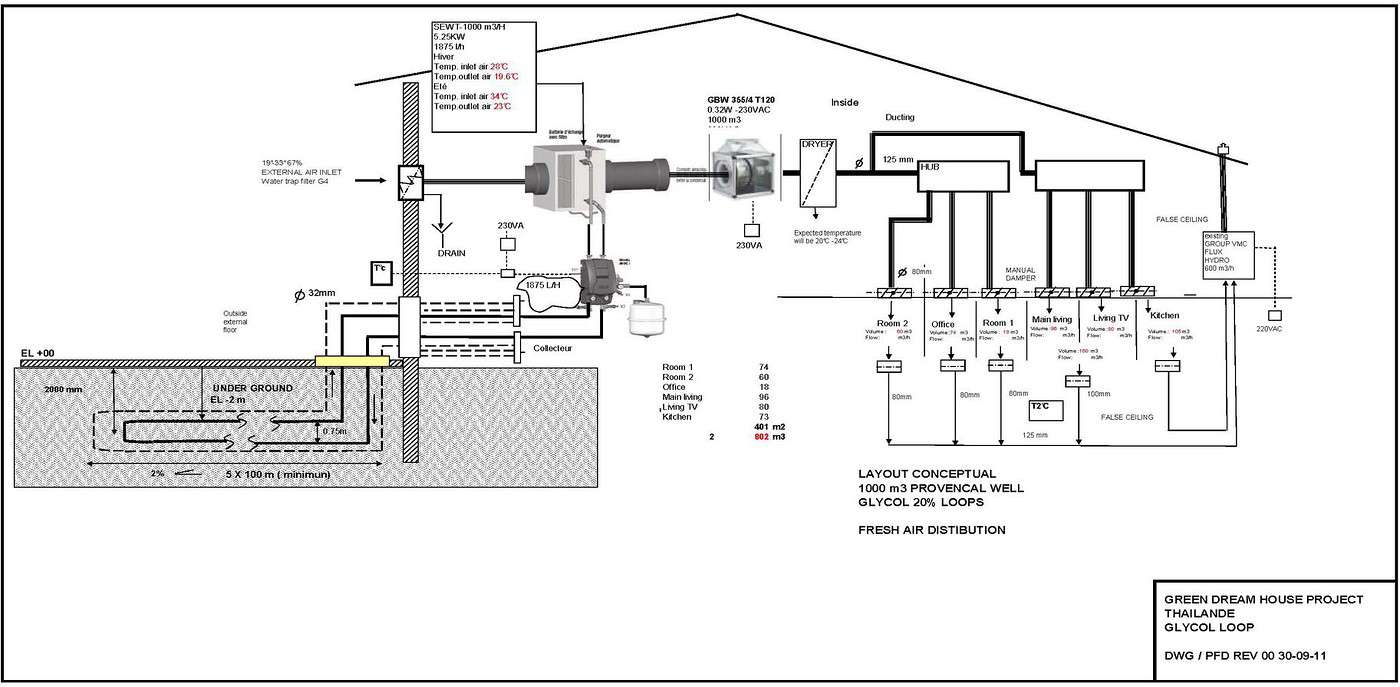
For your info, after extensive conceptual studies, I’m going to install a ventilation system based on the "puits provençal" (French cooling well) principle using a glycol-water mix, with an exchanger and a 1000 m² fan. The calculations look promising—especially when it’s 34°C outside, we’re getting 24°C inside—but it requires 5 x 100m of tubing buried 2000m deep.
I’ll keep you posted. Construction on my house starts in June 2012, and I’m burying the tubes beforehand.
See you soon,
Hey H-M,
Cut it out right now, will you!!!
Just 15 minutes ago, there was a little snowfall after a serious temperature drop last night! In the lowlands...
I’ve had enough.
Can’t wait for mid-May so we can sweat a bit in SEA!
So: see you soon! 😉
And sorry for the off-topic, but replying to a friend is always a priority. 😉
Say, "Just because you’re many and wrong doesn’t mean you’re right" – Edmond Wells, *The Encyclopedia of Relative and Absolute Knowledge*
Have you read the *Ants* saga?
I love Werber!
I read *The Ants* but that’s about it.
My favorite book of his is *The Mystery of the Gods*.
Speaking of ants and housing (to tie it back to the topic), we were overrun by termites. They swarm like bees, and hiring a specialized company hasn’t completely solved the problem yet.
A word to the builders on the forum: treat all your wooden pieces before installation—sometimes even that isn’t enough.
I’m particularly curious about the wildlife and plants that’ll invade the pipes in those wells, the musty smells, etc.
Hope we’ll get updates on how this tropical experiment turns out!
Good evening!
You're right—a standard Provençal well is practically impossible outside of contamination issues. There’s also the problem of condensate recovery, which requires an additional pump. The company Helios is offering me a glycol-water well instead, so I’m going to give this concept a try since the calculations seem to make it viable—but nothing’s certain, of course.
Best regards,
Of course, I’ll share my feedback later... For now, I’m looking into the tax issue for importing materials. It seems possible to apply to the Ministry of Environment for a tax exemption for a Green House. The architect in Bangkok is currently investigating.
I’m open to any information about import taxes in Thailand—some people tell me they’re minimal in my case.
Here’s also some feedback on two air or water-based systems, with glycol offering surprising efficiency for the glycol system...
http://www.econology.fr/blog/2010/06/30/comparatif-puits-canadien-classique-ou-a-eau-glycolee/
Obviously, the ground temperature at -2m isn’t 13°C (like in France) but 16°C in Thailand, according to the soil survey I had done during the study. The entire system is calculated based on this, along with an average humidity level of 68%. But these figures aren’t necessarily reliable, so it’s an adventure...
I’m attaching a PDF of the principle diagram for info.
Have a great day!
Of course, I’ll share my feedback later... For now, I’m looking into the tax issue for importing materials. It seems possible to apply to the Ministry of Environment for a tax exemption for a Green House. The architect in Bangkok is currently investigating.
I’m open to any information about import taxes in Thailand—some people tell me they’re minimal in my case.
Here’s some feedback on two concepts: air or water with glycol, which offers surprising efficiency for glycol...
http://www.econology.fr/...e-ou-a-eau-glycolee/
Obviously, the ground temperature at -2m isn’t 13°C (like in France) but 16°C in Thailand, based on the soil survey I had done during the study. The whole system is calculated on this basis, with an average air humidity of 68%, though these figures aren’t necessarily reliable—so it’s an adventure...
I’m attaching a principle PDF for info.
Have a good day!
Hi,
It would be interesting to know the cost of this installation—transport and taxes included...
The latest base quote I got is 8,600 € delivered to France (Pau). The freight forwarder is working out the cost to ship it as air cargo....
I think it’ll end up around 10,000 € all-in, including installation. Either way, it’s important to know the final price so I can compare it to the investment in five pre-wired split AC units I’m having installed as a safety measure.
Have a great day!
hi everyone! 🙂
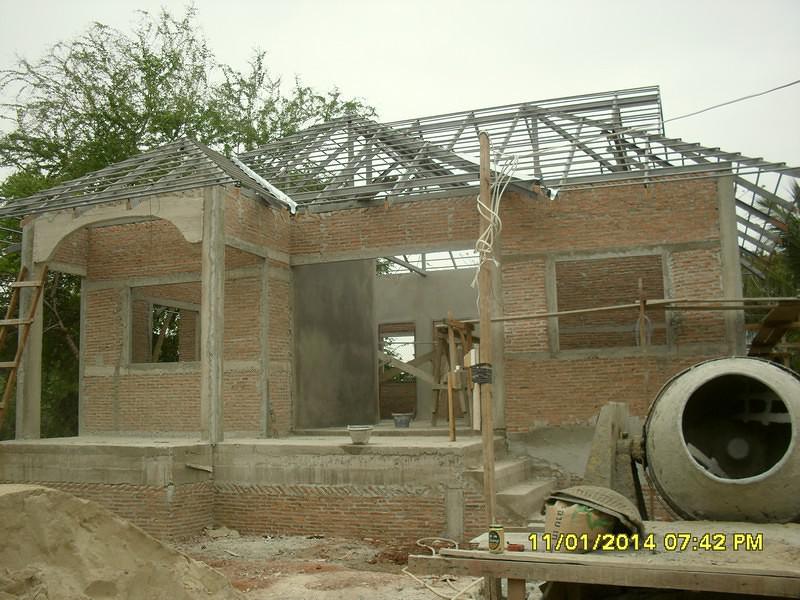
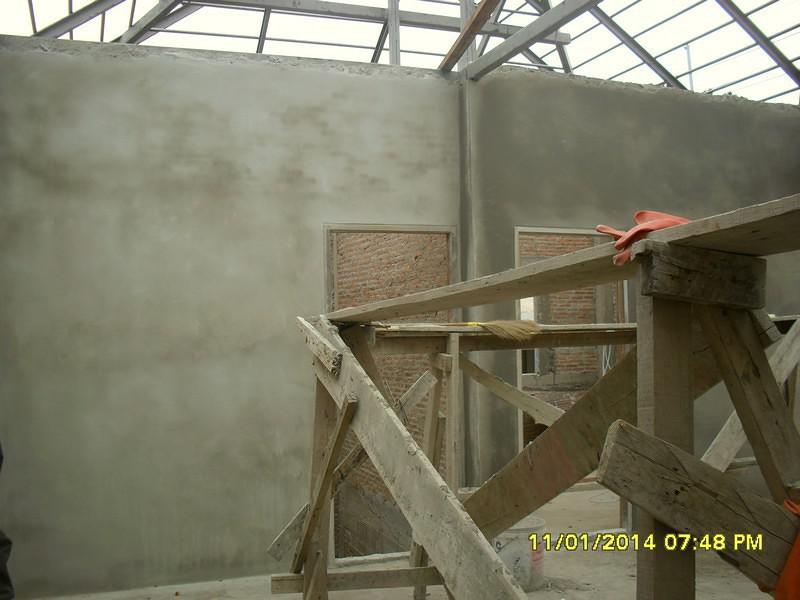
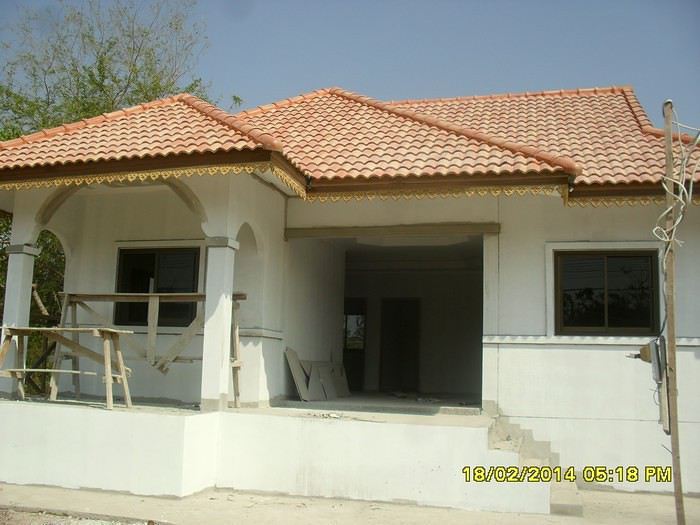
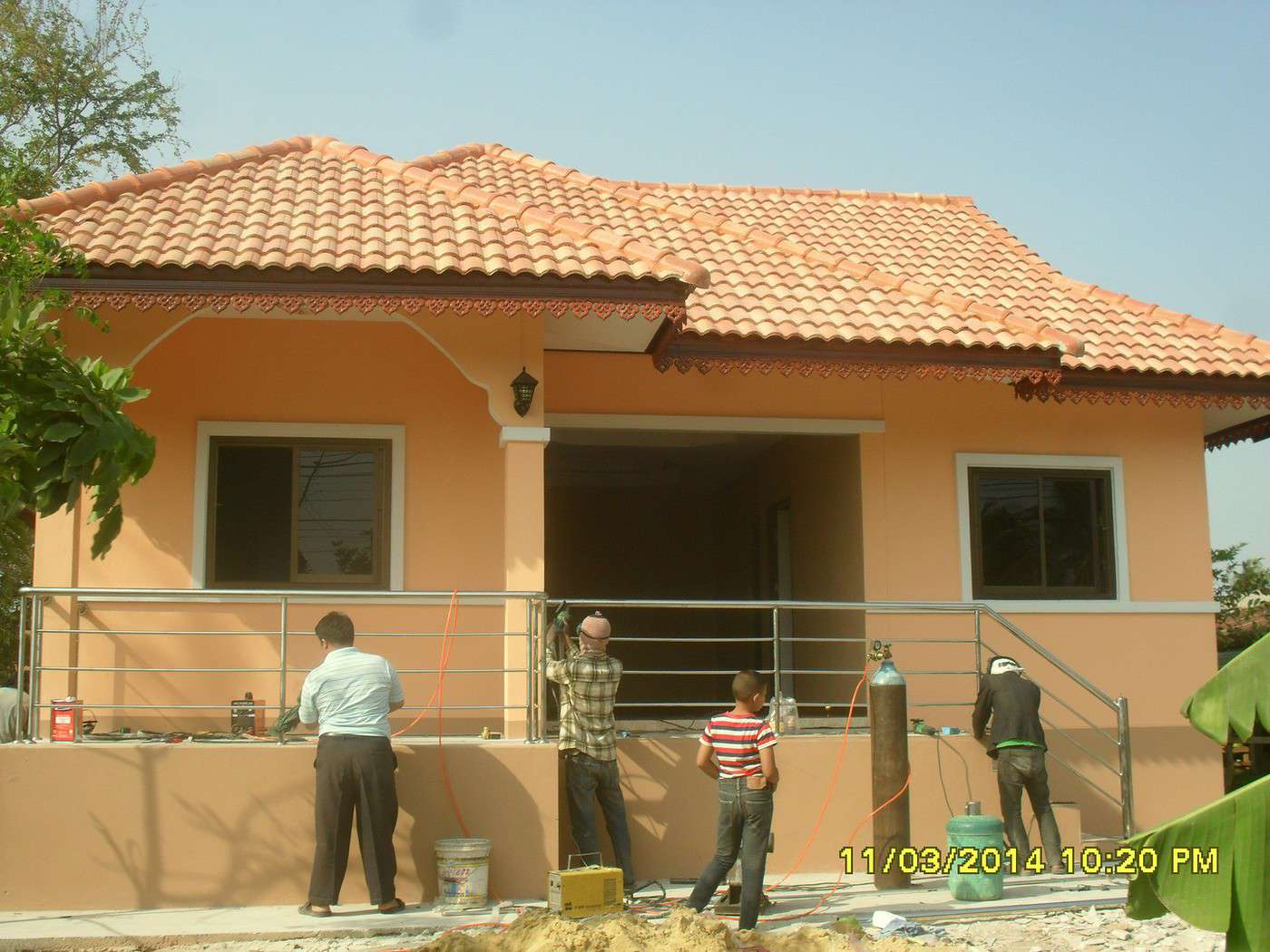
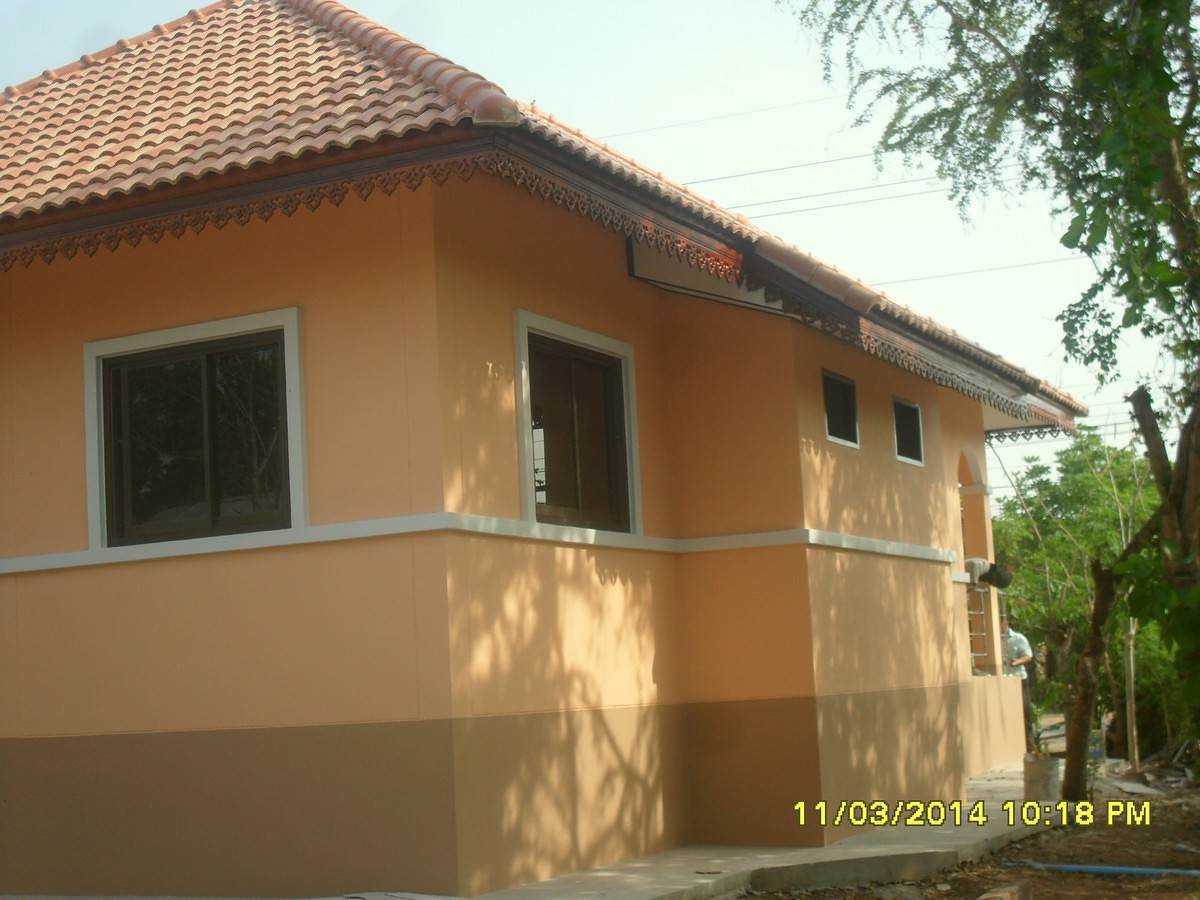
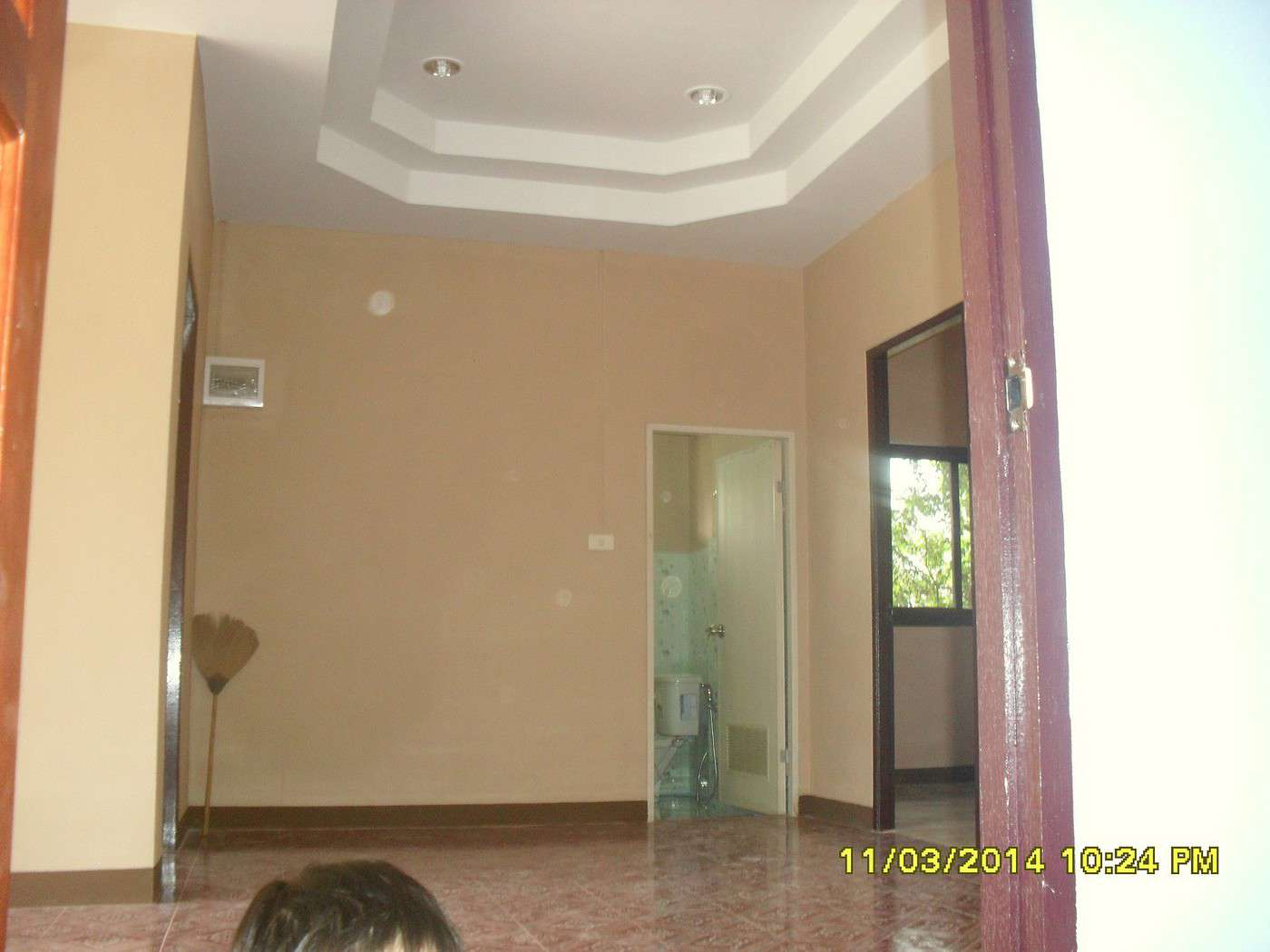
I’m way behind, but here are a few photos of our house being built near Khorat. If anyone needs info, I’m much more available these days.
Hello,
Unfortunately, the Canadian well project with glycol water can't be carried out because the data logger probes that have been buried for 6 months are showing unexpected and surprising temperatures—even the engineers in Toulouse were surprised to find 28°C at -2.5 m.
We checked at -18 m (well), and it's still 21°C...
And yet, there’s no hot spring in the area—it’s quite astonishing and unlucky since a friend of mine down in Phuket has 17°C. It’s incomprehensible.
This is a huge disappointment because everything was ready for implementation, especially in line with the green house concept.
Construction is 60% complete, with delivery scheduled for the end of October.
I really wanted this system to be reliable and finally implemented. Oh well, I’ll install 5 air conditioners instead and won’t hesitate to pay up :(
From memory, the house is between 90 and 110 m², with 4 bedrooms, 2 bathrooms, and a kitchen. For the cost, the land was given to us by my father-in-law, and the finished house construction cost us 800,000 baht, paid in 2011.
Don’t hesitate to reach out if you need more info!
Thanks! :)
That’s exactly the price we paid for our 95m² house with 4 bedrooms and a living room—no kitchen, since we built an outdoor kitchen/coffee shop. So those really are the market prices for this type of house! :)
Looks like a beautiful home, by the way ;).
Thanks to you too, Davidoff... that seems to match the type of construction like mine🙂.
We're currently building a kitchen/coffee shop next door... 17.5 m² for 100,000 baht🙂.
I’m getting back to you with updates on this house, which is nearly finished—they’re fixing the snags I noted during the handover last month, so I haven’t signed the final step yet.
To avoid any speculation and since we’ve been talking about houses for a while, I’ve put together a presentation video that gives a good sense of the house I designed in 3D. I shared my model with a young architect in BKK who adjusted the measurements and standards. You can judge the result—it was a bit tough and took much longer than expected. The challenge was overseeing the construction from several countries, which gave me a few cold sweats, but the result is here. All that’s left is to install the kitchen and furniture, which is way less stressful!
The Thai issue is that they struggle with finishes and you often have to ask them to redo things—it’s pretty frustrating, but they never complain...
Here are the links where you can watch the 18-minute HD video and check out the model made with SketchUp Pro, which can export to AutoCAD or vice versa.
The house’s footprint is 420 m² on 2 RAI (about 3,000 m²).
The living space is around 365 to 380 m².
Total electrical power is 27 kW.
The load for all consumers, including 5 AC units, holds up—phew!
There are 82 lighting points, but don’t worry—most are 3W or 7W LEDs, and they light up really well.
There are 2 septic tanks.
Hot water via a 300L solar heater.
2 spacious bedrooms.
1 office.
1 living room.
1 TV room.
1 large kitchen (currently being measured).
2 bathrooms and toilets.
1 visitor toilet.
1 terrace of 51 m², covered but open (chimney effect).
1 laundry room.
1 workshop.
1 well with a submersible pump (great water, better than public supply).
Thermal insulation: Cool Stay 6 mm in all rooms.
Roof: CPAC MONIER concrete tiles, 5.2 kg each.
As a result, the frame is galvanized steel.
A space ready for a 10x5 m pool (currently being measured).
The cost of this house obviously matches its size, since the location isn’t anything special...
There you go—I’ll let you judge for yourselves that modern construction in Thailand is possible. Of course, you don’t need to build something this big, but I love large spaces. When furnishing in 3D, you realize you actually lose about a third of the surface area.
For those who want more info and the price of this build, contact me via PM.
I’d be surprised if you didn’t drop a bombshell. Maybe you could post some photos of your house, just as a reference for the beauty?
For my part, I think it’s a great achievement.
The big issue in Thailand is maintenance because very quickly, buildings lose their shine. The sun exposure, humidity, and poor-quality materials often explain the rapid deterioration of houses. A new house can age very badly and no longer look like it did just a few years earlier.
I’d have been surprised if you didn’t drop a line. Maybe you could post some photos of your house, just as a reference for the beauty?
Personally, I think it’s a great achievement.
He can barely own up to his thoughts... you want him to be a homeowner too? =)
he can barely handle his own thoughts... you want him to be a homeowner too? =)
I really don’t get what you’re saying... but whatever...
I wasn’t expressing too many thoughts, just my taste 😛
Those colonnades at the entrance with the AC unit as wall decor, the square stainless steel balconies, and the house facade right up against the road—none of that fits my aesthetic criteria. Now, all that’s left is to furnish it with IKEA 😏
As for my house, sorry, that’s my private life 😛
Hi everyone, I m about to head to Thailand with my kids and I ve been put in touch with a French-speaking driver who ll be with us for 3 4 days (for a little…
Hi everyone, I m planning a trip to Thailand. Since we ll only be there for two and a half weeks, we want to visit the Krabi area and then Chiang Mai. So we…
Hi there! I think the question s in the title... What price can I expect to pay in 2025 for a ride of about two kilometers in the tourist center? Thanks
Hi there! Right now, we're in the southeast part, Isan, staying with a French guy. We don t cook much at most, a restaurant meal for 5 people costs us 1000…
Hi, I d been told it was between 2,000 and 2,500 THB per day. 3,000 THB for Doi Inthanon... The driver I found gave me different prices depending on my…
Hello everyone! I’m heading off solo in February and wanted to share my rough itinerary with you. Does this sound doable?
PS: I’m not really into beaches.
D1 Departure on February 17, 2027
D2 Arrival in Kuala Lumpur – stroll through Chinatown and visit the Petronas Towers
D3: Kuala Lumpur – Chow Kit Market, Batu Caves, Little India, Bukit Bintang downtown area
D4: Early morning bus to Malacca. Explore Malacca in the afternoon and evening
D5: Another 2–3 hours in Malacca in the morning, then bus back to Kuala Lumpur. Merdeka Square area. Stay in Chinatown
D6: Bus trip to Kuala Tahan. Night tour
D7: Morning – canopy walk and Bukit Terisek hike. Afternoon – off to Lata Berkoh
D8 & D9: 2-day jungle trek in Taman Negara National Park
D10: Head to Cameron Highlands
D11: Morning hike through the plantations. Afternoon still to be decided
D12: Morning – excursion to Mossy Forest and Sungei Plantation. Afternoon bus to Ipoh
D13: Morning – Mirror Lake / Sam Poh Temple area. Afternoon – explore downtown Ipoh
D14: Morning train to Penang. Afternoon – wander around Georgetown
D15: Morning – Penang Hill and Keh Loh Temple. Afternoon – Georgetown
D16: Bus to Butterfly Garden and Spice Garden. Late afternoon – Burmese and Thai temples
D17: Morning flight to Singapore. Afternoon – Chinatown and Marina Bay tour
D18: Morning – Gardens by the Bay area. Afternoon – Boat Quay, Clarke Quay, Kampong Glam
D19: Morning – The Ridges area and Botanical Garden. Afternoon – Little India, then back to Chinatown before 11:15 PM return flight
D20: Morning arrival
Hi, I’ve read that these two volcanoes are super popular and that there are *tons* of people for sunrise, especially in July. I’m looking for firsthand accounts from anyone who’s done it later, around 9–10 a.m.
Thanks for your help!
Laëtitia
I’m heading to Cambodia at the end of December 2026 – January 2027 for 3-4 weeks. Since I’ve already visited Cambodia twice, my itinerary is a bit different this time—I’d love to explore Botum Sakor Park, Chi Pat, the Tatai region, and the Cardamom Mountains. I’m traveling solo. If you have any tips on transportation, excursions, treks, sights, or accommodations in the area, I’d really appreciate it. Thanks for your feedback!
Has anyone traveled with the Laos travel agency ADV ?
I’m planning a trip to Laos and have received several quotes. Among them, this agency’s seem very reasonable, and so far, the interactions have been positive.
I’ve found a few positive reviews online, but I’d love to hear from travelers who’ve actually booked with them: how’s the organization, guide quality, accommodations, on-the-ground responsiveness, etc.
Thanks for sharing your experiences!
First stop on our discovery of the peninsula: Amphawa. It’s our first night in Thailand (we arrived at Suvarnabhumi at 8:50 AM).
Our initial plan was to explore the area before heading further south. The Mae Klong Railway Market is tempting... but what else is there to do????
We’ll be there on a Wednesday, and from what I’ve read on the forum, some say there’s absolutely nothing to do during the week—no floating market, barely any shops open, no restaurants, etc.
Others, though, say the place is actually more charming without the weekend crowds.
Could you share your thoughts? Missing the floating market is one thing, but if it’s really a ghost town on Wednesdays, I might just drop our bags somewhere else.
Amphawa seemed like a good first stop, just 1.5 hours from the airport, but I’d still like to settle somewhere a bit lively for our first evening.
We’ll be there at the end of October.
Thanks!
Hi,
I wanted to visit the plantations in the morning with GetYourGuide or by just showing up.
How much time should I really plan for?
I’d like to catch either the 3 PM or 5 PM bus back to KL.
Thanks
Hi,
I wanted to get some info about the cable car and the bridge—I see lots of different options...
How much time should we allow for these two activities? If we arrive around 4 PM, will we have enough time to visit without rushing?
Thanks
Hi there,
I didn’t plan to return to Thailand this year, but my health conditions mean it’ll be the best place for me to stay between two trips to India. The tourism setup there is so well-organized that it’s the most "comfortable" country for a short visit. Thailand feels too sanitized for my taste, and there’s too much religion, Buddha, and the King, but it’s still the best option given how my health has been evolving. I’d considered two weeks in ThaTon for hiking, but I got too sick from the burn-offs during my trips to the mountains around Chiang Rai. So I’m not sure where to go this year. Definitely not the sea, touristy spots, or the mountains with burn-offs...
Hi,
On September 1st, we're heading to Kalimantan for six weeks, probably from Pontianak to the Derawan Islands.
I've scoured this site, which is usually my go-to 😉, and others like VoyageForum, but recent info is pretty scarce.
I'd love any tips on places you've visited—our itinerary is still a work in progress.
We're two couples traveling with backpacks, using buses, boats, guesthouses, and homestays.
Thanks in advance!
Hi fellow travelers,
First trip to Vietnam.
We’ll be arriving in Ho Chi Minh City during Tet.
Is it complicated to find accommodation and get around during this period?
Any tips would be welcome.
Thanks for your replies.
Hi! I’d like to split my trip into two parts: 15 days in Phuket and 15 days in Krabi. Do you know if I can rent a car and drop it off in Krabi when I fly back to France?
Thanks for your feedback!
Have a great Sunday!
Martine
Hello,
After 1 night in Khao Sok, I’d like to find a 2 Days 1 Night package on the lake.
After reading a lot, I decided to "break the bank" and treat ourselves to a private tour—mainly to avoid the crowds.
But after contacting several operators, they offer "private tours" that are very expensive (around 700 €), yet in the details, the boats can only leave from the pier at 10 AM like everyone else. (I was hoping to leave much earlier.) The morning program is the same for everyone too (private or not). They drop us off at noon at our floating hotel (I’d chosen Phupha Waree). Free afternoon (swimming or kayaking in front of the hotel). We head back by boat for a 1-hour sunset ride. And the next morning, we leave the hotel at 8 AM to be at the pier by 9:30 AM at the latest—end of the trip.
So basically, we’re paying a lot for a private tour just to do the same thing as everyone else at the same time.
Or maybe I just had bad luck in my search.
I contacted Panida Ladi, who’s very popular on forums. We’d agreed on a private tour that matched my request (departure from the pier at 8 AM, very personalized itinerary). We settled on the itinerary and price, she asked for a Wise transfer for a 30% deposit, confirmed receipt of the deposit. Then 30 minutes later, she messaged me to say she was canceling everything because it was impossible to do the requested tour—and promised a quick refund of my deposit.
So here’s my question: Who’s done a *real* private tour on this lake? Who can recommend a reliable agency? Is it even really possible to do a private tour here?
I’m searching for a real gem for my 3rd stay in Koh Lanta: a lovely, high-quality hotel right by an easily accessible beach in a lively spot.
If you know of anything that fits what I’m looking for and want to share, don’t hesitate!
Hi, is anyone there in Flores right now? According to some websites, everything is closed and the situation is tough. But our guide says it's fine. Who should we believe? We're supposed to leave on September 2nd. Thanks to anyone in Flores at the moment!
Hi dear community,
I'm planning to visit Cambodia this winter, right after Christmas, for my first solo trip and my first trip to Asia. For two weeks (yes, I know it's short, but I really can't do more...). I have two main desires: Siem Reap and the countryside, the villages, the Mekong...
What do you think of this itinerary? Arrival in Siem Reap, departure from Phnom Penh.
SR: 5 days (1 day for arrival, 3 for the temples, 1 for the lake and its villages)
Kratie (stop on the way to Mondolkiri): 3 days (1 day of travel, 2 days there)
Mondolkiri/Sen Monorom: 4 days (1 day of travel, 1 day there, 2 days of treks)
PP: 3 days (1 day of travel, 2 days of sightseeing)
I think I need to cut one day somewhere if I travel from Saturday to Saturday or Sunday to Sunday. In Kratie, maybe? Or in PP? And I'll miss the boat trip that everyone recommends (SR-Battambang), but I don't see where to fit it in. Unless I do a PP-PP loop starting in the east, skip Kratie or just stay one night, then SR, then PP.
In my timing, Mondolkiri seems closer than Ratanakiri, which also tempted me a lot! Will it be too complicated alone? I'm thinking of using local guides or a small local agency for a nature and village getaway.
I've read that Siem Reap is very crowded between Christmas and New Year's. I could also do the circuit in the opposite direction. But I thought it would be easier to get familiar with the country by arriving in a touristy area—I might be wrong...
Thanks for your advice and opinions!
Hi everyone.
I’m planning my trip, and based on all the posts I’ve read, this country is amazing.
Of course, I’ve got a ton of questions for you.
Here’s a possible itinerary: Vientiane - Vang Vieng - Phonsavan - Sam Neua - Nong Khiaw + villages - Phongsali - Luang Namtha and the area - Udomxai - Huay Xai - Luang Prabang and back to Vientiane.
What do you think?
We’re planning to prioritize local transport—is it possible to do this loop?
We’d also love to go kayaking, but I’m not sure if the season’s right or where the best spot is.
For trekking—I read that Phongsali is the most authentic spot to visit villages and see wildlife. Do you know of a reliable agency and a guesthouse with reasonable prices?
Is it worth taking a slow boat for a stretch on the Mekong, and if so, which route?
For accommodations, is it better to book through Booking.com and Agoda or look when we arrive?
Are mosquitoes bad in Laos, and should we take malaria prophylaxis?
What’s the average daily budget (accommodation, food, visits)?
Is renting scooters a good option for exploring towns, and if so, which ones?
From what I’ve read, it’s best to carry cash—euros or dollars? Is it risky to walk around with that much cash?
I’ve still got tons of questions. Thanks to anyone who can help, and I’m open to all tips, info, etc.
Thanks again
Hi there,
I’m planning a family trip (my wife and I, both 47, and our two sons, aged 5 and 12) to Malaysia for the last week of June and the first two weeks of July 2027.
We used to love road trips as a couple, then as a trio, but since our second child arrived, we’ve taken a break with "camping village" style trips.
Now feels like the right time to get back to our old habits, while adjusting the pace for the kids.
We’re craving Asia. We’ve been lucky enough to visit Thailand, Indonesia (Bali and Lombok), and Sri Lanka before.
Friends have raved about Malaysia, so we’re definitely tempted.
For those who know and love Malaysia, what would be a good itinerary starting from Kuala Lumpur, with a maximum of 3-4 stops? We’d like a mix of culture, nature, and relaxation (just to clarify, we’re not big beach fans). All of this without rushing, of course.
Hello,
We’re a family of four with two teens aged 16 and 18. We’re heading to Thailand this summer. We’ll arrive in Bangkok and plan to take a flight to Luang Prabang.
I’ve seen there are some great visits and excursions to do (temples, markets, waterfalls) and maybe even venture a bit north to places like Nong Khiaw, Muang Xay, Muang Ngoy, or Oudom Xay.
But I’ve also heard about the Bokeo region with the Gibbon Experience.
Since we won’t be able to do everything, I’d love to hear about your experiences, impressions, and advice on the two options I’m considering, especially since we’ll be meeting family in Chiang Mai, Thailand, afterward.
Option 1: A loop from Luang Prabang heading slightly north, then a flight from Luang Prabang to Chiang Mai.
Option 2: A few days in Luang Prabang, exploring within a few dozen kilometers around, then heading to Bokeo province for the 2-day/1-night Gibbon Experience. For this option, I saw on Rome2Rio that it’s possible to book a ferry trip on the Mekong from Luang Prabang to Huay Xay—they mention about 8 hours. But is that realistic? What type of boat is it?
Then, to get to Chiang Mai, there aren’t many options—bus or minivan—but how does crossing the border work?
Finally, for those of you who’ve been to Laos in August, what was the weather like?
We’ve already visited Thailand, Vietnam, and Cambodia during the same period over the past four years and weren’t really bothered by bad weather.
I’m starting a discussion about guides in the Mekong Delta because we’ve just finished our trip in this region and had a hard time finding a French-speaking guide. We had Thanh—she speaks French really well and travels all over the delta region, including Ho Chi Minh City. She’s super friendly and flexible. I recommend her wholeheartedly. If it can help someone...
Feel free to contact us for her number.
Hi everyone,
I couldn’t find any recent info on Kuching.
Can anyone recommend a hotel or guesthouse for under 100 RM that’s nice and affordable? No dorms, please.
Also, does it rain a lot in November, and is it still worth visiting Semenggoh or Bako?
We’ll be arriving in Phnom Penh this coming January and we’re thinking of starting our trip with a stop in Kampong Cham, then Kratie.
After Kratie, we’re considering heading toward Siem Reap with a stop in Kampong Thom.
That said, I’m not really sure how long the Kratie–Kampong Thom journey might take or how complicated it is.
Does this stop on the way to Siem Reap seem like a good idea to you?
If we don’t visit the Sambor Prei Kuk site, are there still any walks or sights worth checking out in Kampong Thom?
Silly question—backpack or hard-shell suitcase for the Sepilok, Kinabatangan, Tioman, KL trip?
I’m struggling to fit all my son’s and my stuff into the 70L backpack... and I’m thinking a suitcase would be easier, but I’m not sure if it’ll work for getting around.
After a stay on Koh Phayam this coming November, I’d like to spend 2 or 3 days on Koh Phra Thong before heading further south.
Do you think it’s doable to leave Koh Phayam early enough to catch the 10 AM boat from Khura Buri to Koh Phra Thong? The next one isn’t until 4 PM, which would cost me a whole day.
I’m planning a trip to Indonesia, specifically Sulawesi and Java, in September for 10 days.
I don’t know this part of the world at all—any advice is welcome!
I’ll be traveling solo and would also love tips on meeting other travelers or locals.
Hello everyone,
Not long ago, I used to travel as a couple, but my husband has since passed away, and I’ve decided to set off again. The trip I took to Cambodia in January 2025 did me a world of good.
I’m now considering Thailand, a destination we never included in our plans because even 15 years ago, people said it was too touristy. Still, I’m thinking about the itinerary below, but I don’t feel up to arranging buses, trains, or guides on my own while I’m there. I’m looking for one or more drivers and have been in touch with an agency, but their offers are just copy-paste group tours that I don’t want.
So, if you have any contacts, experiences, or advice, I’d be so grateful if you’d share them with me. Here’s my rough plan:
Arrival in Bangkok
Ayutthaya (2 nights)
Kanchanaburi (2 or 3 nights)
Sangkhlaburi/Sai Yok (3 nights)
Sukhothai (2 nights)
Lampang (I’ve planned 3 nights, but that might be a bit much—it depends on what time I arrive in the city)
Chiang Mai
Chiang Dao
Pai
Chiang Rai
I was thinking about the Mae Hong Son loop—thoughts?
What do you think about staying overnight at the Golden Triangle?
When I look online, of course, I can find agencies that organize tours to national parks, etc.
I’m retired but in great physical shape. I’d rather go hiking than sit in hot springs with crowds of tourists who’ve all arranged meet-ups. I don’t want to spend a day at an elephant camp, and I don’t want to visit Karen villages.
I’d love to hear your advice.
Thank you all,
Hi everyone,
Could you share your thoughts on my 3-week itinerary?
We’re a small group (family + friends) of 12 people, planning to leave around January 21, 2027.
Here’s my itinerary:
3 nights in Bangkok
4 nights in Chiang Mai
3 nights on Koh Samui
3 nights on Koh Phangan
4 nights in Krabi
4 nights in Phuket
I’m also open to any great tips you might have...
Thanks, everyone! Alain.
Hi there,
We’re planning a 3-week family trip next summer with our three kids, who’ll be 8, 8, and 7 years old.
After some research, we’re leaning toward Malaysia to combine nature/forests and paradise beaches. The idea is to introduce our kids to the country’s culture, nature, and wildlife.
We want a great trip but without splurging on luxury options like high-end lodges and resorts. We’re looking for comfort with a touch of authenticity—basically, a good middle ground.
I’ve started putting together an itinerary and would love your expert advice and tips to help us build this amazing trip with our little ones.
Day 1: Departure from France
Day 2: Kuala Lumpur
Stay at a hotel near the airport or KL Sentral.
Just one night.
Day 3: Morning flight to Sandakan (Borneo).
Stay in Sepilok
Day 4: Sepilok:
* Orangutan Center
* Malayan Sun Bear Center
* Rainforest Discovery Centre
Day 5: Depart for Kinabatangan.
Boat safari in the late afternoon.
Day 6: Sunrise safari.
Jungle walk.
Evening safari.
Day 7: Final safari.
Return to Sandakan.
Flight to Kuala Lumpur, then to Kota Bharu (or overnight transit depending on schedules).
Day 8: Transfer to the port.
Boat to the Perhentian Islands.
Days 9 to 13: Perhentian Besar
5 full days.
* Snorkeling
* Hiking
* Turtle watching
* Wild beaches
* Relaxation
Day 14: Return to the mainland.
Bus or private car to Taman Negara.
Summer seems to be the best time weather-wise for Bali.
And since summer’s when we can take a long trip, let’s go for Bali... even though we know it’ll be *packed* with people!
So we’ll steer clear of the island’s south...
Our current plan (19 days on the ground, 7 stops):
- 4 Nights (3 days) in Ubud
2 days for rice terraces / activities (Tegallalang, Campuhan Ridge, Monkey Forest, Bird Park, coffee plantation, market (?), dance "pestacle," cooking class and/or spa)
1 day with a driver for the Temples (Pura Gunung Kawi, Tirta Empul Spring, Pura Mengening, Goa Gajah...)
- 2 nights in Sidemen (1 day for Pura Kehen + Batur Caldera + Pura Besakih and 1 day to relax in the rice terraces)
- 3 nights on Gili Meno (Rest and beaches) from Padangbai
- 2 nights in Amed (1 day from Padangbai with the Abang rice terrace and Tirta Gangga baths, and the next day a boat tour in Amed)
- 4 nights in Pemuteran (1 day for transfer and rest, 1 day to visit Kawah Ijen, and 2 days of snorkeling at Menjangan Island)
- 2 nights in Munduk (1 day with the Dayang rice terrace and the 3-waterfall hike, 1 day at Pura Ulun Danu Bratan)
- 2 nights in Jatiluwih (1 day in the rice terraces, and on the last day, we’ll stop by Pura Taman Ayun in Mengwi and Pura Tanah Lot before catching our red-eye flight).
Accommodations in homestays or hotels.
Transportation to be arranged on-site with the lodgings (?)
Boat to Gili Meno to book in advance (?)
Kawah Ijen excursion to plan ahead (?)—check with the homestay (?)
Thanks for your thoughts/comments to help us explore this destination...