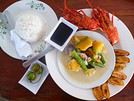
Avec un petit budget, c est vraiment difficile de manger correctement aux Philippines.
Je comprends qu'ils se rabattent sur les chaînes américaines. C est moins pire....
à titre personnel, j'ai correctement mangé dans les carinderias, et parfois très bien mangé(il y en a des bonnes, et d'autres très moyennes) pour un euros avec le coca;J'ai bien aimé adobo poulet, apretada, michado, lechon pork, apretada, michado, brochettes de porc au barbecue, poulet roti, de très bons poissons comme le lapu-lapu, bangous.Et sutout parlons des fruits délicieux, cultivés à Mindanao comme les ananas, les mangues, papayes, lansonis, rambutan, marang, mangoustin, bananes, pour un prix dérisoire que tu découvres sur les marchés.😉Beaucoup de philippins adorent le durian...😏
Là, ou je pense avoir le moins bien mangé, ce sont les KFC, Pizza hut, jollybie, chowking, etc...🤪
Mais là, ou j'ai évidemment le mieux mangé, c'est à la maison, les petits plats préparés par mon épouse...😉😉😉
Je pense que le budget n'est pas important pour bien manger aux Philippines.
Le goût des philippins est très différent du goût dans le reste du monde. Les philippins aiment la nourriture très sucrée et grasse.
Par ex., le petit-déjeuner de mon beau-frère ce matin a été: une tranche de "jambon" philippin (jambon avec au moins 10% de sucre ajouté), frit dans beaucoup d'huile 😐. Avec du riz bien entendu. Et il s'est régalé!!!
Pour "bien" manger, il faut systématiquement demander
- si la nourriture est sucrée (ajout de sucre ou soda). Si oui, ne pas commander et passer au plat suivant.
- La liste des ingrédients. De temps en temps, un ingrédient "surprenant" se glisse dans la recette. Dans ce cas, on passe encore son chemin.
Ex: le sisig est de la joue de porc coupée en petits morceaux avec des oignons et des piments. C'est très bon. Certains cuisiniers ajoutent de la... mayonnaise sucrée! Et le plat devient vite très mauvais...
Autre ex.: le poulet grillé. C'est un poulet entier simplement grillé au barbecue, qui en général assez bon. Mais les sauces qui accompagnent le poulet sont composées de sucre, de sauce soja sucrée et d'autres ingrédients indeterminés mais probablement sucrés aussi 😏. Donc il faut manger le poulet sans sauce ou se faire sa propre sauce.
Les fruits aux philippines sont pratiquement toujours bons. Il faut juste éviter les fruits muris artificiellement (certaines bananes ou mangues).
Le buko juice (eau de jeune noix de coco) est toujours bon, si le vendeur n'a pas ajouté de sucre.
Tous les produits de la mer sont bons et pas chers, si cuisinés correctement.
Des plats comme chicken tinola (soupe de poulet avec gingembre, papaye verte et des feuilles de malungay), kare kare (queue de beuf avec des légumes dans une sauce aux cacahuètes), sinigang (soupe de poisson, porc ou poulet, avec differents légumes et parfumée tamarin vert), adobo (poulet et/ou porc avec une sauce soja/citron vert (ou vinaigre)) sont très bons et pas chers: 40 à 50 pesos par personne dans les carinderias, en peu plus pour le kare kare.
Note: la principale chaine de junk food, jollybee, n'est pas américaine, mais philippine. Et c'est aussi mauvais que mac donalds. Les philippins vont en général dans les fast food entrainés par les enfants, eux même entrainés par la publicité.
@Khrapka n'oubliez pas que c'est la strategie mondiale de McDo, pas seulement aux PH : attirer les enfants par la pub et les ptits jouets afin de pousser les parents a y aller... Avant de critiquer les PH pour leurs fastfood, il ne faudrait pas oublier que la France est le numero 1 mondial (après les US) en ce qui concerne McDo...
Par ailleurs, il y a une excellente cuisine Philippine mais elle n'est malheureusement pas aussi connue que ses voisines chinoise, viet ou thai. Le Departement du tourisme a pour objectif de promouvoir cette cuisine dans les differentes foires internationales. Le probleme c'est qu'il n'y a pas une cuisine mais plusieurs reparties sur les nombreuses iles. C'est un eclatement culinaire si je puis dire qui demande une plus grande visibilite 😉
Excellente cuisine philippines, ç' est un bien grand mot, on est loin de la gastronomie chinoise ou thaï, et même de la cuisine vietnamienne. Mais il y des cuisiniers philippins qui s'applique. Le paradoxe est que dans les écoles de cuisine que je connais on enseigne la cuisine française !
Et un lapu lapu frais péché grillé sans rien ?
Ce n'est pas ce dont je parle quand je dis cuisine. Et on arrive à très bien manger avec ce que l 'on trouve sur place et que l'on cuisine. C'est moins simple pour les voyageurs qui restent peu de temps.
Perso je suis un fan du sweet and sour sauce mais bon tous les gouts sont dans la nature 😉
Pour les voyageurs , il y a des restos de haute tenue a Makati par exemple qui presentent de la cuisine Philippines. Malheureusement certains ont etudie la gastronomie en France et l'appliquent aux Philippines : grandes assiettes avec un tout petit peu a manger au milieu 😕. C'est excellent mais c'est cher et on a faim au bout de deux heures 😐
J'ajoute pour les voyageurs qui ont les moyens le Spiral buffet du Sofitel de Manille (et encore 25€ le ticket (quand il est en promo sinon c'est 50€) d'entrée pour ce buffet, quand on voit le cadre, la taille et la nourriture c'est donné).
Exact ! Et il y a aussi le resto "eat all you can" de l'hotel Peninsula qui est excellent. Le chef est de Pampanga et il fait une excellente cuisine des Philippines (il y a aussi une cuisine internationale). Apres avoir goute les plats philippins de ce resto on ne peut plus dire que les Philippines n'ont pas de cuisine ou qu'elle fait pale figure par rapport aux autres asiatiques. Il faut compter 2500 pesos par personne mais ca vaut le coup.
Le meilleur lieu ou j'ai mangé aux Philippines est le Hof Gorei beach resort à Samal Island, super cuisinier, son poisson une tuerie 😉, vraiment délicieux, pour environ 300 pesos.
J'aime aussi le buffet du restaurant Viking(eat as a viking), tu en trouves quelques uns aux Philippines ou tu as une cuisine internationale filipine, chinoise, japonaise, italienne, buffet à volonté avec désserts, , glaces, bonbons, bières, jus de fruits, café expresso à volonté dans un très joli cadre avec des banquettes confortables, air-con, toilettes pour environ 600 pesos le midi et en prime, si vous fêtez votre anniversaire, c'est gratos pour vous😉 à condition d'etre deux au minimum...
Pour le touriste lambda que je suis, même si je commence à pas trop mal connaître, ça reste le pays d’Asie du Sud-Est ou l’on mange le moins bien...et de loin !
Les junk food ne sont pas donnés. On peut se nourrir, je dis bien se nourrir, correctement dans les eatery, pour 1 à 3 euro.
Pour les carrenderia c est rarement bon. Comme c est préparer à l avance aucune chance de trouver sans monosodium glutamate. J en ai connu 2 ou 3 ou c était acceptable a correct. Et encore fallait aller aux bonnes heures comme le matin ou midi pile pour pas que les plats aient trainer des heures. En général je me limitait au kangkong (liseron deau) ou tranche de tanguegue grilled quand stop dans une caranderia. J appréciais plus par ex le Food mall de SM cebu en bas un assez bon choix de seafood mais ca montait vite a près de 400 pesos pour 2. D ailleurs j a mais vu de lapu lapu dans une carrenderia. Sinon fallait venir chez moi je fais un pusit adobo fantastique , des casag vapeur d une fraîcheur et mon voisin me ramenait toujours de leyte du porc dans une sauce cacaouete et piment en feuille de bananier . On se trompe moins avec les poulet rôti a la braise mais c est mieux de connaître les bonnes adresses , pareil pour les barbecue sticks surtout a cause de la marinade
Pour les fruits y a quand même peu de choix ok les mangues sont sûrement les meilleurs du monde après l ananas un très bon choix de bananes et les lanzones en saison c est a peu près tout. Pareil pour les légumes. En parlant de banane surtout ne pas manquer les banana stick ( banane plantain frite dans l huile sucrees)
En bord de mer être au bon endroit pour acheter a un passant un gros coquillage genre benitier ou un 7doigt bien iodé coupé en tranche encore vivant
Ne pas oublier les mangoustans (c'est la saison), les fruits de la passion, les dragons fruits, les
guyabanos(corossols ou soursop)....Les mangues, j'en suis lasse(faut le faire 😉), je fais surtout des tartes avec, un delice.Pour les lanzones, je n'en peux plus, on me les donnes gratuitement, faut dire
que Camiguin est un des hauts lieux de production aux Philippines, gros exportateur.Une productrice que je connais a pu recolter 400 tonnes cette saison.Imaginez....
Raph
Heaven is a place where nothing ever happens
Il existe au milieu du temps, la possibilite d'une ile....(MH)
Pour continuer dans les fruits: fruit de Jacques, atis (custard apple), rambutan, avocat, dalandan (petite orange verte), sineguelas (spanish plum il me semble), papaye bien sur, pastèque, goyave, santol, caimito (star apple), pomelo. Ce sont tous des fruits qui poussent dans un rayon de 500 mètres autour de ma maison...
@applevillage je voulais simplement dire que les gens (philippins, français ou autres) vont dans les fastfood pour des raisons marketing, pas pour la qualité de la nourriture.
Tous les ingrédients (poisson, fruits de mer, viande, légumes, épices) existent aux Philippines pour faire une bonne cuisine. Les grands restaurants et les gens qui cuisinent chez eux le prouvent. Le problème est, pour moi, que les cuisiniers des petits restaurants/carinderias cuisinent d'une façon qui n'est absolument pas à mon goût. Je suis d'accord avec renosu: il faut chercher pour bien manger.
Quand on est touriste, on n'a pas le temps d'essayer 10 restaurants pour trouver celui qui cuisine au goût du touriste et eliminer les 9 autres qui cuisinent au goût philippin (sprite dans le sinigang et sucre dans l'adobo).
Un truc excellent c'est du jambon cuit dans une sauce au sprite... c'est etonnant mais c'est tres bon.
Pour les fastfoods, les Philippins aiment bien y aller pour feter les anniversaires des enfants, c'est un cote festif et sympathique. La plupart ne commandent pas de hamburgers mais plutot du riz et du poulet, ces fastfoods ont du s'adapter au gout des Philippins. Il y a meme des spaghettis a la sauce tomate sucree 😏.
Mais bon, il y a un tres grand choix d'autres restaurants que fastfoods aux Philippines.
Franchement le jambon au sprite! ! .!!!!
Sinon je me rappelle avoir verser une bouteille de sprite dans la gueule du lechon baboy qui nécessitait des heures de tourner la manivelle et plusieurs caisse de biere
Un truc excellent c'est du jambon cuit dans une sauce au sprite... c'est etonnant mais c'est tres bon.
Pour les fastfoods, les Philippins aiment bien y aller pour feter les anniversaires des enfants, c'est un cote festif et sympathique. La plupart ne commandent pas de hamburgers mais plutot du riz et du poulet, ces fastfoods ont du s'adapter au gout des Philippins. Il y a meme des spaghettis a la sauce tomate sucree 😏.
Mais bon, il y a un tres grand choix d'autres restaurants que fastfoods aux Philippines.
un autre classique, les moules au sprite, surprenant mais bon
le kare kare, le kinilaw, l ' adobo, le pancit lug lug, je me le cuisine à la maison... yummi
Cette discussion m'a fait dresser les cheveux sur la tête ! Les Philippins mettent vraiment du sucre partout ? J'ai de l'arthrose aux genoux et il est vital pour moi de ne pas reprendre du poids et de continuer si possible à en perdre peu à peu, style 1 kg par mois. Je pars pour Cebu dans 10 jours. Est-ce qu'on trouve des grillades (viande ou poisson) sans arrosage de sucre ou piment ? Est-ce qu'on trouve des légumes sans sauce grasse ou sucrée ou de la salade ? Ce sera ma première fois aux Philippines.
Du pot au feu, génial, mais je ne pourrai pas en manger tous les jours pendant 58 jours ... J'ai l'intention de snorkeler souvent et la mer ça creuse, alors tout dépend après si le plat est sain, ou gras et sucré. Merci pour ta réponse rapide.
Les"Adobo" sont sans sucre.Les grillades de poissons aussi ainsi que les"kinilaws".Il y a toujours moyen de manger sans sucre.Moi aussi je deteste les plats cuisines sucres.J'habite depuis 7 ans
aux Philippines et je n'ai jamais eu de problemes pour manger.
Raph
Heaven is a place where nothing ever happens
Il existe au milieu du temps, la possibilite d'une ile....(MH)
Merci de cette bonne nouvelle. La cuisine au sprite m'a surprise aussi. C'est vraiment une très mauvaise limonade, déjà au goût, mais je ne sais pas combien elle contient de sucre, plus ou moins ce que contient une canette de coca cola : 7 morceaux de sucre ?
Un conseil, aux Philippines demander chaque fois un"Calamansi juice", *(petit citrons) et surtout
only little bit of sugar, ainsi que pour les shakes ou milk shakes ou ils ont tendance a forcer la dose de sucre.
* meme si ce n'est pas sur la carte, ils en ont toujours.
Raph
Heaven is a place where nothing ever happens
Il existe au milieu du temps, la possibilite d'une ile....(MH)
Cette discussion m'a fait dresser les cheveux sur la tête ! Les Philippins mettent vraiment du sucre partout ? J'ai de l'arthrose aux genoux et il est vital pour moi de ne pas reprendre du poids et de continuer si possible à en perdre peu à peu, style 1 kg par mois. Je pars pour Cebu dans 10 jours. Est-ce qu'on trouve des grillades (viande ou poisson) sans arrosage de sucre ou piment ? Est-ce qu'on trouve des légumes sans sauce grasse ou sucrée ou de la salade ? Ce sera ma première fois aux Philippines.
Quand je fais remarquer les moules au Sprite, c' est par anecdote curieuse…. j 'avais trouvé cela donc curieux mais bon en final, ceci dit... on n' en mange pas tous les jours
on peut aussi crever de faim aux Philippines, il y a des endroits où il y a peu à manger
lors de mon premier voyage dans le pays, j 'ai trainé pendant un mois dans des coins assez peu fréquentés avec une restauration assez simple; au bout d' un mois j' avais perdu 3-4 kgs - sur 62kgs - , j' avais maigri du visage et je n ' ai jamais récupéré le visage que je possédais avant.
Lors de mon retour en France, on me demandait souvent si j 'étais malade pour dire.
Simple, pas de beurre, pas de crème fraiche, pas de pain et croissant, pas de gâteaux, pas de fromages, pas de vins, pas d' apéro + des truc à grignoter etc et hop tu maigris. C' est le moment d' en profiter…
B
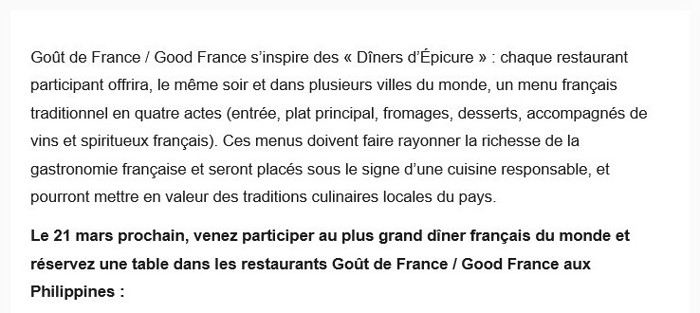
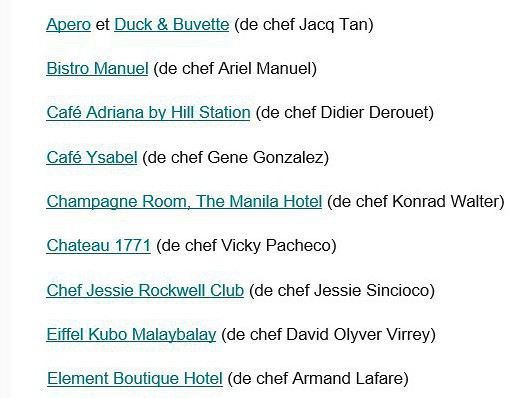
Dans un autre registre, des restaurants dans la région de Manille offrent le 21 mars 2018 des repas gastronomiques au gout de France(mais je pense qu'il faudra payer l'addition à la fin comme meme😉).Cela peut intéresser des expatriés, nostalgiques de la cuisine francaise ou des voyageurs en fin de voyage qui voudraient souffler un peu .Toutes les infos sont sur le site de L'Ambassade de France aux Philippines ainsi que la liste complète des restaurants qui participent…(en photo, en grande partie l'e-mail que j'ai recu de l'Ambassade de France).
Moi, Suisse plutot.Fondue 550p. Cordon bleu,350.Goulash,300.Tres bien servi et tres bon.Une
adresse a retenir.Mon amie a plutot mange "pinoy", j'ai goute, c'etait bien aussi.
Raph
Heaven is a place where nothing ever happens
Il existe au milieu du temps, la possibilite d'une ile....(MH)
Bonjour, A coté de notre maison, poussent beaucoup de bananes, des durians, des mangues, goyaves, fruit de la passion, beaucoup de papayes, des cocotiers, du mais, des courges, des cacahuètes et du malungai(pour mettre dans la soupe) et ce aussi dans un rayon de 500 mètres.Et on habite dans un lieu semi-urbain..Sur les marchés de Davao, il y a une grande de variété de fruits et de légumes.A Malagos, près de Davao, ils cultivent des fèves pour faire du chocolat.Les philippines sont un petit producteur de café..
Adresse a retenir pour le prochain coup.Je decolle pour Camiguin demain a 11h30.J'ai ete au HSBC hier, tiré 80 000p.Plus besoin d'aller au DAB de Mambajao pendant au moins 2 mois....😉
Raph
Heaven is a place where nothing ever happens
Il existe au milieu du temps, la possibilite d'une ile....(MH)
Oui , merci 😉
Mon épouse me dit que j'ai fait une faute d'orthographe et que cela s'écrit malungay.J'écris phonétiquement…😉
Dans quelle ville aux Philippines, le vienna coffee house ?A moins que cela soit à Vienne ou aux Etats-unis ?
ha le malunggay
cette plante arrive en force en Europe depuis un moment, en poudre ou hachée ( à Biocoop par ex ou sur le Net ) plante très riche en vitamines et autres nutriments...et effet de mode; mais sommes nous vraiment carencés les européens?
Par contre, très utilisée en Asie pour ces apports; aux Phils dans les soupes, la salade, le pan de sal...je trouve que cela n 'a pas de goût mais c' est coutumier et bon pour la santé dans les pays où tout le monde ne mange pas à sa faim.
avec malunggay, tu auras un bon terrain résistant au x microbes😉
Qui a déjà voyagé avec l’agence de voyage Laos ADV ?
Je prépare un voyage au Laos et j’ai reçu plusieurs devis. Parmi eux, ceux de cette agence me semblent très corrects et les échanges ont été positifs jusqu’à présent.
J’ai trouvé quelques avis favorables sur internet, mais j’aimerais avoir des retours de voyageurs ayant réellement réservé avec eux : organisation, qualité du guide, hébergements, réactivité sur place, etc.
Merci pour vos retours d’expérience.
hello à tous. Je vais partir en solo en février et je vous place une idée de mon voyage. Celà tient il la route?
ps: je ne suis pas amateur de plages
J1 Départ le 17 février 2027
J2 arrivée Kuala lumpur- balade chinatown et tours petronas
J3 : kuala lumpur : marché chow kit, batu caves, little india, centre ville bukit bintang
J4 : bus vers Malacca tot matin. Balade dans Malacca aprem et soir
J5 : encore 2 à 3h dans Malacca au matin puis retour bus vers Kuala lumpur. Zone merdeka square. Loger chinatown
J6 : trajet bus vers kuala tahan. Night tour
J7 : le matin : rando canopy, bukit terisek. L’aprem : vers lata berkoh
J8 et J9 : trek 2j ds la jungle du parc taman negara
J10 : vers Cameron highlands
J11 : matin rando dans les plantations. L’aprem à définir
J12 : le matin : excursion a mossy forest et plantation sungei. Aprem bus vers Ipoh
J13 : matin : zone mirror lake/ sam poh temple. L’aprem: balade au centre de Ipoh
J14 : matin train vers Penang. Aprem : balade georgetown
J15 : matin penang hill et temple keh loh. Aprem: Georgetown
J16: bus vers butterfly garden et spice garden. Fin aprem : temples birman et thai
J17: matin envol vers Singapour. Aprem: chinatown et tour de la baie
J18 : matin zone gardens by the bay. Aprem : boat quay- clarke quay- kampong glam
J19 : matin : zone the ridges et botanical garden. Aprem: little india et retour Chinatown avant vol retour de 23h15
J20 : arrivée matin
First stop on our discovery of the peninsula: Amphawa. It’s our first night in Thailand (we arrived at Suvarnabhumi at 8:50 AM).
Our initial plan was to explore the area before heading further south. The Mae Klong Railway Market is tempting... but what else is there to do????
We’ll be there on a Wednesday, and from what I’ve read on the forum, some say there’s absolutely nothing to do during the week—no floating market, barely any shops open, no restaurants, etc.
Others, though, say the place is actually more charming without the weekend crowds.
Could you share your thoughts? Missing the floating market is one thing, but if it’s really a ghost town on Wednesdays, I might just drop our bags somewhere else.
Amphawa seemed like a good first stop, just 1.5 hours from the airport, but I’d still like to settle somewhere a bit lively for our first evening.
We’ll be there at the end of October.
Thanks!
Hi,
I wanted to visit the plantations in the morning with GetYourGuide or by just showing up.
How much time should I really plan for?
I’d like to catch either the 3 PM or 5 PM bus back to KL.
Thanks
Hi,
I wanted to get some info about the cable car and the bridge—I see lots of different options...
How much time should we allow for these two activities? If we arrive around 4 PM, will we have enough time to visit without rushing?
Thanks
Hi there,
I didn’t plan to return to Thailand this year, but my health conditions mean it’ll be the best place for me to stay between two trips to India. The tourism setup there is so well-organized that it’s the most "comfortable" country for a short visit. Thailand feels too sanitized for my taste, and there’s too much religion, Buddha, and the King, but it’s still the best option given how my health has been evolving. I’d considered two weeks in ThaTon for hiking, but I got too sick from the burn-offs during my trips to the mountains around Chiang Rai. So I’m not sure where to go this year. Definitely not the sea, touristy spots, or the mountains with burn-offs...
Hi,
On September 1st, we're heading to Kalimantan for six weeks, probably from Pontianak to the Derawan Islands.
I've scoured this site, which is usually my go-to 😉, and others like VoyageForum, but recent info is pretty scarce.
I'd love any tips on places you've visited—our itinerary is still a work in progress.
We're two couples traveling with backpacks, using buses, boats, guesthouses, and homestays.
Thanks in advance!
Hi fellow travelers,
First trip to Vietnam.
We’ll be arriving in Ho Chi Minh City during Tet.
Is it complicated to find accommodation and get around during this period?
Any tips would be welcome.
Thanks for your replies.
Hi! I’d like to split my trip into two parts: 15 days in Phuket and 15 days in Krabi. Do you know if I can rent a car and drop it off in Krabi when I fly back to France?
Thanks for your feedback!
Have a great Sunday!
Martine
Hello,
After 1 night in Khao Sok, I’d like to find a 2 Days 1 Night package on the lake.
After reading a lot, I decided to "break the bank" and treat ourselves to a private tour—mainly to avoid the crowds.
But after contacting several operators, they offer "private tours" that are very expensive (around 700 €), yet in the details, the boats can only leave from the pier at 10 AM like everyone else. (I was hoping to leave much earlier.) The morning program is the same for everyone too (private or not). They drop us off at noon at our floating hotel (I’d chosen Phupha Waree). Free afternoon (swimming or kayaking in front of the hotel). We head back by boat for a 1-hour sunset ride. And the next morning, we leave the hotel at 8 AM to be at the pier by 9:30 AM at the latest—end of the trip.
So basically, we’re paying a lot for a private tour just to do the same thing as everyone else at the same time.
Or maybe I just had bad luck in my search.
I contacted Panida Ladi, who’s very popular on forums. We’d agreed on a private tour that matched my request (departure from the pier at 8 AM, very personalized itinerary). We settled on the itinerary and price, she asked for a Wise transfer for a 30% deposit, confirmed receipt of the deposit. Then 30 minutes later, she messaged me to say she was canceling everything because it was impossible to do the requested tour—and promised a quick refund of my deposit.
So here’s my question: Who’s done a *real* private tour on this lake? Who can recommend a reliable agency? Is it even really possible to do a private tour here?
I’m searching for a real gem for my 3rd stay in Koh Lanta: a lovely, high-quality hotel right by an easily accessible beach in a lively spot.
If you know of anything that fits what I’m looking for and want to share, don’t hesitate!
Hi, is anyone there in Flores right now? According to some websites, everything is closed and the situation is tough. But our guide says it's fine. Who should we believe? We're supposed to leave on September 2nd. Thanks to anyone in Flores at the moment!
Hi dear community,
I'm planning to visit Cambodia this winter, right after Christmas, for my first solo trip and my first trip to Asia. For two weeks (yes, I know it's short, but I really can't do more...). I have two main desires: Siem Reap and the countryside, the villages, the Mekong...
What do you think of this itinerary? Arrival in Siem Reap, departure from Phnom Penh.
SR: 5 days (1 day for arrival, 3 for the temples, 1 for the lake and its villages)
Kratie (stop on the way to Mondolkiri): 3 days (1 day of travel, 2 days there)
Mondolkiri/Sen Monorom: 4 days (1 day of travel, 1 day there, 2 days of treks)
PP: 3 days (1 day of travel, 2 days of sightseeing)
I think I need to cut one day somewhere if I travel from Saturday to Saturday or Sunday to Sunday. In Kratie, maybe? Or in PP? And I'll miss the boat trip that everyone recommends (SR-Battambang), but I don't see where to fit it in. Unless I do a PP-PP loop starting in the east, skip Kratie or just stay one night, then SR, then PP.
In my timing, Mondolkiri seems closer than Ratanakiri, which also tempted me a lot! Will it be too complicated alone? I'm thinking of using local guides or a small local agency for a nature and village getaway.
I've read that Siem Reap is very crowded between Christmas and New Year's. I could also do the circuit in the opposite direction. But I thought it would be easier to get familiar with the country by arriving in a touristy area—I might be wrong...
Thanks for your advice and opinions!
Hi everyone.
I’m planning my trip, and based on all the posts I’ve read, this country is amazing.
Of course, I’ve got a ton of questions for you.
Here’s a possible itinerary: Vientiane - Vang Vieng - Phonsavan - Sam Neua - Nong Khiaw + villages - Phongsali - Luang Namtha and the area - Udomxai - Huay Xai - Luang Prabang and back to Vientiane.
What do you think?
We’re planning to prioritize local transport—is it possible to do this loop?
We’d also love to go kayaking, but I’m not sure if the season’s right or where the best spot is.
For trekking—I read that Phongsali is the most authentic spot to visit villages and see wildlife. Do you know of a reliable agency and a guesthouse with reasonable prices?
Is it worth taking a slow boat for a stretch on the Mekong, and if so, which route?
For accommodations, is it better to book through Booking.com and Agoda or look when we arrive?
Are mosquitoes bad in Laos, and should we take malaria prophylaxis?
What’s the average daily budget (accommodation, food, visits)?
Is renting scooters a good option for exploring towns, and if so, which ones?
From what I’ve read, it’s best to carry cash—euros or dollars? Is it risky to walk around with that much cash?
I’ve still got tons of questions. Thanks to anyone who can help, and I’m open to all tips, info, etc.
Thanks again
Hi there,
I’m planning a trip to Vietnam in February, specifically Da Nang and Hoi An.
Does anyone know a French-speaking guide in the area?
Thanks for your help
Hi there,
I’m planning a family trip (my wife and I, both 47, and our two sons, aged 5 and 12) to Malaysia for the last week of June and the first two weeks of July 2027.
We used to love road trips as a couple, then as a trio, but since our second child arrived, we’ve taken a break with "camping village" style trips.
Now feels like the right time to get back to our old habits, while adjusting the pace for the kids.
We’re craving Asia. We’ve been lucky enough to visit Thailand, Indonesia (Bali and Lombok), and Sri Lanka before.
Friends have raved about Malaysia, so we’re definitely tempted.
For those who know and love Malaysia, what would be a good itinerary starting from Kuala Lumpur, with a maximum of 3-4 stops? We’d like a mix of culture, nature, and relaxation (just to clarify, we’re not big beach fans). All of this without rushing, of course.
Hello,
We’re a family of four with two teens aged 16 and 18. We’re heading to Thailand this summer. We’ll arrive in Bangkok and plan to take a flight to Luang Prabang.
I’ve seen there are some great visits and excursions to do (temples, markets, waterfalls) and maybe even venture a bit north to places like Nong Khiaw, Muang Xay, Muang Ngoy, or Oudom Xay.
But I’ve also heard about the Bokeo region with the Gibbon Experience.
Since we won’t be able to do everything, I’d love to hear about your experiences, impressions, and advice on the two options I’m considering, especially since we’ll be meeting family in Chiang Mai, Thailand, afterward.
Option 1: A loop from Luang Prabang heading slightly north, then a flight from Luang Prabang to Chiang Mai.
Option 2: A few days in Luang Prabang, exploring within a few dozen kilometers around, then heading to Bokeo province for the 2-day/1-night Gibbon Experience. For this option, I saw on Rome2Rio that it’s possible to book a ferry trip on the Mekong from Luang Prabang to Huay Xay—they mention about 8 hours. But is that realistic? What type of boat is it?
Then, to get to Chiang Mai, there aren’t many options—bus or minivan—but how does crossing the border work?
Finally, for those of you who’ve been to Laos in August, what was the weather like?
We’ve already visited Thailand, Vietnam, and Cambodia during the same period over the past four years and weren’t really bothered by bad weather.
I’m starting a discussion about guides in the Mekong Delta because we’ve just finished our trip in this region and had a hard time finding a French-speaking guide. We had Thanh—she speaks French really well and travels all over the delta region, including Ho Chi Minh City. She’s super friendly and flexible. I recommend her wholeheartedly. If it can help someone...
Feel free to contact us for her number.
Hi everyone,
I couldn’t find any recent info on Kuching.
Can anyone recommend a hotel or guesthouse for under 100 RM that’s nice and affordable? No dorms, please.
Also, does it rain a lot in November, and is it still worth visiting Semenggoh or Bako?
We’ll be arriving in Phnom Penh this coming January and we’re thinking of starting our trip with a stop in Kampong Cham, then Kratie.
After Kratie, we’re considering heading toward Siem Reap with a stop in Kampong Thom.
That said, I’m not really sure how long the Kratie–Kampong Thom journey might take or how complicated it is.
Does this stop on the way to Siem Reap seem like a good idea to you?
If we don’t visit the Sambor Prei Kuk site, are there still any walks or sights worth checking out in Kampong Thom?
Silly question—backpack or hard-shell suitcase for the Sepilok, Kinabatangan, Tioman, KL trip?
I’m struggling to fit all my son’s and my stuff into the 70L backpack... and I’m thinking a suitcase would be easier, but I’m not sure if it’ll work for getting around.
After a stay on Koh Phayam this coming November, I’d like to spend 2 or 3 days on Koh Phra Thong before heading further south.
Do you think it’s doable to leave Koh Phayam early enough to catch the 10 AM boat from Khura Buri to Koh Phra Thong? The next one isn’t until 4 PM, which would cost me a whole day.
I’m planning a trip to Indonesia, specifically Sulawesi and Java, in September for 10 days.
I don’t know this part of the world at all—any advice is welcome!
I’ll be traveling solo and would also love tips on meeting other travelers or locals.
Hello everyone,
Not long ago, I used to travel as a couple, but my husband has since passed away, and I’ve decided to set off again. The trip I took to Cambodia in January 2025 did me a world of good.
I’m now considering Thailand, a destination we never included in our plans because even 15 years ago, people said it was too touristy. Still, I’m thinking about the itinerary below, but I don’t feel up to arranging buses, trains, or guides on my own while I’m there. I’m looking for one or more drivers and have been in touch with an agency, but their offers are just copy-paste group tours that I don’t want.
So, if you have any contacts, experiences, or advice, I’d be so grateful if you’d share them with me. Here’s my rough plan:
Arrival in Bangkok
Ayutthaya (2 nights)
Kanchanaburi (2 or 3 nights)
Sangkhlaburi/Sai Yok (3 nights)
Sukhothai (2 nights)
Lampang (I’ve planned 3 nights, but that might be a bit much—it depends on what time I arrive in the city)
Chiang Mai
Chiang Dao
Pai
Chiang Rai
I was thinking about the Mae Hong Son loop—thoughts?
What do you think about staying overnight at the Golden Triangle?
When I look online, of course, I can find agencies that organize tours to national parks, etc.
I’m retired but in great physical shape. I’d rather go hiking than sit in hot springs with crowds of tourists who’ve all arranged meet-ups. I don’t want to spend a day at an elephant camp, and I don’t want to visit Karen villages.
I’d love to hear your advice.
Thank you all,
Hi everyone,
Could you share your thoughts on my 3-week itinerary?
We’re a small group (family + friends) of 12 people, planning to leave around January 21, 2027.
Here’s my itinerary:
3 nights in Bangkok
4 nights in Chiang Mai
3 nights on Koh Samui
3 nights on Koh Phangan
4 nights in Krabi
4 nights in Phuket
I’m also open to any great tips you might have...
Thanks, everyone! Alain.
Hi there,
We’re planning a 3-week family trip next summer with our three kids, who’ll be 8, 8, and 7 years old.
After some research, we’re leaning toward Malaysia to combine nature/forests and paradise beaches. The idea is to introduce our kids to the country’s culture, nature, and wildlife.
We want a great trip but without splurging on luxury options like high-end lodges and resorts. We’re looking for comfort with a touch of authenticity—basically, a good middle ground.
I’ve started putting together an itinerary and would love your expert advice and tips to help us build this amazing trip with our little ones.
Day 1: Departure from France
Day 2: Kuala Lumpur
Stay at a hotel near the airport or KL Sentral.
Just one night.
Day 3: Morning flight to Sandakan (Borneo).
Stay in Sepilok
Day 4: Sepilok:
* Orangutan Center
* Malayan Sun Bear Center
* Rainforest Discovery Centre
Day 5: Depart for Kinabatangan.
Boat safari in the late afternoon.
Day 6: Sunrise safari.
Jungle walk.
Evening safari.
Day 7: Final safari.
Return to Sandakan.
Flight to Kuala Lumpur, then to Kota Bharu (or overnight transit depending on schedules).
Day 8: Transfer to the port.
Boat to the Perhentian Islands.
Days 9 to 13: Perhentian Besar
5 full days.
* Snorkeling
* Hiking
* Turtle watching
* Wild beaches
* Relaxation
Day 14: Return to the mainland.
Bus or private car to Taman Negara.
Summer seems to be the best time weather-wise for Bali.
And since summer’s when we can take a long trip, let’s go for Bali... even though we know it’ll be *packed* with people!
So we’ll steer clear of the island’s south...
Our current plan (19 days on the ground, 7 stops):
- 4 Nights (3 days) in Ubud
2 days for rice terraces / activities (Tegallalang, Campuhan Ridge, Monkey Forest, Bird Park, coffee plantation, market (?), dance "pestacle," cooking class and/or spa)
1 day with a driver for the Temples (Pura Gunung Kawi, Tirta Empul Spring, Pura Mengening, Goa Gajah...)
- 2 nights in Sidemen (1 day for Pura Kehen + Batur Caldera + Pura Besakih and 1 day to relax in the rice terraces)
- 3 nights on Gili Meno (Rest and beaches) from Padangbai
- 2 nights in Amed (1 day from Padangbai with the Abang rice terrace and Tirta Gangga baths, and the next day a boat tour in Amed)
- 4 nights in Pemuteran (1 day for transfer and rest, 1 day to visit Kawah Ijen, and 2 days of snorkeling at Menjangan Island)
- 2 nights in Munduk (1 day with the Dayang rice terrace and the 3-waterfall hike, 1 day at Pura Ulun Danu Bratan)
- 2 nights in Jatiluwih (1 day in the rice terraces, and on the last day, we’ll stop by Pura Taman Ayun in Mengwi and Pura Tanah Lot before catching our red-eye flight).
Accommodations in homestays or hotels.
Transportation to be arranged on-site with the lodgings (?)
Boat to Gili Meno to book in advance (?)
Kawah Ijen excursion to plan ahead (?)—check with the homestay (?)
Thanks for your thoughts/comments to help us explore this destination...
After reading and researching, we're planning the following stops in Cambodia in January 2027:
- Phnom Penh
- Kampong Cham
- Kratie
- Siem Reap
- Battambang
- Kampot (round trip)
I'm wondering about the direction of these stops, which could also influence our international flights.
Either a round trip from Phnom Penh in the order above.
Or landing in Siem Reap with the following order:
This second option would save us the Battambang - PP - Kampot trip but means doing a round trip to Battambang from Siem Reap and placing the "highlight of the trip" (Angkor) at the beginning of our stay.



 Deux semaines de rêve sur PalawanFR
 Les Philippines en familleFR
 Questions sur le tourisme aux PhilippinesFR
 Choisir entre l'Indonésie, les Philippines et le Sri LankaFR
 Carnet de voyage Siargao/Cebu aux PhilippinesFR
 Trip report: Coron and Palawan in the Philippines
 Du nord au sud de l'archipel philippinFR