For you, Max, who not only loves Zambia but also its people. An article in today’s *Le Monde*.
In Zambia, a historic drought disrupting lifeFor a year now, the lack of rain in this southern African country has had multiple social consequences. Poor harvests, power shortages, food insecurity: many aspects of daily life are affected.
Ruth Sibanda may be an experienced farmer, managing six plots and around twenty employees near Mungule, 30 kilometers from Zambia’s capital, Lusaka, but this year her expertise wasn’t enough to save her precious crops. The 15 hectares she planted with maize—a staple turned into nshima, a thick, nourishing flour ball—yielded only four bags, far from the expected 120. The same disastrous results for garlic, onions, and beans. Only the chili peppers held up. « This is the worst drought » this elegant and cheerful 39-year-old woman has ever known.
In Zambia, the rainy season typically lasts about four months, from November to March. But in December 2023, « the rain came for two weeks, then it stopped », halting the growth of plants mid-development. « Everything dried up », says the farm manager as she walks through one of her fields, its sandy, parched soil. « We faced huge losses, we hit rock bottom », she adds, noting that some local farmers took their own lives. « They couldn’t handle the pressure of watching their crops die, wither before their eyes. »
Southern Africa is experiencing a historic drought linked to the natural El Niño phenomenon, considered the most severe in at least forty years. Zambia, along with Zimbabwe, Malawi, Lesotho, and Namibia—a significant part of the region—have declared national disasters. As a result, 27 million people have been plunged into hunger, according to the World Food Programme. The UN agency warned in mid-October of the risk of a « large-scale humanitarian catastrophe ».
In Zambia, traditionally a breadbasket, one in four people is now facing food insecurity. Harvests have dropped by 43% compared to the five-year average (50% for maize), according to the UN’s Food and Agriculture Organization (FAO). In rural areas, family farming—mostly subsistence and non-irrigated—is the hardest hit. Many households are limited to one meal a day due to shortages and soaring prices, reports the NGO Care. Maize prices have risen by an average of 40%, according to the FAO. Some residents even speak of prices doubling. « With the drought, we can only afford small bags of maize, which cost more », laments a group of women with drawn faces near Siavonga, in the south of the country. As for water, « it’s a big problem. The village only has two pumps. In the morning, we reserve them for people, in the afternoon, for the goats », explains one of them, Catherine Palamasaka.
Along the road where their hamlet, Bendele, is located, the landscape is dotted with bleached trees and dried-up riverbeds. Every kilometer, large sacks overflowing with black blocks are for sale: turning away from their fields, residents have shifted to making charcoal. « It’s the only way to survive here, the only business », continues Ms. Palamasaka. The work is tough—trees must be sourced « far away, deep in the bush » to avoid trouble with authorities, who have theoretically banned the practice to curb deforestation. But charcoal, sold here for 75 kwachas (2.60 €) per sack, « is what allows us to send our kids to school », she says. When the rains return, this mother of five plans to replant maize but also continue making charcoal, to avoid reliving such « hell ».
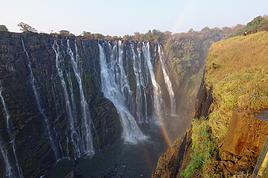
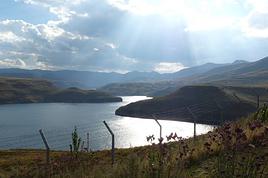
The irony is that Bendele is only a few dozen kilometers from one of the largest artificial water reservoirs: Lake Kariba. The construction of a hydroelectric dam on the mighty Zambezi River (the famous Victoria Falls lie upstream) in the 1950s created this lake, over 200 kilometers long, on the border with Zimbabwe, which co-manages the hydroelectric power. From the massive concrete arch spanning a lush gorge, the lake still appears vast, but its level has dropped several meters, no longer providing enough power to the turbines. The Zambian side of the plant can, according to the operator, produce only at 10% of its capacity (around 1,000 megawatts). A disaster for the country: Kariba is its main source of electricity. As a result, blackouts now last up to twenty-one hours a day, officially.
In Lusaka, the wealthier have generators or even solar panels, but for others, life without electricity means no milk storage, no phone charging, or homework after dark. Many informal workers have also lost their livelihoods. In the Kalingalinga neighborhood, home to welders and carpenters, Benson Simakondo spends his days waiting—even on Sundays—in front of gates and metal structures he can’t finish. His tools sit idle in the backyard. « We come and sit, waiting to see if they bring power, says the 46-year-old welder, father of five. They give us just two hours, sometimes less than an hour. They announce schedules but don’t stick to them. »
Often, the much-anticipated two hours only arrive in the evening. What to do? « You go home and see the electricity is back, so you know it’s at the workshop, explains this calm man. If it’s at 6 PM or until 9 PM, we come back and work. But when it comes at midnight or 2 AM, it’s really tough. » Some in the neighborhood had enough savings to buy a generator, but not him. Mr. Simakondo says welders’ average incomes have dropped from about 25,000 kwachas a month to just 1,000 kwachas. « We can’t pay our rent because of this electricity », he sighs, urging the government to act « so young people can work instead of turning to theft, sometimes even stealing from their neighbors ». He also calls on « those in power to plan ahead, because these droughts will return ».
The government, like all Zambians, is counting on the start of the rainy season, which is on the way. A few showers have already reached Ruth Sibanda’s fields, but she’s far from declaring victory. Many factors will continue to weigh on production and drive up prices: seeds are expensive, farmers are in debt, the harvest won’t come until April, and the arrival of La Niña—the opposite of El Niño—could bring above-normal rainfall. « If there’s too much water, our crops will likely rot, she predicts, standing before tiny new maize shoots, barely visible. « In my opinion, it’ll take three years to recover from this drought. »
(*Le Monde*, please forgive the reproduction of this otherwise freely accessible article)
https://www.lemonde.fr/planete/article/2024/12/08/en-zambie-une-secheresse-historique-qui-deregle-la-vie_6436235_3244.html