Travel journals · Oman
FR

← Travel journals: all destinations

FA
Fabhyène 4 weeks ago · Kate
Oman, at the edge of the sands and the horizon


If I close my eyes and think of the Sultanate of Oman, I first smell a light scent of incense, feel the warmth of a sunbeam on my skin, before sand slips through my fingers. I taste the sweetness of a date, a real candy, then the flavor of coffee with a hint of cardamom and rosewater... I hear the desert wind whistling in my ears, the distant call of a muezzin, then the murmur of water. I open my eyes to see smiles, welcoming gestures, a turquoise sea, rocks ranging from ochre to purple, deep wadis where torrents burst forth, orange dunes, white sandy beaches where tiny crabs scurry at full speed. I see incredible oases emerging between arid mountains. I see abandoned villages that I’d dream were full of life, imposing fortresses overlooking valleys, and lively souks where offers are delicate and negotiation is a mutual courtesy.

All that, and so much more.

This is what I tried to capture in my illustrated travel journal, which I’ll fill in here and there with photos. I drew this journal “cold,” after my return (actually, I made it this summer, while our trip was last winter). It’s a pretty special format—I bought it in Japan without really knowing what I’d do with it. Well, it found its purpose! Below is a photo of this accordion-style journal: here, it’s only partially open, because when fully unfolded, it’s 5 meters long!
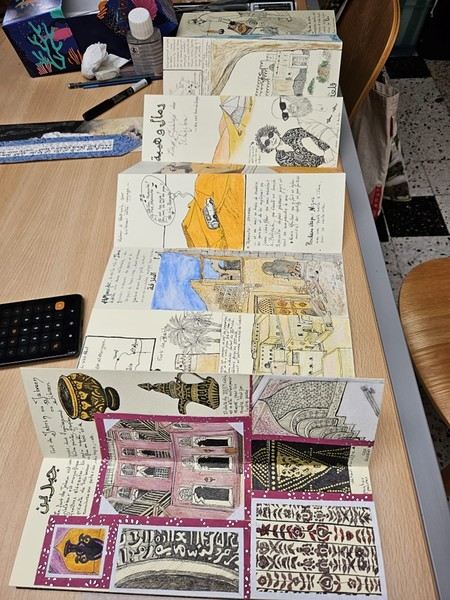


For drawing enthusiasts: The accordion format is both a constraint (each sheet is 9 cm x 27 cm) and a freedom (you can create a fresco). The paper is also a bit special: it doesn’t allow for fine lines, but it takes ink well (liner pen). However, everything has to be done almost in one go (with a very light pencil sketch) because it erases poorly. It absorbs too much water for coloring with markers or watercolors (unless you avoid soaking it), but it works well with oil pastels and their use with a brush and solvent. Since it’s yellowish, it allowed me to create contrasts even with white pastel.
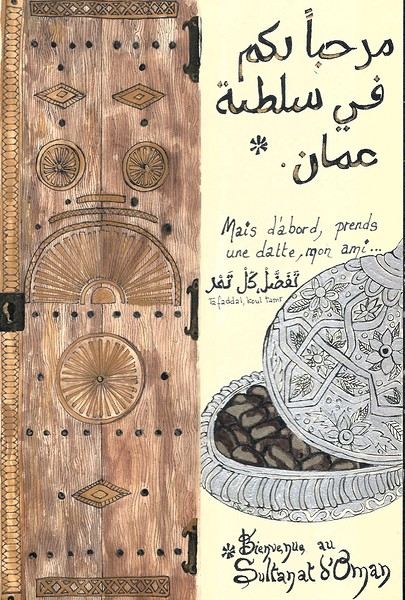
On the right, the "welcome marker"—those dates offered everywhere as a sign of hospitality. On the left, a tribute to those stunning doors worn by time, admired all over the old quarters, including the abandoned ones.
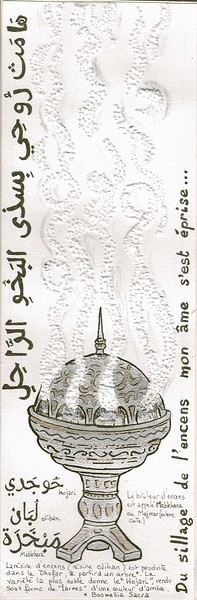


Oman is one of the world’s largest producers of frankincense resin. Incense burners are everywhere, from the simplest clay ones to the most precious handcrafted silver ones...

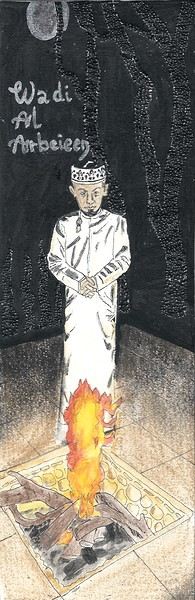
Hospitality will often lead you to accept a small coffee, an "Omani coffee," very light, subtly flavored with cardamom, maybe a touch of saffron, and occasionally rosewater. Here, I’ve depicted a man in the common everyday attire of Omanis: the dishdasha, mostly white (during the week and daytime; colors are more common in the evening or on Fridays and Saturdays). While you’ll see some men dressed in Western clothes, they’re very few. The white dishdasha is truly the shared attire of all men. The dishdasha, which has no hood, is distinguished by a small pom-pom attached to the collar, the furakha, which is soaked in perfume. And believe me, Omanis go overboard with it! "It smells like the pom-pom" is an expression that’s now part of our shared language, my husband and I. Another must of men’s attire is the kuma, a small round head covering, usually white with brightly colored patterns. The keffiyeh is also worn (but without the cord called an agal in Arab countries), and it’s mostly worn by those with roots in the desert, from what I understood. And what about the women, you might ask? Some are veiled, some in full black (but not a burka—more like a chador + abaya), due to the influence of Saudi Arabia and the United Arab Emirates, whereas the traditional outfit used to be a layering of very colorful dresses. Most of the women we saw wore neutral clothing, a plain veil over their hair, but with their faces uncovered. We also saw many saris and colorful veils—don’t forget that 40% of the population consists of Indian, Nepalese, and Bangladeshi immigrants, who work a lot in tourism, hospitality, restaurants, services, and construction. Just to clarify, as a tourist, there’s no pressure to wear a veil, and never any disapproving looks. Of course, you’ll save the mini shorts, plunging necklines, bare shoulders, and midriffs for the hotel terrace—but I’d say that’s the same for men and women, and with the sun being strong, it’s better for your skin too. Here’s the introduction! In the next post, I’ll tell you about my itinerary, and we can dive in!
Open
JA
Jacquesler 9 months ago · Totoescalade
Practical Oman - Back from 18 Days in the Sultanate
Hello, We’re back from an amazing 18-day solo trip in the Sultanate of Oman. Here’s all the practical and useful info (I think). Flights with Oman Air from CDG Paris – on time – good meals – screen. **Phone**: I got the Oman pass from Orange for 29.99 € before leaving – valid for 30 days with 20GB – SMS, etc. Everyone uses WhatsApp there. **Car**: Booked with Travz Car Rental – 18 days – 175 rials – no deposit – delivered to the airport at P1, Level 1 – Tel. +968 9536 1234 – return at P1, Level 4 – all at your convenience and no waiting. I recommend, a brand-new sedan (1,300 km on the odometer) – enough for everything (even Jebel Shams but not Jebel Hajar and the desert). Fuel at 0.229 rials per liter and available everywhere, car wash for 1.5 rials. **Exchange**: We went near the Grand Mosque to exchange money at Unimoni – tel. +968 99326724 – the exchange rate is around 1%. **Hotels**: **Muscat**: Haffa House Hotel (Ruwi) – 54.09 rials – 3 nights with breakfast included – very good hotel – pool – I recommend, and lots of restaurants nearby. **TIWI**: Night at Tiwi Pearl – great welcome even though it wasn’t easy to find – 21.12 rials + breakfast – tel +968 98046446 – I recommend. **SUR**: Zaki Hotel – well located – breakfast and restaurant – tel. +968 79011186 – nice room – I recommend. **RAS AL HADD**: Super OYO 110 – located at the end of the track – tel. +968 93612026 – ask for rooms with a balcony on the 2nd floor – 17 rials with breakfast. **ROMAIL**: Oriental Nights – tel. +968 92896363 – 2 nights for 47 rials without breakfast (2 rials per person, while everywhere else it’s 1 to 1.5 max). The room is very nice. Avoid the food, which is poor and expensive for the country, but there’s nothing else around. **SINAW**: Ain Safnan – tel +968 90627212 – 16.17 rials without breakfast – nothing extraordinary, but there aren’t many choices. However, it’s very well located. **NIZWA**: Nima Guesthouse – very well located in the center – tel +968 90919095 – 2 nights for 45.05 rials + breakfast at 1.5 rials. **AL HAMRA**: Dar Al Hamra – 3 nights for 47.20 rials + breakfast at 1.5 rials – a peaceful haven in the middle of the palm grove with a pool. I recommend. **IZKI**: Cloudy Cloud – a bit isolated but a restaurant 2 minutes away – very nice room – tel. +968 95087776 – 20.08 rials per night. **SEEB**: Al Waves Hotel – 27 rials per night with breakfast – restaurant – 10 minutes from the airport, a very nice Thai/Chinese hotel – beautiful pool and terrace with sea views. That’s the essential info and quick contacts. For more, send me a private message. Happy travels! Jacquesler
Open
GI
Ginedilebart 2 years ago · Blancond
Back from 3 weeks in the Sultanate of Oman
Back from 3 weeks in Oman. My wife and I just returned from 3 weeks in the Sultanate of Oman. I have to say we had a really enjoyable trip. While we usually prefer self-organized trips (real or imagined sense of freedom?), this time we opted for a pre-organized trip with the agency "Omanselfdrivetour" run by Paul Sistac—and we don’t regret it! Based on a 15-day itinerary, we asked for a few adjustments and additions to make it a slightly more active 3-week trip. We rented a 4x4, which is essential for accessing many mountain villages. The road book, prepared by Paul, suggested visits and activities along the routes connecting our accommodations (always well-chosen for their character). We were free to follow it or not, but I have to say it was so well done that we pretty much did and saw everything it suggested—our days were packed! Oman is a country that lends itself well to many outdoor activities thanks to its mountain ranges (the highest peak is at 3000 m) and especially its "Wadis." A "Wadi" simply means "valley," but the local geology makes these valleys often very deep, resembling beautiful canyons. You can explore them by car in the wider ones, on hikes (some with water) in others, and even canyoning (with the right gear) in the narrowest ones with waterfalls, like the stunning Snake Canyon. There are also great mountain hikes, well-marked, often leading to villages abandoned in recent years or decades. These villages are usually hours away on foot, nestled under massive rock overhangs (like those in Saab bani Khamis or Masirat al Jawamid), sheltered from the tropical sun and attacks. For sunbathers, the Indian Ocean coastline offers beautiful beaches and some luxurious hotels. You can also rent kayaks to get a closer look at the rocky shores. Snorkeling is possible too (some spots are well-known), though conditions weren’t ideal during the few days we were by the sea (too much wind and murky waters). Most of the country, however, is a vast desert. We spent 2 days in the Wahiba Sands dunes, but it wasn’t really our cup of tea. Oman has some scattered historical monuments, like well-restored forts that reflect its history of internal rivalries—similar to our medieval castles. The capital, Muscat, is pleasant and has a few great sights to explore over 2 days, like the old center (with the Sultan’s Palace and the National Museum), the Sultan Qaboos Grand Mosque, and the Opera House. Sultan Qaboos, who passed away on January 10, 2020, after nearly half a century of rule, was sometimes called the "Philanthropist Sultan." He worked to modernize his country and open it up to tourism. Visitors are warmly welcomed by a tolerant and hospitable population. Omanis are always ready to help passing travelers, happy that they’re interested in their country (it’s not uncommon to be offered coffee, fruit, or other gifts for no reason). The only downside: despite trash bins being everywhere, their use isn’t yet universal. So, if you’re thinking of visiting Oman, now’s the time—before the crowds of tourists arrive on low-cost flights. If I can humbly and modestly help anyone plan their trip, I’d be happy to.
Open
IS
Isachristian 2 years ago
7-Day Oman Itinerary
7 days in OMAN Day 1: Muscat for a few hours to gather info on diving near the Dimaniyat Islands. Then a tour of the souks and the corniche. The next day, we dropped our diving plans to focus on a "landscapes" vacation.

Day 2: Headed to the mountains with a picnic stop at Nakhal Fort (so renovated it feels like Disney, but really beautiful). In the afternoon, Maps led us astray on rocky paths—we got a flat, and by the time we fixed it, it was dark. We slept near WADI DAMM. Luckily, we stumbled upon a farm stay in the middle of nowhere, right by the wadi for the next day. We found a café selling amazing dhal with bread—but no utensils!—and a small shop for tea and pastries for the next morning. Day 3: WADI DAMM, a long hike up a canyon—gorgeous but very dry. On the way to Oman’s highest mountains, JEBEL SHAMS! But what Maps said would take 1.5 hours turned into hours on off-road trails. We arrived at the top at 4 PM—stunning, but the sun was already low. We hiked for 30 minutes along the corniche and turned back (Balcony Walk). We drove down to Al Hamra as night fell and found a cute hotel where the guy cooked us an incredible chicken. Day 4: Visited MISFAH, an old mountain village. We descended into the wadi and climbed up the other side for the view—absolutely breathtaking! *** Headed to NIZWA for its fort and souk—nice! Apparently, you should visit Friday morning for the camel market (to be confirmed).

Day 5: Headed to the desert, but first, a stop at WADI BANI KHALIL (great hike, even with crowds). The sandwich on the rocks and the swim before leaving were awesome. We reached the sand desert, left the car, and were taken to camp—just us and two young guys serving tea and meals. So beautiful! The walk around the camp in the dunes was fun, the photos were amazing—overall, a fantastic experience!

Day 6: Walked around the desert near camp after breakfast—gorgeous! They drove us back to the car, then we stopped at a shop for a picnic at WADI SHAB. Crossed by boat, but the hike afterward was great—had to swim in some spots, so bring a dry bag. Found a nice guesthouse by the sea nearby and a restaurant in Tiwi since it was already late.

Day 7: After a failed swimming attempt (the waves were too strong), we went to WADI TIWI—nothing special. Then WADI ARBEIEEN as we headed up the coast to the airport, where we crashed for 6 hours at a hotel before flying home!
Open
SO
Solene40 2 years ago
How surprising this Sultanate of Oman is
Hey fellow travelers,

We’re a couple in our fifties who’ve been traveling independently for ages—mostly in Asia, a bit in Africa, very little in the Americas, and never ever in West Asia until November 2023, when we discovered the Sultanate of Oman.


If we waited so long to explore this part of the world, it’s because a few questions were nagging at us, like: Can two Landais party lovers like us survive 15 days without apéro 😄? Or, more seriously: Can a feminist like me enjoy traveling in such a conservative country?

That is the question (and I feel your pain with this unbearable suspense 😅).

Ready to dive in?

PS: Apologies in advance for the casual tone of this travel journal—it’s the one I shared with our loved ones in real time, which explains everything.
Open

Recommended for you

Previous Page 1 of 1 Next

31 more discussions in this forum are in French. Browse them on the French forum