last edited Dec 11, 2019
Culture and Customs of Réunion
Location Map of Réunion
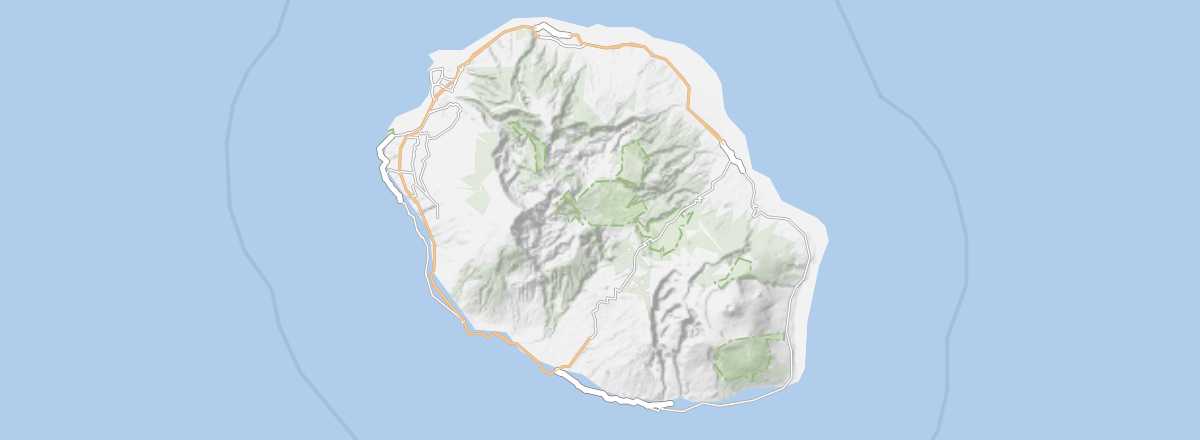 Réunion
Open the interactive map
Arts, Crafts, and Architecture
Arts
Crafts
Architecture
Museums
Customs and Traditions
Local Traditions
Etiquette
Dress and Behavior
Sensitive or Taboo Topics
Nothing specific compared to the rest of France, except perhaps the "economic dependence of the island on Paris" or referring to "France" when meaning the mainland, even though Réunion is a French department.
Languages
While French is the official language, Creole is also widely spoken on the island. Note that, although it draws heavily from French, Réunion Creole is specific to the island and may not be understood by speakers of Antillean Creole, for example. Other languages are also spoken by minority communities on the island, such as Tamil, Gujarati, Chinese, Malagasy, and Comorian.
Glossary
A few local words and expressions useful for travelers:
- Achards : spicy vegetable salad.
- Bouchon : of Chinese origin, a small steamed dumpling filled with meat.
- Cafre : Black person whose ancestors, whether enslaved or not, were brought from Africa.
- Camion bar: an institution that is disappearing—these mobile trucks parked by the roadside sold Creole food or sandwiches.
- Cari : the signature dish of Réunion. A stew made with meat, fish, or vegetables, cooked with turmeric.
- Case : house.
- Cirque : a natural, generally circular enclosure with steep walls, of volcanic origin in Réunion, found in the island’s interior.
- Créole: originally referred to descendants of colonists born on the island. Today, it broadly means anyone born in Réunion.
- Dodo : the brand of the local beer.
- Filao : a common tropical tree.
- Hauts: the central, mountainous part of the island.
- Ilet: a plateau in the interior, difficult to access, and by extension, an isolated village in the Hauts.
- Malabar: Réunionnais of Indian origin.
- Maloya : traditional music of enslaved people, still popular in Réunion.
- Marron: or "maroon." Formerly referred to enslaved people who fled and took refuge in the Hauts.
- Rhum arrangé: rum infused with fruits and various spices.
- Rougail : another popular dish and a variant of cari without turmeric, as well as the spicy sauce that accompanies it.
- Séga: another beloved music style on the island, blending maloya with European folk dances like the polka or quadrille.
- Tamarin: another typical tree of Réunion.
- Z'arabe: people of Indian and Muslim origin.
- Z'oreille: a metropolitan French person living in Réunion, usually temporarily.
- Z'oréoles: those who move to the island permanently.
Festivals and Celebrations
Among the various events, Réunion hosts several Hindu religious festivals that, while not public holidays, are often observed due to their significance. Some of the most notable include:
- Cavadee: a spectacular festival held in January or February. After a period of fasting and prayer, pilgrims process to temples carrying "cavadees" (decorated sculptures). In some countries, participants also pierce their bodies with needles during this event.
- Dipavali: a year-end festival marking the "victory of truth over ignorance." Across the island, people light small lamps at dusk, believed to bring good luck.
- Fire Walking: a ceremony held between December and February. After ten days of purification, participants walk on hot coals before cooling their feet in milk.
Public Holidays
In addition to the same public holidays as mainland France, December 20th—commemorating the abolition of slavery—is also a public holiday.