last edited Dec 11, 2019
Getting Around Hungary
Location Map of Hungary
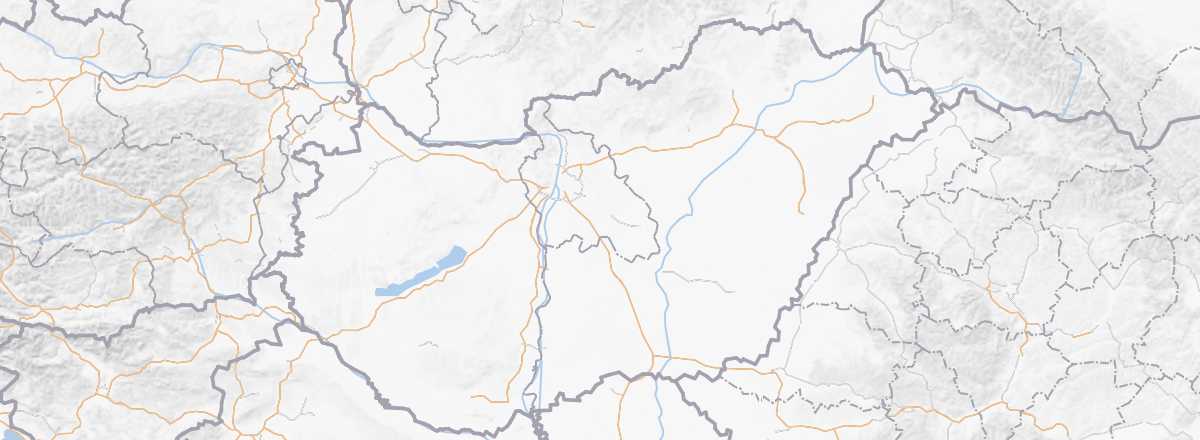 Hungary
Open the interactive map
Hungary
Open the interactive map
Road Network, Traffic
Car, Camper Van
As is often the case in Europe, having your own vehicle is a good option for exploring the country once you’ve decided not to limit yourself solely to Budapest. Moreover, given its central location, Hungary is never too far from most other European countries; Paris to Budapest is less than 1,500 km. Another advantage is that, in terms of paperwork, there’s nothing special required for vehicles already circulating within the Schengen Area. However, be aware that to drive on Hungarian motorways, you need a vignette, which can be purchased at the border or in service stations. These are available for periods ranging from 10 days (12 €) to one year (55 €). Without a vignette, you risk a fine.
Rental
Buses and Shared Vehicles
The country has a well-developed bus network with numerous national and international routes offered by the "group" Volan. This is actually an association of around twenty local companies operating under this label.
You can easily travel by bus throughout the country, including off the beaten track, with express services on major routes and slower, less comfortable options on secondary networks. Prices are quite affordable and slightly lower than those of trains.
In short, the bus is a good mode of transport for those who aren’t self-sufficient in terms of travel. Except for a few routes from Budapest to major cities, it’s generally preferable to the train, if only because you’re not forced to pass through the capital for province-to-province trips.
Two Wheels
Motorcycle
Bicycle
Hungary, being a country without significant elevation changes, is particularly appealing to cycle tourists, especially beginners. There are quite a few cycle paths and opportunities to ride, for example, along the Danube or the Lake Balaton. It’s also permitted to take your bike on trains if needed.
Note that Hungary is crossed by several routes (6, 11, and 13) of EuroVelo, the major European network of cycling routes covering tens of thousands of kilometres across almost the entire continent.
Hitchhiking
Trains
Hungary has over 8,000 km of railway tracks, with a fairly dense network but one that has the drawback of being centred on the capital, from which almost all lines depart and arrive. As a result, there are few or no transversal lines, and you’re almost always required to pass through Budapest to travel between two provincial cities. Several companies operate the services, primarily the national company MAV and GySEV, which is present in the west of the country.
In terms of trains, there are both "InterCity" services, which are relatively fast and comfortable for serving major cities, and others that are much slower and sometimes outdated for secondary networks. However, in all cases, trains remain quite economical. Expect around 5 € per 100 km, often with additional specific discounts. Hungary is also included in the InterRail pass.
Boats
You can travel by water on the Danube and the Lake Balaton.
- Danube: The company Mahart operates a seasonal line from Budapest to Vienna via Bratislava. Along the way, their hydrofoils also serve the Hungarian cities of Szentendre, Visegrád, and Esztergom.
- Lake Balaton: In addition to sightseeing cruises, there are small ferries operated by Balaton Shipping that run between Szántód and Tihany.
Domestic Flights
There are no domestic air routes within Hungary.
In Towns
Taxis
Other Means
Urban buses:
Trams:
Metro:
Bicycle: Bike rental and cycling have developed well in Budapest and a few other cities.
On foot:
What to Choose for Getting Around?
As is often the case in Europe, having your own vehicle remains the best way to explore the country. Otherwise, buses are a good option for those without a car.
Distances Between Cities
Distances (km) between the main cities in the country:
| Buda. | Debrec. | Györ | Miskolc | Pécs | Siofok | Sopron | Szeged | Szomb. | |
|---|---|---|---|---|---|---|---|---|---|
| Budapest | 230 | 120 | 185 | 200 | 105 | 210 | 175 | 225 | |
| Debrecen | 230 | ||||||||
| Györ | 120 | ||||||||
| Miskolc | 185 | ||||||||
| Pécs | 200 | ||||||||
| Siofok* | 105 | ||||||||
| Sopron | 210 | ||||||||
| Szeged | 175 | ||||||||
| Szombathely | 225 |
Siofok*: on Lake Balaton