last edited Aug 18, 2020
Getting Around in Greece
Location Map of Greece
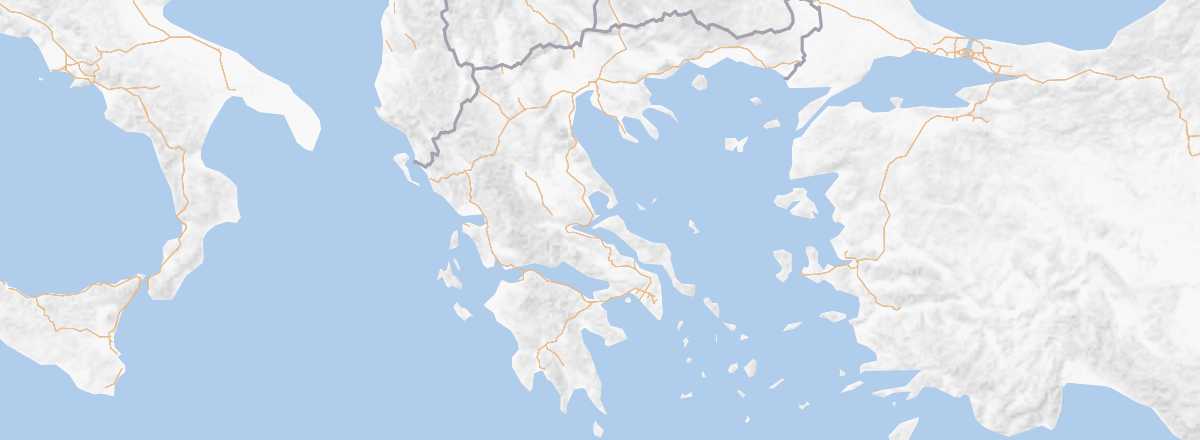 Greece
Open the interactive map
Greece
Open the interactive map
Road Network, Traffic
Car, Camper Van
As is often the case in Europe, having your own vehicle is an excellent way to explore Greece, at least the mainland. It’s even the best option thanks to the freedom and time saved compared to public transport. That said, logically, for small islands or when staying put in an all-inclusive resort, the advantage is clearly less.
As for bringing your own vehicle to Greece, it also depends on how long you plan to stay and the route you want to take. Just keep in mind that transporting your vehicle to the islands as a tourist is rarely worth it due to the high shipping costs, especially in peak season. Here too, it’s best to stick to the mainland.
Rental
Bus
Unlike trains, buses are highly developed and widely used in Greece. The network covers the entire country, both the mainland and the main islands. You can generally get almost anywhere by bus, though outside major city routes, it’s best not to be in a hurry. That said, buses are an excellent way to get around for those without a vehicle.
The company KTEL handles most public transport. It’s actually a grouping of around sixty local or regional companies that together cover over 80% of the country’s coach traffic. As for fares, they remain affordable. Expect roughly 0.7 to 0.9 € per 10 km.
Two Wheels
Motorcycle
Bike
Hitchhiking
Hitchhiking is a possible way to get around in Greece, though it’s not always easy outside major routes.
Trains

With just 1,500 km of tracks, all on the mainland, Greece’s rail network is quite limited. The national company, Trainose, manages everything. In broad terms, there’s now only one major line in the country (with a few small branches here and there) covering the route (Patras by bus)-Corinth-Athens-Thessaloniki, with the option to continue to neighboring countries (except Albania) from the latter. In short, train travel is limited. Also worth noting are two small tourist-only lines: Diakofto-Kalavryta in the Peloponnese and Volos-Mileai in the Pelion.
As for prices, they remain relatively affordable, with various discounts available (Greece is also part of the InterRail pass). For Athens-Thessaloniki, the only stretch really used by tourists (500 km; 5 hours), expect between 20 and 40 € one-way depending on the train, schedule, etc.
Ferries (and Other Boats)
With over a hundred routes, more than ten companies, and 75 ports, Greece is one of the countries with the most extensive internal ferry network in the world. Almost every inhabited—and certainly every tourist—island has at least one regular connection, which will at least take you to/from a more frequented port.
Sailboats and Others
Domestic Flights
Given Greece’s size and geography, with its many islands, air travel is well developed within the country. Around half a dozen airlines operate domestic routes:
- Aegean Airlines: Greece’s leading carrier. Based in Athens (and to a lesser extent Thessaloniki), the airline offers an extensive domestic network, both regular and seasonal, though most flights require a connection through the capital.
- Astra Airlines: This Thessaloniki-based airline serves around twenty Greek airports, operating only regular or seasonal domestic flights.
- Ellinair: A mix of charter and regular flights to the Caucasus and the former USSR, plus some seasonal domestic routes, all launched in 2014.
- Minoan Air: A Cretan airline serving around ten Greek airports, operating only domestic flights.
- Olympic Air: The former Greek national airline, now a secondary player in the Greek skies. Owned by Aegean, it serves only around twenty cities on the domestic network.
- Ryanair: The Irish low-cost airline also operates some domestic Greek routes, such as Chania-Athens or Thessaloniki, Athens-Thessaloniki, and Athens-Santorini or Rhodes.
- Sky Express: Another Cretan airline, serving around twenty Greek airports with only domestic flights, including some inter-island routes.
Direct or Connecting Flights
While the number of domestic routes and options is substantial, not all connections within Greece are direct, even though choices increase in the summer. Outside major routes, especially when traveling from one island to another, many require a connection at the airlines’ hubs: Athens (Aegean, Olympic), Crete (Minoan, Sky), Rhodes (Olympic), or Thessaloniki (Astra, Ellinair, and secondarily Aegean).
Aside from Athens, Thessaloniki, and Crete, which have the best connections, the most well-served cities/islands, especially in summer, are Chios, Corfu, Kos, Mykonos, Rhodes, and occasionally Santorini.
Fares
Even though prices rise in peak season, domestic flights generally remain affordable, especially when traveling to the islands from Athens, where airfare competes with ferry prices, often in the same range. From the capital, you’ll find many options around 40/50 € per trip to the islands or other mainland Greek cities.
In Town
Taxis
Other Means
Métro:
Tram:
Bus urbain:
What to Choose for Getting Around?
As is often the case in Europe, having your own vehicle remains the best way to explore the country, at least on the mainland or in Crete. Otherwise, buses are a good option for those without a car or on most Greek Islands. For inter-island travel, ferries are far more popular among visitors than planes.
Distances Between Cities
Distances (km) between the main mainland cities in the country:
| Alexan. | Agrinio | Athens | Corin. | Ioanni. | Larissa | Piraeus | Patras | Thess. | Volos | |
|---|---|---|---|---|---|---|---|---|---|---|
| Alexandroupolis | 800 | |||||||||
| Agrinio | 275 | |||||||||
| Athens | 800 | 275 | 80 | 420 | 355 | 12 | 210 | 505 | 325 | |
| Corinth | 80 | |||||||||
| Ioannina | 420 | |||||||||
| Larissa | 355 | |||||||||
| Piraeus | 12 | |||||||||
| Patras | 210 | |||||||||
| Thessaloniki | 505 | |||||||||
| Volos | 325 |