last edited Aug 26, 2026
Getting Around Tunisia
Location Map of Tunisia
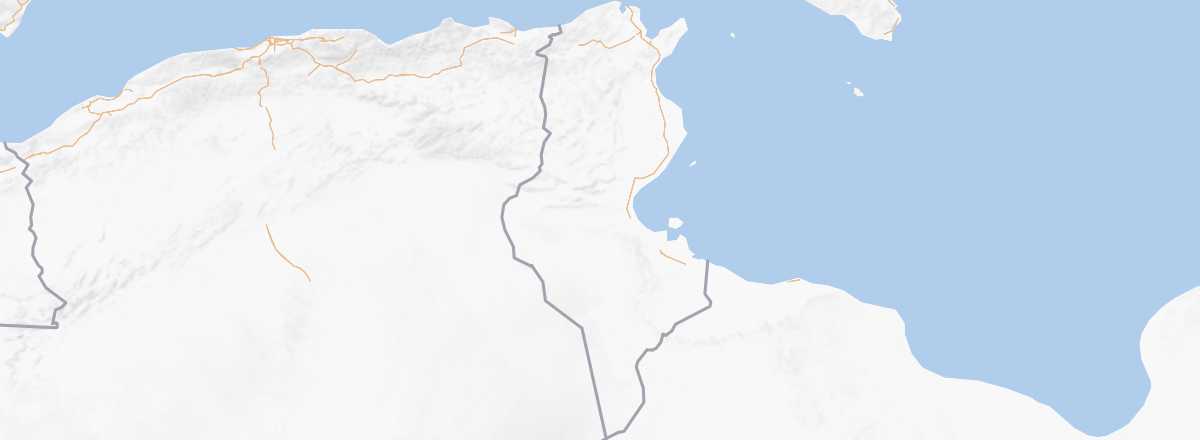 Tunisia
Open the interactive map
Tunisia
Open the interactive map
Road Network and Traffic
Let’s start with Tunisia’s road network and traffic. Tunisian roads are generally in good condition, with a small network of toll highways that are quite affordable. The regulations are the same as in France, with bilingual Arabic-French signage. Speed limits are 50 km/h in urban areas, 90 km/h on rural roads (70 km/h in Djerba), and 110 km/h on highways.
That said, "local driving norms" mean you should never let your guard down on the road. Watch out for other drivers and everything else on the move, especially at dusk—pedestrians, animals, unlit vehicles, and more. Another tip: while gas stations are plentiful in cities, they’re much scarcer elsewhere. If you’re driving, fill up before any excursion, particularly if you’re heading into desert areas.
Car and Camper Van
Having your own vehicle is clearly one of the best ways to explore the country. It’s even the best option for the freedom and time savings it offers compared to other modes of transport, especially in the south.
Personal Vehicle
If you plan to bring your own vehicle to Tunisia, you’ll need to prepare your French driver’s license (valid for one year), the vehicle’s registration papers (in the driver’s name), and a paper copy of your insurance certificate.
Upon arrival, Tunisian customs will issue a temporary circulation permit valid for 3 months. After this period, you’ll need to request an extension at a regional customs office and pay a few taxes. Recently, it’s become possible to pre-declare online for these procedures via dedicated Tunisian customs apps. This simplifies the process and provides a QR code to speed up customs clearance when needed.
Note that every vehicle is linked to its owner’s passport, meaning you must leave the country with the same vehicle. This measure is in place to prevent non-residents from selling foreign cars in Tunisia.
Rental
In general, both international and local rental companies are plentiful and compete for customers, now even offering a small fleet of electric vehicles. As a result, rates are generally reasonable. Expect to pay around 40 €–50 per day for a standard model.
Practically speaking, some rental companies allow pick-up and drop-off in different cities without extra fees. However, many don’t permit off-road driving unless the vehicle is a 4x4. If you plan to explore the Saharan region, make sure you’re minimally equipped and avoid driving at night.
Buses and Shared Vehicles
Tunisia has a solid public transport network that works well and lets you explore the country affordably.
Buses
Tunisia’s bus network is extensive and practical, with a national company (SNTRI) and several regional operators. It covers almost everywhere, particularly in the north, at economical rates—cheaper than the train.
Additionally, some companies (though not all), including the national one, offer comfortable and relatively fast vehicles on certain routes. Generally, there’s only one bus station per city.
In short, buses are a great way to get around if you plan to stick to main routes or cities. For fares, expect a few euros per 100 km traveled, depending on the company. However, in peak season on major tourist routes, it’s a good idea to book your seat in advance.
Main Companies
- SNTRI: The national bus company and the largest in the country, with a strong network of around fifty routes.
- SRTB: A Bizerte-based company serving the northern coast, from Tabarka to Tunis.
- SRTGN: The bus company for the Nabeul region, covering the Cap Bon area and the coast between Tunis and Monastir.
Shared Taxis
These are minibuses or large cars called "louages" that connect nearby towns, typically packing in 6 or 7 passengers—or up to fifteen in a minibus. Very popular, they’re slightly more expensive than local buses but usually faster. You’ll find them near bus stations, and they only leave when full. They don’t have meters, so the fare must always be negotiated beforehand.
Two Wheels
Motorcycle
Enthusiasts will be pleased, though not as much as in Morocco, especially in southern Tunisia, where those who enjoy off-road tracks should find plenty to love.
Bicycle
Cycling in Tunisia is possible and much easier in the north or along the coast. In the south, you’ll need to plan your water and supplies if you venture off the beaten path. You can even load your bike onto a bus for long or tedious stretches. That said, given the temperatures, it’s best to avoid cycling in summer.
Hitchhiking
Hitchhiking isn’t very common in Tunisia for tourists, and the low cost of transport reduces its appeal. That said, along the coast from Tunis to Djerba, hitchhiking can work due to traffic and many vacationers with cars. Elsewhere, it’s far more hit-or-miss, and not recommended in the south. Hitchhiking is also not advised for women.
Trains
Tunisia’s rail network, run by SNCFT, spans about 2,000 km and covers the country well, connecting most major cities. Trains are fairly slow but punctual and economical, though slightly more expensive than buses—though discounts and passes are available. As with buses, in peak season on main routes, it’s wise to book your seat in advance.
Also worth noting is the suburban "RER" (TGM) from Tunis, a convenient and affordable way to reach tourist sites north of the capital, like Carthage and Sidi Bou Said.
For a different experience, the tourist train "Lézard rouge" lets you explore the Selja Gorge in the south, near Tozeur, over about forty kilometers.
Boats
There’s an internal ferry service between Sfax and the Kerkennah Islands with the company Sonotrak. As for Djerba, it’s connected to the mainland by a 7-kilometer road and, occasionally, by a ferry between Jorf and Ajim.
Domestic Flights
Tunisia’s domestic network is limited, with just a few routes operated by the Tunisair group to and from the capital for the most distant cities or Monastir. Fares remain affordable. The Tunis-Djerba route is the busiest and most practical, with several daily flights in season.
In Town
While it’s pleasant to walk around city centers or use urban buses or the TGM (tramway) in Tunis, don’t hesitate to take taxis (yellow ones) when needed—they’re plentiful. They’re very economical as long as the meter is running. Try to have exact change and a small tip ready—around 10%. As always, you can ask your hotel for average fare estimates, but expect around 3 € for a 5–6 km daytime trip in the city (double at night).
What to Choose for Getting Around?
While having your own vehicle offers more freedom and saves time, traveling by bus and train is also a great way to explore Tunisia—especially on a budget.
Distances Between Cities
Distances (km) between Tunisia’s main cities:
| Biz. | Djerba | Gabès | Gafsa | Ham. | Kair. | Mona. | Sfax | Sousse | Tabar. | Tata. | Tozeur | Tunis | |
|---|---|---|---|---|---|---|---|---|---|---|---|---|---|
| Bizerte | 580 | 480 | 425 | 135 | 230 | 230 | 340 | 210 | 150 | 610 | 670 | 70 | |
| Djerba | 580 | 410 | 260 | 450 | 325 | 390 | 245 | 375 | 600 | 160 | 320 | 520 | |
| Gabès | 480 | 410 | 150 | 340 | 215 | 280 | 135 | 265 | 495 | 125 | 210 | 410 | |
| Gafsa | 425 | 260 | 150 | 280 | 180 | 250 | 200 | 230 | 330 | 275 | 95 | 350 | |
| Hammamet | 135 | 450 | 340 | 280 | 90 | 100 | 200 | 80 | 175 | 465 | 550 | 65 | |
| Kairouan | 230 | 325 | 215 | 180 | 90 | 80 | 150 | 60 | 245 | 385 | 470 | 165 | |
| Monastir | 230 | 390 | 280 | 250 | 100 | 80 | 150 | 20 | 265 | 405 | 490 | 165 | |
| Sfax | 340 | 245 | 135 | 200 | 200 | 150 | 150 | 130 | 360 | 260 | 345 | 275 | |
| Sousse | 210 | 375 | 265 | 230 | 80 | 60 | 120 | 130 | 245 | 385 | 470 | 145 | |
| Tabarka | 150 | 600 | 495 | 330 | 175 | 245 | 265 | 360 | 245 | 620 | 430 | 120 | |
| Tataouine | 610 | 160 | 125 | 275 | 465 | 385 | 405 | 260 | 385 | 620 | 180 | 535 | |
| Tozeur | 670 | 320 | 210 | 95 | 550 | 470 | 490 | 345 | 470 | 430 | 180 | 600 | |
| Tunis | 70 | 520 | 410 | 350 | 65 | 165 | 165 | 275 | 145 | 120 | 535 | 600 |