last edited Dec 11, 2019
Getting to Croatia by Land or Sea
Location Map of Croatia
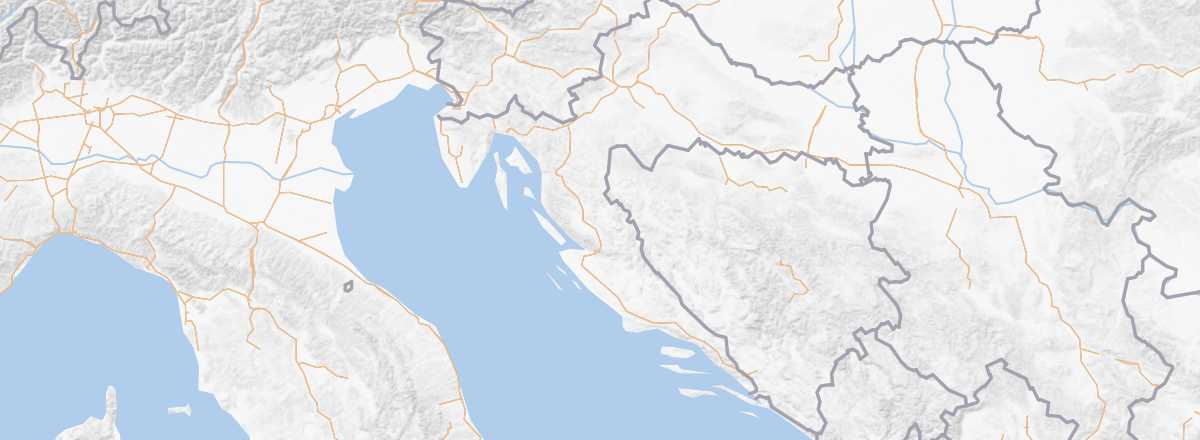 Open the interactive map
By Land
Borders: Bosnia and Herzegovina (932 km), Hungary (329 km), Montenegro (25 km), Serbia (241 km) and Slovenia (455 km).
All neighbouring countries have several border crossings open with Croatia, and numerous buses and trains connect with each, particularly from Zagreb. Note a small peculiarity on the Dalmatian coast (between Split and Dubrovnik), which is "interrupted" for about ten kilometres by the Bosnian enclave of Neum. This brief passage through Bosnian territory poses no problems, including in terms of entry requirements.
From France and other countries
By Car
Zagreb and the Croatian coast are approximately 1,500/2,000 km from Paris and are very easily accessible by car in a day and a half or two, depending on your starting point. In fact, if travelling with others—and if you have some time—driving to Croatia with your own vehicle remains an interesting option, even cost-effective in the end, and will also give you complete freedom of movement once there.
By Bus
This is another possible option, particularly with the company Eurolines, whose pass also covers Croatia. Otherwise, expect roughly 150 €/250 return (which is barely cheaper than flying in many cases) for a full day’s journey between, for example, Paris and Zagreb.
By Train
Croatia is well connected to its neighbours by rail. However, from France, train travel remains expensive compared to other modes of transport, except perhaps within the framework of the InterRail pass.
Ferries
Croatia has several international connections to Italy (only), across the Adriatic. In total, twelve Croatian ports are linked to Ancona, Bari, Pescara, or Venice by four companies: Blueline, Jadrolinija, SNAV, and Venezia Lines. This amounts to over 70 crossings each week, with journey times ranging from about 3 hours at the shortest (Venice-Poreč) to almost 11 hours, such as Ancona-Split.
Routes
From/to Croatian ports, from north to south:
- Istria (Umag, Poreč, Rovinj, Pula, Rabac): Venice (Venezia Lines, seasonal).
- Lošinj Island: Venice (Venezia Lines, seasonal).
- Zadar: Ancona (Jadrolinija).
- Split/Stari Grad: Ancona (Blueline + Jadrolinija + SNAV), Pescara (Jadrolinija).
- Hvar Island: Ancona (Blueline), Pescara (SNAV).
- Korčula Island: Pescara (SNAV).
- Dubrovnik: Bari (Jadrolinija).
Other Maritime Access
Cargo
Rijeka, Šibenik, and Split are Croatia’s main commercial ports, allowing arrival by cargo ship.
Cruises
The Adriatic Sea, with its highlight being Venice, hosts many types of cruises. Naturally, Croatia’s islands and coastline benefit from this popularity, with several of the country’s ports now established as classic stops for cruise lines. In fact, Dubrovnik (900,000 cruise passengers in 2014) is now ranked among the world’s top twenty cruise ports. In short, there’s plenty of choice, and no difficulty in finding ships sailing this part of Europe.
Sailboats
Croatia’s coast and islands are popular destinations for Mediterranean sailing enthusiasts. There are no fewer than 45 marinas along the coastline.