
Travel guide · Canary Islands
Gran Canaria
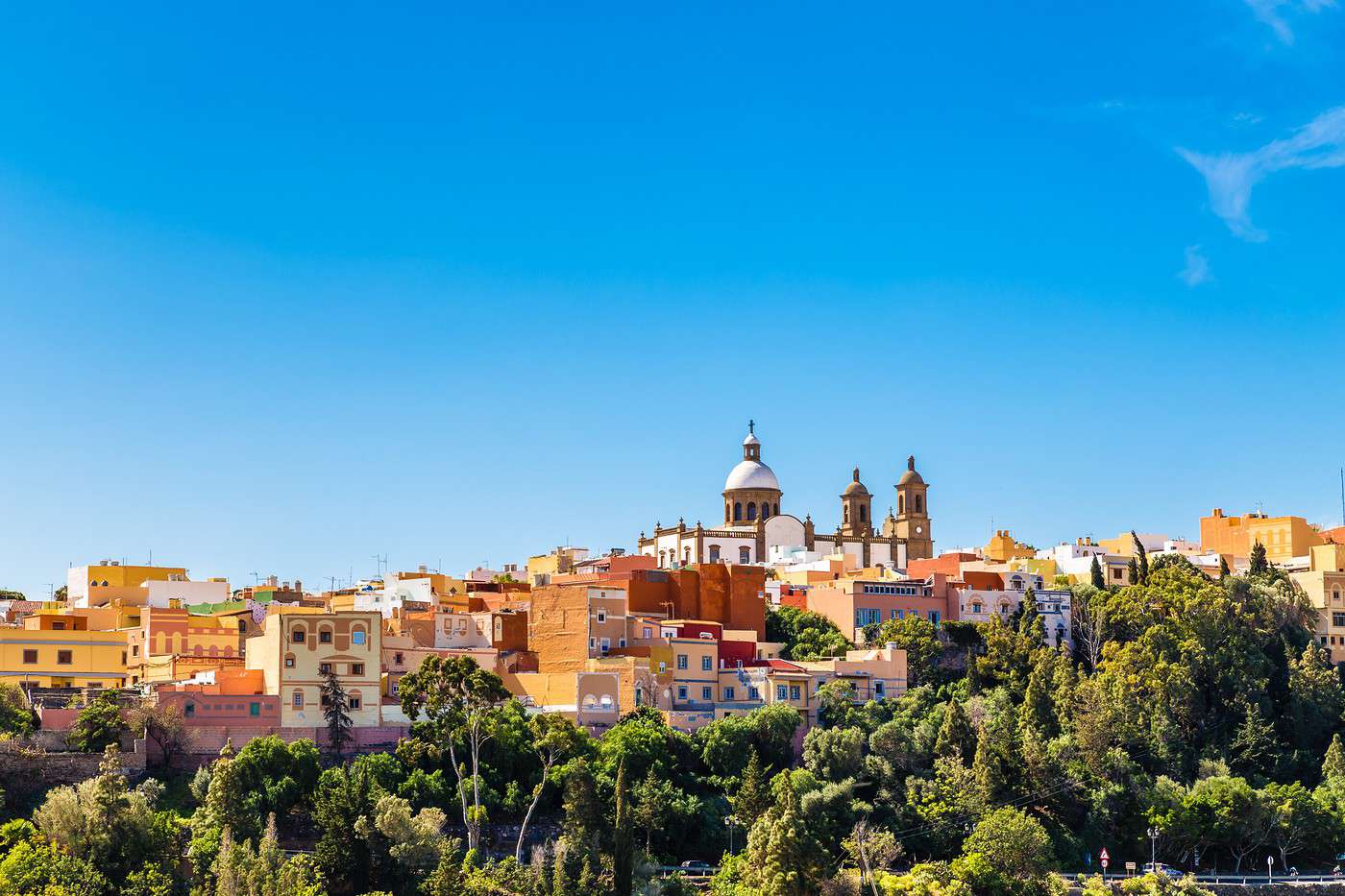
After Tenerife, it is the most populous island in the Canaries. It boasts a wide variety of landscapes and is home to the provincial capital of Las Palmas as well as the archipelago's main tourist hub.
Overview of Gran Canaria
Overview of Gran Canaria
After Tenerife, it is the most populous island in the Canaries. It offers a wide variety of landscapes, though they are not necessarily the most spectacular. It is home to the provincial capital of Las Palmas (which is also the co-capital of the autonomous community of the Canary Islands) as well as the archipelago's main tourist area with Maspalomas. Its economy is largely dependent on tourism. This sector has developed along the east coast and in the south, thanks to the flat terrain, unlike the west coast, where the rugged and rocky shoreline has not allowed for the creation of beach resorts.
Key Facts
- Type of place: main island.
- Location: at the heart of the Canary Islands, between Tenerife and Fuerteventura.
- Latitude/longitude: 27.58' N, 15.36' W.
- "Capital": Las Palmas de Gran Canaria.
- Population: 850,400 inhabitants (2011).
- Area: 1,560 km².
- Density: 545 inhabitants/km².
- Highest point: Pozo de las Nieves (1,949 m).
- Lowest point: sea level.
- Local time: .
- Tourist interest: (worth seeing).
- Website: http://www.grancanaria.com
History and Culture of Gran Canaria
Climate and Weather of Gran Canaria
While the weather is generally pleasant, Gran Canaria is known for its microclimates. Note that it can get quite cool in the mountainous inland areas, and, as is often the case, the southern coast is warmer and sunnier than the north.
Sea Temperature Throughout the Year
| Jan. | Feb. | Mar. | Apr. | May | Jun. | Jul. | Aug. | Sep. | Oct. | Nov. | Dec. | |
|---|---|---|---|---|---|---|---|---|---|---|---|---|
| Gran Canaria | 19 | 18 | 18 | 19 | 19 | 20 | 21 | 22 | 23 | 22 | 21 | 19 |
Getting to Gran Canaria
While the Canary Islands have no ferry links with neighbouring Morocco, there are routes to "mainland Spain". Ferries depart from Cadiz with the company Transmediterranea to Las Palmas de Gran Canaria and Arrecife. The weekly service takes between 30 and 40…
Getting Around Gran Canaria
Transport
Car
Bus
There is a bus network comprising several dozen small routes across the island. It is operated by the company Global.
Taxis
Two Wheels
Hitchhiking
Which Transport to Choose?
Distances
Distances (km) between the island's municipalities.
| Galdar | Las Palmas | Maspalo. | Mogan | San Bart. | Telde | |
|---|---|---|---|---|---|---|
| Galdar | ||||||
| Las Palmas | ||||||
| Maspalomas | ||||||
| Mogan | ||||||
| San Bartolomé | ||||||
| Telde |
Additional Information
Things to See and Do in Gran Canaria
Interests (out of ★★★★ ) : Nature ★★ ; Adventure ★ ; Culture ★★ ; Relaxation-Holidays ★★★★ Gran Canaria is above all the island of holidays, beach relaxation, and all-inclusive resorts. While associated with beaches, seaside resorts, and all-inclusive stays,…
Something wrong or out of date? Report this page