last edited Dec 11, 2019
Introduction to Crete
Location Map of Crete
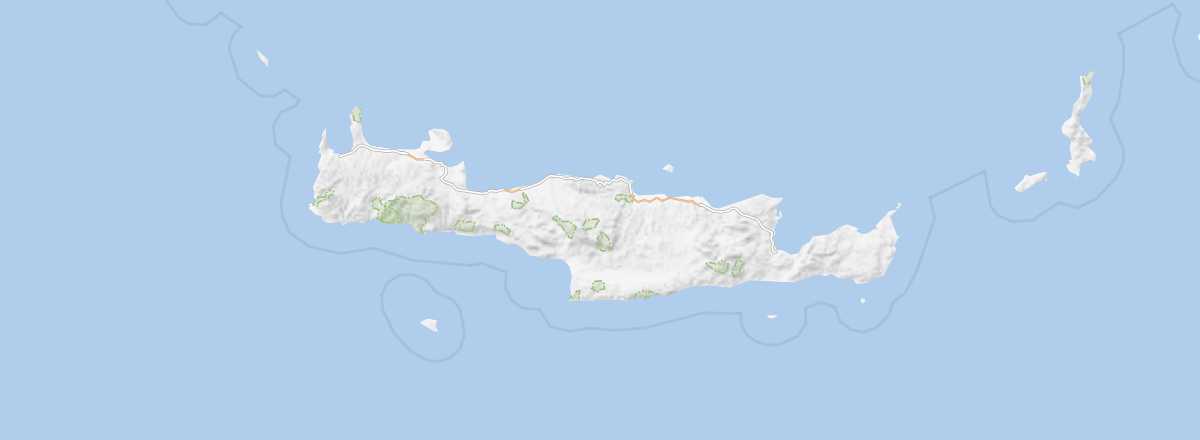 Crete
Open the interactive map
Crete
Open the interactive map
Overview
The largest Greek island, and the fifth largest in the Mediterranean, Crete is elongated and stretches over 250 kilometres, parallel to the African coast. Its centre is dominated by limestone massifs reaching nearly 2,500 metres (Mount Ida), opening onto plains where wheat, vines, and olive trees are cultivated. However, the island relies primarily on tourism and has limited water reserves, a situation exacerbated by the growth of this industry.
Crete is the cradle of the Minoan civilisation, of which Knossos is the centre and the most important archaeological site.
Key facts
- Type of place: tourist region.
- Location: in the eastern Mediterranean, between Mainland Greece and Egypt.
- Latitude/longitude: 35.13' N, 24.47' E.
- Local time: .
- "Capital": Heraklion.
- Population: 621,350 inhabitants (2011).
- Area: 8,336 km².
- Density: 74.5 inhabitants/km².
- Highest point: Mount Ida (2,456 m).
- Lowest point: sea level.
- Coastline: approximately 8,000 km.
Tourism
Crete has relied heavily on tourism since the 1970s, with peak visitor numbers in July and August, particularly along the north coast. This area is far more developed, with beach resorts, compared to the wilder, more "authentic" south. Within Greece, Crete attracts over 15% of holidaymakers and around 20% of the country’s total charter and seasonal traffic.
Travel essentials
- Destination: ideal for first-time travellers.
- By air: Paris-Heraklion for 200 € to 350 € return.
- Backpacker daily budget: 45 € to 65 € per person.
- Accommodation: homestays or, alternatively, camping while travelling; all-inclusive resorts or rentals for longer stays.
- Getting around: car rental or buses.
- Risks: minimal health risks and low security concerns.
- Best time for climate/crowds/prices: late April to mid-June or mid-September to October, avoiding July and August, which are hot and crowded, especially from 15 July to 15 August.
- Interests (rated ): Nature ; Adventure ; Culture ; Relaxation/holidays .
- Website: