last edited Dec 11, 2019
Introduction to Ecuador
Location Map of Ecuador
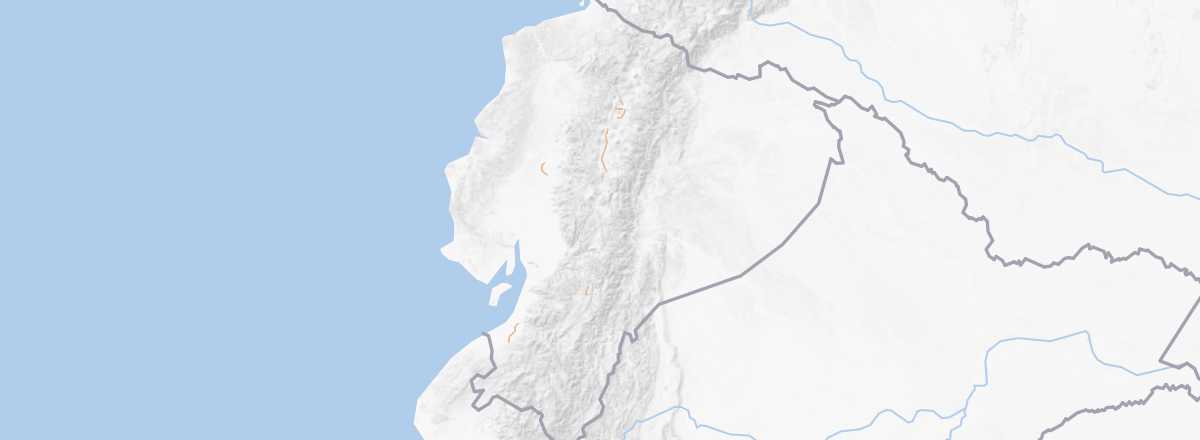 Ecuador
Open the interactive map
Ecuador
Open the interactive map
Quick Overview
Ecuador is the smallest of the Andean countries, which allows you to travel from the level of the Pacific Ocean to the Amazon basin in less than 300 kilometres via mountain ranges sometimes exceeding 6,000 m. The country is made up of three distinct regions: the Costa (Guayaquil and the coast) stretching to the foothills of the Andes; the Sierra (Quito), formed by volcanic reliefs and high valleys; and el Oriente, a vast plain extending from the eastern face of the Andes to the Amazon rainforest. Additionally, the Galápagos Islands, located 950 km west of the mainland, form a unique archipelago. The Ecuadorian population is concentrated 50% on the coast and 45% in the Sierra, with the Amazon region being only sparsely inhabited.
Ecuador's resources come mainly from oil and, secondarily, from fishing, bananas, and agriculture (one-third of the population lives off the land), as well as remittances sent by the Ecuadorian diaspora, particularly from the United States and Spain.
Key Facts
- Type of place: country.
- Location: in northwestern South America on the Pacific coast, just above Peru.
- Latitude/longitude: 2.00' S, 77.30' W.
- Local time: for the mainland.
- Capital: Quito.
- Nature of the state: presidential regime.
- Official language: Spanish.
- Currency: US dollar.
- Population: 16,498,502 inhabitants (2018).
- Area: 283,560 km².
- Density: 58 inhabitants/km².
- Highest point: Chimborazo (6,268 m).
- Lowest point: sea level.
- Coastline: 2,237 km.
- Driving: on the right.
Tourism
Though not the most visited Andean country, Ecuador still attracts its share of tourists each year (2.429 million in 2018), making tourism one of the main sources of income alongside agriculture, oil, and remittances from the Ecuadorian diaspora. Generally, visitors come individually or in small groups to explore nature (Galápagos, Andes, Amazon rainforest...) and local cultures, increasingly through "community-based tourism." In short, Ecuador is a destination that could be described as "responsible ecotourism," far from the mass tourism found in other countries, including in the Latin world.
As for the origin of visitors—not all of whom are necessarily tourists—the main contributors are Colombia, the United States, Peru, Spain, and Germany.
Travel Essentials
- Destination: for beginner travellers.
- By air: France-Quito for 650/1,100 € round trip.
- Entry requirements: passport.
- Currency to bring: US dollar.
- Exchange rate:
- Daily "backpacker" budget: 25 to 35 € per person.
- Accommodation: mid-range hotels and guesthouses.
- Getting around: mainly by bus.
- Risks: fairly low in terms of health and low to (very locally) slightly higher in terms of security.
- Best period for climate/crowds/prices: roughly from May to October, though July-August can be a bit busy.
- Interests (out of ): Nature ; Adventure ; Culture ; Relaxation/holidays .
Addresses in France
- Maison de l'Amérique Latine: 217 Bd Saint-Germain, 75007 Paris. Tel.: 01 49 54 75 00.
Addresses in Belgium, Switzerland, and Quebec
Socio-Economic Statistics
- "Quality of life": 86/188 (rank in 2018)
- GDP per capita: $11,500 (2017)
- Average monthly income: $435 (2012)
- Inflation: +0.4% (2017)
- "Official" unemployment: 4.6% (2017)
- Population below the poverty line: 21.5% (2017)
- Life expectancy: 77.1 years (2018)
- Migration rate per 1,000 inhabitants: 0 (2017)
- Population growth: +1.25% (2018)
- Literacy rate: 94.4% (2016)
- Urban population: 63.8% (2018)
- Press freedom: 92/180 (rank in 2018)
- Political regime: flawed democracy (68/167 in 2018)
Sources: World Bank, Human Development Indicators, RSF, The Economist, The World Factbook