last edited Dec 11, 2019
Introduction to Indonesia
Location Map of Indonesia
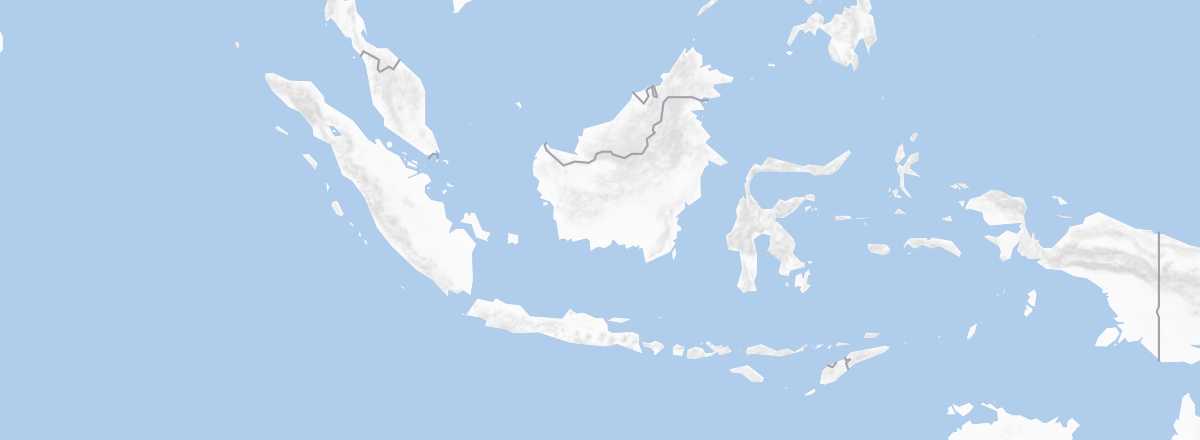 Indonesia
Open the interactive map
Indonesia
Open the interactive map
Quick Overview
Straddling the equator over more than 5,000 km from east to west and 2,000 km from north to south, Indonesia is a vast archipelago of several thousand islands and islets (17,000, of which 6,000 are inhabited!), boasting over 50,000 km of coastline. The main or best-known islands are Sumatra, Java, Bali, Sulawesi, and Borneo (Kalimantan region). Generally, the archipelago is volcanic in origin, with over 100 active volcanoes, and features high reliefs reaching up to 3,800 m (Sumatra) and nearly 5,000 m in West Papua.
Indonesia in Six Regions
- Bali: "The Island of the Gods" has developed a beach tourism industry that attracts millions of visitors each year. Alongside its ever-present beaches, the small island offers beautiful mountains, volcanoes, lakes, rice terraces, and forests, creating a pleasant setting that invites exploration.
- Java: Despite its high population density, the island boasts stunning natural areas that will delight nature and adventure enthusiasts with its mountains, volcanoes, tropical forests, and scattered beautiful beaches. But Java is also rich in heritage, with sites like Borobudur and Prambanan and their many Hindu and Buddhist temples.
- Kalimantan, Moluccas and Sulawesi: Rarely visited, not always easy to travel through, and locally insecure, this region will nonetheless appeal to off-the-beaten-path nature and adventure lovers. It offers Kalimantan with its forest parks, home to orangutan populations, and the Toraja region, where strong traditions still endure.
- West Papua: Facing independent Papua, this wild and barely explored region, which can be challenging to travel through, is perfect for nature lovers and off-the-beaten-path adventurers.
- Lesser Sunda Islands: While Lombok, the Gili Islands, Komodo, and Flores attract their share of visitors, other parts of this archipelago remain almost untouched by tourism. Yet, nearly everywhere, you’ll find beautiful beaches, surfing and diving spots, volcanoes to climb, and traditional villages where local communities have preserved their customs.
- Sumatra: Aside from a few islands off its eastern coast known for their beaches, the rest of Sumatra remains somewhat off the beaten path. Nevertheless, the region is home to several natural parks and, most notably, populations with strong cultures and traditions, which are the main draw for visitors.
Key Facts
- Type of place: country.
- Latitude/longitude: 6°10' S, 106°49' E.
- Local time: Indonesia spans three time zones.
-- "Western Indonesian Time": for Java, Sumatra, and western Kalimantan.
-- "Central Indonesian Time": for Bali, Sulawesi, the Lesser Sunda Islands, and eastern Kalimantan.
-- "Eastern Indonesian Time": for the Moluccas and West Papua.
- Capital: Jakarta
- Nature of the state: republic.
- Official language: Indonesian (but over 700 local languages spoken).
- Currency: Indonesian rupiah.
- Population: 262,787,403 (2018).
- Area: 1,904,569 km².
- Density: 138 inhabitants/km².
- Highest point: Puncak Jaya (4,884 m) in West Papua.
- Lowest point: sea level.
- Coastline: 54,716 km.
- Driving: on the left.
Tourism
Indonesia’s vast archipelago has plenty to delight every type of traveler. Between Bali and its beaches, countless diving and surfing spots, the jungles of Kalimantan and beyond, the ever-present volcanoes, traces of the past, and populations with often well-preserved cultures, everyone can find something to enjoy.
In 2018, 13.396 million visitors traveled to Indonesia, nearly double the number in 2010. While Singaporean and Malaysian neighbors are logically the most numerous, the country also welcomes many visitors from China, Australia, Japan, and South Korea. Among Europeans, the British are the most numerous, followed by the French (288,000 in 2018).
Travel Essentials
- Destination: for beginner travelers (Java, Bali, Lesser Sunda Islands)/somewhat experienced travelers (the rest).
- By air: France-Jakarta.
- Entry requirements: passport valid for 6 months after the planned entry date and no visa required for stays under 30 days.
- Currency to bring:
- Exchange rate:
- Daily "backpacker" budget:
- Best for accommodation:
- Best for getting around:
- Risks:
- Best time for climate/crowds/prices:
- Interests (out of ): Nature ; Adventure ; Culture ; Relaxation-holidays
Useful Addresses
Socio-Economic Statistics
- "Quality of life": 116/188 (rank in 2018)
- GDP per capita: $12,400 (2018)
- Average monthly income: ()
- Inflation: +3.8% (2017)
- "Official" unemployment: 5.4% (2017)
- Population below the poverty line: 10.9% (2016)
- Life expectancy: 73.2 years (2018)
- Migration rate per 1,000 inhabitants: -1.1 (2017)
- Population growth: +0.83% (2018)
- Literacy rate: 95.4% (2016)
- Urban population: 55.3% (2018)
- Press freedom: 124/180 (rank in 2018)
- Political regime: flawed democracy (65/167 in 2018)
Sources: World Bank, Human Development Indicators, RSF, The Economist, The World Factbook