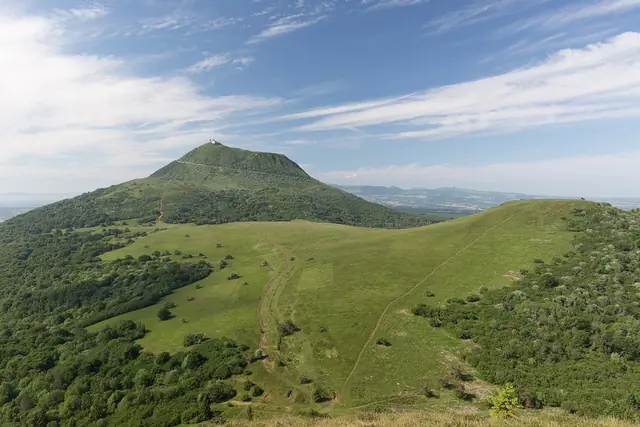
Overview of Le Puy-en-Velay
It is the prefecture of Haute-Loire with an interesting city centre. However, Le Puy is best known as the starting point for one of the four main routes of the Ways of Saint-Jacques-de-Compostela.
Key facts
- Type de lieu: small town.
- Intérêt touristique: (worth seeing).
- Localisation:
- Distances:
- Heure locale: .
- Population: 18,995 inhabitants (2017).
- Superficie: 16.79 km².
- Altitude: from 600 to 888 m.
- Site internet: http://www.ot-lepuyenvelay.fr
History of Le Puy-en-Velay
What to see in Le Puy
Cathédrale Notre-Dame de l'Annonciation
A UNESCO-listed Romanesque cathedral dating back to the 11th century, featuring a lovely cloister and famous for its Black Virgin statue.
A UNESCO-listed Romanesque cathedral dating back to the 11th century, featuring a lovely cloister and famous for its Black Virgin statue.
Saint-Michel d'Aiguilhe Church
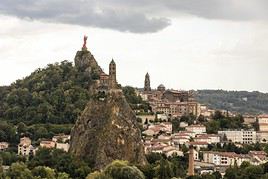
It’s an astonishing chapel perched atop a narrow volcanic pinnacle in the commune of Aiguilhe, on the outskirts of Le Puy-en-Velay.
It’s an astonishing chapel perched atop a narrow volcanic pinnacle in the commune of Aiguilhe, on the outskirts of Le Puy-en-Velay.
Crozatier Museum
This historic museum features paintings, sculptures, and collections on prehistory, natural sciences, geology, lace-making, and regional arts, offering a glimpse into the history of the city and its surroundings.
This historic museum features paintings, sculptures, and collections on prehistory, natural sciences, geology, lace-making, and regional arts, offering a glimpse into the history of the city and its surroundings.
Corneille Rock
This ancient volcanic cone overlooks the city and is visible from afar with its imposing statue of Our Lady of France (16 metres tall and 110 tonnes), built there in 1860. From the top, you can enjoy a beautiful panorama of the entire urban area.
This ancient volcanic cone overlooks the city and is visible from afar with its imposing statue of Our Lady of France (16 metres tall and 110 tonnes), built there in 1860. From the top, you can enjoy a beautiful panorama of the entire urban area.
Vieille-ville
This is the part of the city around Rocher Corneille, with its tall red-roofed houses. It’s also where the Cathedral of Notre-Dame de l'Annonciation is located.
This is the part of the city around Rocher Corneille, with its tall red-roofed houses. It’s also where the Cathedral of Notre-Dame de l'Annonciation is located.
What to do in Le Puy
Climate and weather
Transport
Getting there
Getting around
Accommodation
Food
Useful addresses
Nearby
Some interesting sites to see around Le Puy-en-Velay:
La Chaise-Dieu Abbey
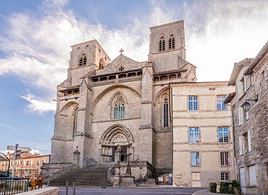
This is one of the best-known Benedictine abbeys in Auvergne and its main Gothic structure.
This is one of the best-known Benedictine abbeys in Auvergne and its main Gothic structure.
Arlempdes
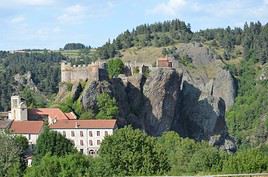
In a very pretty setting, at the source of the Loire River, this is one of the region’s most beautiful villages, featuring its old fortified castle.
In a very pretty setting, at the source of the Loire River, this is one of the region’s most beautiful villages, featuring its old fortified castle.
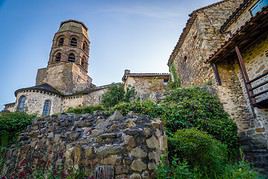
Lavaudieu
It is one of the villages in Haute-Loire classified as one of the "Most Beautiful Villages of France". It is home to a 12th-century abbey.
It is one of the villages in Haute-Loire classified as one of the "Most Beautiful Villages of France". It is home to a 12th-century abbey.

Mount Gerbier de Jonc
Famous for its shape and as the source of the Loire River, this 1,550 m peak is (easily) climbed by half a million people each year, making it the second most visited site in the department after the Ardèche Gorges.
Famous for its shape and as the source of the Loire River, this 1,550 m peak is (easily) climbed by half a million people each year, making it the second most visited site in the department after the Ardèche Gorges.
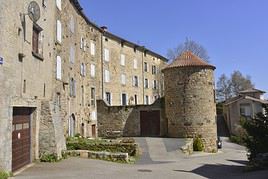
Pradelles
With its buildings dating from the Middle Ages, the village is one of the "most beautiful villages in France".
With its buildings dating from the Middle Ages, the village is one of the "most beautiful villages in France".