last edited Dec 11, 2019
Overview of the Comoros
Location Map of Comoros
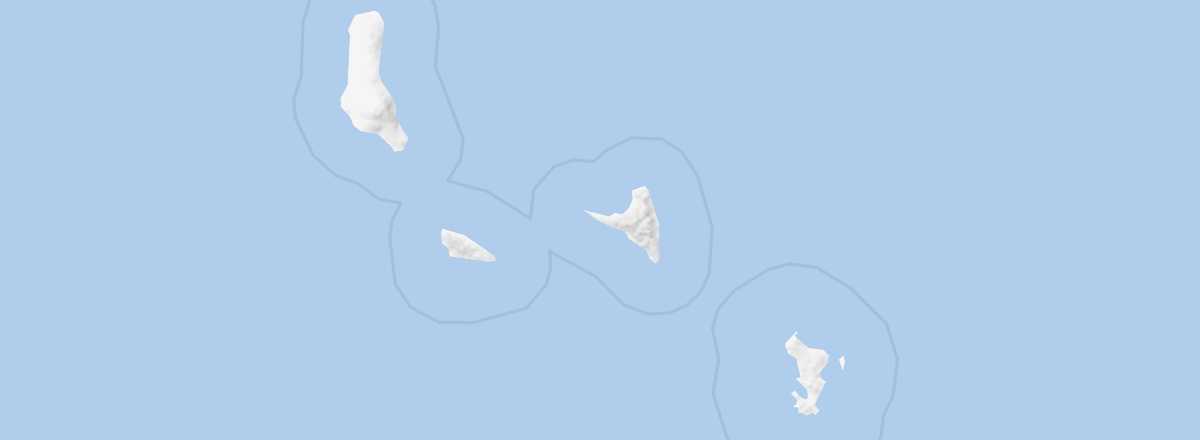 Comoros
Open the interactive map
Quick Overview
The Comoros (including Mayotte) form an archipelago made up of four main islands and numerous islets. Since 1978, Grande Comore (Ngazidja), Anjouan (Ndzuani), and Mohéli (Mwali) have formed the Union of the Comoros, while Mayotte (Mahore) has been a French department since 2009. The entire archipelago is volcanic in origin and has a rugged terrain. Some peaks exceed 2,000 m, such as the Karthala volcano (2,361 m) on Grande Comore.
Key Facts
- Type of place: country.
- Location: between Madagascar and Mozambique, in the channel of the same name.
- Latitude/longitude: 11°41' S, 43°16' E.
- Local time:
- Capital: Moroni on Grande Comore.
- Nature of the state: federal republic.
- Official languages: French, Shikomor, and Arabic.
- Currency: Comorian franc.
- Population: 821,164 inhabitants (2018).
- Area: 2,236 km²
- Density: 366 inhabitants/km²
- Highest point: Mount Karthala (2,361 m) on Grande Comore.
- Lowest point: sea level.
- Coastline: 340 km.
- Driving: on the right.
Tourism
This small archipelago of three islands, to which Mayotte was once attached, is completely off the beaten track. Few tourists (36,000 in 2018) and limited infrastructure make for an authentic discovery of local culture, set against beaches and the imposing Karthala volcano on Grande Comore.
Essentials for Travel
- Destination:
- By air: France-Moroni.
- Entry requirements: passport valid for at least 6 months after return date + return or onward ticket + proof of accommodation + visa (on arrival).
- Currency to bring: euros.
- Exchange rate:
- Daily "backpacker" budget:
- Best for accommodation:
- Best for getting around:
- Risks:
- Best period for climate/crowds/prices: May to October.
- Interests (out of ): Nature ; Adventure /; Culture ; Relaxation/Holidays /
Useful Addresses
Socio-Economic Statistics
- "Quality of life": 165/188 (rank in 2018)
- GDP per capita: $1,600 (2017)
- Average monthly income: ()
- Inflation: +1% (2017)
- "Official" unemployment: 6.5% (2014)
- Population below poverty line: ()
- Life expectancy: 64.9 years (2017)
- Migration rate per 1,000 inhabitants: -2.4 (2017)
- Population growth: +1.57% (2018)
- Literacy rate: 77.8% (2015)
- Urban population: 29% (2017)
- Press freedom: 49/180 (rank in 2018)
- Political regime: authoritarian regime (121/167 in 2018)
Sources: World Bank, Human Development Indicators, RSF, The Economist, The World Factbook