last edited Dec 11, 2019
Overview of Tunisia
Location Map of Tunisia
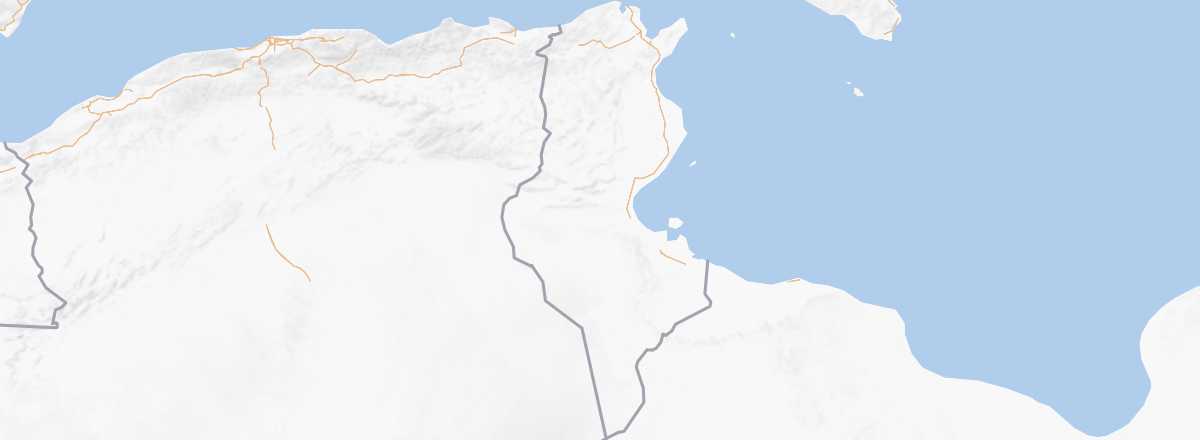 Tunisia
Open the interactive map
Quick Overview
Tunisia, the smallest state in the Maghreb, separated from Europe by the Strait of Sicily and its 150 kilometres. The country consists of mountains, steppes, and deserts. The northern/north-western part is mountainous (Jebel Chambi: 1,544 m), while the rest of the terrain is flat, with a desert and oasis-strewn southern region (Tozeur, Nefta...) occupying more than half of the territory. The majority of the population is concentrated along the coasts, in the Sahelian zone, roughly between Bizerte and Sfax.
In addition to agriculture (fruits, vegetables...), fishing, gas, and oil, tourism is one of the country's main resources. This could also be supplemented by remittances sent by the Tunisian diaspora, particularly those living in France. Since the "Jasmine Revolution" of 2011, Tunisia has undergone significant democratic changes on many levels, but unfortunately, it also faces an extremist terrorist threat aimed at destabilising the country through attacks like those in 2015.
Key Facts
- Type of place: country.
- Latitude/longitude: 36.84' N, 10.22' E.
- Local time:
- Capital: Tunis.
- Nature of the state: republic with a semi-presidential system.
- Official language: Arabic.
- Currency: Tunisian Dinar.
- Population: 11,516,000 inhabitants (2018).
- Area: 163,610 km².
- Density: 70.5 inhabitants/km².
- Highest point: Jebel Chambi (1,544 m).
- Lowest point: Shatt al Gharsah (-17 m).
- Coastline: 1,148 km.
- Driving: on the right.
Tourism
Tunisia has long been a major tourist destination, with its coastal resorts and Saharan tourism in the south. The sector is one of the country's main sources of employment and GDP. However, due to recent events in the country and its neighbours, tourist numbers (including French visitors) have fluctuated significantly in recent years. Currently, Tunisia welcomes around 8 million visitors (8.299 million in 2018), roughly the same as a decade ago.
In terms of source markets, excluding direct neighbours, France remains the leading country (391,000 arrivals in 2016), though its share is declining in favour of new clientele, particularly from Eastern Europe and, gradually, Gulf countries.
Generally, the best time to visit the country is from early spring to early autumn, avoiding the summer months, which are hot inland and crowded on the coast. For the south, November to March is ideal in every respect.
Travel Essentials
- Destination: for beginner travellers.
- By air: France-Tunis for 130/350 €.
- Entry requirements: passport or, theoretically, ID card for organised trips.
- Currency to bring: Euros.
- Exchange rate:
- Daily "backpacker" budget: 25 to 35 € per person.
- Accommodation: small hotels.
- Getting around: bus and train, and occasionally by car.
- Risks: low health risks and "?" for security.
- Best period for climate/crowds/price: March to May and October-November.
- Interests (out of ): Nature ; Adventure ; Culture ; Relaxation-holidays .
Addresses in France
- Tourist Office: 32 avenue de l'Opéra, 75002 Paris. Tel.: 01 47 42 72 67. Open Monday to Thursday from 9:00 AM to 6:00 PM and Friday from 9:00 AM to 5:00 PM.
- Arab World Institute: 1 rue des Fossés St Bernard, 75005 Paris. Tel.: 01 40 51 38 38.
- Tunisair: 0 820 044 044.
Addresses in Belgium, Switzerland, and Quebec
- Tourist Office: avenue Louise 162, Brussels 1050. Tel.: 02 648 23 55.
- Tourist Office: 1155 rue de l'Université, Suite 1014, Montreal, Quebec H3B-3A7. Tel.: 514 397 1182.
- Tourist Office: Bahnhofstrasse 69, 8001 Zurich. Tel.: 44 211 48 30.
Socio-Economic Statistics
- "Quality of life": 95/188 (rank in 2018)
- GDP per capita: $11,900 (2017)
- Average monthly income: $350 (2012)
- Inflation: +5.3% (2017)
- "Official" unemployment: 15.5% of the population (2017)
- Population below the poverty line: 15.5% (2011)
- Life expectancy: 75.9 years (2018)
- Migration rate per 1,000 inhabitants: -1.7 (2017)
- Population growth: +0.95% (2018)
- Literacy rate: 81.8% (2015)
- Urban population: 68.9% (2018)
- Press freedom: 97/180 (rank in 2018)
- Political regime: flawed democracy (63/168 in 2018)
Sources: World Bank, Human Development Indicators, RSF, The Economist, The World Factbook