

Travel guide · Greece
Peloponnese
This vast mountainous peninsula in southern mainland Greece is a diverse region with numerous ancient sites (several of which are UNESCO-listed), beautiful sea and mountain landscapes perfect for hiking, as well as some lovely beaches for swimming enthusiasts.
Introducing the Peloponnese
Quick overview
The Peloponnese is the large mountainous peninsula, with highly indented coasts, located south of mainland Greece. It is home to one-third of the population on less than 20% of Greek territory.
Key facts
- Type of place: tourist region.
- Location: south of mainland Greece.
- Latitude/longitude: 37.30' N, 22.12' E.
- Local time: .
- Main city: Patras.
- Population: 1,100,000 inhabitants (2011).
- Area: 21,549 km².
- Density: 51 inhabitants/km².
- Highest point: Mount Taygetus (2,404 m).
- Lowest point: sea level.
Tourism
For tourism, the Peloponnese is a very rich and varied region with its many ancient sites (including several such as Mystras, Olympia, and Epidaurus listed as UNESCO World Heritage sites), beautiful sea and mountain landscapes perfect for hiking, as well as some lovely beaches for swimming enthusiasts.
Travel essentials
- Destination: for beginner travelers.
- By air: Paris-Kalamata seasonal flights... or more simply Athens (130 € to 300 € round trip).
- Backpacker daily budget: 45 € to 65 € per person.
- Accommodation: homestays or, alternatively, camping.
- Getting around: car or bus.
- Risks: virtually none in terms of health and low in terms of safety.
- Best time for climate/crowds/prices: late April to mid-June or mid-September to October, avoiding July and August, which are hot and especially crowded.
- Interests (out of ): Nature ; Adventure ; Culture ; Relaxation-holidays .
Geography, Climate, and Environment of the Peloponnese
Environment
Physical Geography of the Region
Wildlife and Flora
Natural Areas
Climate
The Peloponnese enjoys a sunny Mediterranean climate, with generally pleasant temperatures and relatively little rainfall. However, there are differences between the coastline and the mountainous interior.
After a typically short spring, the region experiences a dry and hot summer, sometimes very hot, though tempered along the coast by sea breezes that make the climate more bearable. At higher altitudes, temperatures are naturally lower and can feel quite cool in the evenings. Winters are mild and pleasant on the coast but much harsher in the mountains, where snow can fall. November to March is also the rainy season, particularly on the western side of the peninsula.
Best Time to Visit for Climate
Climatically, spring (April–June) and autumn (September–October) are ideal times to visit. This avoids the possible extreme summer heat (and crowds) as well as winter rains.
| Jan. | Feb. | Mar. | Apr. | May | Jun. | Jul. | Aug. | Sep. | Oct. | Nov. | Dec. | |
|---|---|---|---|---|---|---|---|---|---|---|---|---|
| Inland Climate | / | |||||||||||
| Coastal Climate |
: very favorable | : favorable | : moderately favorable | : unfavorable.
Sea Temperatures Throughout the Year
| Jan. | Feb. | Mar. | Apr. | May | Jun. | Jul. | Aug. | Sep. | Oct. | Nov. | Dec. | |
|---|---|---|---|---|---|---|---|---|---|---|---|---|
| Kalamata | 15 | 14 | 15 | 16 | 18 | 21 | 24 | 24 | 23 | 21 | 18 | 16 |
Climate and Weather in the Peloponnese (Coastal Areas)
Society, Culture and Customs of the Peloponnese
Key Historical Dates

Arts and Architecture
Society
Population
Economy
Customs and Traditions
Local Traditions
Regional Languages
Festivals and Celebrations
Books, Films and Music
What to See in the Peloponnese
Numerous ancient sites (including several like Mystras, Olympia, and Epidaurus inscribed on the UNESCO list), beautiful sea and mountain landscapes perfect for hiking, such as in the Mani Peninsula, as well as some lovely beaches for swimming enthusiasts. The…
Things to Do in the Peloponnese
Travel Themes
Interests (rated ): Nature ; Adventure ; Culture ; Relaxation-holidays .
Nature-Adventure
Culture
Relaxation-Holidays
Beaches and Seaside Resorts

Water Activities
Diving
Other Activities
Fishing:
Water Sports:
Sailing:
Thalassotherapy and Wellness
Hiking
Hiking Trails
With its deep gorges and mountainous massifs, the Peloponnese offers a wealth of hiking opportunities. You can walk around the Loussios Gorge and especially in the massifs of Parnon and Taygetus, which rise above 2,000 m.
Cycling
Horseback Riding
Other Outdoor Activities
Golf:
Whitewater Sports:
Climbing and Mountaineering:
Paragliding and Aerial Sports:
Caving:
Cultural Life and Activities
Nightlife and Going Out
Travel and suggested itineraries in the Peloponnese
Best times to visit
Finding the best time to visit means balancing climate constraints with crowd levels and the most attractive prices on-site or for travel.
Climatically, April–June and September–October are good times to visit. This avoids the possible intense summer heat as well as winter rains. Plus, it especially avoids the July–August crowds in the peninsula’s tourist areas, along with the higher prices that come with them. In short, late April–early June and mid-September–late October remain the best compromise.
| Jan. | Feb. | Mar. | Apr. | May | Jun. | Jul. | Aug. | Sep. | Oct. | Nov. | Dec. | |
|---|---|---|---|---|---|---|---|---|---|---|---|---|
| Inland climate | / | |||||||||||
| Coastal climate | ||||||||||||
| Avoid crowds | / | / | ||||||||||
| Low prices | / |
: very favourable | : favourable | : moderately favourable | : unfavourable.
Types of travel
Independent
Like the rest of Greece, the area is very easy to explore independently.
Organised
All-inclusive
Getting Around the Peloponnese
Road Network, Traffic
Car, Camper Van
Having your own vehicle is an excellent way to explore this part of the country. It’s even the best option thanks to the freedom and time saved compared to public transport.
Rental
Bus
Two Wheels
Motorcycle
Bicycle
Hitchhiking
Train
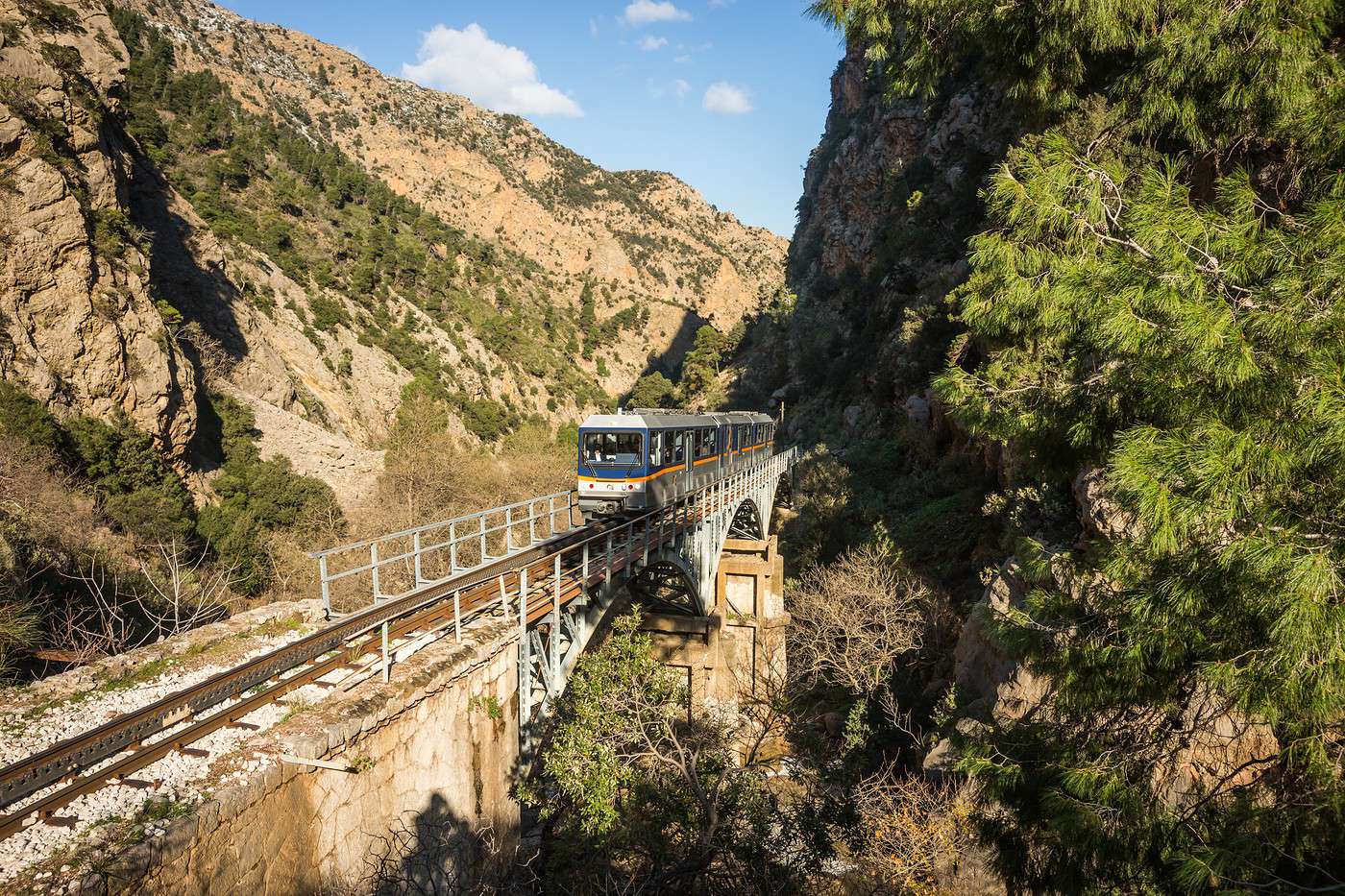
Train travel in the peninsula is limited to arriving in Corinth from Athens. The line that once continued to Patras from Athens is now closed. However, there is a short line (22 km) with a purely tourist purpose running between Diakofto and Kalavryta (between Patras and Corinth).
In Town
What to Choose for Getting Around?
The Peloponnese is a large peninsula with many points of interest spread across different locations, so it’s best to be self-sufficient when it comes to transport. Renting a car will save time and offer freedom. Otherwise, buses can be a good option for those looking to save money and have plenty of time.
Distances Between Cities
Distances (km) between the main mainland cities of the country:
| Alexan. | Agrinio | Athens | Corin. | Ioanni. | Larissa | Le Pirée | Patras | Thess. | Volos | |
|---|---|---|---|---|---|---|---|---|---|---|
| Alexandroupolis | 800 | |||||||||
| Agrinio | 275 | |||||||||
| Athens | 800 | 275 | 80 | 420 | 355 | 12 | 210 | 505 | 325 | |
| Corinth | 80 | |||||||||
| Ioanninna | 420 | |||||||||
| Larissa | 355 | |||||||||
| Le Pirée | 12 | |||||||||
| Patras | 210 | |||||||||
| Thessaloniki | 505 | |||||||||
| Volos | 325 |
Accommodation and Food in the Peloponnese
Accommodation Options
Hotels and Guesthouses
All-Inclusive
Camping
Other Options
Choosing Your Accommodation
Food
Where to Eat?
Other practical information for the Peloponnese
Luggage and equipment to bring
In summer, pack light clothing plus a sweater for inland areas and evenings. In winter, while "mid-season" clothes may just about suffice for the coast, warmer clothing is essential for the mountainous regions. Don’t forget sun protection—it’s intense—and rain gear for the start/end of the year.
Budget
Precautions
As with the rest of the country, there are no real specific issues. With basic precautions for travel or hiking, everything will go smoothly.
Opening hours
Laundries
Local tourist offices
French language use
Getting to the Peloponnese
By land
By road
Motorways (toll roads) and expressways cross the Peloponnese, making it easy and quick to reach the region from Athens via Corinth, or from the north of the country via the bridge (Rio-Antirrio) on the outskirts of Patras.
By train
Train access to the peninsula is limited to an arrival at Corinth. The line that once continued to Patras from Athens is now discontinued.
By sea
Ferries
From/to Italy:
With Igoumenitsa (northwest coast of Greece), Patras is the gateway for ferries arriving from Italy. This is where most motorised tourists from Western Europe disembark, preferring to take the ferry from Italy rather than cross the Balkans. The port of Patras is connected to Ancona (with Anek/Superfast + Minoan), Bari (Anek/Superfast), Brindisi (Grimaldi), Trieste (Minoan), and Venice (Anek/Superfast).
From/to the islands:
The Peloponnese has three small ports with regular ferry connections to the islands. Hermione and Porto Heli serve the Saronic Islands (Hydra, Poros, and Spetses). Meanwhile, the small town of Kyllini on the west coast offers connections to the Ionian Islands.
Cargo
Cruises
Sailboats
By air
While the region has several airports and airfields, the relative proximity of Athens (and even the popular island of Zakynthos in the nearby Ionian Islands) means their activity is very limited. Only the airport at Kalamata attracts some traffic (236,000 passengers in 2014) with its seasonal flights, particularly from the UK and occasionally from Paris. Additionally, the small airport of Patras/Araxos serves as a hub for Tuifly and a few other carriers for summer flights to the region, especially from Germany. In short, for many, air access to the Peloponnese goes through Athens first.
Something wrong or out of date? Report this page