
Overview
The city faces Rabat, with which it is "indissociable," on the opposite bank of the Bouregreg River estuary. Its monuments and cultural heritage are among the attractions of the Rabat-Salé metropolitan area.
Key Facts
- Type of place: large city.
- Tourist interest: (worth a stop if you are in the area).
- Location: on the Atlantic coast, on the outskirts of Rabat.
- Distances: Casablanca (90 km southwest), Meknes (150 km east), Rabat (adjacent to the southwest), Tangier (250 km north)
- Local time: .
- Population: 890,403 inhabitants (2014).
- Area: 87 km².
- Altitude: sea level.
History of Salé
What to see and do in Salé
Medina of Salé
The medina of Salé was founded in the 11th century on the right bank of the Bouregreg estuary. During the Middle Ages, it was the main Moroccan port on the Atlantic coast. You can see, in particular, a large Almohad mosque (entry reserved for Muslims) and an extensive Merinid madrasa decorated with faience tiles and carved panels. Built in 1341, it is one of the most beautiful from the Merinid era. Its souks are among the most "authentic" and oldest in Morocco.
In the surrounding area
Beyond its neighbor Rabat, a few other places to discover within a hundred kilometers:
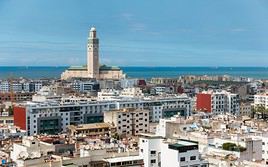
It's the country's largest city and economic capital. Almost all its buildings date from the 20th century, and its new districts, with their contemporary architecture, compete in opulence and modernity. In short, it’s quite far from the "traditional" image one might have of a Moroccan city...
This coastal town near Kenitra is popular for surfing as well as the nearby Sidi Boughaba Lake Park.
Right next to Mehdia, this coastal forest park is home to colonies of rare birds.