
UNESCO World Heritage Sites
Guyana has no sites inscribed on the UNESCO World Heritage list.
Cities and cultural heritage
Corriverton
The small town is located opposite Suriname (Nieuw Nickerie), on the other side of the Corentyne River. It typically serves as the country’s land entry point.
The small town is located opposite Suriname (Nieuw Nickerie), on the other side of the Corentyne River. It typically serves as the country’s land entry point.
Fort Kyk-Over-Al
Near the town of Bartica. These are the last remains of a fort built in the 17th century during the Dutch era.
Near the town of Bartica. These are the last remains of a fort built in the 17th century during the Dutch era.
Georgetown
Located on the Atlantic coast, the capital still features various buildings, particularly wooden ones, dating from the British colonial era.
Located on the Atlantic coast, the capital still features various buildings, particularly wooden ones, dating from the British colonial era.
Lethem
This inland border town lies on the route to/from Brazil. A few walks can be taken in the surrounding mountains or to nearby waterfalls, plus a locally famous rodeo around Easter.
This inland border town lies on the route to/from Brazil. A few walks can be taken in the surrounding mountains or to nearby waterfalls, plus a locally famous rodeo around Easter.
Linden
The country's second-largest urban area, with an economy traditionally centered around bauxite mining.
The country's second-largest urban area, with an economy traditionally centered around bauxite mining.
New Amsterdam
Between Suriname and Georgetown, the city still has a few historic buildings from the British and Dutch eras.
Between Suriname and Georgetown, the city still has a few historic buildings from the British and Dutch eras.
Parika
This town on the banks of the Essequibo River, which you cross by ferry here, is known for its Sunday market.
This town on the banks of the Essequibo River, which you cross by ferry here, is known for its Sunday market.
Natural heritage
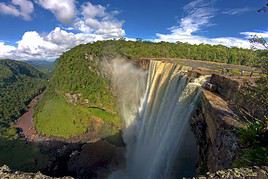
Kaieteur Falls
Spectacular 226-metre-high waterfalls in the heart of the country, making them Guyana's main tourist attraction. They are accessible by small plane from the capital and often combined with a visit to Orinduik Falls.
Spectacular 226-metre-high waterfalls in the heart of the country, making them Guyana's main tourist attraction. They are accessible by small plane from the capital and often combined with a visit to Orinduik Falls.
Orinduik Falls
Though far less spectacular than Kaieteur Falls, these beautiful cascades remain a tourist attraction often combined with them in organized tours.
Though far less spectacular than Kaieteur Falls, these beautiful cascades remain a tourist attraction often combined with them in organized tours.
Iwokrama Forest
A beautiful primary forest in the heart of the country, rich in wildlife and flora, perfect for ecotourism.
A beautiful primary forest in the heart of the country, rich in wildlife and flora, perfect for ecotourism.
Mount Ayanganna
This tepui, similar to Roraima, is more isolated and less well-known. It can still be climbed over several days, preferably with a guided expedition given the necessary preparation.
This tepui, similar to Roraima, is more isolated and less well-known. It can still be climbed over several days, preferably with a guided expedition given the necessary preparation.

Mount Roraima
This large table mountain (flat-topped) is located at the intersection of Guyana, Venezuela, and Brazil. You can reach its summit (2,810 m) via a multi-day trek (from Venezuela only) and enjoy an extraordinary panorama from the top.
This large table mountain (flat-topped) is located at the intersection of Guyana, Venezuela, and Brazil. You can reach its summit (2,810 m) via a multi-day trek (from Venezuela only) and enjoy an extraordinary panorama from the top.