Tout à fait, je parlais bien sûr d'appartenance culturelle pour Korat.
Je ne vois toujours pas ce que vous voulez dire. Un natif de Korat est issanais. Ensuite, dans une région aussi vaste, il est logique de trouver des spécificités locales, patois, cultes, cuisines, et les provinces frontalières sont fortement influencées par leurs voisins, à tel point qu'on distingue par exemple l'Issan lao de l'Issan khmer.
Vous ne voyez pas ce que je veux dire, et bien faites une recherche google et vous verrez que l'appartenance de Korat à l'Isaan est sujette à de nombreuses discussions et débats de salons.
Bonjour
Si vous ne connaissez pas déjà, je vous invite a parcourir ce blog
"Grande(s) et petites histoires de la Thaïlande "
et plus particulièrement les nombreux articles consacrés a Isan
Nous avons voulu savoir ensuite ce que représentaient les Isans en Thaïlande (leur importance démographique, leur origine),
pour découvrir qu’ils composaient 31 % des 68 millions de la population thaïlandaise et que les Siamois y étaient minoritaires (40%).
Que sous ce terme se regroupaient en fait des groupes ethniques très divers, au
Qu’ils avaient été « colonisés » par les Thaïs siamois qui avaient imposé leur langue, leurs normes et établit une « hiérarchie » avec ces autres peuples,
comme avec les Muangs, les Pak Tai, les Kmers, les Chinois, les Khaek, les groupes montagnards (Karens, Hmongs, Akhas …)
Ils étaient tous Thaïlandais, mais pas tous des vrais Thaïs .
Nous avons longuement décrit ensuite cette thaïfication forcée (ou Thaïness) en étudiant l’importance du nationalisme.... ....suite.....
les 8 provinces de l’ « Isan centre » (6 millions d’habitants environ) ont leurs propres spécificités linguistiques,
on y parle le le phouthaï (qui ressemble à du thaï standard).
Ethnologiquement, on trouve une très forte minorité vietnamienne, réfugiés catholiques d’Indochine dans les trois provinces riveraines du Mékong
où fleurissent autant de clochers d’églises catholiques que de djedis bouddhistes.
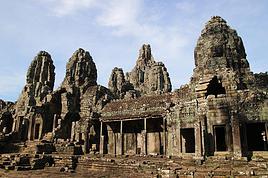
Les 5 provinces du sud, environ 8.000.000 millions d’habitants, ce sont celles de la « route des temples khmers » conduisant à Angkor.
A l’ouest, dans la province de Nakhonratchasima, autrefois et toujours appelée Korat, on parle le thaï de Korat, il y aurait 2 000 000 de locuteurs,
au milieu encore des dialectes tribaux, le koui qui ressemble à du thaï, (300.000 locuteurs), à l’est, n’essayez pas de comprendre,
c’est du khmer, la population d’origine khmer y est nombreuse. Il y aurait encore 2 000 000 de locuteurs.
Non, je ne parlais pas de celui dont on ne sait pas s'il écrit à jeun.
Tu vois bien que tu lui en veux. Peut être ne comprends tu pas ses écrits ?
Ps tu generalises encore avec les anglo saxon.tu devrais lire plus thaivisa peut etre
Si j'en juge par la longueur de ses messages, le membre Jojoone a quantité d'infos à partager sur l'Issan. 🙂
Bref.
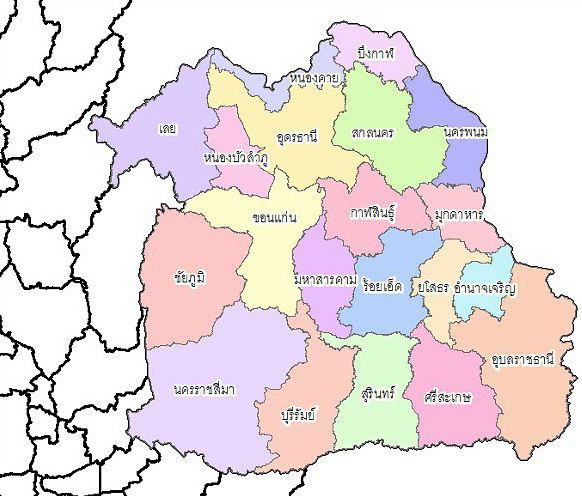
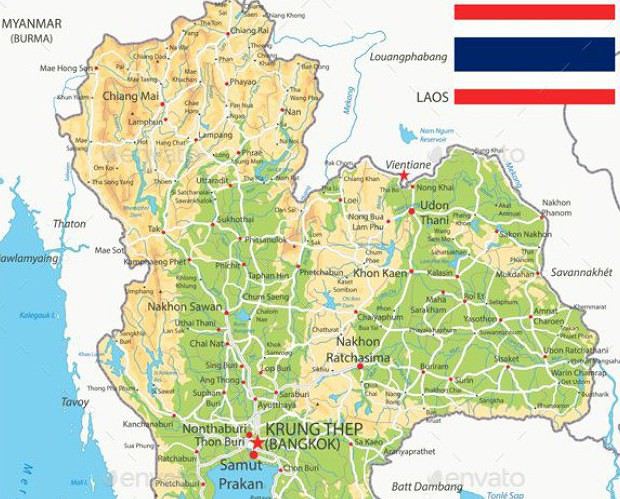
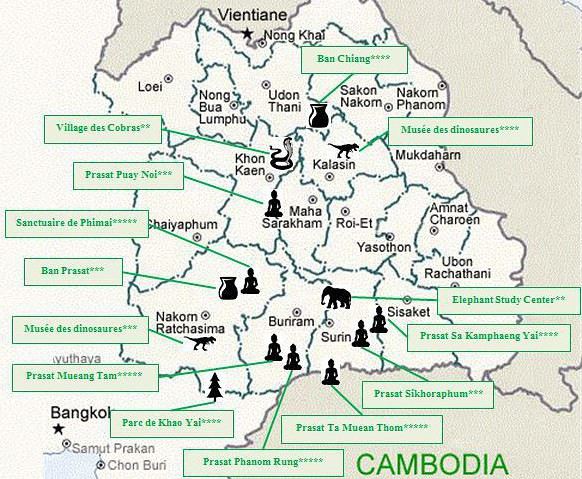
Histoire d'alimenter le salon (moi qui m'attendais à un cercle d'éminents géographes débattant doctement des marches de l'Issan, on me parle de Thaivisa, quelle déception!), une carte basique des provinces de la région reçue ce matin d'une honorable, et fort surprise du débat, correspondante locale.
Il y en a quantité sur le web thaï, et toutes incluent Korat dans l'Issan.
Cela dit, les divisions géographiques suivent très souvent les reliefs et cours d'eau (pas bête) et leur carte est assez parlante.
Par ailleurs, et sauf erreur, Nakhon Ratchasima parlait khmer dans les temps anciens. Signe de plus que la province se différenciait à l'époque de ses voisines de l'Ouest et du Sud.
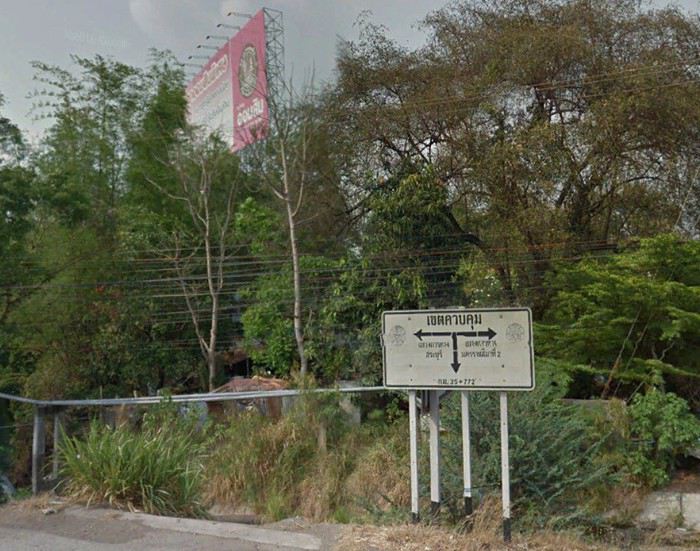
Voici donc l'entrée officielle en Issan quand on vient de Saraburi. Le lecteur aura noté (photo message 8) qu'aucun poste-frontière n'y a été installé.
Cela dit, les historiens se crêpent aussi le chignon sur les faits historiques. Comme quoi toute science est aussi un regard. L'essentiel est d'en débattre sans préjugés. Quant à parler surtout de soi, ça renseigne aussi, mais dans un autre genre.
Quelle importance, sinon, comme de déterminer si le mont St Michel est en Bretagne ou en Normandie. La différence, si différence il y a, vient graduellement.
Je ne vois pas les gens qui iront visiter l'Issan se demander à quel moment ils passent la...frontière.
On va bien devoir te laisser sans réponse pour le reste.
« Tout le monde s'interroge sur comment laisser une meilleure planète à nos enfants, mais on devrait plutôt penser à laisser de meilleurs enfants pour notre planète. » Clint Eastwood
pour moi le mont st michel est en normandie , correspond plus au style normand que style de st brieux. dans mon enfance j y ai ete souvent, habitant pas tres loin, et ce avant que ca ne devienne vraiment une attraction touristique mondiale comme quoi c est partout pareil cf phuket
j avais plus de doute sur l appartenance de chayapum a l issan que de korat, mais c est vrai que de petchabun il faut passer la montagne qui delimite l issan
korat qui est bien khmer sur la meme ligne que buriram et sisaket, mais qui as du bien changé depuis 50 ans entre la plus grande richesse les bases americaine et la proximité de bkk beaucoup d issan lao des region plus pauvre de roi et yasothon amnat et ubon ont du y venir s installer
pareil pour petchabun je ne sais pas qui etaenit les autochtones mais je n y connais que des issan lao des provinces susnommées qui y sont venu pour une terre bien plus riche , et bien sur des sino thai
Si vous ne connaissez pas déjà, je vous invite a parcourir ce blog
"Grande(s) et petites histoires de la Thaïlande "
et plus particulièrement les nombreux articles consacrés a Isan
www.alainbernardenthailande.com/..
Hello Obeo,
Je pense a ce blog presque chaque fois que j ecris isan isaan. Mais ca me gave de tomber sur le Chateau d Isan a chaque recherche google. Que faire. Et isaan, ca fait plus exotique.
Obeo, vous devez trancher entre respect de la forme et petit travestissement a dessein ... philantrope! Telle est votre mission du mois.
j avais plus de doute sur l appartenance de chayapum a l issan que de korat, mais c est vrai que de petchabun il faut passer la montagne qui delimite l issan
korat qui est bien khmer sur la meme ligne que buriram et sisaket, mais qui as du bien changé depuis 50 ans entre la plus grande richesse les bases americaine et la proximité de bkk beaucoup d issan lao des region plus pauvre de roi et yasothon amnat et ubon ont du y venir s installer
pareil pour petchabun je ne sais pas qui etaenit les autochtones mais je n y connais que des issan lao des provinces susnommées qui y sont venu pour une terre bien plus riche , et bien sur des sino thai
Yep mais Petchabun n est pas isaan. Dans la famille ou je vis il y a un filon depuis trois generations entre loei et la pleine centrale - kampang phaet. Pas si loin par phu ruea.
Donc regulierement on fait les allers retours en pickup blindé et inversement, pour les ordinations, les cremations, les mariages, etc..
Yep mais Petchabun n est pas isaan. Dans la famille ou je vis il y a un filon depuis trois generations entre loei et la pleine centrale - kampang phaet. Pas si loin par phu ruea.
Donc regulierement on fait les allers retours en pickup blindé et inversement, pour les ordinations, les cremations, les mariages, etc..
tout a fait ni isan ni plaine centrale, zone tampon
tu rejoins donc l A 12 superbe autoroute sans aucune circulation
Obeo, vous devez trancher entre respect de la forme et petit travestissement a dessein...
Obeo VF: yout, bua !
ca me gave de tomber sur le Chateau d Isan a chaque recherche google. Que faire. Et isaan, ca fait plus exotique.
Dans nos contrées E-san ça le fait aussi
regulierement on fait les allers retours en pickup blindé
Décryptage( avec ou sans Khun Leo pour les esprits chagrins)
Grand sud Thaïlande: pickup blindé: accompagne les profs a l'école.
General bank: transport money
Issan: minimum 12 dans la benne, chiens et coqs de combats non compris
wan nung phop kan nay tee tchi-wit ting,
chock-dee
Sans vouloir interrompre ce passionnant débat sur l’etendue géographique de l’Isan, juste un mot sur le début de notre trip.
Après deux nuits à BKK dans un super quartier, au sud de BKK, un KM en dessous de la station de BTS Thaksin plutôt à l'écart de tout dans un petit hostel avec restos thaï authentique et sourires pas forcés.
Location de voiture ce matin a Suvarnabhumi, les mains un peu moites surtout quand je commence à ouvrir la porte passager pour monter et que l’agent de Hertz éclate de rire.
Finalement les 2h30 de routes jusqu’à la petite guesthouse perdue entre pakchong et Khao Yai sans encombre, faut être concentré mais ça j’ai l’habitude!
Bonjour,
Quelle voiture avez-vous louée?...Pour le trafic, vous avez fait le plus dur. Vous allez voir que sur le reste des routes, c'est plutôt tranquille, même s'il faut rester vigilant.
Quel temps avez-vous sur Khao Yai?
Bonjour Charlie, j’ai pris une moyenne gamme et recu une Toyota vios qui par chance est flambant neuve!
Ça devrait aller alors, d’apres l’expat anglais qui tient la petite guesthouse (de deux chambres et deux tentes) ici, si on part du principe que le conducteur devant peut faire quelque chose de stupide comme mettre un clignotant à droite et tourner à gauche on a juste à rester vigilant 😄.
Pour le temps aujourd’hui magnifique ciel bleu, demain un peu orageux et mardi averses, on a booké une guide apparement très compétente amie de notre hôte pour mardi en espérant ne pas trop se faire arroser!
Tu as certainement du flair. Et pas possible de renier ce que tu dis là.
C'est un blog que j'ai découvert il y a un an ou deux.
Rien à voir avec les milliers de blogs jumeaux ou consacrés à la selfisation, mais bon c'est fait par un anglo-saxon. Effectivement, dans l'ensemble c'est le genre de truc que j'aime bien voir.
Quand je vois la photo du comité d'accueil des touristes à l'aéroport de Nakhon R, je me régale.
Récemment, je suis tombé sur le blog d'un japonais archi minutieux et méthodique. Non seulement il parcourt dans toute la Thailande tout ce qu'il y a à voir, mais il ne rate pas même le moindre vestige.
Au moindre tas de trois briques estampillé Chiang Saen, il répertorie, photographie et publie.
Bon, là il faut vraiment être client. La culture pour la culture, pas trop, quoi.
« Tout le monde s'interroge sur comment laisser une meilleure planète à nos enfants, mais on devrait plutôt penser à laisser de meilleurs enfants pour notre planète. » Clint Eastwood
Ca tombe bien, le dernier reportage posté c'est sur le jardin érotique de Chiang Mai.
Je n'ai pas eu le courage de tout visualiser parce que sinon j'y passe l'hiver.
N'hésite pas à utiliser la traduction en français, c'est très poétique.
On attend tous ton retour avec des analyses par thème et pour nous faire une liste des sites les plus intéressants. 😉
« Tout le monde s'interroge sur comment laisser une meilleure planète à nos enfants, mais on devrait plutôt penser à laisser de meilleurs enfants pour notre planète. » Clint Eastwood
bon bin merci alors
j adore la vision japonaise, beaucoup de similarités entre les 2 cultures, surement pour ca que les japonais se fondent en thailande
Je les trouve absolument fascinants quand je les croise là-bas. Ils sont tellement trop différents.
Eux et nous on pourrait croire qu'on ne vient pas de la même planète.
Merci en passant à Matdej, qui commence à nous faire des retours. On est toujours tellement étonnés quand ça arrive. On prendra les infos avec plaisir, on ne sait jamais.
Mais au fait, j'ai déjà été en Issan : on a pris l'avion à Udon Thani il y a cinq ans. Tout aussi thai typique que le reste du pays, pas de différence flagrante. C'est vrai que c'est une grande ville.
« Tout le monde s'interroge sur comment laisser une meilleure planète à nos enfants, mais on devrait plutôt penser à laisser de meilleurs enfants pour notre planète. » Clint Eastwood
sans aller si loin y a celui la, je suis sure que tu as eu le temps d y jeter un coup d oeil
plus.google.com/...hkey=CLnctdS5-7_S3wE
C'est une sorte de best of. Je n'ai carrément pas le temps de me plonger dans des trucs comme ça. Je suis en pleine préparation du prochain et ça me coûte déjà assez de temps. Même pas encore eu le temps de monter le film de cette année.
J'ai parlé du blog de Mikhtai récemment, pas mal aussi. Il tape fort dans les couleurs mais il visite avec intelligence. Pas mal d'endroits super découverts par lui, mais sur le blog des localisations très approximatives.
Il a raison ce n'est pas vraiment rendre service aux gens que de tout leur présenter tout cuit dans l'assiette. 😉
« Tout le monde s'interroge sur comment laisser une meilleure planète à nos enfants, mais on devrait plutôt penser à laisser de meilleurs enfants pour notre planète. » Clint Eastwood
Ca me fait chaud au coeur de te voir sur le même fil que miss B.
Toujours sur Lampang ?
« Tout le monde s'interroge sur comment laisser une meilleure planète à nos enfants, mais on devrait plutôt penser à laisser de meilleurs enfants pour notre planète. » Clint Eastwood
@Jojoone normal je pense, j’aurai eu beaucoup plus de mal à y voir clair sans les avis, parfois enflammés de chacun et pour ça je le dirai jamais assez :
khorp Khun
Pour le reste après une belle journée à Khao Yai, un petit trek et 3h dans la jungle avec une super guide.
Un prolongement de séjour dans la brousse de pakchong (vraiment une super guesthouse, notre plus chaleureuse expérience à ce niveau là en Thaïlande).
On est ce soir à Khorat après avoir fait l’aller retour Phimai dans la journée (on a quitté pakchong tôt ce matin) pour voir les ruines Khmer, très sympa tout autant que la modeste ville construite autour. Un petit rafraîchissement autour d’un lac avec un banyan sacré de 350ans qui doit bien faire 500m2 de troncs et branches entremêlées.
Petit tour à Khorat en fin de journée, pas grand chose à voir mais quelques sourires, même un « high five » par un groupe de jeunes très enthousiastes, un délicieux repas comme souvent et une brochette sauce cacahuète au night bazar en guise de dessert.
Demain direction Phanom Rung, sur la route de surin et du festival de ce week-end !
Petit tour à Khorat en fin de journée, pas grand chose à voir mais quelques sourires
Bonjour,
SI vous parlez de la ville, vous pouvez dire "Muang Khorat". A voir par exemple:
-le curieux Wat Phayap
-le Wat Sala Loi, avec une partie consacrée à Tao Suranaree, héroïne de la cité dont on peut voir la statue en ville.
Par ailleurs, le banian que vous avez "visité" s'appelle Sai Ngam ("le banian splendide"), et il couvre 1 350 m2.
Et petite question qui me turlupine: avez-vous eu la chance de rencontrer à Nakhon Ratchasima quelques authentiques Issanais, ceux dont la réputation grandit de mois en mois sur ce forum? 😉
Après avoir pris un katoey pour une gentille fille, maintenant vous vous turlupinez.
C'est le moment d'envisager des vacances au grand air, l'Isan peut être?
Je commande un autre expresso pour poursuive d'autres lectures aussi drôles et vous laisse monologuer de votre passion du....cinéma et de Muang Korat
Je le sentais bien un peu morose ces temps-ci... sûr qu'il nous fait un un petit coup de calcaire.
Issan remettra bien 😉
« Tout le monde s'interroge sur comment laisser une meilleure planète à nos enfants, mais on devrait plutôt penser à laisser de meilleurs enfants pour notre planète. » Clint Eastwood
Suite aux deux dernières interventions aussi remarquables qu'utiles au lecteur, J'aurais pu écrire "A la foire, laisse braire les ânes, ils se répondent" (proverbe berrichon) mais pour rester dans la couleur locale et ne pas céder au hors-sujet si apprécié des membres Jojoone et Pricillian qui n'ont rien à apporter que le vide de leur pensée:
"Ne perds pas ton temps à jouer de la musique à un buffle". Proverbe thaï, bien entendu.
Petit tour à Khorat en fin de journée, pas grand chose à voir mais quelques sourires, même un « high five » par un groupe de jeunes très enthousiastes, un délicieux repas comme souvent et une brochette sauce cacahuète au night bazar en guise de dessert.
toute ces villes de thailande sont tres agreable pour 24/ 48 h, korat fait partie des meilleures
la meilleure pour moi c est nakkhon sawan parce que petite, plein de charme et truc a voir et tres bien entretenue , la plus compliquée c est khon kaen tres etendue et tres bordelique si on n y a pas d attache
Ok je note! Même si Nakhon Sawai ça sera pour une autre fois pas trop sur notre route même si j’aurai aimé le faire avec phitsanulok.
Effectivement ça n’a été qu’un stop plus court que prévu à Khorat on a pas pu pleinement en profiter mais c’etait Agréable.
On a un week-end à surin la vous en pensez quoi ? J’ai déjà noté le musée, le festival évidemment.
Khon Khaen sera au retour après avoir remonté le Mékong le long de la frontière Lao jusqu’à Nong Khai, je sais pas encore si ça sera une étape comme camp de base pour voir les points d’interets autour ou si on prendra le temps de flâner dans la ville même.
Ok je note! Même si Nakhon Sawai ça sera pour une autre fois pas trop sur notre route même si j’aurai aimé le faire avec phitsanulok.
Effectivement ça n’a été qu’un stop plus court que prévu à Khorat on a pas pu pleinement en profiter mais c’etait Agréable.
On a un week-end à surin la vous en pensez quoi ? J’ai déjà noté le musée, le festival évidemment.
Khon Khaen sera au retour après avoir remonté le Mékong le long de la frontière Lao jusqu’à Nong Khai, je sais pas encore si ça sera une étape comme camp de base pour voir les points d’interets autour ou si on prendra le temps de flâner dans la ville même.
Cya!
Surin, J'y ai passé une semaine pour Loy Krathong.
Pour ce qui m'a marqué, des paysages ultra bucoliques entre Buriram et Surin avec troupeau de buffles au bord d'un lac etc.... C'est sur le dernier tiers avant d'arriver Surin on voit les plans d'eau de la route et il faut s'engager... peut être vous tomberez dessus.
Sinon la ville, ma foi:
- une rivière - des bonnes nouilles au boeuf - plusieurs coffee shop "duck coffee" ou le café est excellent - une très belle salle de fitness - quelques temples anciens - un quartier avec une série de bars assez mal fréquentés - un resto allemand d'une glautitude (ça existe?) à faire peur - un chouette coffee shop dans un bâtiment en bois vers la gare ferroviaire.
C'est pas mal, ça a son charme, ne vous attendez pas à une claque non plus 😄
Ceci dit, avec le festival ça sera peut-être le feu.
@Renosu on va peut être faire ça, on voulait faire l’extrême est en passant par Ubon Ratchathani mais j’aimerai mieux éviter de faire de trop grandes distances en une journée pour éviter la fatigue de la conduite.
Vu la distance parcourue en 5jours et le trajet restant ça semble plus logique
@Prb Ok merci pour tous les détails! J’ai noté le plan d’eau Huan saneng juste avant Surin, apparement beaucoup de lotus en plus à cette saison !
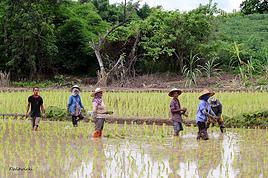
Déjà vers nangrong hier on a pu assister à la coupe du riz, avec séchage sur la route sur des bâches bleues le paysage autour était assez magique.
après avoir remonté le Mékong le long de la frontière Lao jusqu’à Nong Khai,
Bonjour
Bonne idee
Au sud de Surin tu peux rejoindre la route 24 en direction de Ubon Ratchatani
A voir Le Wat Pa Maha Chedi construit en bouteille situé à 80 km au sud de Sisaket dans la petite ville de Khun HanPuis tu rejoins les bords du Mekong
Je connais cette route jusqu a Nakhon Phanom
Plus de details sur cette route ici
https://ma-retraite-en-isaan.blog4ever.com/articles/de-mukdahan-a-sisaket-1
Le pha Taem National Park merite d y passer la journee
De Nakhon Phanom a Bung Kan je ne connais pas mais a Bung Kan n hesite pas a faire un detour jusqu au Phu Tok
https://ma-retraite-en-isaan.blog4ever.com/le-phu-tok-prend-de-la-hauteur
Nong Khai merite d y passer au minimum 2 jours et si le temps le permet va assister au coucher de soleil sur le Mekong depuis le milieu du pont de l Amitie qui marque la frontiere avec le Laos
La route 211 jusqu a Sangkhom est aussi interessante
Entre autre
Hello! Finalement Surin on a trouvé un peu froid et impersonnel, peut être que le festival justement localisait l’animation vraiment à un point et Beaucoup d’échoppes étaient fermées.
On a un peu temporisé devant une série le soir à vrai dire, aussi point de vue budget et on était vraiment pas emballés par la ville.
Festival en lui même sentiment mitigé, d’une part grande richesse culturelle indéniable pendant 2h30 reconstruction de batailles etc et danses traditionnelles toujours aussi captivantes.
S’en suivait une sorte de numéros de cirques avec éléphants qui dansent, qui jouent au foot.
On est pas restés jusqu’au bout, d’une il faisait particulièrement chaud ce week-end et de deux nous trouvions ça d’assez mauvais goût, sans rentrer dans la polémique de la condition animale on fait vite le rapport entre ces « tours » et les crochets/bâtons des mahouts.
Même s’il y a une certaine communion présumée entre un mahout et son animal on imagine bien que le dressage d’un animal de plusieurs tonnes ne se fait pas à certains moments dans la douleur.
Arrivée à Ubon Ratchathani cette aprem la ville a l’air beaucoup plus relax, on a fait un tour ce soir, ambiance jeune et bon enfant. De quoi lever les doutes qui sont nés à Surin.
2 nuits ici et on entame la remonté du Mékong jusqu’à Nong Khai !
Oui, j'avais trouvé aussi les gens en général assez froids sur Surin mais j'avais évité de le mentionner pour ne pas vous lancer sur un biais trop personnel.
En Thaïlande d'ici une dizaine de jours, Ubon Ratchathani m'interesse pour compléter ma collection de provinces visitées.
Avez-vous croisé des loueurs de scooter ? A Surin c'était mission impossible 🙁
Très prévenant ! Mais en tout cas même constat malheureusement.
Pour les scooters pas trop fait attention, j’avais lu sur un forum y’a un moment qu’il valait mieux privilégier les hôtels qui en louaient pour être tranquille.
Je recommande chaudement Ubon en tout cas, c’est le jour et la nuit comparé à Surin, j’avais peur que ça soit un peu austère et morose aussi loin dans l’est mais c’est tout le contraire! Ça fait un peu Chiang Mai de l’est mais sans les farangs et tout ce qui va avec.
On fait le 3ème jour demain on a prolongé d’une nuit, on a croisé qu’un seul blanc jusqu’à maintenant! Il semble y avoir beaucoup de touristes thaï en revanche. Super marché de nuit, globalement un meilleur niveau d’anglais qu’ailleurs dans l’isan.
en plus de savoir ou je vais grace a ma femme , je me sers bien de google map pour prendre des petits racourcis en general toute les petites routes de thailande sont plutot bonne (attention quand meme en monta ou pour faire un stop dans un des point d interet noté en general un wat ou un point de vue qui ne sont pas repertorié dans les guides en plus de m arreter dans les point d interet classiques
Suite aux deux dernières interventions aussi remarquables qu'utiles au lecteur, J'aurais pu écrire "A la foire, laisse braire les ânes, ils se répondent" (proverbe berrichon) mais pour rester dans la couleur locale et ne pas céder au hors-sujet si apprécié des membres Jojoone et Pricillian qui n'ont rien à apporter que le vide de leur pensée:
"Ne perds pas ton temps à jouer de la musique à un buffle". Proverbe thaï, bien entendu.
« Tout le monde s'interroge sur comment laisser une meilleure planète à nos enfants, mais on devrait plutôt penser à laisser de meilleurs enfants pour notre planète. » Clint Eastwood
Salut ! Oui super, voiture rendue ce matin, on loge à proximité de Don Mueang pour prendre le vol pour Vientiane demain.
Près de 3000km parcourus en Isan, des images et des expériences indélébiles gravées dans nos têtes!
Notre chemin a été BKK - Pak Chong - Khorat - Phimai - NangRong - Surin - Ubon - Mukdahan - Nakhon Phanom - Nong Khai - Khon Kaen - Khorat Pak Chong et BKK, plus un bon nombre de Ban ou on s’est attardés au milieu de vaches, du riz étalé sur les routes en train de sécher.
Nous avons adoré l’Isan mais effectivement ne recommanderions pas cette partie de la Thaïlande à n’importe qui.
Les infrastructures sont pas toujours au point, les routes n’en parlons pas.
L’anglais inexistant nous a poussé à apprendre des rudiments de thaï qui a souvent vu naître un sourire rayonnant sur le visage de ceux qui les entendaient.
Je n’ai malheureusement pas les qualités expressives de certains sur ce forum qui sont un bonheur à lire, je vous infligerez pas un carnet de voyage détaillé mais voila, c’etait que du bonheur.
On continue pour le Laos en décembre, le Cambodge en janvier avec nouvel an a Siem Reap, et après on hésite entre le sud du Vietnam ou la Thaïlande de nouveau en février.
Pour ceux que ça pourrait intéresser vu que c’etait Le sujet initial, la conduite une fois sorti de Bangkok n’est pas si terrible, faut juste s’attendre à tout de la part de autres conducteurs,
faire TRÈS attention aux poids lourds que j’ai trouvé particulièrement inconscients.
Attention aussi aux travaux, très mal indiqués.
Système de U-turn souvent archaïque.
Si possible (c’est ce qu’on a fait sauf une seule fois) privilégier des courtes distances pour pas augmenter le risque avec la fatigue. (3h par jour grand Max)
Bref c’est compliqué mais pas insurmontable a condition d’être de nature prudent et patient.
J’étais quand même soulagé quand j’ai rendu les clés, que la voiture était intacte et qu’on avait eu aucun problème.
Phimai et Nong Khai : des endroits très très sympathiques.
Nous avons adoré l’Isan mais effectivement ne recommanderions pas cette partie de la Thaïlande à n’importe qui.
Vous avez raison. Je suis content de faire partie de ceux qui ont pu en profiter. Obéo disait, l'Issan ne se visite pas, il se vit et se savoure. Très juste je trouve.
L’anglais inexistant nous a poussé à apprendre des rudiments de thaï qui a souvent vu naître un sourire rayonnant sur le visage de ceux qui les entendaient.
Ouiiii et c'est très sympa, ça motive à apprendre quelques phrases (qui plus est, ça facilite la vie)
Je n’ai malheureusement pas les qualités expressives de certains sur ce forum qui sont un bonheur à lire, je vous infligerez pas un carnet de voyage détaillé mais voila, c’etait que du bonheur.
Perso, je trouve que vos écrits sont facile et agréables à lire.
Pour ceux que ça pourrait intéresser vu que c’etait Le sujet initial, la conduite une fois sorti de Bangkok n’est pas si terrible, faut juste s’attendre à tout de la part de autres conducteurs,
Oui, tout...mais vraiment tout. Facile à écrire, plus étonnant à vivre.
faire TRÈS attention aux poids lourds que j’ai trouvé particulièrement inconscients
Aux poids lourds, aux bus, aux minivans, aux voitures, bref à peu près à tout ce qui roule.
Système de U-turn souvent archaïque.
Et un tout petit peu....mais alors juste un tout petit peu dangereux. 😄
Bref c’est compliqué mais pas insurmontable a condition d’être de nature prudent et patient.
Et d'avoir un bon karma, d'être capable d'élever son niveau de prudence à son maximum, de ne rien supputer, mais d'être près à s'adapter à tout dans la seconde.
Exemple, une voiture devant vous conduite par un Thaï freine, cela peut vouloir dire, qu'il veut tourner à gauche ou à droite (surprise surprise), qu'il veut simplement ralentir, qu'il ne sait pas où il va, qu'il veut vous laisser passer ou peut-être qu'il freine pour une raison complètement différente qui échappe à votre logique. Peut importe, on s'adapte avec le sourire.
Et surtout, surtout on ne klaxonne pas, généralement ça fait freiner le conducteur de devant encore plus fort.
Il faut également tenir compte de la règle qui dit : Le plus gros à toujours une certaine forme de priorité sur un plus petit. Donc comme piéton, vous n'avez jamais la priorité, sur rien, même pas dans les passages cloutés (et je suis très sérieux en écrivant cela).
J’étais quand même soulagé quand j’ai rendu les clés, que la voiture était intacte et qu’on avait eu aucun problème.
😄 ça je peux le comprendre....une tite offrande à Buddha...ça peut pas faire de mal. 😉
Merci pour ce post qui m'a fait sourire et m'a rappelé beaucoup de souvenirs.
Vivement les prochaines vacances.
Une bonne suite de voyage à vous. 🙂
L'éternité c'est très long....surtout vers la fin (Woody Allen)
Vous avez raison. Je suis content de faire partie de ceux qui ont pu en profiter. Obéo disait, l'Issan ne se visite pas, il se vit et se savoure. Très juste je trouve.
Oui très juste effectivement, je dirai que pour ceux dont le but n’est pas de se noyer dans les marées de touristes des grands sites (justifiés pour autant car pour la plupart grandioses).
Mais plutôt d’apprécier les subtilités discrètes d’un pays en s’immergeant dans sa population, l’Isan est un endroit à vivre absolument!
Ouiiii et c'est très sympa, ça motive à apprendre quelques phrases (qui plus est, ça facilite la vie)
Tout à fait! Surtout en voyageant à plusieurs nous avions souvent l’habitude de communiquer entre nous ou au mieux avec d’autres touristes quand il y en avait! En Isan pas le choix si on veut se faire comprendre et c’était très sympa.
Perso, je trouve que vos écrits sont facile et agréables à lire.
Je le prends vraiment comme un compliment venant de vous merci !
Aux poids lourds, aux bus, aux minivans, aux voitures, bref à peu près à tout ce qui roule.
C’est un peu l’idee En fin de compte oui haha.
Et d'avoir un bon karma[...]d'être près à s'adapter à tout dans la seconde.
Je ne saurai dire pour le premier mais selon les règles du bouddhisme je fais rien à son encontre en tout cas!
Pour le deuxième oui il vaut mieux oublier dans le cas contraire...
Il faut également tenir compte de la règle qui dit : Le plus gros à toujours une certaine forme de priorité sur un plus petit. Donc comme piéton, vous n'avez jamais la priorité, sur rien, même pas dans les passages cloutés (et je suis très sérieux en écrivant cela).
C’est exactement ça, il n’est pas rare que lorsque vous doublez un camion, celui ci bien que vous ayant vu, décide de doubler, changer de voie pour une raison qui comme vous dites « échappe à votre logique » dans ce cas deux possibilités, accélérer si vous y êtes presque (et serrer un peu les fesses faut avouer) ou alors si vous pensez pas que ça passera freiner et espérer que la personne derrière s’en rendent compte rapidement!
Ça fait partie de l’aventure on va dire😇
😄 ça je peux le comprendre....une tite offrande à Buddha...ça peut pas faire de mal. 😉
Merci pour ce post qui m'a fait sourire et m'a rappelé beaucoup de souvenirs.
Vivement les prochaines vacances.
Une bonne suite de voyage à vous. 🙂
Je n’y manquerai pas!
Merci à tout les acteurs de ce forum qui m’ont lu et apporté beaucoup de judicieux conseils.
Voyager à vélo › Inde / Birmanie / Thaïlande · 32 replies
Nous suivons ce forum depuis quelques temps déjà en préparation de notre road-trip à vélo France-Thaïlande sur 14 mois, et départ prévu juillet 2020. Ceci est…
J envisage de partir du 22 septembre au 12 octobre en Thaïlande. Arriver Bangkok dès le j aimerais de la partir vers Chiang mai 2 ou 3 jours puis aller vers…
Ma famille et moi même prévoyons un périple en Asie du 2 aout au 26 aout. Nous souhaiterions découvrir la Thailande principalement, la Malaisie et l'Indonésie…
Je souhaiterais avoir des avis sur notre projet de road trip l'été prochain en Thaïlande. c 'est une première découverte avec bien sur l'envie de découvrir les…
Nous avions prévus initialement un tour du monde en avion (entre autre) mais au fil de nos préparatifs nous nous orientons vers un road trip en 4x4 (Toyota…
Hi there,
We’re planning a 3-week family trip next summer with our three kids, who’ll be 8, 8, and 7 years old.
After some research, we’re leaning toward Malaysia to combine nature/forests and paradise beaches. The idea is to introduce our kids to the country’s culture, nature, and wildlife.
We want a great trip but without splurging on luxury options like high-end lodges and resorts. We’re looking for comfort with a touch of authenticity—basically, a good middle ground.
I’ve started putting together an itinerary and would love your expert advice and tips to help us build this amazing trip with our little ones.
Day 1: Departure from France
Day 2: Kuala Lumpur
Stay at a hotel near the airport or KL Sentral.
Just one night.
Day 3: Morning flight to Sandakan (Borneo).
Stay in Sepilok
Day 4: Sepilok:
* Orangutan Center
* Malayan Sun Bear Center
* Rainforest Discovery Centre
Day 5: Depart for Kinabatangan.
Boat safari in the late afternoon.
Day 6: Sunrise safari.
Jungle walk.
Evening safari.
Day 7: Final safari.
Return to Sandakan.
Flight to Kuala Lumpur, then to Kota Bharu (or overnight transit depending on schedules).
Day 8: Transfer to the port.
Boat to the Perhentian Islands.
Days 9 to 13: Perhentian Besar
5 full days.
* Snorkeling
* Hiking
* Turtle watching
* Wild beaches
* Relaxation
Day 14: Return to the mainland.
Bus or private car to Taman Negara.
Hi everyone,
Could you share your thoughts on my 3-week itinerary?
We’re a small group (family + friends) of 12 people, planning to leave around January 21, 2027.
Here’s my itinerary:
3 nights in Bangkok
4 nights in Chiang Mai
3 nights on Koh Samui
3 nights on Koh Phangan
4 nights in Krabi
4 nights in Phuket
I’m also open to any great tips you might have...
Thanks, everyone! Alain.
Hi,
On September 1st, we're heading to Kalimantan for six weeks, probably from Pontianak to the Derawan Islands.
I've scoured this site, which is usually my go-to 😉, and others like VoyageForum, but recent info is pretty scarce.
I'd love any tips on places you've visited—our itinerary is still a work in progress.
We're two couples traveling with backpacks, using buses, boats, guesthouses, and homestays.
Thanks in advance!
After reading and researching, we're planning the following stops in Cambodia in January 2027:
- Phnom Penh
- Kampong Cham
- Kratie
- Siem Reap
- Battambang
- Kampot (round trip)
I'm wondering about the direction of these stops, which could also influence our international flights.
Either a round trip from Phnom Penh in the order above.
Or landing in Siem Reap with the following order:
This second option would save us the Battambang - PP - Kampot trip but means doing a round trip to Battambang from Siem Reap and placing the "highlight of the trip" (Angkor) at the beginning of our stay.
Hi there,
I’m planning a family trip (my wife and I, both 47, and our two sons, aged 5 and 12) to Malaysia for the last week of June and the first two weeks of July 2027.
We used to love road trips as a couple, then as a trio, but since our second child arrived, we’ve taken a break with "camping village" style trips.
Now feels like the right time to get back to our old habits, while adjusting the pace for the kids.
We’re craving Asia. We’ve been lucky enough to visit Thailand, Indonesia (Bali and Lombok), and Sri Lanka before.
Friends have raved about Malaysia, so we’re definitely tempted.
For those who know and love Malaysia, what would be a good itinerary starting from Kuala Lumpur, with a maximum of 3-4 stops? We’d like a mix of culture, nature, and relaxation (just to clarify, we’re not big beach fans). All of this without rushing, of course.
We’ll be arriving in Phnom Penh this coming January and we’re thinking of starting our trip with a stop in Kampong Cham, then Kratie.
After Kratie, we’re considering heading toward Siem Reap with a stop in Kampong Thom.
That said, I’m not really sure how long the Kratie–Kampong Thom journey might take or how complicated it is.
Does this stop on the way to Siem Reap seem like a good idea to you?
If we don’t visit the Sambor Prei Kuk site, are there still any walks or sights worth checking out in Kampong Thom?
We’ll be arriving in Phnom Penh this coming January and we’re thinking of starting our trip with a stop in Kampong Cham, then Kratie.
After Kratie, we’re considering heading toward Siem Reap with a stop in Kampong Thom.
However, I’m not quite sure how long the Kratie–Kampong Thom journey might take or how complicated it is.
Does this stop on the way to Siem Reap seem like a good idea to you?
If we don’t visit the Sambor Prei Kuk site, are there still some walks and/or things to see in Kampong Thom?
Hi there,
We’re planning to travel from Chiang Rai to Luang Prabang next November.
We’d like to take a slow boat from Chiang Khong—or rather from Huay Xai in Laos—with an overnight stop in Pakbeng.
Could you let us know if the boat still leaves Huay Xai in the late morning? If so, what time roughly, and what’s the price for the trip?
Thanks for your help!
Alod
We (3 adults: 68, 65, and 25 years old) are just back from a short trip to the Philippines, and I’d like to share a little summary of our journey. First of all, I’d like to thank everyone who contributes to this forum about this destination and answers the questions of those who aren’t familiar with it. I should also mention that my comments are personal and don’t reflect anyone else’s opinions. Since I don’t have any literary or photographic talent, I’ll stick to the facts and share a few details about the sights, hotels, and restaurants.
Preparations:
We chose this destination in December and quickly booked our flight tickets (540 € with Turkish Airlines) for a departure on February 16 and return on March 5, 2019. We then contacted two French-speaking tour operators based in Manila, asking them to put together an itinerary based on our wishes (places to visit, type of accommodation) and our budget. We wanted to see the rice terraces in northern Luzon, the hanging coffins in Sagada, before flying to the Visayas (Bohol, Siquijor, etc.), and the Taal Volcano, while limiting our nights in Manila as much as possible. In the end, we opted for Alize, whose itinerary and quote matched our request almost perfectly. Our exchanges helped us refine our circuit.
International flights:
The round-trip flights went smoothly. Turkish Airlines, while not at the level of Asian or Gulf airlines, does the job just fine.
Day 1:
We landed on time (6:15 PM) on Monday, February 16, at Terminal 3. We exchanged our euros (near the car rental counters), and I can confirm the exchange rate was very good. On the way to the St. Giles Hotel (decent and affordable for a transit night), we got our first glimpse of Manila’s dense traffic. The Makati district, where our hotel was located, offers a wide choice of restaurants, so we grabbed a quick bite to recover from the trip.
Day 2:
This day was dedicated to transferring to Banaue. Fortunately, we had a comfortable van and an excellent driver for this journey, which took all day (8 to 9 hours with stops). We got a taste of driving in the Philippines—and it’s terrifying. You wouldn’t want to drive on these roads. The first thing that struck us was the relatively good condition of the roads and the cleanliness (a change from other Southeast Asian countries). This impression lasted throughout our trip. Around 6 PM, we checked into our room at the Banaue Hotel (large, charm-free, but with a beautiful view of the rice terraces).
Day 3:
With the help of a local guide, we took a jeepney to Batad. And then—wow! The rice terraces form an amphitheater overlooking the small village. Under the sun, it’s simply spectacular and breathtaking! Even though we’re familiar with rice terraces (Sapa, Bali, Thailand, etc.), we were dazzled by so much beauty. We spent the day walking along the terrace walls. This place is timeless and fully deserves its UNESCO World Heritage status. However, we returned to the hotel exhausted (due to our ages and lack of exercise). We had dinner with our driver at the Las Vegas restaurant in the center of Banaue. The meal was decent, cheap, and the Filipino owner played the guitar to accompany our dinner.
Day 4:
Today, our driver took us to Sagada. The mountain road offered spectacular landscapes (about 1.5 to 2 hours). Along the way, we stopped in Bontoc to visit the small but interesting anthropological museum. It features old photos and various objects from the Ifugao tribes, as well as a reconstruction of primitive dwellings.
We then went on a short hike in Sagada with a very friendly local guide who explained the region’s funeral rites. The walk started at the communal cemetery before reaching “Echo Valley,” where we saw the first coffins hanging on the cliff. We continued to the “Underground River” and a small waterfall, ending our journey in the “Lumiang Cave” burial cave. All in all, this day was very interesting. On the way back, we made a few photo stops.
In the evening, on our driver’s recommendation, we ate at the “Bistro,” a French enclave in the center of Banaue (good pizza, roasted quail, homemade fries).
Day 5:
Today was a transfer day. To limit fatigue and nights in Manila, our tour operator arranged a flight from Clark to Tagbilaran (Bohol), saving us 2 to 3 hours of driving. But to catch our flight, we had to leave very early: 5:30 AM. Our kind driver dropped us off on time at the airport. To use it, we had to pay a 150 PHP tax per person. The Philippine Airlines flight (15 minutes) left early and was far from full. Upon arrival, we were taken to the Loboc River Hotel, on the banks of the river of the same name. A very charming lodge lost in a tropical garden. We stayed in a stilt cottage overlooking the river. We relaxed a bit in the lovely pool. This place is really great—the staff is charming, and the food is excellent for a reasonable price.
Day 6:
This day was dedicated to exploring Bohol. The program was classic, starting with the tarsier sanctuary. We saw a few specimens in a small garden, each pointed out by a staff member. It was both good and disappointing because the animals were in pseudo-freedom in a small enclosure. Then we went to the “Chocolate Hills” and climbed 240 steps to admire the panoramic view of the hills—but by 10 AM, it was crowded. On the way back, we stopped at the butterfly garden, which was uninteresting: tiny, with few butterflies. We consoled ourselves by photographing beautiful flowers. To please our teen, we stopped at the Loboc Eco Tourism Adventure Park and crossed the river lying down, suspended from a steel cable (300 PHP). Finally, we had the traditional lunch-cruise on the Loboc River. It was a factory-like experience, and the meal was unremarkable. The only good thing was the singer on each boat and the lush vegetation. Afterward, we visited colonial churches and the cathedral, remnants of the Spanish presence, before returning to the hotel for a well-deserved dip in the pool. Note that for those interested, there’s an arena near the hotel where cockfights are held every Sunday—something Filipinos are passionate (if not obsessed) about.
Day 8:
Very early departure for the port. We boarded a *banca* in search of dolphins. After about an hour of sailing, we were lucky enough to spot around a hundred dolphins. Our boat then headed to the small and charming island of Pamilacan. After a walk through the little village, we came across locals traditionally building a boat. They told us it takes about a month to finish their outrigger boat. Then we had to choose our snorkeling spot between the coral garden, the fish park, and the turtle enclosure. Note that a fee is charged for each spot: 150 PHP per place and per person. It felt a bit like we were being ripped off, especially since the spots weren’t amazing—we’d see much better on Apo for much less. We had lunch on the island at one of the many small eateries (350 PHP per person).
Days 9 and 10:
On our return, we were taken to the Bohol Sea Resort on Panglao Island, where we stayed for 2 nights. It’s a small, recent establishment in a quiet corner of the island. It’s relaxing—maybe a bit too much. It has a nice pool and access to Danao Beach, but the view is blocked by a flotilla of boats. We didn’t try their diving school. The meals were good. If we had to do it again, we’d skip this stop to spend more time in Negros.
Days 11 and 12:
We took a fast ferry (Ocean Jet) from Tagbilaran port to Dumaguete and were taken to the Thalatta Resort, about 20 km away near Zamboanguita. We stayed there for 2 nights. Let’s just say it was our favorite. It’s a small place facing Apo Island. The rooms are simple, and the pool, nestled in a magnificent tropical garden, is fantastic. The staff is friendly, and the meals are very good. The hotel has its own diving center (snorkeling gear provided) and its own boats. We booked the Apo Island excursion: 1,350 PHP per person, including lunch. It was incredible: magnificent corals, colorful fish, and turtles of all sizes. The crew was endlessly kind and didn’t hesitate to dive to guide us to the best spots. In short, a perfect day. This site is ranked among the top 5 diving spots in the Philippines.
Since we were lucky enough to be there on a Wednesday morning, we explored the surprising Malapay Market, a 10-minute walk from our hotel. You’ll find numerous stalls selling vegetables, fruits, live or dried fish, and handicrafts. Enclosures are set up for selling livestock (calves, zebu, pigs). There are also restaurants. We were lucky to see two pigs roasted traditionally on a spit. There are few Europeans, and the people are warm. A great moment.
We left this beautiful place with regret because we didn’t have time to visit the island or go swimming with whale sharks.
Days 12 to 15:
From Dumaguete port, we took a short crossing (1 hour with Ocean Jet) to Siquijor Island to reach the Coco Grove Beach Resort. A beautiful hotel nestled in a spacious tropical garden. Several restaurants and bars, 4 pools. Despite the size of the place, it remains intimate. You can snorkel (corals and fish) right in front of the beautiful beach. We stayed in a very pleasant duplex suite. For those interested, there’s a spa and a diving center. You can also take the Apo Island excursion (offered at 1,950 PHP).
We spent our days relaxing between the pool and the beach. In the evening, the sunsets over Negros and Apo were stunning.
We booked an island tour with a comfortable tricycle from the hotel (1,500 PHP). The circuit was classic and allowed us to go around the island. We discovered beaches, the famous 400-year-old ficus tree with its enormous roots, and its equally famous foot bath with its cleaning fish. Then we visited the St. Isidore Convent before heading to the Cambugahay waterfalls and their four pools. The setting is idyllic, and the water is surprisingly good—we had a lot of fun swimming. We had dinner at a restaurant overlooking the island, where you can see Apo, Cebu, and Negros. In the end, Siquijor turned out to be a real little tropical paradise.
Since the hotel restaurants were expensive, we dined at nearby establishments: Fuego (clean, good—excellent raw fish—and quiet), Chekesch (louder), and the very pleasant Baha Bar, which brews its own beer and offers more refined cuisine.
Days 15 to 16:
We left at dawn to return to Dumaguete and its airport by ferry. We had breakfast at the Coco Grande Hotel, an annex of the previous one. The Philippine Airlines flight went smoothly. A driver took us to the town of Taal. We stayed at Paradores Del Castillo, right in the heart of the old town. It’s a charming old house with only 6 rooms. The various rooms are decorated with antiques—a real little museum. The garden is pleasant and opens onto the town.
It’s an old early 19th-century house converted into a hotel, beautifully arranged with 6 rooms in the heart of the city. The restaurant in the garden is very pleasant and offers a panoramic view.
We visited an old Spanish house before heading to the beautiful Basilica of St. Martin of Tours, one of the most beautiful religious buildings in the Philippines. A mass was in progress, allowing us to gauge the Filipinos’ fervor before we could visit. When we left, it was dark, and we could admire the illuminated building. We ended our evening by exploring the night market with its many fruit and skewer stalls. A nice surprise.
In the morning, we were taken to the shores of Taal Lake, an ancient caldera where a second volcano has formed in the middle of the lake, which in turn contains another lake. We boarded a *banca* to reach the island in the middle of the lake. This was followed by an uphill walk, made difficult by the high temperature (36°C) and the dust on the path. The dust was worsened by the many horses carrying (or bringing back) the less courageous. To illustrate the difficulty of the climb, the trail is marked by the Stations of the Cross and its 14 stations. We were panting while our guide trotted far ahead. Our effort was rewarded when we reached the summit and its viewpoints over the inner lake and the surroundings. The wisps of smoke seen here and there confirmed we were on an active volcano. Inside the lake, there are supposedly 45 small volcanoes, one of which emerged during its last eruption in 1911.
On the way back, we had lunch by the lake before returning to Manila and the Bayleaf Hotel, whose main merit is its location in the Intramuros district. In the late afternoon, we walked along the walls of the old city.
We had dinner on the hotel’s panoramic terrace overlooking the city and the bay.
Day 17:
Last day! Our tour operator joined us for a tour of the Intramuros district. He enriched the visit with comments on the history, geopolitics, and economy of the Philippines. We visited the Manila Cathedral, destroyed 7 times in the past (6 earthquakes and the 1945 bombing). It’s beautiful, and its stained glass is magnificent. We couldn’t enter the San Agustin Church, the oldest Catholic building in Manila. We passed by the memorial to the Battle of Manila, which claimed over 100,000 lives. We visited the area around Casa Manila, which was closed on Monday, and had a drink at Barbara’s cabaret, located in a historic house. A very enriching morning.
Then we went to the Mall of Asia, the world’s largest shopping mall, to buy some souvenirs (Kultura store) before being taken to the airport. We exchanged our last pesos at the buying rate right after check-in.
The return flight went smoothly. We regretted not being able to use the facilities of Istanbul’s new airport, as its opening was delayed by another month.
Finances:
In the end, we spent 1,640 € for the international flights, 4,200 € for the stay (hotels, visits, various transports) with the agency (whose professionalism we can only praise), and about 700 € for meals, tips, and souvenirs.
Summary:
Luckily, we had beautiful weather throughout our stay, with temperatures between 26 and 35°C. Discovering the Philippines was a wonderful experience. The diversity of the landscapes, the kindness of the Filipinos, the cleanliness, and the truly delicious fruits (especially pineapples and mangoes). We were never harassed, unlike in many touristy countries. On the other hand, the food, though generally cheap, wasn’t exceptional.
Since this country is so vast, we might return in the near future.
Though I’m not a specialist on this destination, I’m happy to answer your questions based on my experience.
So, my flight tickets have just been booked for a trip to Cambodia from November 4th to 27th, 2025.
I’ll be traveling solo and want to explore this amazing country while getting a bit off the beaten path.
I’m arriving in Phnom Penh and also departing from Phnom Penh.
My goal is to travel as much as possible by bus and scooter.
What itinerary would you recommend?
What are the must-do things?
I’m open to all tips and info.
Thanks in advance for your help and responses.
We got back enchanted from a 6-week trip to Cambodia!
Our itinerary: Kampot - Kampong Chhnang - Battambang - Siem Reap - Kampong Cham - Sen Monorom (Mondulkiri) - Banlung (Ratanakiri) - Kratie - Kampong Thom - Phnom Penh.
We traveled by bus, minivan, boat (between Battambang and Siem Reap), overnight bus, scooter, tuk-tuk, and rickshaw for shorter distances. We stayed in guesthouses, homestays, and even in the jungle during a trek.
While the Angkor temples are fabulous, it’s the people you should visit Cambodia for—the "Land of Smiles" truly lives up to its nickname! Tourists gather in Angkor but are quite rare elsewhere, even though the country is easy to travel around.
I won’t describe our trip in detail but instead highlight a few favorite moments.
From Kampot, don’t hesitate to head out around 6 AM to see the fishermen return and their wives selling their catch (just 10 minutes away by the coast). Guaranteed picturesque!
In Battambang, known for its food scene, we discovered a cooking class with Smokin’ Pot (authentic Khmer cooking class). They pick you up from your guesthouse to shop for ingredients (we made fish amok and beef lok lak) at their village market, then cook and eat together. A private class—just the two of us! They also send the recipes via WhatsApp as a PDF. +855 12 821 400
In Siem Reap, I can recommend a francophone tuk-tuk driver who was very attentive to our wishes. We visited tourist spots but also more remote villages and local grilled-pork restaurants with him. He’s a wealth of information about local life, and chatting with him was a real pleasure—we left with regret! You can reach him on WhatsApp: Vung Hem, +855 96 614 0146.
We did a 2-day, 1-night trek in Mondulkiri. Don’t expect a super dense jungle—it looks more like a forest similar to ours. But Nara, our Bunong ethnic guide, made the experience adventurous and ultimately very immersive! WhatsApp +855 86 630 489
Bee Bee’s Chalets homestay: If you pass through Banlung in Ratanakiri, we *loved* this family and their budget-friendly bungalows. Playing Uno, enjoying Nita’s cooking (ask for her fish amok—amazing!), it was a true homestay experience! Contact Nita on WhatsApp: +855 88 818 5525.
In Kratie, rent a scooter and follow the Mekong north for 40 km at your own pace. Being so close to the locals was a treat! Same goes for heading south if you have time.
Kampong Thom: Head 25 km out to visit the pre-Angkorian temples of Sambor Prei Kuk. Around a hundred monuments spread across three sites… and hardly anyone there!
A few practical tips:
Though prices are often listed in dollars, you can always pay in riels (1 USD = 4000 riels), which is what we preferred.
PassApp: An app to book tuk-tuks or rickshaws (and most importantly, know the price upfront).
Virak Buntham: A bus company connecting several cities, bookable online.
Feel free to ask me questions about places, accommodations, etc.—I’d be happy to answer!
We’re planning our second trip to Thailand (2 weeks on-site, late April/early May) as a family with our 5- and 7-year-olds.
On our first trip, we visited Bangkok, Ayutthaya, the River Kwai, Koh Lipe, Koh Phi Phi, and Khao Lak. We especially loved Koh Phi Phi for its limestone cliffs and lush vegetation, as well as Koh Lipe for its crystal-clear waters and snorkeling.
This time, I’m thinking of spending 7 days on the islands. I was considering Koh Tao and Koh Phangan. We’d like some scenery, snorkeling right from the beach, and a bit of atmosphere—but not too much (just enough to grab dinner in the evening).
For the other part of the trip, we’re torn between Chiang Mai and Khao Sok. One or the other… or both? We don’t want to rush, but we’re really nature-focused, so we won’t be hitting too many temples…
Hi there, I’ll be on vacation in Malaysia in November and plan to spend 5 days in Penang. After that, I’d like to visit some temples and places in Butterworth or nearby, and also explore the city. Since I usually get around on foot, which neighborhood would be best for me—meaning within a 30-minute walk of attractions, street food stalls, bus lines, etc.? Thanks in advance for your help!
Françoise
Hello, it’s been a while since I last asked for your help on this forum—I’ve really missed it! I hope you’re all doing well, whether you're new or returning members.
I’m planning a trip from February 6 to 18, 2027, with my sister (we’re 47 and 50—time flies!). I’ve got my eye on a flight from Paris that lands in Bangkok on February 7 at 3 PM, with a return flight from Bangkok on February 18 at noon.
My sister has never been to this destination, and it’ll be her first time in Asia. Her priorities: beaches, sunshine, and cocktails by the shore. For me, I love that too, but I also enjoy exploring, nature, forests, and a bit of comfort (mixing guesthouses and higher-end hotels with pools). A little evening entertainment would be great, but not too much—good cocktails in a nice atmosphere rather than a rave party ;-). And I can’t help but dream of taking her on a little trek through a tropical forest (guaranteed memories and laughs, though she might curse me at the time) and showing her some karst landscapes.
I’ve been to Thailand before, but it was 15 years ago...
The idea is to give her a taste of Bangkok for 1 or 2 nights, a few days on an island (but which one...?), a tropical forest excursion with 1 or 2 nights on-site (Khao Sok?), and then back to Bangkok.
For the "main" island, even after reading the *Guide du Routard*, I’m still undecided. It’s hard to find a place that ticks all the boxes without feeling as crowded as the French Riviera in August: Koh Lanta? Khao Lak (though it’s not an island)? Koh Tao (I could maybe get my PADI certification, but I’m afraid she’d get bored, and it might be better to save that for a solo trip)? Koh Yao Yai (I worry we’d be bored in the evenings)? What a dilemma!
Thank you if you’ve read this far! Feel free to share any advice—it’ll all be warmly welcomed.
Here’s a rough outline of the itinerary (I’d rather skip a night in Bangkok if needed):
· Saturday, February 6, 2027: departure (overnight flight)
· Sunday, February 7, 2027: arrival at 3 PM, probably at the hotel by 6 PM, evening in Bangkok (overnight in Bangkok)
· Monday, February 8, 2027: day in Bangkok (Wat Pho and a floating market?) (overnight in Bangkok)
· Tuesday, February 9, 2027: travel to Koh Lanta or another island (flight to Phuket or Krabi?) (overnight on island "x")
· Wednesday, February 10, 2027: beach and walks (overnight on island "x")
· Thursday, February 11, 2027: beach and walks (overnight on island "x")
· Friday, February 12, 2027: beach and walks (overnight on island "x")
· Saturday, February 13, 2027: beach and walks (overnight on island "x")
· Sunday, February 14, 2027: beach and walks (overnight on island "x")
· Monday, February 15, 2027: travel to Khao Sok—nighttime excursion to Khao Sok (overnight in Khao Sok)
· Tuesday, February 16, 2027: exploration and hike in Khao Sok (overnight in Khao Sok)
· Wednesday, February 17, 2027: return trip to Bangkok (overnight in Bangkok)
· Thursday, February 18, 2027: return flight to Paris at noon
I’m planning a trip to Cambodia and was set on visiting the Ratanakiri region, which seemed to match what we love most in terms of landscapes: forests, jungle, greenery...
However, as I started looking into the area, I read that deforestation there is massive, and some of the info on the topic is years old—the situation hasn’t improved since, unfortunately.
So my question is: is Ratanakiri still worth visiting, and does it justify the long travel time and distance to get there?
I’ve seen that jungle treks are possible, but from experience, I know guides sometimes hesitate to venture deep into the forest and stick to shorter walks along the edges of parks.
Hi there,
I’ve found so many tips and reviews on this forum, so it’s my turn to contribute a little.
We spent just over two weeks with our family, with the following itinerary:
- Hanoi: 5 days
- Halong Bay: 3 days and 2 nights
- Tam Coc: 3 days
- Mai Chau: 2 days
- Sapa: 3 days
We got around by bike, scooter, Grab, and bus.
Our main accommodations were homestays and hotels in Hanoi.
We visited lots of museums, temples, and neighborhoods in Hanoi.
We did a 2-day, 1-night trek in Sapa with May, a Hmong local, without going through an agency.
A few small regrets: the weather was overcast, and we couldn’t make it to Fansipan, but nothing major 😅. We also couldn’t find transport to get from Sapa to Mu Cang Chai.
Other than that, this trip will stay in our memories for the kindness of the Vietnamese people, the connections we made, the food (street food, homestays...), the coffee 😋, the landscapes, and how easy it was to get around...
Our goal was to take our time and focus only on a small part of northern Vietnam.
If you need any tips or recommendations, don’t hesitate to ask.
Looking forward to hearing from you.
Cédric.
Hi there, we’re landing at Hanoi Airport and would like to head straight to Cao Bang without going into Hanoi. Does anyone know if there are buses that go directly from the airport to Cao Bang (especially in the early afternoon)? Thanks in advance!
Hi everyone,
I’m currently working on a 30-day itinerary for May/June 2027.
10 days in eastern Java (Malang, Bromo, waterfalls, Meru Beriti Park, Banyuwangi, and Ijen), a short transit in Ubud for a few days, then Flores before heading back to Jakarta.
We’ll spend 15 days in Flores (the classic route: Moni, Bajawa, Riung, Ruteng, ending in Labuan Bajo).
I’d love some firsthand feedback on flights to Maumere or Ende from Bali Denpasar. I know there are no direct routes and that you have to connect through Labuan Bajo or Timor (I think), which isn’t an issue in itself.
But I’ve read here and there that flights to these destinations can be delayed—or worse, canceled—and that it’s better to fly in and out of Labuan Bajo, which isn’t exactly ideal...
Thanks for any tips or experiences you can share!
hi everyone,
I want to travel in the north for 3 weeks in September-October 2026 to meet ethnic minorities, photograph mountain rice terraces and their harvest, and revisit Halong Bay—but maybe Lan Ha Bay instead. Can you recommend one or more local agencies?
Thanks, and happy holidays!
I need some expert advice on these two destinations for a 15-day trip. We land in KL and plan to stay for 2 days before heading to Borneo and finishing with an island for snorkeling.
For those who’ve been, what are your must-sees?
We were thinking of spending the last 3 days on the Perhentian Islands, unless you’ve got another island to recommend near Borneo.
Thanks for your tips and help!
I’d love to get some feedback on our itinerary—it’s probably pretty basic! This is our second trip to Asia and our first to Indonesia. We have three kids aged 20, 18, and 12. We land in Jakarta at 4 PM, spend 3 nights/2 days there, then take the train to Yogyakarta for 3 nights/2 days, followed by the train to Surabaya for 2 nights/1 day, then the train to Bromo for 1 day/1 night, a private driver to Ijen for 2 nights/2 days, then on to Bali (Ubud) for 4 nights/3 days, followed by Gili Air for 3 nights/2 days, Senggigi (Lombok) for 2 nights, and finally 5 nights in Kuta. I’m considering cutting the 2 nights in Senggigi to just keep Kuta and extend it to 7 nights. In Lombok, I’m not sure how to get around since I’m not comfortable with scooters... Your thoughts on all of this, and any advice, are more than welcome—don’t hesitate!
For those wondering why cities like Jakarta and Surabaya: we don’t often get the chance to visit big Asian cities, so we wanted to include that discovery in our trip. The trains between Jakarta and Yogyakarta, Surabaya and Probolinggo are booked. The return flight from Lombok to Jakarta is also set. Accommodations are booked but flexible (same for the trains).
Hi everyone,
I’m looking for addresses for guesthouses or, even better, houseboats or rafting houses on the River Kwai, between Kanchanaburi and Sangkhlaburi, to spend a few weeks contemplating this beautiful river.
Thanks for your suggestions!
Premaria
Hi there,
we’re currently in Mai Chau and tomorrow we’re hitting the road back to Hanoi to head up toward Bac Ha and Sapa.
We haven’t really had a set plan since we arrived—we’ve already done the Halong Bay on land and by sea.
I’ve got 2 free days before heading to Bac Ha and Sapa.
Any tips?
Thanks, and looking forward to hearing from you.
Hi fellow travelers,
First trip to Vietnam.
We’ll be arriving in Ho Chi Minh City during Tet.
Is it complicated to find accommodation and get around during this period?
Any tips would be welcome.
Thanks for your replies.
Silly question—backpack or hard-shell suitcase for the Sepilok, Kinabatangan, Tioman, KL trip?
I’m struggling to fit all my son’s and my stuff into the 70L backpack... and I’m thinking a suitcase would be easier, but I’m not sure if it’ll work for getting around.
Hi there,
I didn’t plan to return to Thailand this year, but my health conditions mean it’ll be the best place for me to stay between two trips to India. The tourism setup there is so well-organized that it’s the most "comfortable" country for a short visit. Thailand feels too sanitized for my taste, and there’s too much religion, Buddha, and the King, but it’s still the best option given how my health has been evolving. I’d considered two weeks in ThaTon for hiking, but I got too sick from the burn-offs during my trips to the mountains around Chiang Rai. So I’m not sure where to go this year. Definitely not the sea, touristy spots, or the mountains with burn-offs...
Hello.
In 1996, we crossed Vietnam from Saigon to Hanoi by motorbike—Minsk bikes we bought in Saigon. I haven’t been back since, and it seems like a lot has changed.
- We’re heading to the south (well, the north and center) with the family in July-August (3 people).
- Is the road network more developed now? Back then, there was only National Route 1 from south to north. I’m thinking of renting a car this time (no motorbike with the family—though in ’96, they had a Jawa sidecar for sale, and we hesitated… maybe it’s for the best).
- Is Halong Bay really something to avoid because of overtourism? Even back then, it was pretty crowded. Is there a less touristy alternative?
- We’ll be traveling from Hanoi down to Danang (the only city we didn’t stop in back in ’96). Even though it’s a bit overhyped in a Chinese-tourist kind of way (from what I’ve read), we’re only going for the beach—pure relaxation for 7 days. The beaches are stunning, and I know the South China Sea is warm like coffee.
- Then, we’ll visit Hoi An, where I stopped in ’96. It was already popular with backpackers back then, but no glowing boats or all the touristy fuss!
- After that, Hue, where I have great memories—it’s a beautiful city.
- And also the nature around Ninh Binh, followed by 2-3 days in Hanoi.
That’s the plan. I’d love to hear any tips to avoid mass tourism, and if anyone’s done this before:
- Is it possible to rent a car in Danang and drop it off in Hanoi?