Good evening Nathalie,
To be honest, Japan isn’t a destination that appeals to me at all because all I see is the very urbanized and concrete side. But I’m curious and hope to discover another side of this country through your travel journal.
So see you soon for the next part, and thanks for sharing! 😊
Christelle
From Southern Shikoku, between land and sea, to the blue waters of Miyakojima and finally the Tokyo metropolis
Translated into English.
From Southern Shikoku, between land and sea, to the blue waters of Miyakojima and finally Tokyo’s megacity
Hi everyone,
I have to admit, I really hesitated before deciding to write this travel journal... Writing one takes a lot of time and energy, and since this is my 4th trip, I wondered if it would actually interest anyone other than myself (both for the discovery and the writing). But after a few "Are you going to write a journal?" requests and especially the renewed pleasure from reading other travelers’ travel journals about Japan or elsewhere on this forum or elsewhere, I’ve decided to share this 4th installment in the Land of the Rising Sun here.
The itinerary: 27 full days, from late May to late June 2025, right in the middle of the rainy season, including:
-->13 days in Shikoku, from Kochi (Kochi Prefecture) to Matsuyama (Ehime Prefecture)
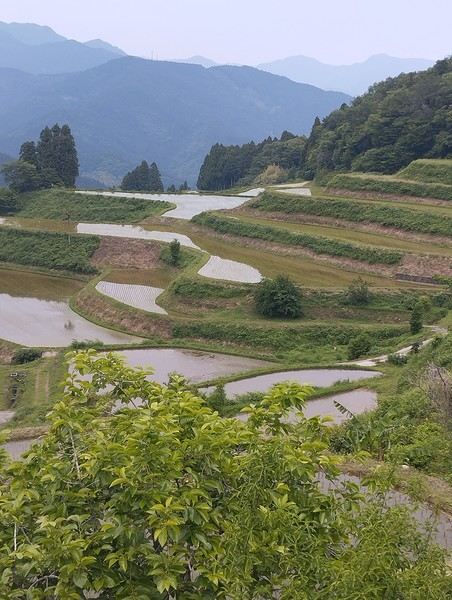
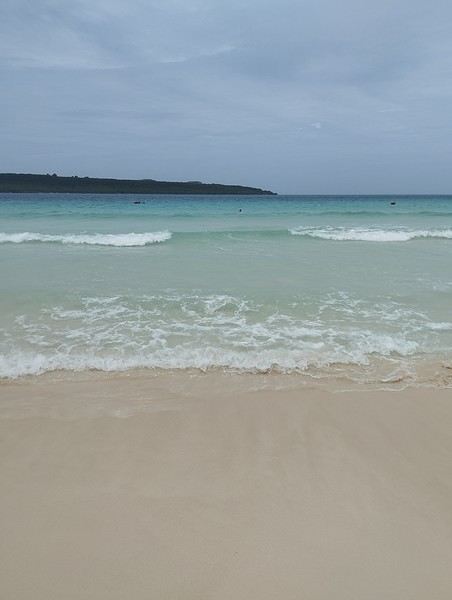
-->7 days in Miyakojima (Okinawa Prefecture)
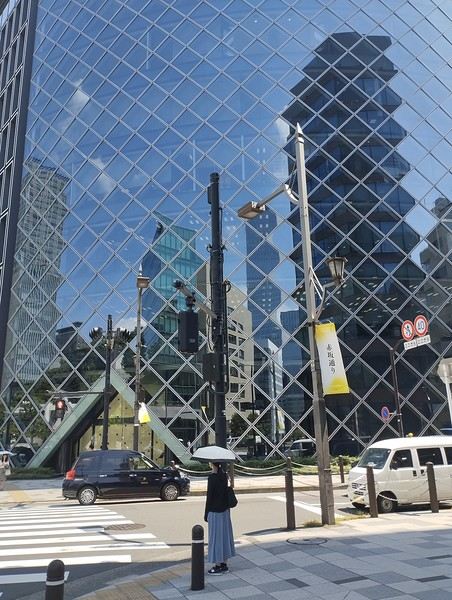
-->7 days in Tokyo
The trip was decided on fairly last-minute this year, as usual.
I regularly check flight prices to track fluctuations for this destination, even without concrete plans. Finding a slightly cheaper direct flight (900 €) than what I’d seen in previous months (around 1,200–1,400 € on average) for a Paris-Tokyo route with Japanese airline ANA was too tempting to resist the urge to return to this enchanting country. After long hesitations between exploring the San’in region (Matsue, Tottori, Yamaguchi) and southern Shikoku, the decision was made—I took the plunge! The tickets are booked: Paris to Kochi with a layover in Tokyo, all with ANA, the airline I’d been dreaming of... for 1,120 € per person. Okay, it’s not cheap, but it’s still better than in 2023.
We leave in 2 weeks!! Now it’s just a matter of getting everything ready!
Intense work ahead in these 2 weeks to:
finalize a more precise itinerary and reach an agreement—yep, because even though we both love Japan, our preferences differ slightly, and we have to choose between exploring new places or taking time to revisit beloved spots... decide how much time to spend in each selected area without rushing while still exploring research places that might interest us and watch videos about Japan book accommodations: yes, it’s possible to do this on the spot as we go, but last year, we noticed that last-minute options were pretty expensive, so we’re booking ahead—even if it means keeping a few options open while we decide or see if better deals pop up later reserve rental cars order yen check the weather regularly and wonder if choosing the *tsuyu* (rainy season) was really a good idea—and whether we’ll be stuck in non-stop rain???
What a tough job, right? Traveling to Japan for a month—such a hard life! Despite this being my 4th trip, the excitement is just as intense as the first time.
The only small downside is that when we booked the flight tickets, there were only a few seats left, so we’re only sitting together on the international return flight. Plus, on the outbound flight, we’ve got the middle seats. Another lingering question: what French-language films will be available? According to the internet, the selection seems limited. Oh well, these are just minor details—it’s almost time to fly!
PS: I’ll be posting slowly and irregularly... so for those interested, be patient or maybe set an alert...
Hi everyone,
I have to admit, I really hesitated before deciding to write this travel journal... Writing one takes a lot of time and energy, and since this is my 4th trip, I wondered if it would actually interest anyone other than myself (both for the discovery and the writing). But after a few "Are you going to write a journal?" requests and especially the renewed pleasure from reading other travelers’ travel journals about Japan or elsewhere on this forum or elsewhere, I’ve decided to share this 4th installment in the Land of the Rising Sun here.
The itinerary: 27 full days, from late May to late June 2025, right in the middle of the rainy season, including:
-->13 days in Shikoku, from Kochi (Kochi Prefecture) to Matsuyama (Ehime Prefecture)
-->7 days in Miyakojima (Okinawa Prefecture)
-->7 days in Tokyo
The trip was decided on fairly last-minute this year, as usual.
I regularly check flight prices to track fluctuations for this destination, even without concrete plans. Finding a slightly cheaper direct flight (900 €) than what I’d seen in previous months (around 1,200–1,400 € on average) for a Paris-Tokyo route with Japanese airline ANA was too tempting to resist the urge to return to this enchanting country. After long hesitations between exploring the San’in region (Matsue, Tottori, Yamaguchi) and southern Shikoku, the decision was made—I took the plunge! The tickets are booked: Paris to Kochi with a layover in Tokyo, all with ANA, the airline I’d been dreaming of... for 1,120 € per person. Okay, it’s not cheap, but it’s still better than in 2023.
We leave in 2 weeks!! Now it’s just a matter of getting everything ready!
Intense work ahead in these 2 weeks to:
finalize a more precise itinerary and reach an agreement—yep, because even though we both love Japan, our preferences differ slightly, and we have to choose between exploring new places or taking time to revisit beloved spots... decide how much time to spend in each selected area without rushing while still exploring research places that might interest us and watch videos about Japan book accommodations: yes, it’s possible to do this on the spot as we go, but last year, we noticed that last-minute options were pretty expensive, so we’re booking ahead—even if it means keeping a few options open while we decide or see if better deals pop up later reserve rental cars order yen check the weather regularly and wonder if choosing the *tsuyu* (rainy season) was really a good idea—and whether we’ll be stuck in non-stop rain???
What a tough job, right? Traveling to Japan for a month—such a hard life! Despite this being my 4th trip, the excitement is just as intense as the first time.
The only small downside is that when we booked the flight tickets, there were only a few seats left, so we’re only sitting together on the international return flight. Plus, on the outbound flight, we’ve got the middle seats. Another lingering question: what French-language films will be available? According to the internet, the selection seems limited. Oh well, these are just minor details—it’s almost time to fly!
PS: I’ll be posting slowly and irregularly... so for those interested, be patient or maybe set an alert...
74 replies
N
Good evening Christelle,
First of all, thank you for your message. It’s motivating and interesting to hear the perspective of someone who’s "not a fan" of this country. We all have one or more destinations that don’t attract us... that was my case too for Japan before my first trip, and now I’m completely smitten.
Yet Japan is made up of 70% mountains and forests, so the urbanized parts are far from representative of the country. Sure, some cities like Tokyo can be densely packed, but even in those places, nature is never far away—gardens, parks, or rivers are part of these urban spaces. The urban environment never feels overwhelming, at least from what I’ve seen and felt there. Plus, this urban landscape isn’t just modern—it’s often mixed with older elements, through scattered monuments or neighborhoods like in Tokyo, where each district has its own vibe.
I hope this journal helps dispel the misconception that it’s all concrete everywhere. And to add to what I said above, I’d also recommend—or rather, suggest—checking out one or more of my travel journals from my previous three trips, covering other Japanese regions like Tohoku, Kyushu, and Yakushima Island. Other travelers have also shared journals about these places. Here are two links I really liked: In Kyushu https://forumvoyage.forumactif.com/t4699-kyushu-2-boucles-en-voiture-et-une-escapade-a-yakushima In Tohokubut not only, and in winter! https://forumvoyage.forumactif.com/t3614-2024-back-to-japan-goshogawara
Get your suitcase ready—the takeoff is coming soon ;)
To be honest, Japan isn’t a destination that appeals to me at all
First of all, thank you for your message. It’s motivating and interesting to hear the perspective of someone who’s "not a fan" of this country. We all have one or more destinations that don’t attract us... that was my case too for Japan before my first trip, and now I’m completely smitten.
...because all I see is the very urbanized and concrete side.
Yet Japan is made up of 70% mountains and forests, so the urbanized parts are far from representative of the country. Sure, some cities like Tokyo can be densely packed, but even in those places, nature is never far away—gardens, parks, or rivers are part of these urban spaces. The urban environment never feels overwhelming, at least from what I’ve seen and felt there. Plus, this urban landscape isn’t just modern—it’s often mixed with older elements, through scattered monuments or neighborhoods like in Tokyo, where each district has its own vibe.
But I’m curious and hope to discover another side of this country through your travel journal
I hope this journal helps dispel the misconception that it’s all concrete everywhere. And to add to what I said above, I’d also recommend—or rather, suggest—checking out one or more of my travel journals from my previous three trips, covering other Japanese regions like Tohoku, Kyushu, and Yakushima Island. Other travelers have also shared journals about these places. Here are two links I really liked: In Kyushu https://forumvoyage.forumactif.com/t4699-kyushu-2-boucles-en-voiture-et-une-escapade-a-yakushima In Tohokubut not only, and in winter! https://forumvoyage.forumactif.com/t3614-2024-back-to-japan-goshogawara
See you soon for the next part, and thanks for sharing! 😊
Get your suitcase ready—the takeoff is coming soon ;)
N
Hi Manu—or rather, hi to the whole family,
Not yet, but maybe you’ll feel like it by the end of the travel journal.
That’s the Japan effect—it seems to work almost every time when you read travelers’ forum posts or talk to friends like yours. If it can be explained, I think it’s only fully understandable once you’ve set foot there. Japan is an absolute joy for tourists. (PS: I’m not saying everything’s perfect, obviously...)
Japan is so diverse—don’t hesitate to read up on other regions too, as Christelle mentioned earlier. Anyway, thanks for your interest, and see you soon.
I don’t know Japan.
Not yet, but maybe you’ll feel like it by the end of the travel journal.
But I have a lot of friends who’ve been there, and they all came back enchanted by these islands and this culture.
That’s the Japan effect—it seems to work almost every time when you read travelers’ forum posts or talk to friends like yours. If it can be explained, I think it’s only fully understandable once you’ve set foot there. Japan is an absolute joy for tourists. (PS: I’m not saying everything’s perfect, obviously...)
We’ll be following your trip closely!
Japan is so diverse—don’t hesitate to read up on other regions too, as Christelle mentioned earlier. Anyway, thanks for your interest, and see you soon.
N
Day 0 - Wednesday - From Paris to Kochi in 24 hours
2:30 PM, Dad just dropped us off at terminal 2 or 1 (I can’t quite remember) at Charles de Gaulle Étoile Airport. We’re *very* early—our flight isn’t until 7:20 PM tonight. No need to rush from one step to the next just to board the plane.
For some, airports are stressful, uncomfortable transit zones. My partner definitely falls into that camp. For me, though, airports are pure joy. I get as excited as a teenager in the throes of a crush. To me, an airport means an imminent trip—discoveries, encounters, languages, adventures, and surprises. It’s also the last moment to imagine, hope, dream, doubt, ask questions, and research before facing reality in a country that will, in turn, bring its own emotions. Today, we’re about to take off for Japan for the 4th time. It still feels unreal, and the happiness it brings can only be understood by someone who’s wanted to return to the same country multiple times. That’s what I tell myself when I think back to some reactions when we announced this 4th trip—"again?" with a hint of weariness, or sometimes just a wordless laugh.
But I don’t have time to dwell on this blissful happiness. I want to wrap up as much work as possible before takeoff. Once we find the check-in area—right where we arrived, perfect—we settle onto some benches. Like I said, teenage-level excitement: a Japanese woman is sitting on the bench, and it makes me happy. It’s a little visual taste of Japan. With my phones charging, I focus on work when a group of Japanese travelers arrives, led by a Japanese guide giving explanations in Japanese. I’m *already* in Japan, even though I haven’t taken off yet. Hearing Japanese spoken is an endless pleasure. I move to make room for a few people from the group. The little bows of thanks and the delicacy of their gestures are all part of the Japanese projection.
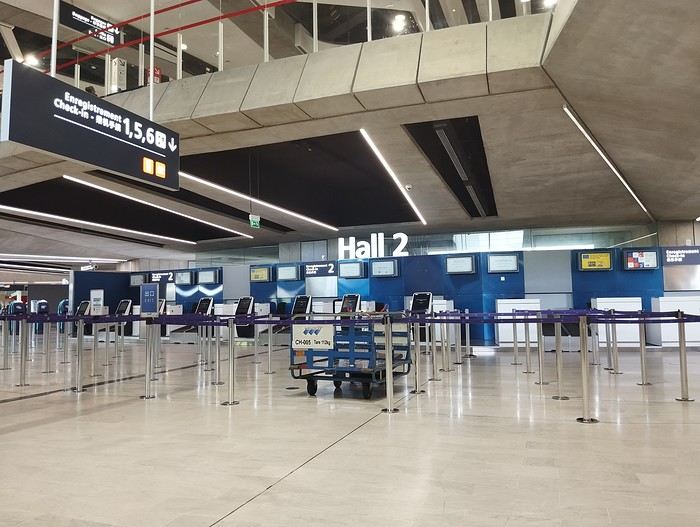
Check-in time arrives. I’m a little disappointed because even ANA is replacing humans with machines. Yep, self-service kiosks where you print your own baggage tags and stick them on your bag yourself. Once you’ve done part of the staff’s job, you can go to the counter to finalize check-in.
Tickets in hand, we walk to security. Strangely, the airport seems *very* quiet today—almost deserted. And for some reason, every staff member we’ve encountered has been charming. The ground hosts and hostesses seem relaxed, smiling, friendly, and helpful. Am I in some kind of fantasy world? What’s going on? It’s wild that in 2025, basic politeness can still surprise you—but how good it feels! I wonder if it’s because we’re traveling on a weekday, a Wednesday, with an early-evening flight. If that’s the case, I think I’ll prioritize midweek flights in the future whenever possible. Have any of you noticed differences in service depending on flight times or days? The boarding lounge is just as quiet, with a peaceful vibe.
This time, we’re sitting in light brown leather seats. I can keep working while occasionally looking up to watch the Roland-Garros tennis match on the TV screen in front of me or just people-watch.
Head down, I wrap up my workday at 6 PM. Finally, I can relax a little.
Funny enough, I got a message from a friend checking in. Just like last year, I tell her—at the exact same moment, while waiting to board—that we’re flying to Japan again. Life’s little coincidences. (Shoutout to you, L—you’ll know it’s you!)
This year, no administrative hassles, so here we are on the plane in seats 29J and 28J. My partner hopes to swap seats with someone. I tell him, "Who’d want a middle seat?" If these were the only ones left at booking, it’s because no one likes them. But apparently, I was wrong—the young woman to his right, who I’ll call Cécile (window seat—dream spot, right?), says she’s happy to switch if needed. I’m almost stunned by her generosity. It won’t be necessary, though, because when the doors close, we realize the plane has *tons* of empty seats. Lots of people will be able to stretch out. I don’t get why these seats weren’t available at booking. Cécile doesn’t even need to move—the seat to my partner’s left is free.
Before that, my only neighbor in row 28, a Japanese woman, settled in by folding her legs and balancing on her seat with her feet and hips. That insane flexibility will *always* amaze me.
The flight from Paris to Tokyo flies by (pun intended). We end up chatting with our friendly neighbor Cécile the whole time, watching a few movies, and getting some sleep.
Cécile is also smitten with Japan. Surprising, right?! This is her 3rd trip there.
She’s done the classics—"Tokyo-Kyoto-Miyajima"—but also Okayama, whose black castle is supposedly stunning. For this trip, she only had a few days off and is flying for 12 days. She’s meeting friends who are already on vacation there. The plan: Kinosaki Onsen, Osaka, Okinawa, and Zamami.
For her flight ticket, she bought a Paris-Tokyo-Osaka round-trip for 1,400 €. Combined with how empty our plane is, it confirms that our ticket—bought just 15 days before—was probably a "promo" and the price we got was good for the season.
Throughout the flight, since it’s our first with ANA, we tried to spot differences from other airlines we’ve flown to Japan in economy. Here’s a quick, unordered list of what stood out:
Way more legroom—the seat in front feels almost far away
Much more overhead space. Cécile says it’s thanks to the clever curved storage system for cabin bags, not straight,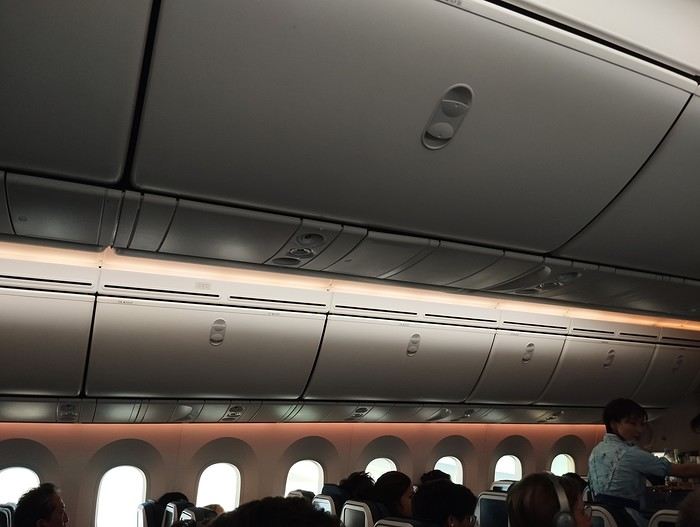
Real headphones, not those tiny earbuds, Windows where you can adjust the opacity to control the light,
Pretty hearty meals
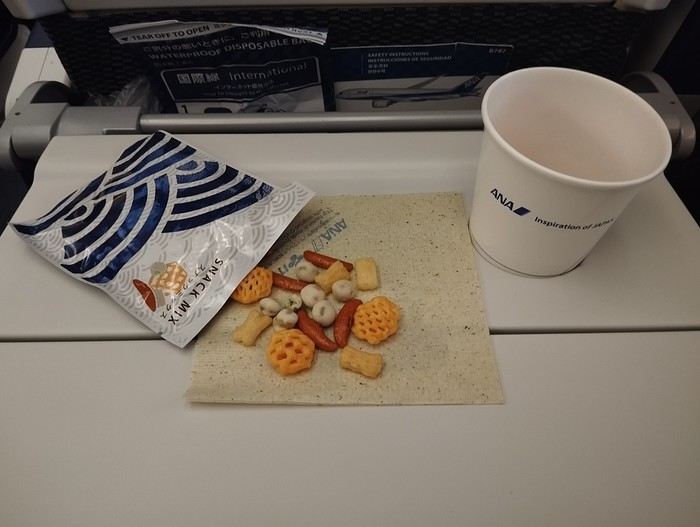
Neighboring screens are blurred for privacy, so you can’t see what others are watching Paper napkins made from tea leaves that smell like the green tea from the cold bottles Refreshing towels Thicker cardboard cups with a hole on the tray to set them in
Decent alcohol selection—wine, whiskey, gin, beer—but champagne only in higher classes Free candy
We arrive in Tokyo without a hitch around 4 PM. We have a 3-hour, 15-minute layover.
We need to collect our luggage. It’s a little confusing since we’re connecting with the same airline, but switching from an international to a domestic flight requires this step. Still, the process is simplified—after security, customs, and baggage claim, transit passengers skip full check-in. There’s a dedicated counter. Staff come to us, scan the baggage tag, and take our bags. Done in 3 minutes. Cécile’s flight to Osaka leaves before ours, so it’s time to say goodbye and wish her a great trip.
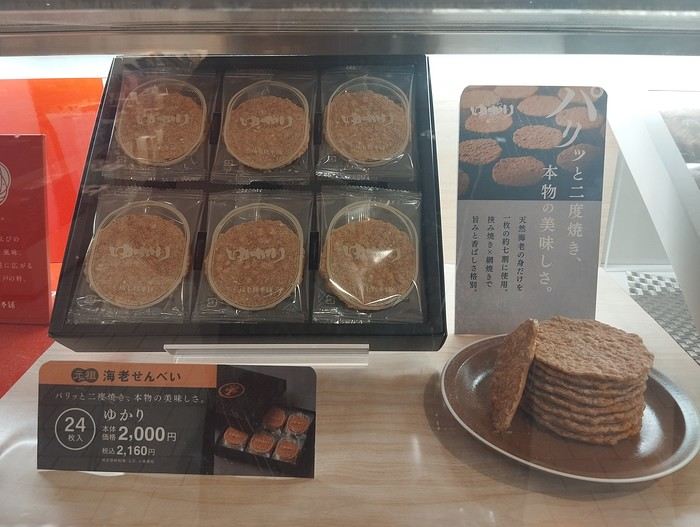
Before heading to the boarding lounge, we take a quick stroll through a store selling local products. We spot the lobster chips a Japanese friend gave our family during her last trip to Hokkaido in early 2025. The taste is incredible—you really get that briny lobster flavor, and the chips aren’t greasy at all. A true taste of the sea.
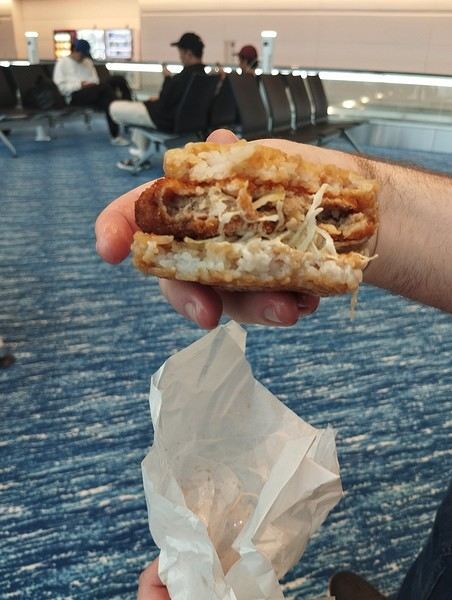
Craving a taste of Japan, we buy rice burgers. We’d recently seen them in a TV report but had never actually tried them, so we couldn’t resist grabbing some to tide us over before our next flight.
We savor our delicious burgers—pork with ginger for me, breaded beef with 7-Eleven fried chicken for my partner—along with a cold drink, some tea.
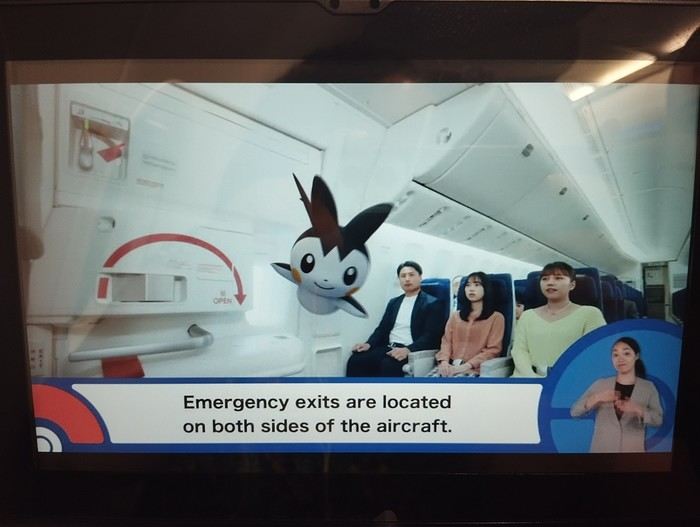
The flight to Kochi is super short—just 1 hour, 20 minutes. We’re on an A321 with wider seats. The in-flight safety demo is done with animated characters in ads. It’s quirky but so Japanese. It’ll *always* amuse me, I think.
In the blink of an eye, we’re at Kochi Airport. I love small regional airports—everything’s quicker. Our flight is the last to land. We grab our bags easily. The fun, propaganda-style Japanese touch: transparent lockers with giant fake bonito pieces—a local delicacy—mixed in with the luggage.
Right next door, there’s a stand with tourist brochures and an info desk. We quickly grab a few. The Kochi tourism office had mentioned a connecting bus after the flight—logical, since we’re in Japan. I barely have time to tell my partner I think the airport’s about to close when the lights start turning off. No joking around with time in Japan. We hurry outside, and sure enough, the bus to Kochi City is waiting for passengers. The driver, in white gloves, is outside keeping an eye out. He helps us buy tickets from the machine (1,700 yen for two, just under 11 €), loads our suitcases into the hold, and we board. The bus is delightfully retro—carpet with old-school patterns, seat doilies, and a red button to ring for stops.
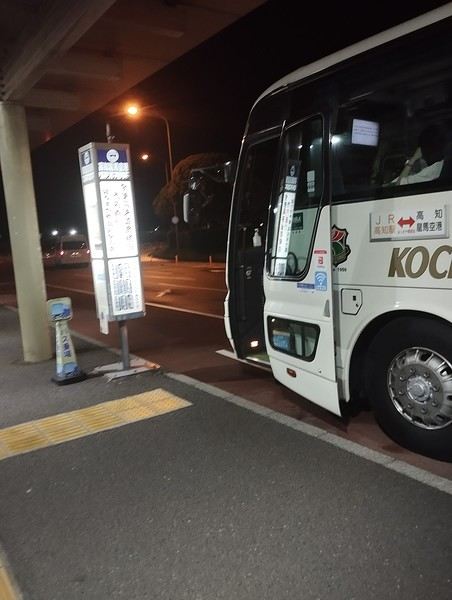
Everything happens so fast, and we’re on our way to Kochi City. It’s dark, so it’s hard to see the city. The bus isn’t full—no Westerners, just Japanese passengers. The ride is short, 25-30 minutes. We let the Japanese conversations near us wash over us while looking out the window, catching glimpses of a bridge hinting at a river or distant lights.
The bus stop isn’t far from our hotel—about a 5-minute walk.
The sound of the pedestrian crossings—a kind of high-pitched bird chirp—makes us smile. Welcome to Japan.
The street is wide, a main thoroughfare. It’s dark, but the lights reflect off the damp sidewalk, suggesting it rained today. *Please*, I hope the rainy season doesn’t drench us nonstop.
We pass a restaurant with a sliding door that opens and closes, laughter spilling out. It’s pleasant but not too hot. We’ll drop off our stuff and then head to the konbini we spotted nearby.
Check-in is quick—done at kiosks, but staff are there to help if needed.
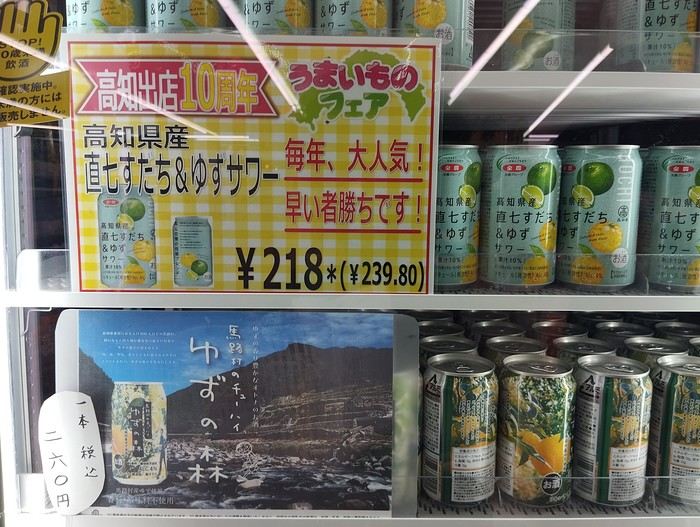
As planned, we head out to grab some supplies at the konbini for tonight and the next few days. We find a drink that seems local, made with yuzu and another green fruit. We grab one to try.
Back at the hotel, we settle into the common lounge—open until 11 PM with free hot and cold drinks. It’s not huge, but it’s cozy and clean. There are books available too.
Quick, unbalanced dinner: curry pan (fried curry-filled dough), fried chicken, egg cake, green tea, and the yuzu drink. Google Translate says it’s yuzu and sudachi—a more bitter local citrus. The drink is really refreshing.
Some sweet and savory snacks for the next few days, just in case:
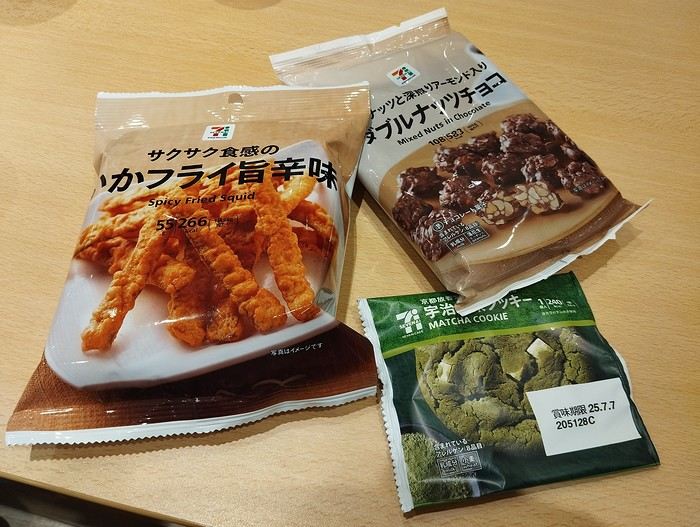
11 PM, we finally head up to our room. Back in France, it’s already 4 PM the next day. It took us 24 hours to get from Paris to Kochi.
One of the joys of staying in Japanese hotels is the free access to certain amenities—cotton swabs, razors, cotton pads, etc. We take what we need and head to our room. As soon as we open the door, a pleasant scent fills the air.
Our room is standard for this type of hotel—nothing to complain about. Time to sleep before the real first day of the trip.
To those who made it this far—details matter in a travel journal, so bravo! Stay tuned for the next part if you’re not too discouraged! The next chapter takes place in Kochi City.
2:30 PM, Dad just dropped us off at terminal 2 or 1 (I can’t quite remember) at Charles de Gaulle Étoile Airport. We’re *very* early—our flight isn’t until 7:20 PM tonight. No need to rush from one step to the next just to board the plane.
For some, airports are stressful, uncomfortable transit zones. My partner definitely falls into that camp. For me, though, airports are pure joy. I get as excited as a teenager in the throes of a crush. To me, an airport means an imminent trip—discoveries, encounters, languages, adventures, and surprises. It’s also the last moment to imagine, hope, dream, doubt, ask questions, and research before facing reality in a country that will, in turn, bring its own emotions. Today, we’re about to take off for Japan for the 4th time. It still feels unreal, and the happiness it brings can only be understood by someone who’s wanted to return to the same country multiple times. That’s what I tell myself when I think back to some reactions when we announced this 4th trip—"again?" with a hint of weariness, or sometimes just a wordless laugh.
But I don’t have time to dwell on this blissful happiness. I want to wrap up as much work as possible before takeoff. Once we find the check-in area—right where we arrived, perfect—we settle onto some benches. Like I said, teenage-level excitement: a Japanese woman is sitting on the bench, and it makes me happy. It’s a little visual taste of Japan. With my phones charging, I focus on work when a group of Japanese travelers arrives, led by a Japanese guide giving explanations in Japanese. I’m *already* in Japan, even though I haven’t taken off yet. Hearing Japanese spoken is an endless pleasure. I move to make room for a few people from the group. The little bows of thanks and the delicacy of their gestures are all part of the Japanese projection.
Check-in time arrives. I’m a little disappointed because even ANA is replacing humans with machines. Yep, self-service kiosks where you print your own baggage tags and stick them on your bag yourself. Once you’ve done part of the staff’s job, you can go to the counter to finalize check-in.
Tickets in hand, we walk to security. Strangely, the airport seems *very* quiet today—almost deserted. And for some reason, every staff member we’ve encountered has been charming. The ground hosts and hostesses seem relaxed, smiling, friendly, and helpful. Am I in some kind of fantasy world? What’s going on? It’s wild that in 2025, basic politeness can still surprise you—but how good it feels! I wonder if it’s because we’re traveling on a weekday, a Wednesday, with an early-evening flight. If that’s the case, I think I’ll prioritize midweek flights in the future whenever possible. Have any of you noticed differences in service depending on flight times or days? The boarding lounge is just as quiet, with a peaceful vibe.
This time, we’re sitting in light brown leather seats. I can keep working while occasionally looking up to watch the Roland-Garros tennis match on the TV screen in front of me or just people-watch.
Head down, I wrap up my workday at 6 PM. Finally, I can relax a little.
Funny enough, I got a message from a friend checking in. Just like last year, I tell her—at the exact same moment, while waiting to board—that we’re flying to Japan again. Life’s little coincidences. (Shoutout to you, L—you’ll know it’s you!)
This year, no administrative hassles, so here we are on the plane in seats 29J and 28J. My partner hopes to swap seats with someone. I tell him, "Who’d want a middle seat?" If these were the only ones left at booking, it’s because no one likes them. But apparently, I was wrong—the young woman to his right, who I’ll call Cécile (window seat—dream spot, right?), says she’s happy to switch if needed. I’m almost stunned by her generosity. It won’t be necessary, though, because when the doors close, we realize the plane has *tons* of empty seats. Lots of people will be able to stretch out. I don’t get why these seats weren’t available at booking. Cécile doesn’t even need to move—the seat to my partner’s left is free.
Before that, my only neighbor in row 28, a Japanese woman, settled in by folding her legs and balancing on her seat with her feet and hips. That insane flexibility will *always* amaze me.
The flight from Paris to Tokyo flies by (pun intended). We end up chatting with our friendly neighbor Cécile the whole time, watching a few movies, and getting some sleep.
Cécile is also smitten with Japan. Surprising, right?! This is her 3rd trip there.
She’s done the classics—"Tokyo-Kyoto-Miyajima"—but also Okayama, whose black castle is supposedly stunning. For this trip, she only had a few days off and is flying for 12 days. She’s meeting friends who are already on vacation there. The plan: Kinosaki Onsen, Osaka, Okinawa, and Zamami.
For her flight ticket, she bought a Paris-Tokyo-Osaka round-trip for 1,400 €. Combined with how empty our plane is, it confirms that our ticket—bought just 15 days before—was probably a "promo" and the price we got was good for the season.
Throughout the flight, since it’s our first with ANA, we tried to spot differences from other airlines we’ve flown to Japan in economy. Here’s a quick, unordered list of what stood out:
Way more legroom—the seat in front feels almost far away
Much more overhead space. Cécile says it’s thanks to the clever curved storage system for cabin bags, not straight,
Real headphones, not those tiny earbuds, Windows where you can adjust the opacity to control the light,
Pretty hearty meals
Neighboring screens are blurred for privacy, so you can’t see what others are watching Paper napkins made from tea leaves that smell like the green tea from the cold bottles Refreshing towels Thicker cardboard cups with a hole on the tray to set them in
Decent alcohol selection—wine, whiskey, gin, beer—but champagne only in higher classes Free candy
We arrive in Tokyo without a hitch around 4 PM. We have a 3-hour, 15-minute layover.
We need to collect our luggage. It’s a little confusing since we’re connecting with the same airline, but switching from an international to a domestic flight requires this step. Still, the process is simplified—after security, customs, and baggage claim, transit passengers skip full check-in. There’s a dedicated counter. Staff come to us, scan the baggage tag, and take our bags. Done in 3 minutes. Cécile’s flight to Osaka leaves before ours, so it’s time to say goodbye and wish her a great trip.
Before heading to the boarding lounge, we take a quick stroll through a store selling local products. We spot the lobster chips a Japanese friend gave our family during her last trip to Hokkaido in early 2025. The taste is incredible—you really get that briny lobster flavor, and the chips aren’t greasy at all. A true taste of the sea.
Craving a taste of Japan, we buy rice burgers. We’d recently seen them in a TV report but had never actually tried them, so we couldn’t resist grabbing some to tide us over before our next flight.
We savor our delicious burgers—pork with ginger for me, breaded beef with 7-Eleven fried chicken for my partner—along with a cold drink, some tea.
The flight to Kochi is super short—just 1 hour, 20 minutes. We’re on an A321 with wider seats. The in-flight safety demo is done with animated characters in ads. It’s quirky but so Japanese. It’ll *always* amuse me, I think.
In the blink of an eye, we’re at Kochi Airport. I love small regional airports—everything’s quicker. Our flight is the last to land. We grab our bags easily. The fun, propaganda-style Japanese touch: transparent lockers with giant fake bonito pieces—a local delicacy—mixed in with the luggage.
Right next door, there’s a stand with tourist brochures and an info desk. We quickly grab a few. The Kochi tourism office had mentioned a connecting bus after the flight—logical, since we’re in Japan. I barely have time to tell my partner I think the airport’s about to close when the lights start turning off. No joking around with time in Japan. We hurry outside, and sure enough, the bus to Kochi City is waiting for passengers. The driver, in white gloves, is outside keeping an eye out. He helps us buy tickets from the machine (1,700 yen for two, just under 11 €), loads our suitcases into the hold, and we board. The bus is delightfully retro—carpet with old-school patterns, seat doilies, and a red button to ring for stops.
Everything happens so fast, and we’re on our way to Kochi City. It’s dark, so it’s hard to see the city. The bus isn’t full—no Westerners, just Japanese passengers. The ride is short, 25-30 minutes. We let the Japanese conversations near us wash over us while looking out the window, catching glimpses of a bridge hinting at a river or distant lights.
The bus stop isn’t far from our hotel—about a 5-minute walk.
The sound of the pedestrian crossings—a kind of high-pitched bird chirp—makes us smile. Welcome to Japan.
The street is wide, a main thoroughfare. It’s dark, but the lights reflect off the damp sidewalk, suggesting it rained today. *Please*, I hope the rainy season doesn’t drench us nonstop.
We pass a restaurant with a sliding door that opens and closes, laughter spilling out. It’s pleasant but not too hot. We’ll drop off our stuff and then head to the konbini we spotted nearby.
Check-in is quick—done at kiosks, but staff are there to help if needed.
As planned, we head out to grab some supplies at the konbini for tonight and the next few days. We find a drink that seems local, made with yuzu and another green fruit. We grab one to try.
Back at the hotel, we settle into the common lounge—open until 11 PM with free hot and cold drinks. It’s not huge, but it’s cozy and clean. There are books available too.
Quick, unbalanced dinner: curry pan (fried curry-filled dough), fried chicken, egg cake, green tea, and the yuzu drink. Google Translate says it’s yuzu and sudachi—a more bitter local citrus. The drink is really refreshing.
Some sweet and savory snacks for the next few days, just in case:
11 PM, we finally head up to our room. Back in France, it’s already 4 PM the next day. It took us 24 hours to get from Paris to Kochi.
One of the joys of staying in Japanese hotels is the free access to certain amenities—cotton swabs, razors, cotton pads, etc. We take what we need and head to our room. As soon as we open the door, a pleasant scent fills the air.
Our room is standard for this type of hotel—nothing to complain about. Time to sleep before the real first day of the trip.
To those who made it this far—details matter in a travel journal, so bravo! Stay tuned for the next part if you’re not too discouraged! The next chapter takes place in Kochi City.

Muriel18· last year
Hi Nathalie,
I’m also setting off for Japan through this travel journal (it’s packed with details but still a pleasant read 😉). All I know of the country is Tokyo and its immediate surroundings, since my son lived there for 7 years. Like other commenters, I’m not exactly a Japan fan (it’s odd—Japan enthusiasts haven’t spoken up yet 🤪), but more than that, I’m just not a city person. I’m hoping this journal will show me some countryside landscapes that might make me want to go back.
I’m also setting off for Japan through this travel journal (it’s packed with details but still a pleasant read 😉). All I know of the country is Tokyo and its immediate surroundings, since my son lived there for 7 years. Like other commenters, I’m not exactly a Japan fan (it’s odd—Japan enthusiasts haven’t spoken up yet 🤪), but more than that, I’m just not a city person. I’m hoping this journal will show me some countryside landscapes that might make me want to go back.

N
Hello Nathalie,
I’m also setting off for Japan through this travel journal (it’s quite detailed but a pleasant read 😉). All I know of the country is Tokyo and its immediate surroundings, since my son lived there for 7 years. Like other contributors, I’m not a huge fan of Japan (it’s odd, actually—the Japan fans haven’t spoken up yet 🤪), but I’m especially not a fan of cities, and I hope this journal will let me discover some countryside landscapes that might make me want to go back.
Hello Muriel,
Thanks for joining the journey.
I’m not a total city person, but Tokyo is, for me, a one-of-a-kind city in the world, where nature isn’t completely absent—something that, in my opinion, adds to its charm.
We’ll see at the end whether it makes you want to return someday. In the meantime, as I’ve told others, I invite you to check out some Japanese travel journals that cover areas outside Tokyo.
See you soon.

N
Hello, I’m curious to read your travel journal and thanks for doing this "work". I know Tokyo, Kyoto, and Nara but I’m interested in reading about a different itinerary. Have a nice day
Hi Rozenn,
They say curiosity is a bad habit, but to me, it mostly shows an openness to others, to the unknown, and to all the richness life has to offer. So thank you for your interest.
I haven’t been to Nara yet. It seems very touristy. Did you like it? Why?
Have a good evening.
Show 9 more replies
Rozennqpe· last year
Hi Nathalie,
I took this trip in 2013, and Japan wasn’t the popular destination it is today. So, there were people around, but it wasn’t overcrowded. In Nara, I loved the park, two temples (Todaiji and Kofukuji), and the ryokan where I stayed—Ryokan Asukasou (I checked the current prices: wow, no comparison to what I paid in 2013, of course). I also remember a stunning garden, but I can’t recall its name or location. Anyway, I loved everything in Nara, just like in Tokyo and Kyoto. It’s Japan and its very special atmosphere—but you know all that much better than I do. I’m maybe thinking of going back to Japan, which is why your travel journal interests me. Thanks for the links to your journals; I’ll read them.
Fairytitania· last year
Happy to share this report, just like I did for the previous one.😉
Fairytitania· last year
Translator
That was my case before going. I went to Japan with my brother—it was his dream (I’m more of a fine-sand-beach person). We did Osaka (and the surrounding area) and Tokyo. In the end, I came back wanting to go again, who would’ve thought.
That was my case before going. I went to Japan with my brother—it was his dream (I’m more of a fine-sand-beach person). We did Osaka (and the surrounding area) and Tokyo. In the end, I came back wanting to go again, who would’ve thought.
N
Hi Nathalie, I took this trip in 2013, and Japan wasn’t the popular destination it is today. So, there were people, but it wasn’t overrun. I loved Nara’s park, two temples (Todaiji and Kofukuji), and the ryokan where I stayed—Ryokan Asukasou (I checked the current prices: wow, no comparison to what I paid in 2013, of course). I also remember a stunning garden, but I can’t recall the name or location. Anyway, I loved everything in Nara, just like Tokyo and Kyoto. It’s Japan and its very special atmosphere—but you know all that much better than I do. I’m maybe thinking of going back to Japan, which is why your travel journal interests me. Thanks for the links to your journals; I’ll read them.
Oh, to be in Japan in 2013 before the tourism boom—that must’ve been a whole different vibe. If you haven’t been back since and decide to return, it’ll be interesting to hear your take on any changes you notice.
Nara and the surrounding area seem really interesting.
N
Hi Marina,
That’s really nice. Thanks!
Japan has some fine sandy beaches, and not just the ugly ones!
The Japan effect!
Present for this report just like I was for the last one.😉
That’s really nice. Thanks!
Translator
That was me before I went. I went to Japan with my brother—it was his dream (I’m more of a fine sandy beach person).
Japan has some fine sandy beaches, and not just the ugly ones!
We did Osaka (and the surrounding area) and Tokyo. In the end, I came back wanting to go again—go figure.
The Japan effect!
N
Day 1 - A day in Kochi City using public transport - Part 1
The alarm goes off. We open the curtain to discover the view from our window. Last night, it was dark. The room faces the main street. In the foreground, we see the KS sign, an electronics store with its roof, then residential buildings in the background, and finally, in the distance, the mountains that often surround Japanese cities. The sky is gray. I wonder what the weather will be like today. It's true that at the start of the trip, the weather is something that worries me—I’m dreading entire days of rain that could totally ruin our plans.
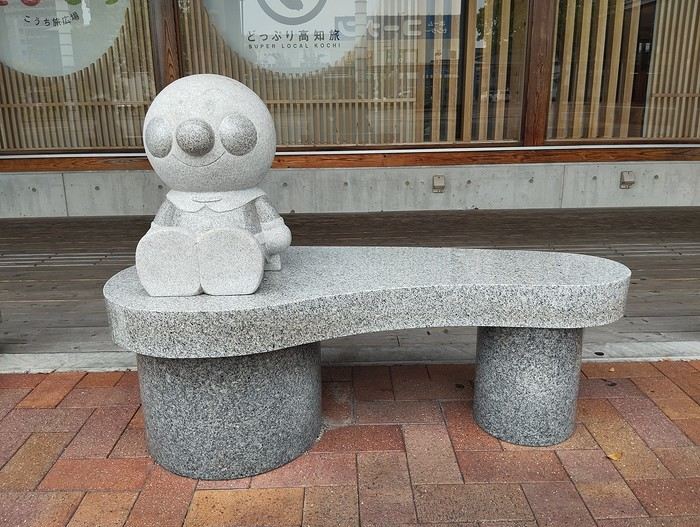
Dressed, we take the elevator down to the common breakfast room, the same one we had our snack in last night. It’s on the ground floor, right next to reception. Breakfast is in full swing. A staff member gives us a small bento-style tray with compartments for different dishes. Breakfast is a buffet where everyone takes what they like. There are cold vegetables for a salad, hot vegetables and meat, small rolls (some to toast), the essential scrambled eggs, fruit, soup, and rice—plus hot drinks. With our trays full, we just need to find a spot. We settle at the "bar" area, which is better suited for solo travelers but has the advantage of a ledge where I can put my bag. Side by side, we eat our breakfast. The quality is pretty average, but let’s just say it’s practical and balanced. It’s not exactly a feast, but it’s edible. Now, off to explore Kochi City! As soon as we step out of the hotel, a light rain starts falling. It only lasts a few minutes. We reach the train station in 5 minutes on foot since the hotel is nearby. For now, the city seems quite calm—there aren’t many people on the streets. We start by heading to the tourist office, a lovely wooden building located in the square outside the station, across from the tram departure point. Right in front, there are benches featuring Anpanman, a Japanese superhero character whose creator is from Kochi.
The inside of the tourist office is spacious and very open. The place is modern. There are 4 staff members. The woman helping us is sweet and pleasant. The explanations are clear, partly thanks to a translator used by the staff. When we ask for information about a less touristy area in Kochi Prefecture, she apologizes because the documentation is only in Japanese and rushes to the shop to get it. That sense of quick and efficient service is always there, even when no other customers are waiting. And on top of that, they give us a bag with the tourist office’s logo to carry the documents. It’s amusing when you think that in France, getting a bag in a store these days is almost a crime... We also bought our unlimited day bus tickets here for getting around the city’s tourist spots. A few stammered words in Japanese, and I quickly got a "Where did you learn to speak Japanese so well?" Let’s be clear—my Japanese is basic, but it’s always nice when a local notices the effort to communicate in their language, even if the Japanese tend to exaggerate ("so well spoken") out of kindness or politeness. The view of Kochi Station from the esplanade is charming. With these tram lines, the city’s retro vibe is already visible.
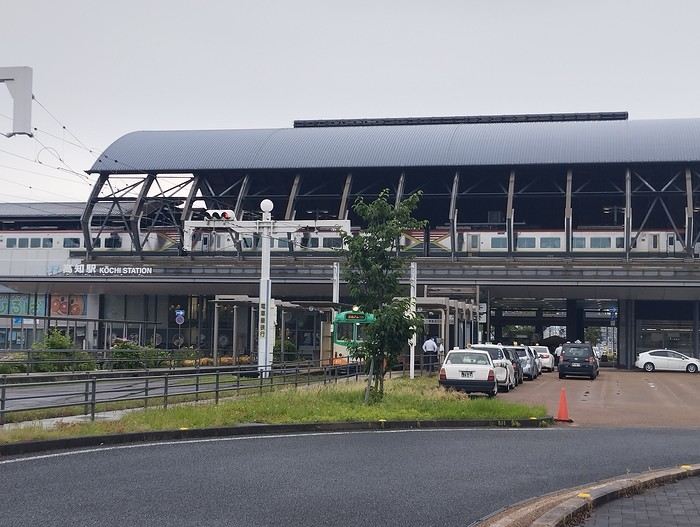
It’s time to take one of these trams. We’ll see that the trams have a lot of charm, each with different colors or designs. Our first tram is burgundy. Inside, we sit on one of the dark jade-green velvet seats.
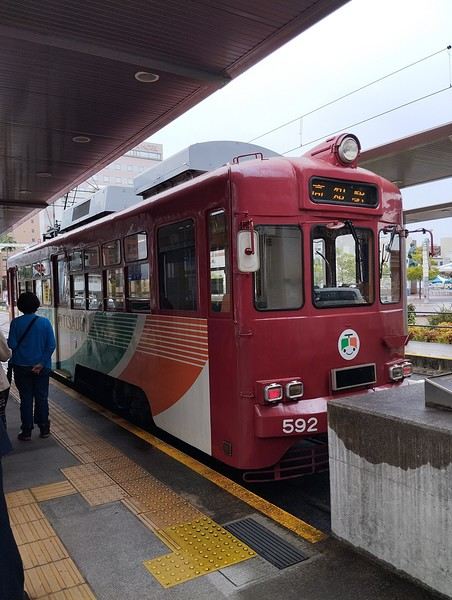
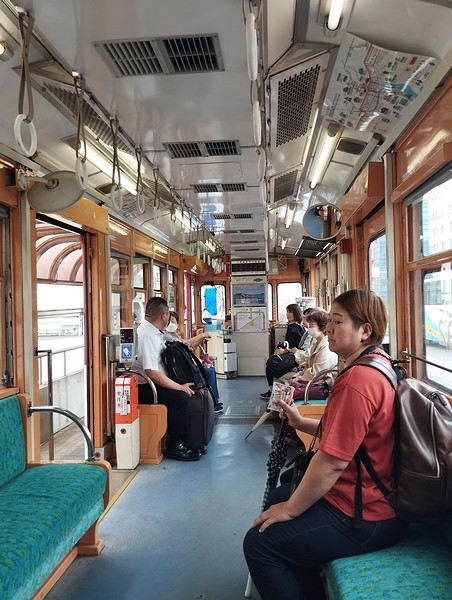
To get off, while locals tap their cards, we just show our paper ticket to the tram driver, who’s wearing nice white gloves. The distinctive chime that plays when crossing a pedestrian crossing rings in our ears. It’s one of those sounds that instantly transports you to Japan, even when you’re not there. Our goal is to visit Kochi Castle. To get there, we need to take two trams. The second one is completely decked out in *Tom & Jerry* themes, both inside and out.
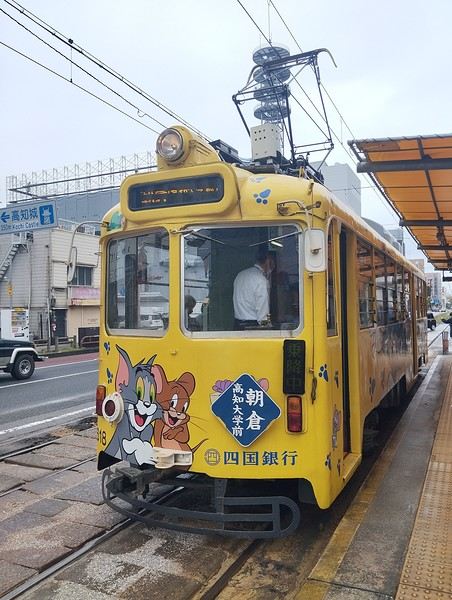
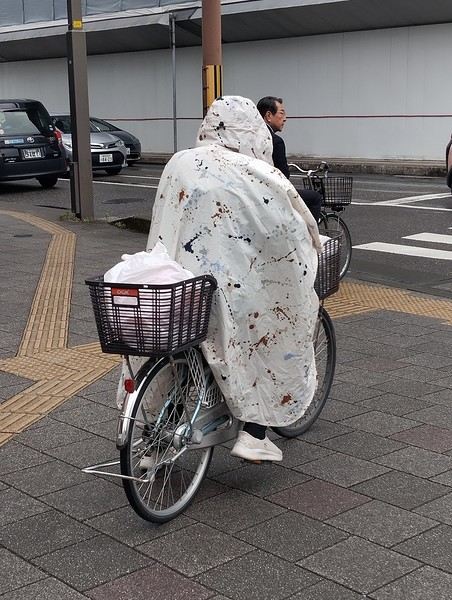
On the tram, there are mostly older Japanese people and a few Western tourists. On the streets, even though it’s not raining at the moment, people are walking around with umbrellas or wearing raincoats while cycling.
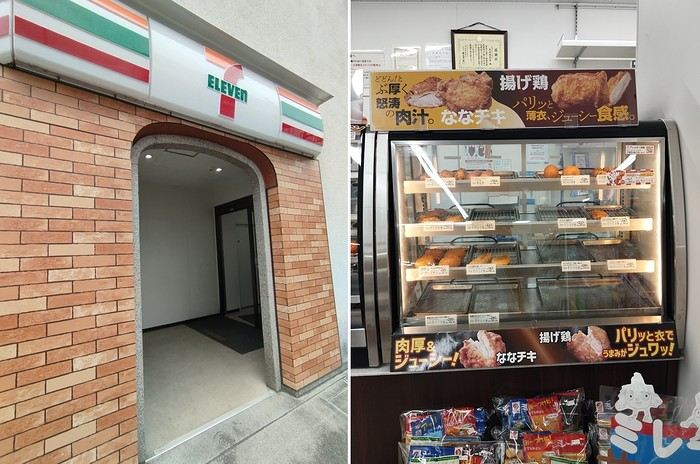
Walking toward the castle, we pass a very retro 7-Eleven convenience store, from its facade to its umbrella stands. But inside, you’ll find all the classic konbini staples, like fried chicken.
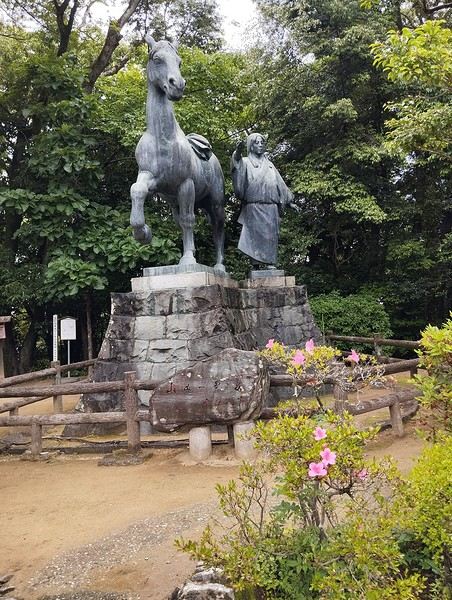
We continue on our way. We’re in the lower grounds of the castle, across from the Kochi Castle History Museum, where the Olympic rings are displayed.
Since the castle is built on a hill, Mount Otakasaka, we take this rather majestic staircase leading to a statue of the first feudal lord’s wife. The first level offers a nice view of the castle and access to a garden (a large green meadow) overlooking the city, where we eat some pepper-fried chicken bought from the retro konbini a few minutes earlier. We were hoping to find the same kind we’d had in Tohoku, but it wasn’t the same. It’s pretty rare to find, so when you see it, you don’t hesitate to try it.
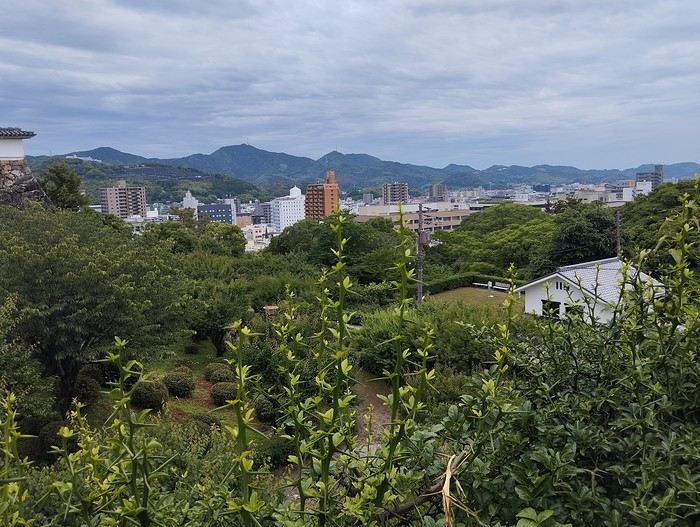
Now we’re at the top of the hill, which offers an open space with trees and a view of the surroundings.
The alarm goes off. We open the curtain to discover the view from our window. Last night, it was dark. The room faces the main street. In the foreground, we see the KS sign, an electronics store with its roof, then residential buildings in the background, and finally, in the distance, the mountains that often surround Japanese cities. The sky is gray. I wonder what the weather will be like today. It's true that at the start of the trip, the weather is something that worries me—I’m dreading entire days of rain that could totally ruin our plans.
Dressed, we take the elevator down to the common breakfast room, the same one we had our snack in last night. It’s on the ground floor, right next to reception. Breakfast is in full swing. A staff member gives us a small bento-style tray with compartments for different dishes. Breakfast is a buffet where everyone takes what they like. There are cold vegetables for a salad, hot vegetables and meat, small rolls (some to toast), the essential scrambled eggs, fruit, soup, and rice—plus hot drinks. With our trays full, we just need to find a spot. We settle at the "bar" area, which is better suited for solo travelers but has the advantage of a ledge where I can put my bag. Side by side, we eat our breakfast. The quality is pretty average, but let’s just say it’s practical and balanced. It’s not exactly a feast, but it’s edible. Now, off to explore Kochi City! As soon as we step out of the hotel, a light rain starts falling. It only lasts a few minutes. We reach the train station in 5 minutes on foot since the hotel is nearby. For now, the city seems quite calm—there aren’t many people on the streets. We start by heading to the tourist office, a lovely wooden building located in the square outside the station, across from the tram departure point. Right in front, there are benches featuring Anpanman, a Japanese superhero character whose creator is from Kochi.
The inside of the tourist office is spacious and very open. The place is modern. There are 4 staff members. The woman helping us is sweet and pleasant. The explanations are clear, partly thanks to a translator used by the staff. When we ask for information about a less touristy area in Kochi Prefecture, she apologizes because the documentation is only in Japanese and rushes to the shop to get it. That sense of quick and efficient service is always there, even when no other customers are waiting. And on top of that, they give us a bag with the tourist office’s logo to carry the documents. It’s amusing when you think that in France, getting a bag in a store these days is almost a crime... We also bought our unlimited day bus tickets here for getting around the city’s tourist spots. A few stammered words in Japanese, and I quickly got a "Where did you learn to speak Japanese so well?" Let’s be clear—my Japanese is basic, but it’s always nice when a local notices the effort to communicate in their language, even if the Japanese tend to exaggerate ("so well spoken") out of kindness or politeness. The view of Kochi Station from the esplanade is charming. With these tram lines, the city’s retro vibe is already visible.
It’s time to take one of these trams. We’ll see that the trams have a lot of charm, each with different colors or designs. Our first tram is burgundy. Inside, we sit on one of the dark jade-green velvet seats.
To get off, while locals tap their cards, we just show our paper ticket to the tram driver, who’s wearing nice white gloves. The distinctive chime that plays when crossing a pedestrian crossing rings in our ears. It’s one of those sounds that instantly transports you to Japan, even when you’re not there. Our goal is to visit Kochi Castle. To get there, we need to take two trams. The second one is completely decked out in *Tom & Jerry* themes, both inside and out.
On the tram, there are mostly older Japanese people and a few Western tourists. On the streets, even though it’s not raining at the moment, people are walking around with umbrellas or wearing raincoats while cycling.
Walking toward the castle, we pass a very retro 7-Eleven convenience store, from its facade to its umbrella stands. But inside, you’ll find all the classic konbini staples, like fried chicken.
We continue on our way. We’re in the lower grounds of the castle, across from the Kochi Castle History Museum, where the Olympic rings are displayed.
Since the castle is built on a hill, Mount Otakasaka, we take this rather majestic staircase leading to a statue of the first feudal lord’s wife. The first level offers a nice view of the castle and access to a garden (a large green meadow) overlooking the city, where we eat some pepper-fried chicken bought from the retro konbini a few minutes earlier. We were hoping to find the same kind we’d had in Tohoku, but it wasn’t the same. It’s pretty rare to find, so when you see it, you don’t hesitate to try it.
Now we’re at the top of the hill, which offers an open space with trees and a view of the surroundings.
N
Day 1 follow-up - A day in Kochi City using public transport - Part 2
We pass through the castle gate, walk a little further, and there it is—the castle reveals itself in all its incredible elegance. Dating back to the 17th century, it’s made of wood and stone. It’s one of the 12 rare castles in Japan that are still authentic. In fact, its keep and tower are original since it never saw battle, though it did suffer from fires.
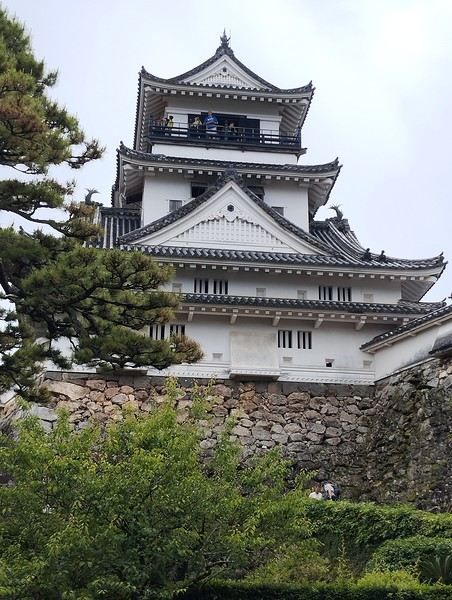 However, we’re surprised by the crowd—especially since a large part of it is foreign. The usual zen atmosphere isn’t quite there; instead, it’s a bit of a cacophony. We get the impression that some of the Western foreigners are from a cruise ship.
To visit the castle, we have to take off our shoes and put them in lockers outside, which we lock with a key. It’s free.
With our entry ticket in hand (paid), the visit is done in socks, walking sometimes on rice mats and sometimes on wooden floors. Since the castle isn’t large, it’s hard to escape the crowd, as there’s a set route to follow. Still, the visit is interesting, with various objects on display, models, and viewpoints from the castle’s five floors. To reach each floor, we queue up to climb the steep stairs at every level.
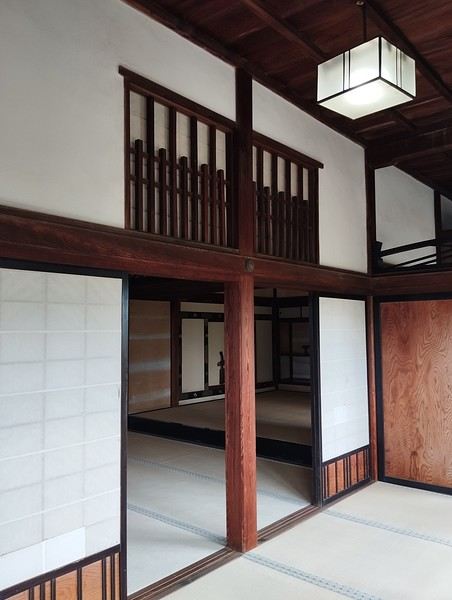
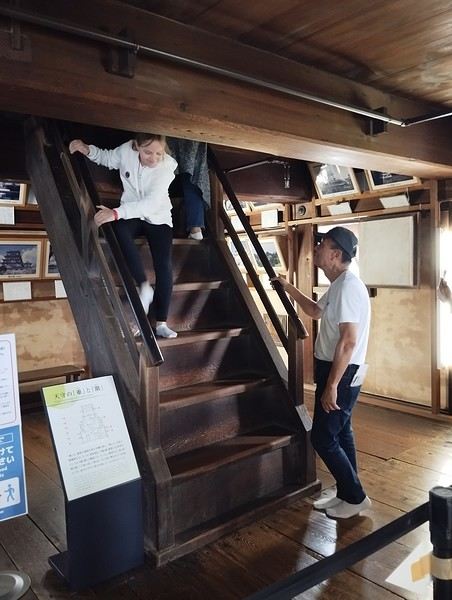
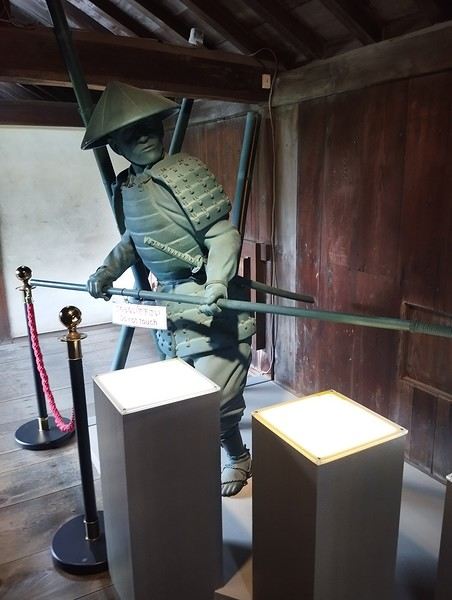

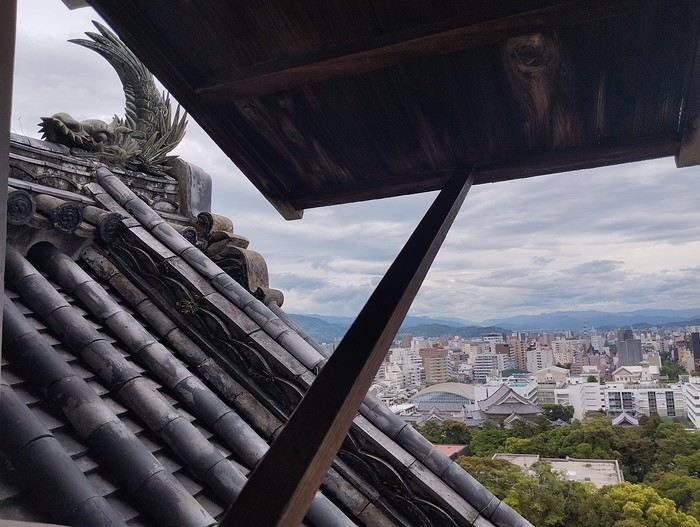
After this historical visit, we check the bus schedule for our next destination, but it turns out the next bus isn’t for another 2 hours. So, we head to the famous Hirome Market nearby on foot. Along the way, we pass a small shrine where the unusual sight of roosters roaming freely on sheet metal catches my attention.
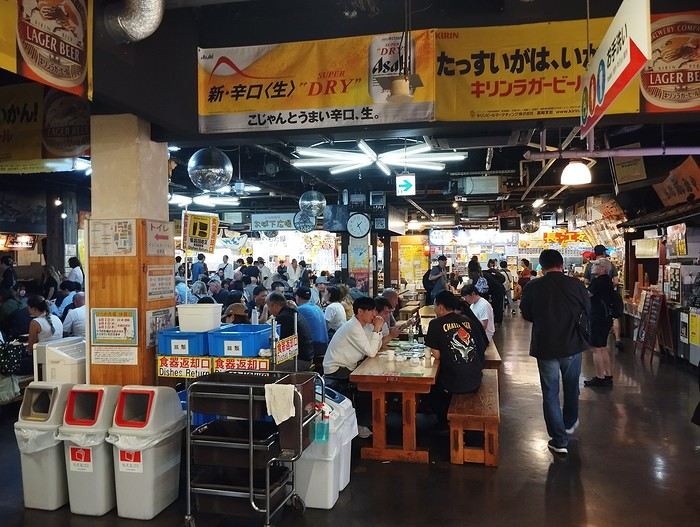
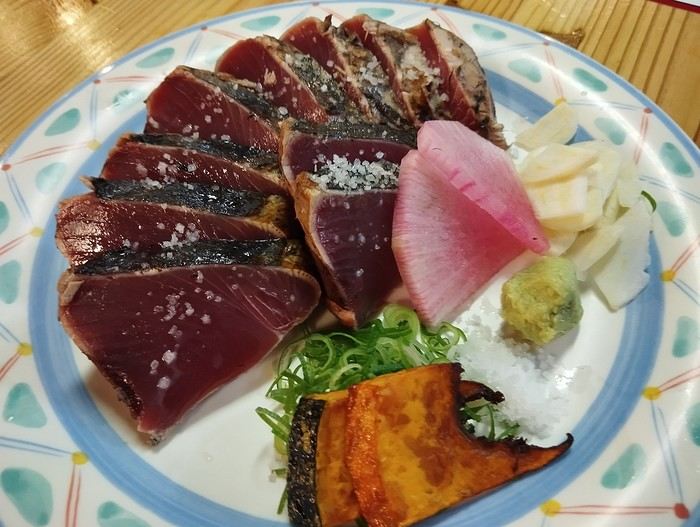
Hirome Market is mainly a food market where you can also eat. It’s a popular spot for locals and tourists alike. For us, it’s a chance to try one of the local specialties: *katsuo no tataki*—bonito seared on the outside and raw inside. The bonito is delicious, with a smoky/hay-like flavor that’s both strong and subtle at the same time.
We pass through the castle gate, walk a little further, and there it is—the castle reveals itself in all its incredible elegance. Dating back to the 17th century, it’s made of wood and stone. It’s one of the 12 rare castles in Japan that are still authentic. In fact, its keep and tower are original since it never saw battle, though it did suffer from fires.
However, we’re surprised by the crowd—especially since a large part of it is foreign. The usual zen atmosphere isn’t quite there; instead, it’s a bit of a cacophony. We get the impression that some of the Western foreigners are from a cruise ship.
To visit the castle, we have to take off our shoes and put them in lockers outside, which we lock with a key. It’s free.
With our entry ticket in hand (paid), the visit is done in socks, walking sometimes on rice mats and sometimes on wooden floors. Since the castle isn’t large, it’s hard to escape the crowd, as there’s a set route to follow. Still, the visit is interesting, with various objects on display, models, and viewpoints from the castle’s five floors. To reach each floor, we queue up to climb the steep stairs at every level.
After this historical visit, we check the bus schedule for our next destination, but it turns out the next bus isn’t for another 2 hours. So, we head to the famous Hirome Market nearby on foot. Along the way, we pass a small shrine where the unusual sight of roosters roaming freely on sheet metal catches my attention.
Hirome Market is mainly a food market where you can also eat. It’s a popular spot for locals and tourists alike. For us, it’s a chance to try one of the local specialties: *katsuo no tataki*—bonito seared on the outside and raw inside. The bonito is delicious, with a smoky/hay-like flavor that’s both strong and subtle at the same time.
N
Continuation Day 1 - A day in Kochi City using public transport - Part 3
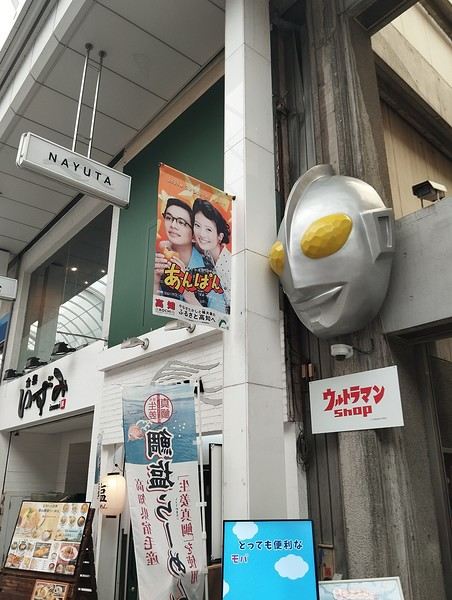
With our taste buds delighted and our bellies full from that simple but delicious meal, we continue our stroll by taking the shotengai (covered shopping arcade) Obiyamachi, located at the foot of Hirome Market. This is the longest shotengai in Kochi, stretching 650 meters. Wandering through it is really pleasant because the alley is wide, and above all, we’re charmed by its retro style and atmosphere. There are places where you instantly feel at ease—this shotengai is one of them. Many of the shops have an "old-school" vibe, like the numerous clothing stores with styles geared toward "older folks." The same goes for the bridal shop selling kimonos. Despite that, you see all generations strolling around. The atmosphere is very laid-back. Our senses are stimulated here—sight with the eye-catching, sometimes futuristic storefronts, or the deep violet flowers that catch my eye; smell with the sweet, warm scent wafting from the Mister Donut sign, which almost makes me want to try one even though I’m not a donut fan; and hearing with the music playing from the speakers or the special tunes at pedestrian crossings.
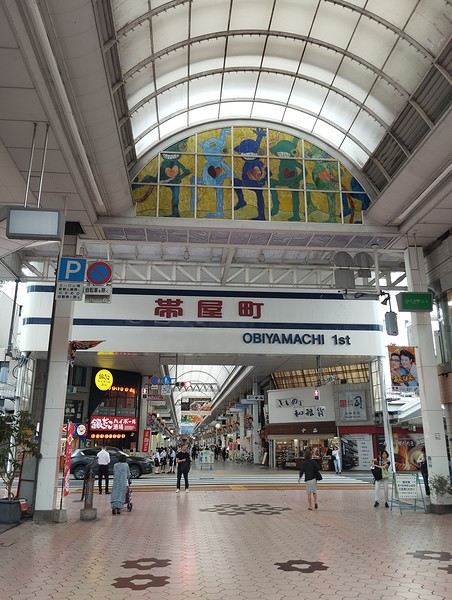
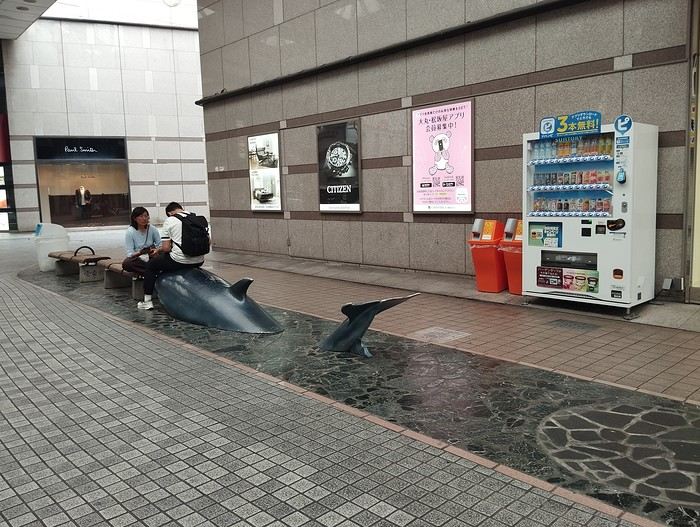
We even spotted a bench shaped like a whale—cetaceans that swim in the Pacific Ocean, both admired and fished here. There are restaurants serving whale meat and moray eel, but we didn’t have time to try them.
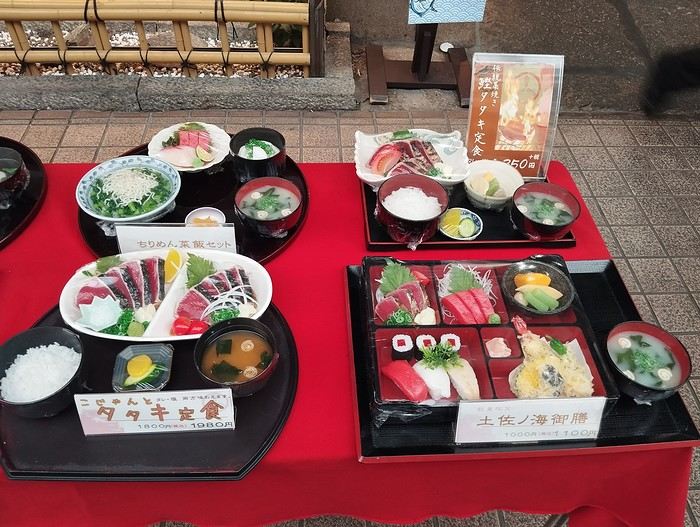
The space is so wide that one restaurant set up a table outside with several *sampuru*—fake food displays.
A square in the middle of this shopping arcade seems to be a local hangout spot. Artists, elderly folks on bikes grabbing coffee and chatting occupy the benches or the ground. In Kochi, it’s retro, as I mentioned—no flashiness like in Tokyo, but a mixed population where some signs of hardship seem to show, like the older men on bikes we pass by. Kochi feels like a place where life is good, human-scale, more rural, more working-class—the unfiltered side of Japanese life. At the end of the shotengai, almost opposite, there’s another shorter arcade with a beautiful wooden framework. Its aesthetic really draws the eye.
We would’ve liked to keep exploring, but we prefer to arrive a little early at the bus stop. Except we struggle to find the right one, so we walk from one stop to another, try asking a young teenager who doesn’t know, then a sign enlightens me—we’re not in the right place at all, and the bus is about to pass. Sure enough, we spot it, wave it down, but it doesn’t stop. If we miss this bus, we’re done for, so we start running as fast as we can. Luckily, a red light buys us some time, but it’s not over yet. I’m a bit out of breath, Mr. is ahead of me, and I tell him, "Don’t stop, keep going, I’m coming!" I run, and somehow—miraculously—we manage to hop on the bus just before it pulls away! That was a close one!! The seats are a welcome relief after that unexpected sprint. A little cardio never hurt anyone! We took the MY YU Bus line, which serves Kochi’s main tourist spots.
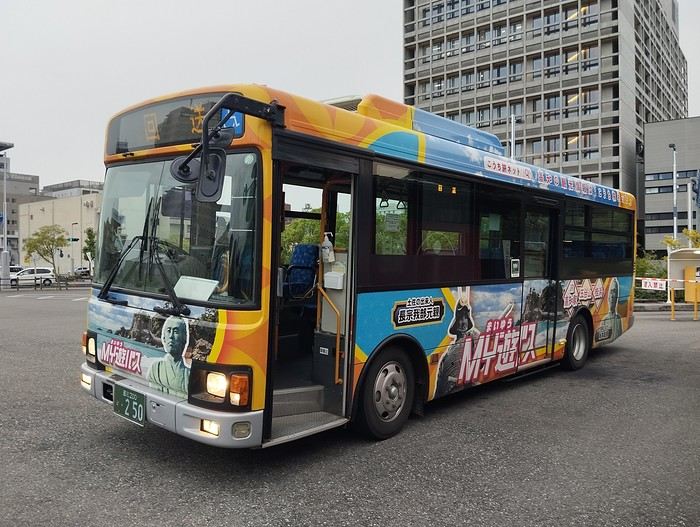
The bus crosses the city and quickly reaches a narrow, winding mountain road that plunges us into the heart of the forest. The road is flanked by mountains on both sides. For the latter, we only catch glimpses of the valley now and then since we’re climbing higher. Bathed in the green light of the trees, the bus takes us to our destination—the Makino Botanical Garden, located on Mount Godai. The site is vast, nearly 8 hectares, where you wander from path to path, leading sometimes to the medicinal plant area, sometimes to the glass tropical greenhouse. The species are well-labeled, and the place is really pleasant—especially since there aren’t many people left. The scientist, Dr. Makino, was the first Japanese person to give a scientific name to a new plant species.
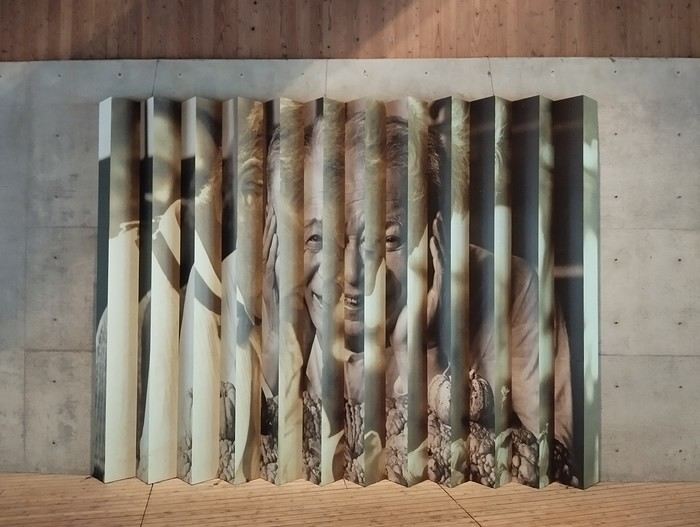
During our self-guided tour, a young woman approaches us in Japanese to ask if there’s anything worth seeing where we came from. We answer as best we can, point her in the right direction, and part ways. A second later, she turns around and asks to take a photo with us to commemorate her solo trip—all with a sweet smile and contagious laughter.
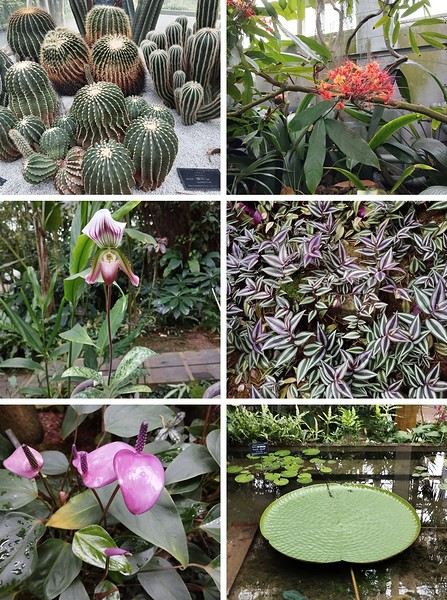
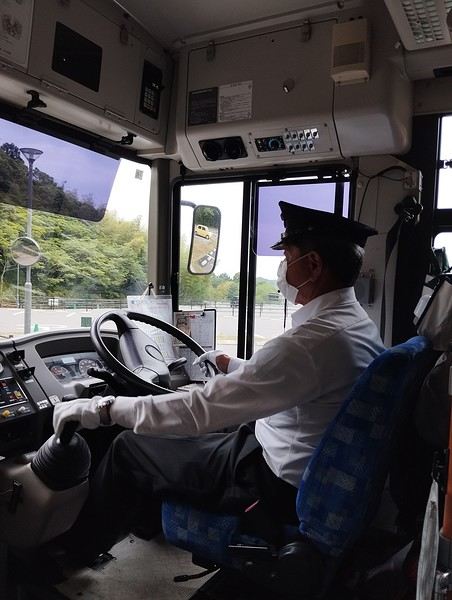
The garden is so big that we don’t have time to visit the café overlooking it because the garden closes. In Japan, many places close at 4:00 PM, 4:30 PM, or 5:00 PM—even in summer when it doesn’t get dark until 7:00 PM or 7:30 PM. We also don’t have time to visit Chikurinji Temple, right across from the garden. We just pass by while waiting for the bus—about 30 minutes. We won’t make it to Katsurahama Beach either because there wouldn’t be a bus back to the city center. I hesitated about renting a car starting today, and if I had to do it over, I’d rent one from the first day—it’s much less restrictive, I think. That said, I should mention that all these visits are doable by public transport, and they’re well-served, but having to watch the clock and wonder how much time you have to visit a place so you don’t miss your bus or the right connection is, for me, a source of stress on vacation. The bus arrives, and while the driver indicates his stop—there’s a sign for that—we get on.
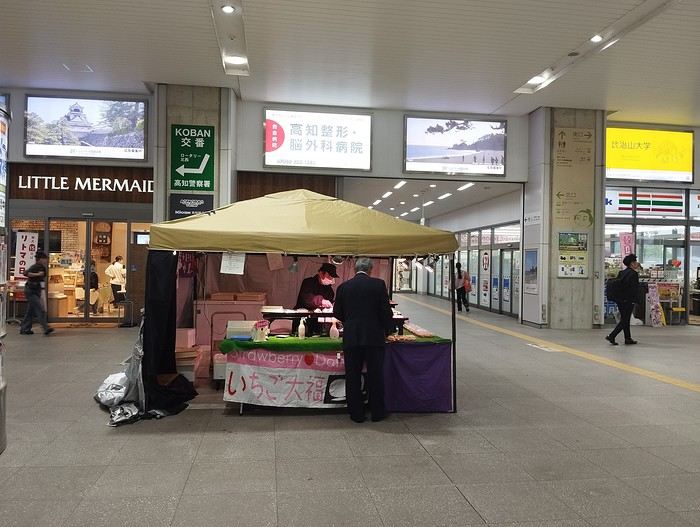
The return trip is the same in reverse. We get off at the terminus—Kochi Station. It’s a chance to see a bit more of the inside. There’s a *konbini* and food stalls, including Japanese pastries. The elderly man running the stall was already there this morning—you could say he works long hours.
We have a ritual when we arrive in Japan—those who’ve read our previous travel journals know it—buying Japanese liposomal vitamin C. Usually, we find it in medical or dental clinics. But this time, the closest place is a beauty salon. We find it without trouble and spot the car rental agency for tomorrow morning. Arriving at the beauty salon called "La Chambre," located in a house, the esthetician is a bit surprised to see us. We explain why we’re there, and we’re allowed in. After the explanations and confirming our purchase, the owner arrives. Her employee introduces us, and we chat with the owner. The conversation then drifts to a few French words she knows (she’d been once) and the places we’re visiting on this trip. We even get a little gift—a storage box for the vitamins. Warm goodbyes, and we continue our quest for hydrogen water, spotting a *drugstore*—a huge pharmacy-like store. For the first time, we find water that might fit the bill, thanks to asking the staff. There are only 4 bottles left, and she apologizes because satisfying the customer is an unconditional rule. After these purchases, we head back to the hotel to relax a bit. We go out again to eat nearby at a restaurant serving another local specialty—*nabeyaki ramen*. It’s a ramen with a light chicken broth, egg, and raw onions, served in a clay pot to keep it hot. The restaurant was pretty basic, so the taste didn’t wow us. We should try another place next time. On the bright side, it was cheap—1500 yen for two, about 9.50 € for both of us.
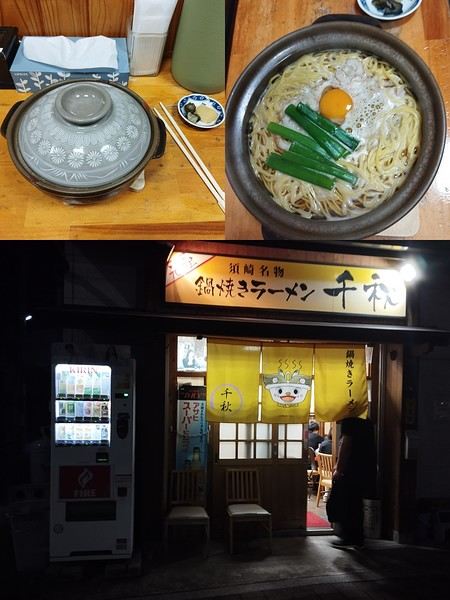
Afterward, we take a walk to a supermarket—here, *Food & Drug*—which is often open until 9:00 PM or 10:00 PM, to grab some fresh fruit, water bottles, and cold green tea—essential for staying hydrated. On our way back to the hotel, while waiting at a pedestrian crossing, a woman who looked Japanese but apparently hadn’t lived in Japan approached us for directions. The exchange was a bit strange, even surreal—the lady was a bit peculiar, maybe even a little eccentric. We couldn’t help her since we weren’t from the area. We end the evening watching a bit of Japanese TV. I stumble upon a movie and catch a few words here and there.
To be continued, Day 2.
With our taste buds delighted and our bellies full from that simple but delicious meal, we continue our stroll by taking the shotengai (covered shopping arcade) Obiyamachi, located at the foot of Hirome Market. This is the longest shotengai in Kochi, stretching 650 meters. Wandering through it is really pleasant because the alley is wide, and above all, we’re charmed by its retro style and atmosphere. There are places where you instantly feel at ease—this shotengai is one of them. Many of the shops have an "old-school" vibe, like the numerous clothing stores with styles geared toward "older folks." The same goes for the bridal shop selling kimonos. Despite that, you see all generations strolling around. The atmosphere is very laid-back. Our senses are stimulated here—sight with the eye-catching, sometimes futuristic storefronts, or the deep violet flowers that catch my eye; smell with the sweet, warm scent wafting from the Mister Donut sign, which almost makes me want to try one even though I’m not a donut fan; and hearing with the music playing from the speakers or the special tunes at pedestrian crossings.
We even spotted a bench shaped like a whale—cetaceans that swim in the Pacific Ocean, both admired and fished here. There are restaurants serving whale meat and moray eel, but we didn’t have time to try them.
The space is so wide that one restaurant set up a table outside with several *sampuru*—fake food displays.
A square in the middle of this shopping arcade seems to be a local hangout spot. Artists, elderly folks on bikes grabbing coffee and chatting occupy the benches or the ground. In Kochi, it’s retro, as I mentioned—no flashiness like in Tokyo, but a mixed population where some signs of hardship seem to show, like the older men on bikes we pass by. Kochi feels like a place where life is good, human-scale, more rural, more working-class—the unfiltered side of Japanese life. At the end of the shotengai, almost opposite, there’s another shorter arcade with a beautiful wooden framework. Its aesthetic really draws the eye.
We would’ve liked to keep exploring, but we prefer to arrive a little early at the bus stop. Except we struggle to find the right one, so we walk from one stop to another, try asking a young teenager who doesn’t know, then a sign enlightens me—we’re not in the right place at all, and the bus is about to pass. Sure enough, we spot it, wave it down, but it doesn’t stop. If we miss this bus, we’re done for, so we start running as fast as we can. Luckily, a red light buys us some time, but it’s not over yet. I’m a bit out of breath, Mr. is ahead of me, and I tell him, "Don’t stop, keep going, I’m coming!" I run, and somehow—miraculously—we manage to hop on the bus just before it pulls away! That was a close one!! The seats are a welcome relief after that unexpected sprint. A little cardio never hurt anyone! We took the MY YU Bus line, which serves Kochi’s main tourist spots.
The bus crosses the city and quickly reaches a narrow, winding mountain road that plunges us into the heart of the forest. The road is flanked by mountains on both sides. For the latter, we only catch glimpses of the valley now and then since we’re climbing higher. Bathed in the green light of the trees, the bus takes us to our destination—the Makino Botanical Garden, located on Mount Godai. The site is vast, nearly 8 hectares, where you wander from path to path, leading sometimes to the medicinal plant area, sometimes to the glass tropical greenhouse. The species are well-labeled, and the place is really pleasant—especially since there aren’t many people left. The scientist, Dr. Makino, was the first Japanese person to give a scientific name to a new plant species.
During our self-guided tour, a young woman approaches us in Japanese to ask if there’s anything worth seeing where we came from. We answer as best we can, point her in the right direction, and part ways. A second later, she turns around and asks to take a photo with us to commemorate her solo trip—all with a sweet smile and contagious laughter.
The garden is so big that we don’t have time to visit the café overlooking it because the garden closes. In Japan, many places close at 4:00 PM, 4:30 PM, or 5:00 PM—even in summer when it doesn’t get dark until 7:00 PM or 7:30 PM. We also don’t have time to visit Chikurinji Temple, right across from the garden. We just pass by while waiting for the bus—about 30 minutes. We won’t make it to Katsurahama Beach either because there wouldn’t be a bus back to the city center. I hesitated about renting a car starting today, and if I had to do it over, I’d rent one from the first day—it’s much less restrictive, I think. That said, I should mention that all these visits are doable by public transport, and they’re well-served, but having to watch the clock and wonder how much time you have to visit a place so you don’t miss your bus or the right connection is, for me, a source of stress on vacation. The bus arrives, and while the driver indicates his stop—there’s a sign for that—we get on.
The return trip is the same in reverse. We get off at the terminus—Kochi Station. It’s a chance to see a bit more of the inside. There’s a *konbini* and food stalls, including Japanese pastries. The elderly man running the stall was already there this morning—you could say he works long hours.
We have a ritual when we arrive in Japan—those who’ve read our previous travel journals know it—buying Japanese liposomal vitamin C. Usually, we find it in medical or dental clinics. But this time, the closest place is a beauty salon. We find it without trouble and spot the car rental agency for tomorrow morning. Arriving at the beauty salon called "La Chambre," located in a house, the esthetician is a bit surprised to see us. We explain why we’re there, and we’re allowed in. After the explanations and confirming our purchase, the owner arrives. Her employee introduces us, and we chat with the owner. The conversation then drifts to a few French words she knows (she’d been once) and the places we’re visiting on this trip. We even get a little gift—a storage box for the vitamins. Warm goodbyes, and we continue our quest for hydrogen water, spotting a *drugstore*—a huge pharmacy-like store. For the first time, we find water that might fit the bill, thanks to asking the staff. There are only 4 bottles left, and she apologizes because satisfying the customer is an unconditional rule. After these purchases, we head back to the hotel to relax a bit. We go out again to eat nearby at a restaurant serving another local specialty—*nabeyaki ramen*. It’s a ramen with a light chicken broth, egg, and raw onions, served in a clay pot to keep it hot. The restaurant was pretty basic, so the taste didn’t wow us. We should try another place next time. On the bright side, it was cheap—1500 yen for two, about 9.50 € for both of us.
Afterward, we take a walk to a supermarket—here, *Food & Drug*—which is often open until 9:00 PM or 10:00 PM, to grab some fresh fruit, water bottles, and cold green tea—essential for staying hydrated. On our way back to the hotel, while waiting at a pedestrian crossing, a woman who looked Japanese but apparently hadn’t lived in Japan approached us for directions. The exchange was a bit strange, even surreal—the lady was a bit peculiar, maybe even a little eccentric. We couldn’t help her since we weren’t from the area. We end the evening watching a bit of Japanese TV. I stumble upon a movie and catch a few words here and there.
To be continued, Day 2.
N
Day 2 - Cave Visits
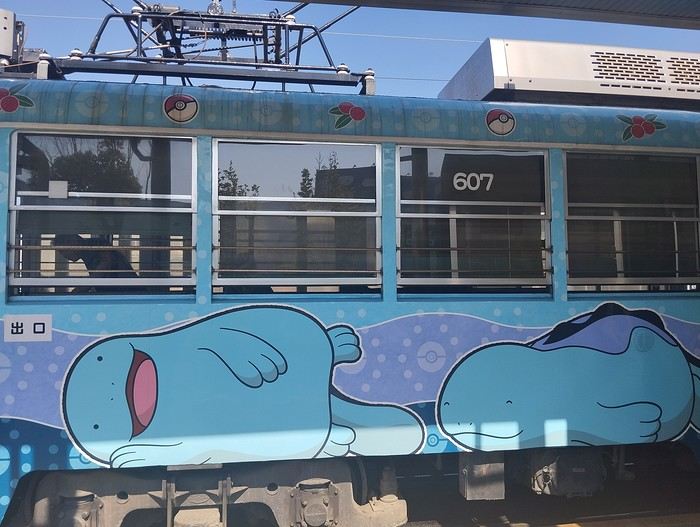
The day starts off great because it's 7:45 AM and outside, the sky is a brilliant blue with not a cloud in sight. Only the sun is lighting our way. From the hotel, we walk to the car rental agency we spotted yesterday. It's located at the north exit of the station, just behind the retro bike parking lot. Just before that, at the south exit, we spotted a tram in shades of blue. I don’t know the name of the character depicted on it.
We’re greeted by a very pleasant Japanese woman and man. Despite a few moments of confusion trying to understand each other, there’s no impatience or annoyance. For some reason, the credit card isn’t working, even though I’ve used it for payments on previous trips. We’re forced to pay in cash. Given that we’re renting the car for a one-way road trip from point A to point B, the options were limited, and the price reflected that. Usually, car rentals cost us around 42-44 € on average, but this time it was more like 50 € per day.
The car is very comfortable. However, once again, the GPS doesn’t work with phone numbers. We improvise by roughly selecting locations on the map and using Maps.me, which works offline.
At 9:00 AM, I get back into the swing of driving on the left in an automatic car—it comes back pretty easily since the last time was only six months ago. We stop at a konbini, and a young Indian guy is at the register. We chat with him a bit. He’s here for his studies and says Kochi is a very small city, and it’s hard to make friends without speaking Japanese since very few people speak English.
Back on the road, we’re close to our morning destination. We see the signs and follow the GPS, but it tries to take us up a mountain path where a sign seems to indicate it’s off-limits, so I turn around. Even though we were only 200 meters from the spot, I took a mountain road that gave us a free detour through the mountains of Kochi Prefecture. That said, the landscapes we passed were lovely—forest on one side and the sea on the other. We even spotted a stone castle with French architectural style. We wanted to stop and check it out, intrigued by the building, but we couldn’t find the road leading to it.
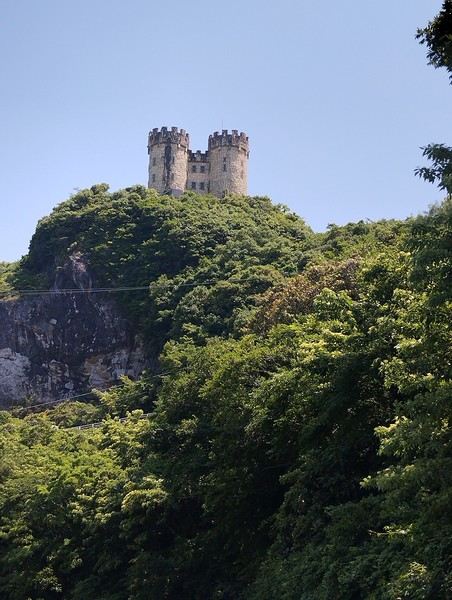
After a free detour, a stop at a very mineral cemetery, and an hour of driving, we end up right back where we started. This time, the entrance to the place jumps out at us—right in front of us, just a few meters away, and we turned right. Oh well, that’s part of the adventure.
We came to visit Ryugado Cave, which means "Dragon River Cave." It’s located in the city of Kami and is one of Japan’s three largest limestone caves. It’s 4 km long, but only 1 km is open to the public. It’s supposedly 175 million years old.
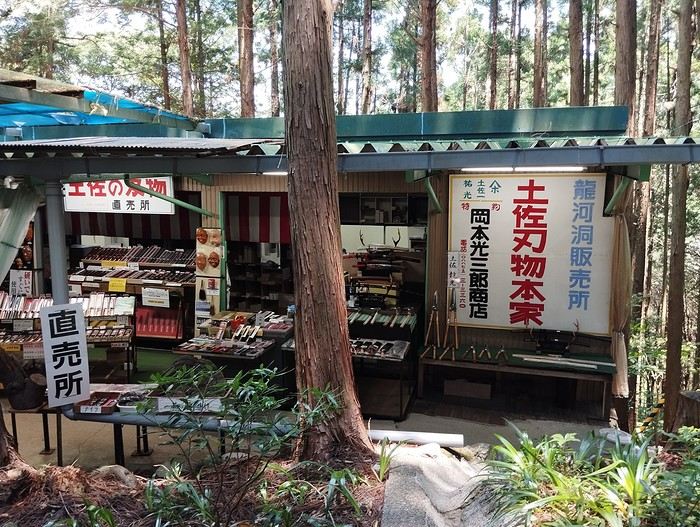
To reach the entrance, you have to walk through a shopping street. There are a few shops selling knives, precious stones, a tourist office with no staff, and one or two restaurants open. Despite it being late morning—after 11:00 AM—there aren’t many people around. We pass two Japanese people coming the other way. At the end of the street, there are the inevitable stairs, made of stone here, a steep climb, but if you turn around, you get a clear view of the peaceful Japanese countryside, not to mention the birdsong, lizards crawling on the ground, and the sound of mountain water flowing—it’s a lovely moment.
There *is* staff: a woman greeting you at the top of the stairs and another at the ticket office.
With our tickets in hand and encouraged by the gentle smile of the woman opening the gate for us, we step into the cave’s depths. The path is well-maintained, so no mining work needed, but there are quite a few very narrow and/or low passages. It requires some gymnastics or hula hoop moves to make progress. You can see stalactites and unique formations. There’s also a waterfall highlighted by lighting. Some sections go up, then down. In several spots, you can take a break if you’re tired or feeling unwell. There are phones to call for help if needed. The accessible 1 km ends with a sound and light show projected onto the cave’s cliffs. It’s quite nice.
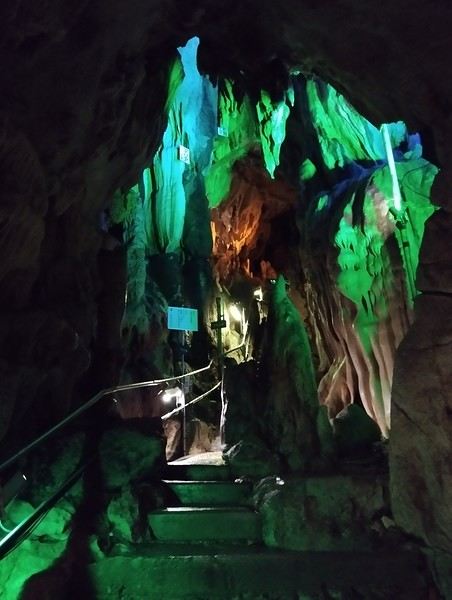
We exit higher up in the mountain. There’s a closed, glass-walled room with armchairs and sofas, free to use for anyone who wants to relax after the visit. The windows look out onto the surrounding forest. The visit itself isn’t very long—less than an hour if you take your time. So, we skip the break and keep going. The path at tree height, swaying in the wind, is very pleasant. The rustling of leaves and branches is refreshing.
Then, to our right, we see a stand selling handmade knives. The region is known for knife-making. There’s an impressive selection, all beautifully crafted. I’ve been wanting to buy a real Japanese knife for a while, so I take a look. In Tokyo, I went into a small shop, but the price stopped me in my tracks. This summer in Brittany, at a handmade knife shop, the prices were much higher—between 600 and 1000 € on average. The 300 € in Tokyo now seems like a steal compared to the quality. The seller—and maker, since he only sells his own work—shows us a knife for cutting meat, among other things. The price is 9500 yen (about 60 €). For the first time in Japan, we try negotiating, not really expecting it to work, but the maker agrees to sell it to us for 1000 yen less—8500 yen. The discount isn’t huge, but I’m proud I managed it because it doesn’t seem like a common practice here, unlike in other Asian countries. And most importantly, I’m going home with a beautiful knife of guaranteed quality.
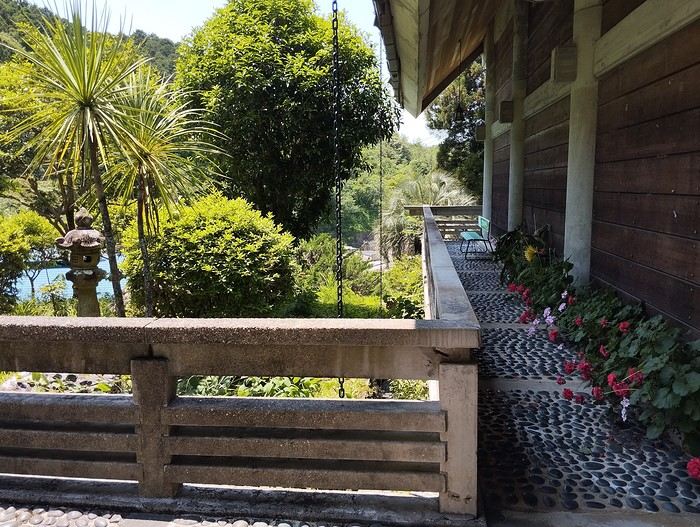
We continue downhill and arrive in front of the entrance to a free museum, open to the public with no staff. The museum is in a pretty building surrounded by greenery, bathed in sunlight.
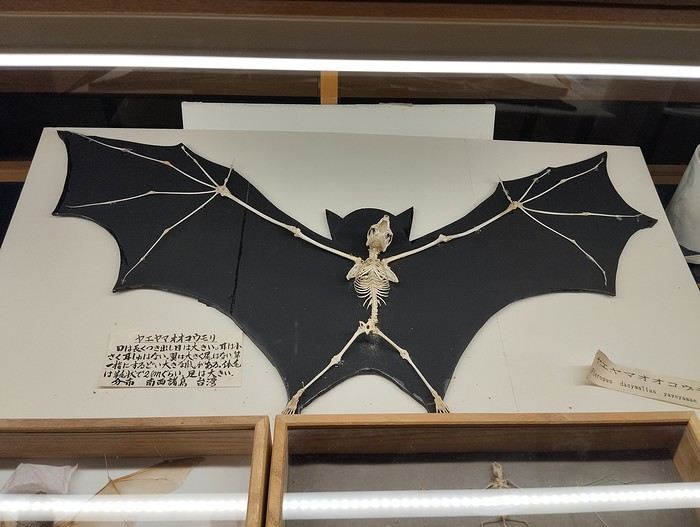
At the museum entrance, there’s another fun sound and light display. Inside, you’ll find bones, ancient objects, and bat skeletons, among other things.
After the visit, we head back to the car, descending the stone stairs and walking through the shopping street with its everyday art.
This morning’s detour cost us some time, so we change the original plan. We’re now driving toward the coastal town of Aki. There, we try artisanal ice cream flavors like sweet potato, ginger, and grilled eggplant. The ginger ice cream is really nice.
We stop at a supermarket to buy some food, where we ask a couple to help us identify the type of fish in the tray we’re holding. They help us kindly. We make a stop at the station, where a mascot is on display, and then at Aki’s tourist office. Three people work there, even though the town seems small and there’s hardly anyone around, including on the streets. For some of our questions, they don’t have the information in English, so they apologize.
The sun’s heat is overwhelming, and time is passing. After a bit of wandering, we decide to eat by the sea at Cape Oyama. We have a picnic near a peaceful little port and a lovers’ sanctuary, which seems to be new. The setting is lovely. We’re lulled by the sound of small waves.
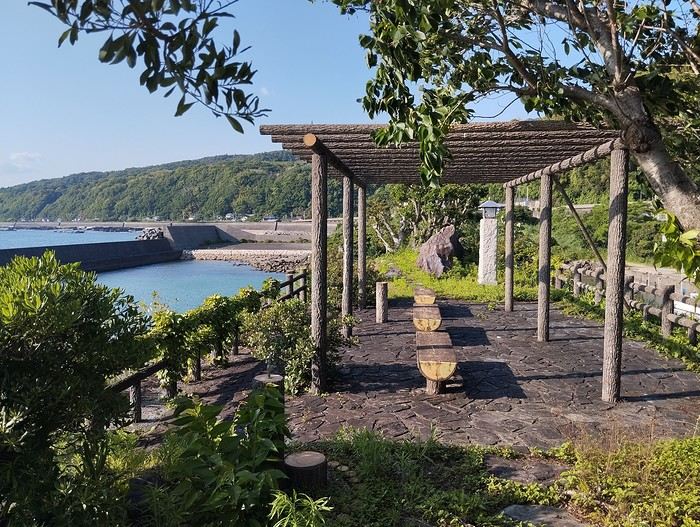
After that, we visit another kind of cave. Ioki Cave is a natural tunnel carved by waves millions of years ago. Inside, there are many different species of tropical ferns creating a green canopy—it feels like you’re in the middle of a forest, even though the road is just a few steps from the cave entrance. First, we cross the tunnel using our phone lights because it’s dark, then we reach the heart of the canyon, and the light returns. We cross several shallow river sections, walk on branches, use a small bridge, and climb slightly with the help of a thick rope provided to descend along the riverbed. We arrive at a small waterfall. It’s possible to do a loop by going further, but honestly, we don’t take the risk because it’s already late, night is falling, we don’t have a headlamp, and we can’t see how bright it really is inside the canyon. So, a bit reluctantly, we simply turn back. We didn’t see anyone except a Japanese family leaving the cave as we arrived, and we exchanged a few words with them.
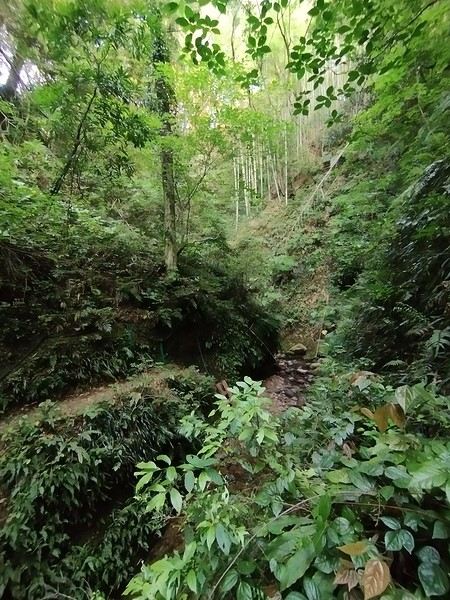
We had planned to do more today, but sometimes there are unexpected things—like getting lost, chatting, and driving time. So, we drive calmly back to the hotel. We can’t find the hotel’s affiliated parking lots, so I park a bit randomly. We go to the reception, which helps us locate the different parking areas, and we go back to park properly. We’ll eat what’s left from our supermarket purchases earlier.
The day starts off great because it's 7:45 AM and outside, the sky is a brilliant blue with not a cloud in sight. Only the sun is lighting our way. From the hotel, we walk to the car rental agency we spotted yesterday. It's located at the north exit of the station, just behind the retro bike parking lot. Just before that, at the south exit, we spotted a tram in shades of blue. I don’t know the name of the character depicted on it.
We’re greeted by a very pleasant Japanese woman and man. Despite a few moments of confusion trying to understand each other, there’s no impatience or annoyance. For some reason, the credit card isn’t working, even though I’ve used it for payments on previous trips. We’re forced to pay in cash. Given that we’re renting the car for a one-way road trip from point A to point B, the options were limited, and the price reflected that. Usually, car rentals cost us around 42-44 € on average, but this time it was more like 50 € per day.
The car is very comfortable. However, once again, the GPS doesn’t work with phone numbers. We improvise by roughly selecting locations on the map and using Maps.me, which works offline.
At 9:00 AM, I get back into the swing of driving on the left in an automatic car—it comes back pretty easily since the last time was only six months ago. We stop at a konbini, and a young Indian guy is at the register. We chat with him a bit. He’s here for his studies and says Kochi is a very small city, and it’s hard to make friends without speaking Japanese since very few people speak English.
Back on the road, we’re close to our morning destination. We see the signs and follow the GPS, but it tries to take us up a mountain path where a sign seems to indicate it’s off-limits, so I turn around. Even though we were only 200 meters from the spot, I took a mountain road that gave us a free detour through the mountains of Kochi Prefecture. That said, the landscapes we passed were lovely—forest on one side and the sea on the other. We even spotted a stone castle with French architectural style. We wanted to stop and check it out, intrigued by the building, but we couldn’t find the road leading to it.
After a free detour, a stop at a very mineral cemetery, and an hour of driving, we end up right back where we started. This time, the entrance to the place jumps out at us—right in front of us, just a few meters away, and we turned right. Oh well, that’s part of the adventure.
We came to visit Ryugado Cave, which means "Dragon River Cave." It’s located in the city of Kami and is one of Japan’s three largest limestone caves. It’s 4 km long, but only 1 km is open to the public. It’s supposedly 175 million years old.
To reach the entrance, you have to walk through a shopping street. There are a few shops selling knives, precious stones, a tourist office with no staff, and one or two restaurants open. Despite it being late morning—after 11:00 AM—there aren’t many people around. We pass two Japanese people coming the other way. At the end of the street, there are the inevitable stairs, made of stone here, a steep climb, but if you turn around, you get a clear view of the peaceful Japanese countryside, not to mention the birdsong, lizards crawling on the ground, and the sound of mountain water flowing—it’s a lovely moment.
There *is* staff: a woman greeting you at the top of the stairs and another at the ticket office.
With our tickets in hand and encouraged by the gentle smile of the woman opening the gate for us, we step into the cave’s depths. The path is well-maintained, so no mining work needed, but there are quite a few very narrow and/or low passages. It requires some gymnastics or hula hoop moves to make progress. You can see stalactites and unique formations. There’s also a waterfall highlighted by lighting. Some sections go up, then down. In several spots, you can take a break if you’re tired or feeling unwell. There are phones to call for help if needed. The accessible 1 km ends with a sound and light show projected onto the cave’s cliffs. It’s quite nice.
We exit higher up in the mountain. There’s a closed, glass-walled room with armchairs and sofas, free to use for anyone who wants to relax after the visit. The windows look out onto the surrounding forest. The visit itself isn’t very long—less than an hour if you take your time. So, we skip the break and keep going. The path at tree height, swaying in the wind, is very pleasant. The rustling of leaves and branches is refreshing.
Then, to our right, we see a stand selling handmade knives. The region is known for knife-making. There’s an impressive selection, all beautifully crafted. I’ve been wanting to buy a real Japanese knife for a while, so I take a look. In Tokyo, I went into a small shop, but the price stopped me in my tracks. This summer in Brittany, at a handmade knife shop, the prices were much higher—between 600 and 1000 € on average. The 300 € in Tokyo now seems like a steal compared to the quality. The seller—and maker, since he only sells his own work—shows us a knife for cutting meat, among other things. The price is 9500 yen (about 60 €). For the first time in Japan, we try negotiating, not really expecting it to work, but the maker agrees to sell it to us for 1000 yen less—8500 yen. The discount isn’t huge, but I’m proud I managed it because it doesn’t seem like a common practice here, unlike in other Asian countries. And most importantly, I’m going home with a beautiful knife of guaranteed quality.
We continue downhill and arrive in front of the entrance to a free museum, open to the public with no staff. The museum is in a pretty building surrounded by greenery, bathed in sunlight.
At the museum entrance, there’s another fun sound and light display. Inside, you’ll find bones, ancient objects, and bat skeletons, among other things.
After the visit, we head back to the car, descending the stone stairs and walking through the shopping street with its everyday art.
This morning’s detour cost us some time, so we change the original plan. We’re now driving toward the coastal town of Aki. There, we try artisanal ice cream flavors like sweet potato, ginger, and grilled eggplant. The ginger ice cream is really nice.
We stop at a supermarket to buy some food, where we ask a couple to help us identify the type of fish in the tray we’re holding. They help us kindly. We make a stop at the station, where a mascot is on display, and then at Aki’s tourist office. Three people work there, even though the town seems small and there’s hardly anyone around, including on the streets. For some of our questions, they don’t have the information in English, so they apologize.
The sun’s heat is overwhelming, and time is passing. After a bit of wandering, we decide to eat by the sea at Cape Oyama. We have a picnic near a peaceful little port and a lovers’ sanctuary, which seems to be new. The setting is lovely. We’re lulled by the sound of small waves.
After that, we visit another kind of cave. Ioki Cave is a natural tunnel carved by waves millions of years ago. Inside, there are many different species of tropical ferns creating a green canopy—it feels like you’re in the middle of a forest, even though the road is just a few steps from the cave entrance. First, we cross the tunnel using our phone lights because it’s dark, then we reach the heart of the canyon, and the light returns. We cross several shallow river sections, walk on branches, use a small bridge, and climb slightly with the help of a thick rope provided to descend along the riverbed. We arrive at a small waterfall. It’s possible to do a loop by going further, but honestly, we don’t take the risk because it’s already late, night is falling, we don’t have a headlamp, and we can’t see how bright it really is inside the canyon. So, a bit reluctantly, we simply turn back. We didn’t see anyone except a Japanese family leaving the cave as we arrived, and we exchanged a few words with them.
We had planned to do more today, but sometimes there are unexpected things—like getting lost, chatting, and driving time. So, we drive calmly back to the hotel. We can’t find the hotel’s affiliated parking lots, so I park a bit randomly. We go to the reception, which helps us locate the different parking areas, and we go back to park properly. We’ll eat what’s left from our supermarket purchases earlier.
You might also like
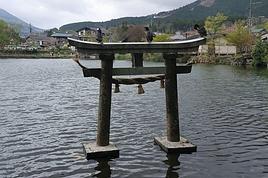 Densha Otaku - A Southern Loop
Travel logs › Japan·237 photos
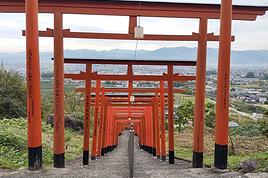 Kyushu between Fukuoka and Nagasaki in autumn 2024 (Japan)
Travel logs › Japan·297 photos
 Draw Me Your Japan...
Travel logs › Japan·54 photos
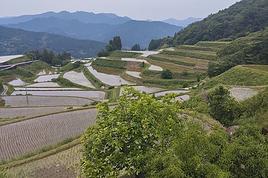 From Southern Shikoku, between land and sea, to the blue waters of Miyakojima and finally the Tokyo metropolis
Travel logs › Japan·300 photos
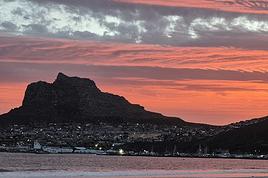 Southern landscapes, northern wildlife: returning to South Africa
Travel logs › South Africa·260 photos
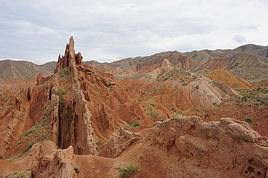 Discovering Kyrgyzstan by marshrutka, hitchhiking, on foot and on horseback – Father/Daughter Trip
Travel logs › Kyrgyzstan·270 photos
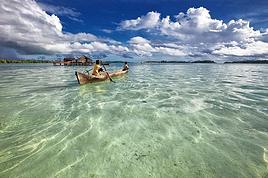 Polynesia: How to choose between the Society Islands, Tuamotu, and the Marquesas?
Features › French Polynesia·4 photos
 A Few Days in Turkmenistan from Uzbekistan
Travel logs › Turkmenistan·73 photos