Skip to content
From Southern Shikoku, between land and sea, to the blue waters of Miyakojima and finally the Tokyo metropolis
Japan › Travel journals Nathalie971

From Southern Shikoku, between land and sea, to the blue waters of Miyakojima and finally the Tokyo metropolis

Translated into English.
Add a reply…

Sign in to reply

Your reply to “From Southern Shikoku, between land and sea, to the blue waters of Miyakojima and finally the Tokyo metropolis” is one step away. We’ll bring you right back to it.

Create a free account

Why become a member?

74 replies

Nathalie971OP· 11 months ago
Hello Nathalie,

and happy New Year 2026


Hi Gérard,

Thanks, and Happy New Year to you too!

I’m following your travel journal, which I enjoy (like your previous ones) for its content and photos. It’s a nice break, right in the middle of my Japanese blues.


I think you were already here at the start of the journal. Thanks for coming back. PS: I checked, and actually, I mixed it up with the previous journal about Kyushu, I think.

Japanese blues after your May trip? Does it ever really leave us? ;)

I didn’t particularly enjoy Nara, except for Todai-ji; nearby Uji appealed to me more. The castles in Kochi and Wajima confirmed my (mistaken?) impression of déjà vu. The castles in Kanazawa, Himeji, and Okayama satisfied my fondness for these fortresses.


Is there a castle in Nara and Uji?

I haven’t seen the castles in the cities you mentioned, but indeed, the ones I’ve visited so far (Kochi, Uwajima, Yokote, and Matsuyama) all look alike. Still, their surroundings are often pleasant and different. Plus, they can offer a great view of the city. The inside can also vary in terms of exhibits.

Anyway, thanks for sharing this journey through lesser-known places. I know how much work a travel journal takes. I’ll add our May 2025 trip journal to my long to-do list.


It’s true that it takes time, which is why I can’t publish regularly. It’s still a "tangible" souvenir of the trip, besides photos, purchases, and, of course, the memories in my head. Mostly, it’s a way to extend the Japan trip. And if it can help people looking for information, well, that’s even better.

I’ll be reading your journal when you have time to share your trip recap. Where did you end up going, since I remember you were hesitating about Tohoku?

I’m curious to read your thoughts on Tokyo, where I made a second visit last year.


This year was my third visit to Tokyo, and indeed, this latest trip was different from the previous ones.
Bluequark· 11 months ago
Thanks for this travel journal that lets us discover a lesser-known Japan. It’s really interesting, and I’m envious of all your discoveries, especially the culinary ones.
Nathalie971OP· 11 months ago
Thanks for this travel journal that lets us discover a lesser-known Japan. It’s really interesting, and I’m envious of all your discoveries, especially the culinary ones.


Hi Bluequark,

Thanks for your message and for joining the journey. Eating is a pleasure that’s inseparable from life—and from travel. You’ll find a few more food photos from this same travel journal here if you’re interested.

See you soon for the next part.
Nathalie971OP· 11 months ago
Day 11 - Tobe

The alarm goes off. It’s raining outside. We get ready and head down for breakfast. It’s not quite the same as in Kochi, even though we’re staying at the same hotel chain. The selection is a bit less varied and not as tasty as in Kochi. We eat, but we’re not exactly savoring it. Luckily, there’s one safe bet: scrambled eggs.

The sky is dark, and the rain is still pouring. Going for a walk in these conditions is out of the question. So, we decide to relax and enjoy our room for a bit. Fatigue takes over, and we end up taking a nap. It’s actually pretty nice. By late morning, the rain has stopped, though the sky remains gray and overcast. We pick up the car—it’s our last day with it, and we have to return it tonight.

Today’s plan is to visit the town of Tobe. It’s not far, just about 30 minutes away. Just enough time for the rain to make a grand comeback. I’d spotted a udon restaurant that looked nice. We rush from the parking lot to the restaurant in the pouring rain, but the place is dark—it seems closed. Still, the sliding door opens when we pull it. Within seconds, a man appears and quickly tells us it’s closed, just as the lack of lights suggested. Oh well, we quickly look up another restaurant online. Another udon place—today’s craving. It’s not far, less than 10 minutes away. It’s right along the national highway. There are 4-5 shops clustered together, but the storefronts are pretty discreet. The restaurant doesn’t stand out—it’s set back, and everything is written in kanji.


A little hesitant in front of the restaurant, a young man approaches and confirms it’s indeed a udon place. We follow him inside. The owners greet us from a distance. We have to order from a machine with no pictures. The guy in front of us orders and points out the udon options. Clearly, we’re ordering at random. The prices give us a vague idea. We get our tickets and hand them to the manager.

In the end, we eat ramen and tempura. It’s simple but good. We’d ordered three udon ramen bowls, but they only brought us two. The owners were watching us as we ate. The manager realized we wouldn’t be able to finish a third bowl, so she came over with the bill and refunded us for the extra ramen. The owners could’ve just brought the dish and thrown it away if we hadn’t finished it, but this is Japan—you don’t sell just to sell. We’re always amazed by these small gestures that show care and honesty. There’s no sunshine in the sky, but our hearts are warmed by Japanese kindness.

Two big bowls of udon and two plates of tempura for 1,840 yen, about 11 €. A cheap and tasty restaurant.

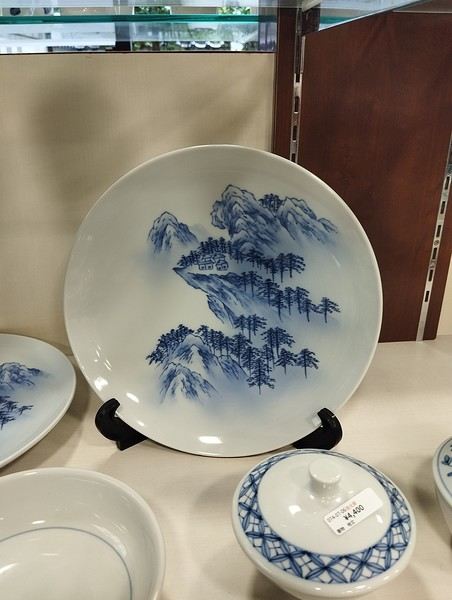
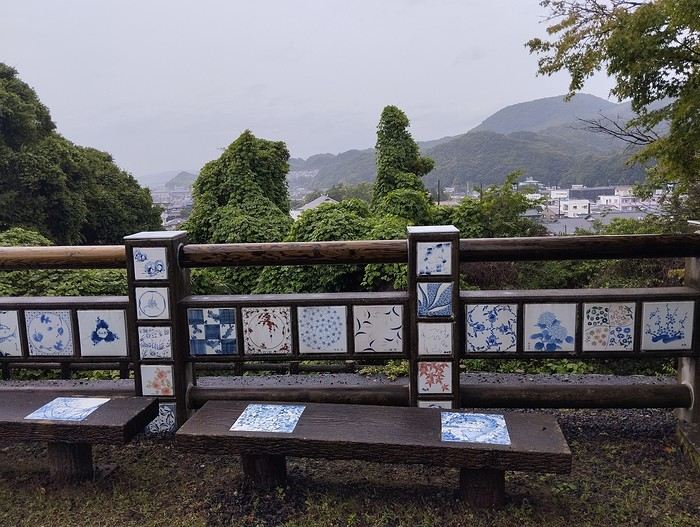
We came to Tobe to see ceramics. The town is a large suburban area, so nothing too exciting. There’s ceramic decor along the highway, separating the opposite lanes of traffic.

We visit the ceramics center, which is a shop and a small museum with a free section and a paid one.


At the entrance, like others, we’re asked by the staff to place a dot indicating where we’re from. It’s a chance to see how many Europeans have already visited this place.

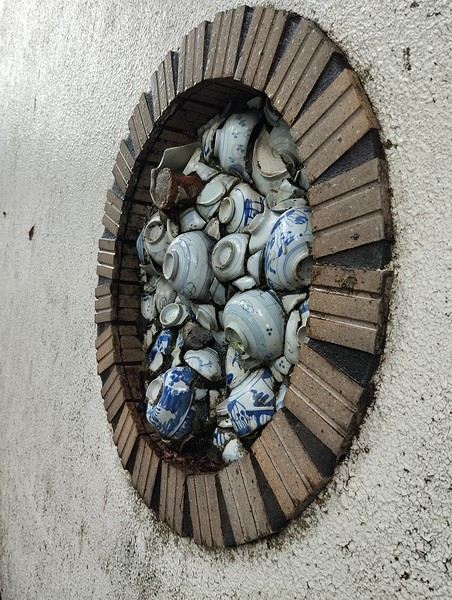
We also find ceramics in the restrooms, just like we saw in Arita (see here), a small town in northwestern Kyushu.

After the visit, we continue on foot along a walking path where we can spot traces of ceramics. It’s short, about 1 kilometer.


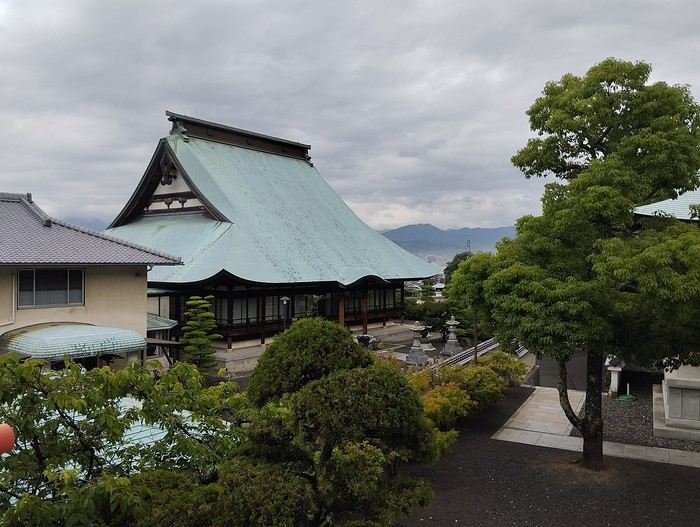
Given the weather, we decide to head back to Matsuyama, knowing we have to return the car by 6 PM. We want to stop at a park that offers a viewpoint over Matsuyama, but we take the wrong road. We end up in hilly backstreets, getting lost—even the GPS is confused. Eventually, we stumble upon a temple and visit it quickly.


There’s traffic in Matsuyama, and rush hour is causing jams, so we skip the park—it’s time to return the car. We find the Nissan agency without any trouble. We haven’t even turned off the engine or parked the car before an agent rushes over at lightning speed to handle the check-out. It’s a little overwhelming, and the agent isn’t the friendliest, though not unpleasant either. Still, no time is wasted—the car is returned quickly. All we have to do is walk back to the hotel, which is about 20 minutes away. Luckily, it’s not raining anymore—for now, at least.
Nathalie971OP· 11 months ago
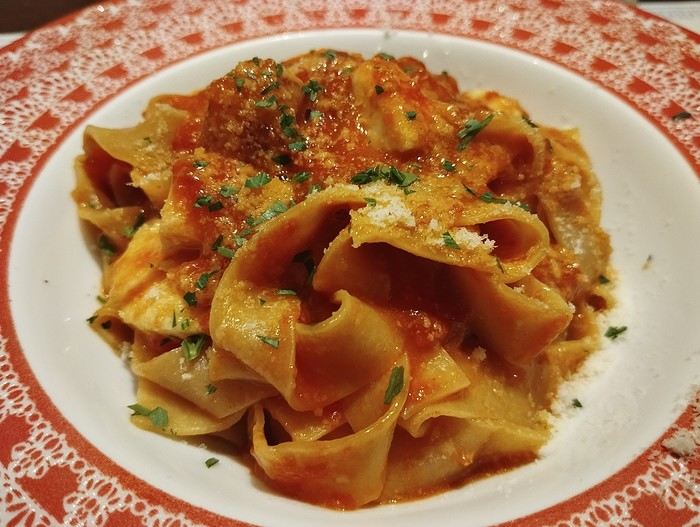
The evening goes by really simply. We find a random restaurant in the street. A desire for change leads us to an Italian restaurant with Japanese touches, like this tuna carpaccio that looks like thick sashimi served with sauce.


We ate well. We’re up and about, and while I wait for my partner who went to the restroom, I start chatting with the chef and restaurant owner. He’s displayed photos of Tuscany all over the restaurant walls, along with some of himself. We learn that he lived in Tuscany for a year, where he learned to cook Italian cuisine. The family that hosted him is in the photos with him. When we leave, the chef and the waitress walk us to the door and even outside.

We walk back to our hotel through the streets.

Nathalie971OP· 11 months ago
Day 12 - Matsuyama

Second wake-up in Matsuyama. We head to breakfast a little later, just before 9 a.m., but it's rush hour and it's crowded. The room is less pleasant than the one at the hotel in Kochi, even though the space itself is nice. It just feels like the flow of people isn’t as smooth, and the noise creates a kind of buzz.

Small disappointment—no edamame on the menu this morning. On the other hand, there’s chili con carne. Mr. tries it but doesn’t approve.

We need to stop by the station to get information from the tourist office about how to get to the airport tomorrow. Except I didn’t realize there were two stations in the city. The hotel is right near the downtown station, but of course, it’s not the right one. We have to get to the other one. After asking an elderly woman for directions—who mumbled something we didn’t understand, asked us to follow her, then left without us really getting it—we make our way to the station via the main streets, walking along part of the river surrounding the park at the foot of the castle. These streets are pretty quiet for a big city.

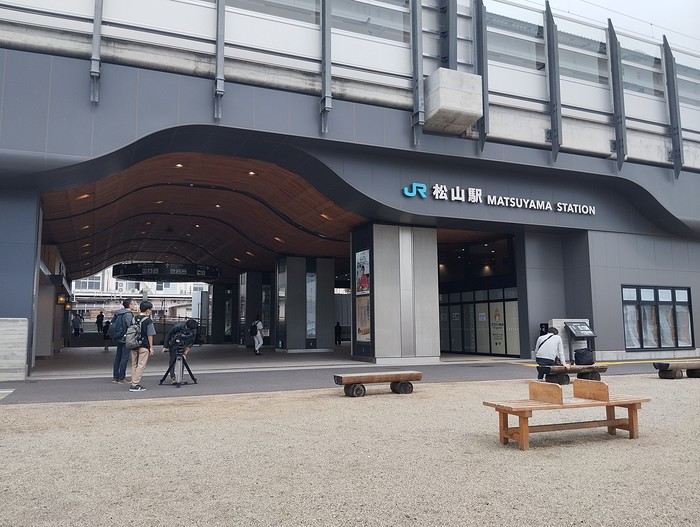
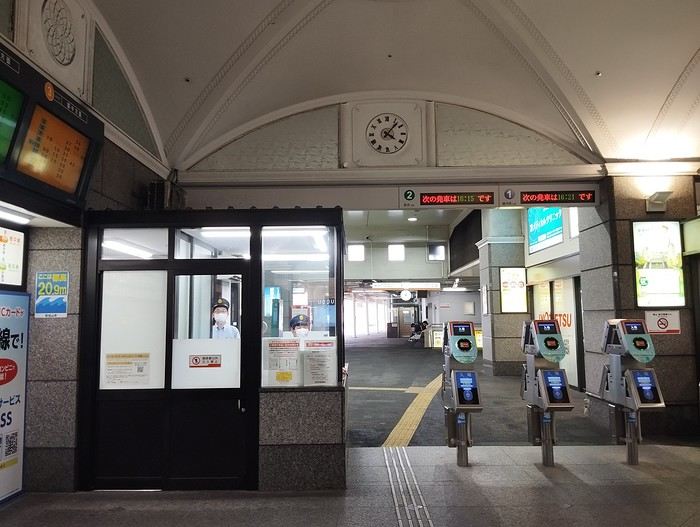
The station is still under renovation. The old station from 1927 is being modernized in a very contemporary way. You can see the old tracks. Too bad—the old-time atmosphere must have been charming. The modern look isn’t bad, but it’s more sterile. A TV crew is filming a report.


So we went to the tourist office and sorted out our travel logistics. We also bought a transit card, an ICOCA, which works in Tokyo too. Perfect since we no longer have the SUICA.

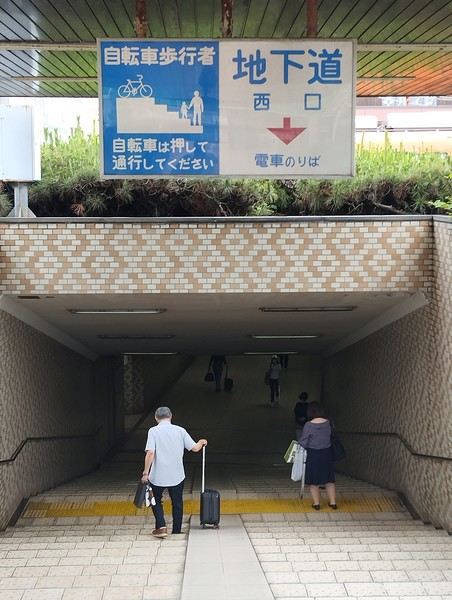
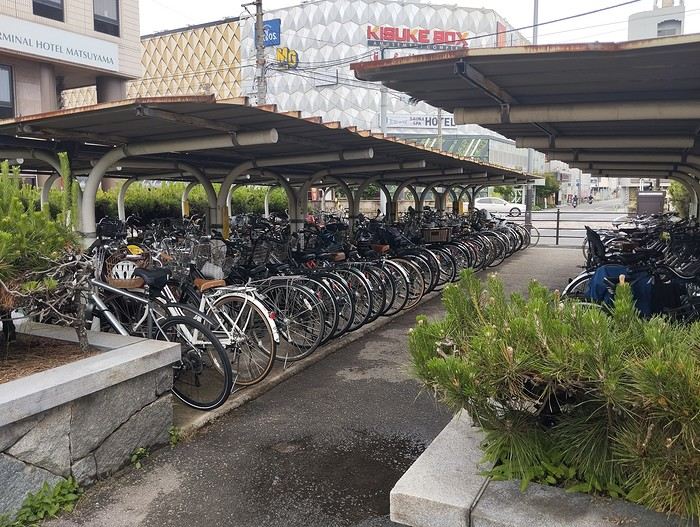
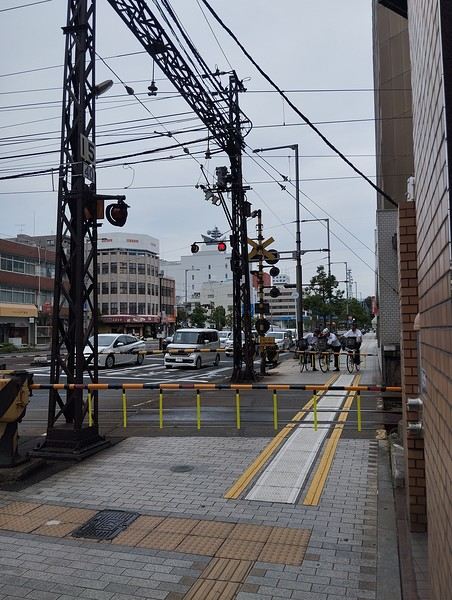
After that, we walk back to the hotel to drop off our stuff, taking time to check out the little shops, the underground passages with spaces to make it easier to move luggage, bike parking, responding to the "hello"s from teenagers who half-laugh as they say it, or waiting for trains to pass right in the heart of the city.


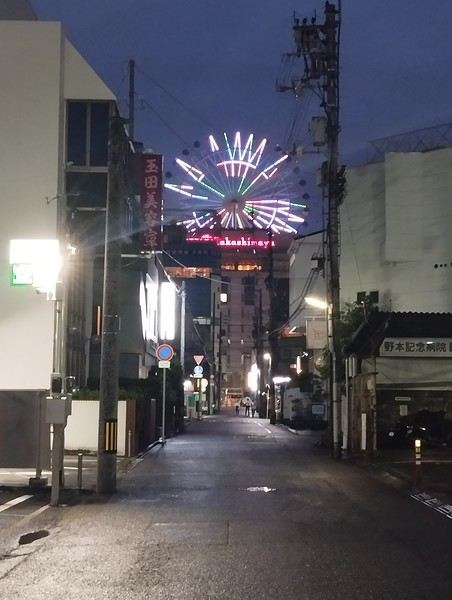
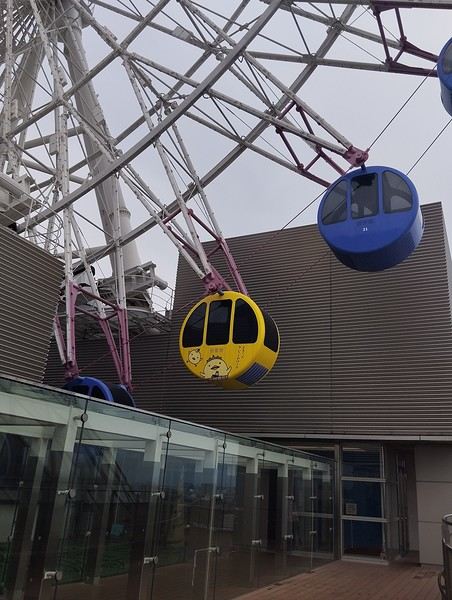
After dropping off our purchases, we head back to the downtown station because we want to visit the shopping mall and the Ferris wheel we spotted last night. The latter is on the roof of the mall.


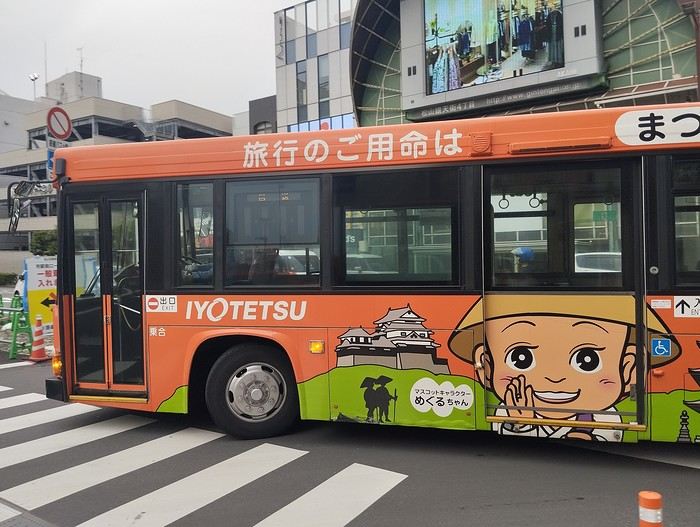
As we walk, we notice the city buses pretty easily thanks to their bright colors.

Nathalie971OP· 11 months ago
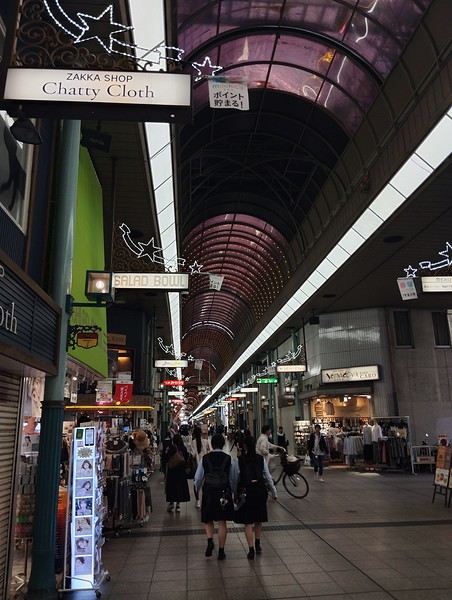
Next, we’ll continue our leisurely stroll through the city by crossing a shotengai with two very different vibes—one retro, the other a modern 90s version.


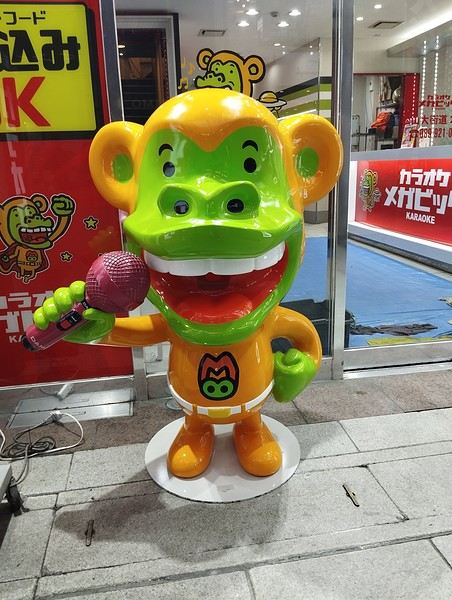
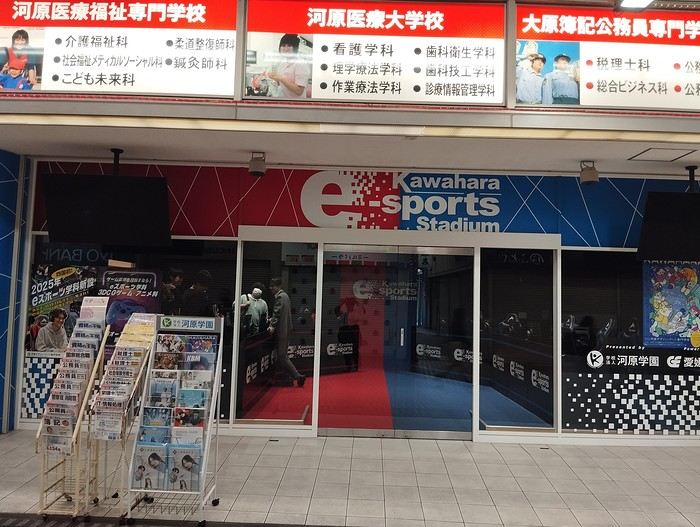
In the second one, Gintengai, there are plenty of entertainment spots: e-sports arenas, karaoke, and gaming rooms.


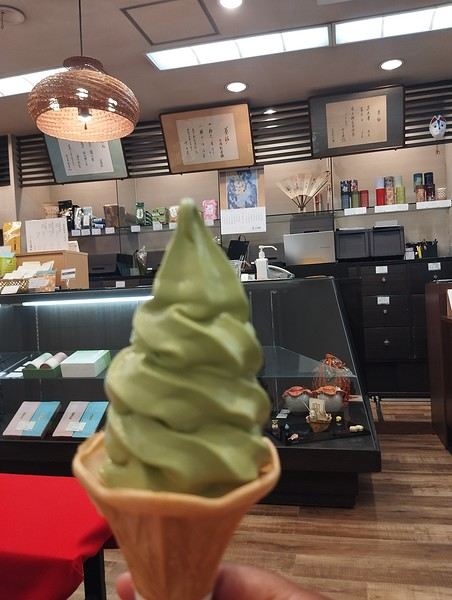
We treat ourselves to a matcha ice cream break at a small tea shop. We enjoy our ice cream inside the store, but it’s really hot in there with no air conditioning. The staff kindly offers and serves us two small cups of tea, which we appreciate.


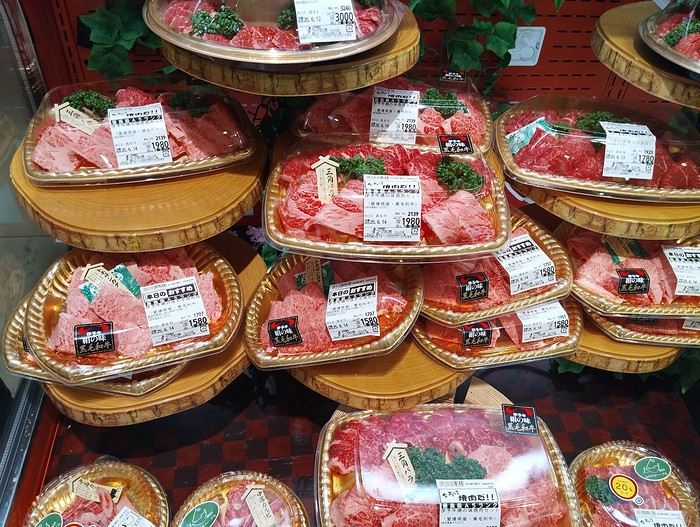
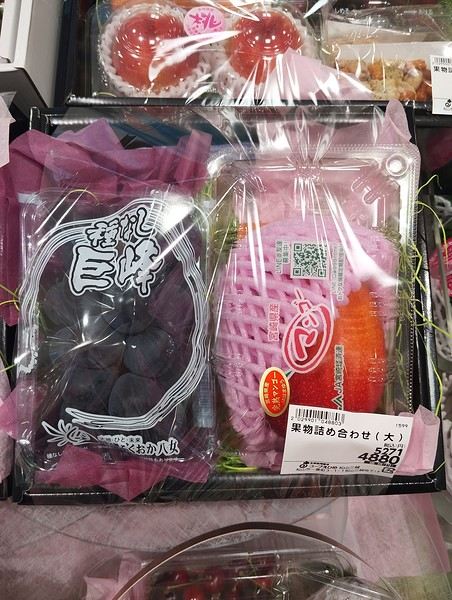
Our steps lead us to the food basement of Mitsukoshi, though it’s not the one in Tokyo. This sparkling supermarket still offers a gorgeous selection of beef that looks tempting, along with gift-wrapped fruits.


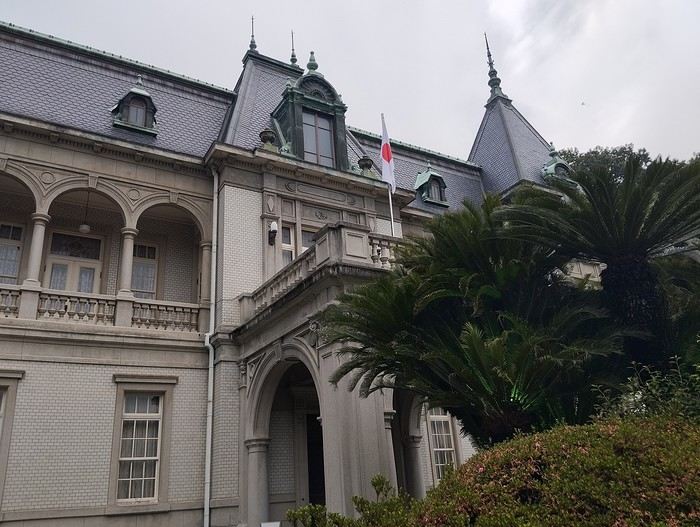
We also admire the architecture of the Bansuiso villa from the outside—a villa with French-inspired design.


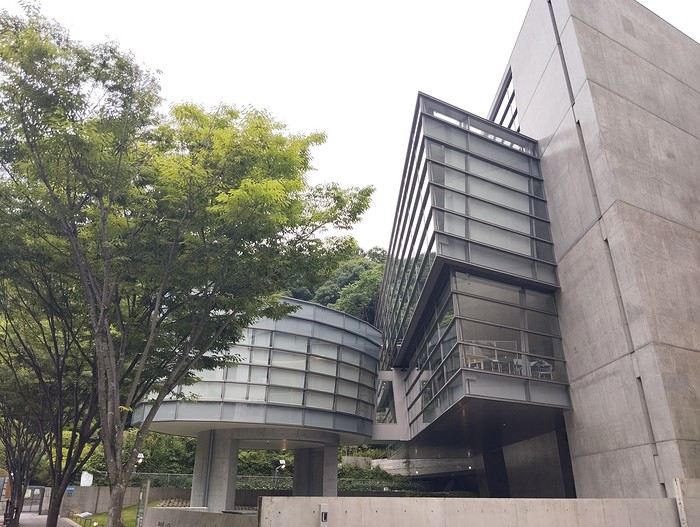
Nearby, there’s also a museum (Saka no Ue no Kumo Museum) with interesting architecture. For fans, it’s a building designed by Tadao Ando.


After that, we head toward the castle park before taking the path leading to the castle. The sun has already started to set.

Nathalie971OP· 11 months ago
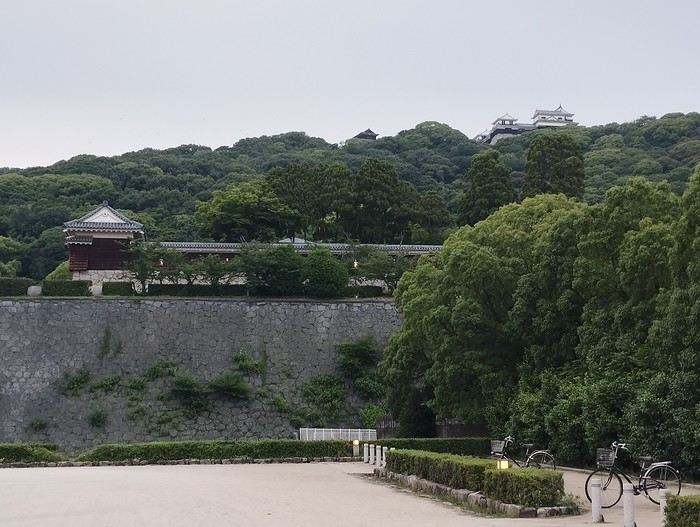
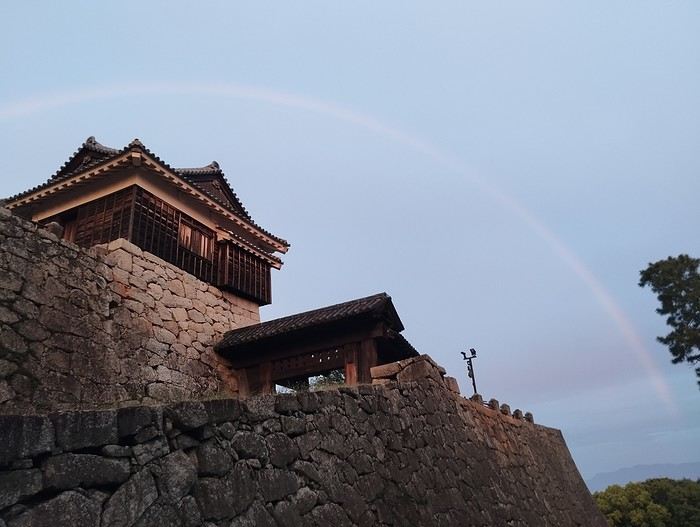
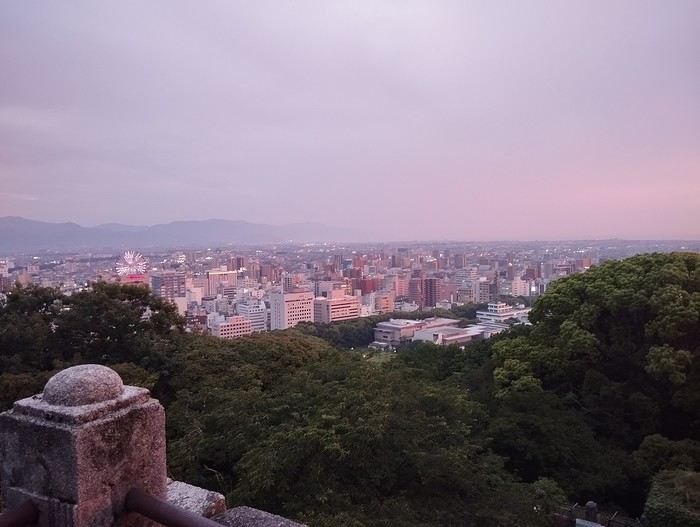
We weren’t expecting a path that climbs through a sort of forest, plunging us into semi-darkness. The stone steps are uneven. It’s an unexpected little workout, but when you emerge from the forest and finally catch sight of the castle ramparts under a magnificent rainbow, you think it’s a lovely reward. Then you get your first view of the city. The vista is clear. Only a few joggers pass by. In the distance, you can see the famous Ferris wheel on the shopping center.


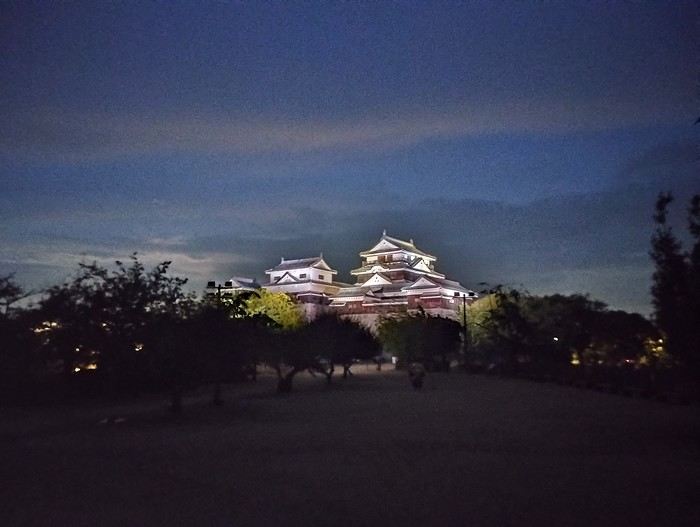
Next, we enter the castle grounds. The castle stands watch in the distance, at the end of the large esplanade. The esplanade itself is a lively spot for athletes and romantic meet-ups. The city of Matsuyama, with the sea in the distance, unfolds unfiltered before our eyes. A beautiful scene with different faces as the sun sets.

As for the castle, its lighting really highlights it. And with those birds flying in formation, it feels like we’re in the middle of a historical film.


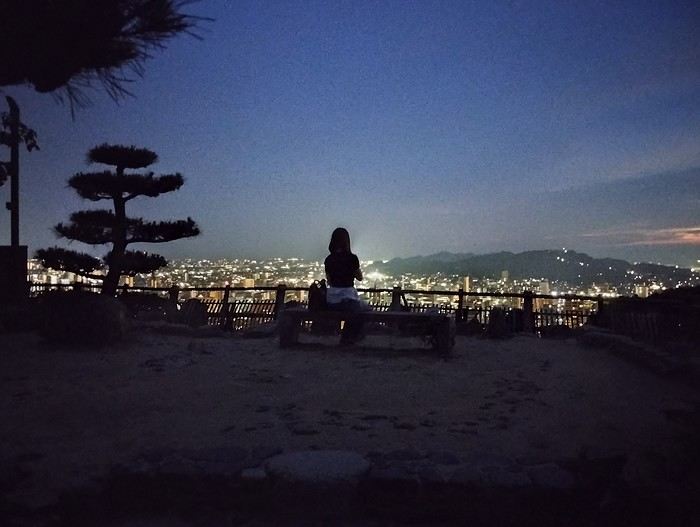
We enjoy the nighttime view of the city, with its many glowing buildings giving us a sense of its grandeur.


The place is both peaceful and alive. We stayed a while to take in this urban and historical magic. The area is lit until 9 PM. If you visit the castle during the day, I highly recommend coming back in the evening and taking the forest path.

We come across countless vending machines for a nice cold drink.

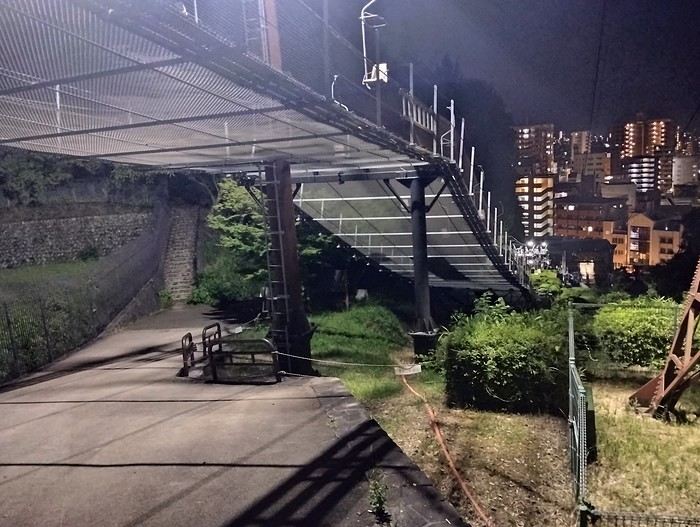
For the return trip, we walked down but took the cable car side this time.


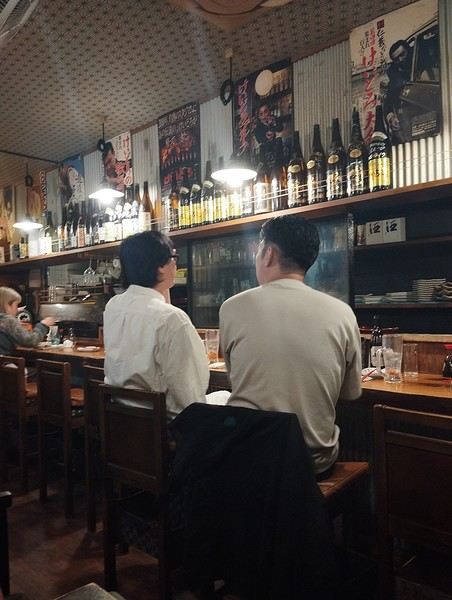
This leads to a charming street where, not long after, we find an izakaya to eat.

The atmosphere is 100% Japanese. We’re seated at a table where we can soak up the lively vibe with the various conversations of the customers.

We don’t have internet, as I mentioned, so the waitress gives us the chef’s phone so we can access the menu and order. The phone is left on our table the whole time we’re there without anyone worrying about it. I can’t imagine something like that happening in France.


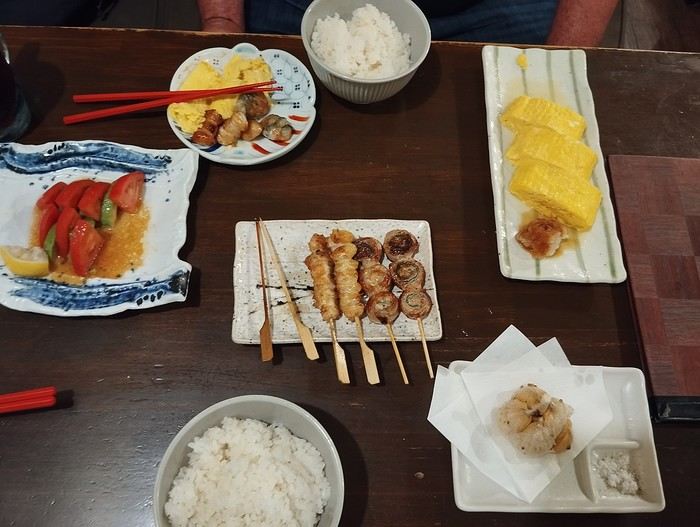
We eat some delicious meat skewers, omelet, garlic, and a small tomato-avocado salad. We paired our meal with those "sour" drinks, which are basically syrup mixed with soda—at least that’s what they taste like to me. For the more natural versions, you’ll find these drinks made with fresh fruit, and the taste is undeniably better.


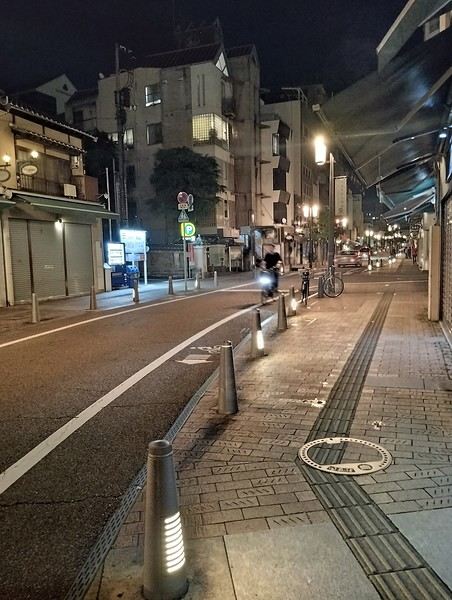
After this pleasant culinary break, we walk back to the hotel while strolling. We discover a nightlife that doesn’t shut down at 8 PM. It’s nice to get back to the hustle and bustle of city life after over 10 days in the quieter countryside.


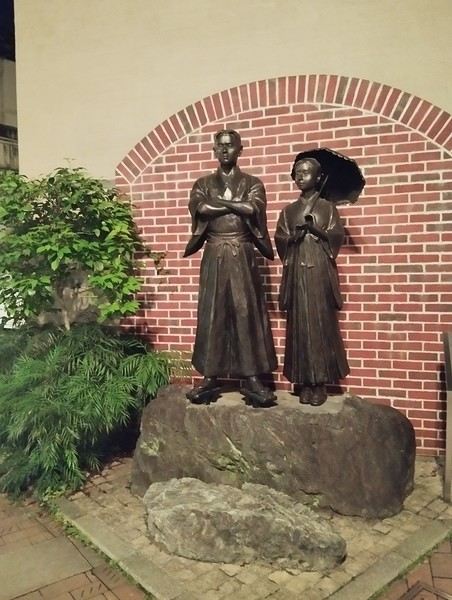
We pass by sculptures of Botchan and the Virgin, characters from Natsume Soseki’s novel *Botchan*.


We walk through a bit of the shotengai before finally heading back to the hotel.
Nathalie971OP· 11 months ago
Day 13 - Flight to Miyakojima

Today, we’re heading back to our little slice of paradise for the third time. Every trip, the same question comes up: are we going back to Okinawa Prefecture, specifically Miyakojima? And if we do, should we switch islands? Even though we’re tempted to explore another region longer (like Shikoku on this trip) and the extra cost of getting there, the pull this island has on us brings us back again. Let’s be clear—it’s not that it’s *more* "touristy" than the rest of Japan, but rather a kind of alchemy you sometimes feel in certain places. Plus, this island gives us a little break within our trip. It’s a vacation within the vacation.

We leave Matsuyama with the desire to come back and explore this city—and more broadly, the prefectures of Kochi and Ehime, which we really enjoyed—more deeply. Still, the rain of the last three days (and the forecast for more) makes us feel zero guilt about flying off to Miyakojima, while hoping the rainy season doesn’t hit too hard there.

From our hotel, which we leave early, we walk 5–10 minutes to the city-center train station to catch the bus. We pay for the ride with our prepaid Icoca card. The trip to the airport costs 800 yen and takes about 15–20 minutes, if I remember right.

There wasn’t a direct flight from Matsuyama Airport to Miyakojima, so a layover in Naha, Okinawa’s capital, was mandatory. We’re happy to fly ANA again—they’re super comfortable. The flight from Matsuyama to Naha takes 1 hour and 50 minutes, from 10:35 AM to 12:25 PM. The flight attendants greet passengers before takeoff.

The layover in Naha is only 50 minutes—just enough time to grab a quick bite. If we’d known, we would’ve packed snacks because the options in our waiting area are *very* limited. There are also several school groups in transit. The students and teachers all sit on the floor. The airport already has that Okinawan exotic vibe, with tons of hibiscus flowers everywhere. There’s even an aquarium where you pick up luggage (ours is checked straight through).

We take off again at 2:10 PM, from Naha to Miyakojima. The flight gives us a glimpse of the little islands surrounded by blue lagoons scattered across the sea. The trip only lasts 50 minutes, so it flies by. That said, even though it’s not raining, the sky over Miyakojima is packed with gray clouds. A few bumps, and we land in Miyakojima. It’s almost like arriving in Japan for the first time—you get this exaggerated feeling of coming "home," a mix of joy and serenity.


Miyakojima Airport is tiny, so it doesn’t take long to grab our bags and head out into the main hall. We reserved a car with the same Japanese rental company as last time. It’s cheap, and even cheaper this season: 24,500 yen for 7 days, about 150 €.

It’s a family-run business—dad, mom, and son. They’ve modernized a bit since our last visit in 2023. When we booked through a Japanese friend, we had to fill out an online form to confirm our reservation, on top of the phone call. We even got an email confirmation!

The son recognizes us right away at the airport before we even have time to think about it. We hop into the van, and—whoa—the dad is already inside, waiting to say hello when we arrive with our suitcases. They remember us perfectly from last time. This family radiates a quiet strength, a stress-free happiness in shorts and flip-flops, with that elegant Japanese calm. We chat casually during the 20-minute drive to their agency from the airport. Apparently, this year in Miyakojima, *tsuyu* (the rainy season) only lasted 10 days. So it’s sunny and hot.

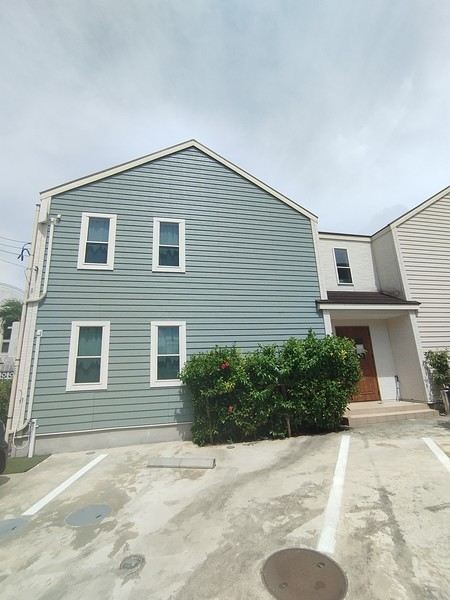
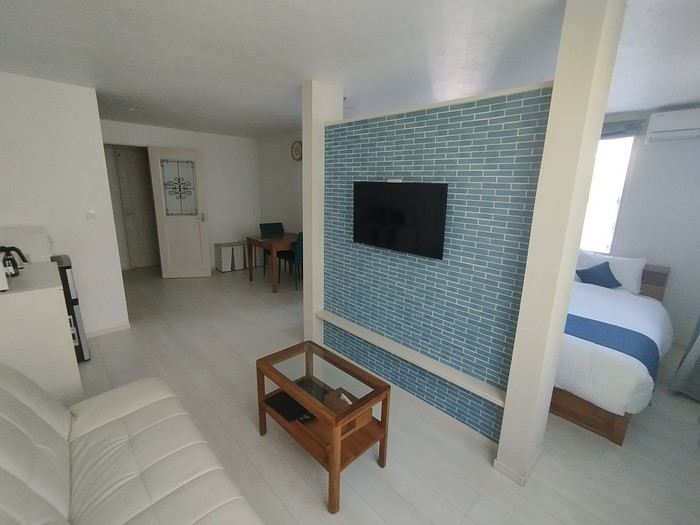
We get the same car as last time. After the quick formalities and dealing with the GPS (which only works in Japanese), we leave them and drive to our accommodation. We wanted to rebook the same place as last time, but it seems to be gone, so we rented a different one. It’s a great surprise—a nice 40 m² studio apartment in a *Desperate Housewives*-style complex. We’re even in the "Hollywood Boulevard" neighborhood. We settle in and take a little rest because the night was short and the transfer was tiring, even so.


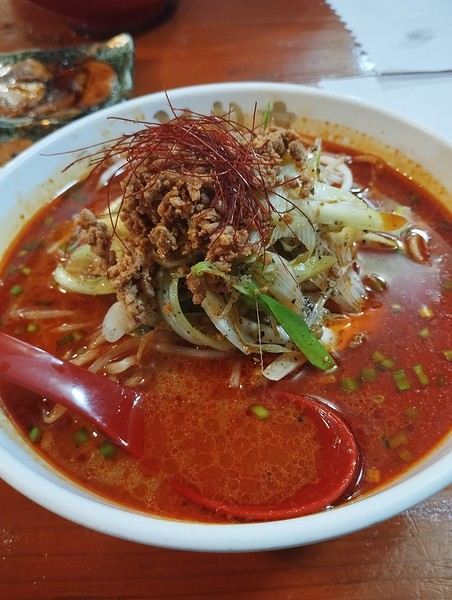
Since we didn’t get to choose our flight times, we arrived midday, and with all the formalities, it’s unfortunately too late for a swim tonight. So we just head out to eat. We want to go to Ramen Tonta, a ramen spot we visit every time we’re here. No frills—just a simple, local, rustic place, but the food’s good and cheap.

Beer, gyoza, and ramen to fill our stomachs and warm our hearts.


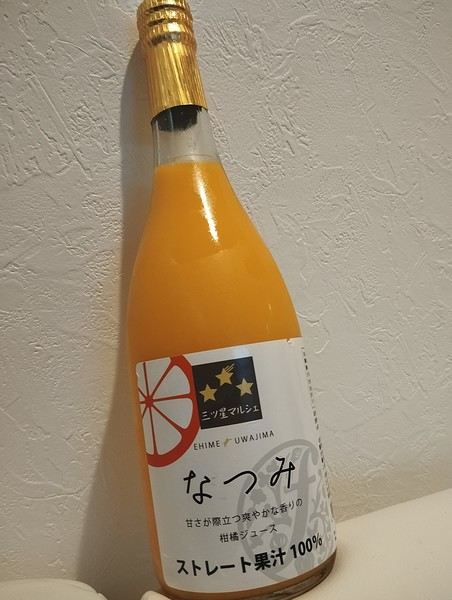
We brought a piece of Shikoku with us—this bottle of mikan juice, sweet and fragrant.


Good night!
Nathalie971OP· 11 months ago
Day 14 - Bocca and Tsuyu

A vacation within a vacation calls for a wardrobe change—exotic vibes mean flip-flops, shorts, dresses, and caps! So long, sneakers, and hello to feet feeling the breeze!

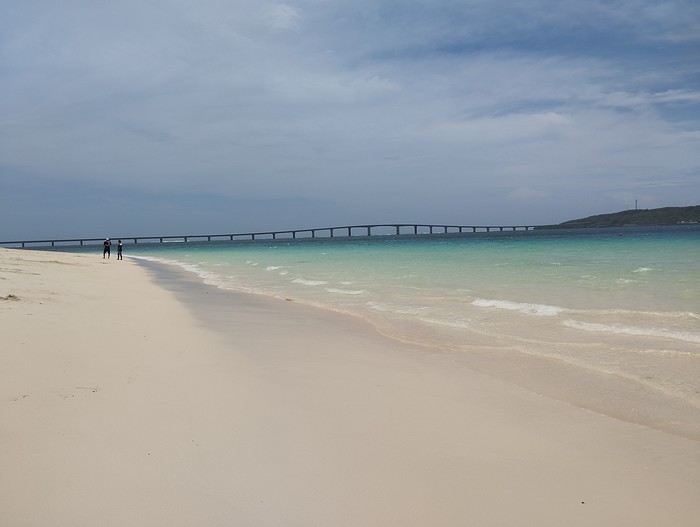
Stepping out of our place, the sun dazzles us and warms our skin. What a pleasant feeling—at least for now... The plan’s simple: one of the joys of revisiting a spot is returning to places you loved and saving time on daily logistics. So this morning, we’re heading to Miyakojima’s most famous beach, Yonaha Maehama.

On the way, we stop by Yoanaha Bay. It’s low tide—nothing extraordinary, but you can walk along the shore.

We park at one of the free lots, which isn’t full but has a few cars. The wind’s blowing, and sand’s taken over part of the parking area. Clearly more people here than on our last trips. Our previous visits were in early October and mid-September, but this time, it’s mid-June. We’ll get to compare the seasons—June marks the start of summer.

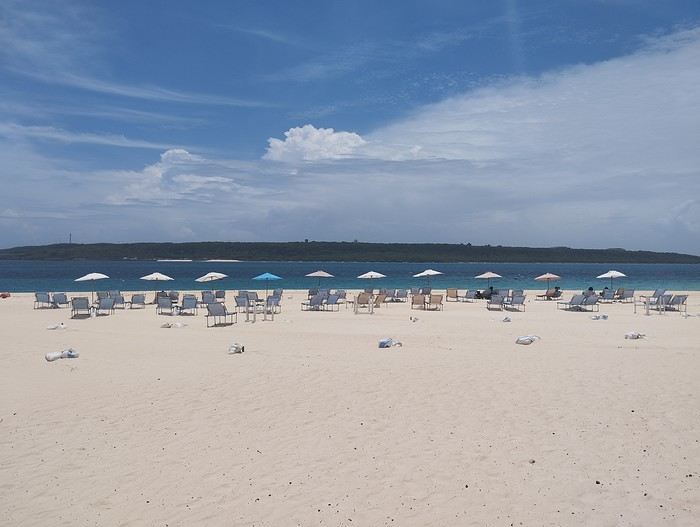
Something new here: lounge chairs and umbrellas set up on a tiny section of the beach, though few are occupied. The beach stretches 7 kilometers, so finding a spot’s no problem.


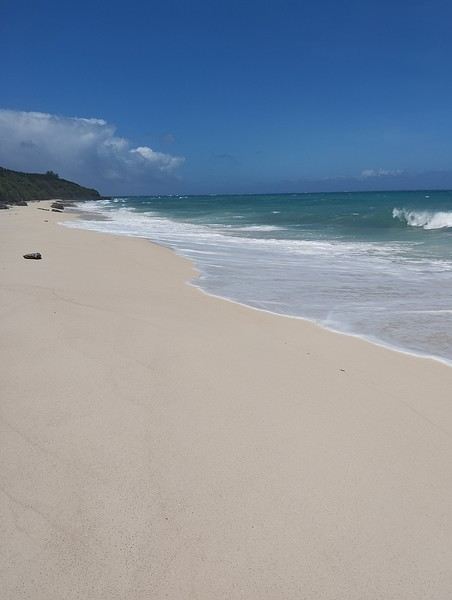
We settle a bit farther down. The beach is just as stunning—the milky blue water stretches out before us. There’s a little more movement in the waves, with small ripples rolling in. The sand remains as white, fine, and sparkling as ever.

We don’t hesitate to leave our towels, bags, phones, passports, and other stuff on the beach while we dive in, unconcerned about theft despite the slightly larger crowd than usual. The water’s warm. We wade in with delight, splashing around and people-watching.


The beach is lively—more activity with a few more folks around. We even spot two other Western families, a first for us.

After a refreshing swim, we notice the wind’s blown quite a bit of sand onto our things.

At the parking lot, there are restrooms and a water station to rinse off your feet. We realize my partner’s gotten a little sunburned in a short time, even with the overcast sky. He thought he could get away with swimming without a long-sleeved rash guard, but the next few days will make him regret that mistake.

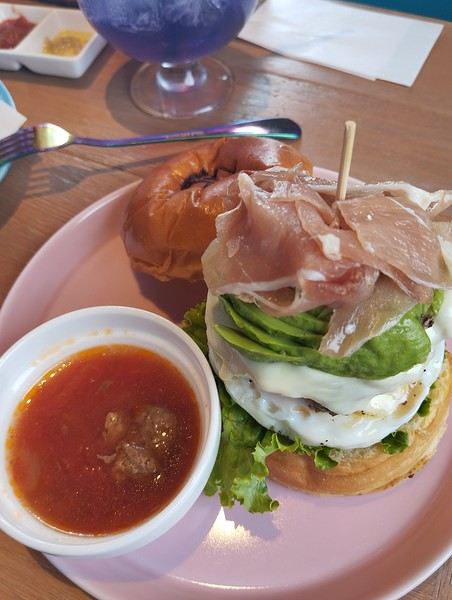
Back in the car, we head to Bocca Burger. We’ve been looking forward to eating here again—it’s hands-down the best burger I’ve ever had. Here too, more people—mostly Korean tourists. The place seems to have become a hotspot, especially since it’s walkable from the downtown beach. The menu’s had a few updates: new burgers, the option to add ingredients, and new drinks. I order a kind of herbal infusion. The color changes when you squeeze lemon into it. It’s unsweetened and super refreshing.

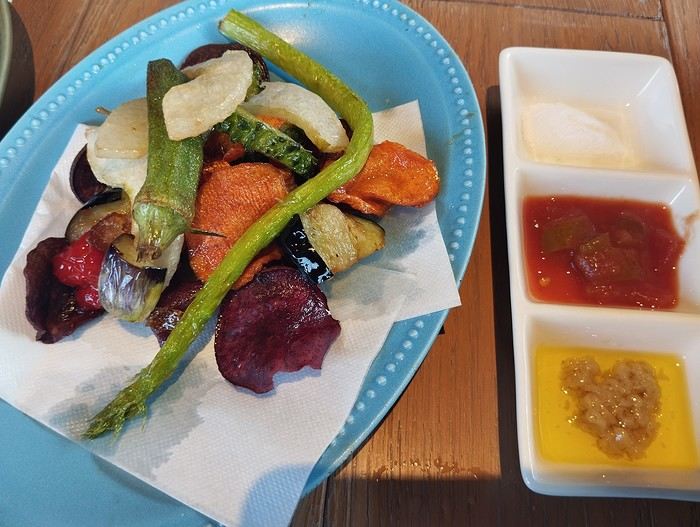
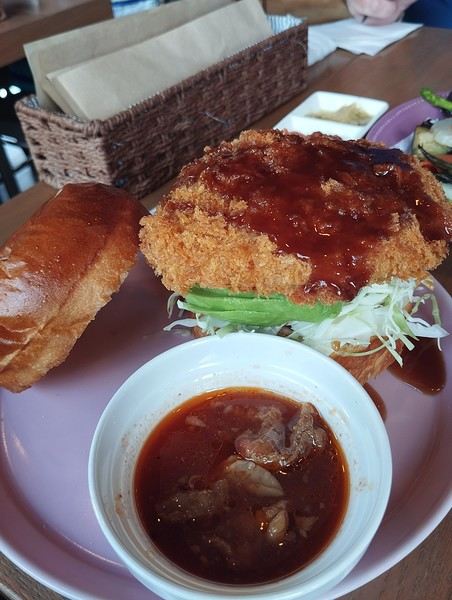
The burgers arrive, still as mouthwatering as ever—big, hearty, and packed with goodness. The veggie sides are just like we remember, served with three condiments (Miyakojima salt, ginger sauce, and tomato/veggie juice). The bread’s sliced and meant to be eaten with a small meaty stew-like sauce. We wrap our burgers in the paper to keep them steady and avoid messy hands. Pure bliss.


While we’re eating, the sky darkens and turns black. It starts pouring—nonstop for the rest of the day. We take the opportunity to grab some groceries at the supermarket. Since the rain’s still coming down, we decide to check out Mango Café, which we spotted yesterday on the way from the airport to our place.

To get to the café entrance, you walk through a tropical jungle-like path. The rain makes the leaves glisten, pulling off that tropical vibe. The café itself is modern and minimalist, but the real charm is outside. The rooftop terrace has sofas, swings, and a tropical area you reach by crossing a little bridge. We don’t get to enjoy it much—it’s wet from the rain. We sit on the slightly damp sofas just long enough to eat our ice cream, one mango and one melon. Unfortunately, we’re disappointed—the fruit’s frozen and flavorless. Still, the place has great reviews online.

The rain keeps coming, so we stick to Plan B for the beach. Next up: a "stroll" at Don Quijote. It’s a chain store you’ll find in many cities—kind of like Babou, Foire Fouille, or Action, but with a wider variety of products. Of course, with this weather, we’re not the only ones with this idea. The rain’s created some big puddles, making the drive to the store a bit risky. We find plenty of non-food items, plus some food products.

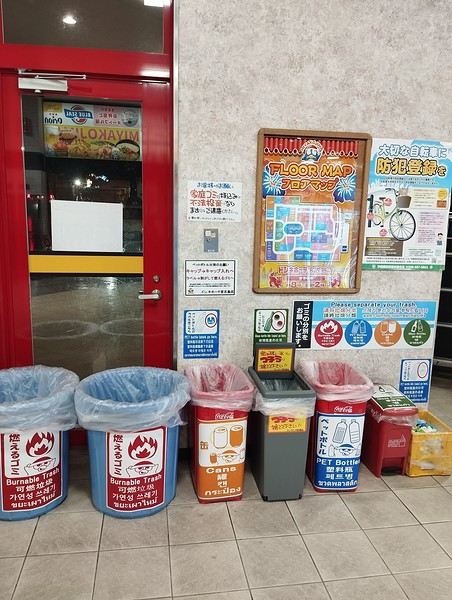
A glimpse of Japan’s sorting obsession: 7 trash bins.


Finally, we stop by Max Value supermarket to grab some snacks for dinner.

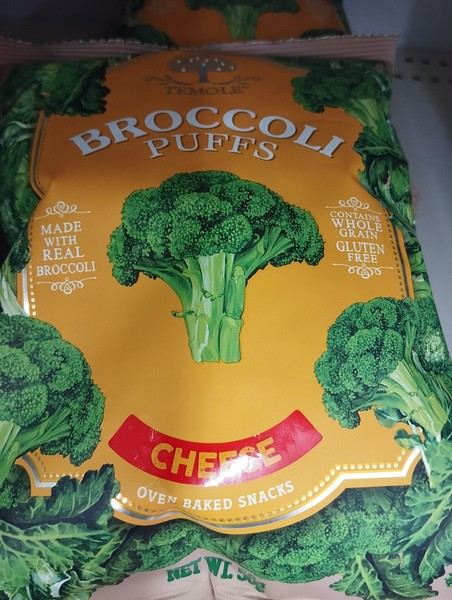
We also spot some unusual apéritifs for a French person.


Broccoli’s the favorite green veggie in Japan—even among kids. Rumor has it that if broccoli gets "criticized" in a movie, anime, or ad, it’s swapped out for another veggie to suit the Japanese audience.

But we also find some French references... like madeleines.

Or even seawater from another Okinawa island (Kumejima).
Show 10 more replies
Nathalie971OP· 10 months ago
It’s considered one of Japan’s most beautiful beaches. Swimming there is really pleasant. That said, it’s not great for snorkeling.
Nathalie971OP· 9 months ago
Day 15 - Miyako Blue and Culinary Delights

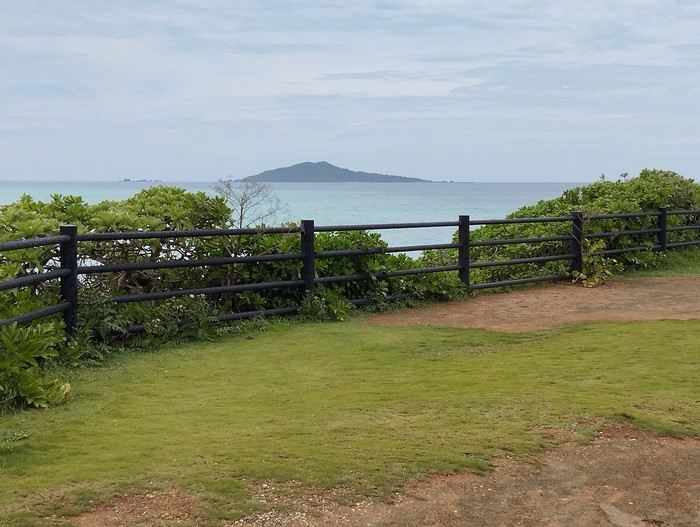
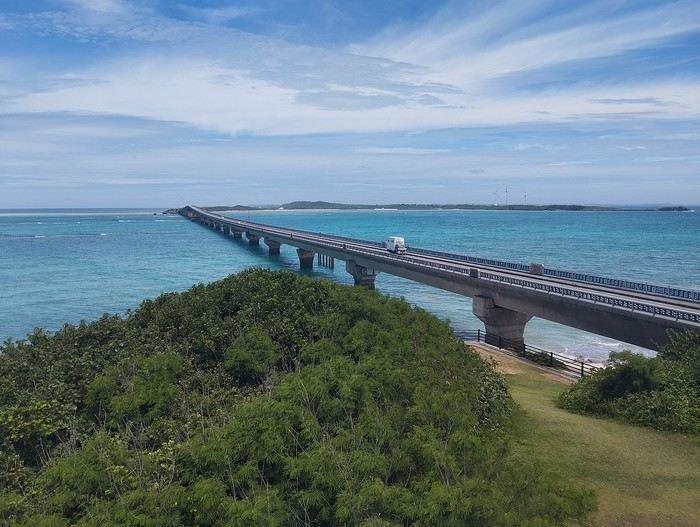
Heading to Ikema Island. We take roads completely unknown to us but that allow us to see the island's rural side. Crossing one of the three bridges connecting Miyako's main island to three smaller islands is always an incredible experience, especially with the mesmerizing blue of the sea. The best part of the bridge linking Miyako to Ikema Island is the small parking lot where you can stop to get a closer look at the sea. From there, there’s a great view of the bridge and, most of all, Ogami Island.


The sky is a bit overcast, so the scenery isn’t at its best this morning, but it’s still nice. Plus, there’s only one Japanese family around for now. The father is fishing near the bridge. A shy conversation starts up. He’s trying to catch octopus. The family (a couple with three kids, including a baby) is from Osaka. They’re traveling in a camper van. In the end, they leave without having caught anything.

We get back in the car and finish crossing the bridge to reach Ikema Island. We drive slowly to a café we’d spotted online during our last trip here (2023) but didn’t have time to try. Once parked in the large lot with no view of the place, we just follow the path marked by a wooden sign. From that point on, a tropical atmosphere takes over with exotic leaves, flowers, and flying insects.

A few steps later, we reach the café entrance. You have to order right away at the counter. Since it’s a café, there are daily specials available. The choices are limited. We place our order and then explore the place. What can I say? A café in a stunning natural setting with different cozy spaces. In short, a place where you just want to settle in.

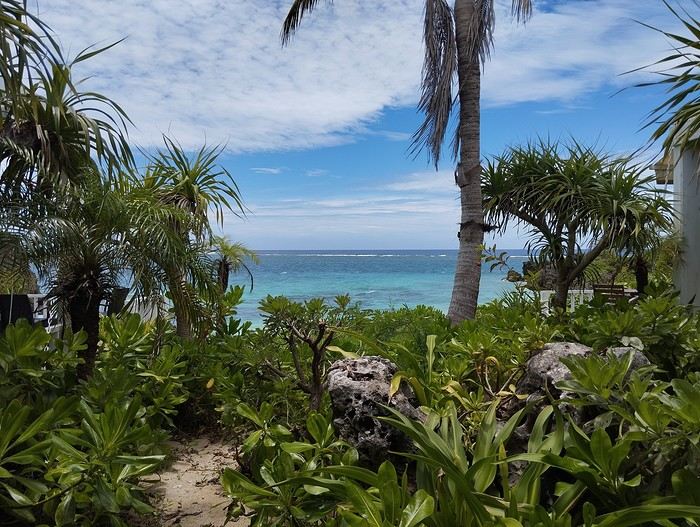
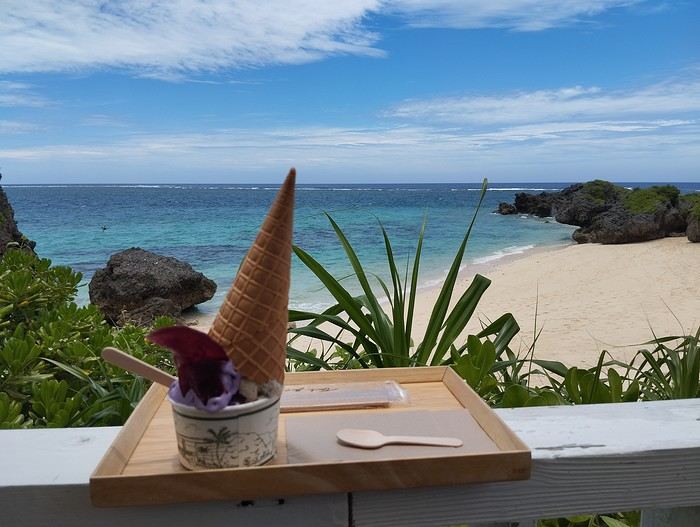
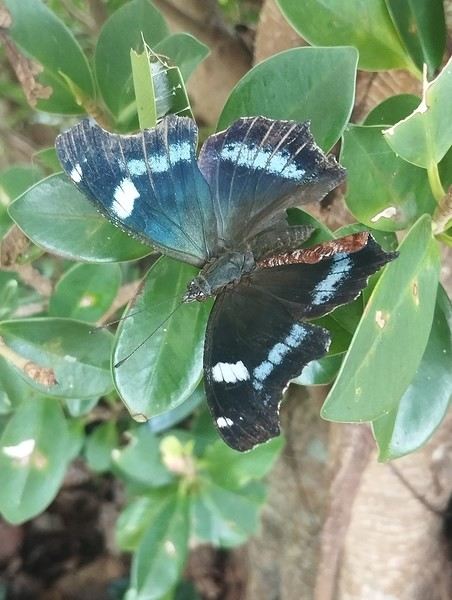
The natural setting is a view of a beautiful beach with gradient blue waters, surrounded by rocks and tropical vegetation, where butterflies and other flying insects flutter about. The beach is accessible via a "wild" path on the side. It’s private to the restaurant, and swimming isn’t allowed, but you can take a stroll. The restrooms are at the back of a tropical area, outdoors but modern and clean.


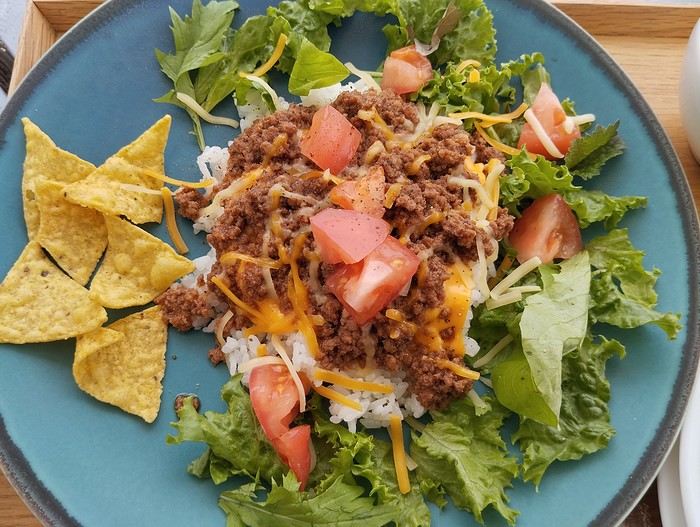
The sun has come out, and we can now enjoy both the beach view and the sound of the waves under a beautiful blue sky. We settle into a lounge corner right by the sea. We dig into our dishes when they’re brought to us. I try an Okinawan dish, Taco Rice. It’s a very simple dish originally created for American military personnel but loved by both Americans and Okinawans. It consists of rice, tomatoes, lettuce, ground meat, and cheddar. My partner ordered a pizza. While pizzas are often good here, they’re usually small. The Taco Rice is delicious. We pair our dishes with a fizzy drink made from Shikwasa, an Okinawan citrus fruit similar to mandarins.


To finish, we end the meal with homemade ice cream, which is incredibly delicious. We tried sweet potato and black tea with figs, along with a sweet potato chip. We forgot the flavor of the last one because it wasn’t as tasty as the others. There were other tempting flavors like brown sugar and kiwi-banana.


All with extremely gentle and attentive service. In short, a place that could become a regular spot. Everything is great: the welcome, the setting, the food.

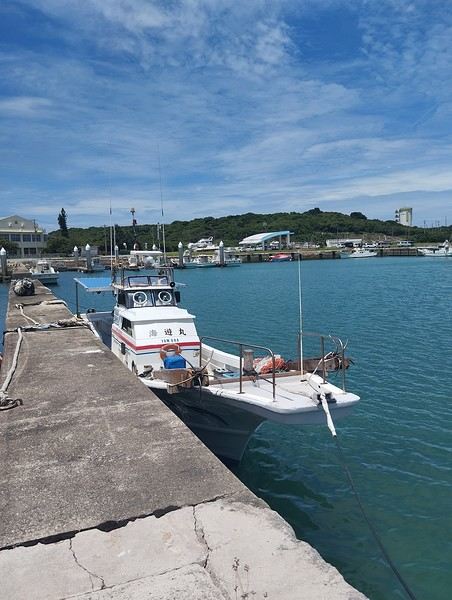
We get back in the car and head to Ikema Port. There’s absolutely no one around except the Japanese police officer I already mentioned in a previous post about Shikoku.

Under the scorching sun, we take a walk on a tiny green path, trying to find some shade.


Then we cross the road to reach the port and observe the beached or moored boats. A car passes by. The driver smiles at us and waves energetically with one hand.


Next, we head to the entrance of Ikema Island to go up to the roof of a restaurant/grocery store, where you can see the sea, Ikema Bridge, and Ogami Island. We’ve been there before, but it’s still nice. However, it’s crowded, and we have to wait to park.

From the observation deck, I notice there are quite a few algae on the beach. There weren’t any during our previous visits.

The view of the bridge overlooking this Miyako-blue sea is a simple but captivating sight—one you never get tired of.

Nathalie971OP· 9 months ago
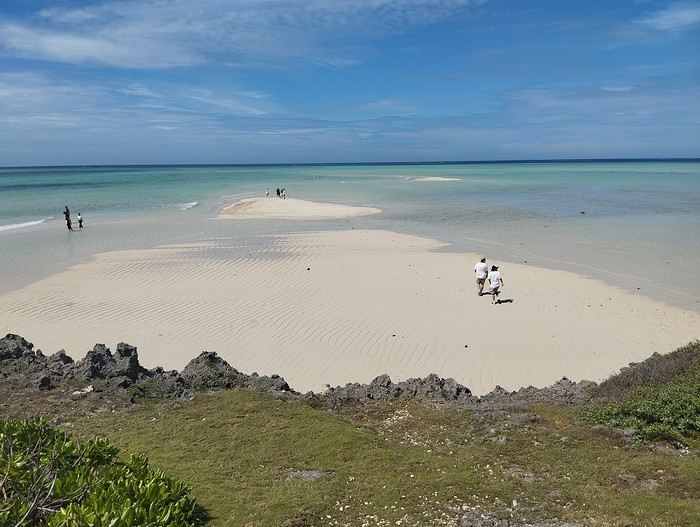
Day 15 continued Crossing the Ikema Bridge again, we spot people in the middle of the sea. It takes us a few seconds to realize that with the low tide, it’s possible to be right in the ocean. You can easily guess we want to see this up close. Unlike this morning, the small parking lot on the bridge is "full," and we have to wait for a spot to open up. It won’t be too long. Not only is the sky clear, but the sun also highlights the blue of the water and the visible sandbanks.


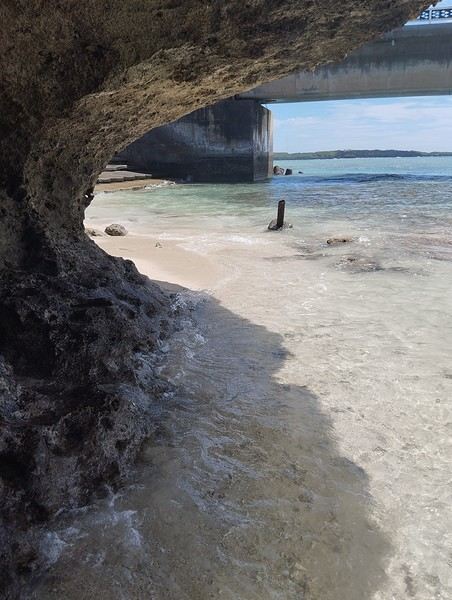
Remember where the Japanese man was fishing this morning? Well, you just have to step over a barrier to go down the "steps" and walk around the rock. Be careful, though—there’s still a current and broken coral, so watch out for bare feet.

The water is crystal clear. It’s pretty wild to walk like this in the middle of the sea. While it’s not as crowded as Kyoto, there are obviously a few people around, but it’s totally manageable. Maybe 15-30 people—we can count them. Even if we’d love to be alone to enjoy the view, it’s also nice to exchange smiles with other travelers.

The farther we walk toward the two sandbanks, the more we can see Ogami Island. We also discover small coves at low tide on the Miyakojima side.

Walking in the sand isn’t that easy because our feet sink in. We’d love to lie down in the water and just float, but the tide is slowly coming back in... After enjoying this moment, which made us feel like we were in French Polynesia on an atoll, we slowly head back to solid ground, walking along the rock again.


From the platform, we look out at the sea and its sandbanks, one of which is heart-shaped. A stunning marine spectacle.

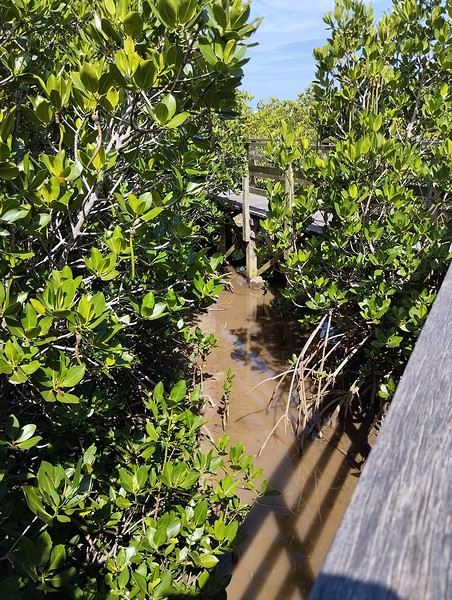
We then head toward the Shimajiri mangrove. It’s a short walk on an elevated bridge, round-trip. The sea water mixes with underground spring water here—there are no rivers on Miyakojima. We didn’t think too much about it, but with the low tide, the mangrove is dry during our visit. There’s absolutely no one around. That said, the blazing sun beating down on us might make an air-conditioned coffee sound better.


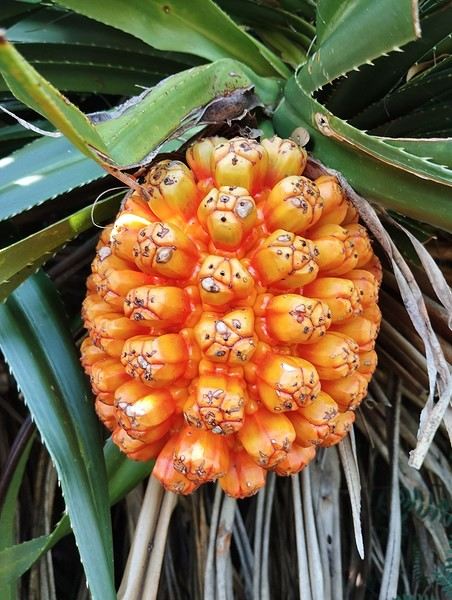
We spot lots of little red crabs, but I can’t photograph them with my phone (useless). We hear lots of birds and a bit of wind rustling the leaves. We also see a colorful fruit that reminds us of a pineapple. After looking it up online, I think it was indeed one. If you’re interested, check out this article on pineapple farming in Japan: https://www.lemanger.fr/index.php/snack-pine-lananas-pour-les-nuls/.

The walk is short—only about a kilometer—but it’s still nice.


Next, we head to Shimajiri Port nearby. I want to check the boat schedule for Ogami Island. Well, spoiler alert—we won’t go. We drive through small streets that give us a peek into local homes. The port is small but charming. You can see Ogami Island clearly from here. Our arrival gets noticed. The person at the ticket booth is in the middle of a conversation with two others. The welcome is very local—first a bit of island nonchalance, then big smiles and a brochure. No need to book tickets in advance—everything’s done the same day.

We continue our day by heading to a beach we really like on Irabu Island to swim. The beach is large, the sand is fine, and there are even some waves today—just enough for a little thrill. We spot transparent crabs in the sand. The late-afternoon vibe is super peaceful. Just a few surfers left and the sound of the waves. A perfect moment to recharge.

After this relaxing break, we want to quickly check out a beach on Shimojima, not far from there by car, where we’d met some Japanese women during our first stay. Just after sunset, the sky turns purple. The scenery is beautiful.


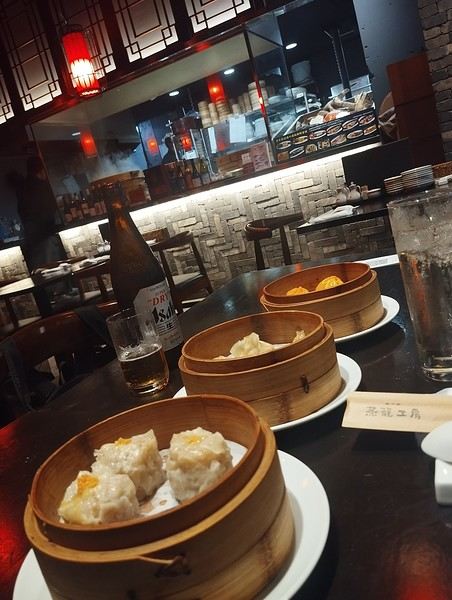
For dinner, we go to the Chinese restaurant we discovered on our last visit. The waitress and the head chef don’t seem to be there anymore. We’re a little disappointed not to see them again—the interaction was really nice. Still, the food quality remains good. And tonight, it’s a feast! We ordered steamed fish with soy sauce and ginger after picking our fish fresh, like at a fishmonger’s. You can also choose between two sauces. The fish is served whole but already pre-cut, so no need to worry about bones. We loved it.

Nathalie971OP· 4 months ago
Day 16 - Under the blue sky, the birth of a meeting

On this particularly sunny morning, we head toward the eastern cape, one of the island’s remote points. There isn’t much infrastructure in this part of Miyakojima, so we decide to eat early to have a relaxed rest of our day. I’d spotted a restaurant online that was on the way to our destination. We head there and discover a place that looks very new—it wasn’t here during our previous visits.

Inside, it’s a small but charming and very clean space. A bar with four stools and two tables seating four each. A Japanese woman welcomes us with a smile and invites us to sit down. While we look at the menu, we take in the room’s decor, which is filled with little objects scattered everywhere.
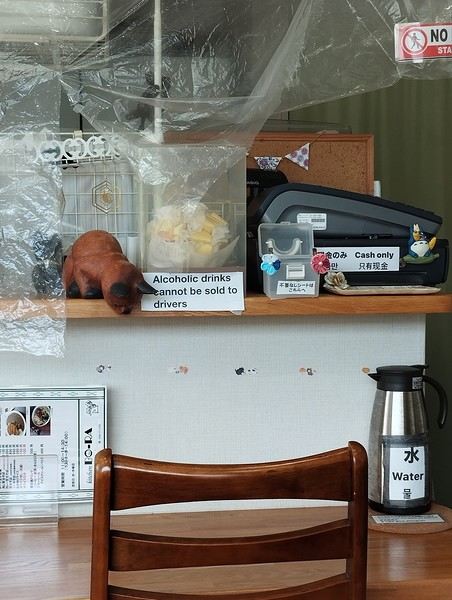


When the woman comes to take our order, we strike up a conversation by mentioning how much she loves cats. Indeed, cats are everywhere—in glasses, figurines, placemats, even in the restrooms. Just mentioning them brings a bright smile to her face and a happy look in her eyes.

Looking through the glass door, I spot a Japanese cyclist parking his bike. Our eyes meet. A few minutes later, he comes into the restaurant and sits at the bar in the middle. We smile and say hello. Our food arrives. My hungry companion ordered two dishes, and the full table catches the cyclist’s attention—he can’t help teasing us with a laugh. This starts a little conversation, and he moves closer, switching seats to sit nearer our table. He speaks English, but we don’t speak it well, so we mix Japanese and English. We learn he’s traveling around the island for two weeks by bike. He once took a year-long trip around the world with his mother before starting his professional life, spending six months of that journey in Europe. He even cycled through France. A cycling enthusiast, he’s ridden in the Alps. The Tour de France is his favorite race. He also visited Russia during his big trip and knows how to say *Je t’aime* in French. He thinks life is more pleasant in Japan, and his favorite spots are Miyakojima in summer and Hokkaido in winter.

Our dishes today are pork curry and fried chicken. We also try Orion, Okinawa’s local beer, but honestly, we didn’t like it—it was too light, almost bland.
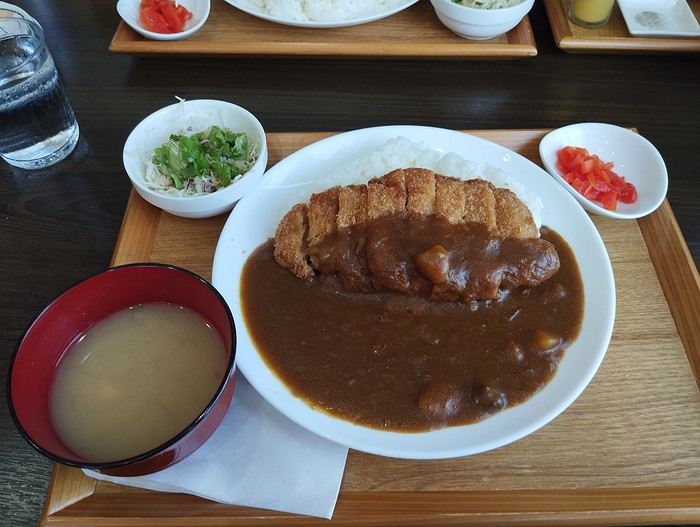


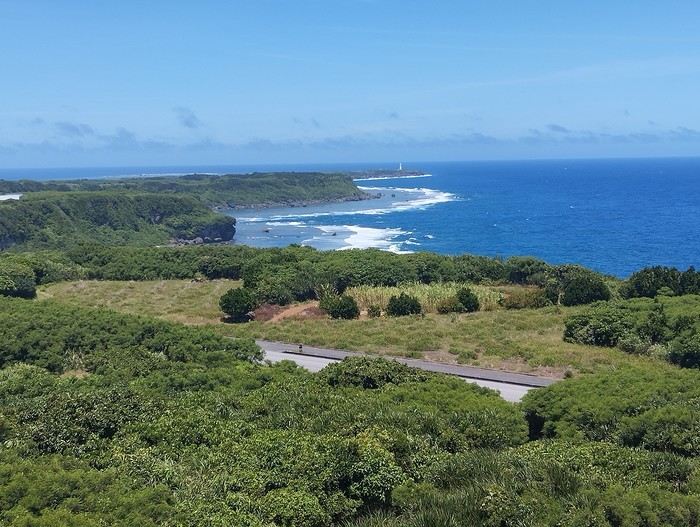
The cyclist leaves before us. We say goodbye, and we finish our meal. We get back in the car, heading toward the eastern cape, but a sea viewpoint makes us stop. There’s also a shell museum nearby, but we skip it. Instead, we spot a tower in the distance and decide to find it by car. We navigate by sight—it’s not far. The area is very natural, with no real development. We drive through sugarcane fields, and suddenly, the hidden tower appears before us.

We climb it and enjoy the 360-degree view of the sea, the distant cape, and the sugarcane fields. A controlled burn is happening nearby. There’s a table at the top, so you could eat there if you wanted. We have the place to ourselves for a while until a taxi arrives with a woman who stays just long enough to take a few photos. Meanwhile, we soak in the rural view, appreciating the calm and the shade from the sun.


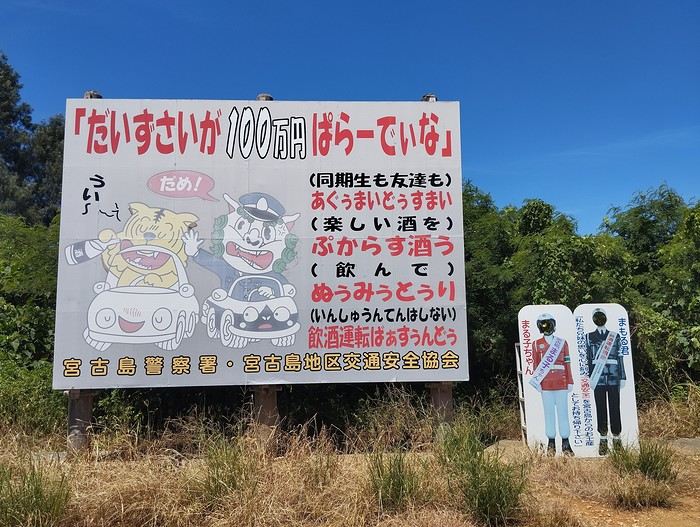
Back in the car, still heading toward the eastern cape, we make another stop for the funny "photo" sign set up by the police, as well as another sea viewpoint.


The sun is blazing down on us. Just as we’re about to leave, the cyclist from the restaurant arrives. He stops to chat again—he’s coming back from the cape we’re about to visit. One of his friends runs one of the food trucks selling ice cream. For a keepsake, we take a few photos together. Since I don’t have internet, I tell him I’ll send them later when I’m connected. One thing leads to another, and we suggest meeting up for a drink before we leave the island. With that plan in mind, we each go our separate ways.

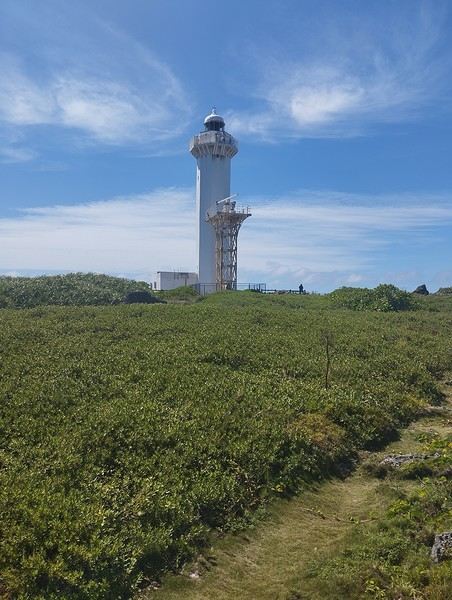
Two minutes later, we finally park at the cape. There are a few food trucks selling snacks and drinks, and a few cars, but the parking lot isn’t full at all. That said, at this early afternoon hour, we’re melting in the heat—our sweaty bodies only find relief with the air conditioning. The cape is called Higashi-Hennazaki. It’s located at the very eastern tip of Miyakojima, a 2-kilometer promontory jutting into the sea. You can take a walk with stunning panoramic views of the ocean. You can see the waves from the East China Sea and the Pacific Ocean crashing together. There’s a lighthouse you can visit, and depending on the season, the walk can be quite floral. The wind is strong in some spots.
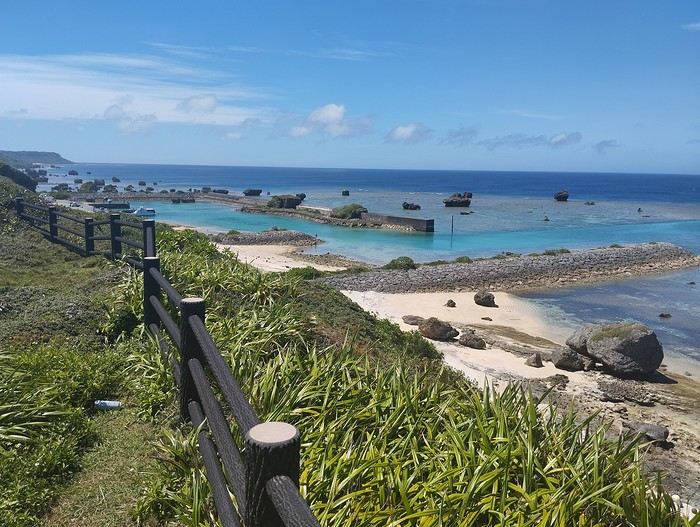


The place is lovely, but this time, we wanted to take a long walk—except the sun is too intense. We’re burning up despite wearing our loose, flowing outfits with headscarves and sarongs to cover our legs. A pretty silver beetle lands on my companion and stays with him during the visit.


Our main goal for the day is snorkeling, so we get back in the car and head to Aragusu Beach, which is particularly famous for this activity. The approach to the beach is always stunning—the beach sits below a steep road, offering a breathtaking panoramic view of the ocean’s gradient blues. The "wow" effect is guaranteed every time. At the bottom, we notice the parking lots are fuller than usual compared to our previous visits. But luck is on our side—the small free parking lot, which only has a few spaces, still has one for us. Otherwise, the larger lot next to it is paid. While the beach itself hasn’t changed, the setup has. Remnants of pink and blue tables are surrounded by vegetation. There’s a small wooden snack bar selling alcoholic drinks, and you can also rent tents for shade.

It’s low tide, so the water is shallow for a long way, making it trickier to move around the coral. The water is still crystal clear. With the naked eye, you can spot tiny electric-blue fish. There are plenty of fish, but no Nemo for us today. We really enjoy observing the underwater life. My companion always stays in the water longer than I do, while I prefer lying on the sand, lulled by the wind, the sounds of swimmers and playing kids, watching the vegetation, and taking a little nap under the now more bearable sun.
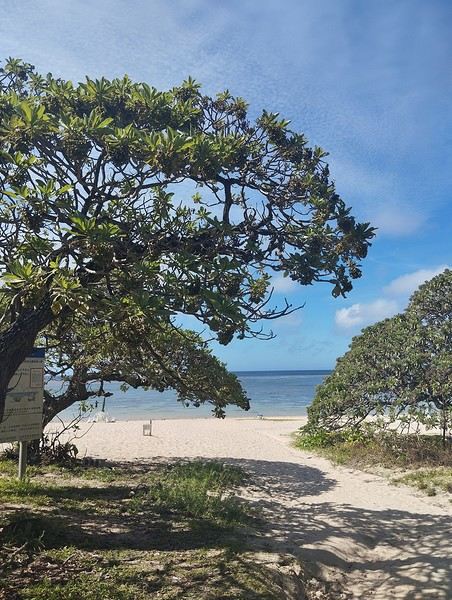
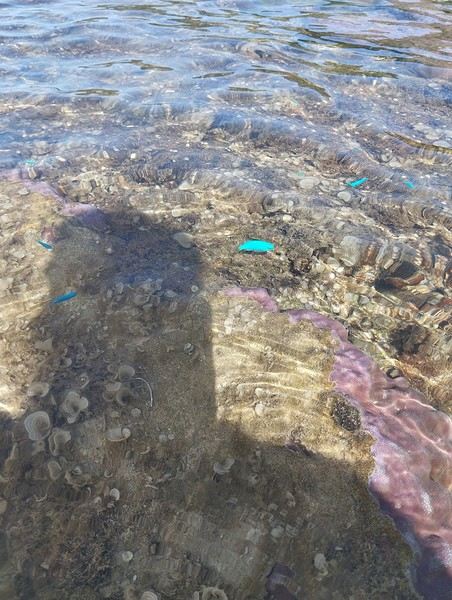

As always, by mid-afternoon (around 4:30 PM), the beach has already emptied out—especially since this one doesn’t offer a sunset view, being on the east side. In fact, it even feels slightly cool when the sun is no longer shining on this side.

Today, we decided to visit just one beach but stay longer. That’s why the sunset accompanies us on the drive back.

For dinner, we choose an izakaya I found online that’s conveniently close to our place.

Parking in Japan, especially in cities, means finding the lot dedicated to each shop. It’s written in kanji, so you really have to look carefully. But this time, we can’t find it, so we park in a random lot and go to the restaurant to ask. A charming young woman explains how to get to their parking lot, which is farther away. Luckily, we already know the area a bit—this restaurant is near the popular local ramen spot, Ramentonta. When we mention it, she’s both surprised and impressed that we know the place. Thanks to that, we understand a little better where to go, even if it’s not entirely clear. It must not be straightforward because she gives us a special parking sheet with a hand-drawn map and a QR code to find it. We turn left a bit higher up the street, then continue down an unpaved, unlit alley. A large shared parking lot appears on the right. We park in one of the spots reserved for the izakaya, which we recognize by the signs with each shop’s name on the spaces. Without those, we never would’ve found it. We walk back to the restaurant in about five minutes. The temperature is perfect.

In front of the izakaya, we wait for the young woman. The place seems busy. She apologizes because only the terrace is available, but as good French people, we’re thrilled. In France, terraces have heaters in winter—here, they have a fan. We’re lucky to have the terrace all to ourselves for the whole evening.

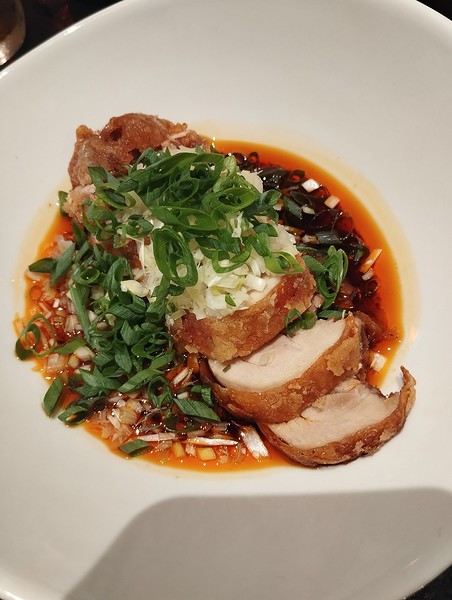
Ordering is simple—there’s a photo album of each dish. We order several things, following the izakaya style, as well as a drink we think is a shikwasa (Okinawa lemon) soda sour. Everything was delicious and flavorful—here’s a non-exhaustive list of what we had: - A small salad with raw fish and smoked/grilled eggplant - Spicy chicken and vegetables, served in two rounds. When we ordered, the woman warned us it was *very* spicy. Wide-eyed, we confirmed anyway. Impressed that we managed to eat it all, she called the chef (her colleague) to come see us and tell her about it. - Crispy truffle potatoes - Fried octopus The sea really whets your appetite, and when the food is this good, you want to try everything! My companion, who was skeptical about izakayas until now, is officially converted!
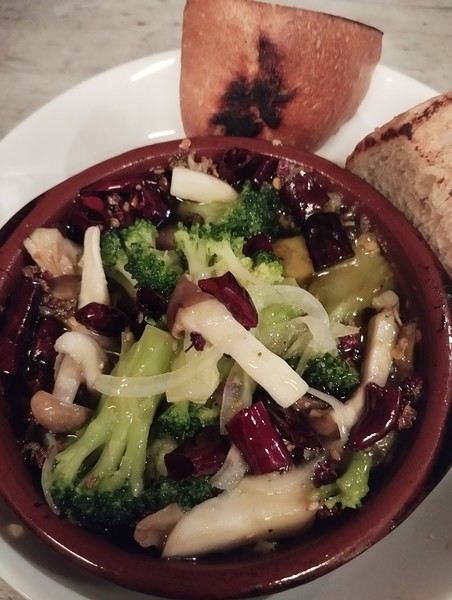


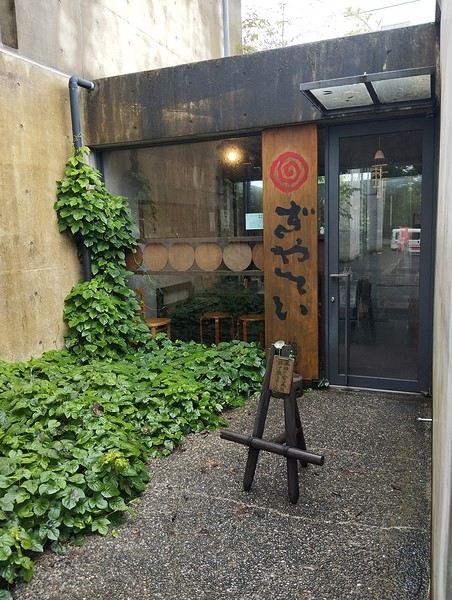
This izakaya offers contemporary, no-frills cuisine in a great atmosphere. Even the restrooms are nice—accessible from the street, they run the length of the restaurant and have a warm, welcoming vibe with flowers, music, and a pleasant scent. A new entry in our Miyakojima travel journal!

Back at the house, I send the Japanese man we met the photos we took together, along with our address and departure date from the island, as agreed. End of the day.
Nathalie971OP· 4 months ago
Day 17 - Dolce vita

Beach, beach, beach, day after day. It's the 5th day, and we still can't get enough because the sun combined with a slow pace makes for a perfect break in the middle of the trip. I know many of you readers aren’t into this beachy side, so just a little more patience—we’ll be in Tokyo in two days. Wearing flip-flops all day is a joy, and even Monsieur seems to be starting to appreciate it. Who would’ve thought! With our feet dressed like this, we get into our car parked right at the foot of the residence—so convenient! As usual, we drive toward a destination and make a stop to admire the view of Yonaha Bay. We’ve been here before at the start of the trip, but the sky was gray. Let’s see if the landscape is more charming under a blue sky. It’s much better. You can walk along the bay or even have a picnic if you don’t need a table. The sea water is a milky blue color. You can’t see through it.
We hit the road again toward one of my favorite islands for its rural and preserved vibe: Kurimajima. It has a rustic charm. To get there, you also have to cross a bridge by car—the same one you can see from Yonaha Beach (the first beach mentioned). Our goal is to visit a part of the island that’s a bit less crowded than on previous trips: the western side. We head to three beaches. The first is a sort of rocky cove with immaculate white sand. It’s high tide, and there’s a lot of wind, so the waves are really strong. They crash against the cliffs, creating water jets in some spots. The beach is stunning. It’s labeled a "wedding photo beach," which you can tell by the "wedding" sign posted there. There are only a few people—two men when we arrive and a couple when we leave. We stayed for a while, enjoying the wild landscape made up of cliffs, the sea, the waves, and the sound of them crashing, along with hummingbirds or butterflies flying around. We wanted to swim, but the current seemed strong, and the beach slopes down. We settled for contemplation, which was rewarded by the few seconds I spotted a baby turtle emerging from the water.


We continued to another beach not far away, also at high tide. There’s barely any beach, and what we saw from the car made us stop for a few minutes to check it out before moving on to a beach we’d visited during our first trip in 2019. We’d seen a gorgeous sunset there. (See https://forumvoyage.forumactif.com/t2646-carnet-de-voyage-automne-2019-japon-de-tokyo-a-okinawa) Like the first beach today, to get to the parking lot, you have to find the small paved road—narrow and not well-maintained—drive very slowly to avoid branches and leaves scratching the rental car, and park in a lot with a maximum of three spaces. The parking lot is completely surrounded by the island’s typical vegetation. A Japanese family—older parents with their son—is coming back from the beach. We exchange a few words. They tell us the sea is a beautiful blue. The jungle path leading to the beach takes about 5 minutes, and flip-flops aren’t the ideal shoes here, but if you walk slowly, there’s no danger. Walking through this tunnel of greenery transports you to another world when the light at the end leads you to a long, immaculate white-sand beach. This beach is mesmerizing. It feels lost at the end of the world. We didn’t think we’d be able to swim, but the call was too strong. We decided to brave the waves anyway. With our stuff in tow, we picked a spot with a bit of shade. Since Japanese people don’t swim much, the only couple who arrived a few minutes after us left after about 10 minutes. We had the beach almost all to ourselves. Later, I spotted a Japanese guy in a corner—unusually tanned! He even swam as we were leaving. At the far end of the beach, you can also see a Japanese couple taking wedding photos in their outfits. We stayed at the beach for a long time, enjoying the absolute calm in this completely preserved environment. The waves were strong but not dangerous if you didn’t go too far from the shore or get too close. We spotted turtles poking their heads out of the water twice more.


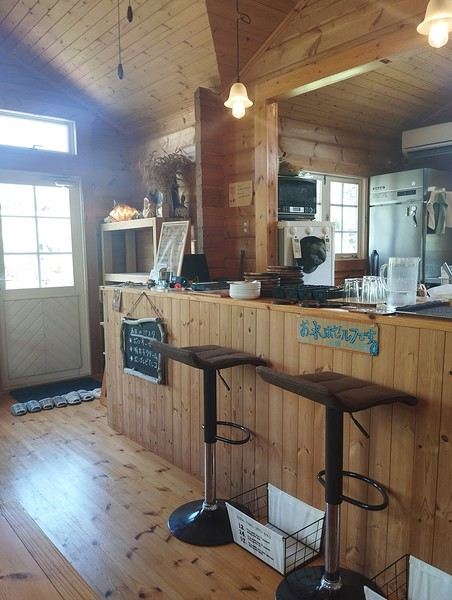
We left this enchanted beach with a bit of regret, but hunger—it’s already 3 PM—was calling. We headed to what you could call the "center": a few narrow streets and small, low houses. There are a few places to eat, but as I’ve mentioned before, finding food at this hour can be tricky. We did find a really nice little spot, though. It’s a wooden café that looks lovely from the outside. And even cuter inside. It’s tiny but cozy, with all that wood, the view of the greenery, and the care put into the decor. The restaurant is run by a laid-back Japanese guy with a rasta style, and reggae music is playing. While chatting with him, we learned he built this house himself. He’s been living here for 20 years and comes from Tokyo. He has no desire to go back. He spent some time in Africa doing humanitarian work and learned a few French words there. The kitchen is open, as is often the case in Japan. You can watch the chef cook. In cafés, it’s not uncommon to find Western dishes. We gave in to pasta and pizza. However, the portion sizes are Japanese—meaning small. We also enjoyed iced tea and a nice cold beer since the heat is still here today.


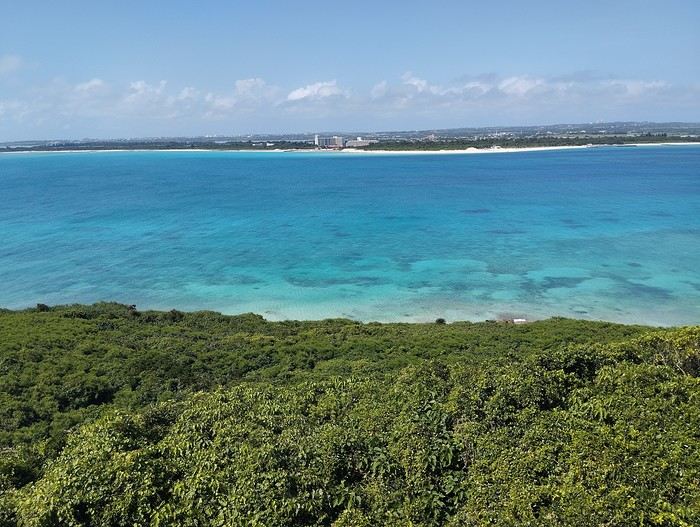
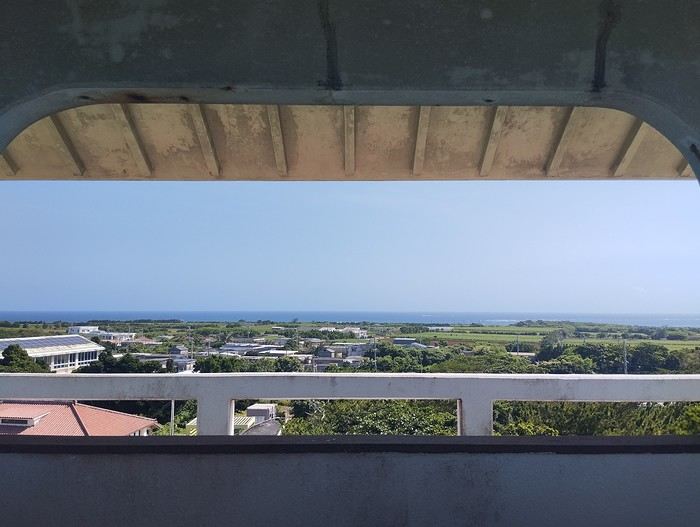
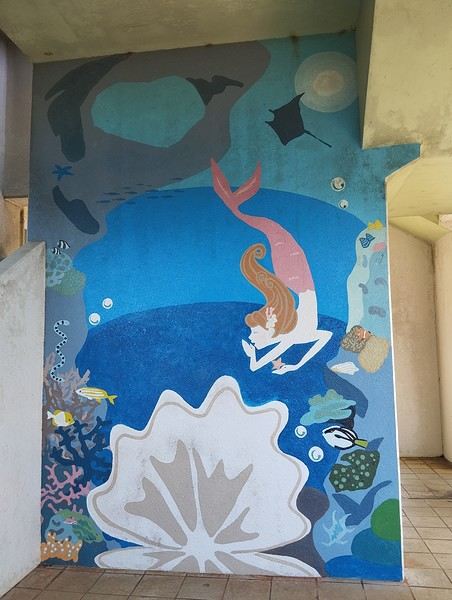
After this meal, we visited the Ryugu Observatory, just a minute away by car. We’ve been here before, but the view is still amazing. You can see the bridge connecting the island to Miyakojima, Yonaha Beach, and the endless sea. A few changes have been made to the observatory, with two sea-themed murals—one on each floor. The spiders, though, are still there.


To be honest, we thought we’d walk more, but the heat sapped our energy. So, we headed to the beach near the island’s port, just before the bridge. But there were too many people for our taste.
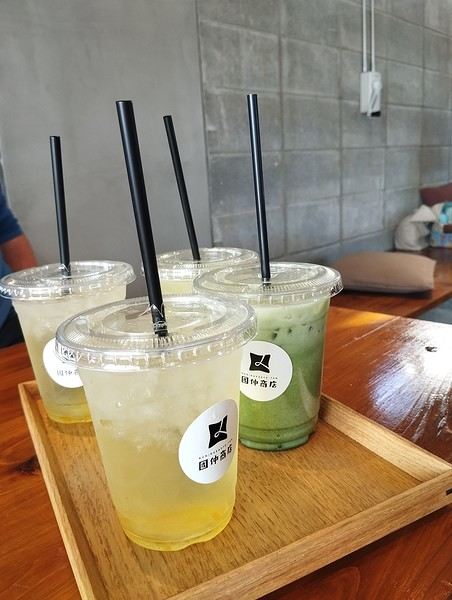
So, we went to a café on Irabu Island. It’s in a less touristy area that you have to search for, but it offers a nice space. Many customers are there for coworking. It’s located by a canal. We enjoyed some great fruit juices with different lemon flavors, as well as a matcha latte. And since we weren’t far, we went for our second swim of the day at the "wedding beach" we’ve mentioned several times.


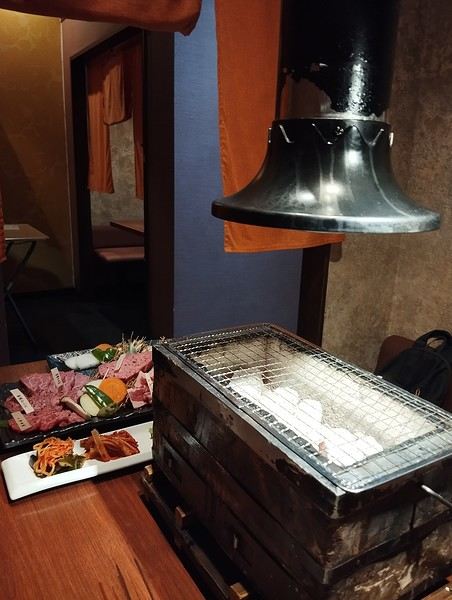
To wrap up this intense day, a tasting of Miyakojima wagyu was a must, so we headed to a yakiniku restaurant. Strangely, we were seated in the same private room as during our first visit in 2019. We know the place, so no surprises—we ate well. We also had sushi made with wagyu, torched in front of us.


We feasted and headed back home.
Nathalie971OP· 4 months ago
Day 18 - A day shaped by encounters

After a well-deserved lie-in, we kick off the day with our favorite burger. The Japanese truly have a knack for making classics their own—even years later, we still dream about the ones from Miyakojima.


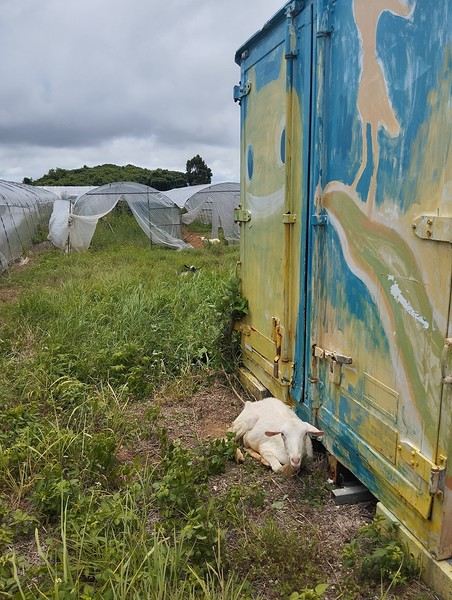
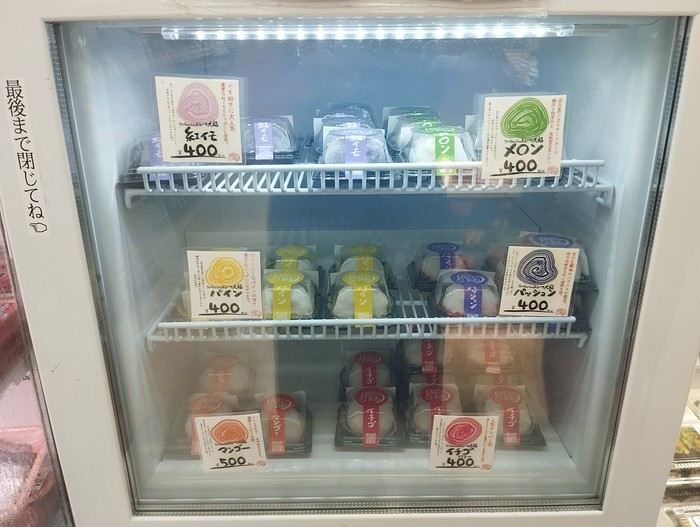
Our mission today is to track down some mysterious mochi made with unsold vegetables by a local farmer. With only the farm’s name and a Japanese website to go on, the treasure hunt begins. After asking a farmer and exploring a small farm lost in the middle of the fields, we come up empty-handed.


Just as we’re about to leave, a Japanese woman who came to buy vegetables comes back specifically to see us. Sorry she couldn’t help us earlier, she went to ask at the nearby supermarket: our famous mochi are sold there. Thanks to her, we finally get our hands on them. Strawberry, sweet potato, kabocha squash, or kiwi—the hardest part is choosing.


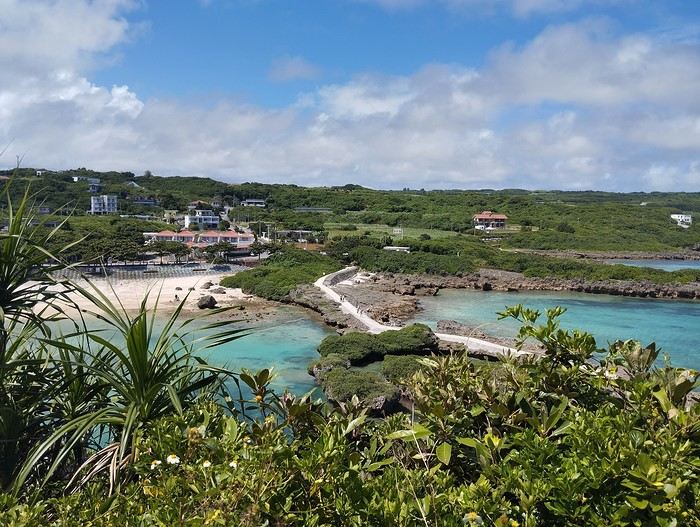
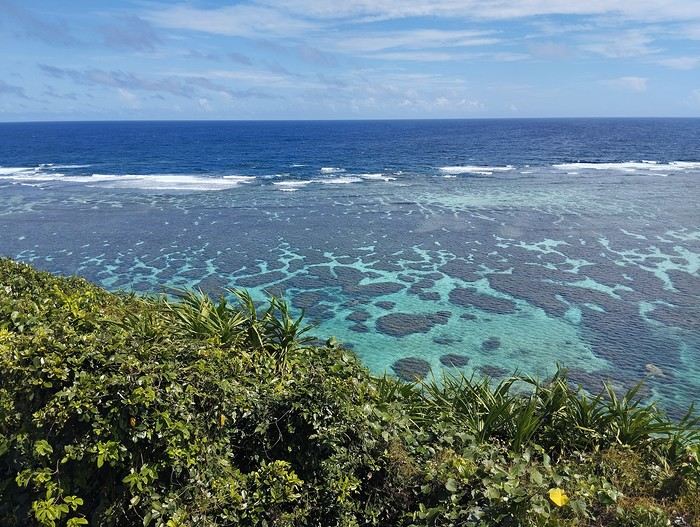
The surprises don’t stop there. A retiree, intrigued by our basket, strikes up a spontaneous conversation. A friend of the producer, he enthusiastically seizes the opportunity to practice his English. This encounter, as unlikely as it is warm, once again confirms that the best travel memories often come from chance. We then head to Imgya Garden, one of the island’s most beautiful natural sites. From the heights, the view of the lagoon and the coral reef is stunning.


After the walk, it’s time for snorkeling among tropical fish, even if the dense coral makes access a bit of a workout. The only downside: despite its waterproof pouch, my phone takes in water. Underwater photos are over...

In the late afternoon, we’re supposed to meet N, the cyclist we met a few days earlier. With our phone out of service, we can’t let him know we’re running late. As we rush back in the pouring rain, a surprise awaits us: N will come pick us up directly at our apartment, unlike the original plan. He had contacted our hotel earlier to find us, but we’ll only discover this much later when the doorbell rings while we’re barely dressed after our shower. The initial restaurant being fully booked, our hosts take us to a... French place instead. The perfect opportunity to try European cuisine reimagined Japanese-style, shared izakaya-style. The ice is quickly broken. Despite the language barrier, English, a few Japanese words, gestures, and improvised translators are enough to spark an evening full of laughter. We exchange stories about our lives, cultures, and habits. N and his son Y make a particularly close-knit duo, while their friend M, a teacher in Miyakojima, tells us about life on the island, her daily routine with her students, and some local anecdotes. Between tastings of awamori, the hours fly by without us noticing. As often in Japan, it’s impossible to chip in for the bill—our hosts generously treat us.

The evening doesn’t end there, though. After N leaves, we continue the conversation with Y and M at a small izakaya where we’d already eaten a few days earlier. The topics become even more varied: Tokyo, Osaka, life in Miyakojima, sharks, sea snakes, tourists, local dialects, discussions about the manga from our childhood, and discovering habushu, Okinawa’s snake alcohol... So many subjects that let us see Japan through the eyes of those who live there.

We finally walk back to our apartment with M, feeling lighthearted. More than the landscapes or beaches, this day will stay with us for all these unexpected encounters that keep making Miyakojima so deeply endearing.
Nathalie971OP· 4 months ago
Day 19 – Final Moments on Miyakojima

All good things must come to an end, and our stay in Miyakojima is already drawing to a close. For this last day, no packed schedule—just enjoying the island one last time, revisiting a few spots we loved, and savoring these final moments before heading to Tokyo.

The morning’s first mission: finding a repair shop for my phone, which suffered a water leak the day before despite its supposedly waterproof case. The verdict was clear—parts wouldn’t be available for days. We’ll try our luck in Tokyo. Luckily, we have a second phone to keep capturing the end of our trip.

As has often been the case since we arrived, the day begins with… a hearty meal. For days, the delicious smells wafting from a tiny restaurant near Bocca Burger had been calling to us. This time, we couldn’t resist.

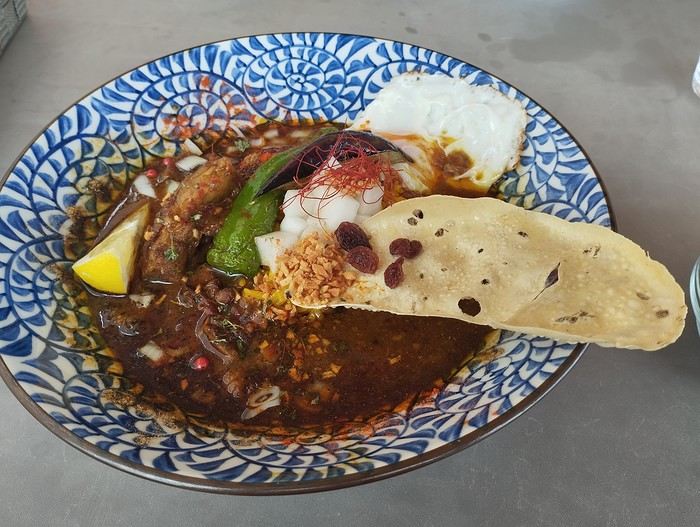
The place is minuscule, almost like a mobile home, but from the moment we step inside, it’s clear this isn’t just another curry spot. Dozens of spice jars line the kitchen shelves. The owner explains that at breakfast, there’s only one menu: Okinawa pork curry or shrimp curry. We order both to compare.


Seated on the small terrace, cooled by a giant fan, we watch the plates arrive directly through a sliding window connecting the kitchen to the outdoors. A simple detail, but full of charm.

The meal is a true revelation. Nothing like the more classic Japanese curries. Here, the spices are plentiful but perfectly balanced. The small cubes of apple, raisins, pomegranate seeds, lemon, chili, and strands reminiscent of saffron create a surprisingly harmonious blend. The Okinawa pork is melt-in-your-mouth tender. One of the best curries we’ve ever tasted.

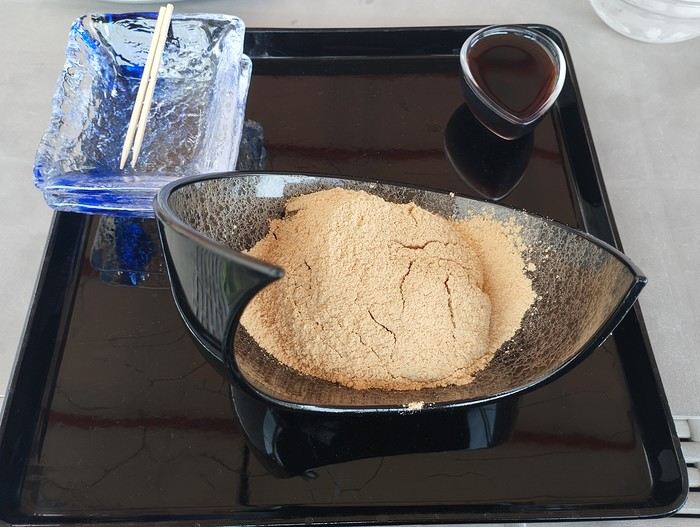
For dessert, another discovery: warabi mochi. This traditional treat, served with kinako and black syrup, has an incredibly soft, melt-in-your-mouth texture. Light, refreshing, and not too sweet—it’s a real favorite.


A spot we’d recommend without hesitation.

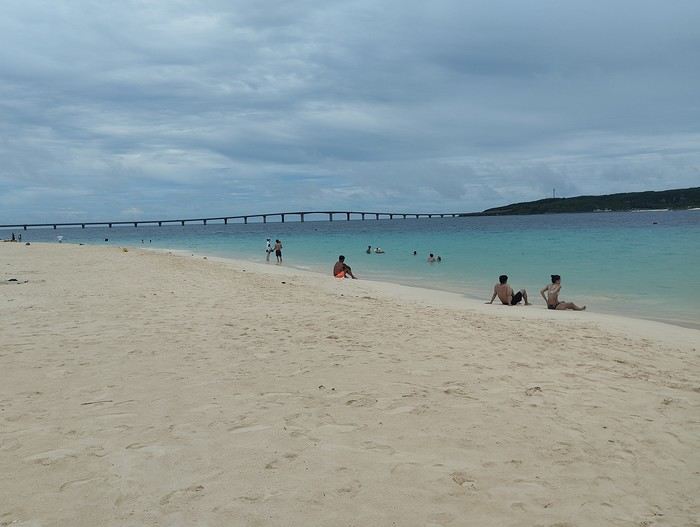
The rest of the morning is spent on a final stroll along Yonaha Maehama. We first look for some wilder access points, hidden behind the woods. The place is peaceful, but unfortunately, a few pieces of litter spoil the scenery. We eventually head back to the main access point, where the water still displays that unreal turquoise color Miyakojima is famous for.


A small curiosity: we finally spot a few Western tourists. Just a handful, but enough to make us think the island is slowly gaining recognition outside Asia.

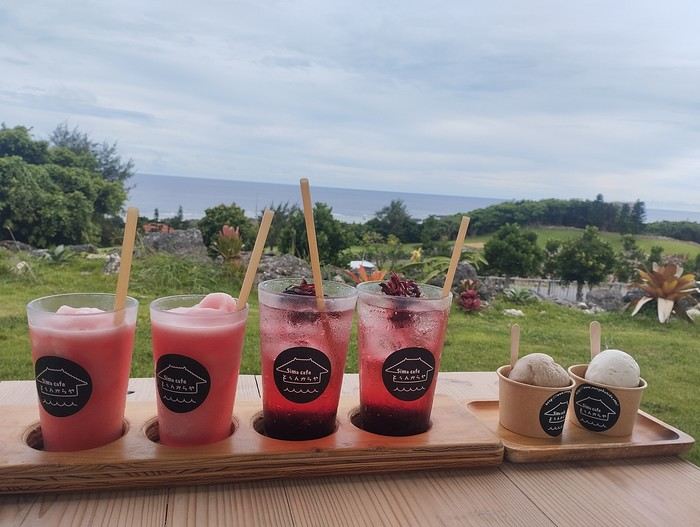
In the early afternoon, we revisit a café we’d discovered on a previous trip but found closed the day before. The wait was well worth it. Facing the sea, lulled by soft bossa nova music, we enjoy a watermelon smoothie, hibiscus soda, and several artisanal ice creams—especially banana and sweet potato. Another excellent spot where the welcome is as warm as the drinks are refreshing.


We continue our walk to the small port of Hakuai Yuri. Quiet and windswept, it’s the perfect place to enjoy the peace. Locals say that on clear nights, you can even see the Milky Way here.

A little farther on, a sign pointing to a waterfall piques our curiosity. After a steep descent through dense vegetation, dodging several giant hermit crabs, we discover… a waterfall that isn’t really a waterfall. The walk is still pleasant, but the effort feels a bit disproportionate to the payoff.


On the way back, a stop at a konbini is a must for a quick snack of spicy fried chicken. One last indulgence before heading to Sunset Beach.

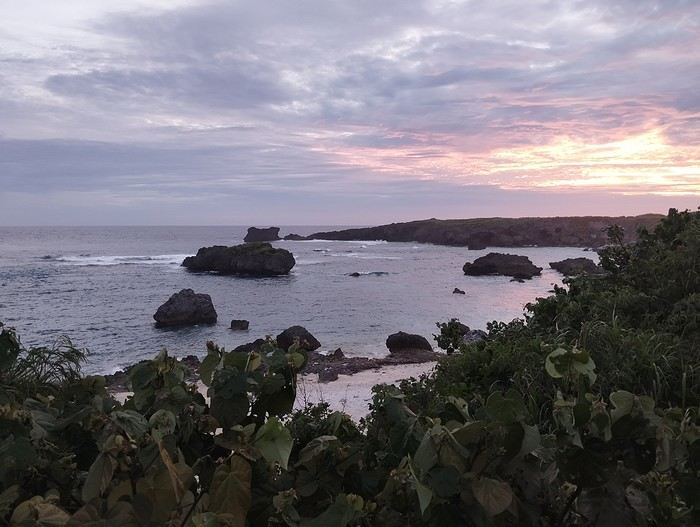
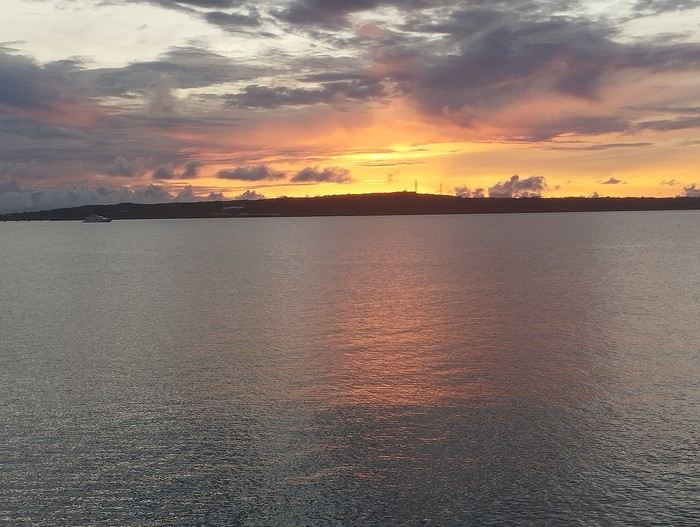
The sun begins its slow descent behind the Irabu Bridge. Despite a few particularly persistent insects, the view is stunning. A beautiful way to say goodbye to Miyakojima’s landscapes.


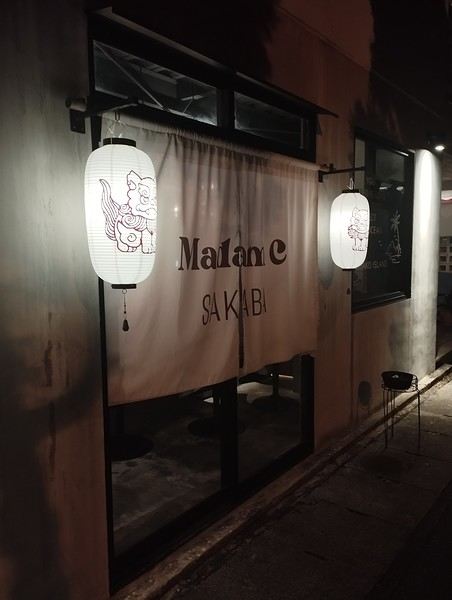
For our last dinner on the island, there’s no question—we have to return to Madame Sakaba. It’s our third visit, but this time we sit at the counter. The atmosphere is different, more intimate. The waitress and cook recognize us immediately and take the time to chat between orders. In just a few days, we almost feel like regulars.


Meanwhile, my partner strikes up a conversation with a Miyakojima local near the outdoor restrooms. He proudly tells him he’s already tried a French dish in sauce—probably beef bourguignon, based on his description.

A final evening, simple and uneventful, but just like our stay: warm, delicious, and filled with spontaneous encounters.
Nathalie971OP· 4 months ago
Day 20 - Flying to Tokyo It’s time to leave. We have a meet-up at 10 AM at the rental agency. I thought I could get there without GPS—anyway, the spot wasn’t saved—but it turns out my sense of direction failed us. As a result, we’re running late. With Japanese punctuality and thinking there were probably other customers, plus our inability to let them know, we worried the team might leave without us. We finally find the agency, but no one’s outside. We knock, the door’s unlocked, but no one’s inside. We call out several times, still nothing. After long minutes, the manager arrives very calmly. Relieved to see her, she’s not stressed at all—probably the Okinawan calm.

We settle the rental payment: 24,500 yen for 7 nights, which comes to 22 € per day at the exchange rate at the time. That’s really cheap.

The manager then drives us to the airport. The plane takes off at 11:50 AM, and we’re flying with ANA. We were allowed two checked bags of 23 kg each. I only had one bag, but it weighed 26 kg. Rules are rules, so they gave me a paper bag to take out 3 kg from my suitcase. A few hours later, we land at 2:30 PM at Tokyo Haneda.

Getting around Tokyo with big suitcases in the heat is a workout, especially since I broke the extendable handle for pulling my suitcase! Tokyo has some uphill spots you discover when leaving the subway to reach your hotel. By "workout," I also mean dealing with crowds again—after three weeks with few people, the transition is a bit overwhelming.


We booked our stay in Akasaka again—not because we’re particularly interested in the neighborhood, but to be close to a sushi restaurant my travel buddy loves. The area is also central, making it easy to reach different parts of this big city.

In the end, even though we landed in the early afternoon, we don’t arrive at our hotel until late afternoon, so there’s no time to sightsee. We just head to a phone repair shop, which, much to my disappointment, sends me to another shop near Shimbashi, a different neighborhood.

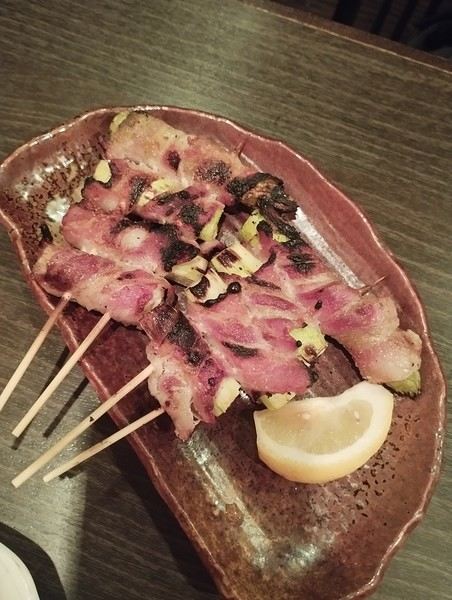
Tonight, we settle for eating at a nearby restaurant—a yakitori place (grilled skewers). The welcome is shy, the service is slow, but the food is pretty good and generous. Run by a couple, the woman handling service is busy but takes the time to run to the door to say goodbye.


We end the evening quietly at the hotel, preparing for tomorrow’s adventures.
Nathalie971OP· 4 months ago
Day 21 - Sushi, wanderings, and Tokyo Tower

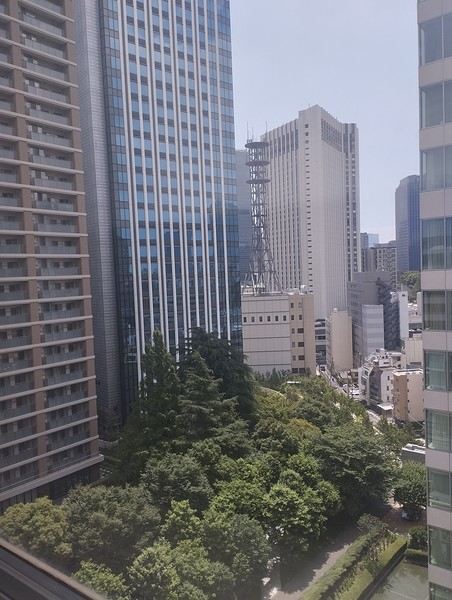
One of the pleasures of starting the day is opening the curtains to discover the environment surrounding our hotel room. Today, it’s a bright sun illuminating the tall Tokyo buildings in the neighborhood, with a small green park at their feet.


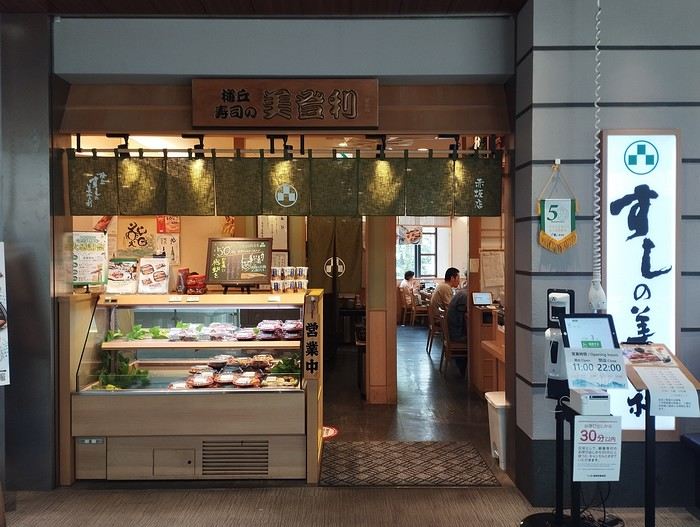
The day’s plan revolves around fixing my phone. The repair shop from yesterday pointed us to a store in Shimbashi, so we decide to take a stroll through the area before walking there. But first, Mr. is eager to return to a sushi restaurant that’s part of a chain—meaning there are several locations in the capital, but they’re all well-made. For those who haven’t read the previous travel journals, we learned about this place from a chance encounter with people from Osaka during our trip two years ago. This will be our brunch. The long-awaited return to Sushi no Midori!


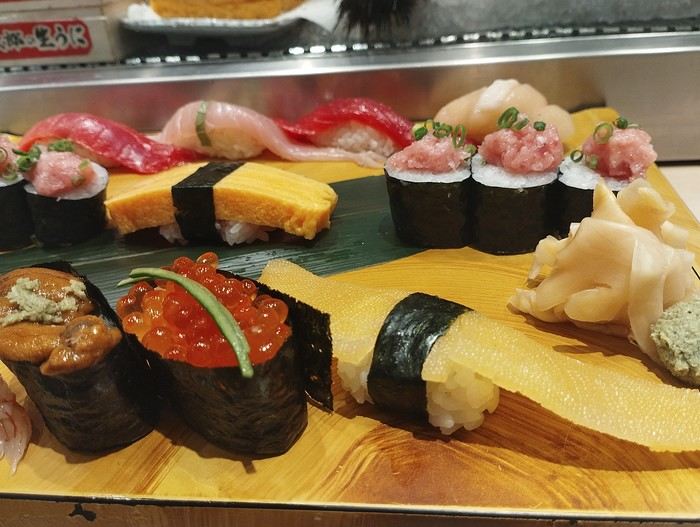
When we arrive, we notice the queue management system has changed. Now, you have to take a ticket with a number. It’s early, so there aren’t many numbers ahead of ours. Our turn comes, and we’re seated at the bar. It’s a different vibe from the dining room. In a sushi restaurant, eating at the bar feels much more immersive, even though here, the chefs are elevated above the customers, and we don’t see all the food prep in detail. For this meal, I try the tuna chirashi with their delicious chawanmushi—a savory egg custard with a light, eggy flavor, topped here with a small shrimp and a mushroom. I really love theirs because it’s rich and subtle while still being comforting. The chirashi is a bowl of rice topped with different types of raw tuna (lean and fatty) prepared in various ways. I really enjoyed the "whipped" tuna—it was very flavorful.

As for my partner, their excitement about returning here leads to ordering several dishes. The only issue is that the service is so efficient and quick that the dishes pile up on the small bar space. It gets to the point where it makes our Japanese neighbor and the chef serving us (there are several) smile. The chef even pats his stomach—I imagine to say "eat well!"


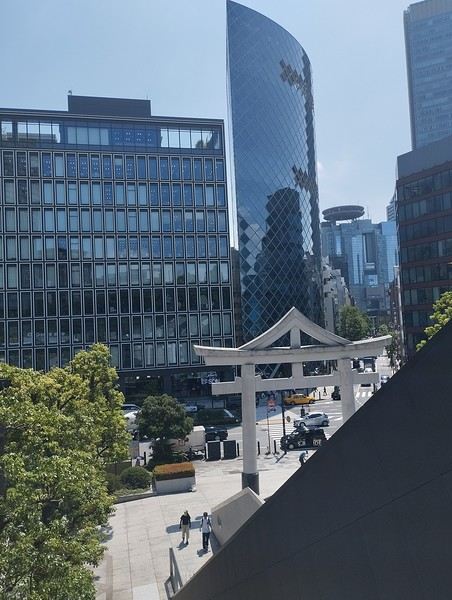
Well-fed, we start our walk toward a famous shrine in Akasaka, just a few minutes away on foot. We stroll through the sunlit buildings, some reflecting off others. Combined with the shrine and the many umbrellas being used as parasols, it feels like a welcome to modern Japan—a blend of tradition and modernity.


From the southern entrance of the shrine, under a large torii, we take the escalator up the hill to enjoy the view of the neighborhood. A sense of harmony emerges.

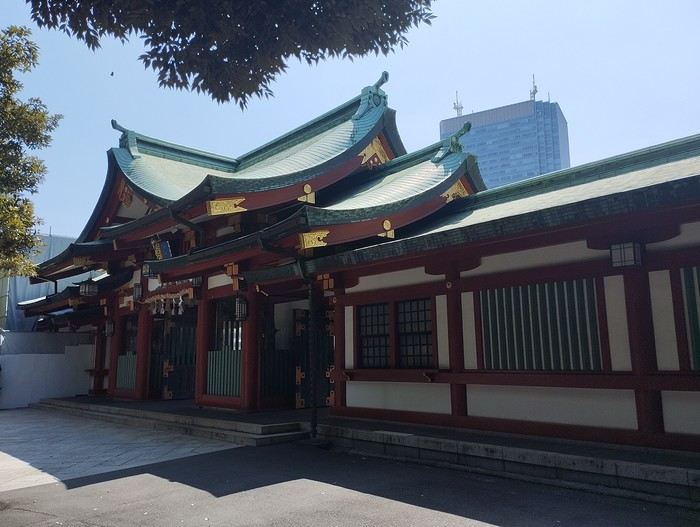
The shrine grounds aren’t particularly remarkable. You’ll find symbols of monkeys, as they’re considered divine messengers and guardians of the mountain—this shrine is linked to Mount Hiei near Kyoto. A ceremony is being prepared.


At the Yasaka Shrine within the grounds, worshippers quietly line up to pray for a happy marriage, a smooth birth, or to bless their children, while crows caw in the background.

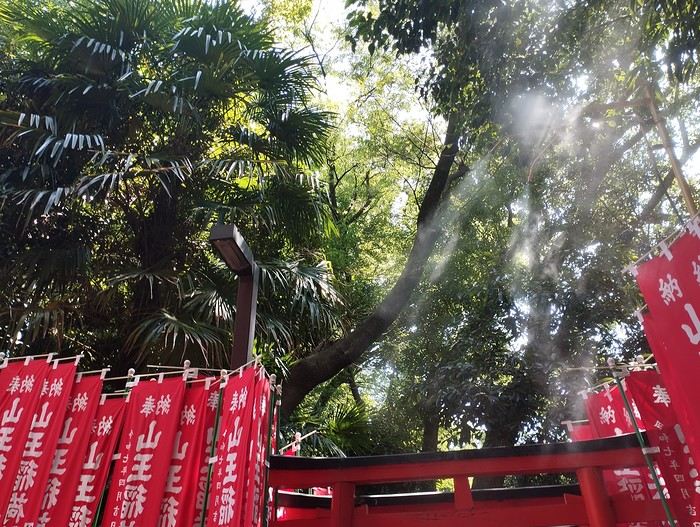
We end the visit by exiting on the west side, descending a narrow, charming alley of torii gates surrounded by greenery. It feels like a misty, exotic oasis.


With the heat bearing down on us, we decide to take the subway to Shimbashi.

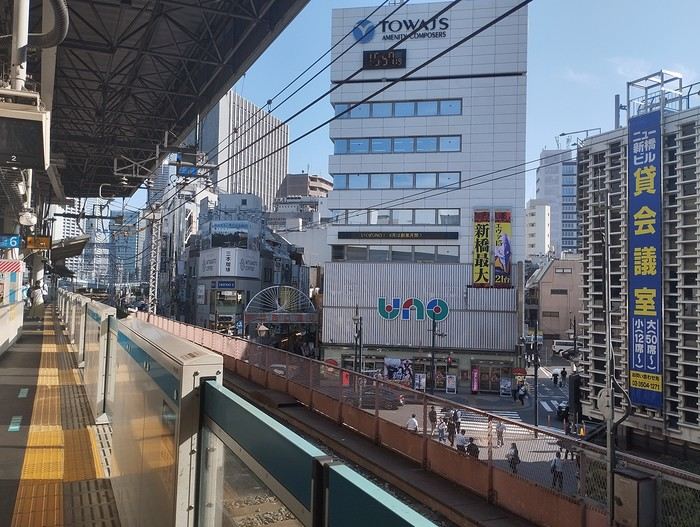
The repair shop is in the New Shinbashi Building, a shopping center at the subway station. It’s a multi-story building filled with shops, bars, and restaurants, with a retro vibe. Some stores seem to have been there for ages. The building buzzes with as much life as the streets outside. What’s nice about retro places is that you can catch glimpses of life from the past, and there’s something reassuring about seeing things that stand the test of time. The store we’re looking for is on an upper floor. We take one of the elevators, but as usual, it doesn’t go to the exact floor we want. We have to stop at a lower floor but can’t find the next elevator, so we opt for the escalators—only to find that’s complicated too. That said, it gives us the chance to be invited into a massage parlor that seems to offer more than just massages. We decline and try to navigate this modern labyrinth. Eventually, somehow, we find a staircase and make it to the right floor, which is mostly empty, with a few scattered shops here and there in the hallways. We’re greeted by a young man who’s anything but welcoming. His voice is barely audible, and the exchange is as brief as can be. Still, I hand over my phone, and we’re told to come back in three hours to see if it’s fixable.

On our way down, before heading back outside, we stop at a fresh fruit juice shop we’d spotted earlier. It’s so hot that we’re craving cold drinks, so we each have two juices. We try kiwi, watermelon, and Japanese plum. So refreshing! You have to drink them standing at the tiny counter in the shop, making sure not to block the aisle.

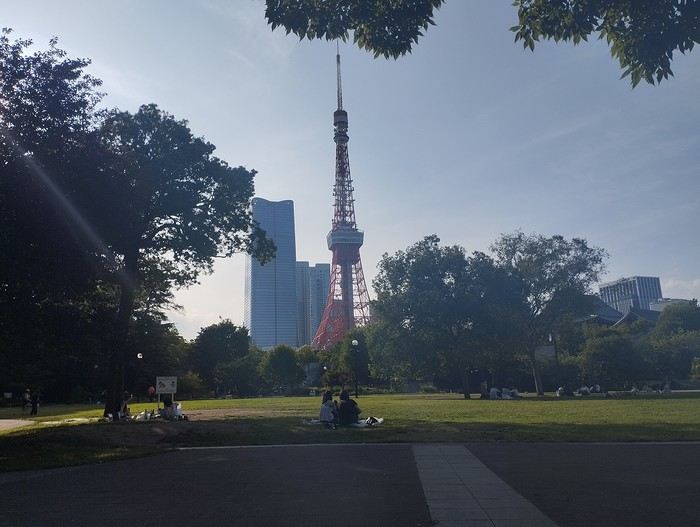
Since we have to come back in three hours, we decide to walk to Tokyo Tower. We cross through Shimbashi and reach Shiba Park, stopping at a konbini to buy cold water—the heat is making us thirsty. Shiba Park isn’t extraordinary, except for the great view of Tokyo Tower. It’s also a local hangout spot—residents relax with family or friends, have picnics, or take photos of the tower.


There are several spiritual sites in the park that we don’t visit, except for what’s visible while walking around. There’s the Tosho-gu Shrine and Zojo-ji Temple.

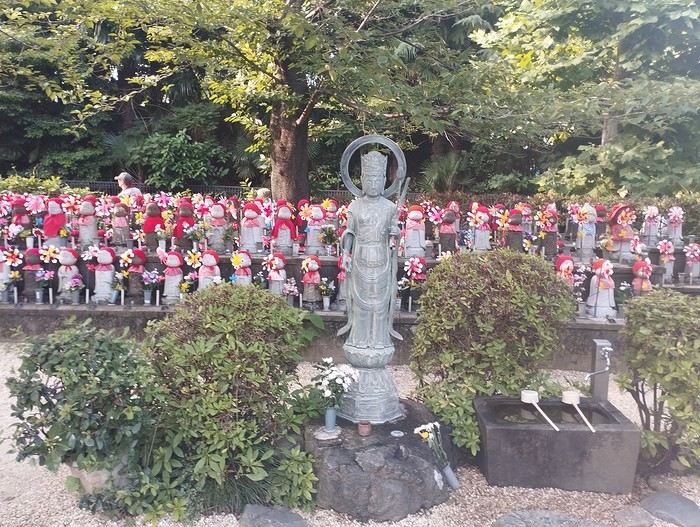
At the temple, there are over 400 small statues of Jizo, a bodhisattva who protects travelers, women, and children. He safeguards the souls of unborn children and those who died too young. Some of these statues are dressed in knitted clothes by grieving parents.


We then head back toward Shimbashi, stopping occasionally at konbinis to connect to the internet. We’re supposed to meet a French couple we met during our second trip, when we were in the wilds of northern Tohoku. They’re traveling in Japan around the same time as us for their honeymoon. Internet access is necessary for the logistics of this meet-up—where and when. Back at the phone repair shop, the lack of acknowledgment from the person who helped us three hours earlier is a bit shocking (not really, given their lack of engagement, but it’s not the usual Japanese service). He sees us but doesn’t assist us, leaving his colleague to handle us. In the end, nothing could be done, so we have to pay 3800 yen even though I’m not sure he spent more than five minutes on the phone. I’m disappointed and worried because the phone is new, and I wonder if it’ll still be fixable when I get back to France. The answer will be yes, and even the repair shop in France didn’t believe it—apparently, seawater usually doesn’t forgive. We leave the building again. The square is crowded. I get the impression there’s a political rally.

We decide to walk back to the hotel, which lets us cross another part of the city. This area is mostly made up of very tall buildings. Though it’s nice, the urban walk, the crowds, and the heat are tiring us out—especially since we’re walking briskly. We have a meet-up at 9 PM in Shibuya and want to drop off our things at the hotel first.

Back at the hotel, we freshen up, and then tonight’s meet-up gets canceled. She’s feeling sick and tired. They’re taking an early flight tomorrow. We still chat a bit on the phone, quickly catching up on our respective trips. We don’t feel like going far, so we decide to try a Vietnamese restaurant (we’re craving a change from Japanese food), but we have to hurry because it’s already 8 PM, and things get tricky at this hour. The Vietnamese place closes at 10 PM. The restaurant is in Roppongi, which we reach on foot.

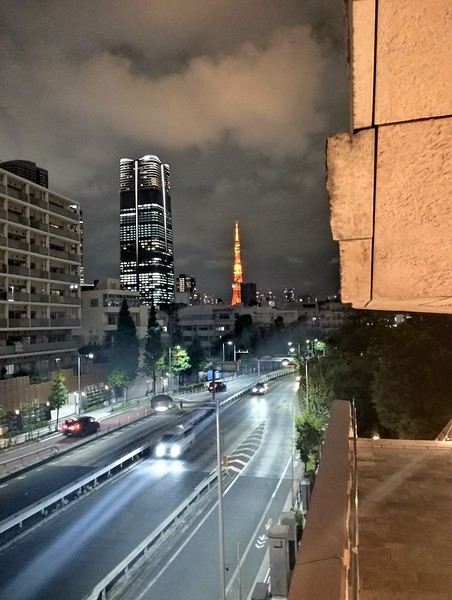
A little night view of Tokyo Tower as we arrive at Roppongi Hills.


We arrive at 8:40 PM, but they refuse to let us in because the kitchen closes at 8:30 PM—no negotiation possible. The other restaurants in the mall are also closing. The surrounding area is full of party bars, which aren’t really our scene. We try several restaurants, but they all turn us away unless we’re just there to drink. We eventually give up and head back to the hotel, stopping at a konbini for fried chicken and cherry tomatoes. We eat in the room. End of this first day in Tokyo.

You might also like