I just stumbled upon this forum I didn’t know about. It’s like a big breath of fresh air this morning (with birds going wild outside as the soundtrack to celebrate the sunrise and their loves).
Since last year, I’ve been preparing a somewhat special Alpine crossing from Salzburg to Nice. My route covers all the mountain passes (103 in total) over 1,900m, and I’ve given myself 15 days to cover these 5,000km.
I’ve checked out a few forums, and it’s kind of funny to see that it doesn’t quite fit in—it’s neither a race, nor cycle touring, nor an adventure trip in the traditional sense, since there’s still an extreme performance aspect to it.
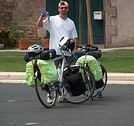
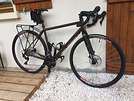
I’ll have my luggage with me—clothes, my camera, and food—on a 6.5kg bike with 4kg of gear plus water.
Preparing for this is super niche; it’s a sort of balance on the edge of breaking point. An experience I’m really excited about, even if it could still go wrong. I’ve already gotten a taste of the thrill.
I’m working on a little book about this experience while waiting for the day I can finally set off like you all with my wife and without any time constraints...
Wow! 5,000 km of mountain passes in 15 days? Hats off!
Still, my bike alone weighs around 12/13 kg, my trailer adds another 4/5 kg, and my luggage maybe 15 to 20 kg! So I’m also setting off to do 5,000 km, like you, but... entirely on flat terrain... and over 2 months ;)
Good luck and all the best with your journey—it’s really amazing!
It's funny how traveling with just 4 kg of luggage makes you weigh everything. You cut off straps that are too long and probably won’t be used. You build your own luggage rack because the commercial ones weigh a ton. You pick ultra-tech clothes that cost an arm and a leg...
And since you’ll be spending 15 to 17 hours on your bike, you tweak the ergonomics. You study your daily movements, how you pedal in the right gear... etc. The goal is to try not to suffer too much...
All that for a little bit of happiness—but what happiness!
That’s over 300 km a day if I’m calculating right? I say: impossible! Even the Tour de France aliens wouldn’t last a week at that pace. And that’s on mountain stages, no less. Even if you pull it off, I honestly wonder where you’d find any enjoyment in it?
I’ll have my luggage with my clothes, my camera, and my food with me, but on a 6.5 kg bike with 4 kg of gear plus drinks.
With my 11 kg bike and 10–13 kg of luggage, I already get looks like I’m some kind of extremist here. Unless you’re doing credit-card touring, I don’t see how you’d get under 7 kg (including pannier weight).
Nine years ago, I covered 9,300 km of mountain terrain in a month under some pretty unusual conditions—all documented in a book published to benefit my association. The money later went toward organizing mountain-biking expeditions for people with leg amputations (prosthetics are my job). It’s not impossible, just very specific. Nothing like the tour—I averaged 20 kph for 15 hours a day.
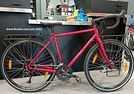
I’m lucky enough to work with carbon fiber: I made a carbon-Kevlar "box" molded to the top tube with a 2L capacity, extended laterally by two carbon struts on either side of the seat tube. At the end of these struts, I’ve bolted the nylon tensioner for the frame of my 20L ultra-light backpack. All I have to do is clip it on. The whole setup weighs exactly 676g empty.
I also have two carbon bottle cages and two one-liter water bottles.
In all that, I pack my Windstopper jacket (220g), my Gore-Tex Packlite 2.5-layer shell (217g), my Oldo top and bottom (225g—it’s both for cold weather and my pajamas), a spare pair of underwear and socks (not weighed), a spare jersey and bib shorts (280g), silk gloves, silk socks, waterproof overshoes, a camera (220g), a phone (65g), my essential ID, some cash, my Mastercard, food and drinks, my roadbook, laminated road map excerpts, and little plastic bags for salt and sugar I snag from hotels... I’m definitely forgetting a bunch of stuff...
You know, I have a blast with all this, and I love those endless rides that let me explore several regions in a single day.
Plus, it’s a discipline of excellence—it forces you to stay sharp throughout the whole prep process.
I love my two half-pints of beer in the evening....
I’ve got the book on my shelf and I’ve read it, of course 😉. It’d be great if you could post a photo of your carbon bike case—I’m thinking of trying out these kinds of long-distance rides over a few days, but I’m having trouble picturing what it looks like. Any issues with thigh discomfort?
Yeah, I was worried about that, but I tested it today for the first time (112 km with 2,100 m of elevation gain), and it seems perfect. Maybe it could annoy me when climbing out of the saddle if I have to tackle a whole pass like that (it happens with a sore butt). I might make a "pleat" like in sewing on a shirt, about twenty-five centimeters from the head tube, but I'm not sure.
I'm not great at taking photos for the internet. I'll put one in my travel journal... if all goes well...
Looks like our friend Chelala has gained some followers lately!!!!
a 6.5 kg bike
Just a reminder, for safety reasons, Tour de France riders aren’t allowed to race with a bike weighing less than 6.8 kg.
Don’t take us for fools!
To give you an idea, here are the times for Milan–San Remo (one of the flattest races of the year, along with Paris-Roubaix... and even here, there’s no cobblestone):
Oscar Freire took the win ahead of Boonen and Petacchi. Winner’s time: 6h57’28”; average speed: 42.829 km/h. Distance: 298 km.
You’d really better not take us for fools!
But hey, since you’re not out there chasing sponsors... I’ll let it slide 😛
Just a reminder, for safety reasons, Tour de France riders can't use a bike weighing less than 6.8kg.
That UCI rule you mentioned has been widely criticized for being absurd.
Anyway, I don’t see the connection?
1 - Carbon frames aren’t banned for the general public as far as I know?
2 - The Tour de France is a race, isn’t it? It’s not about riding at 20 km/h all day while sightseeing. You also haven’t shown that riding 300 km at 20 km/h for 15 hours is impossible.
300 km a day for 30 days—even Tour de France riders don’t do that, and they’re doping, so excuse my skepticism. I hope you at least had a tailwind!
I can guarantee one thing: you’d never have pulled that off here in Quebec with all the constraints.
What kind of luggage did you have?
What the hell is it with you guys always comparing this to the Tour de France? Ben Johnson couldn’t have run the way he did for 20 kilometers either, and he was doping, whereas I’m guessing a 20K walk at your pace doesn’t bother you much.
And I’m not plugging anything, but if you wanna know how it went, buy my book. Sorry, but after nearly ten years of people throwing the same crap at me about this, I’m kinda over it. I came to this site looking for a little fresh perspective, but that seems like a bust. Still love chatting, though.
300 km a day for 30 days—even Tour de France riders don’t do that, and they’re doped up. So excuse me for doubting, I hope you at least had a tailwind.
I can guarantee one thing: here in Quebec, you’d never have been able to pull that off—too many constraints.
What kind of luggage did you have?
Not so sure it’s that impossible (well, not for me, anyway...).
Pro riders dope to beat each other and average 45 km/h, not to cover 300 km a day at 20 km/h. They rarely spend more than 6 hours in the saddle, and the average stage barely lasts 4 hours for the winner, with the last rider finishing just 15 minutes later.
Their effort is way more intense than ours but much shorter. They’re sprinters compared to bike travelers, who are more like marathon runners (even if the analogy stops there since pros cover more daily kilometers than the average bike traveler).
jlclemencon is an "ultramarathoner" who swaps a bike traveler’s luggage for a pro rider’s hotel stays.
I think if you took any pro rider and told them to "just ride at 20 or 25 km/h," they could easily handle 30 stages of 300 km.
In the last Tour de France, the last-place finisher (not a climber) on the "Bourg St Maurice - Morzine" stage (4 Category 1 climbs and 1 Category 2) averaged... 30 km/h over 169 km. 300 km at 20 km/h would’ve been well within their reach, and if jl is a climber, I don’t think it’s unrealistic.
As for luggage, I assume he only carried the bare essentials for repairs and staying warm if the weather turned bad—just a well-funded credit card to really rest in a comfy bed.
The only real issue, though, is the day after the last stage—it must be a serious withdrawal because at that point, it’s not travel anymore; it’s more like an addiction 😉
That said, personally, I prefer stages of 100 to 140 km with a total rolling weight of 150 kg, stopping at campgrounds, trail inns, youth hostels (unfairly overlooked), and making lots of connections. But hey, to each their own!
I have this sneaking feeling the post is going off track!
Could we get back to the real topic of the thread, which is simply sharing the bike trip everyone’s currently planning?
That’s what really interests forum members who start dreaming about future destinations.
Happy planning, everyone!
Best,
I’m planning a 15-day cycling trip in Taiwan.
I’m torn between March and April.
Which way would you go?
Do I need to book accommodations in advance?
Do you have any bike-rental places to recommend?
Thanks for all your tips and first-hand experience!
Hi there, I’m preparing for a 3-month trip next summer (2027) cycling the Baltic Sea on the EUROVELO 10 route using a non-electric bike. I’ll probably start from Hamburg—has anyone done this and have any tips or advice for the preparation?
-Does the direction (east or west) matter?
-Is it possible to pass through the Russian enclave?
-The Russia passage...
Last bike trek 2026 for Claudio from La Faverges
Pretty but pricey!
Tough due to Z-route errors: damn GPS!
Here’s the deal: claudio finally did the bike trek he’d been planning for N+1 years, heading toward the Northeastern Region of France.
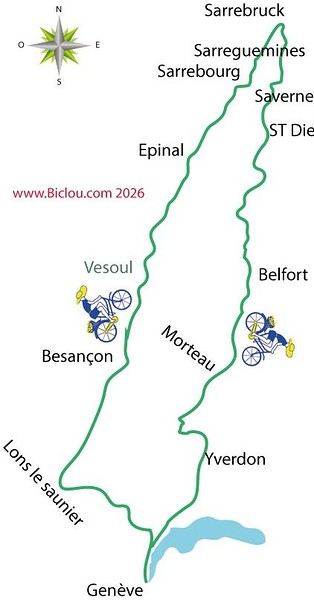
A few highlights: Jura Vesoul Épinal Arbois VéloRoute 50; Northeastern Canals (Saar Canal); Sarrebourg Saarbrücken Alsace Bossue Lorraine Vosges Jura Switzerland
Story and photos coming soon...
Story in progress...
Setting off from Geneva, a bit grumpy, toward the shores of Lake Geneva, we weave through the crowds of wild commuters, but calmly via Versoix, Tannay, Commugny, Founex, Céligny, and finally Genolier, where the real fun begins.
Indeed, while the road from Arzier to St-Cergue and La Givrine offers stunning views of the Lake Geneva basin, the climb is challenging.
But after atoning for a few sins, the village of La Cure is reached as easily as pie.
To avoid the main road and prolong the fun, we opt for the route to Prémanon and Morez via unlikely backroads.
Phew: Lons-le-Saunier at last! Still, quite a bit of meandering to find our campsite.
We lose not only our bearings but also our Michelin map, but eventually stumble upon the hostel—a bit spartan, but at least we’re sheltered.
I wanted to let you know that in September, October, and November 2027, I’ll be cycling across the U.S. from Washington D.C. to Los Angeles to support a cause that’s close to my heart: children with disabilities.
So, for anyone traveling between Washington and Los Angeles during that time—if you see me, give me a wave!
You can easily find me on social media at "Un Frenchy aux USA" if you’d like to support me (just to be clear, I’m not selling anything—I’m doing this for the cause).
Hi everyone, especially to fellow cycle tourists! I’ve just finished a 25-day bike trip from Tamatave to Diego along the east coast—about 1,300 km, including 850 km of pure dirt tracks and bush. I kept a travel journal, so I’ve got plenty of tips for anyone interested.
See you soon
I'm developing a free and open-source web app for planning walking and cycling trips (and even car trips). You can create a route by clicking directly on the map to add waypoints, and it can consist of multiple stages. The app provides tools to edit the stages and the overall route, and to display useful information (distances, altitudes, and elevation changes). A relief profile can be shown as a graph for a specific stage or the entire route.
Once the route is ready, it can be exported as a GPX file, which can then be used with a GPS or a mobile navigation app.
The app is built in JavaScript and runs entirely in the web browser. It uses the Leaflet library and several OpenStreetMap-based services. Initially developed for my personal needs (I enjoy hiking and cycle touring), I’d be happy to share it with anyone who might find it useful. It’s free to use, doesn’t require an account, and the source code is available.
Hi there,
I’m planning to cycle around Taiwan in 2026 and I’d love to know if it’s possible to do the whole island on bike paths, how many kilometers that would be, whether wild camping is easy, and so on…
I’m planning to bike around the Mediterranean.
I’m supposed to go through North Africa, but it seems a bit complicated.
Visas and travel in Algeria and Egypt only work if you book a hotel (no nights spent outside?).
Libya is generally very unclear, and it seems you can only travel there with a local guide (which doesn’t exist for bike trips).
If necessary, I’d skip Libya, but neither a bus ride nor a boat detour seems possible to enter Egypt.
Does anyone have tips on how to get around these issues and secure a visa?
Hello fellow cycle tourists,
Are there any campsites along the Somme cycle route?
Let’s say every 50/60 km starting from Tergnier.
Thanks for your help!
I’m considering applying for the next edition of the Silk Road (Let’s go crazy 😜). Nothing’s certain, of course—I think there’s a lottery for anonymous applicants.
I’m 67, and my goal is to take part and go as far as possible, without necessarily finishing, let alone making it within the time limits.
I already know Kyrgyzstan from cycling there before. The area’s tough, but the landscapes and vibe are stunning.
I’m open to any advice or suggestions. Also up for a race partner (as a duo or solo).
I live in the Monts du Lyonnais and train daily.
Looking forward to hearing from you,
Thierry
When you think of traveling in Tanzania, you often picture high-altitude treks and 4x4 safaris. However, for those who prefer exploring on two wheels, the country’s vast network of dirt tracks, volcanic terrain, and diverse ecosystems make it one of Africa’s most rewarding cycling destinations.
Whether you prefer challenging alpine climbs, fast gravel trails, or coastal rides, here’s a look at what makes cycling in northern Tanzania so exceptional, along with some of the region’s best routes:
1. Climbing Mount Kilimanjaro by bike (Kilema route)
Terrain: Singletracks through humid rainforest, gravel paths in the moorland zone, and alpine desert scree.
* The experience: For experienced mountain bikers seeking a high-altitude challenge, the Kilema route is the official bike-accessible path on Kilimanjaro. The trail winds through lush rainforest before reaching the open heathlands near Horombo. Higher up, crossing the alpine desert toward Kibo demands endless bike carries and pushes, but descending through the forest canopy remains an unforgettable experience.
2. The full 360° loop around Kilimanjaro’s base
Terrain: Red clay earth, two-track trails, rolling gravel, and volcanic paths (total loop of about 360 km).
The experience: Circling Kilimanjaro lets you admire its landscapes from every angle. The route meanders through Chagga farmlands, coffee plantations, dense forests, and the open Maasai plains of the western side (like the West Kili area). It offers stunning views of Kibo and Mount Meru while passing through local villages.
3. From Kilimanjaro to Lake Natron (descent into the Great Rift Valley)
Terrain: Technical gravel, dry riverbeds (wadis), unstable volcanic rock, and acacia scrub.
The experience: This route takes cyclists from the fertile high slopes of Kilimanjaro to the dramatic, arid scenery of the Great Rift Valley. As you approach Lake Natron, the active volcano Ol Doinyo Lengai (“Mountain of God”) dominates the horizon. The final stretch across the Rift floor leads to the saline, serene shores of Lake Natron, a prime breeding ground for large colonies of lesser flamingos.
4. Wildlife zones and corridors
Terrain: Packed dirt tracks, animal trails, and undulating bush paths.
The experience: Pedaling through the northern circuit’s wild buffer zones and Wildlife Management Areas (WMAs) offers an authentic off-the-beaten-path cycling safari. Riding through acacia woodlands often provides sightings of savanna wildlife like giraffes, zebras, and antelopes in their natural habitat.
5. Coast to coast: From Kilimanjaro to Zanzibar
Terrain: Varied surfaces—from highland dirt tracks to coastal asphalt and sandy island trails.
The experience: Combining the cool mountain air of Kilimanjaro with the tropical Indian Ocean coastline, this long-distance route transitions from mountainous foothills to rural towns before ending at the coast for a boat crossing to Zanzibar. There, you can cycle along white-sand beaches lined with palm trees and through the historic heart of Stone Town.
Practical tips for cycling in Tanzania
Bike choice: A sturdy hardtail MTB, full-suspension MTB, or gravel bike with ample clearance (tires at least 2.0 inches) is ideal for tackling loose rocks, sandy patches, and corrugated tracks. Mid-drive e-MTBs are also popular for handling steep climbs.
Navigation: Using offline mapping apps (like Maps.me) alongside pre-downloaded GPX route files is essential for navigating rural tracks where mobile signal may be nonexistent.
Best time to go: The dry seasons—June to October and December to March—offer the best trail conditions, firmer ground, and clear mountain views.
Tanzania delivers the perfect mix of technical riding, impressive elevation, and cultural immersion right alongside local communities. Don’t hesitate to ask if you have questions about trail conditions or gear to bring!
Hi there,
who has already done the EURO VELO 1 in Norway from the south to the North Cape, and what are the main difficulties:
elevation gain, etc.......
Otherwise, who has already done the EURO VELO 7 from south to north, crossing Sweden up to the North Cape? If so, what are the difficulties, elevation gain, and does it pass through villages for supplies, etc.......
I’ve got my flight ticket sorted—departing in mid-November and returning in mid-March. I’ll arrive in Santiago and leave from Buenos Aires.
I’ve already been to southern Argentina, specifically Torres del Paine National Park, and I’d love to go back to do the full W trek (I only did the shorter version last time).
I also want to do some hiking and maybe even tackle a summit. I climb and occasionally do some mountaineering, so I’ll definitely be going with a guide.
I plan to start around Temuco in Chile, with the idea of heading toward the lakes, then taking the Carretera Austral.
I’m not sure if I’ll go all the way to Ushuaia—it’s supposed to not be *that* worth it, except for the bragging rights of saying you’ve been to the end of the world.
I saw there are lakes in Argentina too.
I don’t have a precise itinerary, but what I’d love is, once I reach the southernmost point of my trip, to take a mini-cruise to see some wildlife. Any tips for that?
What kind of sleeping bag did you take? Is a 0°C (32°F) one enough?
And one last question: white gas stove or can I get by with my gas stove?
I’m landing in Madagascar with a buddy before the end of April 2026. We’re planning to bike around for about twenty days or so. We don’t have a specific goal other than exploring the country and meeting the locals.
Ideally, we’d prefer a loop route starting from Antananarivo with a good chunk of it along the coast. On the bike side, we’re used to riding 6 to 8 hours a day, depending on the needs, encounters, and mood 😉 Any feedback or tips from trips around this length?
Hi everyone,
I’m heading to Madagascar in early October to cycle from Tana to Diego along the east coast.
I really want to visit the Masoala Peninsula and its primary forest. If anyone’s interested, I’m open to company.
Maybe see you soon!
I’d been watching this ultra-light travel movement or trend for a while.
So I gave it a try—goodbye to the 5 panniers and rear racks.
A 15L saddle bag for clothes and a stove cookset.
Two cages on the fork blades: 2x5L—mattress on one side, tent on the other.
A 5L frame bag for miscellaneous items: battery, camera, small bits and pieces.
And one on the handlebar for the sleeping bag.
I tested it this summer on a crossing from Valence to Perpignan via the Massif Central.
My conclusions:
The obvious advantage is the reduced weight. In total, I had 12 kg on the bike, which makes climbing in the mountains much easier.
Another benefit I hadn’t considered is the significantly lower wind resistance compared to a traditional setup—you really feel it when the wind’s against you.
Of course, it’s not all perfect...
For example, it’s impossible to carry a food stock. You buy just enough before each meal or go to a restaurant!
You also have to accept a more spartan comfort level at stops.
In conclusion, I think for summer trips in regions where resupplying is easy, it’s an interesting option—especially if there’s significant elevation gain.
On the other hand, it doesn’t allow for enough autonomy, so some trips are off the table.
On the bike side, I swapped my Shimano 11/34 cassette for an 11/40. Even though Shimano doesn’t recommend it with a 105 derailleur and a 46/30 double chainring, it works really well.
The only limit is avoiding the 46/40 gear ratio.
Hi,
what are the easiest ways to get back from Nordkapp without pedaling—
train, boat, or plane?
Has anyone already done this?
Thanks for sharing your tips!
I’m planning to leave Nice for Toulouse around 10/15 and I’m looking for tips / great deals regarding:
- The route: I was thinking of taking Nice - Grasse - Draguignan - Salernes - Cadarache - Cavaillon - Arles, then the Camargue, Sète, and the Canal du Midi to Toulouse. The idea is to avoid high-traffic roads and too many steep climbs. Are there any spots to avoid or must-see stops? Since it’s been a while since I’ve been on the road, I was thinking that sleeping indoors might be preferable. If you have any budget-friendly accommodation suggestions along part of the route, don’t hesitate!
Thanks in advance, and if you’re in the area around that time, we could ride together... Ciao.
Hi,
I need to arrive in Thessaloniki by bike at the end of September and I plan to head to Istanbul along the coast.
Could anyone help me pick the best route? Safety, difficulty.
Thanks in advance.
Marc
Hi everyone! Thanks for welcoming me to the forum :)
I’m preparing for a long trip heading to Nepal, with stops along the way depending on my mood, work needs, and the season. I cycle a lot, but this will be my first big touring adventure. I’d like to camp regularly to keep costs down, so I’ll be riding on all kinds of surfaces: smooth and rough roads, main highways and rocky paths to find my camping spots, flat terrain and the occasional steep slopes.
For my bike model, I’m prioritizing durability, versatility, and repairability. From that perspective, I prefer a steel frame and fork with rim brakes since I’m used to them. I’ve narrowed my choices down to four models:
- The VSF Fahrradmanufaktur T-700 LTD (1400 €): steel frame, aluminum fork, hydraulic rim brakes, 28" wheels, 40mm tires, 36 spokes (2 mm), lightweight rear rack (max 20 kg), no front rack included, smallest gear ratio of 0.72, weight of 13.9 kg.
- The VSF Fahrradmanufaktur TX-400 (2200 €): steel frame and fork, hydraulic rim brakes, 26" wheels, 50mm tires, 36 spokes (2.34 mm), front and rear racks included (40+18 kg), smallest gear ratio of 0.71, weight of 15.9 kg.
- The Genesis Tour de Fer 30 (2150 €): steel frame and fork, mechanical disc brakes, 28" wheels, 36 spokes, 40mm tires, front and rear racks included (27+10 kg), smallest gear ratio of 0.77, weight of 15.9 kg.
- The Rockrider ADTV 900 from Decathlon (1700 €): aluminum frame and fork, mechanical disc brakes, USB port, 28" wheels, 47mm tires, 28 spokes, front and rear racks included (40+20 kg), smallest gear ratio of 0.71, weight of 17.1 kg. This is the successor to the Riverside Touring 900, which was a hit.
I’ve got a few questions:
1/ Should I go for 26" or 28" wheels for my trip? 26" wheels seem better for rough terrain, but 28" wheels feel more comfortable on roads. I’ve also read that 26" tires/tubes are easier to find.
2/ Do you recommend a steel frame and fork over aluminum? I’m guessing a high-quality aluminum frame and fork would be better than a low-quality steel one, right?
3/ Regarding the smallest gear ratio, is 0.71 a good number for a loaded bike in the mountains?
4/ Finally, what do you think of these four models for my project? My heart leans toward the TX-400—it seems to combine the versatility and robustness I’m looking for. But the price difference with the T-700 LTD is making me think twice!
Thanks so much for reading and sharing your thoughts!
17 days, 1,400 km, and 17,500 m of elevation gain cycling in northern Vietnam! 🇻🇳 🚴🇻🇳
From the misty Fansipan to the breathtaking landscapes of the Ha Giang Loop, from remote villages to vibrant markets...
I cycled through the north of the country, getting up close with its people—through mud, heat, endless mountain passes, and unforgettable encounters.
Most importantly, I discovered a Vietnam far different from the usual tourist circuits.
Join me on this adventure through a video that captures these 17 days of travel. :)
If Vietnam calls to you, come ride a stretch with me!
Hi,
can anyone give us some tips on how to get to North Cape from Lyon Gerland?
What’s the best route to join the EuroVelo 7?
How many kilometers is it from Lyon to North Cape via EuroVelo 7?
The best month to leave—we’re thinking early May.
Thanks for any advice!
Looking for a female travel companion for a cycling trip (arriving by plane in Porto Alegre, Brazil, and cycling toward Montevideo, Uruguay, returning by plane to France from Buenos Aires, Argentina) – 1,500 km
Hello everyone!
I’m planning a cycling trip across Brazil, Uruguay, and Argentina, with a departure set for late October, November, or December. I’m looking for a travel companion to share this long-distance adventure with.
Experience:
I already have solid experience in bicycle touring in Georgia, Kazakhstan, and Kyrgyzstan. Currently, I maintain excellent physical condition by cycling an average of 250 km over 3 days per week (4 hours a day at 20 km/h).
The trip & the pace:
Daily pace: Between 50 and 80 km per day, to make steady progress while taking time to explore.
Accommodation: Flexible and authentic. We’ll alternate between wild camping, campsites, Warmshowers, small guesthouses, and budget hotels depending on opportunities and the weather.
Looking forward to reading your message and planning this amazing journey together!
Another long-time dream of Claudio’s: the Petit Mont Cenis pass and the dam at the eponymous lake.
A place where many Italians, including my father, worked in the 1950s–60s.
Faverges → St-Michel-de-Maurienne → Lanslebourg → Petit Mont Cenis → return. 315 km, 3 days. Bivouac at St-Michel-de-M.
Brouter link
Leg One: Faverges → St-Michel-de-Maurienne
Leg Two: St-Michel → Lanslebourg → Mont Cenis Lake → St-Michel
Leg Three: St-Michel → Faverges
And it finally happened in August 2026: in the Maurienne Valley about the famous cycle route known as the V67
🇷🇼 Cycling in Rwanda: 4 episodes, an off-the-beaten-path adventure
After 3 weeks and nearly 1,200 km by bike across Rwanda, I made 4 videos to share this adventure in a different way: the landscapes, the encounters, the villages… but above all, all those incredible scenes of everyday life.
The 4 episodes are available here:
👉 https://www.youtube.com/playlist?list=PLGnfbxjccWAg
The 4th episode focuses on rural Rwandan life: simple, authentic, and sometimes surprising scenes that you only truly discover when you take the time to travel by bike.
If you have a few minutes, let yourself be transported to Rwanda…