Cost of building a house in Thailand?
Translated into English.
hi everyone 🙂, I’d like to know if any of you have recently—or within the last 2 years—built a house in Thailand and could give me an idea of the all-in price. I’m not looking for luxury, just a comfortable home with 3 bedrooms. I already have the land, which is in the Khorat region for those who know it. I’d really appreciate any info you can share—thanks in advance!
Best regards.
167 replies

T

GeorgesOZ· 16 years ago
Hi,
It can easily exceed a million, but as Thuan said, you can get away with 400,000 baht if you already own the land (the land would cost around 200,000 baht, I think).
And I totally agree with Siammmarc’s advice—check, double-check, be on-site, and expect to have things redone when they don’t match what was planned... even if it’s a competent team working on it. Check out my recent post where I talk about construction work, among other things, for an example.
L
Lukmee· 16 years ago
In the provinces, as Thuan mentioned: a base figure of 400 to 500,000 THB and 4 to 6 months of construction
for a single-story house with 3 bedrooms,
and "Thai" standard.
Thai standard means: minimum foundation (depends on the soil) concrete slab floor (no crawl space) and concrete pillars single-thickness concrete walls with no insulation, fibro or metal tile roof (with just an aluminum sheet under the tiles for thermal insulation) fibro false ceiling (no fiberglass insulation) single-glazed windows with wood or aluminum frames and mosquito screens Thai electrical standards (not recessed, no grounding, no phase balancing, no three-phase, overhead power supply) phone lines not recessed (often just 1 or 2 outlets for the whole house—or even useless since mobile phones) TV network not recessed (or not included since satellite is used) water/sanitary network installed under the slab (not accessible) and without intermediate shut-off valves Thai lighting (just one fluorescent ceiling light per room), no two-way switches, no grounding bathroom with wall-mounted water heater (no grounding) open Thai kitchen (reduced to the bare minimum)
As soon as you step outside the standard and what local workers can do, it gets harder—especially for finishes (e.g., it’s tough to get electrical outlets and switches at the same height!!) * *******************
One real piece of advice: like everywhere in the world, you’ll find good and not-so-good craftsmen. So take your time selecting the foreman (by checking out other projects they’re working on) and in all cases, be your own site inspector and do it daily.
GeorgesOZ· 16 years ago
Great detailed answer! You can really tell you’ve got experience!
But when you mention clay tiles as one of the options, I got the impression that they’d be way more expensive than corrugated metal or fibro roofing. I don’t know myself—I’m only doing a renovation without touching the existing roof—but when I ask out of curiosity about tiles (I’m thinking about it for the future because they look so much nicer and might be better for insulation), everyone just goes “phaaeng!”
But when you mention clay tiles as one of the options, I got the impression that they’d be way more expensive than corrugated metal or fibro roofing. I don’t know myself—I’m only doing a renovation without touching the existing roof—but when I ask out of curiosity about tiles (I’m thinking about it for the future because they look so much nicer and might be better for insulation), everyone just goes “phaaeng!”
L
Lukmee· 16 years ago
If it's a renovation, you can't just switch from corrugated iron to fibro, let alone from fibro to tiles—you’d have to completely redo the framework because a tiled roof is *much* heavier.
For insulation, there’s almost no difference between a corrugated iron, fibro, or tiled roof unless you paint your roof a light color, like white—definitely not blue, red, or any dark shade! :) If you have a false ceiling, insulate with fiberglass up to the top of it.
If there’s no false ceiling, that probably means it’s a traditional, completely open house. In that case, you should maximize natural ventilation at the top (since heat rises) and create openings up high so the hot air can escape (and as it does, it pulls in cooler air from below...). That’s the principle behind all traditional tropical architecture (no air conditioning, obviously!!). That’s also why you see temples in Thailand with multiple roofs—for example. Even if there’s a religious or symbolic meaning behind the multiple roofs, practical common-sense rules often originated from religious guidelines.
Cheers,
GeorgesOZ· 16 years ago
If it's under renovation, you can't just switch from corrugated iron to fibro, let alone from fibro to tiles—since you'd then have to completely redo the framework. A tiled roof is significantly heavier.
- -- I completely agree, and that would considerably increase the costs. In my opinion, redoing the framework to install a tiled roof should easily exceed 100,000 baht for a relatively modest-sized house.
But my comment was about installing tiles for a new build. Wouldn’t a tiled roof be much more expensive than a corrugated iron or fibro roof, given the need for a stronger framework and the more costly roofing material?
The comments on insulation and ventilation are also interesting. In the (traditional) house I know, we installed a ceiling on the upper floor to insulate the "ห้องล่างค่ะ" (lower room). Actually, it was always very hot upstairs before, unless we opened all the windows—but that wasn’t always practical either. So, we put in a ceiling, and now we’ll need to add insulation (fiber) on top. You have to explain for a long time what you want because it’s really outside the usual approach. While people here understand ventilation, they don’t really grasp the concept of insulation!

L
Lukmee· 16 years ago
I came across your report on the renovation of the house near your Thai Macondo.
Indeed, a simple Thai farmhouse with wooden posts, an elevated house, and a corrugated iron roof is a great example of tropical architecture with high ventilation.
The roof gables aren’t sealed and let the hot air accumulated under the iron escape. In older traditional houses with small tiles, the hot air obviously passes between the tiles, which isn’t the case with corrugated iron or fibro.
Installing a false ceiling often has the effect of sealing off the space under the roof and trapping hot air in the ceiling-roof volume. As a result, the hot air rises to 50 or 60 degrees and inevitably radiates through the false ceiling into the room.
There are two solutions for this: - Redo openings in the upper part of the roof or at least in the triangle at both ends (you can see in traditional houses that the roof extends beyond the two walls at each end, creating a sort of ventilation skylight—it’s important that the roof is oriented in the direction of the prevailing winds). And, of course, create air inlets at the lower part of the roof.
- Depending on the budget, add glass wool insulation on the false ceiling. However, this solution isn’t well-suited for the countryside, where all sorts of animals (lizards, geckos, and night birds) will nest under the roof. So, in the case of Baan Nork’s house, it’s best to forget about this and focus on a ventilation solution.
The third solution is to set up a very fine water sprinkler system on the roof (you see some countryside restaurants using this). The water evaporates on the superheated iron, and the "refrigerator" effect means the inner side of the iron releases cold (actually absorbs heat). It’s super effective when the sprinkler flow is well-adjusted, and it’s a very efficient (and cheap) air conditioning system if you have a water source nearby.
In my case, I built a modern house with insulation (double walls—the masons were shocked when they saw the plans) and ceiling insulation. But with a modern approach to tropical architecture: very high ceilings, roofs extending well beyond the outer walls, and natural thermal ventilation for walls and ceilings. As a result, I hardly ever use air conditioning (except during the hottest part of April).
Show 9 more replies
GeorgesOZ· 16 years ago
Nice to see forum members who catch literary nods ("Macondo")! Indeed, the roof extends more than a meter on each side, so it’ll be possible to add the openings you mentioned, which are needed to ensure ventilation—now compromised by the ceiling installation. These kinds of openings are well-known in traditional architecture, with grilles to keep birds out (exactly!). You mentioned "air inlets at the lower part of the roof"—what do you mean exactly?
I was thinking about the pest issue regarding the fiberglass we could install above the ceiling to better insulate the upper floor. But I’ll find a solution eventually. The goal is ultimately to minimize the need for air conditioning.
I was thinking about the pest issue regarding the fiberglass we could install above the ceiling to better insulate the upper floor. But I’ll find a solution eventually. The goal is ultimately to minimize the need for air conditioning.
T
Thuan· 16 years ago
The idea is ultimately to minimize the need for air conditioning.
3000 bt
http://fr.ekopedia.org/Puits_canadien
3000 bt
http://fr.ekopedia.org/Puits_canadien
GeorgesOZ· 16 years ago
Hi Bernard,
Back to the topic of the post: costs! Thanks for the info. Since I haven’t looked too closely at roofing (see above: renovation in my case, so keeping the original roof), I’m not entirely sure about the difference (if there is one) between the cement tiles you mentioned and the glazed tiles you see everywhere in all colors. Are they the same thing?
As for costs, based on your figures, the price per square meter works out to between 121 and 143 baht for cement tiles (which doesn’t seem expensive at all), while it’s 143 baht for fibro. So practically the same. I had the impression tiles would be pricier. Plus, you have to factor in the total cost of the framework, and if I understood correctly, you’ll need a sturdier frame to support the tiles, so it’ll still end up being more expensive in the end. Any thoughts on that?
Oh, and by the way, your avatar has gorgeous eyes!
L
Lukmee· 16 years ago
Avoid fiberglass—animals will always find a way to sneak in!
Ventilation or, as mentioned above, spraying the roof (I often saw this in floating restaurants when I lived near Phitsanulok: the corrugated iron roof was constantly sprayed with water).
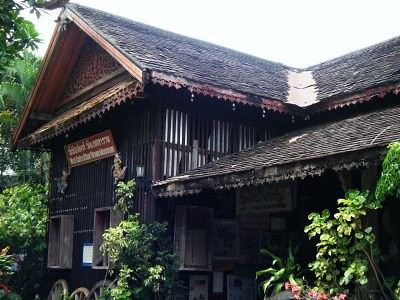
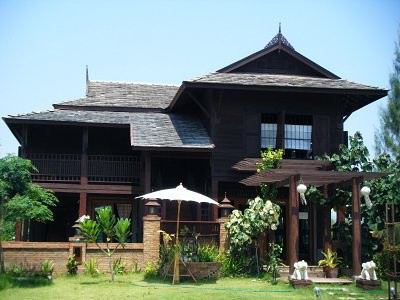
Here are two examples of gables: one with an extended gable, the other completely closed with a beautiful carved wooden lattice panel.
L
J
Thanks so much for all your super interesting info! 🙂 I just got back from work and I’m checking out your tips right now. My budget is 800,000 baht for 2 rai of land. I’m leaving Nice on October 17th for Bangkok with my wife and our four kids. I’ll take the opportunity to meet a builder and do as you suggested—check out what they’re currently working on or have already done to get an idea of the quality of their work. However, for the construction, it’s my father-in-law who’ll be supervising the work. If you know any builders in the Jaturat or Chaiyaphum area, I’d love to hear about them! Thanks again for your help! 🙂
You might also like
 From Bangkok to Krabi, Thailand by Car!
Travel logs › Thailand·292 photos
 Far from the daily grind*
Travel logs › Thailand·88 photos
 Trip to Thailand and Laos
Travel logs › Thailand / Laos·264 photos
 All Over Thailand
Travel logs › Thailand·257 photos
 Memories of Thailand
Photographie et vidéo › Thailand·299 photos
 Thailand via Kuala Lumpur
Travel logs › Thailand·117 photos
 Polynesia: How to choose between the Society Islands, Tuamotu, and the Marquesas?
Features › French Polynesia·4 photos
 A Few Days in Turkmenistan from Uzbekistan
Travel logs › Turkmenistan·73 photos