for anyone who wants to learn a little more about the SOLAS treaty:
http://fr.wikipedia.org/wiki/Solas
Costa Concordia: the investigation
Translated into English.
763 replies

Mondialist· 15 years ago
.............../.................If it had been compartmentalized according to the rules imposed from 2009 onwards, you can imagine the ship could have stayed afloat......./...............
Hi Arsène, That's exactly what I thought from the very beginning of this whole affair: if the Concordia had had properly functioning watertight bulkheads, it could have stayed afloat without any trouble. Completely compartmentalizing all cruise ships shouldn't be an insurmountable problem. J.

Mattaf· 15 years ago
Hello everyone!
I'd like to weigh in, since I don't entirely agree...
Yes, but the Concordia didn't sink, it ran aground. It stayed afloat long enough for that maneuver to be carried out.
Bulkheads don't work or not work. They're structural elements of the ship. They're "walls" with watertight doors. And those doors did their job, otherwise it would indeed have sunk; and quickly too given the size of the breach.
I think the compartments thing is a red herring. As after every disaster, experts will meet to review the standards. Fine, it's not my place to comment on that. But we shouldn't forget that the purpose of compartmentalizing a ship is to prevent complete flooding following a leak.
Once again, everything worked. The problem that arose for the command was whether to capsize or not. But that's a matter of free surface effect, not compartmentalization. Once the flooded compartments were isolated, the ship stopped taking on water. We mustn't forget that with a 60 or 70 meter long breach, bulkheads or not, your chances of saving the ship are very limited.
For a civilian vessel, I don't quite understand the point of compartmentalizing above the bulkhead deck, since in civilian shipping a breach can only come from below the waterline (as here, by the way).
Yes it would, because with total vertical subdivision you say goodbye to the big ballrooms and large reception halls. These halls (I don't know exactly what they're called) are the characteristic feature of cruise ships; saying goodbye to them is unthinkable, both for the shipowner and for the passengers, and that's normal. Especially since they're above the bulkhead deck, so they don't pose a major problem. In this case, these parts of the Concordia were not flooded...
Putting everything down to the compartments is a bit easy and won't help us move forward in my opinion... Once again, with a 60-meter-long breach, there's nothing you can do.
If you want a "telling" example, in '71 the Surcouf (a fleet escort like in the movie Crabe Tambour) was rammed by a tanker in its center. It was cut in two. Both parts kept floating. The front part sank during towing operations (by the Tartu...) being less stable due to the superstructures. But the rear part held up perfectly, and the Navy even used it afterwards for target practice. So yes, compartmentalization works, and has for a long time...
Let's not forget that there are roughly 150 shipwrecks per year on the world's seas. At the same time as the Concordia, off the coast of Brittany, a trawler was sinking, killing 3 people (i.e. the entire crew). In Papua New Guinea a passenger ferry was also sinking, we're currently talking about 350 deaths... So about thirty victims out of 4200 people... It's terrible to say this, but ultimately it's not much, the standards (even before 2009) work perfectly.
We mustn't lose sight of the fact that the sea is dangerous. The sea has always killed and will kill again, whatever the construction standards may be. The first thing you learn as a sailor (whatever your rank) is to be humble before the "elements". The sea will always have the last word... Clearly, one can blame the Concordia's command for having lost sight of these facts. And as long as Officers have this mindset, there will be disasters, disregarding compartments and other ship design methods...
Last point, if we start talking about "compartmentalization" we need to distinguish the axis we're talking about. There's the vertical axis which determines the compartments (the bulkheads in the vertical direction), and the horizontal axis (the decks). This gives you a 3D grid of the ship that "compartmentalizes" your structures. We can increase the number of compartments, but here that's not the issue (once again it's the free surface effect). Increasing the height of the bulkhead deck isn't useful here either, since the breach was below the waterline...
Here are a few thoughts that the forum messages inspired in me at the crack of dawn... If you'd like to discuss this at greater length, don't hesitate to ask questions!!
Anyway, have a good day everyone!
Nicolas
I'd like to weigh in, since I don't entirely agree...
If it had been compartmentalized according to the rules imposed from 2009 onwards, we can imagine that the ship could have stayed afloat
Yes, but the Concordia didn't sink, it ran aground. It stayed afloat long enough for that maneuver to be carried out.
the Concordia had watertight bulkheads that were working normally
Bulkheads don't work or not work. They're structural elements of the ship. They're "walls" with watertight doors. And those doors did their job, otherwise it would indeed have sunk; and quickly too given the size of the breach.
I think the compartments thing is a red herring. As after every disaster, experts will meet to review the standards. Fine, it's not my place to comment on that. But we shouldn't forget that the purpose of compartmentalizing a ship is to prevent complete flooding following a leak.
Once again, everything worked. The problem that arose for the command was whether to capsize or not. But that's a matter of free surface effect, not compartmentalization. Once the flooded compartments were isolated, the ship stopped taking on water. We mustn't forget that with a 60 or 70 meter long breach, bulkheads or not, your chances of saving the ship are very limited.
For a civilian vessel, I don't quite understand the point of compartmentalizing above the bulkhead deck, since in civilian shipping a breach can only come from below the waterline (as here, by the way).
Completely compartmentalizing all cruise ships shouldn't be an insurmountable problem.
Yes it would, because with total vertical subdivision you say goodbye to the big ballrooms and large reception halls. These halls (I don't know exactly what they're called) are the characteristic feature of cruise ships; saying goodbye to them is unthinkable, both for the shipowner and for the passengers, and that's normal. Especially since they're above the bulkhead deck, so they don't pose a major problem. In this case, these parts of the Concordia were not flooded...
Putting everything down to the compartments is a bit easy and won't help us move forward in my opinion... Once again, with a 60-meter-long breach, there's nothing you can do.
If you want a "telling" example, in '71 the Surcouf (a fleet escort like in the movie Crabe Tambour) was rammed by a tanker in its center. It was cut in two. Both parts kept floating. The front part sank during towing operations (by the Tartu...) being less stable due to the superstructures. But the rear part held up perfectly, and the Navy even used it afterwards for target practice. So yes, compartmentalization works, and has for a long time...
Let's not forget that there are roughly 150 shipwrecks per year on the world's seas. At the same time as the Concordia, off the coast of Brittany, a trawler was sinking, killing 3 people (i.e. the entire crew). In Papua New Guinea a passenger ferry was also sinking, we're currently talking about 350 deaths... So about thirty victims out of 4200 people... It's terrible to say this, but ultimately it's not much, the standards (even before 2009) work perfectly.
We mustn't lose sight of the fact that the sea is dangerous. The sea has always killed and will kill again, whatever the construction standards may be. The first thing you learn as a sailor (whatever your rank) is to be humble before the "elements". The sea will always have the last word... Clearly, one can blame the Concordia's command for having lost sight of these facts. And as long as Officers have this mindset, there will be disasters, disregarding compartments and other ship design methods...
Last point, if we start talking about "compartmentalization" we need to distinguish the axis we're talking about. There's the vertical axis which determines the compartments (the bulkheads in the vertical direction), and the horizontal axis (the decks). This gives you a 3D grid of the ship that "compartmentalizes" your structures. We can increase the number of compartments, but here that's not the issue (once again it's the free surface effect). Increasing the height of the bulkhead deck isn't useful here either, since the breach was below the waterline...
Here are a few thoughts that the forum messages inspired in me at the crack of dawn... If you'd like to discuss this at greater length, don't hesitate to ask questions!!
Anyway, have a good day everyone!
Nicolas

Arsene83· 15 years ago
hello everyone;
especially to Mondialist and Nicolas for their views on this case that fascinates us.
In your explanation, Nicolas, several things bother me. and with all friendliness, allow me to present them to you:
it seems to me and there's not a shadow of doubt that without the proximity of land and the providential grounding; the sinking was inevitable. one only has to look at the position of the ship a few hours after the evacuation
of course everything I'm going to write here, as far as I know, will be within the limits of my limited knowledge. And precisely if we refer to the report of the Chairman of COSTA (previous report), it would seem that at least one of the watertight doors did not work. the breach of more than 60 meters would have affected 2 compartments. Due to the structure, if only 2 compartments had been flooded, the ship would have stayed afloat much longer. Unfortunately, in all likelihood, one of the watertight doors isolating the structure from the propulsion electrical room did not work. This would have caused the electrical blackout which however would not have been fatal. But the flooding of an additional watertight compartment (that of the electric propulsion compartment) got the better of the balance due to the hull.
According to some experts, if the ship's structure had been compliant with the 2009 SOLAS convention, the ship could have resisted flooding much longer Certainly with more than the 3 compartments currently flooded. Moreover the electric propulsion room could have been spared, which would have kept the ship maneuverable.
Indeed, for those who haven't read the report on the SOLAS convention; the upgrading of the convention resulted in a better distribution of compartments In ships built after 2009, the compartments are not more numerous but distributed differently: they are more numerous where the ship is most vulnerable, at the ends and on the sides for example, and less numerous in the center. This allows for larger lounges with better passive safety.
In your explanation, Nicolas, several things bother me. and with all friendliness, allow me to present them to you:
Yes, but the Concordia didn't sink, it was run aground. It stayed afloat long enough to carry out this maneuver.
it seems to me and there's not a shadow of doubt that without the proximity of land and the providential grounding; the sinking was inevitable. one only has to look at the position of the ship a few hours after the evacuation
The bulkheads either work or they don't. They are structural elements of the ship. They are "walls" with watertight doors. And these doors did work, at least they fulfilled their role, otherwise it would indeed have sunk; and quickly too given the size of the breach..
of course everything I'm going to write here, as far as I know, will be within the limits of my limited knowledge. And precisely if we refer to the report of the Chairman of COSTA (previous report), it would seem that at least one of the watertight doors did not work. the breach of more than 60 meters would have affected 2 compartments. Due to the structure, if only 2 compartments had been flooded, the ship would have stayed afloat much longer. Unfortunately, in all likelihood, one of the watertight doors isolating the structure from the propulsion electrical room did not work. This would have caused the electrical blackout which however would not have been fatal. But the flooding of an additional watertight compartment (that of the electric propulsion compartment) got the better of the balance due to the hull.
According to some experts, if the ship's structure had been compliant with the 2009 SOLAS convention, the ship could have resisted flooding much longer Certainly with more than the 3 compartments currently flooded. Moreover the electric propulsion room could have been spared, which would have kept the ship maneuverable.
Indeed, for those who haven't read the report on the SOLAS convention; the upgrading of the convention resulted in a better distribution of compartments In ships built after 2009, the compartments are not more numerous but distributed differently: they are more numerous where the ship is most vulnerable, at the ends and on the sides for example, and less numerous in the center. This allows for larger lounges with better passive safety.
Mattaf· 15 years ago
Hi Arsène!
No worries! I'm happy to read your reply!
Totally agree! And I'm not disputing it at all. But let's get our terms straight. Shipwreck doesn't mean much. The Concordia didn't sink, in the Titanic sense if you will. There was a risk of capsizing. But as I explained earlier, you absolutely have to distinguish between the two phenomena:
- the ship will sink if it takes on water continuously (it can actually sink without capsizing, look at the Titanic resting on its keel at the bottom of the sea...) - the ship capsizes because it has taken on a certain amount of water, thus altering the balance of the centers of gravity and buoyancy (see page 3 of this thread for my explanation).
In this context, the doors and bulkheads can only prevent total flooding. The "problem" with the Concordia comes from the size of the breach. Making 10-meter-wide sections instead of 20 or 30 won't change anything. With a 70m-long breach, you'll end up with 6 flooded sections instead of 2... But no change in the amount of water taken on (and therefore the risk of capsizing...).
Certainly, I have no idea. But I'm not convinced it's relevant. The blackout could come from elsewhere: for example: a short circuit, or a circuit breaker (a safety feature that trips the main electrical circuit in case of water ingress). It was then reconnected by bypassing the flooded areas. That helps avoid fires. But another point: under normal operating conditions, the ship's electricity is supplied by the main engines (just like in your car, the engines drive an alternator that generates current).
Shut down the engines and you'll cut the ship's power. You'll then need to start the emergency generators to get some power back.
Finally, even with normal electricity generation, you'll never drive the shaft lines... Unless you're sailing on (or in...) a U-boat... lol!! Personally, I'm even impressed that they could turn (even at low speed) a bow thruster.
I've always been told that emergency power allows you to regain steering control, minimal interior lighting, and ensure communications. We were taught not to expect more...
Another detail: the helm (actually the rudder) only has an effect if the ship has some speed (but you can always try to scull otherwise... lol!).
Last point: a personal comment, binding only myself, and not necessarily related to the Concordia. Rewriting the regulations for the umpteenth time, I don't believe in that. If we exclude the walnut shells sailing in Third World waters, there haven't been any other "accidents" for a long time except: - peril of the sea: an unpredictable and devastating natural event that you can't do anything about, apart from gritting your teeth and manning the battle stations (a rogue wave for example). - human error.
We can talk about human error all night long. Without throwing stones at anyone. But: merchant ships aren't sufficiently crewed, some captains aren't rigorous enough in their navigation. And believe me, even on a warship with a cannon in front, in the Mediterranean or the Red Sea, you'll be up to your neck in "traffic". You quickly learn not to count on the tanker heading straight at you at 20 knots avoiding you... But I'm not generalizing, it's a tough job and 99.999% of Merchant Navy officers are very competent, leaving the 0.0001% who make headlines...
That said, I'm not talking about a captain who passes 150 meters from the coast without a chart...
As usual, if you have any questions!
Nicolas
No worries! I'm happy to read your reply!
it seems to me and there's not a shadow of a doubt that without the nearby shore and the providential grounding, the shipwreck was inevitable
Totally agree! And I'm not disputing it at all. But let's get our terms straight. Shipwreck doesn't mean much. The Concordia didn't sink, in the Titanic sense if you will. There was a risk of capsizing. But as I explained earlier, you absolutely have to distinguish between the two phenomena:
- the ship will sink if it takes on water continuously (it can actually sink without capsizing, look at the Titanic resting on its keel at the bottom of the sea...) - the ship capsizes because it has taken on a certain amount of water, thus altering the balance of the centers of gravity and buoyancy (see page 3 of this thread for my explanation).
In this context, the doors and bulkheads can only prevent total flooding. The "problem" with the Concordia comes from the size of the breach. Making 10-meter-wide sections instead of 20 or 30 won't change anything. With a 70m-long breach, you'll end up with 6 flooded sections instead of 2... But no change in the amount of water taken on (and therefore the risk of capsizing...).
Unfortunately, in all likelihood one of the watertight doors isolating the propulsion electrical room didn't work.
Certainly, I have no idea. But I'm not convinced it's relevant. The blackout could come from elsewhere: for example: a short circuit, or a circuit breaker (a safety feature that trips the main electrical circuit in case of water ingress). It was then reconnected by bypassing the flooded areas. That helps avoid fires. But another point: under normal operating conditions, the ship's electricity is supplied by the main engines (just like in your car, the engines drive an alternator that generates current).
Shut down the engines and you'll cut the ship's power. You'll then need to start the emergency generators to get some power back.
Finally, even with normal electricity generation, you'll never drive the shaft lines... Unless you're sailing on (or in...) a U-boat... lol!! Personally, I'm even impressed that they could turn (even at low speed) a bow thruster.
I've always been told that emergency power allows you to regain steering control, minimal interior lighting, and ensure communications. We were taught not to expect more...
Another detail: the helm (actually the rudder) only has an effect if the ship has some speed (but you can always try to scull otherwise... lol!).
Last point: a personal comment, binding only myself, and not necessarily related to the Concordia. Rewriting the regulations for the umpteenth time, I don't believe in that. If we exclude the walnut shells sailing in Third World waters, there haven't been any other "accidents" for a long time except: - peril of the sea: an unpredictable and devastating natural event that you can't do anything about, apart from gritting your teeth and manning the battle stations (a rogue wave for example). - human error.
We can talk about human error all night long. Without throwing stones at anyone. But: merchant ships aren't sufficiently crewed, some captains aren't rigorous enough in their navigation. And believe me, even on a warship with a cannon in front, in the Mediterranean or the Red Sea, you'll be up to your neck in "traffic". You quickly learn not to count on the tanker heading straight at you at 20 knots avoiding you... But I'm not generalizing, it's a tough job and 99.999% of Merchant Navy officers are very competent, leaving the 0.0001% who make headlines...
That said, I'm not talking about a captain who passes 150 meters from the coast without a chart...
As usual, if you have any questions!
Nicolas
Arsene83· 15 years ago
Certainly, I have no idea. But I'm not convinced that's relevant. The blackout could come from elsewhere: for example, a short circuit, or a circuit breaker (a safety device that trips the main electrical circuit in case of water ingress). It must then be reconnected by bypassing the flooded areas. This helps prevent fires. But another point: under normal operating conditions, the ship's electricity is supplied by the main engines (exactly like in your car, the engines drive an alternator that generates current).
Thank you very much for your reply the point you mention was clarified by FOSCHI (chairman of COSTA) at the Italian Senate and was analyzed by their experts it's true that this hearing is tedious but it is rich in lessons. In his presentation, Chairman & CEO of Costa Crociere SpA, Pier Luigi Foschi, tells us COSTA's analysis of the chain of failures:
It's the malfunction of a forward watertight door on the ship that caused the loss of control.
A/on the consequences: 1/The massive invasion of water into the compartment of the electrical production areas Electrical production which drives the propulsion of certain main propellers 2/stop of the latter, but also total blackout due to short circuits 3/ the blackout nullifies the action of the bilge pumps which no longer have power. 4/ the emergency generator is slow to start because its control station is located in a different part of the ship but must also be activated by the main control station.
B/on the causes of the failure to close this watertight door: 1/the impact would have damaged the structure of the ship 2/the impact would have damaged the compressor operating this door 3/ he dismisses all other causes, citing the reports of the RINA company and arguing that it was inspected this month in San DIEGO
on the technical aspect FOSCHI, through his experts, confirms that the propulsion of the CONCORDIA is entirely electric and that the machinery serves to provide electrical energy to the motor (that's what I understood)
According to my little analysis and I remind you that I'm not a specialist; If this electrical room supplying all the electrical energy to the motors driving the propellers was invaded by seawater, there must have been quite a fireworks display!!!
As for the rest, I completely agree with you, there will always be "specialists craving recognition" and "human errors"; I do acknowledge however that COSTA's experts are not in the first camp - they have too much to lose: prison is near! And that they can hardly be in the second, in hindsight the errors are detectable or correctable with perspective. Perhaps they could be blamed for a certain bias... we'll see!
Regarding the standards: Unfortunately we will never know 100% what would have happened if the CONCORDIA had been built according to SOLAS 2009 However we cannot question this standard. It exists because certain recognized specialists deemed it good for navigation that this be so One cannot refute this system without falling into the darkest obscurantism.
Arsene83· 15 years ago
😐
the news about the case is sad this morning
AFP The Italian civil protection agency, the structure headed by Mr. Gabrielli, indicated that the bodies had been found inside deck number 4 following testimony from survivors about where victims might be located.
Le Parisien: The bodies of eight other victims of the Costa Concordia shipwreck were discovered Wednesday in the submerged part of the vessel and three have already been recovered. The bodies were located Wednesday inside deck number 4 following testimony from survivors. Of the four bodies discovered in the morning, three were recovered. "But the last body as well as the four discovered later could not be recovered due to bad weather conditions. If the weather permits we will try again from Thursday morning," said Francesca Maffini, spokesperson for Franco Gabrielli, government commissioner in charge of managing this disaster. Among the bodies brought ashore were those of a man, a woman and a child, a five-year-old Italian girl, Dayana, who was on a cruise with her father and whose fate moved the whole country.
Mattaf· 15 years ago
Hi Arsène!
To answer you:
Completely agree with you on these points.
That the impact damaged the structure is not impossible at all. I hadn't considered this hypothesis at all. To be continued then....
On the other hand, that's impossible... As far as I know there's only one ship in the world that runs fully electric, it's a solar ship (can't remember its name...). There's a fuel oil engine in all ships (or else it's a sailboat, or nuclear propulsion like the aircraft carrier...). The fuel oil engine (turbine or classic engine) drives the shaft lines and turns an alternator that provides the ship's electricity. Exactly like your car. There's no electric motor for the shaft lines, it's an energy nonsense (except on a U-boat....)
Besides, the pumping of the fuel oil tanks is underway.
The flooding of the engine compartments generally causes a power cut for two reasons (mainly): - either the diesels are flooded so they stop running - or there's a main circuit breaker
I absolutely do not question the construction standards, which saved 4199 people out of 4229. However, I regret that the current debate only revolves around these construction standards, or whether the captain pulled his stunt or not before going up to the bridge.
My opinion as a watch officer is that the accident was due to a navigation error, therefore human. It would be more appropriate to question the watch schedule in the merchant navy (I'm not blaming the crews or the Officers, but the shipowners) and the laxity sometimes observed in navigation (compliance with collision avoidance rules, rigor in route plotting...).
Once again, at the risk of repeating myself, there is no chart (paper, GPS, whatever...) that allows navigation so close to the coast in this area. As said before, this was done once (and only once) in consultation with the local coast guards who know the area perfectly. They know it from frequenting it daily (and generally since their youngest age). They don't need charts and know everything by heart.
When I learned about the shipwreck (Sunday noon I remember on the news), we were 2 sailors, including one with 5 stripes aged 35. Our reaction seeing the images was to say to ourselves "another one who wasn't following navigation...", before spitting on the GPS... lol!!
A month later, with the investigation underway, I regret that we take refuge in questions of standards and structural calculation hypotheses...
The standards did their job. Instead of sinking straight down in half an hour, it was possible to evacuate (almost) all the personnel and the hull still hasn't sunk a month later.
Anyway, to be honest, all this disgusts me a bit... But at the same time, it's not disasters that make things move forward, we'd know...
Best regards, Nicolas
To answer you:
A/on the consequences:
3/ the blackout kills the action of the bilge pumps which no longer have power. 4/ the emergency generator is slow to start because its control station is located in a different part of the ship but must also be activated from the main control station.
Completely agree with you on these points.
B/on the causes of this watertight door not closing: 1/the impact would have damaged the ship's structure 2/the impact would have damaged the compressor operating this door 3/ it rules out all other causes, citing the reports from the RINA company and arguing it was inspected this month in San DIEGO
That the impact damaged the structure is not impossible at all. I hadn't considered this hypothesis at all. To be continued then....
on the technical aspect FOSCHI hiding behind his experts confirms that the CONCORDIA's propulsion is entirely electric and that the machinery serves to provide electrical power to the engine
On the other hand, that's impossible... As far as I know there's only one ship in the world that runs fully electric, it's a solar ship (can't remember its name...). There's a fuel oil engine in all ships (or else it's a sailboat, or nuclear propulsion like the aircraft carrier...). The fuel oil engine (turbine or classic engine) drives the shaft lines and turns an alternator that provides the ship's electricity. Exactly like your car. There's no electric motor for the shaft lines, it's an energy nonsense (except on a U-boat....)
Besides, the pumping of the fuel oil tanks is underway.
If this electrical room providing all the electrical power to the motors driving the propellers was flooded with seawater, there must have been quite a fireworks show!!!
The flooding of the engine compartments generally causes a power cut for two reasons (mainly): - either the diesels are flooded so they stop running - or there's a main circuit breaker
I absolutely do not question the construction standards, which saved 4199 people out of 4229. However, I regret that the current debate only revolves around these construction standards, or whether the captain pulled his stunt or not before going up to the bridge.
My opinion as a watch officer is that the accident was due to a navigation error, therefore human. It would be more appropriate to question the watch schedule in the merchant navy (I'm not blaming the crews or the Officers, but the shipowners) and the laxity sometimes observed in navigation (compliance with collision avoidance rules, rigor in route plotting...).
Once again, at the risk of repeating myself, there is no chart (paper, GPS, whatever...) that allows navigation so close to the coast in this area. As said before, this was done once (and only once) in consultation with the local coast guards who know the area perfectly. They know it from frequenting it daily (and generally since their youngest age). They don't need charts and know everything by heart.
When I learned about the shipwreck (Sunday noon I remember on the news), we were 2 sailors, including one with 5 stripes aged 35. Our reaction seeing the images was to say to ourselves "another one who wasn't following navigation...", before spitting on the GPS... lol!!
A month later, with the investigation underway, I regret that we take refuge in questions of standards and structural calculation hypotheses...
The standards did their job. Instead of sinking straight down in half an hour, it was possible to evacuate (almost) all the personnel and the hull still hasn't sunk a month later.
Anyway, to be honest, all this disgusts me a bit... But at the same time, it's not disasters that make things move forward, we'd know...
Best regards, Nicolas
M
Montérégie· 15 years ago
RE: on the technical aspect, FOSCHI, hiding behind his experts, confirms that the CONCORDIA's propulsion is entirely electric and that the machinery is used to supply electrical power to the engine  However, that's impossible... To my knowledge, there's only one ship in the world that runs fully electric, it's a solar-powered ship (can't remember its name...). There's a fuel oil engine on every ship (or else it's a sailboat, or nuclear propulsion like the PA...). The fuel oil engine (turbine or conventional engine) drives the shaft lines and turns an alternator that supplies the ship's electricity. Just like your car. There's no electric motor for the shaft lines, it's energy nonsense (except on a U-boat...).
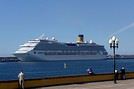
Last November I was on RC's Adventure of the Seas. To my great surprise, I learned that this ship's main propulsion—3 propellers—were each driven by a double-wound three-phase synchronous motor. To power these motors there are 6 Wärtsilä Diesel 12v46 generators producing 12 600 kw each for a total power of 75 600kw or 103 345 BHP. Same principle for the bow thrusters. I have the technical data sheet in front of me, unfortunately I don't have a scan to send you the whole thing.
However, that's impossible... To my knowledge, there's only one ship in the world that runs fully electric, it's a solar-powered ship (can't remember its name...). There's a fuel oil engine on every ship (or else it's a sailboat, or nuclear propulsion like the PA...). The fuel oil engine (turbine or conventional engine) drives the shaft lines and turns an alternator that supplies the ship's electricity. Just like your car. There's no electric motor for the shaft lines, it's energy nonsense (except on a U-boat...).Last November I was on RC's Adventure of the Seas. To my great surprise, I learned that this ship's main propulsion—3 propellers—were each driven by a double-wound three-phase synchronous motor. To power these motors there are 6 Wärtsilä Diesel 12v46 generators producing 12 600 kw each for a total power of 75 600kw or 103 345 BHP. Same principle for the bow thrusters. I have the technical data sheet in front of me, unfortunately I don't have a scan to send you the whole thing.
Charleslebon· 15 years ago
Hi everyone,
I don't quite understand this explanation, Montérégie 😉
First you say it can't be electric, then you say the generators produce electricity ??????
- That's what I gathered from the explanations given about Costa ships. - We were always told that diesel was used to generate electricity, which in turn powered the propeller motors. Because diesel consumption would be much higher if it directly powered those same propellers.
At least that's what I understood! 😉
Show 10 more replies
M
Montérégie· 15 years ago
I was replying to Mattaf—if you read the first paragraph carefully, it's marked (REF), so I was quoting him.
My reply to him is in the 2nd paragraph.
Is that clearer?
And so you're saying the same thing as me regarding the propulsion of the ship(s)
My reply to him is in the 2nd paragraph.
Is that clearer?
And so you're saying the same thing as me regarding the propulsion of the ship(s)
P
PAP86· 15 years ago
hello everyone!
I'll just chime in here, having no technical expertise whatsoever, to quote what is said (almost constantly, when they say a few words about the engines) by all the Costa hosts who give the "behind the scenes of the Costa xxx" presentation:
"The engines that turn the ship's propellers are electric motors, themselves powered by electricity from generators run by diesel engines. These generators *also* supply all the ship's power..."
But I don't know if that's true or if it's "something to tell the tourists"...
Note for Jacques: you select the piece of text you're quoting and click on the double quote just to the right of G I S
so no more ambiguity 😉
I'll just chime in here, having no technical expertise whatsoever, to quote what is said (almost constantly, when they say a few words about the engines) by all the Costa hosts who give the "behind the scenes of the Costa xxx" presentation:
"The engines that turn the ship's propellers are electric motors, themselves powered by electricity from generators run by diesel engines. These generators *also* supply all the ship's power..."
But I don't know if that's true or if it's "something to tell the tourists"...
Note for Jacques: you select the piece of text you're quoting and click on the double quote just to the right of G I S
As I'm doing in this example
so no more ambiguity 😉
Charleslebon· 15 years ago
However, that's impossible...
But is it really you saying that?
So that still doesn't explain your first paragraph in which you say that the
electric propulsion is not possible
😉
P
PAP86· 15 years ago
Hello Charles
I'm picking up Montérégie's post in the "clear" version where Monteregie replies to Mataff who was replying to Arsène83:
- --
However, that's impossible... As far as I know, there's only one ship in the world that runs entirely on electricity—it's a solar ship (can't remember its name...). There's a fuel oil engine on every ship (or else it's a sailboat, or nuclear propulsion like the aircraft carrier...). The fuel oil engine (turbine or conventional engine) drives the shaft lines and spins an alternator that supplies the ship's electricity. Exactly like your car. There's no electric motor for the shaft lines; it makes no energy sense (except on a U-boat...).
Last November I was on RC's Adventure of the Seas. To my great surprise, I learned that the main propulsion of this ship—its 3 propellers—were each driven by a double-wound three-phase synchronous motor. To power these motors there are 6 Wartila Diesel 12v46 generators producing 12 600 kw each, for a total power of 75 600kw or 103 345 BHP. Same principle for the bow thrusters. I have the technical sheet in front of me; unfortunately, I don't have a scan to send you.
- --
There you go. That makes it clear 😉😉
I'm picking up Montérégie's post in the "clear" version where Monteregie replies to Mataff who was replying to Arsène83:
- --
REF: regarding the technical aspect, FOSCHI, backed by his experts, confirms that the propulsion of the CONCORDIA is entirely electric and that the machinery serves to supply electrical power to the engine
However, that's impossible... As far as I know, there's only one ship in the world that runs entirely on electricity—it's a solar ship (can't remember its name...). There's a fuel oil engine on every ship (or else it's a sailboat, or nuclear propulsion like the aircraft carrier...). The fuel oil engine (turbine or conventional engine) drives the shaft lines and spins an alternator that supplies the ship's electricity. Exactly like your car. There's no electric motor for the shaft lines; it makes no energy sense (except on a U-boat...).
Last November I was on RC's Adventure of the Seas. To my great surprise, I learned that the main propulsion of this ship—its 3 propellers—were each driven by a double-wound three-phase synchronous motor. To power these motors there are 6 Wartila Diesel 12v46 generators producing 12 600 kw each, for a total power of 75 600kw or 103 345 BHP. Same principle for the bow thrusters. I have the technical sheet in front of me; unfortunately, I don't have a scan to send you.
- --
There you go. That makes it clear 😉😉
M
Montérégie· 15 years ago
I'M JUST PICKING THIS UP FOR YOU!
However, that's impossible... To my knowledge there's only one ship in the world that runs fully electric, it's a solar ship (can't remember its name...). There's a fuel oil engine in all ships (or else it's a sailboat, or nuclear propulsion like the PA...). The fuel oil engine (turbine or conventional engine) drives the shaft lines and turns an alternator that supplies the ship's electricity. Exactly like your car. There's no electric motor for the shaft lines, it's an energy nonsense (except on a U boot....)
That's MATTAF's statement
AND I replied to him with this::
Last November I was on Royal Caribbean's Adventure of the Seas. To my great surprise I learned that the main propulsion of this ship, 3 propellers, were each driven by a double-wound three-phase synchronous motor. To power these motors there are 6 Wartila Diesel 12v46 generators producing 12 600 kw each for a total power of 75 600kw or 103 345 BHP. Same principle for the bow thrusters. I have the spec sheet in front of me, unfortunately I don't have a scanner to send it all to you.
[/cita
P
M
Montérégie· 15 years ago
A bit of trouble with the quotes but I'm getting to it these days.🙁
You learn at any age.😉
Thanks
You learn at any age.😉
Thanks
C
Condor1· 15 years ago
If I understand the explanations given by Montérégie, the propulsion of cruise ships is identical in every respect to how large freight train locomotives work—that is, the diesel engine is only used to drive a generator to produce the electricity needed to power the wheel motors. This system is much more flexible and efficient than using a diesel engine alone to produce the motive force for the propellers. This diesel engine-generator-electric traction motor combination is also used on very large mining trucks.
Arsene83· 15 years ago
Haaaa!!! as soon as we get into stories that make no sense, some people get lost!!!😛
I'm joking of course, and I'm glad Charleslebon is taking this thread more seriously.
Mattaf I think Montérégie did specify the system I visited. It's a shame we don't have the diagram mentioned, but maybe we could find it online.
The much-discussed principle of electric motor efficiency is applied here. PAP summed up this principle, I won't go back over it.
However, it's a fact that on this type of ship there's a compartment that centralizes the electrical power sent to the propulsion, and that's the compartment that would have flooded.
But in all likelihood, it wasn't the electrical blackout that caused the grounding, but the hull effect from the flooding of this third compartment. Even though the blackout and the relatively long time to activate the emergency systems didn't help matters
I'm writing here to the best of my current knowledge, thanking the participants in this thread for these constructive exchanges and criticisms.
Charleslebon· 15 years ago
Hi everyone,
Well, here it is!!! 😉
"What is well conceived is clearly expressed....!!!!!" he said! 😉😉😉
Well, here it is!!! 😉
"What is well conceived is clearly expressed....!!!!!" he said! 😉😉😉
You might also like
 Tuscany: Arezzo province and the Siena area
Travel logs › Italy·286 photos
 Two weeks under the Puglia sun
Travel logs › Italy·275 photos
 Visiting Bologna in Photos
Travel logs › Italy·45 photos
 Autumn trip from Puglia to Naples via Basilicata...
Travel logs › Italy·149 photos
 A "relaxed" 16-day tour of Corsica in autumn 2024
Travel logs › France › Corsica·274 photos
 Southern landscapes, northern wildlife: returning to South Africa
Travel logs › South Africa·260 photos
 Discovering Kyrgyzstan by marshrutka, hitchhiking, on foot and on horseback – Father/Daughter Trip
Travel logs › Kyrgyzstan·270 photos
 Polynesia: How to choose between the Society Islands, Tuamotu, and the Marquesas?
Features › French Polynesia·4 photos