Excuse me Major for posting the following "homemade" translation of Corsairt's long post that I found very interesting, but perhaps I'm a bit biased...
In January 2012, the Costa Concordia cruise ship ran aground in dangerous waters, costing lives and alarming the industry. Frances Cook speaks to industry experts about the technology and procedures needed to help passengers and crew in perilous situations.
Although the Concordia incident was a tragic disaster, with 17 confirmed deaths and many missing, disasters of this magnitude are fortunately rare nowadays. However, regular accidents, albeit on a smaller scale, still occur at sea. According to the Maritime Accident Review, in 2009, 626 ships were involved in 540 serious accidents in EU waters, accidents such as shipwrecks, collisions, groundings and fires.
However, in terms of passenger ships, 135 (121 ferries and 14 cruise ships) were reported as being involved in accidents in 2009, with a loss of life of four in 2009 and six in 2008.
In the EMSA review (European Maritime Safety Agency) notes that there were several accidents in 2009 that "could have had a worse outcome". The Concordia disaster perhaps best embodies this potential for averted disaster, under the spotlight this industry has led to a review of its safety and emergency procedures
"In the EMSA review (European Maritime Safety Agency) notes that there were several accidents in 2009 that 'could have had a worse outcome'." On February 9, 2012, a new emergency policy was announced. Under the International Convention for the Safety of Life at Sea (SOLAS), passenger drills will now take place before departure from port.
On the Concordia, 700 passengers boarded at Civitavecchia a few hours before the accident and had not been briefed on muster stations. Because this was supposed to be done the next day (the policy at the time required this to be done within 24 hours).
In an emergency situation, such as that of the Concordia on January 13, what emergency procedures should be followed?
"The emergency procedure is to gather everyone at the muster station," said Dr Tom Allan, an international maritime consultant. "If the captain then decides to abandon ship, passengers are escorted from their muster station to the lifeboat station where they are then loaded onto lifeboats. For the majority of ships, the lifeboats are then lowered so that they are level with the embarkation deck and passengers enter through the lifeboat entrances. This general principle is the same on all ships.
The list affecting lifeboats
Although many Concordia passengers managed to escape in lifeboats, the ship's list, which was about 20 degrees, hampered evacuation efforts. Lifeboats are designed to operate with a negative list of 20 degrees.
"If the list is more than 20 degrees, it will be extremely difficult to launch the lifeboats," confirmed Allan. "Even attempts to move people from one side of the ship to the other become more difficult; transverse corridors become tunnels, shafts. Normally an evacuation should take place well before reaching this point."
Cruise route issues
According to Lloyd's List Intelligence, automatic tracking systems showed that the route Captain Francesco Schettino took the Concordia that night was much closer to the island than on the previous cruise, that of January 6, 2012.
However, they also show a pre-approved route taken in August 2011 that passed near the island. Piet Luigi Foschi, president of Costa Cruises, confirmed at a press conference that this pre-approved close route was "no less than 500 meters" from the island. Video footage shows the captain interviewed confirming that the ship was less than 300 meters from the shore. He explained in another interview that he was sailing along the coast with the "tourist navigation system" and that the "rocks were detected not at the front of the ship, but when they were on the side". He also claimed that the nautical chart showed there was "enough water at 100-150 meters from the rocks", which is why, at 300 meters, he believed the ship would not touch.
Navigation technology But could navigation technology really have failed?
"Every ship knows where it is with submerged hazards, that's what the electronic chart does for you, and as for floating hazards, the radar," explained John Davis, marketing director at Kelvin Hughes. "Thus, identification of floating and submerged hazards should be sufficient." He added: "Navigation equipment goes through a long approval process before it is on a ship. The IMO has set performance standards and the IEC has created test programs so that all navigation equipment is rigorously tested before getting approval to equip a ship."
Design issues 'for the new generation of ships'
Even as investigators work on the causes of accidents, questions have been raised about the design of cruise ships, which have changed dramatically since the Titanic 100 years ago.
"Although there have been criticisms surrounding the evacuation of the Concordia, Allan says that the fact that 99.5% of people were rescued in such a situation was no small feat." "Most modern cruise ships are built on the same deck plan, off-axis (Translator's note: 'beam' I don't know the nautical term) beam?, with a draft of about 10m to enter shallow anchorages, and have a short length to accommodate berth cabins," said Captain Paul Townsend.
"Can you imagine all the large buildings in the world with the same deep draft (same?)?" He added: "our naval architects are usually employed by the ship owner and not independent, they design this floating block of apartments - where this generation is double the previous one - carrying 4,000 passengers and 1,000 crew members. This allows greater efficiency in catering and costs and, consequently, profits, but in terms of ship length, there is no more room for lifeboats along the sides."
Allan, however, stated that the same standards apply to all cruise ships, regardless of size, when it comes to evacuation and safety. "You have to show that you can load and lower the lifeboats within 30 minutes when evacuation is announced," he said. Over the past 40 years, the shipping industry has focused on improving ship structure and improvements in hull design, stability systems, propulsion systems and navigation equipment have been made, and yet the maritime accident rate is still very high
Personnel and system errors
"Although many Concordia passengers managed to escape in lifeboats, with a list of about 20 degrees, evacuation efforts were hampered." "Why? With all the improvements and regulatory changes we implemented over the last decade, have we not significantly reduced the risk of incidents?" said Davis.
"Because the ship's structure and system reliability are the relatively small part in the maritime safety equation. The system is a system of people, and in the human-system error equation (Translator's note: I resist human error) human error features prominently in accident situations, about 75-96% of maritime accidents are due, at least in part, to some form of system error."
Areas where measures can be taken to minimize risks in design include: bridge layout, navigation equipment: focusing on the following: ship speed (ship schedule), crewing levels, crew attitude, maintenance and training.
Townsend believes that failures are often a combination of design and management problems. "I was captain of a RoRo passenger ship the night of the Herald of Free Enterprise disaster (it capsized and 193 people lost their lives) and we had a relief captain traveling with me, so we were able to discuss the matter. Our initial beliefs were completely wrong, the real error was in the design and management."
The importance of training Effective crew training is essential for the proper operation of a cruise ship. Although there have been criticisms surrounding the Concordia evacuation, Allan says that the fact that 99.5% of people were rescued in this situation was no small feat. "The crew", "No matter what is said, we must take just a little credit for that. Training must have been lacking somewhere and that's what was demonstrated there," he said. There will be lessons learned from the Concordia incident, even if these only emerge following the official investigation.
"There are always lessons to be learned about ship evacuation," said Allan. "All operators must provide training in passenger control and management - how you control passengers, especially when panic sets in, is probably the most difficult."
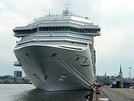

 Vietnam V, the Silver Shadow cruise ship hit a Vietnamese container ship in Ha Long Bay. The cause was thick fog, it can happen, but of course, hearing one piece of news after another (Concordia, Allegra, etc.) is always more impressive.