Hello,
It’s so great to be able to write on this site again—it was such a valuable resource during my travels in the past!
We’re planning a 6-week trip (as a couple) to Nepal in July and August. It’s not the ideal time, I know, but you’ve probably guessed we don’t really have a choice.
I’ve read briefly that it’s doable, that it limits some options (but hey, we always have to make choices anyway), but at least there’s the advantage of not being there during peak season.
Do any of you have experience or advice to share about this? Any tips or opinions?
Thanks, and welcome back to everyone on Voyage Forum!
Thérèse
9 similar discussions in English
hi,
we’d like to do a trek in Nepal, and we’re thinking of the Annapurna Circuit—it’s cheaper than the Everest trek.
Our plan is to do it without a guide or porter. We’re used to the mountains, not so much to high altitude, but if we acclimate well, there’s no reason it should go wrong ;)
No guide = handling permits, transport, and accommodation on our own...
So my question is: is it possible to book lodges in advance before departure? Or, even better, day by day?
I’ve read some older posts, so I’m asking again to get up-to-date info on what’s happening now. We’re planning to go mid-November 2026 or March 2027.
Thanks for your tips! :)
No guide = handling permits, transport, and accommodation on our own...
So my question is: is it possible to book lodges in advance before departure? Or, even better, day by day?
I’ve read some older posts, so I’m asking again to get up-to-date info on what’s happening now. We’re planning to go mid-November 2026 or March 2027.
Thanks for your tips! :)
We did the Langtang trek (hike) from September 10th to 17th, with the first and last days being the trip from Kathmandu and back—so 6 days of actual walking. It’s a fairly well-known trek but certainly not as famous or crowded as those in the Annapurna or Everest regions, which is why we chose it.
In theory, it’s mandatory to have a guide for this trek. In reality, it seems there are ways to bypass the regulations: we met at least two people hiking without a guide—a South Korean, a New Zealander, and possibly also a couple of English women and an American couple, though we’re not sure if they had a guide.
The agency we booked with had told us it was an affordable trek for relatively older people in good shape—which is our case (I’m 72 myself). I have to say upfront that we found it quite challenging, maybe because we didn’t have good weather—it was the end of the monsoon season. To be clear, no matter your fitness level, I’d say doing this trek in the middle of the monsoon season would be suicidal.
Day 1 – Journey from Kathmandu to Syapru Besi
On Monday, September 8th, there had been violent protests in Kathmandu against the government, which had, among other things, blocked access to social media and been accused of nepotism and corruption. There were 19 deaths. The situation was very tense on the day of our departure, Wednesday the 10th. The agency warned us that public transport was very unreliable. So, we decided to take a jeep, at an additional cost of $100 ($160 minus what was already budgeted for the bus).
We left a little before 7 a.m. and it took us a good hour just to reach the outskirts of Kathmandu. Along the way, we saw several houses and vehicles set on fire by protesters.
The road to Syapru Besi is only 120 km, but it’s frankly awful. It’s always narrow, winds through endless mountains, and the shoulders range from bad to confusing to nonexistent. Several sections are just dirt tracks. We didn’t regret opting for the jeep, as we could stop several times at our convenience—if only to let Y (my Thai partner) throw up everything she had. She’d taken her usual motion sickness medication, but the constant turns, accelerations, and braking eventually made her terribly carsick.
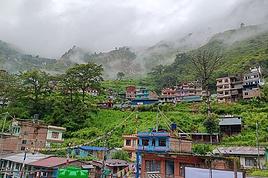
In Nuwakot, we stopped for breakfast at a nice little restaurant, Jimbu. It was around 8:30 a.m., and we’d barely covered 60 km. The restaurant has a lovely garden overlooking the Trishuli Ganga, the river flowing down from Syapru Besi. First photo: the river in the bottom right corner, mist and clouds over the mountain on the other side.
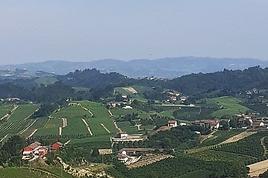
An hour later, my second photo: the hills along the Trishuli Ganga. You can see the different crops—lush green rice paddies in the lower right and corn, already yellowed and likely harvested, in the foreground on the left. And of course, the mist and clouds through which you can glimpse the mountain on the other side of the river.
In theory, it’s mandatory to have a guide for this trek. In reality, it seems there are ways to bypass the regulations: we met at least two people hiking without a guide—a South Korean, a New Zealander, and possibly also a couple of English women and an American couple, though we’re not sure if they had a guide.
The agency we booked with had told us it was an affordable trek for relatively older people in good shape—which is our case (I’m 72 myself). I have to say upfront that we found it quite challenging, maybe because we didn’t have good weather—it was the end of the monsoon season. To be clear, no matter your fitness level, I’d say doing this trek in the middle of the monsoon season would be suicidal.
Day 1 – Journey from Kathmandu to Syapru Besi
On Monday, September 8th, there had been violent protests in Kathmandu against the government, which had, among other things, blocked access to social media and been accused of nepotism and corruption. There were 19 deaths. The situation was very tense on the day of our departure, Wednesday the 10th. The agency warned us that public transport was very unreliable. So, we decided to take a jeep, at an additional cost of $100 ($160 minus what was already budgeted for the bus).
We left a little before 7 a.m. and it took us a good hour just to reach the outskirts of Kathmandu. Along the way, we saw several houses and vehicles set on fire by protesters.
The road to Syapru Besi is only 120 km, but it’s frankly awful. It’s always narrow, winds through endless mountains, and the shoulders range from bad to confusing to nonexistent. Several sections are just dirt tracks. We didn’t regret opting for the jeep, as we could stop several times at our convenience—if only to let Y (my Thai partner) throw up everything she had. She’d taken her usual motion sickness medication, but the constant turns, accelerations, and braking eventually made her terribly carsick.
In Nuwakot, we stopped for breakfast at a nice little restaurant, Jimbu. It was around 8:30 a.m., and we’d barely covered 60 km. The restaurant has a lovely garden overlooking the Trishuli Ganga, the river flowing down from Syapru Besi. First photo: the river in the bottom right corner, mist and clouds over the mountain on the other side.
An hour later, my second photo: the hills along the Trishuli Ganga. You can see the different crops—lush green rice paddies in the lower right and corn, already yellowed and likely harvested, in the foreground on the left. And of course, the mist and clouds through which you can glimpse the mountain on the other side of the river.
Hi there,
I’m heading to Nepal for two months in October/November, including a 20-day trek that I’m planning in Dolpo this time (after the Dhaulagiri Circuit and the Three Passes trek in the Khumbu region in previous years).
1/ Is it possible to organize a trek in Dolpo solo—that is, without going through an agency? (I know permits are mandatory, but I’ve heard conflicting info about whether a guide is required.)
I’m considering one of these two routes: - Lower Dolpo loop + variations - Dunai to Lo Manthang traverse (I’d love any tips if someone’s done this route, especially about resupply points)
2/ If it’s not allowed, are there guides or agencies in Dunai that might offer services? I’d appreciate any local contacts.
3/ Lastly, I’m looking for 1–3 trekking partners. Dates and route to be decided together. Experience with high-altitude trekking would be a plus, but simplicity, a thirst for adventure, and a good sense of humor are non-negotiable. Also, up for a self-sufficient experience (no guide or porters), depending on the answers to the points above.
Thanks in advance for your replies!
Olivier
I’m heading to Nepal for two months in October/November, including a 20-day trek that I’m planning in Dolpo this time (after the Dhaulagiri Circuit and the Three Passes trek in the Khumbu region in previous years).
1/ Is it possible to organize a trek in Dolpo solo—that is, without going through an agency? (I know permits are mandatory, but I’ve heard conflicting info about whether a guide is required.)
I’m considering one of these two routes: - Lower Dolpo loop + variations - Dunai to Lo Manthang traverse (I’d love any tips if someone’s done this route, especially about resupply points)
2/ If it’s not allowed, are there guides or agencies in Dunai that might offer services? I’d appreciate any local contacts.
3/ Lastly, I’m looking for 1–3 trekking partners. Dates and route to be decided together. Experience with high-altitude trekking would be a plus, but simplicity, a thirst for adventure, and a good sense of humor are non-negotiable. Also, up for a self-sufficient experience (no guide or porters), depending on the answers to the points above.
Thanks in advance for your replies!
Olivier
Hi everyone,
I'm heading to Nepal solo for over 3 weeks at the beginning of March and wanted to get your thoughts on this itinerary:
Mon 03/03: Visit Kathmandu in the afternoon (night in Kathmandu) Tue 04/03: Kathmandu (night in Kathmandu) Wed 05/03: Swayambunath – Pashupatinath (night in Kathmandu) Thu 06/03: Kathmandu in the morning then go to Boudhanath (night in Boudhanath) Fri 07/03: Shechen - Patan (night in Boudhanath) Sat 08/03: Bhaktapur (night in Bhaktapur) Sun 09/03: Changu Narayan (night in Bhaktapur) Mon 10/03: Bhaktapur (night in Bhaktapur) Tue 11/03: Panauti – Namo Buddha (night in Dhulikhel – drop off my bag at the hotel in the morning) Wed 12/03: Dhulikhel (night in Dhulikhel) Thu 13/03: Nagarkot (night in Nagarkot) Fri 14/03: Kathmandu Airport – Flight to Chitwan Park (night in Chitwan) Sat 15/03: Chitwan Park (night in Chitwan) Sun 16/03: Chitwan Park (night in Chitwan) Mon 17/03: Departure to Pokhara (6-hour bus ride) (night in Pokhara) Tue 18/03: Pokhara (Poon Hill trek) Wed 19/03: Pokhara (Poon Hill trek) Thu 20/03: Pokhara (Poon Hill trek) Fri 21/03: Pokhara (Poon Hill trek) Sat 22/03: Pokhara (Paragliding or Sarangkot? Is it possible to do both in one day?)
Sun 23/03: Bandipur (night in Bandipur) Mon 24/03: Kathmandu (night in Kathmandu)
I plan to travel mostly by bus and taxi (for destinations where I can’t take the bus), except for the trip from Kathmandu to Chitwan Park, where I’ll take a flight. Should I book the flight now, or can I do it once I arrive in Nepal? Is a trekking permit required for the hike from Panauti to Namo Buddha Monastery? And is it required for the trek from Dhulikhel to Nagarkot?
Is it better to book the Poon Hill trek in advance through an agency, or is it best to do it independently (without an agency) without a guide or porter? Is it easy to do this trek without getting lost? What’s the typical price for the Poon Hill trek when going through an agency? Is it better to book accommodations for the Poon Hill trek before leaving for Nepal, or can I easily find places to stay on the same day without prior booking? Is it possible to do both the sunrise excursion to Sarangkot and paragliding over the lake in one day (on my fifth and final day there)? Thanks in advance for your help!
I'm heading to Nepal solo for over 3 weeks at the beginning of March and wanted to get your thoughts on this itinerary:
Mon 03/03: Visit Kathmandu in the afternoon (night in Kathmandu) Tue 04/03: Kathmandu (night in Kathmandu) Wed 05/03: Swayambunath – Pashupatinath (night in Kathmandu) Thu 06/03: Kathmandu in the morning then go to Boudhanath (night in Boudhanath) Fri 07/03: Shechen - Patan (night in Boudhanath) Sat 08/03: Bhaktapur (night in Bhaktapur) Sun 09/03: Changu Narayan (night in Bhaktapur) Mon 10/03: Bhaktapur (night in Bhaktapur) Tue 11/03: Panauti – Namo Buddha (night in Dhulikhel – drop off my bag at the hotel in the morning) Wed 12/03: Dhulikhel (night in Dhulikhel) Thu 13/03: Nagarkot (night in Nagarkot) Fri 14/03: Kathmandu Airport – Flight to Chitwan Park (night in Chitwan) Sat 15/03: Chitwan Park (night in Chitwan) Sun 16/03: Chitwan Park (night in Chitwan) Mon 17/03: Departure to Pokhara (6-hour bus ride) (night in Pokhara) Tue 18/03: Pokhara (Poon Hill trek) Wed 19/03: Pokhara (Poon Hill trek) Thu 20/03: Pokhara (Poon Hill trek) Fri 21/03: Pokhara (Poon Hill trek) Sat 22/03: Pokhara (Paragliding or Sarangkot? Is it possible to do both in one day?)
Sun 23/03: Bandipur (night in Bandipur) Mon 24/03: Kathmandu (night in Kathmandu)
I plan to travel mostly by bus and taxi (for destinations where I can’t take the bus), except for the trip from Kathmandu to Chitwan Park, where I’ll take a flight. Should I book the flight now, or can I do it once I arrive in Nepal? Is a trekking permit required for the hike from Panauti to Namo Buddha Monastery? And is it required for the trek from Dhulikhel to Nagarkot?
Is it better to book the Poon Hill trek in advance through an agency, or is it best to do it independently (without an agency) without a guide or porter? Is it easy to do this trek without getting lost? What’s the typical price for the Poon Hill trek when going through an agency? Is it better to book accommodations for the Poon Hill trek before leaving for Nepal, or can I easily find places to stay on the same day without prior booking? Is it possible to do both the sunrise excursion to Sarangkot and paragliding over the lake in one day (on my fifth and final day there)? Thanks in advance for your help!
Hi there,
I’m heading to Nepal very soon to do the Three Passes Trek, among other things. Could anyone tell me what the average daily budget is for this trek? From what I’ve heard, this area seems more expensive than others.
Thanks in advance for your replies! :)
I’m heading to Nepal very soon to do the Three Passes Trek, among other things. Could anyone tell me what the average daily budget is for this trek? From what I’ve heard, this area seems more expensive than others.
Thanks in advance for your replies! :)
Hi everyone!
New to this forum, I’m planning a pretty big project for 2028. I’m heading to Nepal to do a trek from Kathmandu all the way to Everest Base Camp (a cool 5,300 m 😄). This trek is a bit special because even though I’ll be part of a group, I’m going solo (so far, no problem—I’m used to it). But it’s my first real trek, and it’s also a humanitarian one: once I reach base camp, I’ll stay an extra week to help clean up the waste left by tens of thousands of climbers! Since I’m originally from South America, from two countries that share the Andes, I have a deep respect for mountains—they fascinate me. So Everest… it’s kind of the trip of a lifetime!
So, a little question for those who’ve done treks to Everest before… any tips for good mental preparation (I’m already working on the physical side)?
Thanks in advance for your advice! 🙂
New to this forum, I’m planning a pretty big project for 2028. I’m heading to Nepal to do a trek from Kathmandu all the way to Everest Base Camp (a cool 5,300 m 😄). This trek is a bit special because even though I’ll be part of a group, I’m going solo (so far, no problem—I’m used to it). But it’s my first real trek, and it’s also a humanitarian one: once I reach base camp, I’ll stay an extra week to help clean up the waste left by tens of thousands of climbers! Since I’m originally from South America, from two countries that share the Andes, I have a deep respect for mountains—they fascinate me. So Everest… it’s kind of the trip of a lifetime!
So, a little question for those who’ve done treks to Everest before… any tips for good mental preparation (I’m already working on the physical side)?
Thanks in advance for your advice! 🙂
Hello,
We’d like to go on a 3- to 4-month bike trip starting in December, crossing from Assam (northeast India) to New Delhi via Nepal.
Are there routes with light traffic along the Brahmaputra and through Nepal?
We’re also looking for any info on accommodations, wild camping, local interactions, etc.
Thanks,
Michel
Namaste everyone,
We went to Nepal last October and literally fell in love with this country (like so many others, it seems). During our trek, we had the chance to meet and travel with an incredible independent local guide, Apsara Luitel. She told us about a unique project she’s organizing starting mid-May, and we wanted to share it in case it interests anyone. We mentioned it on another travel forum, but just in case, we’re posting it here too to reach as many people as possible.
Apsara, who knows the Api mountain valley (a name as joyful as it is intriguing!) in Nepal’s Far West (on the border between India and Tibet, at the edge of the world) perfectly, is offering an off-the-beaten-path trek for a group of 3 to 8 people max. The program? An authentic and preserved itinerary combining homestays and small mountain lodges, all the way to the Api base camp. Once at base camp, locals will guide us to secret spots only they know, where we’ll harvest yarsagumba (those famous caterpillar-fungi, rare and prized for their medicinal properties in traditional Chinese medicine—they were going for $20,000 per kilo last year!).
Mid-May is the ideal time to discover this almost unexplored region and take part in harvesting these natural treasures. This kind of adventure, led by an inspiring young woman like Apsara, is rare, and we think it could appeal to Nepal lovers and those who enjoy authentic treks far from the usual tourist routes.
No matter how many participants there are (between 3 and 8), there will always be two guides: Apsara, who speaks English (and is learning French!), and a French-speaking guide. The dates are flexible around May 15th, depending on the availability of those who’d like to take on the adventure.
We went to Nepal last October and literally fell in love with this country (like so many others, it seems). During our trek, we had the chance to meet and travel with an incredible independent local guide, Apsara Luitel. She told us about a unique project she’s organizing starting mid-May, and we wanted to share it in case it interests anyone. We mentioned it on another travel forum, but just in case, we’re posting it here too to reach as many people as possible.
Apsara, who knows the Api mountain valley (a name as joyful as it is intriguing!) in Nepal’s Far West (on the border between India and Tibet, at the edge of the world) perfectly, is offering an off-the-beaten-path trek for a group of 3 to 8 people max. The program? An authentic and preserved itinerary combining homestays and small mountain lodges, all the way to the Api base camp. Once at base camp, locals will guide us to secret spots only they know, where we’ll harvest yarsagumba (those famous caterpillar-fungi, rare and prized for their medicinal properties in traditional Chinese medicine—they were going for $20,000 per kilo last year!).
Mid-May is the ideal time to discover this almost unexplored region and take part in harvesting these natural treasures. This kind of adventure, led by an inspiring young woman like Apsara, is rare, and we think it could appeal to Nepal lovers and those who enjoy authentic treks far from the usual tourist routes.
No matter how many participants there are (between 3 and 8), there will always be two guides: Apsara, who speaks English (and is learning French!), and a French-speaking guide. The dates are flexible around May 15th, depending on the availability of those who’d like to take on the adventure.