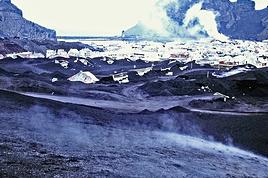
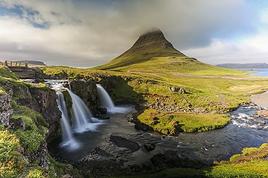
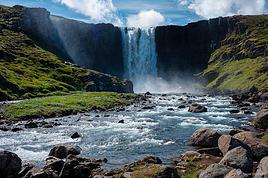
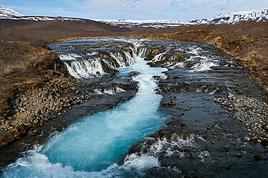
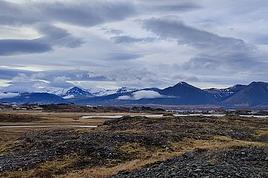
Ah, Iceland and us—it’s quite the story, or rather, a long wait... The first time we considered going was already 7-8 years ago, after reading travel journals describing breathtaking landscapes, countless active and dormant volcanoes, glaciers, and waterfalls with extraordinary flows. In short, this island, made of fire and ice, right at Europe’s doorstep with its own unique culture, had nothing but advantages, and it was urgent to visit without delay 😇
My *Routard* guidebook is actually from 2016. So why did Iceland make us wait so long before we finally gave in to its charms? Yes, why indeed?
Simply because reading other travel journals revealed the cost of living there—and especially the harsh climate, even in the middle of July 🤪! Some journals described entire weeks of rain and foggy weather, making it tricky to explore the island. The budget wasn’t spared either, because in the most touristy areas, especially in the south and around Myvatn, accommodation prices are downright indecent—even outright robbery. 😕
Plus, in the Highlands, there’s literally no permanent lodging, and the only way to spend several nights there is to camp. And camping in winter conditions wasn’t exactly part of our plans... 😄
So, year after year, this trip kept getting postponed...
until August 2023, when prices for Southern Africa, North or South America, or even Asia were all way too high for summer 2024!
That’s when I turned my attention back to the Land of Fire and Ice and scoured all the comparison sites for the best accommodation deals across the country. Planning for 20 nights, I found 13 nights in "proper" lodging for 5 people at an average cost of under 200 €! A miracle, considering that in the southern glacier region, around Vik or Myvatn, prices range from 300 to 1000 € per night 😮 😮!
Still, that means we’ll have to camp for 7 nights, mostly in the Highlands, near Askja or Landmannalaugar. 😎
For once, I built the daily itinerary entirely around the decently priced lodgings I found 11 months in advance! The shortage of places to stay in some areas forced me to plan a few long transition days and make some tough choices. No big deal, though—there’s so much to do on this island 🙂!
Once the main itinerary was set, everyone agreed to the plan: 2/3 in proper lodging and 1/3 camping, even the most camping-averse among us! *Follow my gaze...*
By the time we bought the flight tickets, I had to tweak the itinerary a bit because one or two places were already booked! Plus, it was impossible to wait for a more refined plan to adjust reservations, since almost all bookings are non-refundable!!
The harsh law of supply and demand...
For the car rental, we booked a Hyundai Tucson, approved for the Highlands, from Lava Car Rental—a company I’d read good reviews about in a Facebook group—for a cool 2500 € with full insurance. A real 4x4, like a Defender, would’ve been more than double...! Welcome to Iceland 😕...
Activities and excursions also required some tough choices. We had two must-dos: whale watching in Húsavík (60 € pp on Getyourguide) and a Glacier and Summer Treasure Glacier Walk with BlueIceland (165 € pp with discount codes on Getyourguide).
For the baths, we skipped the Blue Lagoon—too expensive—in favor of the Secret Lagoon and the Myvatn Baths, the Blue Lagoon’s equivalent but half the price.
Two baths for the price of one... and even more, since I spotted several free hot-water swimming spots.
Itinerary:
Day 1: Arrival in Reykjavik - Hraunfossar Waterfall - Surtshellir Cave
Day 2: Grábrók Crater - Snæfellsnes Peninsula
Day 3: Stykkishólmur - Sturlungalaug Hot Springs
Day 4: Northwest Coast - Akureyri - Goðafoss
Day 5: Myvatn
Day 6: Myvatn - Dettifoss - Selfoss - Rauðhólar
Day 7: Húsavík Whale Watching - Dettifoss - Selfoss
Day 8: Stuðlagil Canyon - Seyðisfjörður
Day 9: Puffin colony - Störurð Hike
Day 10: Hengifoss - East Fjords, Mjóifjörður
Day 11: Viking Village - Jökulsárlón - Fjallsárlón
Day 12: Glacier Excursion - Svartifoss
Day 13: Fjaðrárgljúfur Canyon - Vík
Day 14: Þakgil - Lava Show Vík
Day 15: Southern Waterfalls Day
Day 16: Landmannalaugar - Skalli Hike
Day 17: Landmannalaugar - Bláhnjúkur - Brennisteinsalda
Day 18: Secret Lagoon, Kerlingarfjöll, and Gullfoss
Day 19: Geysir - Reykjavik
Day 20: Bruarfoss - Þingvellir - Kerid Crater - Krýsuvík Geothermal Area
Day 21: Reykjanes Peninsula
Friday, July 5, 2024, is our last workday before driving up to Alsace overnight to leave the cockers at Grandpa’s for boarding. Then, at 1:30 AM, we’ll head to Frankfurt, where a direct flight to Iceland awaits.
We arrive at 4 AM. Since we leave at 7 AM, the "night" will only last the equivalent of a 30-minute nap 🤪... just enough to get us in the road-trip mood 😏!!
2,760 similar discussions in English
Hi everyone,
I’m starting to plan my next trip to Southeast Asia this winter (2.5 months, leaving in early December), and here’s a rough outline of my route—I’d love to share it with you and hear your thoughts and tips.
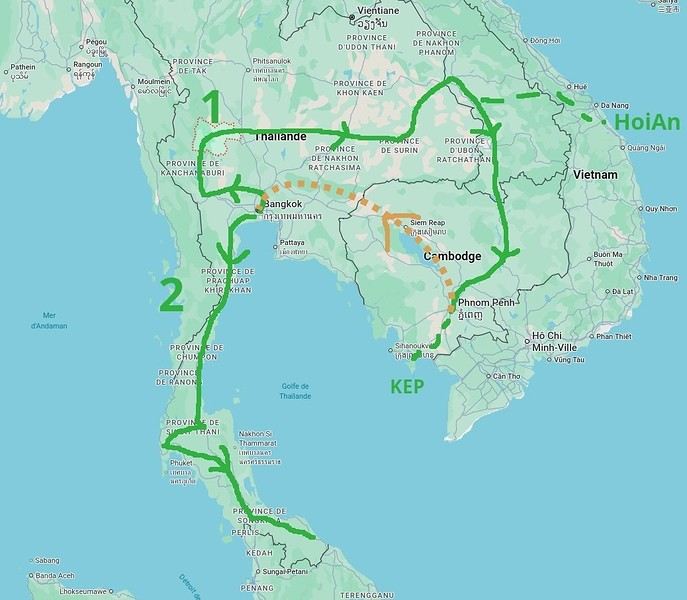
- I’ll start in Bangkok and already have three spots I’ve marked: Ayutthaya, Kanchanaburi, and Uthai Thani (I haven’t been to any of these places yet). - Next, I’d like to cross the country from west to east to reach the Laos border. I’d love suggestions for any interesting stops along this route—I don’t know this part of Thailand at all... - Then I’ll head into Laos, probably at Savannakhet (you can usually get a visa at the border). - > I’m tempted to spend a week in Hoi An, Vietnam, since I loved that city and the area when I visited two years ago. No visa needed for Vietnam now, so it could be a nice little detour. On the map, it doesn’t look too far, but I know you’ve got to be careful with these things, and I’m not sure if it’s a good idea. Any opinions on this? - Back to Laos (maybe via Dakta), and I’ll head south along the Mekong, probably doing the Bolaven Plateau loop that I missed last time. Then Paksé, the 4,000 Islands... I’ve been before, but I’d happily go back. - Crossing into Cambodia, I’ll follow the Mekong down to Phnom Penh (I know this area and love how untouristy it is). From there, I’ll probably spend a few days in Kep (quieter than Kampot). Still undecided, though. - Then back to Thailand (BKK), likely by plane from Phnom Penh since the borders between the two countries are currently closed (plus, let’s be honest, Cambodian roads... ;-). We’ll see how things look when the time comes. - After that, I’d like to explore southern Thailand, taking it slow with short hops. I’ve got my eye on Khao Sok National Park, and I’ve heard good things about Krabi... Again, I don’t know this region well, so any info or tips would be great.
So, I think this should be doable in 2.5 months, especially since I prefer short hops of 300 km max to avoid getting too tired, and I like staying 2-3 days in each place to explore. Plus, I’ll take a week off to relax if I find a spot I love—maybe by the sea for some real downtime.
Thanks for your feedback and for sharing your favorite spots! Pascal
Hi everyone,
I’m reaching out for your help because I’m a bit lost trying to rent a car in Washington, DC. I’ve already rented twice out West with ALAMO—no issues, brand-new SUVs… This time, I need to rent an SUV for 12 days in Washington and return it at Newark Airport in NYC. I never would’ve thought there’d be such a price difference between the East and West Coasts!!! 12 days out East costs almost the same as 26 days out West! With Alamo out West, full insurance where you return the vehicle no matter its condition is called CDW. Here, it’s not clear at all. I’ve never rented from another company. If I stick with the two "big rental companies," here are my options:
ALAMO DULLES AIRPORT: 1,250 € with additional protection included (96 €) AVIS AIRPORT: 831 € with additional protection included (96 €) Or AVIS downtown WASHINGTON, 700m from my hotel, where I’d save on the taxi to the airport! Same price: 831 €. Has anyone ever picked up a vehicle downtown? Given the small indoor parking lot, I’m guessing the selection is limited. Is there a difference between AVIS and ALAMO? Because between 830 € and 1,250 €??????????? I’m not too familiar with other rental companies. I’ve rented brand-new cars in Europe from BUDGET for 70 € a week with no issues, but this is on the other side of the world!!!! Thanks so much for your feedback! Have a great day
This trip had been on my mind for about fifteen years.
But the discomfort of overnight stays, the difficulty of communication, and the prices of the few car rental options kept making me postpone the project.
And then, everything suddenly fell into place—I told myself, it’s time!
The preparations took longer than usual; the destination is still far from mainstream.
A bit of Kazakhstan? Not in the end.
The south or not the south? Yes, in the end.
Pre-book or go with the flow? Only two stops were a leap into the unknown.
To help me find the ideal route, I made great use of this forum (thanks to everyone for patiently answering my questions!), pored over travel journals and blogs (Christian, Jeff), zoomed in on Google Maps and Yandex, and bought the guide published by OunTravela about this destination (the guide has been updated since).
---/---
You’ve got your passport, international driver’s license, bank cards, and euros?
Off we go to Lyon—just one night left before our early morning flight.
Tomorrow night, we’ll be sleeping in Bishkek! (Steak for my partner’s mischievous nephews...)
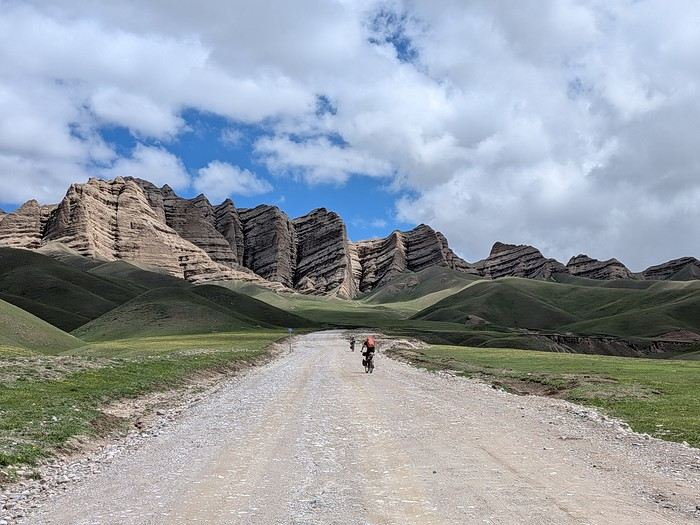
You’ll find here a post with some practical information.
And here, the version of the travel journal without comments.
---/---
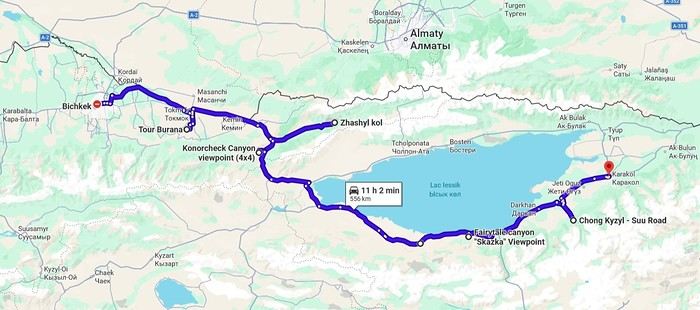
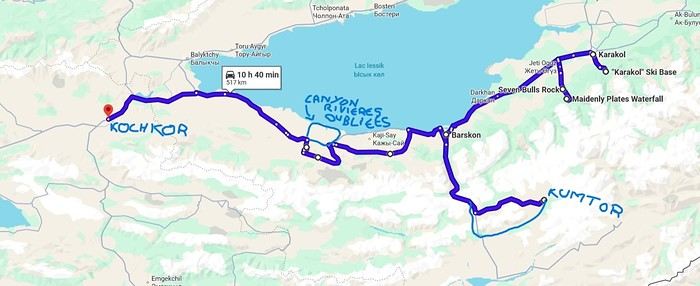
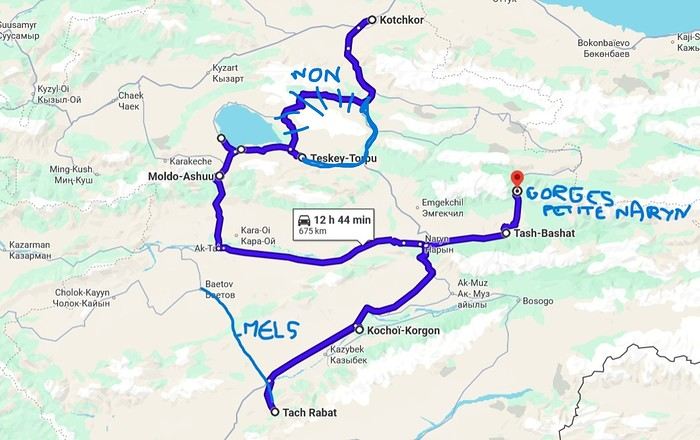
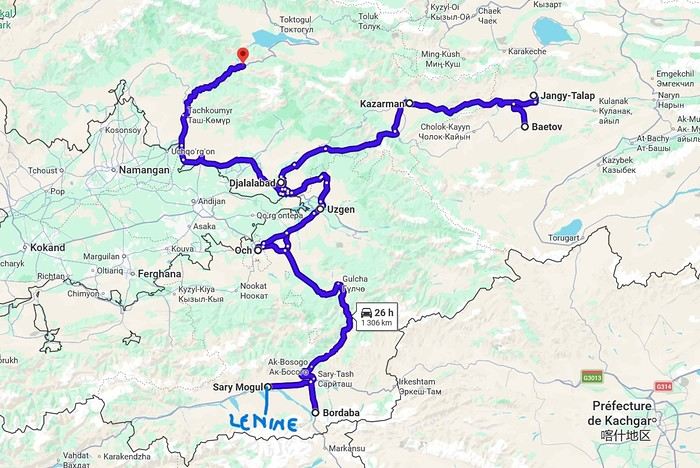
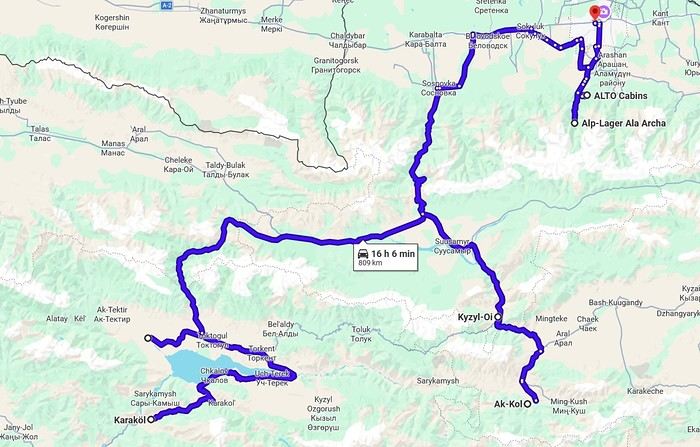
As a supplement, the route track. Not necessarily ultra-accurate since Google has serious gaps for this destination...
From Bishkek to Karakol:
From Karakol to Kochkor:
From Kochkor to Baetov:
From Baetov to Kara-Köl:
From Kara-Köl to Bishkek:

But the discomfort of overnight stays, the difficulty of communication, and the prices of the few car rental options kept making me postpone the project.
And then, everything suddenly fell into place—I told myself, it’s time!
The preparations took longer than usual; the destination is still far from mainstream.
A bit of Kazakhstan? Not in the end.
The south or not the south? Yes, in the end.
Pre-book or go with the flow? Only two stops were a leap into the unknown.
To help me find the ideal route, I made great use of this forum (thanks to everyone for patiently answering my questions!), pored over travel journals and blogs (Christian, Jeff), zoomed in on Google Maps and Yandex, and bought the guide published by OunTravela about this destination (the guide has been updated since).
---/---
You’ve got your passport, international driver’s license, bank cards, and euros?
Off we go to Lyon—just one night left before our early morning flight.
Tomorrow night, we’ll be sleeping in Bishkek! (Steak for my partner’s mischievous nephews...)
You’ll find here a post with some practical information.
And here, the version of the travel journal without comments.
---/---
As a supplement, the route track. Not necessarily ultra-accurate since Google has serious gaps for this destination...
From Bishkek to Karakol:
From Karakol to Kochkor:
From Kochkor to Baetov:
From Baetov to Kara-Köl:
From Kara-Köl to Bishkek:
Alright, I'm diving into this Hawaiian travel journal!
I hope lots of you will follow along because the destination is absolutely charming. 🙂
Just a heads-up—I might take a while to finish it.
The trip took place from February 20th to March 3rd, 2025 (11 days total, with 9 days on-site). It was a trip with my friend Christelle, with whom I’ve already traveled to Iceland and Morocco in recent years. We’re totally on the same wavelength, with the same expectations and desires, which makes things a lot easier (and, as a bonus, it helps cut down the final bill). Being the generous soul I am, I asked Christelle which country she wanted to visit. Her answer: Asia, since I’ve never been, or Namibia... Hawaii is basically the same thing, right?!! All thanks to the search comparator—I stumbled upon round-trip tickets from Paris to Honolulu for 580 € per person during school holidays, with a layover in Canada (I don’t get to choose my vacation dates). We jumped on it on August 28th (didn’t take much convincing). For info, I always check flight tickets during the last week of August or the first half of September because there are always amazing deals.
Nine days on-site is short, so we had to make some tough choices for the islands we’d visit (I’m only listing the main ones): - Oahu: the most urbanized but also home to Honolulu, Pearl Harbor, and some stunning beaches.
Kauai: the Garden Isle. It’s the island from *Jurassic Park*, with lush vegetation—so it’s pretty rainy. Big Island: volcanoes, volcanoes, and more, but also things like night snorkeling with manta rays. Maui: very touristy, with a magnificent volcano, the Road to Hana, and the ultimate spot for whale watching (and we were there right in the middle of whale season).
We limited ourselves to two islands to avoid rushing, and in the end, we picked Kauai (non-negotiable) and Oahu (which saved us an extra domestic flight and, since we were there in winter, let us experience the BIG WAVES on the North Shore). We would’ve loved to visit Big Island, but we’d already seen volcanoes in Iceland, and the island is huge—we just didn’t have enough time. Maui was recently hit by a major wildfire and is also the most expensive island (along with Kauai). We were really hoping to see humpback whales (my favorite animal) on both Oahu and Kauai. Hawaii is far, and it’s worth the effort. The journey went smoothly. I took a 40-minute bus ride and a 1h32 RER trip just to get to Roissy, then a 9h15 flight to Calgary, with a two-hour layover before a 6h45 flight to Honolulu. 11 hours of time difference, arriving at 10 PM local time. And you know what? (spoiler alert) I’d do it a thousand times if I got the chance.
Alright, let’s go—here we go!
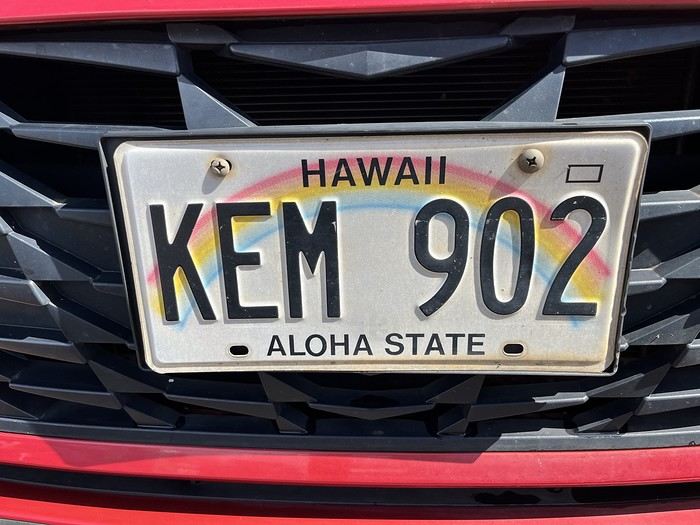
The trip took place from February 20th to March 3rd, 2025 (11 days total, with 9 days on-site). It was a trip with my friend Christelle, with whom I’ve already traveled to Iceland and Morocco in recent years. We’re totally on the same wavelength, with the same expectations and desires, which makes things a lot easier (and, as a bonus, it helps cut down the final bill). Being the generous soul I am, I asked Christelle which country she wanted to visit. Her answer: Asia, since I’ve never been, or Namibia... Hawaii is basically the same thing, right?!! All thanks to the search comparator—I stumbled upon round-trip tickets from Paris to Honolulu for 580 € per person during school holidays, with a layover in Canada (I don’t get to choose my vacation dates). We jumped on it on August 28th (didn’t take much convincing). For info, I always check flight tickets during the last week of August or the first half of September because there are always amazing deals.
Nine days on-site is short, so we had to make some tough choices for the islands we’d visit (I’m only listing the main ones): - Oahu: the most urbanized but also home to Honolulu, Pearl Harbor, and some stunning beaches.
Kauai: the Garden Isle. It’s the island from *Jurassic Park*, with lush vegetation—so it’s pretty rainy. Big Island: volcanoes, volcanoes, and more, but also things like night snorkeling with manta rays. Maui: very touristy, with a magnificent volcano, the Road to Hana, and the ultimate spot for whale watching (and we were there right in the middle of whale season).
We limited ourselves to two islands to avoid rushing, and in the end, we picked Kauai (non-negotiable) and Oahu (which saved us an extra domestic flight and, since we were there in winter, let us experience the BIG WAVES on the North Shore). We would’ve loved to visit Big Island, but we’d already seen volcanoes in Iceland, and the island is huge—we just didn’t have enough time. Maui was recently hit by a major wildfire and is also the most expensive island (along with Kauai). We were really hoping to see humpback whales (my favorite animal) on both Oahu and Kauai. Hawaii is far, and it’s worth the effort. The journey went smoothly. I took a 40-minute bus ride and a 1h32 RER trip just to get to Roissy, then a 9h15 flight to Calgary, with a two-hour layover before a 6h45 flight to Honolulu. 11 hours of time difference, arriving at 10 PM local time. And you know what? (spoiler alert) I’d do it a thousand times if I got the chance.
Alright, let’s go—here we go!
A wonderful journey through Colombia
Our 3-week itinerary: Bogotá, the Coffee Region, Medellín, then heading north to finish in Cartagena de Indias and the Caribbean coast.
A rich history from the Pre-Columbian era and, of course, from the 1980s onward, with drug cartels and guerrilla movements.
Today, the country is peaceful and developing.
Agriculture is thriving, and there are abundant underground resources…
Colombians are incredibly welcoming and always smiling, despite a low minimum wage.
We had some amazing encounters.
We organized this trip with a local agency, specifically with Cinderella, who was very attentive to our wishes. Thanks so much, Cinderella!
Don’t hesitate to visit this beautiful country
We just spent a little over 3 weeks in Morocco.
Three weeks on the road starting from Marrakech in a rental Logan.
We decided to split this trip into 3 highlights: the seaside first, a week in Aourir north of Agadir, Aït Baha and Tafraoute for another week, then a week in the Skoura palm grove followed by 3 days in Marrakech before heading back.
When we arrived, we were surprised by the temperatures—much higher than in previous years—and we were amazed by the quantities of flowers we saw throughout our journey. Moroccans explained that they had a lot of rain this winter, beneficial water, not the kind that destroys everything in its path.
First stop: AOURIR. Staying at Bab Aourir, we were able to explore the area. A great discovery this year: the Assif El Had cave, beyond Imouzzer. A beautiful road to get there. Absolute tranquility once you're inside. A lovely spot for a picnic by the *séquia* (irrigation channel) at the cave’s entrance.
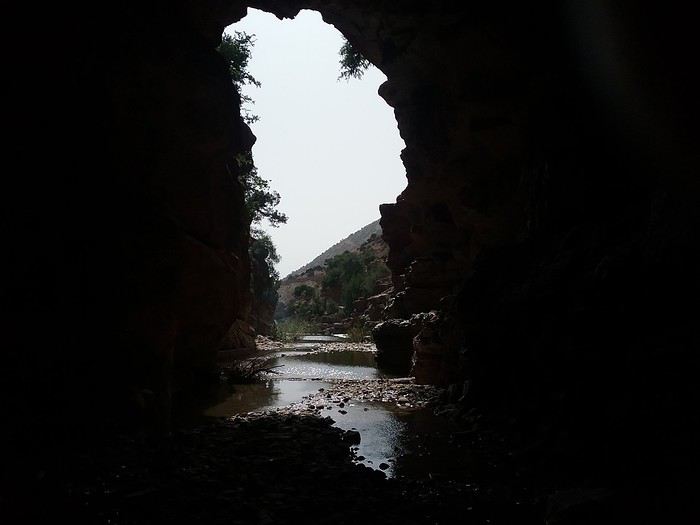
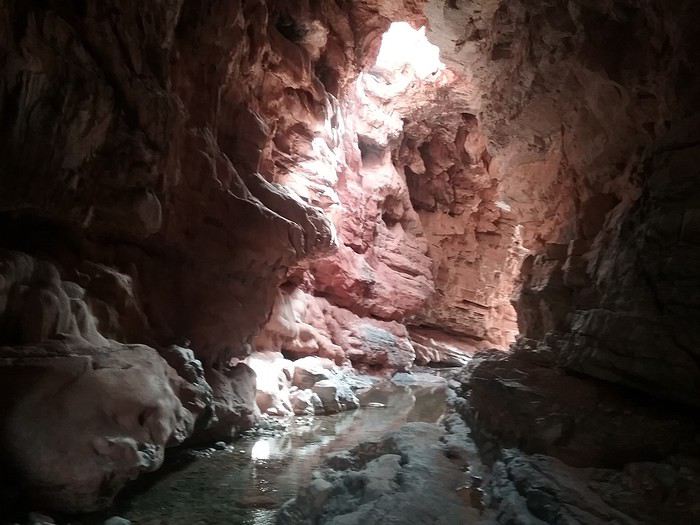
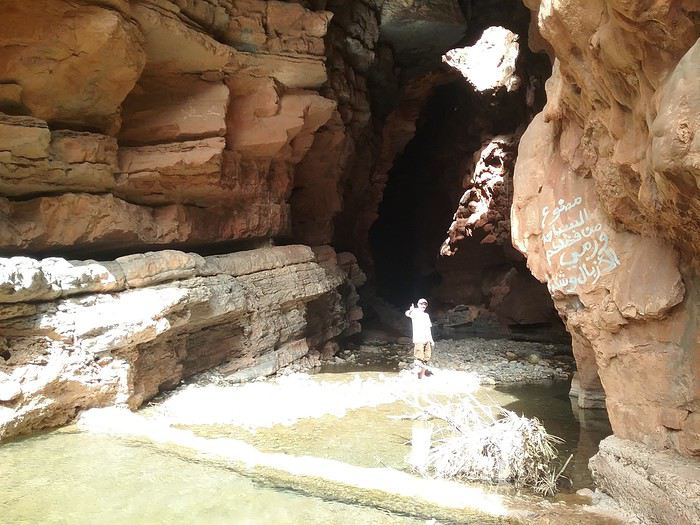
When we arrived, we were surprised by the temperatures—much higher than in previous years—and we were amazed by the quantities of flowers we saw throughout our journey. Moroccans explained that they had a lot of rain this winter, beneficial water, not the kind that destroys everything in its path.
First stop: AOURIR. Staying at Bab Aourir, we were able to explore the area. A great discovery this year: the Assif El Had cave, beyond Imouzzer. A beautiful road to get there. Absolute tranquility once you're inside. A lovely spot for a picnic by the *séquia* (irrigation channel) at the cave’s entrance.
Hi there,
If anyone's interested, I got back a month ago from a nearly 3-week motorcycle trip on a 125cc bike through Benin and Togo. I’ve attached an overview of my route. There was no planning at all before leaving—everything was done a bit on the fly. I arrived and left from Cotonou. I rented the bike from a garage through Thibault (already known on this forum). However, it was nothing but hassle with the bike; I had to pretty much rebuild/replace all the parts. A real time-waster on an already long and exhausting route.
The main roads are extremely good, and the tracks are too (dry season). Money is a bit tricky to manage since 10,000 CFA notes are really hard to use (even at gas stations). Crushing heat in February—it was really tough to sleep every night.
If you have any questions, don’t hesitate!
I’m sharing our three-week trip to Japan from late October to mid-November 2025. There were four of us—my partner and a couple of friends.
I’ve traveled often with my friend Christian (Bolivia, Argentina, Costa Rica, Namibia, Laos), but this time our partners joined us.
The rough itinerary:
Arrival in Tokyo. Visiting Shinjuku/Shibuya districts + day trip to Kamakura
5 days in the Japanese Alps, from Matsumoto to Kanazawa (via Kamikochi, Hirayu Onsen, and Takayama)
5 days in Kyoto
Nara, Osaka, Koyasan
Return to Tokyo (Asakusa district), with a day trip to Nikko
We booked our flights well in advance (9 months ahead): the flight cost 1086 € per person. Compared to over 2000 € if we’d booked for the same dates just 3 months prior.
For accommodations, we mostly used Booking.com. The onsen was booked via Japanican, and in Kyoto, we stayed in an Airbnb.
We also made 5 train reservations a month in advance on Klook or directly on the train’s website.
Day 1: Departure from Brussels (October 24, 2025) Early morning takeoff at 6 AM to Munich (1.5-hour layover) with Lufthansa, then a 12-hour flight with ANA, arriving the next morning at 7 AM at Tokyo Haneda.
Day 2: Arrival in Tokyo Airport formalities were quick. The eSIM we bought before leaving activated as soon as we landed (10 GB plan with Saily—more than enough for our mobile internet needs, mainly Google Maps and Google Translate). We’d received 4 ICOCA cards from our neighbors, which we loaded with 15000 ¥ each. We took the Keihin train, then the Yamanote Line. It’s easy to navigate since everything is in English, and each station is announced on scrolling displays in English too.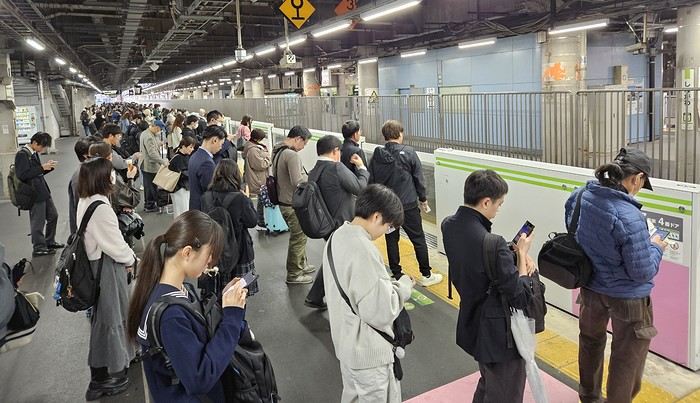
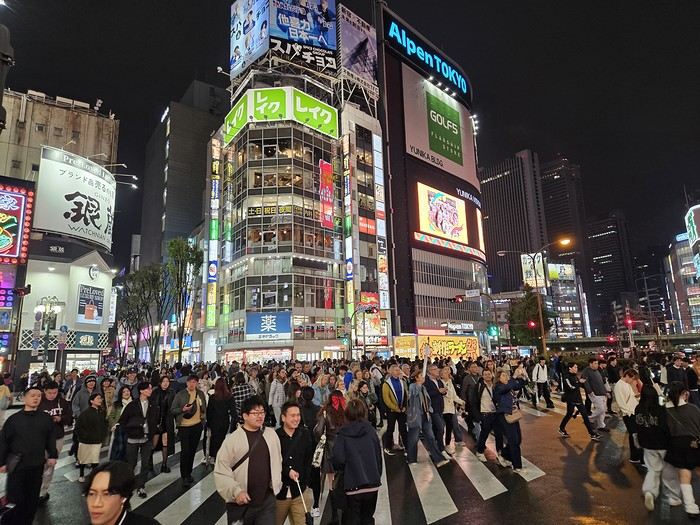
We got off the Yamanote Line at the station just after Shinjuku because it’s easier to exit that massive station with our luggage. So we ended up in Shin-Okubo, right in the Korean district. A 10-minute walk took us to Villa Fontaine Hotel. A great hotel, well-located north of the Kabukichō district. The room even seemed bigger than we’d expected.
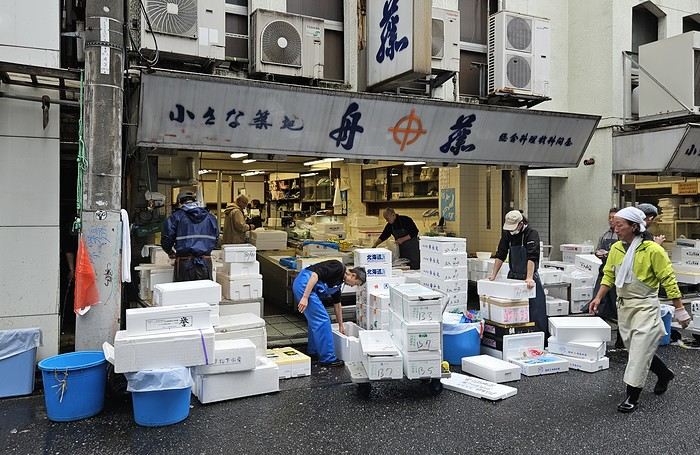 It was 15°C, but it rained—and kept raining on and off all day. Belgian weather, basically.
We went for a walk in Shinjuku Gyoen Park. Not as pretty in the rain, but the big greenhouse was interesting.
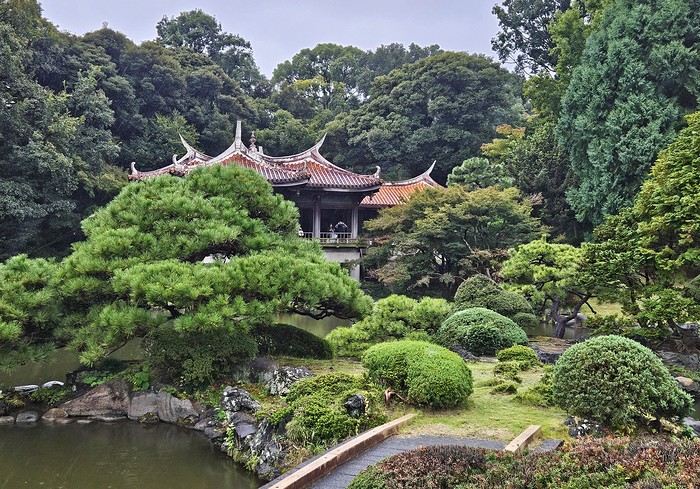
Then our first ramen (hearty and for 1000 ¥—pretty much the price of all our ramen during the trip). We headed back to the hotel since check-in was after 3 PM. Shower and relax before going out for dinner. Dinner was barbecue at Shichirin Yakiniku Anan (1700 ¥ each—good and cheap). Ordering via tablet wasn’t easy, but luckily it was in English.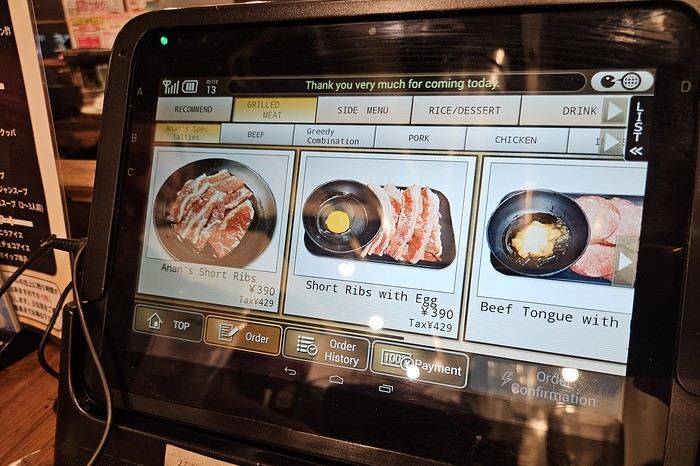
We ended the evening with a stroll through Kabukichō before a well-deserved sleep.
Day 1: Departure from Brussels (October 24, 2025) Early morning takeoff at 6 AM to Munich (1.5-hour layover) with Lufthansa, then a 12-hour flight with ANA, arriving the next morning at 7 AM at Tokyo Haneda.
Day 2: Arrival in Tokyo Airport formalities were quick. The eSIM we bought before leaving activated as soon as we landed (10 GB plan with Saily—more than enough for our mobile internet needs, mainly Google Maps and Google Translate). We’d received 4 ICOCA cards from our neighbors, which we loaded with 15000 ¥ each. We took the Keihin train, then the Yamanote Line. It’s easy to navigate since everything is in English, and each station is announced on scrolling displays in English too.
We got off the Yamanote Line at the station just after Shinjuku because it’s easier to exit that massive station with our luggage. So we ended up in Shin-Okubo, right in the Korean district. A 10-minute walk took us to Villa Fontaine Hotel. A great hotel, well-located north of the Kabukichō district. The room even seemed bigger than we’d expected.
It was 15°C, but it rained—and kept raining on and off all day. Belgian weather, basically.
We went for a walk in Shinjuku Gyoen Park. Not as pretty in the rain, but the big greenhouse was interesting.
Then our first ramen (hearty and for 1000 ¥—pretty much the price of all our ramen during the trip). We headed back to the hotel since check-in was after 3 PM. Shower and relax before going out for dinner. Dinner was barbecue at Shichirin Yakiniku Anan (1700 ¥ each—good and cheap). Ordering via tablet wasn’t easy, but luckily it was in English.
We ended the evening with a stroll through Kabukichō before a well-deserved sleep.
Hi there,
I’m so glad the VoyageForum is back up. Reading 'Montagnard74’s' Laos trip report (which I read yesterday) made me want to share my own (which I already posted a year ago on another forum).
Here’s a little recap of our 3 weeks in northern Laos, plus a few days in Vientiane.
By the way, we could easily go back to the north—there’s so much to see and do; probably in a few years.
This was our 3rd trip to Laos after having already done:
1st trip in 2012 (3 weeks), a quick overview: Vientiane Vang Vieng Luang Prabang Plain of Jars
2nd trip in 2017 (1 month): Vientiane all the way to the 4,000 Islands via Thakhek, Kong Lor, the Bolaven Plateau, Savannakhet, Pakse...
Our 2023 itinerary (1 month): Vientiane Luang Prabang Muang Ngoi Nong Khiew Luang Namtha Muang Sing Boten Vang Vieng Vientiane
Some general info (2023): For those who’ve already been to Laos: everything has gone up a lot—I think prices have almost doubled for transport, accommodation, meals... everything. But Laos is still a budget-friendly country for us. As a couple, we spent 1,100 € for a month, all included (and we definitely didn’t skimp on massages :)).
Don’t trust the transport signs posted everywhere—at travel agencies, bus terminals, hotels... THEY’RE ALL WRONG (especially the schedules). They haven’t been updated since before Covid.
There are hardly any bikes for rent anymore, but scooters are easy to find everywhere. We switched our mode of transport toward the end of our stay: from bikes to scooters, which let us go farther. In Vientiane, we only saw one bike rental place, near Ong Teu Pagoda.
BCEL bank doesn’t charge a commission on foreign currency exchanges. Using ATMs is expensive due to fees. Outside Laos, Lao kip are basically worthless. There’s so much inflation that I couldn’t find a single bank or exchange office willing to swap the kip we had left. So, don’t exchange too much toward the end of your trip.
Some little tips from our experience (2023): The Muang Koua to Muang Ngoi boat still runs daily. At the dam, you have to get off and take a bus, then get back on the boat.
The boat from Muang Ngoi to Nong Khiew only leaves at 9:30 AM (don’t miss it or you’ll pay a lot for a private boat). From Nong Khiew to Muang Ngoi, there are at least two boats a day.
From Luang Namtha to Muang Sing: 4 to 5 buses a day, the last one leaves around 3:30 PM.
From Luang Namtha or Muang Sing to Nateuy or Boten (to catch the new train): 3 to 5 buses a day.
The new train is really hard to book—it’s often fully booked 48 hours in advance, even the local train (5 hours from Boten to Vientiane instead of 3 hours on the high-speed train). (That makes it tough to travel day by day, which we love... too bad.) For baggage checks: don’t bring anything flammable (sprays...) or sharp. My mosquito repellent (flammable but in a small plastic bottle) got through. Water bottles and a tiny pocketknife are okay. But it seems to depend on the station.
Some guesthouses prefer to be paid in dollars, otherwise the price is much higher.
If you’re entering Laos from Vietnam via Dien Bien Phu, you have to get your visa at the embassy in Hanoi—otherwise, you’ll be refused at the border (no e-visa or visa on arrival).
Apart from Luang Prabang, Vientiane, and Muang Ngoi/Nong Khiew, there are very few tourists.
Some bus prices (in addition to those mentioned in my trip report) (with pick-up) 2023: Luang Prabang to Luang Namtha: 320,000 kip per person, 9h LP to Phonesavan: 250,000 kip per person, 7h LP to Phongsaly: 450,000 kip per person, 13h LP to Huay Xai: 420,000 kip per person, 14h Train Nateuy to Vientiane: 400,000 kip per person LP to Chiang Rai: 780,000 kip per person, 18h LP to Hanoi: 900,000 kip per person, 24h LP to train station: 50,000 kip per person LP to airport: 100,000 kip per person Vientiane from train station: 180,000 kip by taxi
Boats: LP to Pak Beng: 300,000 kip per person, 1 day LP to Houay Xai: 500,000 kip per person, 2 days LP to Pak Ou: 180,000 kip per person, 5h
Hi everyone,
We’ve just returned from a 3-week trip to South Africa:
2 weeks in Kruger Park, Manyeleti, and White River
5 days in Vilankulo
1 day in Johannesburg
If you have any questions or are planning your trip, don’t hesitate! 🙂
Hi everyone.
I wanted to share a little feedback from our trip to Guatemala—we got back a month ago, and I really appreciated the well-commented posts here that helped us out. So, in turn, I wanted to share our own little recap.
We’ve traveled quite a bit together (we’re 38 and 42), and Guatemala had been on our radar for a while. But with so much info out there, it was hard to sort through it all—especially since we only had 3 weeks on the ground and didn’t want to waste time.
Here’s the itinerary we followed: Antigua, the Pacific coast, Lake Atitlán, a private coffee and bird reserve, Chichicastenango, Sayaxché, El Remate, Río Dulce, and Lake Izabal.
We rented a 4x4, which was essential given the state of some roads.
Our highlights: * **Pacific coast**: So authentic and preserved. We met sea turtles, cooked and baked coconut bread with a women’s community—such a meaningful exchange—and kayaked through a pristine mangrove full of birds. * **Lake Atitlán**: Even though we were worried it might feel too touristy, a private tour let us discover local crafts, hidden workshops (weaving, pottery), and the stunning views from the boat. * **Sayaxché**: The starting point for the Aguateca and Dos Pilas sites—one of our favorite outings. The site is breathtaking: walking through the canyon and jungle-covered ruins with almost no one around. We stayed in a little bungalow on an island, totally off the grid. * **In Petén**, we met an Itza Maya tribe—an unforgettable day sharing a meal and plant-based healing rituals. Wow. This tribe resisted the conquistadors and still lives traditionally. We also took a tour on Lake Petén and swam at hidden little beaches. Tikal was nice, but we preferred Yaxhá. * **Río Dulce**: A day at a private cocoa plantation—an adventure in a buggy with the owner himself. We harvested cocoa and ate the chocolate paste afterward, then swam in a waterfall on the property. Since it’s private, there was no one else around. A real privilege. * **Boat tour on the Río Dulce**: For us, the highlight. We visited a school where they’re committed to giving kids a solid education while blending Maya rituals. * **Lake Izabal**: A peaceful end to the trip in a magical setting. We visited Quiriguá.
We went through an organizer who knows the country really well. We weren’t initially planning on that, but thanks to her, we had experiences we never would’ve found on our own. On top of that, we actually paid less for the trip overall because of her local rates. I’m not getting anything out of this—I just think it could help other travelers. Her business is Secretplaceincostarica (she also does Costa Rica, which we’re now eager to explore).
On the ground, we felt completely safe. The people are lovely, the roads can be a little chaotic at times, but we loved every minute of it.
Happy travels to all! Marie
Hi there,
- Rented a Budget car online, pick-up and drop-off at the airport: 11 days for 540 €, 1,400 km driven, gas at 0.85 €/litre. Driving was very easy in the country.
- Two weeks was enough to see the highlights of Taiwan, especially with a car.
- Withdrawing cash with a Revolut or Wise card: no bank fees at Cathay Bank ATMs. They’re yellow and green, often found in Family Mart stores.
- Hikes: we did a few, the landscapes were interesting, but the trails were often too artificial for our taste (concrete, slabs, endless stairs, etc.).
- Accommodation: averaged 42 €/night, booked in the afternoon for the same evening with no issues. Often stayed in B&Bs run by locals in remote areas—sometimes hard to find and with little English spoken, but no problem with a car.
- Food: Chinese cuisine everywhere was excellent.
- Weather in December: 8 great days, 5 average, 1 bad. Temperatures were pleasant, a bit chilly at higher altitudes.
- Chungwa SIM card: 15 days for 20 €.
- Most comprehensive website: taiwanobsessed.com.
- We loved the hikes through the tea plantations in the Alishan region, Kenting Park, and the incredible Chung Tai Chan Monastery (tour with an English-speaking nun). Since Taroko was closed, the drive up the east coast from Kenting to Hualien felt long and not essential.
Here’s our practical feedback from the trip—feel free to ask if you have any questions. Safe travels!
hi everyone, I just got back from 3 weeks in Paraguay. If you'd like any info, feel free to ask!
Hi there,
My friend and I are heading to Thailand for three weeks between December 14th and January 4th.
After a week of relaxation in the south by the beach, we plan to explore northern Thailand to see the mountains and discover the country’s history before wrapping up in Bangkok.
I’m torn about which region to explore. For convenience, we’ll arrive in Chiang Mai, spend a few days in the area, then head to Lampang, followed by Sukhothai, and finally Bangkok.
After Chiang Mai (1 or 2 days—I’m worried the period might be too crowded and we won’t enjoy it much), we’ll have 3 days and could go to: Mae Hong Son (with a potential return flight); Chiang Dao and Fang; or Nan province, though that seems a bit far for just 3 days. We could also spend only one day in Chiang Mai and have 4 days instead.
For these 3 (or 4) days between Chiang Mai and Lampang, we’d love to do some beautiful hikes, preferably on our own, and see stunning landscapes, nature, and small villages.
Among my options, which would you recommend? Or where can we find great hikes that we can do independently and that aren’t overrun by mass tourism? I’ll admit, I’m struggling to find info—there are lots of small national parks, but details are scarce, and even AllTrails doesn’t have much for some of them...
Just to clarify, we’re considering hiring a car with a driver if needed.
Thanks so much to anyone who can help, and have a great weekend!
Leslie
We just spent three weeks in Yunnan.
I’ve started writing up a travel journal about the trip.
Hi there,
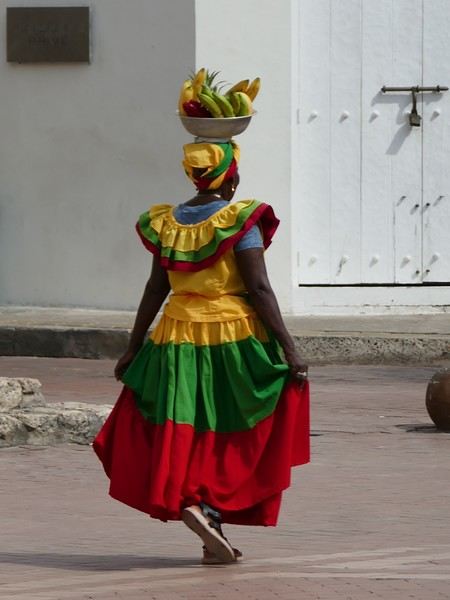
This summer, we spent 3 weeks in northern Colombia. A vibrant trip that complemented our southern Peru adventure from the previous year perfectly. Two neighboring countries, but completely different.
To start, we had to make a choice because the country is vast.
So we focused on 3 different regions for our 3 weeks: - Week 1: Bogotá and the colonial villages (Villa de Leyva, Barichara) - Week 2: Medellín and the Coffee Region - Week 3: the Caribbean coast
We entrusted the organization to a small local agency that handled accommodations, guides, and transportation. Transportation is key. The country is large, the road network isn’t very efficient, and we spent a lot of time traveling (cars, planes, and boats...), but it was the price to pay to explore it.
The overall budget isn’t exactly "backpacker" level. We spent 7,500 € (excluding Air France) for our 3-week stay (hotels, drivers, guides, flights, visits, meals). But we treated ourselves to nice accommodations—you’ll see as we share more posts.
For vacations, I try to follow Philippe Noiret’s motto: "Travel is short. Let’s try to do it first class."
This summer, we spent 3 weeks in northern Colombia. A vibrant trip that complemented our southern Peru adventure from the previous year perfectly. Two neighboring countries, but completely different.
To start, we had to make a choice because the country is vast.
So we focused on 3 different regions for our 3 weeks: - Week 1: Bogotá and the colonial villages (Villa de Leyva, Barichara) - Week 2: Medellín and the Coffee Region - Week 3: the Caribbean coast
We entrusted the organization to a small local agency that handled accommodations, guides, and transportation. Transportation is key. The country is large, the road network isn’t very efficient, and we spent a lot of time traveling (cars, planes, and boats...), but it was the price to pay to explore it.
The overall budget isn’t exactly "backpacker" level. We spent 7,500 € (excluding Air France) for our 3-week stay (hotels, drivers, guides, flights, visits, meals). But we treated ourselves to nice accommodations—you’ll see as we share more posts.
For vacations, I try to follow Philippe Noiret’s motto: "Travel is short. Let’s try to do it first class."
Hi fellow travelers!
I’m planning a little 3-week trip to Vietnam in mid-to-late March. It’ll probably be the only time I can go.
I enjoyed Thailand but clearly preferred Laos—it was calmer.
For Vietnam, I don’t have a precise idea of what I want to see yet, and I’m the type to improvise a bit once I’m there. I’m not super adventurous but I’m curious, and I prefer street food over restaurants, markets and off-the-beaten-path villages over big attractions.
But I don’t want to miss the must-sees either.
So, given that I’ll only be there for 3 weeks, I’m wondering: should I absolutely stick to either the north or the south? Or is it possible to have a nice, not-too-hectic trip by spending, say, one week in the south and two in the north?...
(I’d take a multi-city flight for arrival and departure)
What do you think?
Thanks! 🙂
Hi there,
We’re just back from a three-week trip to Sri Lanka, from July 15 to August 11. A few random tips—if you’ve got more specific questions, just ask. If we know the answer, we’ll be happy to help!
What an amazing country! I had a small bias at first, wasn’t totally convinced, but that disappeared fast. Stunning coastal and mountain landscapes, cultural visits, hikes, and such a warm welcome.
Here’s our itinerary in order: Colombo-Anuradhapura-Trincomalee-Polonnaruwa-Dambulla-Sigiriya-Kandy-Haputale-Ella-Tangalle-Galle-Negombo.
Whenever we can, we travel only by public transport, and in Sri Lanka, it’s totally doable. Trains, of course, and buses all the time—everywhere and super cheap. We’d head to the bus station to get a seat, but they also stop along the route. From the airport to Colombo Fort, take bus 187—it’s parked on the right as you exit.
Weather-wise, despite it being the less favorable season for some regions, we only had two half-days of rain. That was one of our worries, but maybe we just got lucky.
For hiking, beyond the well-known climbs in all the guidebooks and blogs (which are great too), there’s a long-distance trail in the mountain region (Kandy, Ella, etc.) that’s really well marked. It’s called the Pekoe Trail, and there’s an app you can download (Pekoe Trail) that gives you the full route and details for each stage—25 in total, I think, ranging from 9 to 15 km. We did 4 of them, not in a row, but starting from our different accommodations. They’re not loops, but you can always find a bus, train, or tuk-tuk to get back or to reach the end of a stage and return. The landscapes are beautiful, the encounters plentiful, and tourists are rare—which is nice sometimes.
Happy travels!
We just got back from a nearly 3-week trip to Costa Rica in March. For the occasion, we used EVANEOS to plan our trip based on our preferences.
After some setbacks with ADOBE RENT-A-CAR—they refused the Visa Premier card and forced us to pay for extra insurance (which is usually covered by the Visa Premier)—we finally set off to explore the country.
Observation: Apart from nature, wildlife, and flora, there isn’t much else to see, but it’s so beautiful! Some people criticize the country as insignificant, with bland food and unwelcoming locals. I think those people didn’t really explore—maybe they stayed in their hotel near the beach (UVITA?) without venturing out. Otherwise, there wouldn’t be so many Europeans living in Costa Rica who don’t even consider going back to their home countries.
For our part, we found Costa Ricans very kind and welcoming. It’s often said they’re thieves, but personally, we left a small suitcase in a restaurant. When we returned after driving 20 km round trip, the staff were trying to find our phone number to contact us. I think it’s like anywhere—even in France, I’d tell tourists not to leave anything in their car to avoid… well, you know.
Food: Traditional dishes, fish plates (tilapia was excellent), and especially ceviche (around 15 € per person)—really good—and lobster (around 30 to 35 € per person), all served with fruit batidos (around 3 € per person).
Car: We had a 2-wheel-drive vehicle, which kept us from visiting some sites that require a 4x4, like Boruca, the town of artisan masks. Some lodges are also only accessible via rough, rocky trails that are tough to navigate in a regular car. Don’t hesitate to insist on a 4x4.
Keep in mind that driving fast in Costa Rica isn’t possible. Some roads are in poor condition, and there are often unmarked speed bumps that are much worse than the ones in France. You’ll average about 50 to 60 km/h on a leg of the trip.
I also recommend bringing a road map to cross-check the routes suggested by Waze or Google Maps. Sometimes, these apps will send you down completely wrecked roads to save time! A paper map will help you verify the road type. It’s better to drive an extra 20 km than to get stuck on a rocky path.
- San José to Barra de Pacuare (much less crowded than Tortuguero). Sea turtles are still rare this time of year. Via the canals, we spotted howler monkeys, sloths, and birds, and on land, we saw venomous spiders, poisonous frogs, and a leatherback turtle conservation site.
Explored a primary tropical forest with its many species of flora and fauna (monkeys, snakes, sloths, toucans, raccoons, etc.).
- Barra de Pacuare to Cahuita: Explored Cahuita National Park (howler monkeys, capuchin monkeys, raccoons, sloths, blue crabs, leaf-cutter ants, etc.) and walked along the trail by Puerto Viejo’s beach.
- Cahuita to Bambú: Visited the Bribri tribe and their customs. This isn’t a tourist trap—it’s a deep immersion into a community living almost self-sufficiently. To get there, you take a motorized canoe for over an hour. But be warned:
1 - The restroom cleanliness leaves a lot to be desired
2 - There’s no hot water
3 - A waterfall hike is offered. The first two-thirds are fine, but the last third is very dangerous, especially if it’s rained, even with sneakers. You need sturdy shoes. Our guide turned back halfway…
- Bambú to Sarapiquí:
- La Fortuna: Explored the Mistico Park tropical forest. A 3+ km trail lets you discover animals and lush vegetation. Sixteen suspension bridges, some up to 45 meters high, offer stunning views of the canopy.
Walked around Arenal Volcano: Big disappointment for seeing lava flows. After 2 km, a viewpoint shows vegetation that’s taken over—only a few volcanic rocks hint at the 1968 eruption.
- La Fortuna to Carara: Spotted crocodiles at the Tarcoles Bridge.
- Carara to Uvita: Relaxed. Uvita is a small tourist town with nothing particularly original, but it’s the place to try CEVICHE, a typical dish of raw fish “cooked” in lime juice. Delicious! We recommend Mestizo for very affordable prices.
- Osa to Corcovado National Park: This park is gorgeous. You’ll see all four monkey species, tapirs, scarlet macaws, etc.
From Drake Bay, it takes about 1 hour 15 to 1 hour 30 to cross to the park. After navigating the mangroves, the boat heads into open sea until reaching the beach, where you’ll wade ashore (water up to your thighs—bring shoes for the slippery rocks).
National Geographic called the park a "jewel of humanity" that must be preserved at all costs due to its incredible biodiversity. The park represents 3% of the world’s biodiversity. You can observe countless monkeys (all four species are present), crocodiles, tapirs, and scarlet macaws.
Our guided hike with a French-speaking guide lasted 4 hours before returning by boat to the lodge.
WARNING: There’s strict control at the park entrance:
- No plastic bottles
- No knives
- No plastic items
- No bare feet. Closed-toe shoes are required (in addition to a pair for the boat)
- Osa to Zona de los Santos: This is the coffee region and home to the quetzal, a stunning but hard-to-spot bird that’s also Guatemala’s symbol. Paraíso Quetzal Lodge has a platform with a spotting scope to try to see the bird in the forest. CAUTION: This beautiful lodge is at 2,650 meters altitude. The rooms have incredible forest views, but it’s VERY VERY cold!
- Zona de los Santos to San José: Detour to Irazú Volcano. WARNING: Buy tickets before arriving. The staff kindly bought them for us via their phone. Small disappointment: The crater lake hasn’t existed for years! The ads are misleading about this.
- San José: A city we found uninteresting.
Hi everyone,
We’re heading to Sri Lanka for three weeks in July with two kids (ages 6 and 13). We’ve drafted a rough itinerary but would love to hear from those who’ve already been there 😊 Of course, we want to see everything, but we have to make choices—even though three weeks on the ground lets us do quite a bit. We originally planned a schedule that felt too packed, so we had to cut one stop. We decided to skip Tangalle, even though we were really tempted. The monsoon won’t let us swim there, and the weather in the south is too uncertain, so we preferred to keep our stops on the east coast. Plus, we don’t think it’s reasonable to cut nights from other places. We’ve added a stop in Batticaloa, which we think will be a nice break between Arugam Bay and Sigiriya. What do you think? We’re also debating between Batticaloa and Passikudah. Does the itinerary seem logical to you?
Here it is:
Sri Lanka Itinerary Day 1 Arrival around 1 PM at the airport Night in Negombo Day 2 Drive from Negombo to Galle Visit Galle and surrounding areas Night in Galle Day 3 Visit Galle and surrounding areas Night in Galle Day 4 Visit Galle and surrounding areas Drive from Galle to Udawalawe Night in Udawalawe Day 5 Visit Udawalawe National Park Night in Udawalawe Day 6 Drive from Udawalawe to Ella Night in Ella Day 7 Ella Rock + Nine Arch Bridge Night in Ella Day 8 Visit Haputale Lipton’s Seat and Dambatenne Tea Factory Train ride back from Haputale to Ella Night in Ella Day 9 Little Adam’s Peak + drive from Ella to Arugam Bay Night in Arugam Bay Day 10 Visit Arugam Bay and surrounding areas Night in Arugam Bay Day 11 Visit Arugam Bay and surrounding areas Night in Arugam Bay Day 12 Drive from Arugam Bay to Batticaloa Night in Batticaloa Day 13 Visit Batticaloa Night in Batticaloa Day 14 Drive from Batticaloa to Sigiriya Night in Sigiriya Day 15 Lion Rock and Pidurangala Night in Sigiriya Day 16 Visit Dambulla Drive from Sigiriya to Trincomalee Night in Trincomalee Day 17 Visit Trincomalee and surrounding areas Night in Trincomalee Day 18 Visit Trincomalee and surrounding areas Night in Trincomalee Day 19 Drive from Trincomalee to Anuradhapura Night in Anuradhapura Day 20 Visit Anuradhapura Night in Anuradhapura Day 21 Visit Mihintale Drive from Anuradhapura to Negombo Night in Negombo Day 22 Day in Negombo and return flight
We’d love to hear your thoughts and tips! Thanks in advance!
A nice itinerary for 3 weeks in Cape Verde. Hiking, beaches, music, meeting Cape Verdeans.
Thanks,
fabie
We’re a retired French couple.
We’ve just spent 4 weeks in China:
- 1. Exploring Yunnan in a group (12 people); a journey that took us from the Vietnamese border in the south to the edges of Tibet in the north.
- 2. A private trip to Guizhou with just a driver.
We’re absolutely delighted with what we discovered: a modern country with excellent infrastructure (especially the low level of urban pollution thanks to the high number of electric vehicles, the absence of diesel, and no noisy motorbikes in these two less industrialized provinces), friendly Chinese people who were always ready to help us when we had difficulties or questions, and a rich natural and cultural heritage.
The language barrier remains the biggest challenge, despite instant translation tools.
For both trips, we booked through the agency CIELCHINE, which we highly recommend.
The value for money is unbeatable.
The services were luxurious, especially for us since we usually travel alone on a tight budget for accommodation and food.
The agency’s staff were perfectly competent and, what’s more, warm and welcoming.
For Yunnan, our guide SEBASTIEN, who was experienced and knowledgeable, won everyone over.
In Guizhou, our driver HUANG was professionally flawless and guided us through villages he knows well. Friendly and full of humor, he’d spontaneously talk to people he met, which made us be treated with much more kindness and allowed us to exchange a few basic words.
As you can see, I haven’t ticked anything negative—not because I’m hiding anything or have any ulterior motive, but because I’m completely satisfied and the experience even exceeded all my expectations.
Hello,
As a senior woman, I’m planning a 3-week solo trip (late April or early May) to explore the country by public transport, visiting the main cities (Khiva, Bukhara, and Samarkand), the Ferghana Valley, and if possible, the Aral Sea.
I’m reaching out to the community to see if there are flights arriving in Urgench and returning from Tashkent—or the other way around?
Thanks in advance to anyone with insights! 😉
Hey everyone, so happy the site is back!
After traveling solo across Iran and the Stan countries from one end to the other,
this time I’m heading to Southeast Asia with my wife and our 3-year-old.
I went to the Philippines almost 10 years ago and actually met some forum members there. It was love at first sight.
I’ve booked tickets from January 10 to March 31 for Bangkok (amazing price from Milan). I was thinking of spending: 3 weeks in Thailand 3 weeks in Vietnam 1 month in the Philippines.
Don’t worry, I won’t spam the forum with a thousand messages asking how to get from point A to point B :)))
I’m reaching out to the experts or regulars here for suggestions and ideas!
For Thailand, Obviously, some beautiful beaches wouldn’t hurt for a bit of relaxation. I was thinking of Koh Phayam or Koh Kood (or Koh Chang). If anyone knows a nice spot, even if it’s not on an island, I’m all ears. It’s tricky to ask this for Thailand, but I’m looking for a bit of tranquility (so I’ll probably avoid Phuket, Koh Samui, etc.). (Though I know sometimes you just need to get off the beaten path to find some peace, but I’m not sure if that’s the case in Thailand.)
Vietnam—I have no idea!! A friend mentioned Danang, which could be a good base to explore the countryside/inland areas.
And the Philippines—I had a huge crush on the country (Bantayan, Dumaguete, Sipalay, Siquijor) and really want to go back, maybe to new places/islands.
I have one constraint: We’ll stay in the same place each time. With a kid, it’s tough to move every 2 days (unlike when I’m solo), and I hope this will let us connect with locals by staying put for 3 weeks at a time. (Plus, my budget is pretty tight, so the idea is to negotiate a good price for 3 weeks in the same accommodation.) (My rough budget is 1000 € per month for the three of us: 450 € for lodging, 450 € for food, and 100 € for a scooter. This doesn’t include boat, bus, etc. transfers.)
If you have any ideas, tips, or experiences to share, I’m all ears! I’m totally open to shortening or extending our stays in each country, even if it means skipping one of the three.
Hi there,
A friend and I are planning to visit Northern India from March 3rd to March 25th. We’ll arrive in New Delhi, then take a night train to Bikaner, Bikaner to Jaisalmer (train) Jaisalmer to Jodhpur (train) Jodhpur to Udaipur (car) Udaipur to Bundi (train) Bundi to Jaipur (train/bus) Jaipur to Agra by train Agra to Varanasi and return from Varanasi to Delhi by night train
We’re planning to stay 1 or 2 days in each city. This itinerary was recommended by a guide my friend has been talking to—what do you think?
It’s our first time in Northern India. I’ve only been to Southern India before—Pondicherry for 10 days about 10 years ago—so it’s nothing like the North. Thanks!
Hi everyone!
We’re heading to Uganda next summer for three weeks with our two kids, who’ll be 7 and 9 years old. We’ve been to Southern Africa before but not East Africa, and after a trip to South Africa two years ago, the kids wanted to return to Africa, while we wanted to explore a new region while staying independent... Uganda’s been catching our eye for a while, and with Rwandair offering relatively attractive prices, we’re going for it!
We’ll be traveling in a 4x4 (self-drive) with roof tents. I don’t have any 4x4 driving experience, so it’ll be a first for me, but we’ll manage 😉 No great apes for us—kids need to be 15, and we don’t want to do that experience without them.
I don’t usually ask the forum much for trip planning, but this time, I’d love your thoughts and advice!
First question: Karamoja or not? At first glance, if we want to add it to a "classic" loop in the southwest, it doesn’t seem realistic—too packed, too much driving. We could consider doing the full loop via Kidepo and then heading down to Murchison, but I’m worried the trip might feel less varied and less kid-friendly. That said, the region looks stunning, and I’m struggling to accept not going at all... What do you think?
If we skip Karamoja, we’d do a loop: Murchison/Fort Portal/QENP/Bunyonyi/Mburo, which seems pretty comprehensive and would let us take our time, which is nice. A few random questions: - How much time should we plan for the Fort Portal area? I was thinking at least 3 days to visit Bigodi Swamp, walk around the craters, and maybe do a community walk (any thoughts on that?). - Between Murchison Falls and the Fort Portal area, is it worth breaking up the drive? I spotted Lake Albert Safari Lodge on the shores of Lake Albert—it’s not too expensive and looks nice. - I’d love to do some easy walks/hikes at the foot of the Rwenzori Mountains, ideally without a guide, but it doesn’t seem straightforward. Do you know if it’s possible to do nice walks independently? I’ve read about hikes in the hills near Kilembe but nothing very specific. Maybe staying somewhere at the foot of the mountains, like Ruboni Community Camp, would allow that. - Lake Mutanda looks really cool, and so does Lake Bunyonyi... Ideally, I’d like to see both, but won’t that feel repetitive? Is Lake Mutanda worth the detour?
Last practical question, since we don’t have experience with this: for the car with kids, would you recommend two tents (a bit more space) or a four-person tent?
I’ll stop here—already a lot of questions...
Thanks in advance for your feedback, and looking forward to exchanging ideas! Gabriel
Hello fellow travelers,
I spent 3 weeks in Cambodia this January, and I completely fell in love with this country—especially the Cambodian people. I took my time because it was possible, and it turned out to be a total success. Originally, this trip was planned for 2021 and 2022 with my husband, but COVID and an illness threw everything off. Now traveling solo, I went with Siem Reap à la Carte, a local agency. I can’t recommend Mélanie and Nathalie enough—they helped design the itinerary together with me, and the guides and drivers were top-notch. Since I was alone with them, the connection was incredible.
My itinerary: Phnom Penh (2 nights). I arrived at the airport at 1 PM, and everything went super smoothly—I had my E-visa and E-arrival. I had the afternoon free on arrival, a guide the next morning, and the afternoon free again. Battambang (2 nights) with a local guide for all the visits (temples, the bat flight, bamboo train, the surrounding countryside, markets, etc.). Siem Reap (6 nights). I chose to take the public boat across the Tonlé Sap—8 hours on the water, but it goes by quickly, and the scenery is stunning. Of course, in Siem Reap, it’s all about the Angkor temples—most people come for that—but Nathalie and Mélanie also arranged some unique experiences, like visiting a lacquer workshop (even though this wasn’t my first trip to Asia and I’d seen them before, this one was different). I even tried making incense sticks (I’m not very good at it), and we had lunch at a local’s home. There are, of course, the markets, and I also took a cooking class with a chef at his home, where we ate what we prepared. I also spent another day on a boat visiting a village on the Tonlé Sap. I used my free time for a massage, a stroll around town, and in the evenings, I’d head to Pub Street—guaranteed fun. I also visited the Thousand Lingas River. I won’t list all the temples I saw—you can make your own choices or follow recommendations. Either way, everything is breathtaking. Banlung and Ratanakiri, where I spent 4 nights. Because of that, I didn’t go to Mondulkiri. I loved it—jungle walks, visits to ethnic villages and cemeteries, and for those who want, there are plenty of waterfalls where you can swim. The most tourists I saw at once was 5 (a group of 4 and me a little farther away, so you can have peace and quiet). I also spent time at an elephant sanctuary. I was hesitant at first, but everything had been so perfect up to that point that I went, and I have no regrets. It was just me, the guide, and the rangers—lovely people—and the elephants were living their best lives. Next, I headed to Kratié for 2 nights: temples, the Irrawaddy dolphins, and a half-day on Koh Trong Island by bike, tasting their famous pomelos—a pure delight. No cars on the island, just calm and serenity. On my way to Kep, where I spent 4 nights, I stopped for a night in Kampong Cham, visiting temples, villages, and the bamboo bridge. With this kind of travel style, it’s easy to stop wherever you feel like it. So, I arrived in KEP to taste the famous Kep crabs—don’t miss them! The agency arranged a full-day motorbike tour (I wasn’t the one driving!), exploring the countryside and salt marshes. Of course, you should also visit Kampot, and if you love pepper, make sure to leave room in your luggage to bring some back. A full day of fishing by boat, with lunch on board (the fish we caught—though not by me, I’m terrible at that too). A kayak trip through the mangroves. In short, everything was perfect here too, and I took my time to enjoy the sunsets. Back to Phnom Penh for one last night before returning to France. A sunset cruise on the Mekong, and I visited some places I didn’t have time for when I arrived. This was my first solo trip—I usually travel with someone—but the organization was flawless, and the people were wonderful. I didn’t go to the islands near Sihanoukville, even though that was originally part of the plan. But I truly fell in love with this country. I’m considering Thailand next winter, but I’m also seriously thinking about returning to Siem Reap or even visiting those islands. If you’d like more details, I’m happy to help. Nathalie and Mélanie were incredibly patient with me—I’d been in touch with them since 2020, and in 2021, I had to cancel everything. They’re two French women who’ve lived there for a long time, know the country inside out, and—most importantly—have immense respect for the people they work with (guides, drivers). That’s a value that’s very important to me. Happy travels to all!
Hi,
We’re considering a discovery trip to Brazil in summer 2025 for a maximum of 3 weeks, transport included.
Since the must-see sites are very far apart, we’ve selected the ones that seemed the most spectacular and have little or no equivalent elsewhere in the world.
Here’s what we’re thinking:
Outbound: 1 day Paris → São Paulo
Iguaçu: 2 days
Transfer: 1 day via São Paulo or Rio and São Luís
Lençóis National Park: 3 days
Transfer: 1 day via São Luís
Salvador de Bahia: 2 days
Transfer: 1 day via Rio
Rio: 4 days
Return: 1 day
What do you think?
I was thinking of adding a stop that’s easily accessible without flying from one of the places above. Ilha Grande? Tinharé Island? Any other suggestions?
Thanks in advance for your tips!
Virginie
Hi there,
Alright, here’s my own road book for 3 weeks (late June – mid-July 2025) — looking forward to your feedback!
We’re not hikers or hardcore adventurers, so I’ve focused the itinerary on what we consider the essentials. We’re flying into SF and out of Las Vegas (because of airfare prices!) and also because I’m skipping Yosemite (doesn’t really tempt us). I’m planning a day trip to Death Valley from LV (been there before — it lets you see the highlights, and that was enough for me at the time). We’re not going as far as Canyon de Chelly — already done, and it didn’t really wow me. Just to note, this is pretty similar to a trip I’ve done before that worked well for us, but I’m open to tweaking it based on your suggestions. The duration (23 days) isn’t flexible — even one extra day sends the ticket prices skyrocketing.
Here’s what it looks like: Day 1: Arrival in SF Day 2 – Day 4: SF Day 5: Monterey (the Aquarium and the bay) – Overnight in Monterey Day 6 – Day 7: Drive down Highway 1 to Los Angeles – Overnight Day 6, e.g., in St. Simeon or nearby, and Day 7 in LA Day 8 – Day 9: LA (possibly an extra day) – Overnights in LA Day 10: Drive to Kingman and sightseeing – Overnight in Kingman Day 11: Drive to Grand Canyon and start exploring GC – Overnight in Tusayan Day 12: Explore GC – Overnight in Tusayan Day 13: Drive to Monument Valley and visit – Overnight nearby (Mexican Hat, Kayenta, etc.) Day 14: More sightseeing in the area (Valley of the Gods, Gooseneck Park) and drive to Mesa Verde – Overnight in Cortez Day 15: Visit Mesa Verde – Overnight in Cortez Day 16: Drive to Page and sightseeing – Overnight in Page Day 17: Antelope Canyon, Horseshoe Bend – Overnight in Page Day 18: Drive to Bryce Canyon NP and start exploring Bryce – Overnight in the area! Day 19: Explore Bryce => Question: It’s a 2.5-hour drive from Page to Bryce. If we leave early, can we see the highlights of Bryce on Day 18 and skip Day 19? I’ll admit, I don’t remember much (it was back in 2009!) Day 20: Drive to Las Vegas with stops along the way (a quick detour to Zion just to say we’ve been, Valley of Fire) – Overnight in LV Day 21: LV; Cirque du Soleil show in the evening – Overnight in LV Day 22: Day trip to Death Valley (or a lazy day and outlet shopping!) – Overnight in LV Day 23: Flight back at 4:10 PM, which still gives us time to enjoy the morning.
What do you think? Best regards,