Discussions similar to: Proposition hébergement inde
FR

12 similar discussions in English

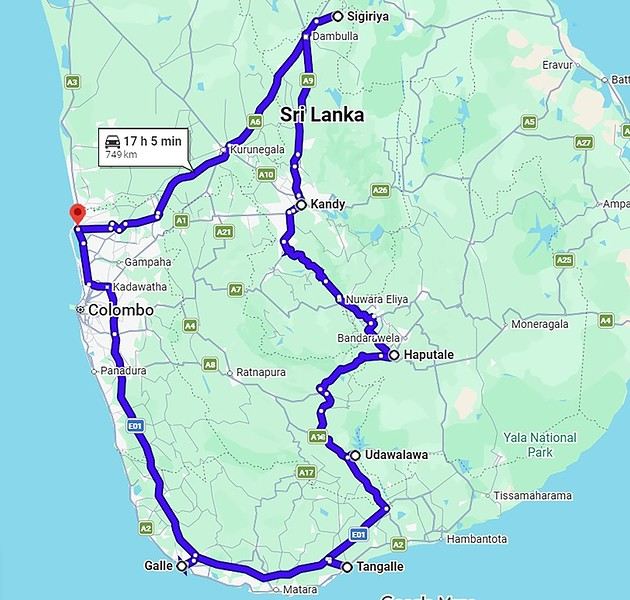
Looking for opinions and advice on Sri Lanka itinerary with Mumbai extension
Hi there! 🙂

We’re heading to Sri Lanka for 23 days in January 2027—there are four of us—and we’ll wrap up the trip with 5 days in Mumbai. Our itinerary is coming together, but what do you think? (We can’t change the dates since our flights are already booked.)

We still have one night to slot in, and I’ve tentatively planned it in Tangalle, though it was a bit random. Would it make more sense to place it at a different stop? Or is there an intermediate stop I might be missing?

I’ve got accommodations sorted everywhere except Mumbai—it’s a nightmare (either way too expensive or really dodgy). By default, we’ve spotted the Residency Hotel Fort, but 70 € a night (with a discount) for a hotel that doesn’t offer anything special in India?!

Thanks so much for your help!


Open
Discovering Assam and Nagaland 2025
Before I begin, I’d like to thank Michèle Buisson and her "Misha’s travel journals," which really helped me plan this trip. It’s tough to find information about this part of India, which is quite different from the "more traditional India." I’m so grateful to her for introducing me to a family who hosted me for 4 nights and 3 days. I can’t wait to return the favor and welcome you all to my place in early July!

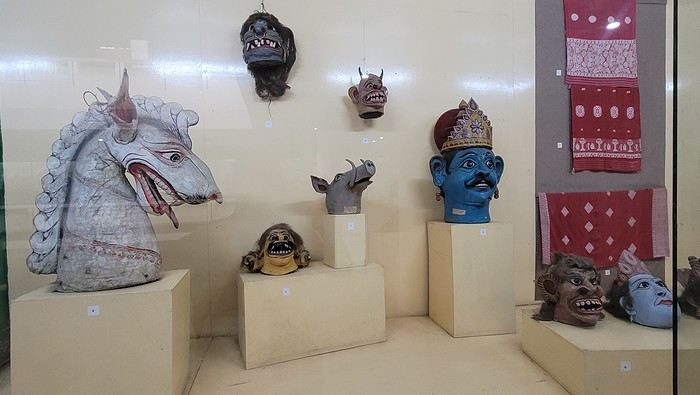
Thursday, March 20th. The alarm goes off super early, but I’m already awake—I was too worried I’d sleep through it. I leave the house at 4:00 AM. The rain has stopped, and at this hour, there aren’t many trucks on the road. I arrive at Barcelona Airport easily by 6:20 AM, let the valet know I’m there, and he quickly picks up my car. This time, I’m flying with Etihad Airways again. I booked the ticket during my trip to Cambodia: Barcelona/Kolkata, Delhi/Barcelona for 567 €. At that price, I didn’t hesitate for long—I knew I had to take it. And I’m glad I did because, by the time I returned, the price had gone up to 700 €. I can already hear the reactions: "Wow, how’d you get a ticket for that price? What site did you use? You’re amazing, MarieJo!" One thing’s for sure—I’m really happy with this deal. The flights from Barcelona to Abu Dhabi and Abu Dhabi to Kolkata go smoothly, and we arrive on time at 2:55 AM. There aren’t many people at immigration, so I get through quickly. My luggage isn’t on the carousel yet. After collecting my bag, I check in for my next flight with IndiGo, a 5:40 AM flight to Guwahati, arriving at 7:00 AM. I’m starting to feel pretty tired, so I take a taxi from the airport to Gruham Sojourn Homestay. The house is upstairs, and the neighborhood seems quiet, with restaurants lining the street. The room won’t be ready until 10:00 AM, so I rest on the bench in the meantime. Once in the room, I take a shower—it really helps me feel refreshed. I need to exchange some euros, so I look up a nearby exchange bureau on Google and head out to find it. I locate it easily, and the staff are super friendly. I get a great rate (1 € = 90 INR). I wander around the neighborhood. The train station isn’t far, and small markets line the streets. I head back to my area, walking along the main avenue. About 500 meters from my street, I discover a museum. The visit is fascinating—I see the famous Majuli masks, among other things.


I’m not far from the Brahmaputra River, and the temptation to visit is too strong to resist. I’d hoped to find a promenade along the river, but that doesn’t exist here. I walk back calmly and notice several restaurants in my street. On the doorstep of my accommodation, I spot a pastry shop with cakes that look more like the ones we have in France than the typical ones here in India. A visit is a must, and I’m not disappointed!


Tonight, I’m dining at a restaurant in the street. The menu is a bit disappointing—burgers, pizzas, pasta—nothing very Indian. So, I’ll go with tomato pasta.
Open
4 friends discover a piece of North India
Hello fellow travelers!

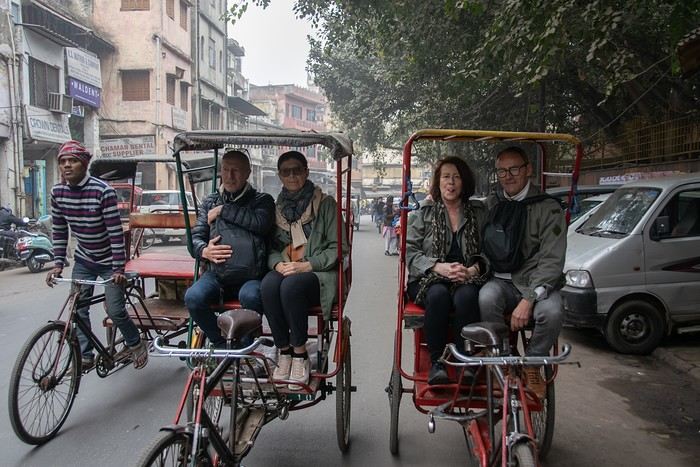
I’m adding my small contribution to the reopening celebration by posting this travel journal from India, made in January 2024. We’re 4 friends (2 couples), and we did a 3-week loop in Rajasthan, stopping by Delhi and Agra (which, as everyone knows, aren’t in Rajasthan 😛). Delhi - Agra - Jaipur - Bundi - Udaipur - Jodhpur - Jaisalmer - Delhi

We rented a car with a driver from Agra to Jaisalmer, 550 € for 14 days. https://chauffeurpriveeninde.com/fr/

We took the train from Delhi to Agra and the plane (Spicejet) from Jaisalmer to Delhi.

Most of the accommodations were booked on Booking before we left.

I’m sharing this story written by Richard and illustrated by me. We dedicate it to Nathalie and Bruno, our amazing travel companions.

Open
Villages around Hazaribagh in West Bengal
Wednesday, April 1st

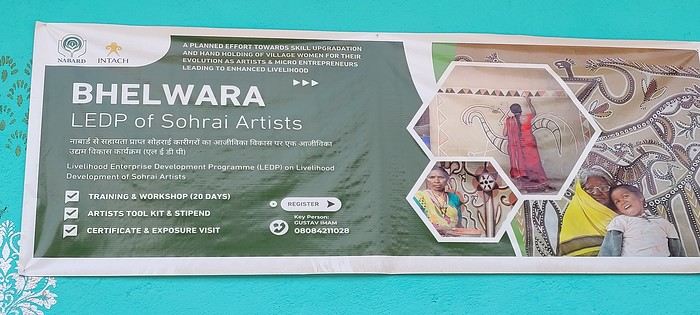
Hazaribagh I’ve got a meet-up with Adam Iman, a guide and painter. He picks me up from the hotel at 10 AM. Another traveler from Bangalore is supposed to join us, but while we wait for him to arrive, Adam takes me to see the paintings his mother and sister created at Hazaribagh station. The town became famous thanks to these murals, which can also be found in several surrounding villages. This art form has earned recognition and is now protected, a sign of its cultural importance. Once the visit is over, we go to pick up the other traveler and then head to our first village: Belwara, where Sohrai art is practiced. At the entrance, a sign proudly announces that we’re entering an artists’ village, where this art is created by women organized into micro-enterprises. Some even offer workshops for those who’d like to learn this tradition.


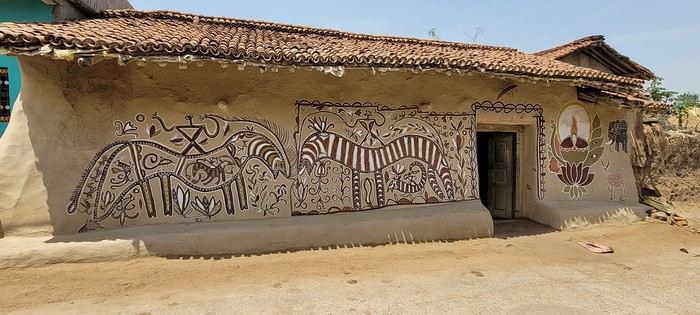
Sohrai art is tied to the harvest season, from October to mid-November. The motifs, in natural colors, celebrate fertility and abundance. The artists use pigments from the earth: red oxides, ochre, white kaolin, and black manganese. On the walls, you’ll see animals, fish, birds—all symbols of life and prosperity. As I look closer at the murals, I start to realize that each motif tells a story. Large animals like cows or bulls often take center stage. Their bodies are filled with intricate, almost hypnotic patterns. They symbolize wealth and prosperity for the household, as well as the deep respect for cattle, which are essential to daily life. On some facades, elephants stand out—massive and decorated with the same precision. They evoke quiet strength and protection. But it’s when I stop in front of one of the houses that I really take the time to look. The wall, a soft ochre, is entirely covered in murals. Two large animals stretch out on either side of the door, their elongated bodies fitting the length of the wall. Their silhouettes are filled with geometric patterns and incredibly fine curved lines, as if every space was patiently filled. Around them, stylized plants, flowers, and small decorative elements fill every gap. The door, dark and worn, becomes almost the silent center of the composition, framed by these living, protective forms. To the right, a more colorful motif catches the eye—a flower or a stylized lamp—like a touch of light on the earth. The whole thing gives an impression of perfect balance, between the rigor of the patterns and the freedom of the gesture.


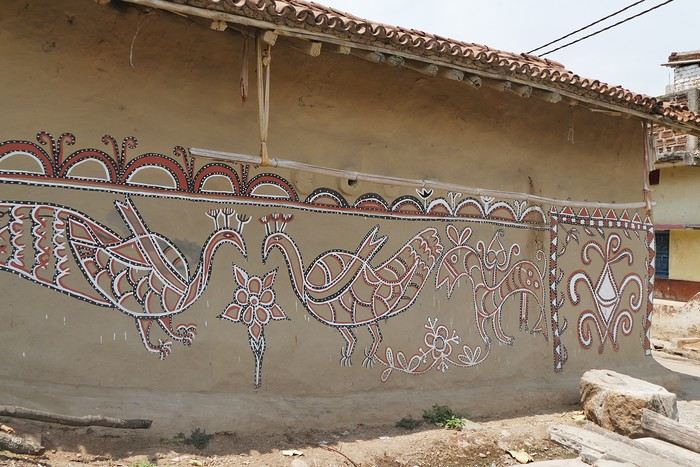
Elsewhere, birds and freer forms bring movement. Peacocks, recognizable by their stylized silhouettes, embody beauty and vitality, while fish symbolize water, fertility, and the continuity of life.
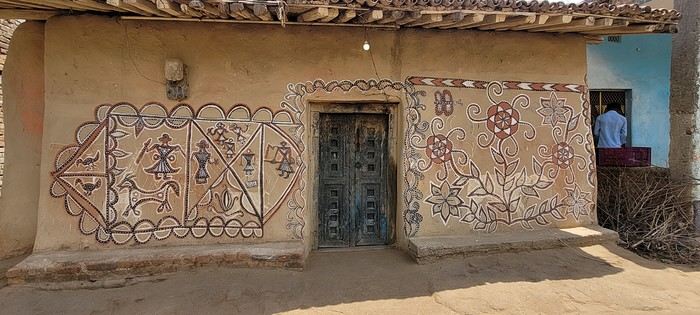
On some paintings, the scenes become almost narrative: you can make out figures, everyday gestures, like a memory of the village inscribed in the walls. The decorative frames around the doors aren’t left to chance either—they symbolically protect the house, like a boundary between the inside and the outside world.
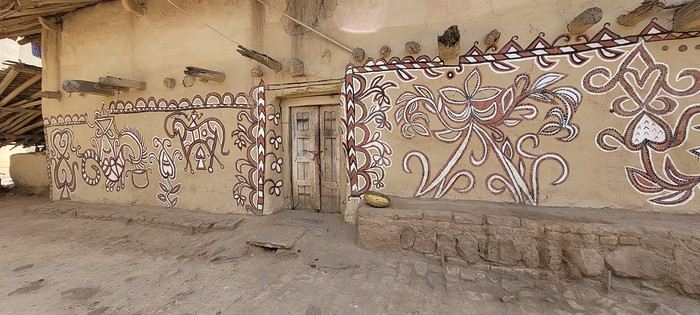
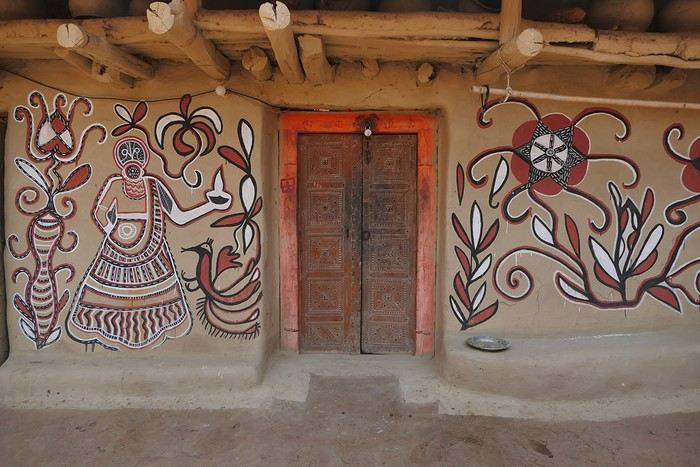


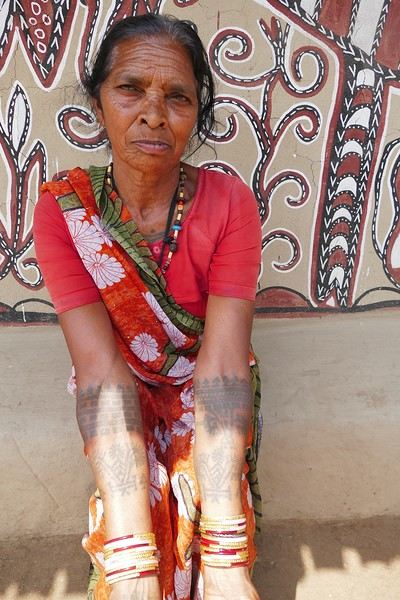
During the Sohrai festival, cattle are led into the jungle in the morning. Meanwhile, the women finish the *aripans*—these floor paintings—and continue the wall murals. Around noon, the animals return to the village, and the bulls’ horns are anointed with oil and vermilion in a gesture of gratitude, amid the vibrant colors adorning the houses. We visit several artists, including Parvat Devi, a well-known woman who has received many awards. Her arms are adorned with intriguing tattoos, which I’ll talk about in more detail later.


On another wall, the style changes completely. Here, no massive animals—just birds occupying the space, light and graceful, as if caught in mid-movement. Two silhouettes face each other, their long necks arched almost like mirrors, while their outstretched wings seem to vibrate with the patterns that compose them.
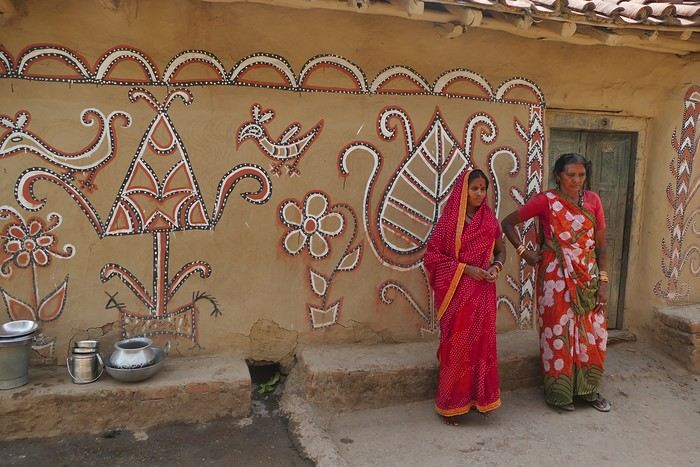


The design is more graphic, almost airy. The lines are smoother, more fluid, as if drawn in one confident stroke. The birds’ bodies aren’t solid—they’re filled with repetitive motifs like scales, stylized feathers, and spirals, giving a sense of continuous movement. Around them, everything comes to life: flowers burst open, arabesques swirl, and even the simplest shapes seem alive. What strikes me here is the sense of lightness. Where the large animals evoked stability and grounding, these birds bring something freer, almost joyful. They seem to embody movement, the circulation of life, like a breath flowing through the village.
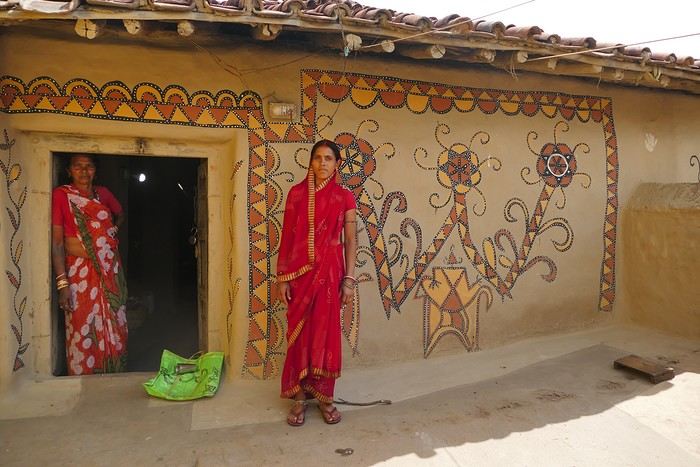


The colors remain the same—deep reds, intense blacks, and chalky white—but the rhythm is different. Faster, more spontaneous. As if each wall had its own personality, while still speaking the same language.

That’s probably why I’m so moved. I’d heard about these paintings from my friend Raja, and last year, I saw an exhibition in a village near my home. That first encounter made me want to come here. But seeing them in person is a whole different experience. These paintings are unique. This ancient art is passed down from mother to daughter, or mother-in-law to daughter-in-law, in a quiet, deeply living continuity. At first glance, it might seem almost childlike in its simplicity and pared-down forms. And yet, everything is thought out, balanced, mastered. Nothing is left to chance.
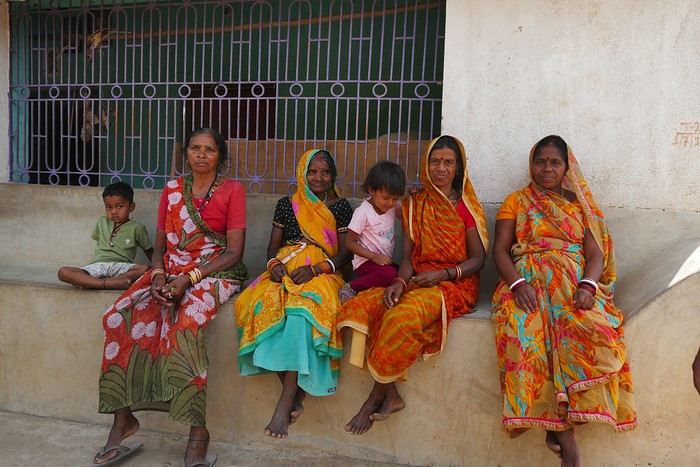


That apparent simplicity, combined with such rich symbolism, touches me deeply. There’s something sincere and essential in these walls—and that’s what moves me.
Open
Some information following our trip to Kashmir and Ladakh in spring-summer 2026
Hello everyone, we got back from our trip to Kashmir and Ladakh three weeks ago. We spent 4 weeks there, including one in Kashmir. We’re really happy with our stay in Srinagar and Sonamarg. The Kashmiris gave us a very warm welcome and seemed pleased to see tourists who weren’t Indian. In fact, over the 4 days we spent in Srinagar, we only saw 4 people who looked European... Srinagar is stunning with its lakes and the lively Mughal gardens. No trouble getting around, whether by shikara, rickshaw, taxi, or on foot. The houseboats are gorgeous, unfortunately controlled by consortiums. We took a taxi to Sonamarg (20 €).

Sonamarg (two nights) and its glacier are easy to explore, either on horseback or on foot, but it’s becoming a leisure spot for Indians. To get to Ladakh afterward, we opted for a private taxi (quite expensive at 100 €, but the road is long). Since we’re a couple, it allowed us to stop whenever we wanted... and the route is beautiful all the way to Lamayuru, with our first snow-covered pass under snow when we crossed around May 21st. Then we stopped in Mulbek and Kargil before arriving in Lamayuru (three nights). We took another taxi to Alchi (26 €), spent one night there, and took the local bus at around 8 AM to Leh (3 €, a comfortable one-hour ride). We arrived in Leh around 9:30 AM, and Gyatsel from Tsarap Guesthouse came to pick us up with our backpacks. His guesthouse is located 500 meters from the market square in Leh, in a quiet little alley with no traffic. We highly recommend it because Gyatsel is invaluable for arranging taxis and organizing off-agency circuits...

His accommodation is super comfortable, and he cooks with vegetables from his garden. His wife also helps out... It’s Gyatsel’s mother who tends the garden. Through him, we arranged permits for the Nubra Valley up to Turtuk, then the Pangong and Tso Moriri lakes (we didn’t do the latter due to snow overnight!). We also crossed the Changtang (magnificent) to reach Thiksey, Stakna, Hemis, and returned to Leh. Six days in a private taxi (400 €). Since the roads were clear, we headed to Zanskar for 5 days in a shared taxi (28 € round trip for both of us). The route from Leh to Zangla follows the Zanskar gorges (impressive!).

We discovered Padum, Pibiting, Karsha, and Puktal, which you can reach via a small 7 km road and a 45-minute walk to finish, plus the sacred summit on the way to Manali.

Back in Leh, we extended our permit to visit the Aryan Valley by taxi (round trip, two days, 90 €). We spent our last two days resting in Leh—the altitude is really tiring...

I’m sharing these taxi prices as a guide for a couple. Accommodation ranged from 12 € in Leh to 30 € at Pangong Lake (the most expensive), but averaged around 15-17 € per night.

We’re not trekkers, but we love walks, discovery, and meeting people along the way. It was an amazing trip, and we even discovered a very old monastery a few kilometers before Lamayuru, where a monk took us—timeless...

I’m sharing these details because it’s hard to find precise information about Kashmir.
Open
Yet Another Travel Journal in this (Too) Familiar Rajasthan, But with Family and Kids
Prologue

This journal recounts a trip to Rajasthan that’s already over a year old and that I’ve only now found the chance to write about. The summer of 2024 marked my return to India—my tenth trip—after six long years away since my last solo wanderings in Tamil Nadu in 2018 (the journal of which is published on this site). That absence was partly (but not only) due to the long COVID and post-COVID period, which saw a complete halt and then a major slowdown in global tourism. To top it off, Voyage Forum announced its closure in an end-of-the-world atmosphere. A sad time for our favorite social activity…

A few weeks after returning from Rajasthan, I tried to motivate myself to start writing a journal to publish on a forum claiming to be VF’s successor, which I’d eventually signed up for out of desperation. But I kept hesitating and putting the project off because, for one, I no longer have the time I used to. For another, the vibe wasn’t really taking off on that forum—it was overrun with ads and not very active, contrary to what its host’s name suggested. Despite its good intentions and commendable role as a stopgap, it also turned out to be very impractical to use, especially when you don’t have much time like me. I’ll admit I’d occasionally check back on VF to see if anything was happening. But all the discussions remained frozen in time, stuck in that fateful year, 2020. Then, rumors swirled online about shady reasons behind its closure, leaving little room for hope.

And then, one fine morning, I got a message at work from Marien informing me that VF had reopened. What a huge surprise! Even though the forum’s “end” had played out in a somewhat apocalyptic atmosphere, the memories of passionate and heated discussions, the frank debates, and the useful exchanges that made this site a traveler’s goldmine and a unique hub of conviviality all came rushing back to me like a breath of fresh air. I finally saw a sign and tried to motivate myself to find the time to publish the journal of this tenth trip to India and fifth to Rajasthan. But in the end, I got bogged down in professional and family obligations and never managed to find the time to get started. That’s now fixed, though, because I had two reasons for wanting to do it: I find that looking back on a trip to tell others about it is a highly beneficial introspective exercise. Also, I thought this journal could be useful to other travelers on a few points.

Because, “do we really need yet another journal about Rajasthan?” you might rightly ask! Especially in a time when so many journals about the “Land of Kings” have been published since VF’s return, not to mention the countless stories you can already find online about this region, one of India’s most touristy. And I’d add, why go back to Rajasthan for a fifth time, where I’ve already dragged my feet more than enough—through its forts, deserts, temples, cities, villages, bumpy roads, train stations, tasty street food stalls, cheap guesthouses, and more? Where some might see just another overhyped tourist destination full of the same old *Arabian Nights* clichés, worn to a thread, that I mentioned earlier, when there’s so much else to see in India? Well, first because it’s a magnificent country I never tire of, where I started an academic study and made so many connections. It’s also packed with places where you won’t find a single tourist (right, Marie-Jo?), even in the heart of well-trodden paths and classic itineraries. And most importantly, as I said earlier, things have changed in recent years. First, after six years without traveling far, the urge to go back to India was getting stronger. But this time, no more solo trips (often) or duo adventures (sometimes)—now it’s a team of four that has to come along! And even if you can argue with that, what better place than Rajasthan to introduce India to people who’ve never seen it? To kids you want to amaze? Plus, traveling with your new little family to your favorite country isn’t the same as going solo in often spartan conditions that only affect you. It’s a different challenge, but ultimately probably much harder. So, is it really reasonable to take two kids to India, including a two-year-old baby? That’s one of the main goals of this journal (but not the only one)—to try to answer that question.

As you can tell, it’s not so much the destination but the slightly unusual setup of this trip that, in my opinion, will make this journal interesting. Despite my experience and expertise (yes, I dare say it) in India, there were plenty of questions before we finalized the plan and said, “Alright, let’s go!” The questions were flying for us parents. Is it wise to travel to India with a two-year-old? What would we do (it happened) if the kids got very sick? Would they be able to handle a road trip on Rajasthan’s bumpy, dusty roads using public transport? Could they handle the shock of such a different world—the dirt, poverty, pollution, noise (…and the smell, as they say), the spicy food, monkeys, mosquitoes, snakes, tigers, leopards, and so on? In short, all the clichés that I usually joke about suddenly became potential realities. Another concern: as a mixed Franco-African family (not me, but my partner and her oldest), wouldn’t we risk not always being well received, given what you sometimes hear about that in India? How would Indians react to seeing a mixed-race family, the ultimate taboo in a country of purity and social segregation, which would undoubtedly raise many questions for them? Of course, not everything went as expected… Because, as you know, with India—and what makes it charming for some—there are always complications: sometimes where you don’t expect them… and sometimes where you do. I’ll go into detail about that in the journal to come (not right away) and in the final review (even later). These experiences could be useful to travelers who find themselves in similar situations and have the same questions we did before embarking on such a journey. And maybe it’ll spark the curiosity of those who aren’t concerned and will read yet another Rajasthan journal, but with its own unique twists.

Despite my unchanged constraints, which mean I have little time to write this, I don’t want to rush the story, so I’ll take my time. There will probably be lulls. I hope that won’t stop people from coming to react, debate, share their impressions, or ask for information.
Open
Travel companions for Sri Lanka January–March 2027
Hello, Don’t stay in the cold and damp! I’m looking for one or more people (men or women, travel companions) to spend a few weeks in South India and Sri Lanka from late January to early March.

I’m Jean Pierre, 75 years old, and I manage just fine when traveling. Phone: 0389812641 Cheers, Jean Pierre
Open
Looking for travel companions to explore Kerala in a friendly atmosphere Dec 2026-Jan 2027
Hello, My name is Anne, I’m 57 years old, and I’ll be traveling in Kerala from December 26, 2026, to January 14, 2027. I’m looking for a group or travel companions from January 6 to 12, 2027, ideally with participants aged 50 to 65, to enjoy yoga, Ayurveda, relaxation, and social activities. Thanks in advance for your replies!

My name is Anne, I am 57 years old and I will be travelling in Kerala from 26 December 2026 to 14 January 2027.

I am looking for a friendly group or company from 6 to 12 January 2027, ideally with participants aged between 50 and 65, to enjoy yoga, Ayurveda, relaxation and social activities.
Open
Self-sufficient treks in Ladakh and Zanskar – August to mid-September 2026
Hello

I’m looking for people who might be interested in joining me on one or more self-sufficient treks, no agencies, between Zanskar and Ladakh this summer. My plans: Trek from Songde to Phuktal Gompa (return by hitching on the new road to Padum) Trek from Lingshe to Kanji (hitch to Lingshe using the new Padum–Nimmu road) Trek from Leh to Hundar (Nubra Valley) via Lasermo La Trek from Korzok (Tso Moriri) to Kibber via Parang La, probably after September 10th (there are 3 buses a month on the 10th, 20th, and 30th between Leh and Korzok) I’m pretty used to long-distance treks with a heavy backpack (self-sufficiency is key 😄!) and reasonably fit for my age 😅 (the big 5-0!). Feel free to reach out with any ideas if you’re interested, and we can figure out what’s doable together... Looking forward to hearing from you! Raf
Open
A Guide to Kashmir
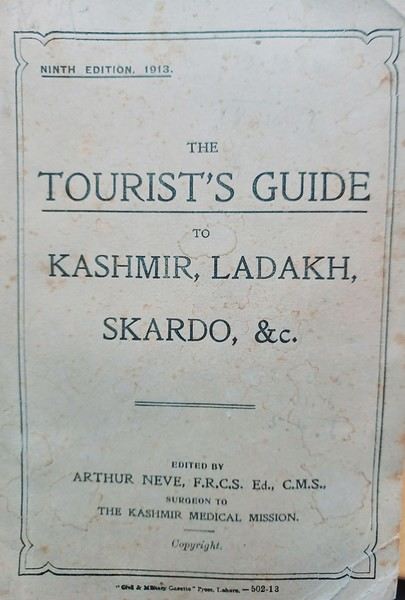
Arthur Neve (1859–1919), an English doctor and missionary, dedicated most of his life to his passion for Kashmir, a region he wrote several books about—including this guide (18 editions published between 1890 and 1945).

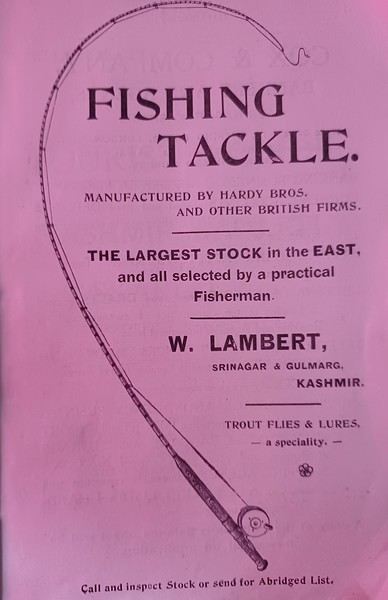
This copy (225 pages, 9th edition, 1913), published in Lahore, features dozens of detailed itineraries with maps, covering campsites, mountain pastures, river crossings, and more. Among them, you can trek from Srinagar to Khapalu and then to Baltistan, or "travel" from Leh to Yarkand (Xinjiang) via the Nubra Valley, along with other unexpected destinations. The guide also includes suggestions for shikara rides, houseboat rentals, and gear for hunting, camping, fishing, and photography. Plus, it lists various supplies like chocolate, Egyptian cigarettes, frames, and alcohol. Note that the Murree Brewery, relocated to Rawalpindi, is still operational—though, in theory, the predominantly Muslim population can’t access it. I found this book in a box of old books, and you can still find copies on Anglo-Saxon websites—though often at prohibitive prices.

Open

You might also like