Hi there,
We’re a couple traveling with our 2.5-year-old baby. We’re heading to Patagonia in March or April 2026. We don’t have exact dates yet because this will be the start of a long trip around Latin America.
We’ll be traveling by public transport, with our backpacks and a baby carrier for support.
We’ll take a domestic flight from Buenos Aires to Ushuaia, and the rest will be by bus.
Here’s the itinerary we’ve planned:
- Buenos Aires (5 days)
- Ushuaia (5 days or more)
- El Calafate (3 days)
- El Chaltén (5 days)
- Los Antiguos + border crossing at Chile Chico
- Puerto Río Tranquilo (Chile) (5 days)
- Coyhaique (Chile) (3 days)
- Chiloé Island (Chile) (10 days)
- Puerto Varas (Chile) (3 days)
- Bariloche (5 days)
- San Martín de los Andes (3 days)
- Mendoza (5 days)
After that, we’re thinking of spending a few days in Córdoba, then a month in Salta.
We plan to head back down to Santiago (Chile) and then head north along the Chilean side toward Peru.
What do you think of this itinerary (especially the Patagonia part)? Is it doable with a young child just over 2.5 years old?
I’d also love to include Esquel and El Bolsón in Argentina, but I’m not sure how to fit them in or if they’re really worth it.
The durations are approximate, depending on what there is to do in each place...
Do you have any suggestions for improving it or any tips?
We want to do some easy hikes or half-day walks since we won’t be able to carry him all day. That’s why we’ve intentionally left out Torres del Paine National Park (very expensive and not very baby-friendly, I think).
Do you know of any hikes that are accessible with a little one?
Thanks in advance! !
33 similar discussions in English
Hi everyone,
We’re heading to Chile and Argentina for 4 weeks (Atacama Desert, Easter Island, and Chilean and Argentine Patagonia).
For Patagonia, our itinerary (rental car) is as follows:
1 night in Puerto Natales
2 nights in Torres del Paine.
Then we’ll drive back up to El Chaltén, where we’ll spend 3 nights (fingers crossed the weather lets us do the two hikes we’ve planned). After that, we’re off to El Calafate for 2 nights (Perito Moreno Glacier). Our last day and night in Argentina will be spent at an estancia (Nibepo Aike). This is where I’m wondering: We have to drive in one day from the estancia (1.5 hours of dirt road from El Calafate) all the way to Punta Arenas. On paper, it seems doable. But what’s it like in reality? Is it too long? Thanks for your thoughts and advice—I hope I’ve been clear. Pilar
Then we’ll drive back up to El Chaltén, where we’ll spend 3 nights (fingers crossed the weather lets us do the two hikes we’ve planned). After that, we’re off to El Calafate for 2 nights (Perito Moreno Glacier). Our last day and night in Argentina will be spent at an estancia (Nibepo Aike). This is where I’m wondering: We have to drive in one day from the estancia (1.5 hours of dirt road from El Calafate) all the way to Punta Arenas. On paper, it seems doable. But what’s it like in reality? Is it too long? Thanks for your thoughts and advice—I hope I’ve been clear. Pilar
Hi there,
I’d like to walk in the footsteps of Antoine de Tounens, the king of the Mapuche.
Would you happen to have a suggested route for me in the Chilean Araucanía?
I’ve got the historical info from araucanie-patagonie.org, but I’d love some ideas for places to visit.
Thanks
Hello,
For our trip in September 2025 from mid-September to early October (3 weeks), we’ve planned 8 days in San Pedro, then a transit night in Santiago, 8 days in Chilean Patagonia, and 3 days for Santiago/Valparaíso before heading back. Is it possible to easily explore with a rental car from a lodge based in Puerto Natales, including visiting Torres del Paine National Park? Or does that mean too much driving in a day, or would it be better to plan an overnight stay in the park or nearby?
We applied for our international driver’s permit in January 2025 for September, hoping to get it in time—I checked the forum about this. Regarding the car rental, do we really need a credit card (not debit) in the main driver’s name for the deposit?
How far in advance should we book entry tickets to the national parks for this period?
Best regards,
Odile
Hi everyone,
We’re heading to Patagonia for three weeks in November, starting from Coyhaique in Chile.
We won’t have a car, and I’m struggling to find information about transportation options for a few parts of the itinerary we’d like to do:
1) From Perito Moreno (the town, near Los Antiguos), we’d like to travel down Ruta 40 to visit Perito Moreno National Park and then cross into Chile via the Paso Roballos (at the latitude of Bajo Caracoles) to reach the road to Cochrane. Without a car, it seems we’ll need to use private agencies to get to the national park—do you have any recommendations or suggestions? Also, does anyone know if it’s possible to cross into Chile via Paso Roballos (from Bajo Caracoles) without a rental car? That is, without having to go all the way down to El Chaltén or back up toward Perito Moreno/Los Antiguos, etc.?
2) The second stretch that seems a bit tricky (though still easier, in theory) is from Caleta Tortel to Villa O’Higgins on the Chilean side. Do we have to go back through Cochrane, or are there ways to get directly from Tortel to Villa O’Higgins?
3) Finally, we’d like to hike into Argentina (El Chaltén) from O’Higgins. Any recommendations for this? Do we need to go through an agency? What’s the estimated duration of the trek?
As you’ve probably gathered, we want to visit some off-the-beaten-path spots but don’t have a car, so we’re looking for the best possible compromises.
Thanks so much in advance for all your suggestions! Thomas
A 70-year-old woman is planning a two-week trip to Patagonia in early February 2027 (around the 10th or 11th) without doing any strenuous hikes—physically not possible.
Looking for a travel companion to potentially do a road trip or simply follow this itinerary by plane and bus... the exact route isn’t set yet depending on the cost of domestic flight tickets.
BUENOS AIRES OR SANTIAGO
EL CALAFATE
EL CHALTEN
TORRES DEL PAINE
USHUAIA
SANTIAGO OR BUENOS AIRES
Thanks for your attention, and have a great day everyone! Anne
Thanks for your attention, and have a great day everyone! Anne
Hi there,
Three years after exploring northern Argentina and Chile, my two travel buddies and I want to discover the southern part of these two countries. We’re traveling on a budget, backpacker-style, favoring public transport and modest accommodations, but we don’t hesitate to splurge a little when it’s worth it. The classic spots that have been fueling our dreams: Bariloche, the lakes, Chiloé, El Chaltén, Torres del Paine, Perito Moreno, El Calafate, Fitz Roy, Ushuaia and Tierra del Fuego, and wrapping up in Valparaíso. We’ll take a round-trip flight to Santiago, then I’m thinking of a one-way flight from Santiago to Punta Arenas. From there, we’ll explore and do several day hikes in the south, including Ushuaia and, if possible, Tierra del Fuego. Then we’ll head back north by bus to Bariloche and the lakes, followed by Chiloé, then a bus to Santiago and Valparaíso. Based on your experience, could you help me figure out the best way to structure this trip and maybe suggest some ideas? Thanks in advance. Didier
Three years after exploring northern Argentina and Chile, my two travel buddies and I want to discover the southern part of these two countries. We’re traveling on a budget, backpacker-style, favoring public transport and modest accommodations, but we don’t hesitate to splurge a little when it’s worth it. The classic spots that have been fueling our dreams: Bariloche, the lakes, Chiloé, El Chaltén, Torres del Paine, Perito Moreno, El Calafate, Fitz Roy, Ushuaia and Tierra del Fuego, and wrapping up in Valparaíso. We’ll take a round-trip flight to Santiago, then I’m thinking of a one-way flight from Santiago to Punta Arenas. From there, we’ll explore and do several day hikes in the south, including Ushuaia and, if possible, Tierra del Fuego. Then we’ll head back north by bus to Bariloche and the lakes, followed by Chiloé, then a bus to Santiago and Valparaíso. Based on your experience, could you help me figure out the best way to structure this trip and maybe suggest some ideas? Thanks in advance. Didier
Hello,
We’re planning a trip to Patagonia for November–December 2026.
After reading forums, blogs, and guidebooks, we’ve sketched out a rough itinerary and would love to hear from experts.
We initially wanted to rent a camper van, but it’s hard to find options and we have no idea about prices.
We’ve settled on starting in Bariloche, crossing into Chile for the Carretera Austral, then back into Argentina before crossing into Chile again for Punta Arenas, and finally ending in El Calafate to drop off the car. We don’t want to make any advance reservations so we can stay flexible based on weather and road conditions.
Do you think this route is reasonably doable?
And if you have any idea about the cost of renting a car for 17 days with a different drop-off location and the paperwork needed for border crossings…
Thanks a million in advance for your replies!
Céline
Day 1: Flight – 24 hours of travel, overnight on the plane Day 2: Arrival in Buenos Aires, overnight in BA Day 3: BA, overnight in BA Day 4: BA, overnight in BA Day 5: Flight to Bariloche, overnight in Bariloche Day 6–7: Seven Lakes route, overnight in Bariloche Day 8: Drive to La Junta, overnight stop Day 9: Drive to Puerto Tranquilo, overnight in Puerto Tranquilo Day 10: Catedral de Mármol, overnight in Puerto Tranquilo Day 11: Drive to El Chaltén, overnight stop Day 12: Arrival in El Chaltén, overnight in El Chaltén Day 13: El Chaltén, overnight in El Chaltén Day 14: El Chaltén, overnight in El Chaltén Day 15: Drive to Punta Arenas, overnight in Punta Arenas Day 16: Punta Arenas, overnight in Punta Arenas Day 17: Punta Arenas, overnight in Punta Arenas Day 18: Drive to Torres del Paine, overnight in Torres Day 19: Torres del Paine, overnight in Torres Day 20: Torres del Paine, overnight in Torres Day 21: Drive to El Calafate, overnight in El Calafate Day 22: El Calafate, overnight in El Calafate Day 23: Flight to BA, overnight in BA Day 24: Flight to Paris
Day 1: Flight – 24 hours of travel, overnight on the plane Day 2: Arrival in Buenos Aires, overnight in BA Day 3: BA, overnight in BA Day 4: BA, overnight in BA Day 5: Flight to Bariloche, overnight in Bariloche Day 6–7: Seven Lakes route, overnight in Bariloche Day 8: Drive to La Junta, overnight stop Day 9: Drive to Puerto Tranquilo, overnight in Puerto Tranquilo Day 10: Catedral de Mármol, overnight in Puerto Tranquilo Day 11: Drive to El Chaltén, overnight stop Day 12: Arrival in El Chaltén, overnight in El Chaltén Day 13: El Chaltén, overnight in El Chaltén Day 14: El Chaltén, overnight in El Chaltén Day 15: Drive to Punta Arenas, overnight in Punta Arenas Day 16: Punta Arenas, overnight in Punta Arenas Day 17: Punta Arenas, overnight in Punta Arenas Day 18: Drive to Torres del Paine, overnight in Torres Day 19: Torres del Paine, overnight in Torres Day 20: Torres del Paine, overnight in Torres Day 21: Drive to El Calafate, overnight in El Calafate Day 22: El Calafate, overnight in El Calafate Day 23: Flight to BA, overnight in BA Day 24: Flight to Paris
Hi there,
We’re two friends and want to explore Patagonia in 3 weeks, traveling from Puerto Natales to Santiago. We’d like to use public transport. Has anyone tried this before? If so, could you share your itinerary, booking tips, etc.? We’ll be traveling in December–January.
Thanks!
Hi! We’re planning to spend a month (February or March 2026) in southern Chile, starting from Santiago (Lake District, Torres del Paine Park, Punta Arenas).
Can we do this itinerary by car, or do we need to take internal flights?
Has anyone done this trip and can give us some tips?
Thanks!
Fabienne and Jérôme
Hi there,
Could you recommend any car rental agencies in Calama and Punta Arenas? Best regards,
Could you recommend any car rental agencies in Calama and Punta Arenas? Best regards,
Hello,
I’ve planned a 3.5-week trip to Chile in February/March 2025, with the goal of driving the Carretera Austral from Puerto Montt to Caleta Tortel in a rented 4x4. The itinerary is set, accommodations are booked, and the 4x4 is reserved. We could still tweak things a bit, but it’s getting harder to find available lodging in some spots.
Here’s the planned route: - 1 night in Puerto Montt on arrival day - 2 nights in Castro (Chiloé Island) - 2 nights near Ensenada - 1 night in Horniporén - 1 night in Chaitén - 3 nights in Puyuhuapi - 2 nights in Coyhaique - 3 nights between Puerto Bertrand and Cochrane - 2 nights in Caleta Tortel - 3 nights in Puerto Guadal - 1 night in Chile Chico (to take the ferry across the lake) - 1 night in Villa Cerro Castillo before flying out from Balmaceda
I have a few questions about the activities we’d like to do:
The **Marble Caves**: I’d love an option that lets us "go inside" them. From what I’ve read, this depends on the water level, wind, and type of boat. Any tips or advice? We’d like to do an **excursion to see condors**. We were thinking of doing this while in Coyhaique (we’re staying 2 nights). Has anyone done this? With which agency? We’re spending 3 nights between Puerto Bertrand and Cochrane. The idea is to **explore the vast Patagonia Park and its wildlife**. But I’m not sure where to start. Any recommendations for day hikes or itineraries? I read somewhere that you can do a day trip with a guide that includes a boat ride on Lake Cochrane, but I can’t find the booking info. An agency for **glacier exploration** (we were thinking of **Lake Leones Glacier**). I contacted Ruta León but haven’t heard back. Any agencies to recommend?
Thanks so much! Pascale
Hi everyone,
We’re planning 40 days in Uruguay and Argentina in February and March, trying to avoid as much rain as possible.
We’re thinking of starting in Buenos Aires, then heading to Bariloche, and from there flying to Córdoba, Mendoza, or Salta. Maybe by bus or renting a car to explore each region.
Do you have any suggestions or tips for us? We love picturesque, historic cities and landscapes. As seasoned travelers, we’re used to planning our trips ourselves.
Thanks in advance!
Hello,
How good it feels to be back on this forum!!!!
Today, we started looking into traveling in April 2026, either to Chile or Argentina. It’s our first trip to South America. I’ve only been to French Guiana once, about ten years ago, for the space center. In recent years, we’ve usually gone to Asia during the spring holidays.
Based on the flight tickets I’ve found, two arrival and departure options are available: - Arriving in Buenos Aires and departing from Salvador de Bahia. - Arriving in Santiago, Chile, and still departing from Salvador de Bahia.
We’re considering flying business class on the outbound flight so we arrive a bit more rested. The travel class might influence our choice between itinerary A or B.
We’d like to spend two days at Iguazu Falls (both the Argentine and Brazilian sides), which explains the departure from Brazil.
Initially, we thought about arriving in Buenos Aires and staying in Argentina before heading to Iguazu. However, the itinerary forces us to go back through Buenos Aires.
We love nature. The El Calafate region seems to offer beautiful, easily accessible landscapes. Maybe there’s another area we should prioritize.
Here are two itineraries—what do you think? I know it’s short, but we can’t add any more days. We’ll have to make it work.
Option A: D1(Sat): Flight from France to Buenos Aires – arrival at 9:55 PM. D2(Sun): Visit Buenos Aires D3(Mon): Visit Buenos Aires. D4(Tue): Flight from Buenos Aires to El Calafate – 3.5-hour flight – arrival around midday. D4(Tue) – until D11(Tue) – visit the El Calafate region: El Calafate / 121km / El Chaltén / 12km / Mount Fitz Roy / 4km / Cerro Torre Mountain / 132km / Perito Moreno Glacier / 57km / El Calafate. D11(Tue): Flight to Buenos Aires D12(Wed): Morning flight to Iguazu (Argentine side) – flight at 6:40 AM or 8:10 AM – 2-hour flight. D13(Thu): Half-day on the Brazilian side – flight around 7:00 PM to Salvador de Bahia. D14(Fri): Visit Salvador de Bahia (downtown) D15(Sat): Morning visit + midday departure for the airport – flight at 5:45 PM from Salvador de Bahia D16(Sun): Arrival in France.
This itinerary forces us to pass through Buenos Aires twice.
Option B: D0(Fri): Flight from France to Santiago, Chile – departure at 11:20 PM from CDG. D1(Sat): Arrival at 7:45 AM in Santiago, Chile – hotel + city visit. D2(Sun): Visit Santiago, Chile D3(Mon): Departure for Puerto Natales, Punta Arenas, or El Calafate – to be decided. There’s about a 3-hour flight. We need to check the drop-off fees if we pick up the car in Chile and return it in Argentina – see ADEL RENT A CAR. D3(Mon) – until D10(Mon) – visit the El Calafate region: El Calafate / 121km / El Chaltén / 12km / Mount Fitz Roy / 4km / Cerro Torre Mountain / 132km / Perito Moreno Glacier / 57km / El Calafate. D10(Mon): 3.5-hour flight + visit Buenos Aires. D11(Tue): Visit Buenos Aires D12(Wed): Morning flight to Iguazu (Argentine side) – flight at 6:40 AM or 8:10 AM – 2-hour flight. D13(Thu): Half-day on the Brazilian side – flight around 7:00 PM to Salvador de Bahia. D14(Fri): Visit Salvador de Bahia (downtown) D15(Sat): Morning visit + midday departure for the airport – flight at 5:45 PM from Salvador de Bahia D16(Sun): Arrival in France.
The end of the itinerary is the same. This option avoids passing through Buenos Aires twice. Thanks for your feedback.
If you dream of an extraordinary adventure, you’ve come to the right place! Argentina, this land at the end of the world, offers a unique change of scenery and the perfect opportunity to travel solo. With its spectacular landscapes, stretching from the ends of Tierra del Fuego to the high Andean plateaus, this vast country captivates both nature lovers and those passionate about authentic encounters. Here, the notions of borders and distance fade away: the glaciers of Patagonia, the Iguazu Falls in the heart of the tropical forest, wild steppes, and Andean villages nestled in colorful valleys. In Argentina, you quickly forget the passing of time, as the human experience and the beauty of the places leave their mark on every moment.
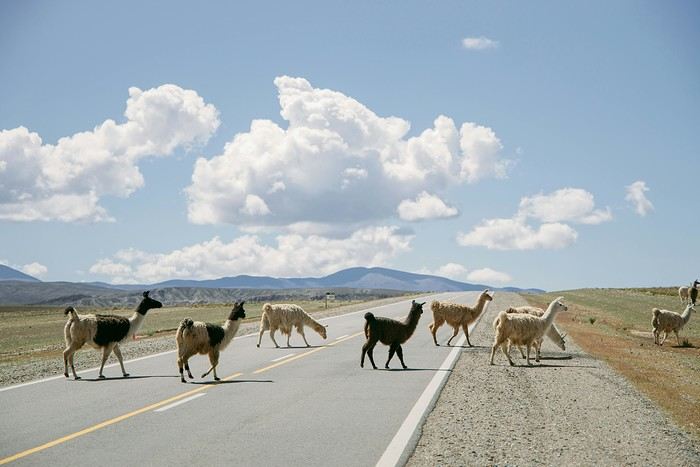
The perfect place to escape mass tourism
When traveling solo, there’s nothing like Argentina to get off the beaten path and avoid the crowds. Of course, some iconic spots like the Perito Moreno Glacier in El Calafate or Tierra del Fuego National Park in Ushuaia attract travelers from all over the world. However, the country’s vastness offers plenty of opportunities to find yourself almost alone in nature. A sunrise over the Andes, an afternoon riding with gauchos in the pampa, or a hike deep in Patagonia—these suspended moments happen far from the crowds.
A country ideal for connecting with local communities
One of Argentina’s strengths is the warmth of its people. Deeply attached to their traditions and genuinely curious about visitors, Argentinians have a knack for breaking down barriers, whether linguistic or cultural. You might find yourself chatting in Spanish over a mate (the local herbal tea), joining an impromptu barbecue, or even trying a few tango steps in a milonga. Simply showing interest in their culture and history is often enough to start a conversation. With Argentinians’ innate sense of hospitality, you never feel alone, even as a solo traveler.
Meeting local communities: a unique human adventure
Traveling solo in Argentina also means encountering its diverse communities. Staying with a local family or in an estancia (an Argentine ranch) lets you dive into the daily lives of families who often live self-sufficiently. In the Northwest, for example, you can share the life of an Andean community and learn to cook delicious local specialties. In Bariloche, some stays even include discovering a Mapuche community, offering a chance to better understand their relationship with the land and the importance of their ancestral traditions.
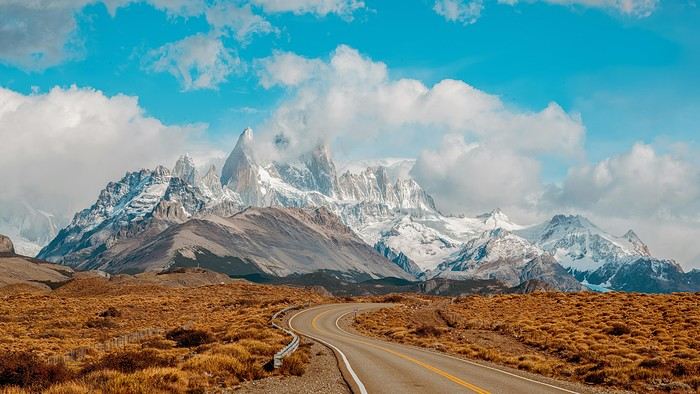
Diverse experiences for an unforgettable trip
Argentina is a true playground for outdoor enthusiasts: hikes in the steppes, sailing on the Beagle Channel in Tierra del Fuego, whale watching in Puerto Madryn (from June to December), or exploring the Iguazu jungle to encounter its wildlife and flora. And just when you think you’ve seen it all, Argentina still has surprises in store. In the Salta region, the Quebrada de Humahuaca reveals mountains with seven colors that tell the geological history of the Andes. It’s a feast for the eyes!
Why not join a small group with Tierra Latina?
Traveling alone doesn’t mean you can’t share parts of your journey with other enthusiasts. That’s what Tierra Latina offers: small-group tours (between 2 and 12 people), designed to balance the freedom of traveling in a small group with the camaraderie of exchanges between travelers. Each itinerary is crafted to alternate highlights (like visiting must-sees: Buenos Aires, Ushuaia, Perito Moreno…) with more intimate moments, far from mass tourism.
The focus is on authentic encounters and respect for local communities—that’s Tierra Latina’s signature. For example, in northwestern Argentina, Tierra Latina offers the chance to spend time in an Andean community to learn about traditional dish preparation during a cooking workshop. It’s an opportunity to exchange recipes and knowledge passed down through generations. The goal: to go beyond simple sightseeing and experience true moments of sharing.
In a small group, you quickly feel like part of a family of travelers, all united by the beauty of the landscapes. You also benefit from French-speaking guides who share their tips and anecdotes while leaving plenty of free time to explore at your own pace. Whether you’re traveling solo, as a couple, or with friends, you’ll find the perfect balance between independence and the comfort of being surrounded.
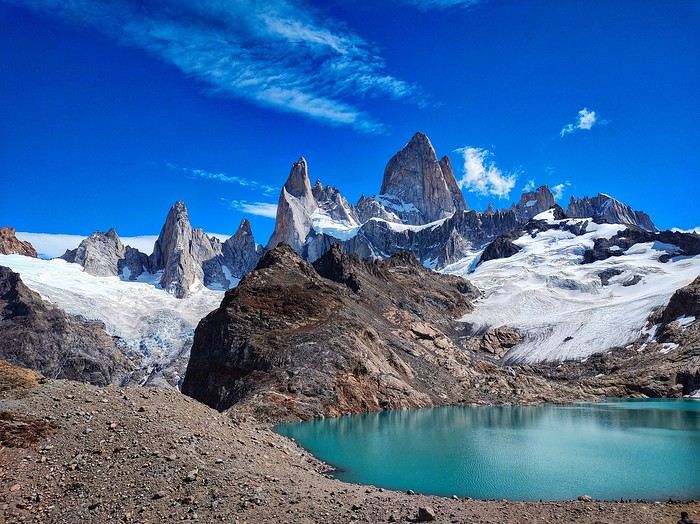
Human connections at the heart of the journey
At Tierra Latina, the goal is to put people at the center of the experience. Accommodations are chosen for their authentic character, often tested and approved by the team itself. Whether you’re staying with an Andean family in a small village in the Quebrada de Humahuaca or in an estancia in the heart of the Patagonian steppe, you’ll take part in local life and contribute to the economy of these sometimes isolated regions.
This responsible approach to travel helps minimize environmental impact while maintaining a privileged connection with those who make Argentina so rich: its people. You’ll leave with intense memories, marked by moments of sharing that are hard to replicate elsewhere. So, ready to pack your bags? Follow the guide and fly off to this fascinating country—you’ll only want one thing: to come back!
The perfect place to escape mass tourism
When traveling solo, there’s nothing like Argentina to get off the beaten path and avoid the crowds. Of course, some iconic spots like the Perito Moreno Glacier in El Calafate or Tierra del Fuego National Park in Ushuaia attract travelers from all over the world. However, the country’s vastness offers plenty of opportunities to find yourself almost alone in nature. A sunrise over the Andes, an afternoon riding with gauchos in the pampa, or a hike deep in Patagonia—these suspended moments happen far from the crowds.
A country ideal for connecting with local communities
One of Argentina’s strengths is the warmth of its people. Deeply attached to their traditions and genuinely curious about visitors, Argentinians have a knack for breaking down barriers, whether linguistic or cultural. You might find yourself chatting in Spanish over a mate (the local herbal tea), joining an impromptu barbecue, or even trying a few tango steps in a milonga. Simply showing interest in their culture and history is often enough to start a conversation. With Argentinians’ innate sense of hospitality, you never feel alone, even as a solo traveler.
Meeting local communities: a unique human adventure
Traveling solo in Argentina also means encountering its diverse communities. Staying with a local family or in an estancia (an Argentine ranch) lets you dive into the daily lives of families who often live self-sufficiently. In the Northwest, for example, you can share the life of an Andean community and learn to cook delicious local specialties. In Bariloche, some stays even include discovering a Mapuche community, offering a chance to better understand their relationship with the land and the importance of their ancestral traditions.
Diverse experiences for an unforgettable trip
Argentina is a true playground for outdoor enthusiasts: hikes in the steppes, sailing on the Beagle Channel in Tierra del Fuego, whale watching in Puerto Madryn (from June to December), or exploring the Iguazu jungle to encounter its wildlife and flora. And just when you think you’ve seen it all, Argentina still has surprises in store. In the Salta region, the Quebrada de Humahuaca reveals mountains with seven colors that tell the geological history of the Andes. It’s a feast for the eyes!
Why not join a small group with Tierra Latina?
Traveling alone doesn’t mean you can’t share parts of your journey with other enthusiasts. That’s what Tierra Latina offers: small-group tours (between 2 and 12 people), designed to balance the freedom of traveling in a small group with the camaraderie of exchanges between travelers. Each itinerary is crafted to alternate highlights (like visiting must-sees: Buenos Aires, Ushuaia, Perito Moreno…) with more intimate moments, far from mass tourism.
The focus is on authentic encounters and respect for local communities—that’s Tierra Latina’s signature. For example, in northwestern Argentina, Tierra Latina offers the chance to spend time in an Andean community to learn about traditional dish preparation during a cooking workshop. It’s an opportunity to exchange recipes and knowledge passed down through generations. The goal: to go beyond simple sightseeing and experience true moments of sharing.
In a small group, you quickly feel like part of a family of travelers, all united by the beauty of the landscapes. You also benefit from French-speaking guides who share their tips and anecdotes while leaving plenty of free time to explore at your own pace. Whether you’re traveling solo, as a couple, or with friends, you’ll find the perfect balance between independence and the comfort of being surrounded.
Human connections at the heart of the journey
At Tierra Latina, the goal is to put people at the center of the experience. Accommodations are chosen for their authentic character, often tested and approved by the team itself. Whether you’re staying with an Andean family in a small village in the Quebrada de Humahuaca or in an estancia in the heart of the Patagonian steppe, you’ll take part in local life and contribute to the economy of these sometimes isolated regions.
This responsible approach to travel helps minimize environmental impact while maintaining a privileged connection with those who make Argentina so rich: its people. You’ll leave with intense memories, marked by moments of sharing that are hard to replicate elsewhere. So, ready to pack your bags? Follow the guide and fly off to this fascinating country—you’ll only want one thing: to come back!
hi
I’m planning a 10-month trip to South America, and I’m looking into options for shipping a motorcycle to Buenos Aires by air or sea. If anyone has any info, thanks in advance!
christian
Hi there,
I’ve got my flight ticket sorted—departing in mid-November and returning in mid-March. I’ll arrive in Santiago and leave from Buenos Aires. I’ve already been to southern Argentina, specifically Torres del Paine National Park, and I’d love to go back to do the full W trek (I only did the shorter version last time). I also want to do some hiking and maybe even tackle a summit. I climb and occasionally do some mountaineering, so I’ll definitely be going with a guide.
I plan to start around Temuco in Chile, with the idea of heading toward the lakes, then taking the Carretera Austral. I’m not sure if I’ll go all the way to Ushuaia—it’s supposed to not be *that* worth it, except for the bragging rights of saying you’ve been to the end of the world.
I saw there are lakes in Argentina too.
I don’t have a precise itinerary, but what I’d love is, once I reach the southernmost point of my trip, to take a mini-cruise to see some wildlife. Any tips for that?
What kind of sleeping bag did you take? Is a 0°C (32°F) one enough? And one last question: white gas stove or can I get by with my gas stove?
Nath
Hi there,
I’m planning a trip with my partner (no kids this time—thanks, Grandma!) for two weeks to celebrate her 40th birthday. I’ve been thinking about Chile. We’re looking at leaving around September 18, 2027, starting in the south and returning in early April.
Here’s what I had in mind:
8 nights in a van in the Lake District and the start of the Carretera Austral (up to the Chaitén area). We’re set to arrive in Puerto Montt around 2:00 PM. We don’t want to go too far south since we’re planning to explore the heart of Patagonia (Chile and Argentina) with the kids when they’re older. The idea is to spend 3 nights discovering the lakes (up to Cochamó) and 3 nights in Pumalín Park. I’ve also added two transition nights. 7 nights in the Atacama to experience another side of Chile (San Pedro), taking a domestic flight from Puerto Montt to Calama in the early afternoon. We’ll depart for France in the early evening from Santiago.
What do you think? Thanks,
Alright, this year, we're heading back to South America!
The initial plan was to retrace the route we imagined in the summer of 2020: a trip to northern Argentina starting from Córdoba.
Unfortunately, the flight to Córdoba no longer exists, and airfares to Javier Milei’s country are both outrageously priced and involve multiple layovers.
So, I tweaked Google Flights every which way and finally found a flight within my budget—departing from Clermont-Ferrand!
Not to Argentina, though...
Our transatlantic flight will cross the snow-capped Andes, landing in Santiago, Chile, with a return from Lima!
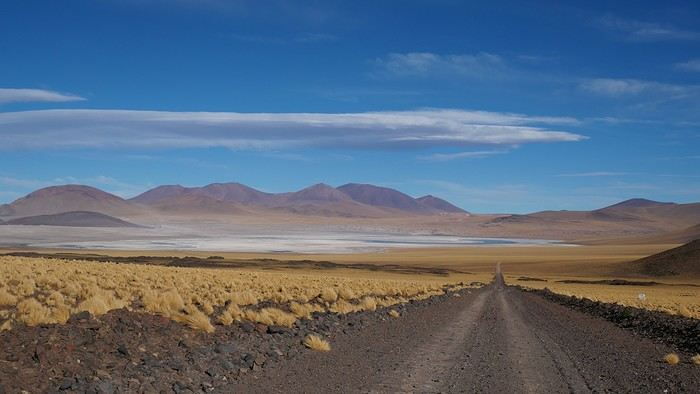
In between, two domestic flights and a big road trip loop starting from the coastal city of Arica to explore the treasures of northern Chile.
Our mode of transport: a pseudo 4x4 that won’t take us through sand dunes or devilish tracks but will let us tackle the entire secondary network, including unpaved main roads, while still being insured.
Is the suitcase packed with all-season clothes?
Are the driver’s license and passport ready?
Bank cards and a few euros too?
Off we go for just over 3 weeks of southern wanderings!
--/--
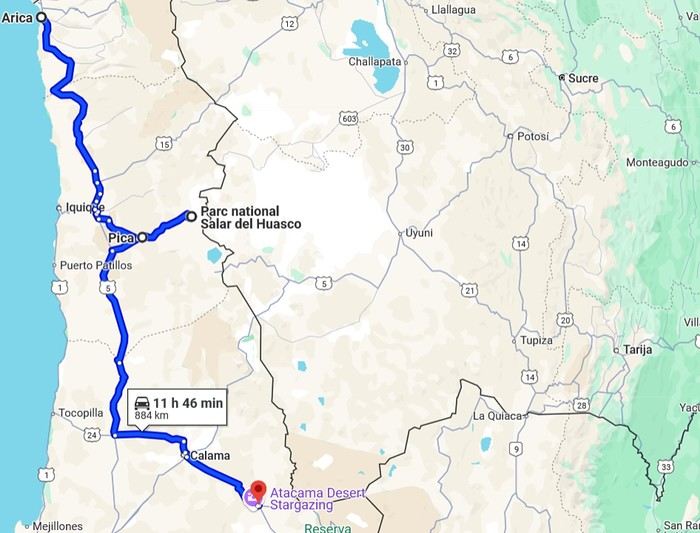
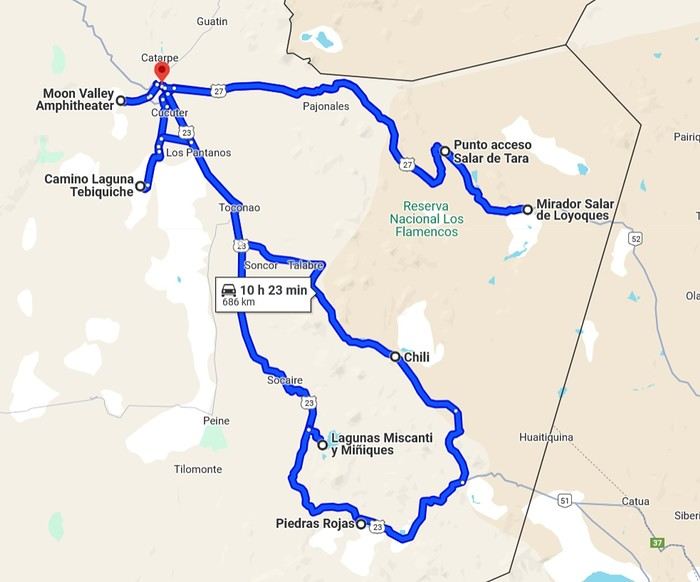
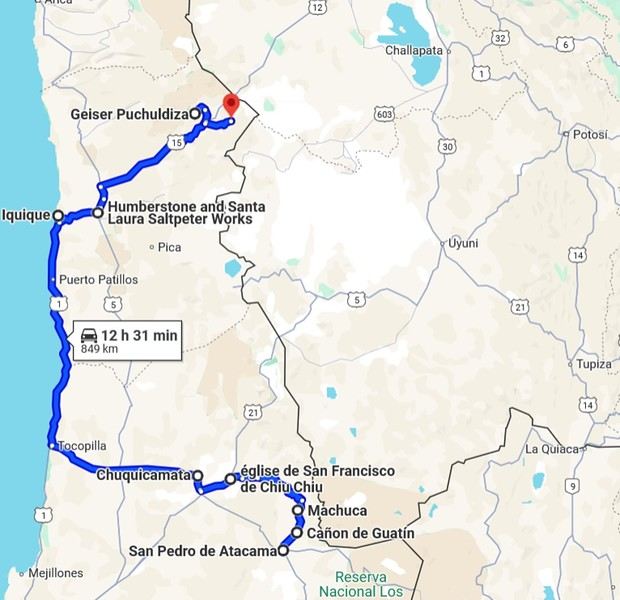
To keep all my esteemed readers on track, here are a few maps outlining the Arica-Arica loop!
1- From Arica to San Pedro de Atacama via Pica and the Salar de Huasco
 2- Around San Pedro
3- From San Pedro to Cariquima
4- From Cariquima to Putre
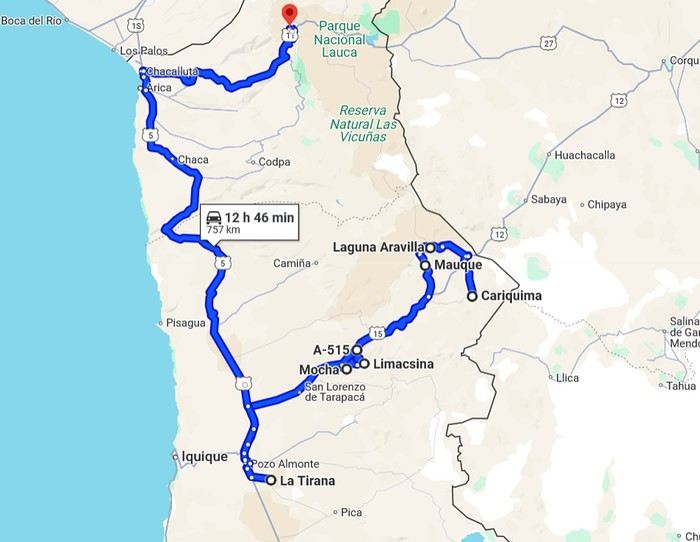
5 - From Putre to Arica
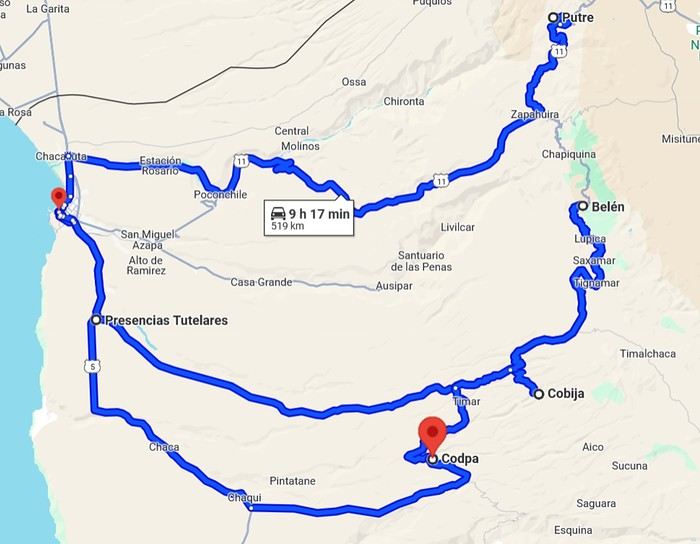
Gas stations in this part of Chile are located in Arica, Iquique, Pozo Almonte, Pica, Calama, and San Pedro de Atacama.
The initial plan was to retrace the route we imagined in the summer of 2020: a trip to northern Argentina starting from Córdoba.
Unfortunately, the flight to Córdoba no longer exists, and airfares to Javier Milei’s country are both outrageously priced and involve multiple layovers.
So, I tweaked Google Flights every which way and finally found a flight within my budget—departing from Clermont-Ferrand!
Not to Argentina, though...
Our transatlantic flight will cross the snow-capped Andes, landing in Santiago, Chile, with a return from Lima!
In between, two domestic flights and a big road trip loop starting from the coastal city of Arica to explore the treasures of northern Chile.
Our mode of transport: a pseudo 4x4 that won’t take us through sand dunes or devilish tracks but will let us tackle the entire secondary network, including unpaved main roads, while still being insured.
Is the suitcase packed with all-season clothes?
Are the driver’s license and passport ready?
Bank cards and a few euros too?
Off we go for just over 3 weeks of southern wanderings!
--/--
To keep all my esteemed readers on track, here are a few maps outlining the Arica-Arica loop!
1- From Arica to San Pedro de Atacama via Pica and the Salar de Huasco
2- Around San Pedro3- From San Pedro to Cariquima
4- From Cariquima to Putre
5 - From Putre to Arica
Gas stations in this part of Chile are located in Arica, Iquique, Pozo Almonte, Pica, Calama, and San Pedro de Atacama.
Hi,
we’re planning to travel through Patagonia (Chile and Argentina) in February and March 2027.
From a seasonal and weather perspective, at that time of year and with hiking as our main activity, is it better to explore Patagonia from south to north or the other way around?
Thanks in advance.
Anne Marie
Hi there,
We’ll be in Argentina for 24 days starting mid-September 2025. I’m not sure where to go for this time of year—is Patagonia doable? Iguazu without a doubt, Salta, Peninsula Valdes to see the wildlife? Can we see penguins at that time? We love hiking, thanks for your tips!
Hey everyone!
I’m planning a van trip along the Carretera Austral from February 9th to March 1st, 2025.
My main questions are about timing and the must-see spots.
Here’s what I’m thinking, but I’m not sure if it’s realistic (ferries, road conditions, weather, etc.).
I’d love all your tips and suggestions! 🙂
Sun 2/9: Pick up van in Puerto Montt, explore the area, hot springs (which ones?) 2/10: Drive to Chaitén (too short?) – road + 7-hour ferry according to maps 2/11: Drive from Chaitén to Queulat – 200 km, 3 hours (still according to maps) 2/12: Queulat + hike to see the hanging glacier, then drive to Coyhaique – 3 hours, 200 km 2/13: Coyhaique to Cerro Castillo Park – 100 km, how long is the drive on this stretch? 2/14: Drive to Puerto Río Tranquilo – how long is the drive? 2/15: Exploradores Valley + is a day hike doable? 2/16: San Rafael Lagoon 2/17: Mármol Chapels 2/18: Drive to Puerto Yungay to catch the ferry to Puerto Natales around 7–8 PM with the van.
For the short ferry crossings, how far in advance should I book?
All your advice is welcome! Thanks so much!!
Hi there,
Could you let me know if this itinerary is doable:
14/09: Arrival in BA at 9:45 PM
15/09 to 16/09: BA
17/09: Flight to Iguazu early in the morning + visit the falls on the Brazilian side
18/09: Visit the falls on the Argentine side
19/09: Flight to Salta + visit Salta
20/09 to 25/09: Northern + Southern Loop in 6 full days (rental car)
26/09 to 28/09: Tolar Grande 3 days (with an agency)
29/09: Flight to Puerto Madryn (arrival in the evening)
30/09: Valdes Peninsula
01/10: Valdes Peninsula + Punta Tombo + overnight bus to Bariloche
02/10 to 07/10: 6 days to see Bariloche and the surrounding area by car (what are the must-sees?)
08/10: Flight to BA
09/10: Flight to Paris at 2:40 PM
Hello,
Departure is getting closer (September 4th), and the itinerary is now more or less set.
In two and a half months, I plan to cover:
TRUJILLO-HUARAZ - CERRO DE PASCO - HUANCAYO - AYACUCHO - CUSCO - LA PAZ Bus: LA PAZ - PUTRE Then: PUTRE - COLCHANE - UYUNI - SAN PEDRO DE ATACAMA
If I'm a bit short on time, which part of the route would you skip? Northern Chile or between Cerro de Pasco and Cusco?
If, on the other hand, I’m ahead of schedule, I might consider going from San Pedro to Salta.
That’s it—thanks for your wise advice!
Vincent
Easter Island, located between Tahiti and Chile, fascinated me with its volcanic landscapes and legendary Moai statues, erected by the first Polynesian inhabitants to honor their ancestors. Mysterious and iconic, this isolated land intrigues with its history and the enigmas that researchers and explorers are still trying to unravel.
To help you prepare for your trip, here’s my five-day itinerary. I was able to explore major sites while leaving room for some free and adventurous moments. Here’s the program I followed:
Day 1: Discovering Hanga Roa and nearby moais
For my arrival, I started slowly by visiting the village of Hanga Roa. I took the time to stroll around, check out some local shops, and especially admire the first moais accessible for free, to ease into the island’s fascinating history.
Day 2: The must-see sites with a guide (Vaihu, Te Pito Kura, Anakena, Tongariki, Rano Raraku)
The second day was dedicated to the highlights. With a guide, I explored the island’s iconic sites, including the imposing aligned moais of Tongariki and the ancient "statue factory" of Rano Raraku. This intense day helped me understand more about the island’s culture and mysterious history, especially with the paradise-like beach of Anakena at the end of the day.
Day 3: Historical sites and museum (Orongo, Rano Kau, Puna Pau, Akivi)
On the third day, I continued with a guided morning, particularly at the ceremonial village of Orongo, perched atop Rano Kau. After visiting Puna Pau and Akivi, I spent the afternoon at the museum to deepen my knowledge of the Rapa Nui civilization.
Day 4: Bike ride in nature
Craving freedom, I devoted this day to a bike ride along the coastline and through the island’s natural spots. It was the perfect opportunity to explore at my own pace and stop at secret coves, enjoying the tranquility of the landscapes.
Day 5: Hike to the summit of Terevaka
For my last day, I set off on a hike to the summit of Terevaka, the island’s highest point. From there, the 360° view of the island and the ocean is breathtaking and gave me a memorable souvenir of this trip.
This five-day stay was a real journey through time, landscapes, and the mysteries of Easter Island!
If you want more details on my favorite spots, accommodation ideas, or practical tips, you can check out my article: https://un-tour-dans-le-sac.fr/ile-de-paques-5-jours/
Hi everyone,
I’m planning a trip to Argentina in February. I’ll be starting from Buenos Aires and want to do a loop that goes through Salta and Mendoza before returning to Buenos Aires. I’m still undecided on the direction: • Buenos Aires → Mendoza → Salta → Buenos Aires or • Buenos Aires → Salta → Mendoza → Buenos Aires.
I plan to explore each region, alternating between buses and a rental car.
In your opinion, which direction makes more sense for this itinerary (climate, roads, logistics, etc.)?
Thanks in advance for your tips! !
Hi everyone,
I’m currently on a motorcycle trip through South America. I’m riding a Honda XR 150L registered in Chile, which I bought in my name. I have my Chilean RUT and the *padrón* (vehicle registration) for the bike. I’m traveling solo and planning to visit the Salar de Uyuni, Cusco, and Machu Picchu before returning to Santiago in the next 60 days.
I tried crossing the border at Ollagüe, but I was denied entry into Bolivia even though I have all the necessary paperwork. The customs officers told me I needed to be a Chilean resident to enter with a Chilean-registered motorcycle, which I’m not (I only have the RUT).
I’m looking for: -A more flexible alternative to cross into Bolivia (or even Argentina or Peru if necessary). -Recent experiences from other travelers who entered Bolivia with a Chilean-registered motorcycle. -Possible solutions (additional documents? international insurance? special visa or permit?).
I’m open to adjusting my itinerary, but I’d really like to continue the trip with my motorcycle. Thanks in advance for any help or advice! !
Hi there.
I already posted a message asking for advice about our upcoming trip to Chile.
Details: Getting around by bus or train.
Starting from Valparaiso, heading north, passing through cities and places to visit, then returning to Santiago via a different route.
Avoid the beaches...
Thanks
Hi everyone,
I’m heading to Chile this coming November and I’d love to spend a few days cycling from Santiago (Chile) to Mendoza (Argentina).
Has anyone done this route before? If so, do you have any tips (stages, gear, accommodation spots, etc.)?
Also, to avoid carrying too much stuff, I’d like to rent a bike in Santiago. Any recommendations for a good rental shop?
Thanks so much in advance for your help :)
Clément
Hi there,
This topic has come up before, but I wanted to share a fresh experience from early 2025.
For those of you looking to take the bus to Santiago Airport, I recommend taking the Centropuerto bus from their departure point, which is located in the middle of Alameda, Santiago’s main avenue, just outside Line 1 of the Los Héroes metro station. If you board the bus anywhere else, it’ll most likely be full, and if you have luggage, that can be a hassle.
During daytime hours on weekdays, these buses run every 10 to 15 minutes. Plan for anywhere between 30 minutes to an hour to reach the airport from this spot, depending on the time and traffic.
The ticket costs 2000 CLP pesos, payable in cash in the local currency—about 2 € or $2 USD per person.