What’s the maximum weight of gear I can carry in my panniers:
- For a woman on an e-bike
- And for a man on a muscle-powered bike
Thanks
hi there
After covering thousands of kilometers over the years with front and rear panniers, I’m now facing a problem: broken spokes on the rear wheel.
Once, twice—imagine the hassle of fixing it when you're in the middle of nowhere in the Cévennes!
So, drastic times call for drastic measures! I switched to a reinforced wheel and, following my bike mechanic’s advice, fitted a tire that’s a "tad" wider than the front one.
We set off on our summer adventure feeling confident, and guess what—"BAM"—a broken spoke after just 200 km. Seriously?! Not even that heavily loaded—just around 30 kg, plus my 80 kg. Even with the sturdier wheel, I still ended up with a broken spoke after 300 km! Back to the bike mechanic, and the only explanation: "It’s your pedaling style..." Not convinced at all! So here’s the idea: a Bob trailer! I’m done with this sword of Damocles hanging over my head—it’s a real buzzkill. Has anyone here tried a Bob trailer? Could you share your experiences—pros, cons, etc.? Thanks!!!
We set off on our summer adventure feeling confident, and guess what—"BAM"—a broken spoke after just 200 km. Seriously?! Not even that heavily loaded—just around 30 kg, plus my 80 kg. Even with the sturdier wheel, I still ended up with a broken spoke after 300 km! Back to the bike mechanic, and the only explanation: "It’s your pedaling style..." Not convinced at all! So here’s the idea: a Bob trailer! I’m done with this sword of Damocles hanging over my head—it’s a real buzzkill. Has anyone here tried a Bob trailer? Could you share your experiences—pros, cons, etc.? Thanks!!!
Hi everyone! Thanks for welcoming me to the forum :)
I’m preparing for a long trip heading to Nepal, with stops along the way depending on my mood, work needs, and the season. I cycle a lot, but this will be my first big touring adventure. I’d like to camp regularly to keep costs down, so I’ll be riding on all kinds of surfaces: smooth and rough roads, main highways and rocky paths to find my camping spots, flat terrain and the occasional steep slopes.
For my bike model, I’m prioritizing durability, versatility, and repairability. From that perspective, I prefer a steel frame and fork with rim brakes since I’m used to them. I’ve narrowed my choices down to four models:
- The VSF Fahrradmanufaktur T-700 LTD (1400 €): steel frame, aluminum fork, hydraulic rim brakes, 28" wheels, 40mm tires, 36 spokes (2 mm), lightweight rear rack (max 20 kg), no front rack included, smallest gear ratio of 0.72, weight of 13.9 kg.
- The VSF Fahrradmanufaktur TX-400 (2200 €): steel frame and fork, hydraulic rim brakes, 26" wheels, 50mm tires, 36 spokes (2.34 mm), front and rear racks included (40+18 kg), smallest gear ratio of 0.71, weight of 15.9 kg.
- The Genesis Tour de Fer 30 (2150 €): steel frame and fork, mechanical disc brakes, 28" wheels, 36 spokes, 40mm tires, front and rear racks included (27+10 kg), smallest gear ratio of 0.77, weight of 15.9 kg.
- The Rockrider ADTV 900 from Decathlon (1700 €): aluminum frame and fork, mechanical disc brakes, USB port, 28" wheels, 47mm tires, 28 spokes, front and rear racks included (40+20 kg), smallest gear ratio of 0.71, weight of 17.1 kg. This is the successor to the Riverside Touring 900, which was a hit.
I’ve got a few questions:
1/ Should I go for 26" or 28" wheels for my trip? 26" wheels seem better for rough terrain, but 28" wheels feel more comfortable on roads. I’ve also read that 26" tires/tubes are easier to find.
2/ Do you recommend a steel frame and fork over aluminum? I’m guessing a high-quality aluminum frame and fork would be better than a low-quality steel one, right?
3/ Regarding the smallest gear ratio, is 0.71 a good number for a loaded bike in the mountains?
4/ Finally, what do you think of these four models for my project? My heart leans toward the TX-400—it seems to combine the versatility and robustness I’m looking for. But the price difference with the T-700 LTD is making me think twice!
Thanks so much for reading and sharing your thoughts!
I’m preparing for a long trip heading to Nepal, with stops along the way depending on my mood, work needs, and the season. I cycle a lot, but this will be my first big touring adventure. I’d like to camp regularly to keep costs down, so I’ll be riding on all kinds of surfaces: smooth and rough roads, main highways and rocky paths to find my camping spots, flat terrain and the occasional steep slopes.
For my bike model, I’m prioritizing durability, versatility, and repairability. From that perspective, I prefer a steel frame and fork with rim brakes since I’m used to them. I’ve narrowed my choices down to four models:
- The VSF Fahrradmanufaktur T-700 LTD (1400 €): steel frame, aluminum fork, hydraulic rim brakes, 28" wheels, 40mm tires, 36 spokes (2 mm), lightweight rear rack (max 20 kg), no front rack included, smallest gear ratio of 0.72, weight of 13.9 kg.
- The VSF Fahrradmanufaktur TX-400 (2200 €): steel frame and fork, hydraulic rim brakes, 26" wheels, 50mm tires, 36 spokes (2.34 mm), front and rear racks included (40+18 kg), smallest gear ratio of 0.71, weight of 15.9 kg.
- The Genesis Tour de Fer 30 (2150 €): steel frame and fork, mechanical disc brakes, 28" wheels, 36 spokes, 40mm tires, front and rear racks included (27+10 kg), smallest gear ratio of 0.77, weight of 15.9 kg.
- The Rockrider ADTV 900 from Decathlon (1700 €): aluminum frame and fork, mechanical disc brakes, USB port, 28" wheels, 47mm tires, 28 spokes, front and rear racks included (40+20 kg), smallest gear ratio of 0.71, weight of 17.1 kg. This is the successor to the Riverside Touring 900, which was a hit.
I’ve got a few questions:
1/ Should I go for 26" or 28" wheels for my trip? 26" wheels seem better for rough terrain, but 28" wheels feel more comfortable on roads. I’ve also read that 26" tires/tubes are easier to find.
2/ Do you recommend a steel frame and fork over aluminum? I’m guessing a high-quality aluminum frame and fork would be better than a low-quality steel one, right?
3/ Regarding the smallest gear ratio, is 0.71 a good number for a loaded bike in the mountains?
4/ Finally, what do you think of these four models for my project? My heart leans toward the TX-400—it seems to combine the versatility and robustness I’m looking for. But the price difference with the T-700 LTD is making me think twice!
Thanks so much for reading and sharing your thoughts!
Great news that the forum is back—we’ve been waiting for this for ages! Now we can chat again with the die-hards like Claudio, Luc Bertand, and everyone else...
Voyager à vélo
Hello fellow cycling friends,
I’m heading out very soon for a few weeks in France and elsewhere on my trusty two-wheeled steel steed, with a total of me + luggage = around 120 kg gross weight, and I’ve never really tackled mountain passes before—something I’ll definitely be facing this time...
Currently, I’m running 700c wheels and a Deore XT 10-speed drivetrain (long-cage derailleur) with a 26/36/48 chainring setup and an 11-36 cassette. I’m considering two options (and possible modifications) to get a lower gear ratio (currently 0.72) and spin more easily on steep and mountainous climbs...
1 – Install an 11-42 cassette This would give me a gear ratio of 0.61. Would this be feasible with my current rear derailleur, please?
I have several new chains with 116 links—would these work for this cassette, which would have 6 more teeth on the largest cog, or would I need a longer chain?
2 – Swap the 26-tooth small chainring for a 24-tooth one This would give me a gear ratio of 0.66. Would this be feasible, please?
When switching to a 24T, will the gap be accepted by the 36-tooth middle chainring, and will shifting remain as smooth as it is now? Will this setup (24/36/48 + 11-36 cassette) still work well together, in your opinion?
Which of these two options do you think would be more feasible and preferable?
What drivetrain and gearing do you use on your bikes for loaded touring that sometimes involves climbing mountain passes and other steep ascents?
So many questions... Thanks for your answers and advice! Have a great day,
Spady
I’m heading out very soon for a few weeks in France and elsewhere on my trusty two-wheeled steel steed, with a total of me + luggage = around 120 kg gross weight, and I’ve never really tackled mountain passes before—something I’ll definitely be facing this time...
Currently, I’m running 700c wheels and a Deore XT 10-speed drivetrain (long-cage derailleur) with a 26/36/48 chainring setup and an 11-36 cassette. I’m considering two options (and possible modifications) to get a lower gear ratio (currently 0.72) and spin more easily on steep and mountainous climbs...
1 – Install an 11-42 cassette This would give me a gear ratio of 0.61. Would this be feasible with my current rear derailleur, please?
I have several new chains with 116 links—would these work for this cassette, which would have 6 more teeth on the largest cog, or would I need a longer chain?
2 – Swap the 26-tooth small chainring for a 24-tooth one This would give me a gear ratio of 0.66. Would this be feasible, please?
When switching to a 24T, will the gap be accepted by the 36-tooth middle chainring, and will shifting remain as smooth as it is now? Will this setup (24/36/48 + 11-36 cassette) still work well together, in your opinion?
Which of these two options do you think would be more feasible and preferable?
What drivetrain and gearing do you use on your bikes for loaded touring that sometimes involves climbing mountain passes and other steep ascents?
So many questions... Thanks for your answers and advice! Have a great day,
Spady
Hi there,
I’m currently looking for a bike to do my first bike trip across France, with the ultimate goal of cycling through Latin America. I’ve got a lot of questions and I’d love to hear if you have any answers or advice to share. First off, I’ve been through this before with hiking. I want to get top-quality gear right away. When I started hiking, I ended up buying everything three times—first beginner gear, then intermediate, then expert, etc. For biking, I’d prefer to skip that process and invest right now in a bike that could ideally handle Latin America. I’ve set a total max budget of around 5000 € (roughly 4000–4500 € for the bike and the rest for accessories: panniers, helmet, cycling shorts, etc.).
So, I’ve got quite a few questions:
* I’ve read in several places that some people recommend buying the bike directly in Latin America. Since I need a first bike to train in Europe, would it be better to buy an entry-level bike in France (and sell it before the big departure)? Or is it preferable to start right away with my final bike to get used to it? Is buying it there just to save a bit of money?
* For a long-term trip (around six months) in Latin America, is it better to go for a gravel bike or a mountain bike?
* Should I buy a new bike or a refurbished one? Even more so given that I’m planning a long trip—could a refurbished bike end up causing more breakdowns?
If you have any advice on models, technical features to prioritize, or recommended sellers or resellers, I’d love to hear it. I’m a total beginner—I’ve only just started watching videos and reading up on the subject, and all the technical specs are new to me!
Thanks in advance for your help!
I’m currently looking for a bike to do my first bike trip across France, with the ultimate goal of cycling through Latin America. I’ve got a lot of questions and I’d love to hear if you have any answers or advice to share. First off, I’ve been through this before with hiking. I want to get top-quality gear right away. When I started hiking, I ended up buying everything three times—first beginner gear, then intermediate, then expert, etc. For biking, I’d prefer to skip that process and invest right now in a bike that could ideally handle Latin America. I’ve set a total max budget of around 5000 € (roughly 4000–4500 € for the bike and the rest for accessories: panniers, helmet, cycling shorts, etc.).
So, I’ve got quite a few questions:
* I’ve read in several places that some people recommend buying the bike directly in Latin America. Since I need a first bike to train in Europe, would it be better to buy an entry-level bike in France (and sell it before the big departure)? Or is it preferable to start right away with my final bike to get used to it? Is buying it there just to save a bit of money?
* For a long-term trip (around six months) in Latin America, is it better to go for a gravel bike or a mountain bike?
* Should I buy a new bike or a refurbished one? Even more so given that I’m planning a long trip—could a refurbished bike end up causing more breakdowns?
If you have any advice on models, technical features to prioritize, or recommended sellers or resellers, I’d love to hear it. I’m a total beginner—I’ve only just started watching videos and reading up on the subject, and all the technical specs are new to me!
Thanks in advance for your help!
Hi,
I’ve browsed the forum but can’t find an answer to my question: Which brand offers bikes suitable for bike touring for an 11-year-old / 140 cm tall? The D4 range is really limited... We’re looking at covering about 50/60 km max per day.
Thanks in advance for your suggestions!
I’ve browsed the forum but can’t find an answer to my question: Which brand offers bikes suitable for bike touring for an 11-year-old / 140 cm tall? The D4 range is really limited... We’re looking at covering about 50/60 km max per day.
Thanks in advance for your suggestions!
Who among you has explored northern Italy along the Mediterranean, in Liguria?
I’m dreaming of cycling there from Nice, crossing through villages like Menton, Ventimiglia, Dolceacqua, Apricale, Monte Ceppo, Triora, Ponte di Nava, Ormea, Garessio, Ceva, Mondovì, and Cuneo.
Beyond that, it’s the route toward Queyras in France via the Col dell’Agnello, on the slopes of Monte Viso.
A few questions for those who know the area: Is it interesting by bike? Is the road surface decent? Is car traffic low, or at least manageable?
We had this plan back in 2009 as part of a Nice-Rome crossing, but we ended up doing it differently. I might get to revisit it this summer (solo this time, not on a tandem like we usually do).
Looking forward to your thoughts and comments!
Beyond that, it’s the route toward Queyras in France via the Col dell’Agnello, on the slopes of Monte Viso.
A few questions for those who know the area: Is it interesting by bike? Is the road surface decent? Is car traffic low, or at least manageable?
We had this plan back in 2009 as part of a Nice-Rome crossing, but we ended up doing it differently. I might get to revisit it this summer (solo this time, not on a tandem like we usually do).
Looking forward to your thoughts and comments!
Hi everyone,
I’m seriously considering going bikepacking with my Brompton (6-speed model) on a mixed route of roads and bike paths for a trip lasting a few days or even a week.
I know the Brompton isn’t the typical touring bike, but its compactness and practicality really appeal to me for combining train + bike travel and staying super mobile.
I’ve got a few questions, and I’d love to hear your experiences or tips:
What panniers or luggage setup do you recommend for a Brompton in travel mode? Have you run into any specific limitations (comfort, carrying capacity, elevation gain, etc.)? Should I adjust any components (tires, gearing, saddle) to make it more durable for multi-day trips? Do you prefer wild camping or lightweight accommodations (hostels, campsites, etc.) with this kind of setup? Finally: what types of routes do you think a Brompton handles well? (And what should I absolutely avoid?)
I’d love to chat with others who’ve tried (or are considering) the Brompton bikepacking adventure. Thanks in advance for your insights! 🚴♂️ Happy riding,
What panniers or luggage setup do you recommend for a Brompton in travel mode? Have you run into any specific limitations (comfort, carrying capacity, elevation gain, etc.)? Should I adjust any components (tires, gearing, saddle) to make it more durable for multi-day trips? Do you prefer wild camping or lightweight accommodations (hostels, campsites, etc.) with this kind of setup? Finally: what types of routes do you think a Brompton handles well? (And what should I absolutely avoid?)
I’d love to chat with others who’ve tried (or are considering) the Brompton bikepacking adventure. Thanks in advance for your insights! 🚴♂️ Happy riding,
I’ve gotten used to crossing Europe by bus to return by bike.
It was really convenient to take the bike without having to disassemble it.
But FlixBus no longer accepts bikes...
What alternatives do you know about?
Thanks.
Hi there,
Last spring, I set off from Villeréal (47) on a road bike and reached the North Cape after 6 weeks of cycling.
I had a particular concept: I’d cycle each stage (averaging 140 km) and then return to the starting point either by carpooling, hitchhiking (not often), bus, or train. I’d meet up with my van (a Trafic) and then drive the same stage to eat and sleep there.
This approach let me choose where I stayed for the night and, most importantly, ride the distance I wanted—my longest stage was 217 km—without carrying any weight, since I can’t imagine doing a fully self-supported bike trip.
I did a first 3-week stretch that took me to the top of Denmark using this method. Then I drove back to Hamburg in my van, left it there, and flew back to Bordeaux.
I spent two weeks at home because my autistic son was staying with me, then my wife and I flew to Hamburg. We picked up the van and drove back to the top of Denmark to catch a ferry to Oslo.
For this second leg, my wife drove the Trafic, and we met up along the stages, which allowed me to focus solely on my ride.
I chose to go through Sweden—it would’ve been much more complicated going up through Norway because of all the tunnels, frequent small ferries to cross the fjords, and a lot more elevation gain.
I had favorable winds most of the time, a few hiccups, but overall everything went smoothly, and I stuck to my route and schedule.
I kept a travel journal on My Atlas—here’s the link: https://www.myatlas.com/danielcramay/du-47-au-cap-nord
I have 5 months left to prepare for the most ambitious project of my life...
In 5 months, I’ll hit the road, heading to Nepal. Not by plane. Not by train. But by bike.
13,000 km, 18 countries crossed. Powered only by my legs, my will, and a dream.
This journey isn’t just a physical challenge. It’s:
🌍 A human and cultural adventure, meeting locals, landscapes, and traditions. 🌱 A meaningful project: discussing climate change and, above all, listening to those who experience it daily. 🔥 An inner quest, to push my limits and inspire others to step out of their comfort zones. A message of hope for self-discovery.
I have 20 weeks left to: ✅ Finalize my route ✅ Gather the budget and equipment ✅ Sort out the logistics ✅ And most importantly… find committed sponsors to bring this adventure to life.
Any help is welcome!
In 5 months, I’ll hit the road, heading to Nepal. Not by plane. Not by train. But by bike.
13,000 km, 18 countries crossed. Powered only by my legs, my will, and a dream.
This journey isn’t just a physical challenge. It’s:
🌍 A human and cultural adventure, meeting locals, landscapes, and traditions. 🌱 A meaningful project: discussing climate change and, above all, listening to those who experience it daily. 🔥 An inner quest, to push my limits and inspire others to step out of their comfort zones. A message of hope for self-discovery.
I have 20 weeks left to: ✅ Finalize my route ✅ Gather the budget and equipment ✅ Sort out the logistics ✅ And most importantly… find committed sponsors to bring this adventure to life.
Any help is welcome!
I’d been watching this ultra-light travel movement or trend for a while.
So I gave it a try—goodbye to the 5 panniers and rear racks.
A 15L saddle bag for clothes and a stove cookset.
Two cages on the fork blades: 2x5L—mattress on one side, tent on the other.
A 5L frame bag for miscellaneous items: battery, camera, small bits and pieces.
And one on the handlebar for the sleeping bag.
I tested it this summer on a crossing from Valence to Perpignan via the Massif Central.
My conclusions: The obvious advantage is the reduced weight. In total, I had 12 kg on the bike, which makes climbing in the mountains much easier. Another benefit I hadn’t considered is the significantly lower wind resistance compared to a traditional setup—you really feel it when the wind’s against you. Of course, it’s not all perfect... For example, it’s impossible to carry a food stock. You buy just enough before each meal or go to a restaurant! You also have to accept a more spartan comfort level at stops.
In conclusion, I think for summer trips in regions where resupplying is easy, it’s an interesting option—especially if there’s significant elevation gain. On the other hand, it doesn’t allow for enough autonomy, so some trips are off the table.
I took the opportunity to replace my tent. Given the prices of lightweight gear, I went with Decathlon. For 150 €, I chose the MT900 tent/tarp (D4 model). https://www.decathlon.fr/p/tente-tarp-de-trekking-1-place-ultra-legere-et-ultra-compacte-mt900/343262/c193c382m8968612 Not the easiest to set up (at first) and it’s not freestanding. You can sit up inside, which isn’t common for this type of shelter. We’ll see how it holds up over time.
On the bike side, I swapped my Shimano 11/34 cassette for an 11/40. Even though Shimano doesn’t recommend it with a 105 derailleur and a 46/30 double chainring, it works really well. The only limit is avoiding the 46/40 gear ratio.
I tested it this summer on a crossing from Valence to Perpignan via the Massif Central.
My conclusions: The obvious advantage is the reduced weight. In total, I had 12 kg on the bike, which makes climbing in the mountains much easier. Another benefit I hadn’t considered is the significantly lower wind resistance compared to a traditional setup—you really feel it when the wind’s against you. Of course, it’s not all perfect... For example, it’s impossible to carry a food stock. You buy just enough before each meal or go to a restaurant! You also have to accept a more spartan comfort level at stops.
In conclusion, I think for summer trips in regions where resupplying is easy, it’s an interesting option—especially if there’s significant elevation gain. On the other hand, it doesn’t allow for enough autonomy, so some trips are off the table.
I took the opportunity to replace my tent. Given the prices of lightweight gear, I went with Decathlon. For 150 €, I chose the MT900 tent/tarp (D4 model). https://www.decathlon.fr/p/tente-tarp-de-trekking-1-place-ultra-legere-et-ultra-compacte-mt900/343262/c193c382m8968612 Not the easiest to set up (at first) and it’s not freestanding. You can sit up inside, which isn’t common for this type of shelter. We’ll see how it holds up over time.
On the bike side, I swapped my Shimano 11/34 cassette for an 11/40. Even though Shimano doesn’t recommend it with a 105 derailleur and a 46/30 double chainring, it works really well. The only limit is avoiding the 46/40 gear ratio.
Hi there,
I’ve got my flight ticket sorted—departing in mid-November and returning in mid-March. I’ll arrive in Santiago and leave from Buenos Aires. I’ve already been to southern Argentina, specifically Torres del Paine National Park, and I’d love to go back to do the full W trek (I only did the shorter version last time). I also want to do some hiking and maybe even tackle a summit. I climb and occasionally do some mountaineering, so I’ll definitely be going with a guide.
I plan to start around Temuco in Chile, with the idea of heading toward the lakes, then taking the Carretera Austral. I’m not sure if I’ll go all the way to Ushuaia—it’s supposed to not be *that* worth it, except for the bragging rights of saying you’ve been to the end of the world.
I saw there are lakes in Argentina too.
I don’t have a precise itinerary, but what I’d love is, once I reach the southernmost point of my trip, to take a mini-cruise to see some wildlife. Any tips for that?
What kind of sleeping bag did you take? Is a 0°C (32°F) one enough? And one last question: white gas stove or can I get by with my gas stove?
Nath
I’ve got my flight ticket sorted—departing in mid-November and returning in mid-March. I’ll arrive in Santiago and leave from Buenos Aires. I’ve already been to southern Argentina, specifically Torres del Paine National Park, and I’d love to go back to do the full W trek (I only did the shorter version last time). I also want to do some hiking and maybe even tackle a summit. I climb and occasionally do some mountaineering, so I’ll definitely be going with a guide.
I plan to start around Temuco in Chile, with the idea of heading toward the lakes, then taking the Carretera Austral. I’m not sure if I’ll go all the way to Ushuaia—it’s supposed to not be *that* worth it, except for the bragging rights of saying you’ve been to the end of the world.
I saw there are lakes in Argentina too.
I don’t have a precise itinerary, but what I’d love is, once I reach the southernmost point of my trip, to take a mini-cruise to see some wildlife. Any tips for that?
What kind of sleeping bag did you take? Is a 0°C (32°F) one enough? And one last question: white gas stove or can I get by with my gas stove?
Nath
Hi there,
I’m planning to cycle the Vélodyssée from Hendaye to Saint-Brevin in July 2026. My issue: how do I get to Hendaye with my bike? FlixBus doesn’t take bikes, and SNCF is complicated. Any ideas? Has anyone got a solution to suggest? Thanks in advance! Cheers, Patrig
I’m planning to cycle the Vélodyssée from Hendaye to Saint-Brevin in July 2026. My issue: how do I get to Hendaye with my bike? FlixBus doesn’t take bikes, and SNCF is complicated. Any ideas? Has anyone got a solution to suggest? Thanks in advance! Cheers, Patrig
Hi,
what are the easiest ways to get back from Nordkapp without pedaling—
train, boat, or plane?
Has anyone already done this?
Thanks for sharing your tips!
Hello, I have a TX400. We're heading to the Andes this spring, and I wanted to see about changing my cassette to switch from an 11-35 to an 11-42 so I can tackle the big climbs more easily. So far, I've only found discussions from cyclists who switched from a 48-36-26 chainring to a 44-32-22. Has anyone kept the original chainring and just changed to a larger sprocket?
Hi,
First off, I just want to say how happy I am that the forum’s back up. It really means a lot. When it went down, I realized how much time I spent here and how much I valued this space for sharing. :) Hopefully, it’ll regain its momentum.
Anyway, I’m starting a thread. I’d like to get a saddle bag. I’m working on making my touring bike more versatile. It’s currently set up with racks for panniers, but for shorter rides, I’d like to remove the racks and switch to "bike-packing" mode. I’ll also be using a lighter set of wheels.
Long story short, I’d love to hear about your experiences with saddle bags you’ve used. This way, I can make an informed choice before buying.
Thanks!
Matt
First off, I just want to say how happy I am that the forum’s back up. It really means a lot. When it went down, I realized how much time I spent here and how much I valued this space for sharing. :) Hopefully, it’ll regain its momentum.
Anyway, I’m starting a thread. I’d like to get a saddle bag. I’m working on making my touring bike more versatile. It’s currently set up with racks for panniers, but for shorter rides, I’d like to remove the racks and switch to "bike-packing" mode. I’ll also be using a lighter set of wheels.
Long story short, I’d love to hear about your experiences with saddle bags you’ve used. This way, I can make an informed choice before buying.
Thanks!
Matt
Good evening,
We’re planning a cycling tour in Denmark and I’m figuring out how to get there. We have electric mountain bikes (and since I’m really happy with mine, I’d prefer not to rent bikes there). We have 9 days.
- I looked into trains, but the prices aren’t great, and I’m worried we won’t always be able to take our bikes. Packing them in a bag and disassembling them seems overwhelming, especially given how big mine is.
- The Flexibus: we’d have to go through Paris from Lyon, which would waste a lot of time.
- Flying? It might not be more expensive than the train.
- We have a camper van, and I’m wondering if that’s an option. Do you know if you can park your vehicle for a week in a parking lot? I get the impression that parking time is limited. Thanks for your advice! Have a great evening,
Sandrine
We’re planning a cycling tour in Denmark and I’m figuring out how to get there. We have electric mountain bikes (and since I’m really happy with mine, I’d prefer not to rent bikes there). We have 9 days.
- I looked into trains, but the prices aren’t great, and I’m worried we won’t always be able to take our bikes. Packing them in a bag and disassembling them seems overwhelming, especially given how big mine is.
- The Flexibus: we’d have to go through Paris from Lyon, which would waste a lot of time.
- Flying? It might not be more expensive than the train.
- We have a camper van, and I’m wondering if that’s an option. Do you know if you can park your vehicle for a week in a parking lot? I get the impression that parking time is limited. Thanks for your advice! Have a great evening,
Sandrine
Hi! I’d like to cycle from Basel to Budapest in August and then take the train back to Besançon.
Which website should I use to book, and how far in advance do I need to reserve my tickets?
Thanks for your help!
Thanks for your help!
Heinz Stucke has passed away.
He never stopped traveling the world since 1962.
So sad.
https://www.facebook.com/heinzstucke
https://www.facebook.com/heinzstucke
Hi there,
I’m planning to cycle from Morlaix to Brest (via Roscoff and the V45 coastal route). We’ll start riding on August 16th for 13 days (with stops for island visits, surfing, etc.). Is there a lot of traffic at this time of year? I’ve got two kids, 11 and 13, and we don’t like riding in the middle of cars (we’ve already done the Vélomaritime—Caen to Cherbourg—the Loire route from Orléans to Saumur, the Vélodyssée from Nantes to Royans, and the canals like the Nivernais and Bourgogne, where there were plenty of bike-only lanes, which isn’t the case on this route).
Thanks for your help if you’ve already done this route in late August! Virginie
I’m planning to cycle from Morlaix to Brest (via Roscoff and the V45 coastal route). We’ll start riding on August 16th for 13 days (with stops for island visits, surfing, etc.). Is there a lot of traffic at this time of year? I’ve got two kids, 11 and 13, and we don’t like riding in the middle of cars (we’ve already done the Vélomaritime—Caen to Cherbourg—the Loire route from Orléans to Saumur, the Vélodyssée from Nantes to Royans, and the canals like the Nivernais and Bourgogne, where there were plenty of bike-only lanes, which isn’t the case on this route).
Thanks for your help if you’ve already done this route in late August! Virginie
Hi fellow travelers,
I’m an old-school cycle tourist, traveling by bike... and I’ll be heading to England, Scotland, and Ireland in September. I was wondering if cash is still used in supermarkets, grocery stores, and generally—do people still use cash in the UK?
Thanks for your replies, happy travels!
I’m an old-school cycle tourist, traveling by bike... and I’ll be heading to England, Scotland, and Ireland in September. I was wondering if cash is still used in supermarkets, grocery stores, and generally—do people still use cash in the UK?
Thanks for your replies, happy travels!
Has anyone done the Atlantic cycling route crossing Norway (EuroVelo 1)?
Which direction is the hardest?
From NORTH to SOUTH or the other way around?
Hi there,
My friend and I are planning to bike down to Tierra del Fuego starting from Santiago, Chile, in early February. The big question is: "Is it possible to find decent and reasonably priced bikes in Santiago?" Are there local resale sites like Leboncoin, or any second-hand spots worth knowing about there? If anyone’s done this before, I’d love to hear your tips! ;)
Thanks! !
Hi, I'd like to know if anyone has done this route recently or has reliable info.
Does the track exist, and most importantly, is there sand (for biking)?
Any info is welcome.
Cheers,
diego ambilobe: mangaoka, manondro, ramena vohemar sambava: masondrono, tanambao
diego ambilobe: mangaoka, manondro, ramena vohemar sambava: masondrono, tanambao
It’s never too late to live intensely.
I’m Guy, I’ve passed 70, and I’m looking for a female travel companion for an extraordinary adventure aboard OTONOMI—a solar-powered tandem I built with my own hands over two years.
My past is that of an unrepentant traveler: crossing the Atlantic in an ultralight aircraft, swimming across channels, and a high-level sailing record in major transatlantic races... OTONOMI isn’t a retiree’s whim—it’s the final chapter of a life of adventure, perhaps the most beautiful one.
Departure at the end of May. Route: Europe to Baku, crossing the Caspian by ferry, then Turkmenistan, Uzbekistan, Tajikistan, the Pamir, Kyrgyzstan, and return via Kazakhstan. At least 3-4 months.
No need to be athletic—a session of *longe côte* (coastal walking) requires more physical effort than a full day on OTONOMI. You don’t even have to pedal at all.
OTONOMI tows a foldable solar-powered caravan trailer—camping under the stars or staying in small local hotels, depending on your mood. Road expenses are shared simply.
I’m looking for a free-spirited woman, curious, passionate about genuine encounters and wide-open spaces—appearance or insecurities don’t matter. Just that flame still burning inside you.
A real-life test run is planned before departure—so we can meet naturally, without pressure.
📩 guy.otonomi@outlook.fr
Hi there,
Has anyone here cycled in the Canary Islands in August? Is it not too hot? Not too crowded on the roads?
Thanks
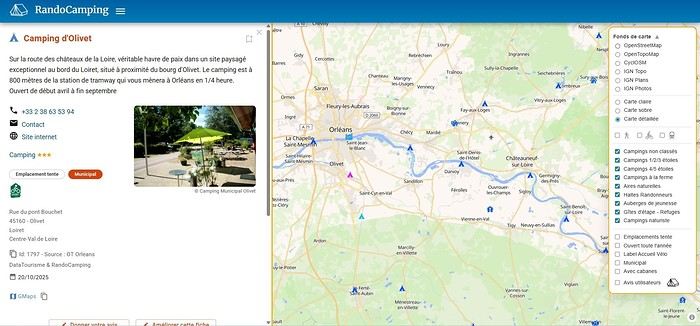
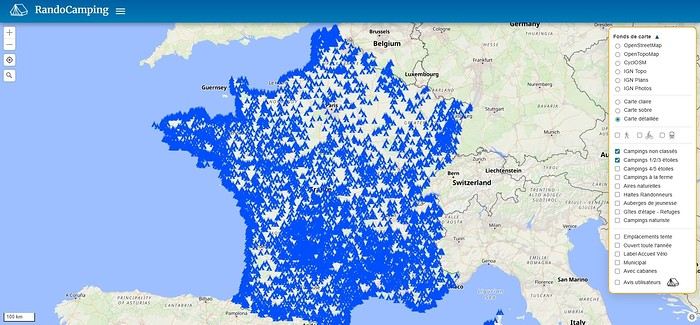
The RandoCamping site is free for users and hosts.
Its goal is to help trekkers find accommodations (usually by the night) all across France and to promote hosts who welcome trekkers satisfactorily.
Check it out here: https://randocamping.touteslatitudes.fr
The site is collaborative and supported by associations like Cyclo-Camping International or AF3V.
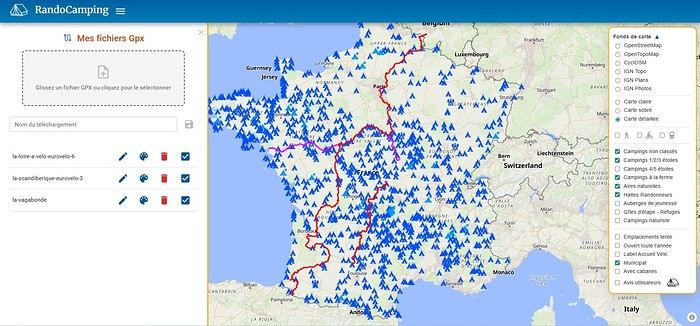
It lets you plan a trip or trek (on foot or by bike) by searching for accommodations along a route. The accommodations come from the DataTourisme platform (which aggregates information from Tourist Offices) and from users (trekkers & hosts).
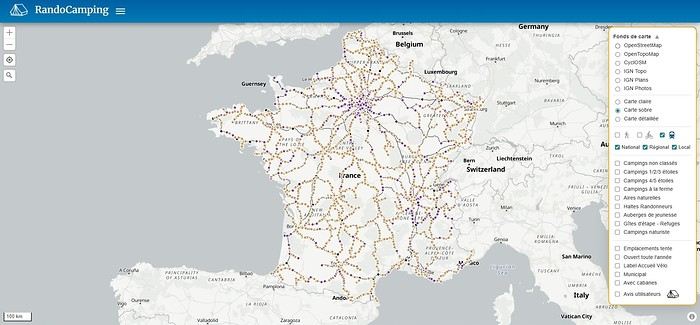
Train lines and passenger stations are also listed. Clicking on a station can show you (if the data is available) how accessible the platforms are with a non-dismantled bike. Bike and hiking routes come from Waymarked Trails (which is based on OpenStreetMap).
You can find more details about the site’s features on this page (version 1.0): https://randovelo.touteslatitudes.fr/randocamping-v1/
Its goal is to help trekkers find accommodations (usually by the night) all across France and to promote hosts who welcome trekkers satisfactorily.
Check it out here: https://randocamping.touteslatitudes.fr
The site is collaborative and supported by associations like Cyclo-Camping International or AF3V.
It lets you plan a trip or trek (on foot or by bike) by searching for accommodations along a route. The accommodations come from the DataTourisme platform (which aggregates information from Tourist Offices) and from users (trekkers & hosts).
Train lines and passenger stations are also listed. Clicking on a station can show you (if the data is available) how accessible the platforms are with a non-dismantled bike. Bike and hiking routes come from Waymarked Trails (which is based on OpenStreetMap).
You can find more details about the site’s features on this page (version 1.0): https://randovelo.touteslatitudes.fr/randocamping-v1/
hi everyone
It's still just a plan, but I'm considering traveling to Antalya in Turkey in autumn 2025 using the following route: - From France to the Croatian coast (route not yet defined) - "Down" the Croatian coast, Montenegro, Albania, and Greece. - Crossing the Peloponnese to Kalamata - Ferry to Kissamos (Crete) - Crossing Crete and ferry from Sitia to Rhodes - Tour of Rhodes and crossing to Fethiye (Turkey) - Connection to Antalya
If anyone has already taken this route, I’d love to hear any tips or advice. For now, I don’t have info on ferries for September and October—have you taken them? Do they allow bikes? Top
It's still just a plan, but I'm considering traveling to Antalya in Turkey in autumn 2025 using the following route: - From France to the Croatian coast (route not yet defined) - "Down" the Croatian coast, Montenegro, Albania, and Greece. - Crossing the Peloponnese to Kalamata - Ferry to Kissamos (Crete) - Crossing Crete and ferry from Sitia to Rhodes - Tour of Rhodes and crossing to Fethiye (Turkey) - Connection to Antalya
If anyone has already taken this route, I’d love to hear any tips or advice. For now, I don’t have info on ferries for September and October—have you taken them? Do they allow bikes? Top