hi there
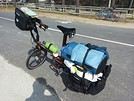
After covering thousands of kilometers over the years with front and rear panniers, I’m now facing a problem: broken spokes on the rear wheel.
Once, twice—imagine the hassle of fixing it when you're in the middle of nowhere in the Cévennes!
So, drastic times call for drastic measures! I switched to a reinforced wheel and, following my bike mechanic’s advice, fitted a tire that’s a "tad" wider than the front one.
We set off on our summer adventure feeling confident, and guess what—"BAM"—a broken spoke after just 200 km. Seriously?! Not even that heavily loaded—just around 30 kg, plus my 80 kg. Even with the sturdier wheel, I still ended up with a broken spoke after 300 km!
Back to the bike mechanic, and the only explanation: "It’s your pedaling style..." Not convinced at all!
So here’s the idea: a Bob trailer! I’m done with this sword of Damocles hanging over my head—it’s a real buzzkill.
Has anyone here tried a Bob trailer? Could you share your experiences—pros, cons, etc.?
Thanks!!!
Pros:
- Large useful volume, lets you pack without overthinking, like when resupplying for several days.
- Follows the bike’s path and isn’t any wider, nothing like the handling of a two-wheel child trailer, for example.
Cons:
- Adds weight compared to a pannier setup.
- So much space you might be tempted to bring too much stuff... You’ve got to organize the inside with bags so it’s not all jumbled.
- More noticeable on climbs (you feel the weight pulling backward).
- Not practical if you need to take a train, for instance—can be a hassle in tight spots like chicanes.
Having tried both, the Bob only makes sense if you really need the extra space. In my case, traveling with family, the Bob was hitched behind a tandem. Solo, I much prefer panniers, splitting the load front and rear.
Was the reinforced wheel an off-the-shelf one or a custom build? To give you an idea, no wheel issues in 10,000 km of tandem riding (adult + child) with a Bob trailer *and* 2x20L panniers on the back. So a properly adapted wheel should handle the job just fine...
thanks for your reply!
to answer your question about the wheel, it was a bike shop that did the setup for us! we trusted them.
our concern now is that after riding 250 km with a weakened wheel, the spoke breakage might happen again...
we’ve decided to go for a spring trip of a few days with a rented Bob trailer—no impulsive purchases for now!
best regards
Good evening!
Thanks for your reply and your interest!
I do have a reinforced wheel, 36 spokes, and a slightly larger tire (38)! All of that was set up by my bike mechanic. During my last breakdown with this reinforced wheel, I got the impression he didn’t take me seriously, which is why I’ve decided to try a Bob trailer! I’ll rent one this spring before possibly buying one.
Best regards,
I'm surprised by a broken spoke on a nearly new wheel. Uneven spoke tension???
Otherwise, to answer your questions, a single-wheel trailer is easy to handle. It's a bit heavier than the rack + panniers solution, but the weight is lower, so it doesn’t unbalance the bike if you need to ride out of the saddle for a stretch. Depending on your load, you can opt for a lighter trailer than the Bob. I have a Beez (sold by Beecyclo), and I’m happy with it. It can carry a large bag with the same volume as the Bob.
Or if you're traveling light, the Zap Outdoor trailer for a 40-liter bag is great too. Oh no, I just saw that this small artisanal company has stopped production.
Hi Meg,
It’s been a while since I last checked the site, so I hadn’t seen your message! Thanks for the super helpful info and for your interest!
It’s really baffling why this keeps happening! The first wheel was fine, but even after switching to a reinforced wheel, using a slightly larger tire than the front, being careful with inflation, and watching our load, it happened again this summer—and not even on rough roads! The cyclist weighs 78 kg, and the fully loaded panniers are about 28 kg, so roughly 100 kg total!!!! That’s why I’m looking into single-wheel trailers now. Just a small note: the new wheel was installed by a bike shop, so it *should* be good...
Best regards,
Totally surprising... at 105 kg plus 23/25 kg of gear, no problems at all with a stock wheel... but, it's true, it was a 26" MTB wheel, and I’m an ex-tandem rider who used to deal with frequent spoke breakage. The issue was solved the day I switched to very stiff, deep-section rims—back then, Rigida DP 18. Another weak point: hub braking (rather than rim braking) puts a lot of stress on the spokes with every stop... so check if your bike or new wheel might have these same issues. Otherwise, a trailer is both extra weight (especially on climbs) and a source of added friction. Single-wheel trailers are often recommended as the best option for us—good luck!
hi there!
we really don’t understand this breakage! wheel with reinforced spokes installed by our bike shop, standard rider weight, reasonable load! 30 kg! roads taken were clean! the only upside with reinforced spokes is that we could ride 200 km with one missing spoke without the wheel going out of true!!!! but that’s not the point! I also think that riding with this issue means next time there’ll be another breakage, even after obviously taking the wheel back to the bike shop. You know as well as I do that gear failure can ruin a trip, especially if you’re a bit far from civilization—that’s why we’re going to try the **Bob Yak**, renting one for a week to test it out!
Best regards
If the rim doesn’t warp with one (or several?) broken spokes, it means the wheel wasn’t built properly... which doesn’t necessarily mean your wheel builder is at fault. The breakage could be due to the quality (or type, brand) of the spokes... or nuts that are too "soft" or too loose, which come undone quickly (in the old days, they’d use thread locker or even super glue on them). Worth looking into that... Otherwise, even if you ditch the 25 kg of luggage for a trailer, you might still have breakage issues just from your own weight. In any case, spokes breaking with (only) around 100 kg of load isn’t normal—better to find the root cause (spokes stressed by sudden braking with disc brakes, wheels with a wobble—sometimes caused by a bent hub axle, etc.). As a first step, I’d check if the spoke tension stays stable and even with use. Anyway, good luck! !
hi
Thanks for the extra info! I really hope that by leaving our bike with a pro, they’ve checked everything thoroughly... We explained it to them clearly, but I don’t feel like they’re very receptive. Maybe we should look elsewhere! We’ve never broken spokes without the pannier load.
FYI, the last break was with a brand-new wheel!!!!
Hello,
Thanks for the additional info! I really hope that by entrusting our bike to a pro, they’ve covered all the bases... We explained everything clearly, but I don’t feel like they were very receptive! Maybe we should look elsewhere. We’ve never had broken spokes without the weight of panniers.
FYI, the wheel was brand new when it last broke!!!!
Hi Nicolas,
It’d be great to get a few more details about this setup that didn’t work out: brand and type of rim, disc brakes or rim brakes? Hub, and especially the tire—what pressure were you running?
Like Lethieu, I’m leaning toward an assembly issue since the weight you described isn’t excessive. Do you have panniers on the front, or is everything on the back?
I think it’s worth digging a little deeper into the question.
Best regards,
I checked the invoice again for that famous wheel with the reinforced hub, but there’s no info about the brand... not even on the hub itself!
As for the panniers: 2 up front, 2 in the back, 5.5 kg when inflated! Disc brakes too!
Best regards,
I checked the invoice for that famous wheel with reinforced rim, but there’s no brand info... not even on the rim itself!
As for the panniers: 2 at the front, 2 at the back, inflation at 5.5 kg! Disc brakes!
Best regards
Well, after reading all the details you’ve shared, the one common factor in all your issues seems to be the bike shop—especially if they’re the ones assembling the wheels!!! I’m also skeptical about a rim with no brand or reference...
Final piece of advice from an old-timer: learn how to true your wheels. A simple fork is all you need, and the technique is super straightforward. With a little practice, you can even do it on the road (including replacing a spoke). Given the poor quality of today’s pros—who know Chinese parts catalogs and profit margins better than the basics of technical craftsmanship—it’s better for travelers like us to be self-sufficient in this area...
I use a folding bike with 20" wheels for hiking. Over about ten years, I’ve had three or four broken spokes on the rear wheel.
I managed to find a craftsman [1] who could re-spoke a wheel.
When he re-spoked my rear wheel, I watched him do it. He showed me how he did it and told me something important for spoke strength: make sure that where the spokes cross for the third time, they properly support each other. That’s because the spokes reinforce each other to handle stress [2]. Two spokes at a time, using a bar, he applied a strong twisting motion as if he wanted to wrap them around each other.
[1] This craftsman made the spokes himself from long spokes (Sapim stainless steel 2 mm), cutting them to the right length and threading the ends. That’s when I realized I was dealing with an expert—because everyone I’d worked with before would only repair or re-spoke a wheel if they had the right-length spokes in stock or if I provided them.
[2] In the past, at the third crossing point, you’d sometimes find a tie that held the two spokes together.
The holy grail is learning how to true your wheels... it's actually simple, but we take an hour where a pro takes 20 minutes. It's more cost-effective to re-true your wheels, even new ones or after a hundred kilometers. Re-true all the spokes to ensure even, high tension, fix wobbles, and especially the hop. If spokes or some are loose, don’t hesitate to glue them. To answer your question, yes, I’ve often used a bit of copper wire at the spoke crossings... I even used to true wheels with four hands at times! But with modern rims, you shouldn’t need to do that anymore.
hi there!!
Hub braking—that’s the case since they’re disc brakes, right? In the end, disc brakes are more efficient, but good old brake pads do the job just fine, especially if you’ve got a spare pair tucked away in your panniers! So easy to set up in the middle of nowhere! That said, we’ll try renting a Bob trailer to get an idea—it’ll be an experience, and I’ll share feedback on it!
Best regards,
Je pars a voyage a vélo suivant l'Eurovélo6 les 2 dernieres semaines de mai. Je cherche pour cela une remorque style bob yak a louer... Car je n'ai pas envi de…
Voyager à vélo › France › Paris - Île de France · 5 replies
J'ai vu qu'il y avait un festival du voyage à vélo prochainement vers Paris. Vu que nous souhaiterions nous équiper pour traverser la France, notamment en…
Pouvez vous me conseiller un modèle de remorque? Nous avons deux enfants (3 ans et demi et 7 mois) et envisageons l'achat' d'une remorque vélo. Nous en ferons…
Je pense avoir besoin d'un petit conseil! Après avoir réalisé mon premier voyage en vélo l'été dernier (Poitiers - Lyon - Poitiers), j'ai envie de repartir à…
Je pars faire une semaine de vélo en Normandie dans quelques jours et j'ai eu une mauvaise surprise: j'avais l'intention de mettre un porte bagage sur mon vélo…
Hi,
what are the easiest ways to get back from Nordkapp without pedaling—
train, boat, or plane?
Has anyone already done this?
Thanks for sharing your tips!
Hi,
I need to arrive in Thessaloniki by bike at the end of September and I plan to head to Istanbul along the coast.
Could anyone help me pick the best route? Safety, difficulty.
Thanks in advance.
Marc
Hi everyone! Thanks for welcoming me to the forum :)
I’m preparing for a long trip heading to Nepal, with stops along the way depending on my mood, work needs, and the season. I cycle a lot, but this will be my first big touring adventure. I’d like to camp regularly to keep costs down, so I’ll be riding on all kinds of surfaces: smooth and rough roads, main highways and rocky paths to find my camping spots, flat terrain and the occasional steep slopes.
For my bike model, I’m prioritizing durability, versatility, and repairability. From that perspective, I prefer a steel frame and fork with rim brakes since I’m used to them. I’ve narrowed my choices down to four models:
- The VSF Fahrradmanufaktur T-700 LTD (1400 €): steel frame, aluminum fork, hydraulic rim brakes, 28" wheels, 40mm tires, 36 spokes (2 mm), lightweight rear rack (max 20 kg), no front rack included, smallest gear ratio of 0.72, weight of 13.9 kg.
- The VSF Fahrradmanufaktur TX-400 (2200 €): steel frame and fork, hydraulic rim brakes, 26" wheels, 50mm tires, 36 spokes (2.34 mm), front and rear racks included (40+18 kg), smallest gear ratio of 0.71, weight of 15.9 kg.
- The Genesis Tour de Fer 30 (2150 €): steel frame and fork, mechanical disc brakes, 28" wheels, 36 spokes, 40mm tires, front and rear racks included (27+10 kg), smallest gear ratio of 0.77, weight of 15.9 kg.
- The Rockrider ADTV 900 from Decathlon (1700 €): aluminum frame and fork, mechanical disc brakes, USB port, 28" wheels, 47mm tires, 28 spokes, front and rear racks included (40+20 kg), smallest gear ratio of 0.71, weight of 17.1 kg. This is the successor to the Riverside Touring 900, which was a hit.
I’ve got a few questions:
1/ Should I go for 26" or 28" wheels for my trip? 26" wheels seem better for rough terrain, but 28" wheels feel more comfortable on roads. I’ve also read that 26" tires/tubes are easier to find.
2/ Do you recommend a steel frame and fork over aluminum? I’m guessing a high-quality aluminum frame and fork would be better than a low-quality steel one, right?
3/ Regarding the smallest gear ratio, is 0.71 a good number for a loaded bike in the mountains?
4/ Finally, what do you think of these four models for my project? My heart leans toward the TX-400—it seems to combine the versatility and robustness I’m looking for. But the price difference with the T-700 LTD is making me think twice!
Thanks so much for reading and sharing your thoughts!
17 days, 1,400 km, and 17,500 m of elevation gain cycling in northern Vietnam! 🇻🇳 🚴🇻🇳
From the misty Fansipan to the breathtaking landscapes of the Ha Giang Loop, from remote villages to vibrant markets...
I cycled through the north of the country, getting up close with its people—through mud, heat, endless mountain passes, and unforgettable encounters.
Most importantly, I discovered a Vietnam far different from the usual tourist circuits.
Join me on this adventure through a video that captures these 17 days of travel. :)
If Vietnam calls to you, come ride a stretch with me!
Hi,
can anyone give us some tips on how to get to North Cape from Lyon Gerland?
What’s the best route to join the EuroVelo 7?
How many kilometers is it from Lyon to North Cape via EuroVelo 7?
The best month to leave—we’re thinking early May.
Thanks for any advice!
Looking for a female travel companion for a cycling trip (arriving by plane in Porto Alegre, Brazil, and cycling toward Montevideo, Uruguay, returning by plane to France from Buenos Aires, Argentina) – 1,500 km
Hello everyone!
I’m planning a cycling trip across Brazil, Uruguay, and Argentina, with a departure set for late October, November, or December. I’m looking for a travel companion to share this long-distance adventure with.
Experience:
I already have solid experience in bicycle touring in Georgia, Kazakhstan, and Kyrgyzstan. Currently, I maintain excellent physical condition by cycling an average of 250 km over 3 days per week (4 hours a day at 20 km/h).
The trip & the pace:
Daily pace: Between 50 and 80 km per day, to make steady progress while taking time to explore.
Accommodation: Flexible and authentic. We’ll alternate between wild camping, campsites, Warmshowers, small guesthouses, and budget hotels depending on opportunities and the weather.
Looking forward to reading your message and planning this amazing journey together!
I’m planning to leave Nice for Toulouse around 10/15 and I’m looking for tips / great deals regarding:
- The route: I was thinking of taking Nice - Grasse - Draguignan - Salernes - Cadarache - Cavaillon - Arles, then the Camargue, Sète, and the Canal du Midi to Toulouse. The idea is to avoid high-traffic roads and too many steep climbs. Are there any spots to avoid or must-see stops? Since it’s been a while since I’ve been on the road, I was thinking that sleeping indoors might be preferable. If you have any budget-friendly accommodation suggestions along part of the route, don’t hesitate!
Thanks in advance, and if you’re in the area around that time, we could ride together... Ciao.
Another long-time dream of Claudio’s: the Petit Mont Cenis pass and the dam at the eponymous lake.
A place where many Italians, including my father, worked in the 1950s–60s.
Faverges → St-Michel-de-Maurienne → Lanslebourg → Petit Mont Cenis → return. 315 km, 3 days. Bivouac at St-Michel-de-M.
Brouter link
Leg One: Faverges → St-Michel-de-Maurienne
Leg Two: St-Michel → Lanslebourg → Mont Cenis Lake → St-Michel
Leg Three: St-Michel → Faverges
And it finally happened in August 2026: in the Maurienne Valley about the famous cycle route known as the V67
🇷🇼 Cycling in Rwanda: 4 episodes, an off-the-beaten-path adventure
After 3 weeks and nearly 1,200 km by bike across Rwanda, I made 4 videos to share this adventure in a different way: the landscapes, the encounters, the villages… but above all, all those incredible scenes of everyday life.
The 4 episodes are available here:
👉 https://www.youtube.com/playlist?list=PLGnfbxjccWAg
The 4th episode focuses on rural Rwandan life: simple, authentic, and sometimes surprising scenes that you only truly discover when you take the time to travel by bike.
If you have a few minutes, let yourself be transported to Rwanda…
Hi, I'm looking for info on cycling to Nordkapp via the EuroVelo 7. Has anyone done it already, and where’s the best place to start the EuroVelo 7?
Thanks
Hi,
We bought the MSR bike tent model (2-person + large awning that can fit 2 bikes) back in 2005. It’s served us really well, especially during a year-long trip in Africa. Now, one of the poles is broken, and we’d love to replace it since that’s the only issue with the tent—we still love it! The poles are 9.35 mm in diameter, with 8 sections of 49 cm and 2 sections of 28 cm. Total length when assembled: 416 cm. Actually, two large sections are broken: one straight and one curved. It’s a pain to find replacements since this model is no longer sold anywhere.
Would anyone have this model lying around unused and be willing to sell me a pole?
Hi everyone,
In early April, I’m redoing the Vélo Francette (La Rochelle to Ouistreham), and then I’d like to cycle along the Cotentin Peninsula (which I don’t know at all), follow the coast up to Cherbourg, and then head back down to at least Saint-Malo. I’d love to know if it’s pleasant for cycling—are the roads nice? Not too windy? What are the must-see spots? Any great campsites? All your tips and advice are more than welcome, and I thank you in advance.
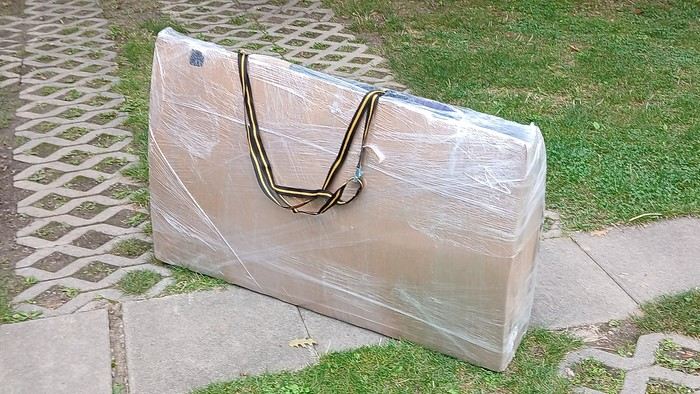
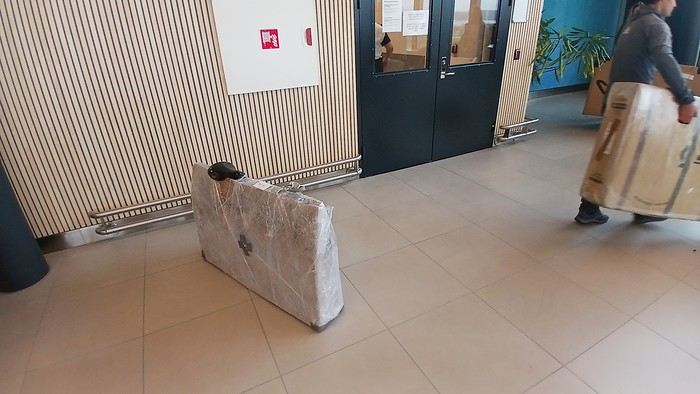
After testing it for three years across various modes of transport, I’m sharing this video of a bike packing case. It’s made from recycled cardboard and shrink-wrapped, with adjustable thickness and added bubble wrap depending on the level of protection you want.
Installing spacers at the fork and chainstays makes the packaging compact. With the fifteen-odd euros for shrink-wrapping at the airport, this case travels really well.
https://youtu.be/_GDJi-GqmkM
- Low bulk (1.10m x 0.70m x 0.25m for a large frame), it fits vertically in train luggage compartments and the total dimensions (x+y+z) don’t exceed 2.40m.
- Two carrying solutions for public transport and easy handling by airport staff (no more tears in the cardboard from openings).
- Discreet packaging when dealing with bus drivers and train conductors, as it looks like an ordinary parcel.
- No need to return to the starting point to retrieve the case from your outbound trip, which you’d otherwise have to store somewhere, or deal with a bulky cover to pack in your panniers.
- You can still check tire pressure through the plastic film without damaging the packaging too much.
Drawbacks: Around 3 hours for this lengthy and meticulous process—removing the wheels, pedals, handlebars, and derailleur without misaligning them, then securing all components to the frame.
If you get a chance to test it, send me your feedback for future improvements.
I just took a trip in Tunisia from Tozeur to Douz, skirting Chott el Jerid to the south. I’m back with the urge to keep going further south via the 4x4 tracks to connect Douz to Ksar Ghilane. Has anyone driven this route recently or explored southern Tunisia?
Thanks for your tips!
fix
😎Fellow traveling cyclists or not, all of you who love travel, the pleasure of physical effort, nature, beautiful machines, people with true passions they seek to fulfill, and who also enjoy reading great literature about all this—the *200* magazine is for you just as it is for me. I should mention I have no financial or other interest in this (in an era where we accuse our politicians of all sorts of vile interests, I prefer to take precautions). I’ve been subscribed since the beginning, and every three months, I get my 130 pages of dreams (the magazine just went from 110 to 130 pages).
It covers everything from the trans-America route to the TCR (Trans Continental Race) from Belgium to a small town in Turkey, with mind-blowing averages—4,000 km and 80,000 m of elevation gain in 8 days and 15 hours for the winner. Let that sink in, and all of it without assistance—accepting a patch could penalize you. There’s also a story about crossing Iran, encountering one of the world’s most welcoming populations, following in the footsteps of Nicolas Bouvier, as well as retirees leisurely traversing France. The common thread in all these stories? Beautiful writing. Take, for example, a stunning article: *"Passengers of the Cold: From Edinburgh to Thurso, at the very north of Scotland, 550 km of moors, coasts, and icy wind. In Thurso, the road ends at a quay, facing the Orkney Islands. We wanted a November trip, off-season. We wanted to surprise winter. Just before the snow."* A sublime piece on the experience of facing adversity and the chance encounters along the road and in the elements.
Before I embarked on my own bike trips, I dreamed a lot about them—from the Atacama to the Gobi, along the Mekong, and not forgetting France. And now, these 130 pages every quarter keep those dreamy vibes alive through stories written in the most beautiful prose.
I’ll stop here because it might sound like I’m advertising, but if you don’t know *200*, I invite you to discover it. It’ll give you wings for the most incredible challenges or simply reinforce your desire for slow rides with your eyes open to others and nature.
A little news to wrap up: Axel Carion and a friend just broke the record for crossing South America from Colombia to Ushuaia in 59 days. On its own, that doesn’t mean much, but I can’t help it—it makes me dream. You should see how he talks about it, the flashes of that wild nature he’s stored away: a snowstorm at Paso Jama and the surreal sight of the suddenly snow-covered Licancabur!
Luc
PS: The magazine is called *200* because a day’s ride starts at 200 km—well, I’ve never done a ride like that since my longest was 167 km (with 18 kg of luggage, mind you), but why not one day? The magazine will explain how to tackle your first 200, and then the question in conclusion: when will you do your first 300?😏
I’ve got my flight ticket sorted—departing in mid-November and returning in mid-March. I’ll arrive in Santiago and leave from Buenos Aires.
I’ve already been to southern Argentina, specifically Torres del Paine National Park, and I’d love to go back to do the full W trek (I only did the shorter version last time).
I also want to do some hiking and maybe even tackle a summit. I climb and occasionally do some mountaineering, so I’ll definitely be going with a guide.
I plan to start around Temuco in Chile, with the idea of heading toward the lakes, then taking the Carretera Austral.
I’m not sure if I’ll go all the way to Ushuaia—it’s supposed to not be *that* worth it, except for the bragging rights of saying you’ve been to the end of the world.
I saw there are lakes in Argentina too.
I don’t have a precise itinerary, but what I’d love is, once I reach the southernmost point of my trip, to take a mini-cruise to see some wildlife. Any tips for that?
What kind of sleeping bag did you take? Is a 0°C (32°F) one enough?
And one last question: white gas stove or can I get by with my gas stove?
I'm developing a free and open-source web app for planning walking and cycling trips (and even car trips). You can create a route by clicking directly on the map to add waypoints, and it can consist of multiple stages. The app provides tools to edit the stages and the overall route, and to display useful information (distances, altitudes, and elevation changes). A relief profile can be shown as a graph for a specific stage or the entire route.
Once the route is ready, it can be exported as a GPX file, which can then be used with a GPS or a mobile navigation app.
The app is built in JavaScript and runs entirely in the web browser. It uses the Leaflet library and several OpenStreetMap-based services. Initially developed for my personal needs (I enjoy hiking and cycle touring), I’d be happy to share it with anyone who might find it useful. It’s free to use, doesn’t require an account, and the source code is available.
hello fellow cycling enthusiasts
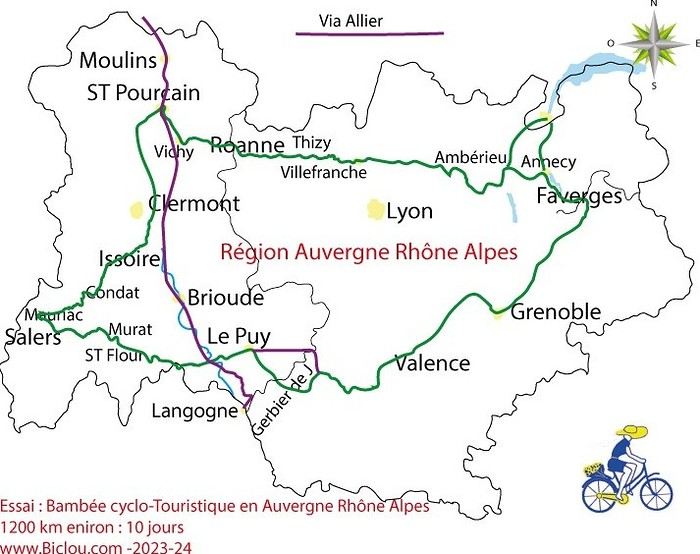
here’s a travel journal of the cycling tour through the Rhône-Alpes Auvergne region by Claudio
zouli
it was the plan
http://cbandiera.free.fr/parcours/auvergne-Ralpes/
the trip was completed
story being posted online soon
1100 km in 11 days
beautiful and varied regions
Hello,
We’d like to go on a 3- to 4-month bike trip starting in December, crossing from Assam (northeast India) to New Delhi via Nepal.
Are there routes with light traffic along the Brahmaputra and through Nepal?
We’re also looking for any info on accommodations, wild camping, local interactions, etc.
Thanks,
Michel
I’m planning to cycle from Morlaix to Brest (via Roscoff and the V45 coastal route). We’ll start riding on August 16th for 13 days (with stops for island visits, surfing, etc.). Is there a lot of traffic at this time of year? I’ve got two kids, 11 and 13, and we don’t like riding in the middle of cars (we’ve already done the Vélomaritime—Caen to Cherbourg—the Loire route from Orléans to Saumur, the Vélodyssée from Nantes to Royans, and the canals like the Nivernais and Bourgogne, where there were plenty of bike-only lanes, which isn’t the case on this route).
Thanks for your help if you’ve already done this route in late August!
Virginie
Hi there,
I’ve been road cycling for several years, and I’m about to switch to gravel in the next few days—I’m waiting for my bike, which should arrive this week.
I’m planning a bikepacking trip in a few weeks along the Véloroute V81, also known as the Vélosud, from Biarritz to Le Barcarès.
Has anyone here already done this route? Any info is welcome, whether it’s about the route itself, gear, or accommodation. I’ll prioritize staying with locals as much as possible. On that note, I just signed up for the brand-new site *Guidon et Couette* ((www.guidon-et-couette.fr)), which offers free accommodation between cyclists across the country, but there’s almost no one listed along my route!
Thanks in advance.
Laurent.
Hi there, I’m planning a cross-Canada bike trip, and I’ve got a question that might seem silly, but could someone tell me how to pack a bike (in a box, with a fragile sticker... I don’t know) for a flight? Thanks in advance!
This summer, we’re planning to cycle along the EV 19 that follows the Meuse River from Langres all the way to Rotterdam.
My question is about getting back to Nantes.
Do any of you know what the best return option might be? I’d love to hear about your experiences.
I saw that FlixBus doesn’t take bikes.
By train, I think it’s possible but would involve multiple local trains.
We were also wondering if there’s a boat from Rotterdam to Saint-Nazaire that could take passengers with bikes.
Any tips or experiences you can share would be really helpful—thanks in advance!
Have a great evening
I’ve gotten used to crossing Europe by bus to return by bike.
It was really convenient to take the bike without having to disassemble it.
But FlixBus no longer accepts bikes...
What alternatives do you know about?
Thanks.
Hi there,
I’m planning to ride the Dutch section of the EuroVelo 19, from Maastricht to Rotterdam.
Since it’s too complicated to bring my bike on the train, I’m looking to rent one locally.
I’d love any tips or bike rental shop recommendations—I’m struggling to find options even in Rotterdam.
The plan is to rent in Rotterdam, take the train to Maastricht with the bike, then cycle back to Rotterdam.
Thanks in advance for any advice or suggestions!
Nath